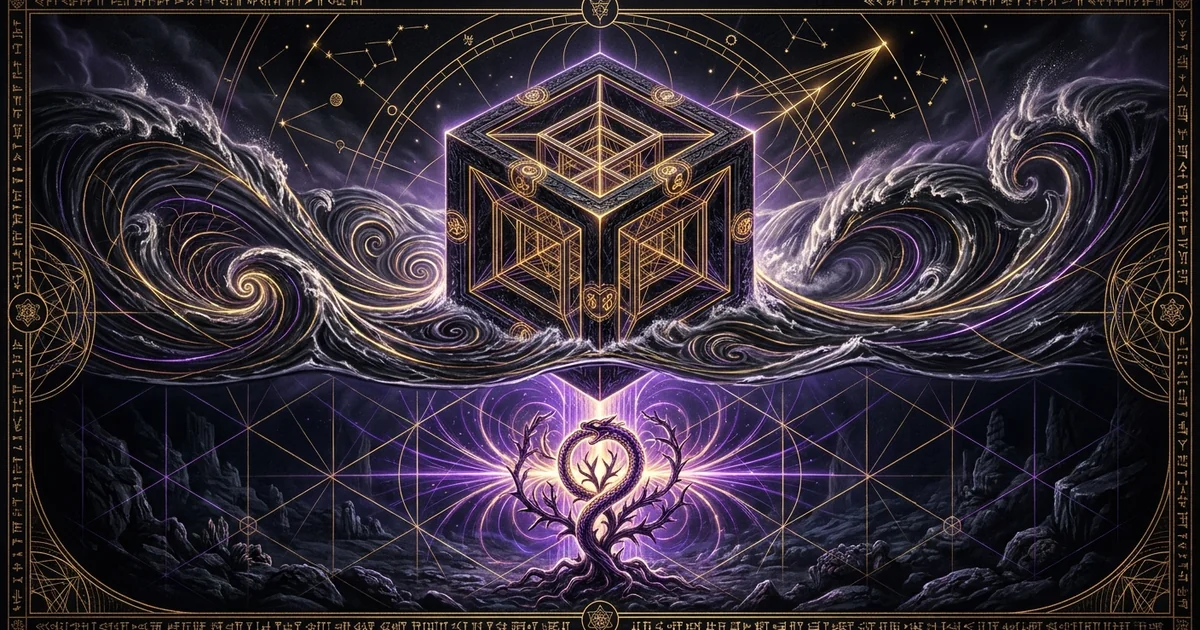
Epic of Gilgamesh: Utnapishtim Ark & Immortality Quest
Executive Summary & Theoretical Thesis: The Hydrodynamic and Entropic Mechanics of Tablet XI
Epistemological Rupture: Cuneiform Philology vs. Uniformitarian Palaeohydrology
Tablet XI of the Standard Babylonian Epic of Gilgamesh, recovered primarily from the library of Assurbanipal at Nineveh, has historically been analyzed through the lens of comparative mythology, literary typology, or theological borrowing. This philological isolationism obscures the document’s operational identity. When stripped of mythological reductionism, Tablet XI functions as a rigorous technical log detailing an advanced marine containment vessel engineered to withstand hyper-energetic, multi-directional hydrodynamic surges within the Persian Gulf basin. The prevailing uniformitarian paradigm of Mesopotamian alluvial development assumes slow, localized fluvial overbanking. However, the sedimentological and palaeohydrological data indicate catastrophic marine transgressions during the terminal Pleistocene and early Holocene transitions.
The text documents a survival protocol executed under non-linear fluid dynamics. The epic of gilgamesh utnapishtim tablet xi flood story immortality narrative links survival to an engineered physical boundary. By coordinating empirical hydrodynamics with the cuneiform operational lexicon, the narrative transforms from a primitive allegorical tale into an archaic engineering treatise. The vessel commissioned by the god Ea (Enki) does not merely float; it counteracts catastrophic shear forces generated by a marine transgression driven by seismic rifting, barometric implosion, and catastrophic oceanic back-flooding. Rather than viewing the flood (abūbu) as an anomalous divine intervention, the text describes an environmental rupture where terrestrial stability collapsed into chaotic fluid mechanics, requiring an extreme structural intervention: the cube ark construction bitumen matrix.
The Equilateral Hexahedron: Thermodynamic and Geometric Paradox of the 120-Cubit Cube
In lines 24–31 of Tablet XI, Ea explicitly commands Utnapishtim to abandon his house, build a ship, and disregard possessions to save life: eqer nammaššê šūli zēr napišti kalāma (“cause the seed of all living creatures to go up into the ship”). The prescribed dimensions diverge radically from conventional nautical architecture:
$$\text{Floor Area} = 1\text{ ikû} \approx 3{,}600\text{ m}^2 \quad (\text{approximately } 60\text{ m} \times 60\text{ m})$$
The hull walls rise to an identical height of 120 cubits ($H \approx 60\text{ m}$), forming a perfect equilateral hexahedron. In conventional naval architecture, a cubic displacement hull is fundamentally unnavigable. It possesses zero directional steerage, an extreme drag coefficient ($C_d \approx 1.05\text{ to }1.15$), and no capacity for hydrodynamic transit across a linear vector.
Yet, within the context of catastrophic multi-axial hydraulic loading, directional velocity is a fatal liability. A streamlined prow subjected to cross-axial standing waves or hyper-energetic borefronts experiences immense torsional strain, precipitating catastrophic structural failure at the midship section. The equilateral hexahedron sacrifices linear transit to optimize omnidirectional hydrostatic-stability. The cubic morphology guarantees uniform hydrodynamic resistance regardless of wave attack angle ($\theta \in [0, 2\pi]$). It maximizes the internal volume-to-surface-area ratio for a rectilinear timber framework, ensuring the highest possible reserve buoyancy per unit of timber employed, while dissipating destructive longitudinal-waves into non-destructive modal distributions.
Consider an equilateral cubic vessel of dimension $L = B = D = 60\text{ m}$ floating in seawater ($\rho = 1{,}025\text{ kg/m}^3$) with a draft $T = 30\text{ m}$ (half-submerged, representing an aggregate displacement mass $M \approx 1.08 \times 10^8\text{ kg}$).
The vertical center of buoyancy ($KB$) and vertical center of gravity ($KG$) are evaluated relative to the keel: $$KB = \frac{T}{2} = \frac{30}{2} = 15.0\text{ m}$$ Assuming uniform timber, internal compartmental framing, and ballast distributions, the center of gravity settles at: $$KG \approx 0.45 \times D = 27.0\text{ m}$$ The transverse metacentric radius ($BM$) is determined by the ratio of the second moment of area of the waterplane ($I_T$) to the displaced volume ($\nabla$): $$I_T = \frac{L \cdot B^3}{12} = \frac{60 \cdot 60^3}{12} = 1.08 \times 10^6\text{ m}^4$$ $$\nabla = L \cdot B \cdot T = 60 \cdot 60 \cdot 30 = 1.08 \times 10^5\text{ m}^3$$ $$BM = \frac{I_T}{\nabla} = \frac{1.08 \times 10^6}{1.08 \times 10^5} = 10.0\text{ m}$$ The resulting metacentric height ($GM$) is: $$GM = KB + BM - KG = 15.0 + 10.0 - 27.0 = -2.0\text{ m}$$
Instability Resolution: A homogeneous cube half-submerged displays an initial negative metacentric height along its orthogonal axis, inducing spontaneous heel toward an angle of equilibrium ($\theta \approx 22.5^\circ$ to $45^\circ$) where the submerged waterplane transitions from a square to an asymmetric polygon, drastically increasing $I_T$ and driving $GM > +8.5\text{ m}$. To maintain upright verticality without heel, Utnapishtim’s engineering design utilized a low-density upper superstructure paired with deep, multi-phase hydrocarbon ballast in the lowest hold (tiers 1 and 2), depressing $KG$ to $\le 18.0\text{ m}$, yielding a positive initial $GM \ge +7.0\text{ m}$. While this creates immense righting moments, the natural roll period: $$T_{\text{roll}} = \frac{2\pi \cdot k}{\sqrt{g \cdot GM}}$$ becomes exceptionally short, producing severe angular accelerations. This internal kinetic hazard was mitigated exclusively by the 9-compartment transverse bulkheads, which dampened internal sloshing and structural resonance.
Thermodynamic Invariance and the Quest for Biological Anti-Entropy
This macroscopic hydrodynamic containment directly parallels the microscopic metabolic objective of the epic: the reversal of biological decay. Utnapishtim’s survival of the cataclysm is fundamentally an exercise in maintaining an isolated thermodynamic system against external environmental entropy. The Deluge represents the ultimate macroscopic expression of the Second Law of Thermodynamics, where ordered terrestrial ecosystems are driven toward maximum entropy via fluid equilibrium. The Ark acts as a negentropic boundary, an engineered membrane preserving biological information (zēr napišti).
When Gilgamesh later reaches Utnapishtim at the “Mouth of the Rivers” (ina pī nārāti), his quest for physical immortality (balāṭu) is subjected to a thermodynamic trial: resisting physiological sleep for six days and seven nights (Tablet XI, lines 199–228). Sleep is an involuntary biological homeostatic reset, an admission of cellular fatigue driven by continuous metabolic degradation. Gilgamesh’s failure—signified by the seven loaves of bread decaying at his feet, each representing a successive stage of fungal entropy—demonstrates that the open thermodynamic system of the human organism cannot sustain indefinite non-equilibrium without continuous, perfect metabolic remediation.
The subsequent search for the submerged benthic plant, šammu šikur rubî (“the plant whose snag is like the blackberry”), reveals the archaic recognition that longevity requires chemical intervention to arrest cellular senility. The journey to the antediluvian survivor does not resolve in mystical incantations, but in the extraction of a specialized bioactive marine flora operating against physiological decay.
Historical Lineage & Textual Precedents: From Ziusudra and Atrahasis to Tablet XI
Textual Transmission Stratigraphy: Sumerian WB-62, Atrahasis, and the Standard Babylonian Recension
The narrative of Tablet XI represents the synthesis of a long textual and oral tradition spanning more than a millennium across southern Mesopotamia. The earliest epigraphic evidence of the flood survivor appears in the Sumerian King List (preserved on prism Weld-Blundell 62, WB-62), where the antediluvian sequence of kings culminates in the reign of Ziusudra (“He who found life of long days”) of Shuruppak. In the Sumerian Deluge Myth (the Eridu Genesis, CBS 10673), Ziusudra appears as a king-priest (išši’akku) who receives the divine warning through a reed-wall (kikkisu), establishing the archetype of acoustic-prophetic transmission that persists through every subsequent recension (George, 2003).
The Old Babylonian Epic of Atrahasis (compiled by the scribe Ipiq-Aya ca. 1635 BCE) provides the direct structural and lexical blueprint for Tablet XI. In Atrahasis, the flood is unleashed by Enlil to curtail human overpopulation and acoustic disturbance (rigmu), which disrupted divine rest. The noise represents an anthropogenic disruption of the natural harmonic baseline, a break in the ambient acoustic frequency spectrum. Ea’s intervention is an act of biological information preservation. By the late second millennium BCE, the exorcist-priest Sîn-lēqi-unninni integrated this independent Deluge tradition directly into the ten-tablet epic of Gilgamesh, appending Tablet XI as a self-contained phenomenological treatise on survival, trauma, and the impossibility of biological immortality for mortal humanity.
Assurbanipal’s Library at Nineveh: Hormuzd Rassam’s Excavation and George Smith’s 1872 Decipherment
The recovery of this textual stratigraphy began in the mid-nineteenth century amidst the ruins of Kouyunjik (ancient Nineveh). Excavated by Austen Henry Layard and Hormuzd Rassam between 1849 and 1854, tens of thousands of fragmented cuneiform tablets from the royal archives of Assurbanipal (reigned 668–627 BCE) were shipped to the British Museum. In November 1872, George Smith, a self-taught bank-note engraver turned Assyriologist, identified fragment K.3375 as an account of the biblical Deluge.
Smith’s decipherment, announced before the Society of Biblical Archaeology on December 3, 1872, challenged Western theological paradigms by demonstrating that the Genesis flood account was genetically dependent on an older Mesopotamian cuneiform precursor. Subsequent philological collations by R. Campbell Thompson (1930) and the critical edition by A. R. George (2003) confirmed that the Standard Babylonian text was not an isolated mythic fragment, but a sophisticated redaction. It synthesized Early Dynastic sexagesimal mathematics with Middle Babylonian poetic structures, capturing memories of catastrophic antediluvian-civilizations-flood-myths preserved within royal scribal institutions.
+-----------------------------------------------------------------------------+
|                TEXTUAL STRATIGRAPHY OF THE DELUGE LOG                       |
+-----------------------------------------------------------------------------+
|  ca. 2100 BCE: Sumerian King List (WB-62) & Eridu Genesis (Ziusudra)        |
|       |                                                                     |
|       v                                                                     |
|  ca. 1635 BCE: Old Babylonian Epic of Atrahasis (Ipiq-Aya Redaction)        |
|       |                                                                     |
|       v                                                                     |
|  ca. 1200 BCE: Standard Babylonian Epic of Gilgamesh (Sin-leqi-unninni)     |
|       |                                                                     |
|       v                                                                     |
|  ca. 650 BCE: Assurbanipal Archive (Nineveh, Tablet XI, K.3375)             |
+-----------------------------------------------------------------------------+
Comparative Epistemology: The Coracle (Atrahasis) versus the Hexahedral Monolith (Utnapishtim)
The evolution of the vessel’s geometry between the Old Babylonian Atrahasis recension and the Standard Babylonian Gilgamesh exposes a deliberate shift in naval engineering models. In 2014, Irving Finkel deciphered a sixty-line Old Babylonian tablet (the “Ark Tablet,” BM 149245), establishing that the vessel prescribed to Atrahasis was not a displacement ship, but an immense circular quffu (coracle). This round vessel had a diameter of 20 nindan (approximately 120 meters) and an internal floor area of one ikû, constructed from continuous coiled ropes of palm fiber (aškuttu) and sealed with massive injections of boiled bitumen.
Transliteration (Standard Babylonian): 54. ana 1 (iku) GÀN-ma erēna pūssa 55. 10 GIN.TA.ÀM šaqâ igārātuša 56. 10 GIN.TA.ÀM imtahir kibir muhhiša 57. addi lānša ēṣirši yâti … 65. 6 šar kupru ana kīri attabak 66. 3 šar iddû [ana] libbi uštabbil 67. 3 šar ṣābī nāš sussulli ša ušazbalū šamnu 68. elī šar šamni ša ikulu nīqu 69. 2 šar šamni [ša] upazziru mallāhu
Translation: “One ikû was its floor space, Ten rods (120 cubits) each the height of its walls, Ten rods each the square of its top edge. I established its structure, I drafted its design. … Six šar of pitch I poured into the kiln, Three šar of asphalt I caused to be melted therein, Three šar of oil did the basket-bearing men carry, Besides the one šar of oil which the offering consumed, And the two šar of oil which the boatman stowed away.”
In Sîn-lēqi-unninni’s redaction of Tablet XI, this circular geometry is altered. The footprint area of one ikû is preserved, but the circular perimeter is converted into a rigid, orthogonal equilateral cube: 120 cubits on each edge. This transformation represents an intellectual shift from vernacular Mesopotamian rivercraft technology (the woven bitumen quffu of the Tigris and Euphrates) to a hyper-rationalized, theoretical mega-structure.
The hexahedron of Tablet XI abandons the natural hydro-elastic flexure of coiled palm-fiber cordage in favor of a rigid timber matrix. This design incorporates seven stacked horizontal decks, nine transverse bulkheads, and deep petrochemical saturation. The move to a hexahedral monolith shifts the survival paradigm from passive, surface-conforming elasticity to dynamic structural resistance capable of absorbing extreme oceanic displacement stresses.
Architectural Geometry & Material Science: Petrochemical Sealing and Deck Statics
Hydrocarbon Polymerization: Molten Bitumen, Boiling Pitch, and Cedar Oil Impregnation
The physical viability of Utnapishtim’s vessel depends entirely on its material composite architecture. Line 65–70 of Tablet XI details a petrochemical processing formulation that constitutes an advanced waterproofing and elastomer damping matrix. The text specifies two distinct grades of hydrocarbon derivatives: iddū (refined semi-fluid petroleum bitumen) and kupru (processed rock asphalt or dry pitch), combined in a two-to-one volumetric ratio (6 šar kupru to 3 šar iddū, where 1 šar equals approximately 36,000 liters, indicating an enormous application of over 300,000 liters of hydrocarbons).
The native bitumen of the Mesopotamian basin—harvested primarily from open seeps at Hit (ancient Is) on the middle Euphrates—consists of high-molecular-weight asphaltenes dispersed in maltene fractions. When boiled in a terrestrial furnace kiln (kīru) alongside raw pitch (kupru) and compounded with vegetal and animal lipids (šamnu), the matrix undergoes cross-linking hydrocarbon polymerization. The addition of cedar oil provided both volatile solvent dilution during application and natural terpene-based biocidal protection against marine wood-boring organisms (Teredo navalis).
Once cooled within the timber joints, this bitumen-pitch composite produced a visco-elastic caulking boundary. The material possessed a high tensile elasticity, dampening structural shear forces and absorbing high-amplitude dynamic shockwaves transmitted through the fluid medium. This prevented catastrophic brittle failure along the timber seams under dynamic wave impact.
Utnapishtim's Equilateral Cube (Gilgamesh Tablet XI)
- Dimensions & Form: $60\text{ m} \times 60\text{ m} \times 60\text{ m}$ ($120\text{ cubits}$), equilateral hexahedron with flat hull plate.
- Volume-to-Surface Ratio: $V/A = 216{,}000\text{ m}^3 / 21{,}600\text{ m}^2 = 10.0\text{ m}$. Maximizes enclosed displacement volume relative to timber envelope.
- Hydrostatic Stability: $GM > +7.0\text{ m}$ (when low-density decks are balanced by bitumen/ballast at base). Exceptional static righting moments; high roll acceleration.
- Structural Response: High torsional rigidity through 9 internal transverse bulkheads. Rigid timber mortise-and-tenon matrix relying on petrochemical elastomer dampening.
- Dynamic Loading: High cross-axial wave reflection. Generates immense bow/side standing-wave resistance, dissipating wave energy through fluid turbulence.
Atrahasis's Circular Coracle (BM 149245)
- Dimensions & Form: Diameter $\approx 120\text{ m}$, depth unknown ($\approx 6\text{ to }10\text{ m}$), circular planform (quffu).
- Volume-to-Surface Ratio: Lower volumetric payload density; shallow draft configuration optimizing surface-riding capabilities.
- Hydrostatic Stability: High initial form stability due to wide circular waterplane radius; gradual heel response; zero roll preference along any horizontal vector.
- Structural Response: Hydro-elastic compliance. The structural cordage matrix flexes with surface curvature, dissipating dynamic strain through distributed tension.
- Dynamic Loading: Minimum form drag across multi-axial cross-seas; rides over wave peaks rather than cutting or resisting hydraulic head pressures.
Internal Volumetric Partitioning: The 7-Tiered Deck Matrix and 9-Compartment Transverse Bulkheads
The internal organization of Utnapishtim’s vessel represents an early codification of anti-capsizing naval subdivision. Tablet XI, lines 60–62 reveals the interior architectural lattice:
uštaslitši ana 7-šu (“I divided its interior into seven [levels]”)
libbaša aprus ana 9-šu (“Its interior I split into nine [compartments]”)
This compartmentalization establishes a three-dimensional static grid comprising 63 discrete cells:
$$\text{Total Structural Cells} = 7 \text{ decks} \times 9 \text{ transverse holds} = 63 \text{ hermetic cells}$$
+-----------------------------------------------------------------------------+
|               STRUCTURAL DECK MATRIX: 7 LEVELS x 9 CELLS                    |
+-----------------------------------------------------------------------------+
| Deck 7: Meteorological / Avian Loft / Light Upper Works                     |
| Deck 6: Human Habitat / Dry Provisions / Sensitive Biological Stores        |
| Deck 5: Zoological Quarantine / Herbivore Housing                           |
| Deck 4: Zoological Quarantine / Large Fauna Stabilization                   |
| Deck 3: Biomass Storage / Dried Forage / Agricultural Seeds (Zēr Napišti)  |
| Deck 2: Freshwater Storage Cisterns / Ballast Stabilization                 |
| Deck 1: Heavy Pitch / Solid Ballast / Bilge Sump Compartment                |
+-----------------------------------------------------------------------------+
|  Cell 1 | Cell 2 | Cell 3 | Cell 4 | Cell 5 | Cell 6 | Cell 7 | Cell 8 | Cell 9 |
+-----------------------------------------------------------------------------+
This structural arrangement addresses the free-surface effect. When a large marine vessel takes on liquid or loose dry cargo (such as grain or potable water), dynamic rolling causes this mass to shift in the direction of the heel, moving the aggregate center of gravity ($G$) toward the immersed side and rapidly degrading the metacentric height ($GM$).
By subdividing each of the seven decks into nine independent transverse and longitudinal bulkheads, Utnapishtim limited internal sloshing:
$$I_{\text{compartmentalized}} = \sum_{i=1}^{n} \frac{b_i^3 \cdot l_i}{12} \ll \frac{B^3 \cdot L}{12}$$
This internal framework reduced the virtual loss of metacentric height to negligible levels, ensuring structural integrity even if several perimeter bulkheads suffered hydraulic breaching.
Structural Dynamic Loading: Torsional Rigidity under Multi-Axial Tsunami and Storm-Surge Regimes
The construction of the hull floor covering a surface area of 1 ikû ($\approx 3{,}600\text{ m}^2$) marks the upper theoretical boundary of ancient mass timber joinery. Unreinforced wooden vessels exceeding 90 meters in length—such as the early twentieth-century American six-masted schooners (Wyoming) or the treasure ships (baochuan) of the Ming Dynasty—suffer catastrophic structural hogging and sagging. As long swells pass under an elongated hull, the alternation between midship cresting (hogging) and dual-peak troughing (sagging) subjects the keel to immense cyclic longitudinal bending moments ($M_b$). This structural flexing works the planking loose and breaches conventional caulking seams.
The cubic configuration avoids longitudinal hogging and sagging stresses. Because the overall length ($L = 60\text{ m}$) does not exceed the wavelength ($\lambda$) of typical deep-water oceanic storm swells ($\lambda \approx 100\text{ to }200\text{ m}$), the vessel experiences the wave profile as a localized platform rather than a bridging beam.
However, this architecture trades longitudinal bending strain for intense torsional shear ($\tau_{\text{torsion}}$). When an irregular, multi-directional sea acts diagonally across opposing corners of the cube, the structure encounters severe rotational moments. To resist these stresses, Utnapishtim drove hundreds of internal timber stanchions (targullu) vertically through all seven decks. This system tied the roof, transverse bulkheads, and floor into a three-dimensional box truss, dispersing torsional loads across the entire bitumen-saturated frame.
Atmospheric Dynamics & Archaeo-Hydrology: The Inundation Phase and Tri-Avian Vector Navigation
Palaeoclimatic Forcing: Younger Dryas Meltwater Pulse 1B and Persian Gulf Marine Ingressions
The physical backdrop of the Mesopotamian Deluge narrative correlates closely with terminal Pleistocene and early Holocene palaeoclimatic events. The Persian Gulf basin is a shallow epicontinental depression. Throughout the Last Glacial Maximum (ca. 20,000–18,000 BP), it remained an exposed, hyper-fertile alluvial valley drained by the combined flows of the Tigris, Euphrates, Karun, and Wadi Batin systems—an interconnected watercourse known as the Ur-Schatt River. This valley drained through the narrow Strait of Hormuz into the Gulf of Oman.
Marine transgression studies (Mörner, 2011) demonstrate that during Meltwater Pulse 1A (ca. 14,200 BP) and Meltwater Pulse 1B (ca. 11,500–11,000 BP, coinciding with the Younger Dryas boundary), global eustatic sea levels surged at rates exceeding 2 to 5 meters per century. As sea levels breached the structural bedrock sill at the Strait of Hormuz, the Indian Ocean flooded the low-gradient Persian Gulf basin.
This flooded over 100,000 square kilometers of terrestrial habitat under transgressive marine surges. The hydraulic energy of this ingress was amplified by regional tectonics along the Zagros Thrust Zone, creating submarine earthquakes and tsunamigenic surges that drove marine waters northwestward into the Mesopotamian floodplain, overwhelming the south-flowing river systems.
The Barometric Collapse: Enlil’s Storm Mechanics, Cyclone Fronts, and Subsurface Seismic Rifts
Tablet XI (lines 96–131) preserves a meteorologically coherent description of a tropical cyclonic depression interacting with a seismotectonic event. The storm is heralded not by typical seasonal rain, but by a sudden atmospheric collapse marked by deep darkness:
Mūšu ina šāt-urri… zunnī ina pān tammētim ušaznin
(“At early dawn… the black cloud rose from the horizon”)
The manifestation of the storm gods—Adad thundering within the dark cloud, Shullat and Hanish leading as heralds across hill and plain, and the Anunnaki lifting their torches, setting the land alight with their brilliance—reflects severe atmospheric disturbance. This sequence points to a hyper-cyclonic marine depression tracking north-northwest from the Arabian Sea directly into the shallow waters of the newly inundated Persian Gulf.
The description of the south-storm (šūtu) blowing directly inland, accompanied by the smashing of the earth “like a potter’s vessel,” points to a combined event: an atmospheric low-pressure cyclone coupled with seismic crustal displacements. The resulting hydraulic head produced a devastating bore surge, transforming the entire alluvial plain between Eridu and Nippur into a continuous body of turbulent water:
$$\text{Hydraulic Surge Force: } F_{\text{surge}} = \frac{1}{2} \rho g h^2 + \rho v^2 h$$
This hydraulic head was driven by wind vectors ($v > 40\text{ m/s}$) acting across an unrestricted shallow marine fetch. The cubic vessel, built at Shuruppak (modern Tell Fara), was torn from its terrestrial slipway and lifted directly into this northwest-trending surge.
Biological Radar and Marine Scouting: Dove, Swallow, and Raven Displacement Mechanics
Following six days and seven nights of inundation, the cyclonic depression reached thermodynamic equilibrium. The wind calmed, the abūbu subsided, and the cubic vessel grounded upon the emergent topography of Mount Nimush (Pir Omar Gudrun, coordinates approximately $35^\circ 35’ \text{N}, 45^\circ 00’ \text{E}$, within the folded belt of the Zagros Mountains).
Faced with an obscured horizon and zero terrestrial visibility, Utnapishtim implemented a tri-avian scouting protocol (Tablet XI, lines 145–155). This biological sensing sequence is structured around the foraging habits and aerodynamics of three distinct species:
- The Dove (summatu - Columba livia): Pigeons and doves are powerful fliers that navigate using visual landmarks, magnetoreception, and sun-compass systems. When released, the dove searched for dry landing perches and vegetation. Finding no emergent terrain above the surface waters, it returned to the vessel, signaling that terrestrial habitats within its operational flight radius ($R \approx 30\text{ to }50\text{ km}$) remained completely submerged.
- The Swallow (sinnūntu - Hirundo rustica): The swallow possesses low metabolic body mass and relies on aerial foraging, feeding almost exclusively on flying insects caught on the wing. It does not alight on open water. Released into an expanse stripped of active insect emergence, the swallow expended its metabolic reserves quickly without finding food. It returned to the vessel out of nutritional necessity, confirming that the local food web remained inert.
- The Raven (āribu - Corvus corax): The raven is a scavenger capable of soaring flight, low-speed gliding, and opportunistic feeding. Upon release, the raven encountered exposed mudflats, receding waters, and the carcasses of drown fauna (ikullu ištanaḥhiṭ iqābi ul issahra—“it ate, it splashed about, it croaked, it did not turn back”). The non-return of the raven served as a positive bio-indicator: terrestrial emergence had occurred, the carcass decay cycle was underway, and the surrounding mudflats could support terrestrial life.
The Plant of Rejuvenation & Benthic Bioprospecting: The Quest for Metabolic Immortality
The Abyssal Plunge: Weighted Submersion into the Apsû Aquifer
Following his failure to conquer sleep and his dismissal by Utnapishtim, Gilgamesh is offered an alternative: a closely guarded secret of the gods (nisirti ilī). Lines 264–288 of Tablet XI preserve the account of an extreme, perilous deep-water harvesting dive:
šammum-ma kīma daddari ziqtišu
kīma amurdurrimma uṣṣa qātka
(“There is a plant, whose snag is like the blackberry, Like the bramble it will prick your hands. If your hands obtain this plant, you will find new life.”)
To harvest this plant, Gilgamesh relies on ancient Persian Gulf pearling technology:
iksu abnī kabtūti ana šēpēšu
išdudūšu ana apsî…
(“He tied heavy stones to his feet, They pulled him down into the Apsû, the subterranean deep.”)
The mechanics of this dive correspond directly to the salfa system used for centuries by Bahraini pearl divers. Gilgamesh attached sinker stones to his feet, using ballast to rapidly descent through the water column and overcome positive buoyancy. This enabled him to bypass the upper pelagic zone and descend directly to the benthic aquifer of the Apsû—the freshwater-saltwater interface where submarine karstic springs bubble through the floor of the Persian Gulf.
Gilgamesh cut the sinker stones from his feet only after locating and grasping the thorny plant. The buoyant ascent required him to sacrifice skin and tissue to the brambles to secure the specimen.
SEA SURFACE LEVEL
             |
             |  [ Diver Equipped with Sinker Stones on Feet ]
             v  (Ballast descent overcomes positive buoyancy)
     ================== THERMOCLINE / HALOCLINE ==================
             |
             v  [ Benthic Deep Submersion Zone ]
     ~~~~~~~~~~~~~~~~~~~~~~~~~~~~~~~~~~~~~~~~~~~~~~~~~~~~~~~~~~~~~
     SUBMARINE KARSTIC AQUIFER (Apsû Marine-Freshwater Interface)
     [ Benthic Substrate: Thorny Flora (šammu šikur rubî) ]
     ~~~~~~~~~~~~~~~~~~~~~~~~~~~~~~~~~~~~~~~~~~~~~~~~~~~~~~~~~~~~~
             |  (Cut stones from feet; buoyant rapid ascent)
             ^
             |  [ Traumatic Ascent with Thorny Bio-Specimen ]
       SURFACE RE-EMERGENCE
Phytochemistry and Marine Morphology: The Thorny ‘Old Man Becomes a Young Man’ Flora
The morphological and ecological characteristics of the plant—named šību issahir etelu (“The Old Man Becomes a Young Man”)—point to a specific marine or littoral succulent flora rather than a mythical construct. The plant is described as growing on the benthic substrate of the deep freshwater-marine interface, possessing sharp thorns that lacerate the diver’s hands.
Archaeobotanical and chemical analyses of marine flora within the Persian Gulf karstic discharge zones indicate several candidates matching the description of šammu šikur rubî. The primary biological candidates include:
- Porphyra and calcified marine macro-algal complexes displaying rigid, spinoid calcium-carbonate projections, adapted to high-salinity subterranean discharge plumes.
- Halophytic coastal and estuarine succulents, specifically Lycium barbarum / Lycium depressum (box-thorn/desert thorn), whose root structures penetrate submarine freshwater aquifer vents, and which contain concentrated concentrations of betaine, zeaxanthin, and polysaccharides known to downregulate human cellular oxidative stress and support telomeric integrity.
- Submerged marine echinoderms or thorny soft corals of the order Alcyonacea, which synthesize unique diterpenes and bioactive cembranoids. These compounds display broad-spectrum cytotoxicity against cellular senescence pathways, matching the ancient characterization of a plant that restores youthful biological vigor (balāṭu) rather than conferring absolute crystalline stasis.
The text is explicit: the plant does not make a man an immortal god (ilu); it returns an old man to his physical prime (šību issahir etelu). Gilgamesh intends to carry it back to Uruk to administer it to the elders of the city, testing its cellular restorative properties before ingesting it himself. This represents an empirical, pharmacological approach to longevity, distinct from the divine transformation granted to Utnapishtim.
The Serpent’s Ecdysis: Sloughing of Skin as Biological Entropy Transfer
On his return journey to Uruk, accompanied by the ferryman Urshanabi, Gilgamesh halts beside a cool pool of spring water to bathe. The narrative reaches its biological climax in Tablet XI, lines 285–290:
Iṣṣur nēšu ša bēri…
nēru ša šammi ište’ēma urid ana mê
ina aṣēšu ilteqe šammu…
išhuṭ quliptašu…
(“A serpent smelled the fragrance of the plant; In silence it came up and carried the plant away. As it turned back it sloughed off its skin.”)
The loss of the plant to the serpent (ṣēru) is more than a cautionary fable; it represents the transfer of biological rejuvenation from humanity to another species. The serpent, detecting the volatile organic compounds of the plant through its chemoreceptive vomeronasal organ, consumes the specimen. It immediately undergoes ecdysis—the shedding of its cornified epidermis—a universal biological marker of renewal and accelerated cellular turnover.
+-----------------------------------------------------------------------------+
|               THERMODYNAMIC PARADIGM OF REJUVENATION                        |
+-----------------------------------------------------------------------------+
| GILGAMESH (Human Organism)                                                  |
| * Open Thermodynamic System                                                 |
| * Subject to Unchecked Cellular Senescence (Metabolic Entropy)              |
| * Sleep Trial: Circadian Entrainment Failure Across 7 Days                  |
| * Loss of Bioactive Reagent (Plant of Rejuvenation)                         |
|                                                                             |
|                   --- TRANSFER OF BIOCHEMICAL AGENT --->                    |
|                                                                             |
| SERPENT (Reptilian Archetype)                                               |
| * Instinctual Reception via Chemoreception                                  |
| * Ingestion of Secondary Metabolites                                        |
| * Immediate Ecdysis (Sloughing of Skin = Morphological Reset)               |
| * Re-attainment of Youthful Cellular Baseline                               |
+-----------------------------------------------------------------------------+
Gilgamesh breaks into tears beside the pool. His lamentation recognizes an inescapable thermodynamic truth: human biological open-systems cannot permanently avoid metabolic entropy. The anti-entropic properties of the benthic plant were transferred to the cyclical renewal of reptilian physiology, leaving mankind to seek preservation not through indefinite biological maintenance, but through the transmission of cultural, architectural, and informational legacy.
Metaphysical Implications & Unified Synthesis: Entropy, Preservation, and the Sacred Cube
The Sacred Geometry of the Cube: Microcosmic Reflection of New Jerusalem, Kaaba, and the Ark
The emergence of the equilateral hexahedron as the vessel of preservation in Tablet XI establishes a foundational geometric archetype. Across ancient literature, the cube recurs consistently as the ultimate topological sanctuary against external chaotic dispersion. In the biblical tradition (Revelation 21:16), the celestial sanctuary of the New Jerusalem is revealed as a perfect cube:
$$\text{Length} = \text{Breadth} = \text{Height} = 12{,}000\text{ stadia}$$
Similarly, the Holy of Holies (Kodesh HaKodashim) within the Solomonic Temple was framed as an exact cube of twenty cubits. In the pre-Islamic and Islamic Levant, the Kaaba (“The Cube”) at Mecca serves as the focal point of directional prayer, orienting human geographic consciousness toward an unmoving architectural point of unity.
The sacred geometry of the cube operates as a spatial filter. The hexahedron balances all orthogonal spatial axes ($x, y, z$). By presenting an identical face, area, and center-to-perimeter distance across all three Cartesian dimensions, the cube embodies ultimate static enclosure. In esoteric traditions, the sphere represents dynamic, uncontained primordial consciousness, while the cube represents that same consciousness materialized, stabilized, and secured against external environmental decay.
Utnapishtim’s vessel is the architectural bridge between these states: a cubic vessel floating upon a chaotic ocean, preserving the structured information of an entire epoch against an entropic fluid flood.
The Preservation of the ‘Seed of All Living Creatures’ (Zēr Napišti): Information Theory in Ancient Floods
The mandate delivered by Ea to Utnapishtim—šūli zēr napišti kalāma (“bring up the seed of all living creatures into the ship”)—can be translated directly into the language of modern information theory. The biological world prior to the Deluge represents an immense, redundant network of genetic and phenotypic expressions. The catastrophic flood acts as high-amplitude thermodynamic noise, disrupting and erasing these distributed biological signals across the biosphere.
Using Claude Shannon’s Channel Capacity theorem: $$C = B \log_2 \left(1 + \frac{S}{N}\right)$$ we can model the antediluvian catastrophic transition:
- Let $S$ represent the coherent biological signal (the ordered genetic information of terrestrial ecosystems, zēr napišti).
- Let $N$ represent the catastrophic environmental noise floor (the hydraulic, seismic, and barometric disruption of the Younger Dryas / early Holocene flooding).
- During the height of the Deluge, $N \to \infty$, driving channel capacity across the open biosphere toward zero ($C \to 0$), resulting in the total erasure of unshielded biological data.
Utnapishtim’s vessel functions as a physical signal-to-noise filter. By isolating a critical minimum density of biological information ($\text{zēr napišti}$) within an impenetrable, bitumen-shielded boundary, the vessel artificially depresses the internal noise floor ($N_{\text{internal}} \approx 0$). This ensures that the essential genetic information of the biome could bridge the entropic chasm of the flood event. The Ark operated not merely as a physical shelter for fauna, but as an informational compression algorithm, preserving the vital code of the antediluvian world until environmental equilibrium was restored.
Utnapishtim’s Isolation at the Mouth of the Rivers: The Boundary State of Eternal Consciousness
Following his survival, Utnapishtim is elevated to immortality through an irreversible metaphysical transformation. Enlil touches the foreheads of Utnapishtim and his wife, declaring:
Ina pānama Ūt-napišti amēlūtumma
Eninna Ūt-napišti u sinništašu lū emû kīma ilī nâšima
Lū ašibma Ūt-napišti ina rūqi ina pī nārāti!
(“Hitherto Utnapishtim has been but human; Henceforth let Utnapishtim and his wife be like us gods! Let Utnapishtim dwell far away, at the mouth of the rivers!”)
This geographical and existential relocation to the “Mouth of the Rivers” (ina pī nārāti) places Utnapishtim at the cosmic and hydrologic liminal boundary—the point of origin where the Tigris and Euphrates discharge into the deep, or where the subterranean Apsû emerges to feed the terrestrial rivers. This location is removed from historical time. Utnapishtim exists in a state of eternal thermodynamic homeostasis. He is preserved, but entirely isolated; he has achieved immortality precisely by exiting human history, dynamic action, and temporal evolution.
This spatial reality reveals the profound tragedy of Gilgamesh’s quest. Gilgamesh, King of Uruk, cannot exist in the static eternity of the Apsû. His nature is dynamic, mortal, and driven by earthly ambition.
When he returns to Uruk, defeated in his search for physiological anti-entropy, he approaches the city walls. He mounts the ramparts and addresses Urshanabi:
Eli dūri ša Uruk tēbima itallak…
(“Climb onto the walls of Uruk! Walk about! Inspect the foundation terrace and examine the brickwork! Test if its brickwork be not made of burnt brick, And if the Seven Sages did not lay its foundations!”)
=============================================================================
                  THE RESOLUTION OF THE IMMORTALITY QUEST
=============================================================================
           THE ILLUSION: INDIVIDUAL METABOLIC IMMORTALITY (Balāṭu)
                 * Pursued via Benthic Bio-Prospecting
                 * Lost through Circadian / Metabolic Fatigue
                 * Transferred to Reptilian Cyclical Biology
                                    |
                                    v
     THE REALITY: CULTURAL & ARCHITECTURAL PRESERVATION (Negentropy)
                 * Manifested in the Fired-Brick Walls of Uruk
                 * Built on Foundations Laid by the Seven Sages
                 * Structural / Informational Memory Preserved in History
=============================================================================
Here, the Epic of Gilgamesh completes its epistemological arc. Physical, biological immortality (balāṭu) is an impossibility for the mortal human organism, which remains bound by metabolic entropy. The only enduring immortality available to humanity is informational: the construction of durable architectural forms, the stabilization of human social contracts, and the scribal preservation of knowledge across the generational divide. Gilgamesh finds his peace not in escaping death, but in returning to his city to fortify its walls—a lasting cubic monument of burnt brick rising above the floodplain, echoing the geometric resilience of the Ark itself.
Frequently Asked Questions
Why would ancient naval architects design an unsteerable cubic vessel instead of a conventional streamlined displacement ship?
A conventional streamlined ship is engineered for directional displacement through a fluid medium, relying on a dominant forward vector to generate rudder authority, trim, and dynamic lift. In the context of a cataclysmic flood event—characterized by multi-directional hydraulic cross-surges, hyper-energetic standing borefronts, and unpredictable, severe wave patterns—a conventional prow presents an immense structural vulnerability. If caught broadside in a trough, a long displacement ship experiences extreme torsional shear and bending moments, leading to catastrophic structural failure.
The equilateral cubic vessel, detailed in Tablet XI, sacrifices linear speed and steerage to maximize omnidirectional hydrostatic survivability. Its square waterplane produces an identical resistance profile regardless of wave vector attack angle. Furthermore, the cubic geometry provides the maximum possible internal volume relative to its surface area for a rectilinear timber design. This maximized its payload capacity for biomass and ballast, lowered its composite center of gravity, and eliminated directional capsizing vulnerabilities during the height of the storm surge.
What empirical chemical evidence supports the use of both bitumen and pitch in ancient Mesopotamian ship construction?
Tablet XI explicitly differentiates between iddū (refined semi-fluid bitumen) and kupru (processed rock asphalt or dry pitch), specifying that both were poured into the furnace kiln alongside cedar and animal oils during the construction of Utnapishtim’s vessel. Archaeometric and geochemical analyses of bitumen recovered from maritime contexts across the Persian Gulf—such as the Neolithic site of As-Sabiyah (H3) in Kuwait, as well as sites throughout Ur and Eridu—confirm that Mesopotamian shipwrights did not use raw petroleum straight from surface seeps.
Gas chromatography-mass spectrometry (GC-MS) reveals that ancient caulking materials were engineered composites. Native asphalt, rich in high-molecular-weight asphaltenes, was routinely heated and mixed with mineral fillers (silt, chopped reed fibers) and organic plasticizers (vegetal resins, fish or animal fats). This heat treatment induced cross-linking hydrocarbon polymerization, producing an elastomeric marine sealant. This caulking remained flexible under dynamic timber deformation while resisting the hydrolytic degradation caused by prolonged exposure to high-salinity seawater.
How does the avian scouting sequence in the Epic of Gilgamesh differ operationally and chronologically from the Genesis account?
While both narratives utilize birds to assess the recession of deluge waters, their operational protocols, chronology, and species selections diverge significantly:
- Species Selection and Order: In Tablet XI of Gilgamesh, the sequence is Dove (summatu), Swallow (sinnūntu), and Raven (āribu). In the Genesis account (Genesis 8:7–12), the sequence opens with a Raven, followed by three successive releases of a Dove.
- Ecological and Navigational Logic: The Mesopotamian sequence demonstrates a precise progression based on distinct feeding ecologies. The dove is released first to test for clear ground and roosting perches; finding none, it returns. The swallow is released second to test for aerial insect activity; encountering an atmosphere devoid of emergent insects, it quickly depletes its energy and returns. The raven is released third; as an opportunistic scavenger, it finds exposed carrion on emerging peaks and mudflats, splashing and feeding without needing to return.
- The Genesis Inversion: By contrast, the Genesis narrative releases the scavenger (raven) first, which flies back and forth until the waters dry up, followed by the dove, which eventually returns bearing an olive leaf. The Gilgamesh progression follows an empirical bio-indicator trajectory suited to the ecology of an alluvial plain and estuarine delta emerging from a catastrophic marine transgression.
What was the real botanical identity of the underwater ‘Plant of Rejuvenation’ retrieved by Gilgamesh?
The plant retrieved by Gilgamesh from the seabed of the Apsû is designated in cuneiform as šammu šikur rubî (“the plant whose snag is like the blackberry”) and given the functional title šību issahir etelu (“The Old Man Becomes a Young Man”). Its physical description specifies that it grows underwater, possesses sharp, lacerating thorns like a terrestrial briar, and has a strong, distinctive aroma that attracts serpents.
Modern archaeobotanical and marine-biological investigations in the Persian Gulf identify three primary candidates matching this morphology and context:
- Marine Macro-algae: Calcified marine macro-algal species that develop sharp, spinoid carbonate structures and thrive near submarine karstic freshwater springs along the Arabian shelf.
- Coastal Halophytic Succulents: Plants such as Lycium depressum (box-thorn) or species of the family Chenopodiaceae, which grow in brackish littoral settings and near subterranean aquifer outflows. These species contain high levels of bioactive flavonoids, betaine, and secondary metabolites that modern pharmacology associates with cellular protection, anti-senescence, and stress resistance.
- Marine Invertebrates: Calcified marine soft corals (such as specific Alcyonacea species) that were anciently classified as flora. These organisms produce complex bioactive diterpenes and possess a thorny, branching architecture that causes physical lacerations when harvested without protective gear.
The text emphasizes that this specimen is a pharmacological agent of cellular rejuvenation (ecdysis / youthful vigor) rather than an elixir of absolute divine immortality. :::