32 min readichinghexagram-analysis
Six Line Structural Topography Hexagram Analysis: Theory
Explore six line structural topography hexagram analysis to decode state-space phase transitions, vector latency, and resonance dynamics in the I Ching.
The Book of Changes, 64 Hexagrams & Binary Oracle Cosmology
The I Ching is humanity’s oldest binary cybernetic oracle—a dynamic mathematical matrix tracking the perpetual transformation between Yin and Yang.
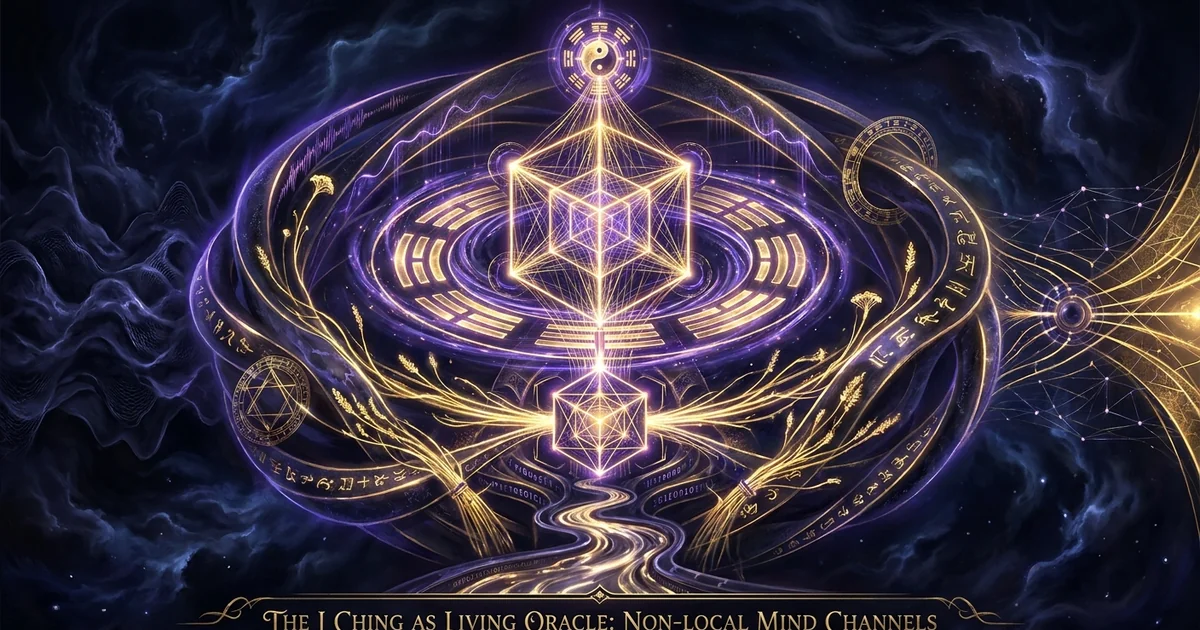
Epistemological principles, cosmological framework, and ontological mechanics.
The I Ching (Zhouyi) represents the summit of ancient Chinese cosmological science, originating in the Neolithic era through oracle bone plastromancy and formalized by Fu Xi, King Wen of Zhou, the Duke of Zhou, and Confucius (via the Ten Wings commentaries). It is not a fatalistic oracle, but an open-ended dynamic system describing the ceaseless flux of the universe through the interplay of Yin (receptive, broken, dark) and Yang (creative, solid, luminous) polarities.
The mathematical architecture of the I Ching is fundamentally binary: two primordial polarities (Liangyi) generate four manifestations (Sixiang), which expand into the eight trigrams (Bagua) and culminate in the 64 hexagrams (Gua)—a 6-bit binary matrix of 64 permutations. When Gottfried Wilhelm Leibniz received Shao Yong's circular hexagram diagrams from Jesuit missionary Joachim Bouvet in 1701, he realized that the ancient Chinese had discovered the binary numeral system (0 and 1) millennia before modern computation.
Metaphysically, the I Ching functions as an interface with what modern physics describes as non-linear dynamic systems and what Carl Jung termed the collective unconscious. Through the ritual manipulation of 50 yarrow stalks or three bronze coins, random mechanical entropy collapses into synchronistic order, revealing the invisible trajectory of the present moment and offering strategic guidance for harmonizing with the Dao.
Systematized repositories, categorical frameworks, and primary archetypal divisions.
Exhaustive commentaries, judgment, image, and line transformations for all 64 hexagrams.
Earlier (Fu Xi) and Later (King Wen) Heaven arrangements, directional vectors, and elemental dynamics.
Authentic 50-yarrow-stalk manipulation, 3-coin casting protocols, and probability matrices.
Shao Yong's line dynamics, mutual hexagrams (Hu Gua), reversed hexagrams (Zong Gua), and polar opposites (Cuo Gua).
From Daoist cosmology and Leibnizian binary mathematics to modern information theory and quantum biology.
Systematic pedagogical progression from elemental principles to operative synthesis.
Master Yin/Yang polarities, the Eight Trigrams (Bagua), and foundational consultation etiquette.
Delve into changing line mechanics, probability differences, and structural transformation techniques.
Synthesize the 64 hexagrams with cellular genetics, binary computation, and Hermetic alchemy.
Exhaustive historical analysis, metaphysical mechanics, and empirical syntheses.
Explore six line structural topography hexagram analysis to decode state-space phase transitions, vector latency, and resonance dynamics in the I Ching.
Analyze the King Wen sequence cosmological order as a non-equilibrium thermodynamic model mapping manifest reality via 64 hexagram structural pairing.
Explore the hexagram 6 conflict iching meaning to analyze how Heaven over Water signals divergent vectors, urging systemic mediation before calamity.
Explore hexagram incubation meditation somatic iching methods to reconfigure consciousness and ground archetypal dynamics via Daoist internal alchemy.
Analyze macrocosmic iching divination world events cycles through complex systems, phase transitions, and collective historical attractor dynamics.
Explore dipolar resonance of lines iching corresponding positions to map structural equilibrium, systemic tension, and archetype individuation dynamics.
Analyze the third line crisis iching transition threshold as subjective lower trigram dynamics rupture upon confronting objective systemic realities.
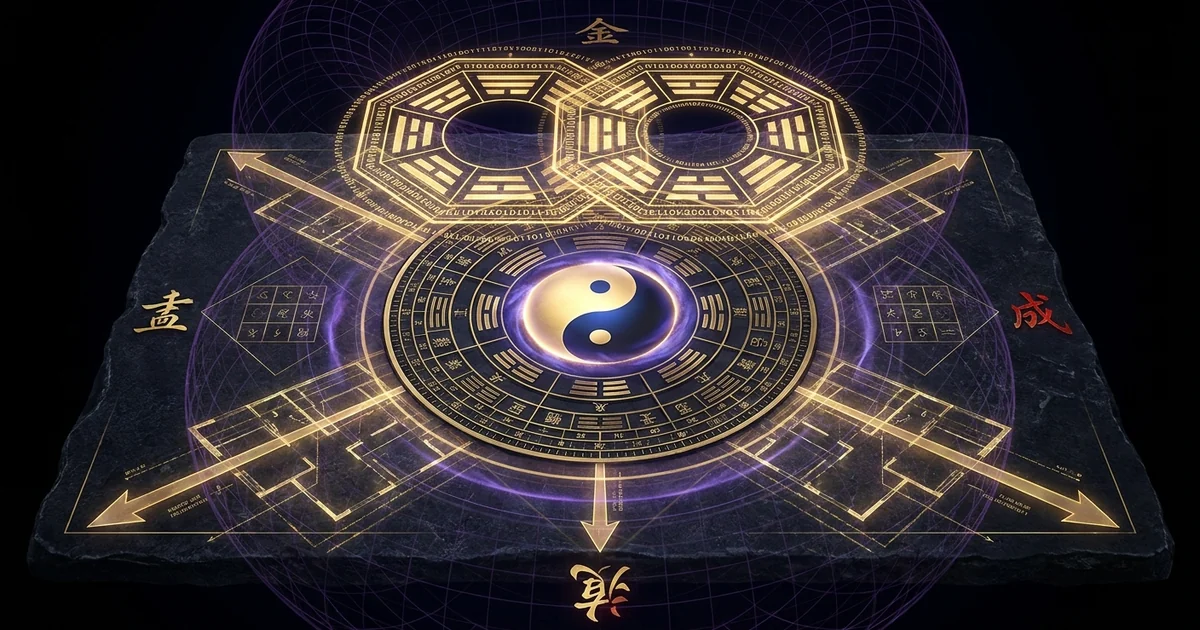
Analyze the bagua map feng shui spatial placement energetic topology to harmonize environmental chi across architectural eight directional sectors.
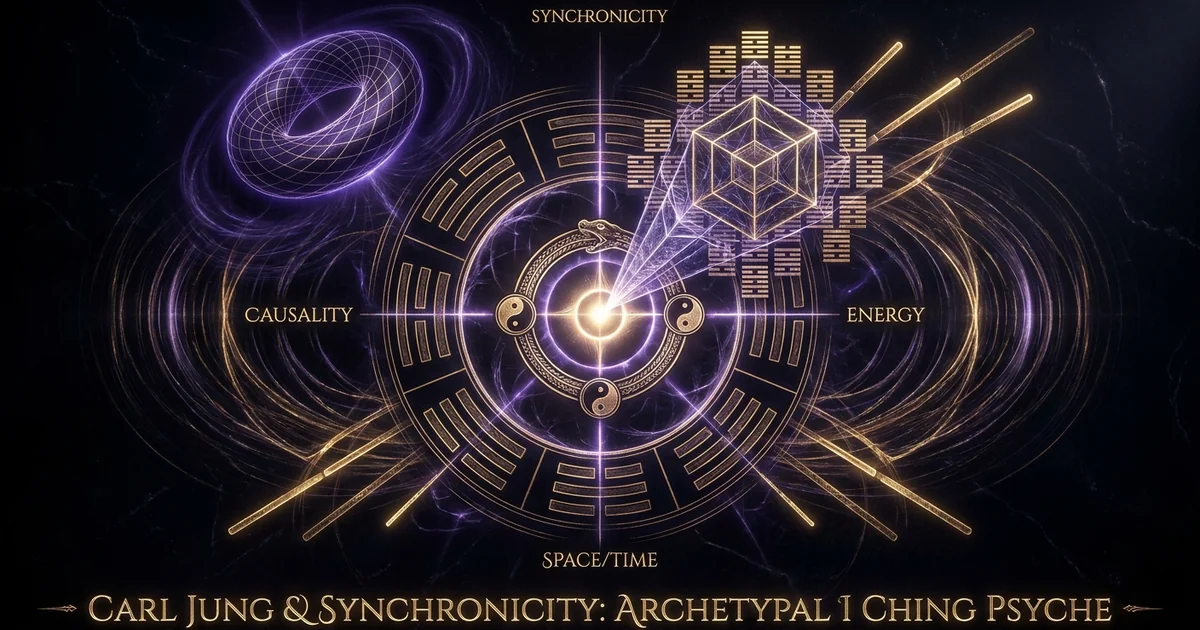
Explore the Carl Jung synchronicity iching foreword meaning, uncovering how Wilhelm's translation reveals archetypal divination and acausal psychic order.
Full categorical archive of all 97 authoritative treatises, historical decodings, and practical commentaries across this domain.
Exhaustive commentaries, judgment, image, and line transformations for all 64 hexagrams.
Earlier (Fu Xi) and Later (King Wen) Heaven arrangements, directional vectors, and elemental dynamics.
Authentic 50-yarrow-stalk manipulation, 3-coin casting protocols, and probability matrices.
Shao Yong's line dynamics, mutual hexagrams (Hu Gua), reversed hexagrams (Zong Gua), and polar opposites (Cuo Gua).
From Daoist cosmology and Leibnizian binary mathematics to modern information theory and quantum biology.
Experience esoteric wisdom through digital simulation. Our specialized apps model traditional archetype distributions and energetic resonance calculations in real-time.
Full-Spectrum Divination & Multi-Tradition Astrological Synthesis Workstation
Daily Astrological Timing, Natal Transits & Personal Divination Companion
How I Ching Knowledge Hub intersects with companion traditions across the four hermetic pillars.
The 64 Hexagrams & The 64 BodyGraph Genetic Gates
Binary Polarity, Information Theory & Cybernetics
Daoist Metaphysics & Hermetic Polarity
Authoritative answers to primary inquiries, historical controversies, and esoteric mechanics.
The ancient 50-yarrow-stalk procedure involves a three-phase division protocol that results in unequal probabilities: generating an Old Yang (changing 9) has a probability of 3/16 (18.75%), while Old Yin (changing 6) has a probability of only 1/16 (6.25%). In contrast, the simplified 3-coin method assigns equal probability to heads and tails, making Old Yang and Old Yin both 2/16 (12.5%). Consequently, the yarrow stalk method favors Yang stability and makes Yin transformation rarer and more poignant.
The Early Heaven (Xiantian) Bagua, attributed to Fu Xi, represents the primordial universe of perfect symmetry, unmanifest potential, and cosmic balance where opposing pairs face each other (e.g., Heaven opposite Earth, Fire opposite Water). The Later Heaven (Houtian) Bagua, attributed to King Wen, reflects the manifested, temporal world of cyclical change, directional geography, and seasonal progression.
In 1701, French Jesuit missionary Joachim Bouvet sent German mathematician Gottfried Wilhelm Leibniz a woodblock print of Shao Yong's 64-hexagram arrangement. Leibniz immediately recognized that by substituting a 0 for a broken Yin line and a 1 for an unbroken Yang line, the hexagrams formed a flawless progression of binary numerals from 0 (000000) to 63 (111111), proving that ancient Chinese sages had discovered binary mathematics millenia earlier.
A nuclear hexagram reveals the latent, internal dynamics embedded within a primary hexagram. It is constructed by taking lines 2, 3, and 4 of the primary hexagram to form the lower trigram of the nuclear hexagram, and lines 3, 4, and 5 to form the upper trigram. This reveals the core psychological motive or hidden tension operating beneath the manifest surface of the inquiry.
The Ten Wings are the classical philosophical commentaries appended to the original divination text of the I Ching during the Warring States and early Han periods, traditionally attributed to Confucius and his school. They include the Tuan Zhuan (Commentary on the Judgments), Xiang Zhuan (Commentary on the Images), and Xi Ci Zhuan (The Great Treatise), transmuting a bronze-age divinatory manual into an exalted philosophical treatise on cosmic change.