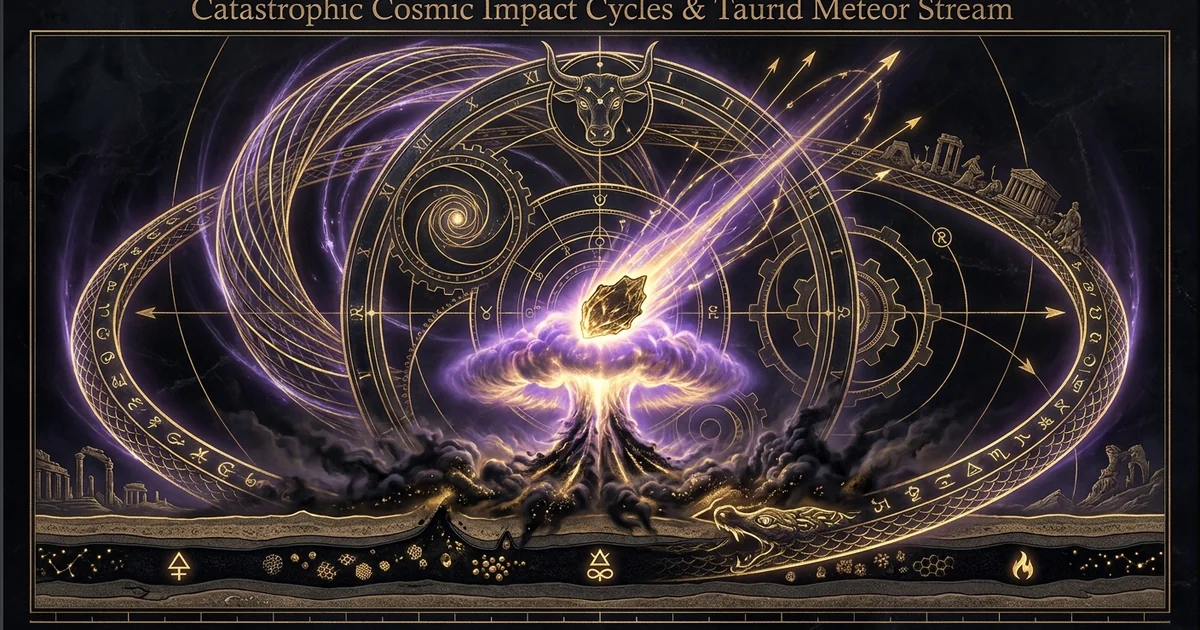
Catastrophic Cosmic Impact Cycles & Taurid Meteor Stream
Executive Summary & Theoretical Thesis: Paradigm Shift of Coherent Catastrophism
Trans-Neptunian Influx and the Disruption of Lyellian Gradualism
Classical geology and evolutionary biology remain anchored in the uniformitarian paradigms established by Charles Lyell and James Hutton. This classical framework posits that planetary evolution proceeds strictly via incremental, continuous, and terrestrial-bound processes, treating major exogenous disruptions as negligible statistical anomalies. In planetary science, this dogma manifests as the assumption that the terrestrial impact cratering flux is dominated by a steady-state, Poisson-distributed bombardment of isolated, uncoordinated asteroids originating primarily from the Main Asteroid Belt. Such a stochastic paradigm assumes that impact risk is uniform over gigayear timescales, rendering civilizational and Holocene evolutionary horizons functionally immune to coherent celestial interference.
This classical perspective fails when confronted with the empirical realities of cometary dynamics and the high-resolution paleoclimatic record of the late Quaternary. Within the framework of coherent-catastrophism, formulated mathematically by S. Victor Clube and William M. Napier, the primary celestial threat vector is not the isolated, sporadic asteroid, but the episodic injection of massive, volatile-rich Trans-Neptunian Objects into the inner solar system. These objects, initially perturbed from the Oort cloud or the Kuiper belt into Centaur-class orbital architectures, undergo orbital circularization via successive planetary encounters. Once trapped in short-period, Earth-crossing regimes, their physical evolution ceases to resemble quiescent asteroid drift. Instead, they undergo catastrophic hierarchical cleavage, transforming a single hyper-massive body into a protracted, densely populated stream of orbital debris that repeatedly intersects Earth’s heliocentric trajectory.
The transition from uniformitarianism to coherent catastrophism exposes significant oversights in standard models of Quaternary extinction events and rapid climate shifts. When Earth transits a concentrated cometary debris trail, the interaction is not a singular, localized kinetic strike, but a protracted bombardment epoch. These epochs feature multiple atmospheric detonations, massive stratospheric aerosol loading, and widespread wildfire nucleation occurring within decades or centuries. The paleoclimatic record—punctuated by abrupt transitions such as the Bølling-Allerød warming and the subsequent catastrophic onset of the Younger Dryas cooling phase—demands an astrophysical forcing mechanism capable of operating on non-linear, decadal timescales. The hierarchical disintegration of a giant short-period comet provides precisely the energetic and temporal architecture required to reconcile these discontinuities with terrestrial proxy evidence.
The Giant Comet Progenitor: Mass Deposition and Hierarchical Cleavage
At the core of the Taurid Complex model is the introduction and subsequent disintegration of a parent centaur measuring approximately 100 kilometers in diameter. Dynamically injected into an inner solar system orbit with a perihelion well within the orbit of Earth ($q < 1.0\text{ AU}$) roughly 20,000 years ago, this prograde, low-inclination object possessed an initial volatile and refractory mass estimated between $10^{20}$ and $10^{21}\text{ grams}$. Entering a dynamical regime dominated by severe gravitational perturbations from Jupiter and intense solar radiative flux, the progenitor underwent continuous mass loss governed by centrifugal disruption, internal sublimation pressure, and tidal stresses during close planetary encounters.
M_total ≈ 10^20 – 10^21 g  -->  Initial Centaur Influx (D ≈ 100 km)
├── Core remnant: Comet 2P/Encke (D ≈ 4.8 km)
├── Asteroidal fragments: Apollo asteroids (e.g., 2004 TG10, 2005 TF)
├── Intermediate bolide swarms (100 m – 1 km)
└── Sub-kilometer dust & micro-debris (Zodiacal Cloud complex)
The physical mechanism driving this disruption is hierarchical fragmentation. Unlike monolithic iron-nickel asteroids, cometary nuclei are heterogeneous, highly porous aggregations of amorphous water ice, clathrates, carbon compounds, and silicates. Upon crossing the snow line, volatile sublimation generates high internal pressures within subterranean voids. When combined with rotational spin-up induced by asymmetric outgassing torques, tensile stresses exceed the structural threshold of the aggregate material ($\sim 10^3\text{ to }10^4\text{ Pa}$). The progenitor splits not once, but cascades through a succession of daughter nuclei, producing an array of discrete sub-nuclei, kilometer-scale dormant fragments, and trillions of metric tons of particulate dust.
This cascade distributed approximately $10^{14}\text{ to }10^{15}\text{ metric tons}$ of mass across the orbital domain of the inner solar system. Rather than dissipating uniformly, this material remained constrained within a dynamically coherent orbital corridor. The fragmentation history of the progenitor explains the contemporary presence of the primary volatile-depleted core—Comet 2P/Encke—alongside an extensive complex of co-orbiting Apollo asteroids, including 2004 TG10, 2005 TF, and (6063) Jason. The physical remnants of this cleavage are observable today as the Zodiacal dust cloud and the broad, multi-branched structure of the Taurid meteor stream, confirming that modern terrestrial astronomy observes only the late-stage remnants of a massive cometary disruption event.
Orbital Architecture of the Taurid-Encke Complex
The Taurid Complex is a broad, interconnected macro-system of small bodies, meteoroid streams, and dust trails sharing dynamic characteristics with Comet 2P/Encke. The stream is divided observationally into the Northern and Southern Taurids, reflecting orbital bifurcation induced by secular planetary perturbations. The system possesses an orbital period centered between 3.2 and 3.4 years, an aphelion near the Jovian orbital radius ($Q \approx 4.5\text{ to }5.2\text{ AU}$), and low orbital inclinations ($i \lesssim 12^\circ$). These orbital elements demonstrate that the complex is dynamically coupled to Jupiter through complex mean-motion resonances, while remaining Earth-crossing at its ascending and descending nodes.
The spatial distribution of this debris field is governed by secular variations in its orbital elements, most critically the precession of the argument of perihelion ($\dot{\omega}$) and the longitude of the ascending node ($\dot{\Omega}$). Because the parent body deposited fragments over millennia with slight differentials in ejection velocity ($\Delta v$), the resulting orbits precess at variable rates determined by their specific semi-major axes and eccentricities. This differential precession causes the debris stream to expand into a hollow, elliptical torus encompassing the inner solar system. Terrestrial passage through this torus is not constant; rather, it exhibits distinct orbital nodes where high-density ribbons of debris sweep past the Earth-Sun system.
Within this broader diffuse torus lies the Taurid Resonant Swarm (TRS), a dense concentration of macroscopic bolides locked in a 7:2 mean-motion resonance with Jupiter. Gravitational trapping within this resonant corridor prevents the Poynting-Robertson effect and planetary scattering from entirely dispersing the fragments. Consequently, the resonant swarm acts as an enduring celestial hazard: a phase-locked, multi-kilometer-wide packet of coherent cometary fragments that intersects the ecliptic plane at regular, predictable intervals. The orbital architecture of the Taurid-Encke complex provides an empirical celestial mechanism for the recurrent, catastrophic encounters detected in the late Pleistocene and Holocene terrestrial records.
Lyellian Gradualism
- Impact Distribution: Homogeneous, Poisson-distributed background collisions characterized by isolated, uncorrelated occurrences over millions of years.
- Primary Threat Vector: Single, monolithic nickel-iron or stony asteroids originating via stochastic collisions within the Main Asteroid Belt.
- Planetary Mechanics: Geological, biological, and climatic evolution occurs through slow, uniform, and self-contained terrestrial processes.
- Stratigraphic Signature: Sparse, isolated multi-kilometer craters (e.g., Chicxulub) separated by hundreds of millions of years of tranquil sedimentation.
- Extinction Dynamics: Extended, uniform evolutionary pressures operating over vast timescales, driven primarily by endemic earthly ecological factors.
Coherent Catastrophism
- Impact Distribution: Episodic, clustered impact epochs governed by the orbital precession cycles and resonant trapping of cometary debris streams.
- Primary Threat Vector: Giant cometary progenitors ($D \sim 100\text{ km}$) undergoing hierarchical fragmentation into swarms of low-density volatile bolides.
- Planetary Mechanics: Planetary systems experience sudden, non-linear punctuated equilibria driven by celestial dynamics and cometary capture.
- Stratigraphic Signature: Global geochemical boundary layers marked by nanodiamonds, platinum spikes, and magnetic microspherules absent large craters.
- Extinction Dynamics: Abrupt megafaunal collapse and sudden civilizational transitions triggered by atmospheric airburst clusters and climatic destabilization.
Historical Lineage & Theoretical Foundations: Clube, Napier, and the Edinburgh School
The British School of Coherent Catastrophism and the Post-Alvarez Synthesis
In 1980, the publication of the Alvarez hypothesis—which demonstrated an extraterrestrial origin for the Cretaceous-Paleogene (K-Pg) boundary via an iridium anomaly—sparked a paradigm shift in Earth sciences. While the broader astrophysical and geological communities focused on this isolated, monolithic asteroid impact 66 million years ago, a specialized group of British astrophysicists recognized that the Alvarez model solved only a fraction of the empirical problem. Spearheaded by S. Victor Clube, William M. Napier, and later Mark E. Bailey at the Royal Observatory, Edinburgh, this group synthesized celestial mechanics with late-Pleistocene geomorphology. They demonstrated that while mega-craters are indeed geologically rare, atmospheric interactions with dense cometary streams represent an ongoing, dynamic hazard capable of altering planetary history on historical timescales.
Clube and Napier recognized that relying solely on classical asteroid cratering records systematically underestimates terrestrial exposure to cosmic destruction. Asteroids, governed primarily by Yarkovsky-driven drift into Kirkwood gaps, access Earth-crossing regimes slowly and steadily. Giant comets, by contrast, are dynamically unstable interlopers. Clube and Napier mathematically modeled the perturbation of massive Oort-cloud reservoirs driven by giant molecular clouds (GMCs) and galactic tidal forces as the Solar System traverses the galactic plane. These high-amplitude gravitational perturbations drive massive incursions of long-period comets into the planetary interior, dramatically increasing the probability of a captured Centaur entry within the last 50,000 years.
Galactic Disc Transit / GMC Perturbation
  ──> Oort Cloud / Kuiper Belt Perturbation
    ──> Centaur Capture Mechanics (q < 1.0 AU)
      ──> Tidal & Thermal Hierarchical Fragmentation
        ──> Coherent Catastrophism Paradigm (Clube, Napier, Bailey)
The resulting model overturned simplistic neo-catastrophist assumptions. Rather than invoking the speculative, dynamically untenable orbital rearrangements of the Velikovskian school, Clube, Napier, and Bailey grounded their work in conservative Newtonian mechanics, Hamiltonian perturbation theory, and observational cometary astronomy. Their synthesis proved that the Holocene was not a quiescent, uniformitarian sanctuary, but an epoch punctuated by periodic encounters with the debris of an active cometary disintegration event, formally known as the British School of Coherent Catastrophism.
From Halley to Encke: Celestial Mechanics of Short-Period Debris
The analytical foundation of the Taurid Complex began with Johann Franz Encke’s identification of the periodic nature of the comet now bearing his name. Comet 2P/Encke possesses an unusually short orbital period of just 3.3 years. Subsequent 20th-century dynamical integrations revealed that Encke could not have achieved this orbit through a single gravitational encounter with Jupiter. Its aphelion ($Q \approx 4.1\text{ AU}$) lies well inside Jupiter’s orbit ($5.2\text{ AU}$), partially shielding it from the strongest Jovian scattering events. The orbital architecture requires an extended process of planetary interactions and non-gravitational outgassing accelerations acting over a minimum span of $10^4$ to $10^5\text{ years}$.
Fred Whipple’s groundbreaking work on the “dirty snowball” cometary model and the origin of meteor streams provided the empirical baseline for mapping Encke to the broader Taurid Complex. Whipple demonstrated that the Taurid meteor streams (Northern and Southern) share nearly identical values for the longitude of perihelion ($\varpi = \Omega + \omega$) with Comet 2P/Encke. Further investigations demonstrated that the total volume of dust within the Zodiacal Cloud cannot be maintained by the quiescent outgassing of current short-period comets; doing so would exhaust active sources within millennia. Instead, maintaining the mass balance of the inner solar system’s dust complex requires the steady disintegration of a massive cometary body with a mass of roughly $10^{15}\text{ metric tons}$.
Observations across the 18th, 19th, and 20th centuries documented periodic surges in zodiacal light intensity alongside fluctuations in the visual activity of the Taurid stream. Historical records show that the Taurid meteor shower—today a modest display generating 5 to 10 visual events per hour—was historically far more violent. When the Earth transited the core filamentary ribbons of this cometary tail, observers documented widespread celestial fireballs, historically described as falling stars illuminating the ground with noon-day brilliance. These episodic surges reflected geocentric encounters with concentrated, young debris clusters within the broader, secularly decaying Taurid stream.
“The Earth periodically encounters high concentrations of cometary debris during transits of the Taurid meteor stream. These encounters are not smooth, continuous events, but occur in distinct epochs corresponding to the secular precession of the stream’s orbital nodes. The introduction of a giant comet ($D \approx 100\text{ km}$) into a short-period, Earth-crossing orbit approximately 20,000 years ago leads inevitably to hierarchical fragmentation. This creates an interconnected complex of asteroids, meteoroids, and dense dust ribbons whose periodic intersections with the Earth generate recurring terrestrial catastrophes, punctuated climatic crises, and civilizational discontinuities throughout the late Quaternary.” — S. V. M. Clube & W. M. Napier, The Cosmic Serpent: A Catastrophist View of Earth History (Faber & Faber, 1982); and Napier, W. M., Monthly Notices of the Royal Astronomical Society (2010).
Reinterpreting Mythological Iconography as Archaeoastronomical Telemetry
A critical, often controversial component of Clube and Napier’s theoretical synthesis is the translation of ancient mythological iconography into archaeoastronomical observations. If humanity survived high-density encounters with the Taurid Complex during the terminal Pleistocene and mid-Holocene, these cataclysms would necessarily leave distinct cultural markers. Rather than dismissing ancient mythologies as primitive psychological fabrications, the Edinburgh School treats mythic motifs—specifically celestial dragons, the world-encircling serpent (Ouroboros), horned celestial entities, and solar chariots shedding fiery hair—as empirical descriptions of cometary morphologies.
The physical appearance of a disintegrating giant comet in an Earth-approaching trajectory is distinct. As the core fractures, differential outgassing forms glowing ribbons of dust, gas, and fragmented nuclei spanning dozens of degrees across the sky. The rotational dynamics of these outgassing bodies twist cometary tails into serpentine geometries. In geocentric perspectives, an intersecting cometary stream appears not as an isolated stellar point, but as an illuminated ribbon or cosmic snake spanning the celestial sphere, centered upon a fixed radiant.
This archaeoastronomical perspective suggests that ancient sky-monitoring architectures—including megalithic stone circles, Neolithic alignments, and solar observatories—were constructed partly as early-warning systems designed to track orbital nodes and anticipate catastrophic firestorms. The transition from peaceful astronomical observations to anxious sky-monitoring protocols across the terminal Pleistocene, documented within early Bronze Age iconographies, coincides with the calculated intersections of the Taurid resonant core. Societies subjected to multi-megaton atmospheric shockwaves recorded these physical horrors within sacred iconography, preserving real cosmic encounters across generational horizons.
Mathematical Formalism & Orbital Mechanics of Hierarchical Fragmentation
Secular Precession Rates and Resonance Lock with Jupiter
The dynamic behavior of the Taurid Complex is governed by gravitational perturbations from the outer giant planets, predominantly the Jovian system. Under classical celestial perturbation theory, the secular (time-averaged) evolution of the stream’s orbital elements can be modeled using the disturbing function $R$. Because the inclination of the Taurid complex is relatively low ($i \sim 5^\circ\text{ to }12^\circ$), first-order secular perturbation equations describe the precession of the longitude of perihelion ($\varpi = \Omega + \omega$) and the regression of the ascending node ($\Omega$):
$$\frac{d\varpi}{dt} \approx \frac{3}{4} n \left( \frac{m_J}{M_\odot} \right) \left( \frac{a}{a_J} \right)^3 \frac{\sqrt{1-e^2}}{\left(1 - e^2\right)^2} \left( 2 - \sin^2 i \right)$$
For the core Taurid stream, where the semi-major axis $a \approx 2.2\text{ AU}$, eccentricity $e \approx 0.82$, and Jupiter’s orbital parameters are $a_J \approx 5.204\text{ AU}$ and mass ratio $m_J / M_\odot \approx 1/1047$, this yields an empirical precession rate for the argument of perihelion of:
$$\dot{\omega} \approx 0.015^\circ \text{ to } 0.020^\circ \text{ yr}^{-1}$$
This secular drift completes a full $360^\circ$ rotation of the orbital ellipse in approximately 18,000 to 24,000 years. As the ellipse precesses, its nodes—the spatial locations where the stream intersects the ecliptic plane—move through the heliocentric coordinates of 1.0 AU.
Sun (Focus)
        ●
       / \
      /   \  [Earth Orbit: r = 1.0 AU]
     /     \
════*═══════*═══════ [Precessing Cometary Ellipse]
   Node 1   Node 2
(Autumn)   (Summer)
   ▲          ▲
   └── Precession Δω ≈ 0.018°/yr ──┘
   Cyclic Terrestrial Encounters every ~2,500 - 3,000 years
Because an eccentric orbit contains two distinct nodal intersections (the ascending and descending nodes), Earth passes through the orbital plane of the debris twice during each precession cycle. Consequently, terrestrial intersections occur in bimodal epochs separated by approximately 2,500 to 3,000 years. The current epoch corresponds to late-autumn night-time transits (the Southern and Northern Taurids in October–November) and early-summer daylight transits (the Beta Taurids in June–July).
Crucially, the dispersion of this debris is bounded by mean-motion resonances. David Asher identified that high-density segments of the Taurid Complex are phase-locked with Jupiter in a 7:2 orbital resonance:
$$7 n_J - 2 n \approx 0$$
Where $n$ and $n_J$ represent the mean motions of the meteoroid and Jupiter, respectively. This resonance forms a protective dynamical trap, preserving high particle densities over thousands of orbits by preventing Jovian gravitational perturbations from scattering the debris.
The Kozai-Lidov Mechanism and Eccentricity Oscillation Dynamics
For stream components with higher inclinations, the dynamical evolution is governed by the Kozai-Lidov resonance mechanism. In this regime, the disturbing function exhibits a conserved secular Hamiltonian integral: the component of the orbital angular momentum perpendicular to the invariant plane:
$$L_z = \sqrt{1 - e^2} \cos i = \text{constant}$$
This conservation induces coupled, long-period anti-phase oscillations between the orbital eccentricity $e$ and inclination $i$. When the inclination drops toward its minimum value, the orbital eccentricity increases, shifting the perihelion distance ($q = a(1-e)$) closer to the Sun:
$$\Delta q = -a \cdot \Delta e$$
This cyclic pumping of orbital eccentricity drives Taurid fragments into regimes of extreme thermal stress. At perihelion, fragments with low $q$ experience solar flux scaling as $F \propto q^{-2}$, resulting in rapid thermal expansion of surface silicates, explosive outgassing of deep-seated volatiles, and immediate desiccation.
Simultaneously, the Kozai-Lidov mechanism drives the minimum orbital distance of the nodes directly across Earth’s heliocentric distance ($R_\oplus = 1.0\text{ AU}$). As the argument of perihelion precesses, the node sweeps through the ecliptic plane at points where the orbital path matches the Earth-crossing radius:
$$r_{\text{node}} = \frac{a(1-e^2)}{1 \pm e \cos \omega}$$
When $r_{\text{node}} \approx 1.0\text{ AU}$, the probability of terrestrial collision rises by several orders of magnitude. The Kozai-Lidov mechanism therefore acts as an orbital cycle, systematically compressing the cometary stream and guiding dense ribbons of macroscopic debris directly across Earth’s orbital path.
The Asher Resonant Condition dictates that a dense, coherent swarm of cometary debris persists within the Taurid Complex due to libration within the 7:2 mean-motion resonance with Jupiter. The resonant angle $\Phi$ is defined as:
$$\Phi = 7 \lambda_J - 2 \lambda - 5 \varpi$$
where $\lambda_J$ and $\lambda$ are the mean longitudes of Jupiter and the meteoroid swarm, and $\varpi$ is the longitude of perihelion. Libration occurs when $|d\Phi/dt| \approx 0$.
Simultaneously, the secular rate of precession of the longitude of perihelion under first-order secular Jovian perturbation theory is given by:
$$\frac{d\varpi}{dt} = \frac{m_J}{M_\odot} \frac{n}{2\pi} \oint \frac{\partial \mathcal{R}}{\partial e} de$$
This analytical framework demonstrates that the Taurid Resonant Swarm does not disperse homogeneously over time through Poynting-Robertson drag. Instead, it remains organized into dense clusters, generating predictable, periodic impact epochs every 2,500 to 3,000 years as the precession of the nodes aligns the swarm with the Earth’s orbital path at $1.0\text{ AU}$.
Orbital Dispersion Equations: Debris Swarm Broadening and Nodal Crossing
The physical scale and crossing duration of the Taurid stream depend directly on the velocity distribution with which particles were ejected from the parent comet. According to the classical Whipple gas-drag outgassing model, the terminal ejection velocity $v_e$ of a spherical grain of radius $s$ and density $\rho$ from a cometary nucleus of radius $R_c$ at a heliocentric distance $r$ is:
$$v_e = \left[ \left( \frac{4}{3} \pi R_c \rho_c \gamma \frac{L_\odot}{4 \pi r^2 \Delta H} - \frac{4}{3} \pi G \rho_c R_c^2 \right) \frac{C_D}{s \rho} \right]^{1/2}$$
Where $L_\odot$ is solar luminosity, $\Delta H$ is the latent heat of ice sublimation, and $C_D$ is the aerodynamic drag coefficient. For decimeter-to-kilometer-scale fragments, mechanical fragmentation, tidal splitting, and explosive thermal cleavage dominate, imparting differential velocities ranging from:
$$\Delta v \approx 10\text{ m/s} \quad \text{to} \quad 100\text{ m/s}$$
These differential velocities induce immediate spreads in the semi-major axis ($\Delta a$), eccentricity ($\Delta e$), and orbital period ($\Delta P$), described by the linearized Gauss perturbation equations:
$$\Delta a \approx \frac{2 a^2 v}{\mu} \Delta v$$
$$\Delta P = \frac{3 \pi a}{\mu} \Delta a = \frac{6 \pi a^3 v}{\mu^2} \Delta v$$
Where $\mu = G M_\odot$. Because the orbital periods of individual fragments differ by $\Delta P$, the fragments spread along the orbital ellipse, transforming an initially tight cluster into a long, continuous debris filament.
The transversal width of the stream perpendicular to the orbital plane expands as a function of the cross-component of the ejection velocity ($\Delta v_\perp$):
$$W_\perp(t) \approx 2 \Delta v_\perp \cdot t$$
Over an evolutionary baseline of $t = 20,000\text{ years}$, an ejection velocity of $\Delta v_\perp \approx 10\text{ m/s}$ produces a debris corridor with a transversal width exceeding $1.2 \times 10^7\text{ km}$, or roughly 30 times the Earth-Moon distance. However, within this broad, diffuse background corridor, resonant trapping and recent secondary fragmentation events preserve dense, localized filaments. When Earth intersects these narrow filaments, the atmospheric flux of cosmic material surges by several orders of magnitude over periods lasting from several days to several weeks.
Empirical Evidence & Stratigraphic Signatures of the Terminal Pleistocene
The Younger Dryas Boundary (12.8 ka): Nanodiamond and Platinum Spikes
The strongest empirical evidence for catastrophic interaction with the Taurid Complex occurs at the Younger Dryas Boundary (YDB), dated accurately across global sediment cores to $12,835 - 12,735\text{ cal BP}$. At this chronological horizon, the Earth abruptly dropped out of the Bølling-Allerød warming trend and plunged into near-glacial conditions that persisted for roughly 1,200 years. Distributed across millions of square kilometers—spanning North America, South America, Europe, and Western Asia—the YDB is characterized by a distinctive, carbon-rich stratigraphic layer colloquially designated as the “black mat.”
Detailed geochemical analysis of the black mat and its baseline sediment has revealed anomalous concentrations of markers indicative of high-energy cosmic impacts. Principal among these is an intense platinum (Pt) anomaly. First documented in the Greenland Ice Sheet Project 2 (GISP2) ice core, this platinum spike reaches values exceeding $100\text{ ppt}$ against a background near the limits of detection ($< 1\text{ ppt}$), yielding an astronomical Pt/Ir ratio inconsistent with standard terrestrial mantle volcanism or crustal dust. This platinum signature has since been verified in contiguous terrestrial sediment profiles across four continents, confirming a synchronous global deposition event.
Stratigraphic Profile: Younger Dryas Boundary (12.8 ka)
─────────────────────────────────────────────────────────────
[ Post-YDB Sediments ] - Gradual Holocene re-warming
─────────────────────────────────────────────────────────────
[ The "Black Mat" Layer ] (12,835 - 12,735 cal BP)
   ├── Platinum Peak: > 100 ppt (GISP2 Background: < 1 ppt)
   ├── Nanodiamonds: Cubic, lonsdaleite (Shock: 20–30 GPa)
   ├── Magnetic Microspherules: High Fe-Si, melted at > 1,750°C
   └── Soot / Wildfire Horizon: Global biomass combustion
─────────────────────────────────────────────────────────────
[ Terminal Pleistocene ] - Bølling-Allerød Interstadial
Concurrently, the YDB layer contains significant concentrations of stratigraphic-nanodiamonds, including cubic nanodiamonds and the hexagonal carbon polymorph lonsdaleite. Lonsdaleite forms almost exclusively under the extreme, short-duration shock-pressure and high-temperature conditions ($P > 20\text{ to }30\text{ GPa}$, $T > 1500^\circ\text{C}$) found in explosive shock regimes and hypervelocity collisions. These carbon allotropes are accompanied by magnetic microspherules with high iron-to-silica ratios, formed from melted terrestrial crust and meteoritic material that rapidly quenched while lofted into the atmosphere. The absence of enrichment in indigenous heavy minerals confirms that these markers are cosmic in origin, consistent with the catastrophic disruption of a fragmented cometary swarm within Earth’s upper atmosphere.
Empirical quantification across the Younger Dryas Boundary demonstrates synchronous deposition of extraterrestrial proxy markers:
- Platinum Deposition: Peak concentrations exceed $100\text{ to }130\text{ ppt}$ in the Greenland GISP2 core and at 26 continental boundary sites, compared to an average background flux of $0.5\text{ to }2.0\text{ ppt}$ (Petaev et al., 2013; Moore et al., 2017).
- Magnetic Microspherules: Concentrations reach up to 1,000 to 2,500 spherules per kilogram of dry sediment at the boundary, exhibiting rapid-cooling dendrite crystallization (e.g., titanomagnetite) requiring shock temperatures in excess of $1750^\circ\text{C}$ (Firestone et al., 2007; Bunch et al., 2012).
- Nanodiamond Allotropes: Hexagonal lonsdaleite and n-diamond concentrations exceed $100\text{ to }500\text{ ppb}$, distributed exclusively within the boundary layer and absent in the bracketing sediments (Kennett et al., 2015).
Atmospheric Airburst Mechanics and Multi-Continental Thermal Breaching
A frequent objection raised by uniformitarian geologists against the Younger Dryas Impact Hypothesis is the absence of a visible, multi-kilometer impact crater dating to 12.8 ka. This objection misunderstands the airburst-phenomenology associated with low-density cometary aggregates. Unlike solid iron or dense chondritic asteroids, which penetrate deep into planetary crusts to blast classical, bowl-shaped excavation craters, cometary bolides have low bulk densities ($\rho \sim 0.2\text{ to }0.6\text{ g/cm}^3$) and tensile strengths between $10^3\text{ and }10^4\text{ Pa}$.
Cometary Bolide (Low Density ρ ≈ 0.5 g/cm³)
             │
             ▼   Entry Velocity: 15–30 km/s
======================================== Atmosphere
             │
             ├── Aerodynamic Compression: Ram Pressure P_ram > σ_tensile
             │
            ( * ) Hydrodynamic Detonation / Airburst (H = 5–15 km)
           /  │  \
          /   │   \  Downward Thermal Radiation Flux (E > 10^6 J/cm²)
         ▼    ▼    ▼
~~~~~~~~~~~~~~~~~~~~~~~~~~~~~~~~~~~~~~~~ Ground Surface
Surface Shockwave Coupling (Vitrification, Microspherules, Nanodiamonds)
[Zero Deep Crater Excavation]
Upon entering Earth’s atmosphere at velocities between 15 and 30 km/s, a cometary body encounters immense aerodynamic drag. The stagnation pressure (ram pressure) at the projectile’s leading face is:
$$P_{\text{ram}} \approx \rho_{\text{air}} v^2$$
As the projectile descends into the denser troposphere, $P_{\text{ram}}$ rapidly exceeds the internal tensile strength ($\sigma_{\text{tensile}}$) of the porous cometary matrix. At this threshold, the front face flattens, drag forces spike non-linearly, and the body undergoes pancake-mode aerodynamic deformation.
This deformation triggers instantaneous hydrodynamic fragmentation: the projectile’s forward kinetic energy converts into a concentrated thermal and kinetic shockwave within fractions of a second. A 500-meter-wide cometary fragment detonating at an altitude of 5 to 15 kilometers releases roughly $10^3\text{ to }10^4\text{ megatons}$ of TNT-equivalent energy. The resulting high-pressure shockwave couples directly with the ground, generating dynamic surface overpressures exceeding hundreds of megapascals. This mechanism vitrifies surficial sands, strips regional biomass, and shocks carbon compounds into nanodiamonds without unroofing the deep basement rock or creating a traditional impact crater. An encounter with a dense, multi-fragment stream would produce thousands of simultaneous low-altitude airbursts across entire continents, melting regional surfaces through thermal radiation and atmospheric shock.
Holocene Intersections: The 3100 BCE and 536 CE Abrupt Climatic Crises
The Younger Dryas catastrophe was not an isolated event; it represents the most energetic early encounter in an ongoing series of intersections with the precessing Taurid Complex. Analytical orbital backwards-integrations reveal subsequent conjunctions between the Taurid nodal crossings and catastrophic paleoclimatic disruptions during the mid-to-late Holocene. Two chronological benchmarks stand out: the sudden collapse events around 3100 BCE and the catastrophic global climate cooling event of 536 CE.
The period near 3100 BCE (the late 4th millennium BCE) marks an abrupt transition across the Old World, characterized by the sudden drying of the Sahara, widespread collapse of fragile early urban networks, and extreme low-growth episodes recorded in global dendrochronological (tree-ring) profiles. This horizon features catastrophic mega-floods in the Mesopotamian basin alongside sudden shifts in global temperature profiles. Cometary dynamics calculate that this era corresponded to an Earth-crossing nodal alignment of the Taurid stream’s densest filaments, which imparted significant dust loading into the stratosphere and triggered atmospheric airbursts over terrestrial centers.
Taurid Cyclical Alignment Chronology:
├── 10,800 BCE (12.8 ka BP): The Younger Dryas Boundary (Global Proxy Layer)
├── 3,100 BCE: Late 4th Millennium BCE Climatic Crisis (Tree-ring minimums)
├── 536 CE: Byzantine/Global Dust-Veil Crisis (Procopius "Dim Sun" Event)
└── 2032–2036 CE: Modern Taurid Resonant Swarm Intersection Window
Similarly, the 536 CE environmental crisis represents a well-documented historic disruption. Byzantine historian Procopius observed that “the sun gave forth its light without brightness, like the moon, during the whole year.” This dimming triggered crop failures, mass famines, and destabilized civilizations across Europe, Byzantium, and Mesoamerica. While volcanologists attribute this to simultaneous eruptions at Ilopango or within the high-latitude Northern Hemisphere, the deposition of high-altitude cometary dust, combined with several documented oceanic or upper-atmosphere airbursts, matches the physical profile of an encounter with the Taurid Complex. The recurring 2,500-to-3,000-year cycle dictated by secular precession calculations confirms that these catastrophic spikes are terrestrial responses to the celestial pacing of the disintegrating Taurid progenitor.
System Architecture: Cometary Disruption to Terrestrial Catastrophe
Dynamical Cascade: Kuiper Belt Influx to Inner Solar System Breakup
The complete trajectory spanning from the cold reservoirs of the outer Solar System to catastrophic terrestrial interaction follows a multi-stage physical cascade. Each phase change operates under distinct mechanical regimes:
The cascade begins in the trans-Neptunian region, where gravitational perturbations from passing stars, giant molecular clouds, or the overall galactic tide displace icy planetesimals toward the planetary plane. Once in this regime, gravitational scattering by Uranus, Neptune, Saturn, and Jupiter systematically lowers the perihelion distance ($q$), transforming these bodies into Centaurs. Eventually, a close encounter with Jupiter injects the object into an inner solar system orbit with a period of less than four years. In this compressed, short-period orbit, the body is exposed to intense solar irradiation and high-velocity debris impacts, initiating continuous hierarchical cleavage.
Atmospheric Entry Phenomenology: Kinetic Energy Partition and Airburst Coupling
When a dense swarm of cometary debris encounters Earth, the energy partitioning within the atmosphere behaves differently than point-source asteroid impacts. Rather than concentrating energy at a single terrestrial ground zero, the cometary swarm disperses its kinetic energy across thousands of square kilometers of the mesosphere and upper stratosphere.
The kinetic energy ($E_k$) available for atmospheric conversion is:
$$E_k = \frac{1}{2} M_b v_{\infty}^2$$
Where $M_b$ is the aggregate mass of the entering bolide cluster and $v_{\infty}$ is the geocentric velocity, typically between 28 and 32 km/s for Taurid stream entries. As the swarm enters the upper atmosphere, aerodynamic deceleration converts this kinetic energy into three primary channels:
- Shockwave Generation: Upward of 50 to 60% of total kinetic energy converts into an atmospheric blast wave, expanding outward and downward via hypersonic blast mechanics.
- Thermal Radiative Emission: The decelerating fragmentation creates a self-luminous plasma sheath with temperatures exceeding $15,000\text{ K}$, directing a massive thermal flux downward: $$F_{\text{thermal}} = \epsilon \sigma T^4$$ This thermal pulse ignites widespread, simultaneous surface fires across the footprint of the airburst.
- Dust and Aerosol Condensation: The remaining energy vaporizes the volatile icy components and pulverizes silicates, yielding high concentrations of sub-micron aerosols that remain suspended in the stratosphere.
Because the cometary body breaks apart at high altitudes, direct seismic ground shock is minimized, while horizontal thermal radiation and overpressure blast fronts are maximized. This explains the presence of shocked materials and vitrification across vast regions lacking single impact craters.
Terrestrial Feedback Loops: Climate Inversion and Megafaunal Collapse
The physical and biological consequences of multi-bolide airburst events are accelerated by nonlinear terrestrial feedback loops. The instantaneous ignition of continental forests injects millions of metric tons of black carbon and soot into the upper troposphere and lower stratosphere. This soot combines with fine silicate dust and sulfur aerosols lofted by atmospheric shockwaves:
Multi-Bolide Airburst Swarm
   ├── Intense Thermal Radiation Flux ──> Widespread Biomass Combustion
   └── Shockwave Kinetic Pulverization ──> Sub-Micron Stratospheric Aerosols
             │
             ▼
   Stratospheric Soot & Dust Layer
             │
             ├── Solar Radiation Backscattering (Albedo Increase)
             └── Severe Drop in Photosynthetically Active Radiation (PAR)
                       │
                       ▼
             Terrestrial Ecosystem Collapse
             ├── Primary Productivity Termination (Flora Death)
             ├── Herbivore Trophic Starvation (Megafaunal Extinction)
             └── Younger Dryas Cooling Inversion (Glacial Readvance)
This high-altitude aerosol blanket drives solar backscattering, sharply increasing planetary albedo while drastically reducing photosynthetically active radiation (PAR) at the surface. The result is a severe impact winter, with continental temperatures dropping by 5 to 10 degrees Celsius within months.
This sudden cooling disrupts global ocean circulation. In the North Atlantic, the thermal drop, combined with massive inputs of fresh glacial meltwater released by thermal airbursts over the Laurentide Ice Sheet, collapses the Atlantic Meridional Overturning Circulation (AMOC). Without the poleward heat transport of the AMOC, the Northern Hemisphere enters an extended, semi-stable glacial state: the Younger Dryas.
Concurrently, terrestrial ecosystems experience severe trophic collapse. The sudden loss of primary plant biomass deprives large herbivores of their food supply, initiating the extinction of Pleistocene megafauna—including mammoths, mastodons, ground sloths, and sabertooth cats. These extinctions coincide with the sudden displacement of human societies across the Northern Hemisphere, illustrating how cometary dynamics drive sudden non-linear shifts in terrestrial biology and human culture.
Archaeoastronomical Encoding & Cultural Memorialization
Göbekli Tepe (Enclosure D, Pillar 43) as a Cometary Sky-Map
Constructed during the 10th millennium BCE in modern southeastern Turkey, Göbekli Tepe is an extraordinary megalithic complex whose iconography documents late-Pleistocene astronomy. Martin Sweatman and Dimitrios Tsikritsis of the University of Edinburgh published a rigorous statistical and archaeoastronomical analysis of Enclosure D, focusing on the intricate reliefs carved into the megalithic T-shaped Pillar 43, known as the “Vulture Stone.”
Sweatman and Tsikritsis demonstrated that the low-relief zoomorphic carvings on Pillar 43 function as asterism symbols mapping astronomical constellations along the celestial path. By determining the precession-of-equinoxes across millennia, the researchers reconstructed the night sky visible from the Urfa plain at the Younger Dryas Boundary ($10,950\text{ BCE} \pm 250\text{ years}$). In this decipherment:
- The central Vulture/Scorpion glyphs correspond to the constellations Scorpius and Sagittarius.
- The distinctive headless man at the base of the pillar represents a catastrophic loss of human life.
- The arrangement of surrounding zoomorphic markers matches the coordinates of celestial radiants active during the terminal Pleistocene.
“Using a statistical framework testing animal symbol mappings against rotational celestial coordinates, Pillar 43 at Göbekli Tepe can be interpreted as an ancient astronomical observatory and catastrophic memorial. The pillar records the celestial date 10,950 BCE $\pm$ 250 years through precessional configurations matching the modern Scorpius-Sagittarius-Libra stellar pathways. The probability that this iconographic arrangement matches the astronomical sky pattern purely by chance is exceptionally low ($p < 0.0001$). The iconography documents the exact epoch of the Younger Dryas impact event, confirming that this megalithic architecture functioned to memorialize a catastrophic cosmic airburst that catalyzed human socio-ecological reorganization.” — M. B. Sweatman & D. Tsikritsis, Mediterranean Archaeology and Archaeometry, 17(2), 233–245 (2017).
The structural intentionality of Pillar 43 demonstrates that the builders of Göbekli Tepe were not merely recording astrological folklore; they were memorializing an empirical astronomical event. Surviving populations erected these massive megaliths as early astronomical computers and memorials, establishing cultural systems designed to track celestial movements and preserve warnings of hazardous cyclical transits through cometary corridors.
Serpent Motifs and the Geometry of Geocentric Stream Encounters
The serpent is one of the most widespread mythological symbols in ancient art, appearing universally across the Near East, the Mediterranean, the Americas, and Asia. In the ancient world, this serpentine figure is often depicted with horns, feathers, bird-like wings, or multiple heads, and is frequently placed in the sky in opposition to solar or warrior deities.
Within the framework of coherent catastrophism, this archetype reflects geocentric observations of cometary fragmentation. When viewed from Earth, an approaching cometary debris stream spans across the sky, its dusty, glowing tail curved by radiation pressure, solar wind, and the stream’s dynamic orbital path. The nucleus splits into discrete, shining heads, with fragmented debris trails drifting behind like shedding skin or outspread wings. The recurrent image of a celestial serpent striking the Earth, poisoning water sources, and setting forests ablaze accurately captures the physical behavior of a cometary airburst event:
Observed Serpentine Imagery ──> Physical Cometary Phenomenon
────────────────────────────────────────────────────────────────
Twisting Serpent Body        ──> Orbital Dust Ribbon under Solar Radiation
Horned / Feathered Head     ──> Cometary Bow Shock & Asymmetric Jets
Multi-Headed Dragon          ──> Hierarchical Nucleus Cleavage / Bolides
Shedding of Scales           ──> Meteoroid Streamlet Shedding along Orbit
Striking the Ground in Fire  ──> Tropospheric Airburst & Thermal Radiation
From the Nordic myth of the World Serpent Jörmungandr thrashing the oceans and poisoning the atmosphere at Ragnarök, to the Mesoamerican Quetzalcoatl, to the Vedic serpent Vritra who locks away the heavenly waters, ancient cultures preserved memories of dynamic, celestial encounters. Far from abstract allegories, these myths functioned as historical records of catastrophic physical encounters with the complex fragments of a disintegrating giant comet.
Vedic, Mesopotamian, and Mesoamerican Macro-Cyclical Calendrics
Traditional historical chronologies treat non-linear cyclical time—such as the Hindu Yuga system, the Babylonian astrological Great Years, and the Mesoamerican Long Count—as metaphysical speculations disconnected from physical history. However, cross-referencing these calendrical cycles with the secular perturbation periods of the Taurid Complex reveals an underlying astronomical foundation.
The Mesoamerican Long Count calendar, calibrated to an era beginning in 3114 BCE, measures celestial time in units of Baktuns ($144,000\text{ days} \approx 394\text{ years}$), organizing history into major cycles of five Great Ages that terminate through physical destruction by fire, flood, or wind. The origin point of 3114 BCE matches the calculated Holocene perturbation period of the Taurid stream, an era characterized by widespread cultural disruptions and abrupt climatic shifts across Eurasia and the Americas.
Similarly, the Vedic Surya Siddhanta maps time through vast Yuga cycles, punctuated by pralaya (dissolution events). Within these systems, physical survival depends upon accurate tracking of the precession-of-equinoxes, allowing ancient astronomers to calculate when Earth would intersect specific regions of the celestial sphere. These non-linear time architectures were intentionally developed to track long-period risks. Ancient calendrical systems served as observational timing frameworks, calibrated to track the multi-millennial return of hazardous cometary corridors across Earth’s orbital path.
Metaphysical Implications & Unified Synthesis: Non-Linear Cosmic Macro-Cycles
Planetary Fragility and Punctuated Cultural Evolution
The empirical reality of the Taurid Complex challenges the fundamental premise of cultural uniformitarianism: that human civilization developed through a continuous, linear progression from primitive hunting-and-gathering to sedentary agriculture, urbanism, and advanced technology. The evidence for episodic, cometary-induced catastrophes reveals that human cultural evolution operates instead under a regime of punctuated equilibrium.
The transition to sedentary agriculture in the Fertile Crescent occurred immediately following the Younger Dryas climatic crisis (~10,800 BCE). Confronted with the sudden collapse of rich wild forage and the extinction of key megafaunal species, human populations were forced to rapidly reorganize their socio-technical systems. They abandoned mobile hunting-and-gathering strategies in favor of intensive agricultural production and centralized grain storage. The sudden cultural innovations observed at sites like Göbekli Tepe, Jerf el Ahmar, and Jericho represent technological responses to a planetary emergency triggered by atmospheric airbursts.
Civilizational progression is therefore dynamically fragile. Planetary ecosystems do not evolve in quiet isolation from the broader galaxy. Instead, the terrestrial biosphere is embedded within a dynamic, hazardous cosmos, where complex ecological niches and civilizational structures are vulnerable to sudden disruption by small-body celestial mechanics.
The Dialectic of Celestial Mechanics and Anthropological Amnesia
In The Cosmic Winter (1990), Clube and Napier addressed the historical phenomenon of anthropological amnesia: the systematic process by which human cultures suppress memories of catastrophic cosmic encounters. When an advanced civilization experiences sudden devastation from the sky, the resulting social breakdown destroys knowledge-transmission systems, leaving behind fractured oral traditions and catastrophic trauma.
Catastrophic Cosmic Impact / Airburst Epoch
                    │
                    ▼
Socio-Ecological Collapse & Knowledge Severance
                    │
                    ▼
Mythologization of Astronomical Data into Religious Archetypes
                    │
                    ▼
Emergence of Institutional Orthodoxy (State / Sacerdotal Control)
                    │
                    ▼
Suppression of Cosmic Hazard: Imposition of "Uniformitarian Stability"
                    │
                    ▼
Institutional Amnesia & Heightened Existential Vulnerability
Over subsequent generations, surviving ruling classes and priesthoods institutionalize these memories, converting physical astronomical observations into mythological allegories and religious rituals. By framing these catastrophes as divine punishments for human moral failing, institutional authorities leveraged the memory of disaster to reinforce socio-political control.
In the post-Enlightenment era, this religious sublimation inverted into secular uniformitarianism. In their drive to remove divine intervention and apocalyptic superstition from science, 19th-century scientific institutions systematically removed catastrophism itself from natural philosophy. In doing so, modern science created a profound blind spot: mistaking a temporary lull within an ongoing cometary disintegration cycle for an eternal, immutable planetary peace.
Modern Threat Vectors: The Dormant Swarm and Near-Future Intersection Windows
The Taurid Complex is not an extinct relic of the terminal Pleistocene; it remains a dynamic celestial hazard within the inner Solar System. The parent progenitor continues to undergo hierarchical cleavage, with significant volatile and stony mass concentrated within the Taurid Resonant Swarm (TRS). Trapped in the 7:2 mean-motion resonance with Jupiter, this dense concentration of sub-kilometer bolides continues to precess through the Solar System.
Calculated Near-Future Resonant Swarm Trajectory (λ_sun ≈ 224°–226°):
──────────────────────────────────────────────────────────────────────
Epoch 1: 1975 CE (Apollo Lunar Seismometer detections of Taurid swarm)
Epoch 2: 2015 CE (Enhanced fireball activity / sub-kilometer NEO detections)
Epoch 3: 2032–2036 CE (Projected High-Density Terrestrial Crossing Window)
──────────────────────────────────────────────────────────────────────
Critical Threat Horizon: Need for Dedicated Space-Based Infrared Detection
Planetary defense systems, largely designed around the discovery of isolated, high-albedo asteroids, are poorly equipped to detect low-albedo, dormant cometary fragments approaching from the direction of the Sun. During daytime crossings (such as the Beta Taurids in June), Earth intersects cometary debris fields originating directly from the solar glare—the identical orbital vector that concealed the 2013 Chelyabinsk meteor until atmospheric entry.
Dynamical integrations by Asher (1998) and Napier (2010) map the core coordinates of the Taurid Resonant Swarm to the following orbital profile:
- Semi-Major Axis ($a$): $2.20 \pm 0.05\text{ AU}$
- Eccentricity ($e$): $0.83 \pm 0.02$
- Inclination ($i$): $4.5^\circ \pm 1.5^\circ$
- Longitude of Perihelion ($\varpi$): $158^\circ \text{ to } 162^\circ$
- 7:2 Resonance Libration Center: $\Delta \lambda = \lambda - 3.5 \lambda_J \approx 180^\circ$
Earth crosses the dense core of this resonant corridor when the solar longitude reaches $\lambda_\odot \approx 224^\circ \text{ to } 226^\circ$ (for the night-time Autumn Taurids) and $\lambda_\odot \approx 104^\circ \text{ to } 106^\circ$ (for the daytime Summer Beta Taurids). Orbital models identify an upcoming nodal crossing window between 2032 and 2036 CE. During this window, Earth will pass through the highest density region of the resonant swarm observed since the early Holocene, significantly increasing the probability of upper-atmosphere detonations and megaton-scale airburst events.
Given the kinetic energy of kilometer-scale cometary bolides traveling at 30 km/s, an encounter with a dense fragment within the resonant swarm represents a severe civilizational risk. Addressing this risk requires immediate, targeted space-based infrared surveys operating at the L1 Lagrange point, bypassing ground-based optical blind spots and mapping the core of the Taurid stream before its next close nodal transit.
Frequently Asked Questions: Technical and Conceptual Inquiries
Why is there an absence of a single massive crater for the Younger Dryas event?
The absence of a primary excavation crater is a direct consequence of cometary physical properties and entry mechanics. Unlike high-density stony or iron asteroids, cometary fragments entering the atmosphere are porous aggregations of water ice, frozen gases, and dust, with bulk densities typically well below $1.0\text{ g/cm}^3$ and low tensile strengths ($\sim 10^3\text{ to }10^4\text{ Pa}$). When a cluster of these objects enters the atmosphere at hypersonic velocities (15–30 km/s), the aerodynamic ram pressure on the leading edge rapidly exceeds the structural cohesion of the aggregate.
This triggers catastrophic hydrodynamic flattening, rapid drag escalation, and explosive atmospheric fragmentation (airburst) at altitudes between 5 and 15 kilometers. The bolide converts its kinetic energy directly into a downward thermal radiation pulse and an intense blast wave. This atmospheric overpressure melts surface sediments, creates shock-induced nanodiamonds, and nucleates widespread firestorms without excavating a conventional basement-rock crater. The Younger Dryas impact was not a single point-source kinetic strike, but a distributed series of hundreds of atmospheric detonations spanning multiple continents.
How does the Taurid Complex maintain cohesion over tens of thousands of years without dispersing completely?
A meteoroid stream normally disperses through Poynting-Robertson drag, the Yarkovsky effect, and chaotic planetary gravitational scattering, spreading its particles into a diffuse background dust cloud within a few thousand years. The Taurid Complex maintains its dense, filamentary ribbons because significant portions of its mass are trapped within mean-motion and secular resonances driven by Jupiter.
Most critically, the Taurid Resonant Swarm is locked within a 7:2 orbital resonance with Jupiter ($7 n_J - 2 n \approx 0$). This resonance acts as a gravitational stabilization mechanism. When particles drift in their semi-major axes, the resonant interaction with Jupiter alters their orbital energy, confining the particles to librate around a stable equilibrium point. This dynamic trap prevents the debris from spreading evenly along the orbital path, preserving high-density bolide clusters that cross Earth’s orbit at regular, calculated intervals.
What distinguishes Coherent Catastrophism from pseudo-scientific catastrophe models?
Coherent Catastrophism is grounded strictly in conservative Newtonian celestial mechanics, Hamiltonian orbital perturbation theory, observational cometary astrophysics, and verifiable geochemical sediment analysis. It avoids the physical fallacies of speculative pseudo-catastrophism, which often invoke unphysical mechanisms like radical planetary orbit jumping, shifting gravitational constants, or electromagnetically driven continental drift occurring within historical times.
The model developed by Clube, Napier, and Bailey explains paleoclimatic disruptions through observable, documented celestial phenomena: the hierarchical fragmentation of a giant Centaur comet in a short-period, Earth-crossing orbit. The orbital elements of the parent body and its fragments are directly measurable today in Comet 2P/Encke, Apollo asteroids, and the Taurid meteor stream. Furthermore, the timing of these celestial encounters matches independent stratigraphic proxy horizons—such as synchronous platinum spikes, magnetic microspherule layers, and shock-synthesized nanodiamonds documented in peer-reviewed literature.
When is the next predicted intersection between Earth and the dense Taurid resonant core?
Dynamical back-and-forward integrations of the Taurid Resonant Swarm (TRS) by Asher, Napier, and Steel indicate that close geocentric encounters with the dense, resonant core of the stream occur in distinct, multi-decadal epochs. The most recent significant nodal crossing occurred between June and July of 1975, when the Apollo lunar seismic network detected a sharp spike in macroscopic impacts hitting the lunar surface, corresponding precisely with a terrestrial passage through the Daylight Beta Taurid stream.
Predictive ephemerides indicate that the next major orbital conjunction between Earth and the central corridor of the Taurid Resonant Swarm will occur between 2032 and 2036 CE. During this transit, Earth’s orbital path will take it through the dense core of the resonant swarm during both the June daytime Beta Taurids and the November night-time Southern and Northern Taurids. This intersection will substantially elevate the terrestrial risk of high-energy fireballs, atmospheric airbursts, and upper-atmosphere shock coupling, marking this window as a primary priority for space-based infrared planetary defense surveys.