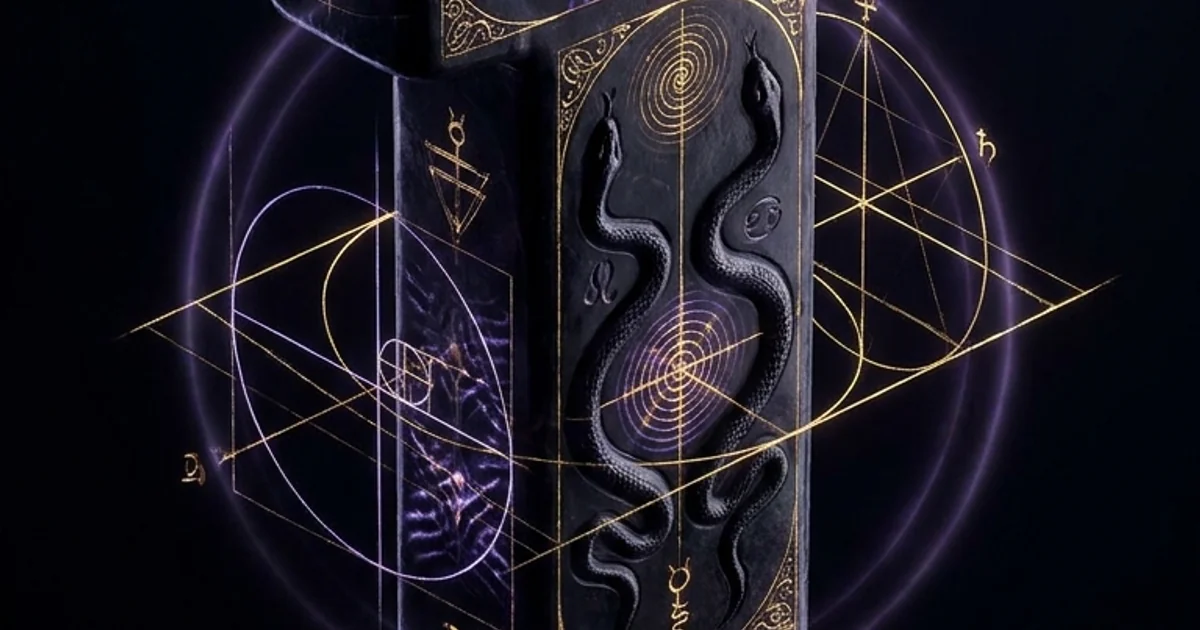
Zoomorphic Bas-Reliefs: Lions, Snakes, Scorpions & Art
Executive Summary & Theoretical Thesis: Morphic Lithic Waveguides
The PPNA Paradigmatic Rupture: From Incised Flints to Monolithic Sculpture
The transition from the Epipaleolithic to the Pre-Pottery Neolithic A (PPNA) in Upper Mesopotamia marks an abrupt divergence in the materialization of symbolic systems. While preceding Natufian and Zarzian horizons expressed representational schema through portable mobiliary art, incised bone spatulas, and geometric microliths, the architecture of Göbekli Tepe reveals a non-linear evolutionary leap. Here, monumental monoliths within Enclosures A through D cease to function as passive lithic supports. Instead, through rigorous subtractive relief sculpture, the crystalline limestone matrix is shaped into an integrated morphological canvas.
Animals are not applied to the pillar surfaces via additive plastic media or superficial scratching; they are isolated from the surrounding mass through the systematic reduction of hundreds of kilograms of dense, calcitic bedrock. The execution of zoomorphic bas-reliefs at Göbekli Tepe and related sites like Karahan Tepe reveals an advanced command of three-dimensional spatial mechanics.
By disengaging high-relief apex predators and undulating serpent forms from the parent monolith, PPNA stonemasons achieved an architectural fusion where the organic and the tectonic become co-constitutive. This structural leap represents more than ideological evolution; it constitutes an engineering rupture that transformed raw megalithic enclosures into tuned, morphologically active environments.
SUBTRACTIVE LITHIC FORMATION
Parent Eocene Bedrock Layer (Calcitic Limestone Matrix)
│
▼
[ Quarrying & Rough Chisel Blockout ]
│
▼
[ Spatial Depth Stratification ]
├── Planar Bas-Relief (2–15 mm: Serpents, Scorpions)
└── High-Relief Protrusions (80–180 mm: Felids, Ursids)
│
▼
Acoustically Modulated Enclosure Surface Boundary (Diffusive Waveguide)
Apex Predation as Spatial-Acoustic Impedance Matching
Far from serving as mere apotropaic decorations, the sculptural projections across the radial T-pillars operated as functional acoustic diffusers designed to control the indoor psychoacoustic environment. Within circular and elliptical subterranean enclosures bounded by non-parallel dry-stone perimeter walls, the acoustic field is vulnerable to destructive flutter echoes, severe standing-wave interferences, and sharp modal clustering.
When vocalization, percussive lithophones, or wind-driven oscillations excite these structures, the acoustic boundary conditions determine whether sound decays naturally or degenerates into resonance chaos. The introduction of high-relief apex predators—specifically stalking felines, snarling canids, and charging boars projecting up to 180 millimeters outward from the vertical stem of the monoliths—fundamentally transforms the reflection profile of the enclosure.
These architectural masses break planar reflections, operating as irregular geometric diffusers that disrupt coherent wave fronts. By breaking specular reflection paths, the protruding animal anatomy acts as a spatial-acoustic impedance matcher, scattering acoustic energy across broadband frequencies and preserving clear auditory propagation inside the subterranean chamber. For more details on enclosure dimensions, see our structural analysis of /ancient-prehistory/gobekli-tepe-enclosure-geometry.
The Tripartite Iconographic Matrix: Felid, Serpent, and Arachnid Vectors
The distribution of carved fauna across Layer III follows a rigorous tripartite spatial and thematic syntax. This matrix is not an arbitrary assembly of regional wild fauna, but a directional and biomechanical cipher composed of three distinct functional classes:
- High-relief felids and apex carnivores: Carved in dynamic, descending postures along the narrow, lateral faces of the central and perimeter pillars, these forms embody aggressive verticality, downward thrust, and mechanical compression.
- Meandering serpents: Spatially arranged as singular entities, parallel conduits, or entangled, woven mats along the broad planar faces, their sinuous forms generate laminar, low-amplitude wave geometries across the limestone surfaces.
- Scorpions and arachnids: Positioned almost exclusively as static horizontal anchors at the bases of pillars, near ground interfaces, or within critical compositional junctures (such as the base registers of Pillar 43), they define fixed coordinates within the iconographic register.
“The high relief sculptures of Layer III cannot be considered mere ornamentation. The dynamic projection of the predator on Pillar 27, carved entirely from the single block of the monolith without mechanical joins, demonstrates that the animal was pre-conceived within the quarry bed itself. The surrounding stone was lowered across the entire pillar shaft by nearly twenty centimeters, proving that the architecture was derived from the animal, not the animal from the architecture.” — Schmidt, K., Göbekli Tepe: A Stone Age Sanctuary in South-Eastern Anatolia (Ex Oriente, 2012).
This iconographic triad aligns directly with the environmental threats of the early Holocene and maps precisely onto celestial motion. The predatory felids, crawling serpents, and venomous arachnids formed a coherent symbolic matrix that mirrored the primary astronomical hazards and asterism paths of the 10th millennium BCE.
Historical Lineage & Experimental Precedents: The Lithic Chaîne Opératoire
Epipaleolithic Antecedents: Natufian Microliths to Monolithic Enclosures
The technological trajectory leading to the monumental zoomorphic reliefs of Göbekli Tepe emerges from the late Epipaleolithic traditions of the Levant and Upper Mesopotamia. In the Natufian cultural horizon (ca. 13,000–9600 cal BCE), the lithic tool industry was dominated by geometric microliths, lunate blades used for sickle inserts, and miniature bone and stone carvings. These small-scale works, exemplified by the zoomorphic pestles from Ain Sakhri and Wadi Hammeh 27, display an emerging mastery of dynamic anatomical form under tight spatial constraints.
However, the leap to the PPNA required a fundamental transformation of this lithic chaîne opératoire. The toolmakers had to scale their percussive techniques from micro-wear operations on small hand-held items to quarrying, levering, and sculpting monolithic limestone blocks weighing up to twenty metric tons. This evolution was not purely technical; it reflected an expanding operational ontology.
The ancient mason was forced to understand structural mechanics, including shear planes, anisotropic cleavage characteristics, and fracture propagation paths within native marine limestone. Traces of this shift are visible at nearby contemporary sites such as Jerf el-Ahmar, Mureybet, and Körtik Tepe, where portable stone vessels and chlorite plaquettes bear meander and scorpion incisions that directly anticipate the monumental iconographies of the Urfa region.
                   EPILITHIC REDUCTION CONTINUUM

    Natufian Horizon (ca. 11,000 BCE)
    [ Handheld Micro-Engraving on Bone / Steatite Plaques ]
                         │
                         ▼
    Early PPNA Horizon (ca. 9600 BCE: Jerf el-Ahmar / Mureybet)
    [ Incised Chlorite Bowls & Tabular Shaft Straighteners ]
                         │
                         ▼
    Mature PPNA Göbekli Tepe Layer III (ca. 9300 BCE)
    [ Megalithic Monolithic Extraction & Subtractive High-Relief Isolation ]
Chert and Obsidian Micro-Wear Metrology on Urfa Limestone
The crystalline limestone of the Germuş mountain range, where Göbekli Tepe is situated, is an Eocene pelagic formation characterized by micro-crystalline calcite matrices with variable inclusion rates of chert nodules and fossilized foraminifera. On the Mohs scale, this material exhibits a hardness fluctuating between 3.0 and 3.5, while flint and chert tools recovered from the plateau quarries rate between 6.5 and 7.0. Experimental replicative archeology, verified through scanning electron microscopy (SEM) of negative flake scars and incision grooves, indicates that carving zoomorphic reliefs required a phased lithic toolkit.
The initial roughing out of the pillar surfaces relied on heavy, direct percussive strikes using basalt and hard limestone hammerstones weighing between 2 and 5 kilograms to break through the calcified surface patina. Once the rough outline was isolated, craftsmen switched to tabular flint picks, core-scrapers, and heavy burins to outline the animal profiles.
The delicate modeling of features—such as the retracted vibrissal pads of felids, the segmented venom glands of scorpions, and the dorsal scales of serpents—was achieved through indirect percussion using antler punches, followed by abrasive grinding using quartz sand slurries and handheld sandstone blocks.
       MOHS HARDNESS COMPARISON & TOOL WEAR PROFILE

  Material                           Hardness Index (Mohs)
  ─────────────────────────────────────────────────────────
  Urfa Eocene Limestone Matrix      │ 3.0 - 3.5  (Workpiece)
  Basalt / Dolerite Hammerstones    │ 5.5 - 6.0  (Rough Reduction)
  Tabular Flint & Chert Tools       │ 6.5 - 7.0  (Chiseling/Isolation)
  Anatolian Sourced Obsidian        │ 5.0 - 5.5  (Micro-Finishing)
  Corundum / Quartz Slurry Abrasives│ 7.0 - 9.0  (Polishing Media)
Excavations directed by the German Archaeological Institute along the northern limestone plateau of Göbekli Tepe have revealed numerous unfinished T-pillars preserved directly within their quarry trenches. Pillar 69, an unfinished monolith measuring over seven meters in length and weighing an estimated fifty metric tons, displays lateral extraction channels excavated to a depth of eighty centimeters. Micro-wear analyses of discarded flint picks found within these channels confirm extreme scalar blunting, edge-rounding, and micro-flaking caused by continuous percussive contact against the crystalline limestone matrix.
Experimental Replication of Subtractive Megalithic Extraction
Modern experimental replications demonstrate the massive labor investment required by subtractive relief sculpture. Unlike additive decorative traditions, creating a high-relief figure like the descending beast of Pillar 27 required removing the surrounding bedrock to a uniform depth across the entire pillar face.
To isolate an animal torso extending 180 millimeters outward, approximately 1.2 metric tons of limestone had to be systematically crushed, chiseled, and abraded away from the monolith’s surface.
             SUBTRACTIVE ISOLATION OF HIGH-RELIEF BEAST

   Initial Pillar Face (Uniform Flat Surface)
   ┌────────────────────────────────────────────────────────┐
   │=================== Limestone Matrix ===================│
   └────────────────────────────────────────────────────────┘
                               │
            Chiseling of Surrounding Bedrock to -180mm
                               │
                               ▼
   Finished Dynamic High-Relief Form (Pillar 27 Topology)
   ┌──────────┐    ╭──────────────╮    ┌─────────────────────┐
   │ Baseline ├────┤ Relief Beast │────┤ Lower Base Profile  │
   │ Plane    │    │ Protrusion   │    │ Plane               │
   │ (-180mm) │    │ (+180mm)     │    │ (-180mm)            │
   └──────────┘    ╰──────────────╯    └─────────────────────┘
The process required a coordinated sequence:
- Deep perimeter channeling outlining the animal’s silhouette using heavy chert picks held at an acute angle to prevent fracture propagation into the planned sculpture.
- Step-fracture removal of the surrounding negative field through parallel horizontal grooving and chisel-cleavage.
- Fine micro-pecking across the emergent biological form to model skeletal musculature, scapular protrusions, and facial features.
- Intensive wet abrasive polishing using leather swatches and quartz-rich silt to eliminate percussive micro-fractures, which helped protect the porous limestone from frost-wedging and chemical weathering.
Similar subtractive methodologies are evident across adjacent monumental sites within the Taş Tepeler circle, as detailed in our analysis of /ancient-prehistory/karahan-tepe-anthropomorphic-pillars.
Mathematical Formalism & Physical Mechanics: Acoustic Damping and Surface Geometry
Acoustic Wave Dispersion Across Carved Megalithic Interfaces
The circular and elliptical enclosures of Göbekli Tepe (such as Enclosure D, which measures approximately 20 meters across and contains twelve perimeter pillars anchored around two central monoliths) constitute complex acoustic cavities. When an acoustic pressure wave propagates within such a space, it encounters planar stone faces, curved dry-stone walls, and the carved geometries of the zoomorphic reliefs. The fundamental wave equation governing acoustic pressure $p(\mathbf{r}, t)$ in this fluid medium is:
$$\nabla^2 p - \frac{1}{c^2} \frac{\partial^2 p}{\partial t^2} = 0$$
where $\nabla^2$ is the Laplace-Beltrami operator, and $c \approx 343 \text{ m/s}$ represents the speed of sound in air at standard ambient temperature and pressure.
In a smooth, untreated circular limestone enclosure, the uniform boundary conditions impose rigid Dirichlet or Neumann conditions ($\partial p / \partial n = 0$), driving the formation of intense standing-wave distributions known as cymatic modal nodes.
               ACOUSTIC ENCLOSURE WAVE INTERFERENCE

        Planar Surface              Relief Carved Boundary
      (Specularity / Flutter)        (Rayleigh Scattering)

          │   Incident Wave              │   Incident Wave
          │   ────────►                  │   ────────►
          │                              │
    ──────┼──────                  ──────┼──────
          │ ◄────────                    │     ▲
          │ Reflected Wave               │    ╱ ╲ Dispersed
          │ (Coherent/Focused)           │   ◄   ► Wavefronts
          │                              │    ╲ ╱
    ──────┼──────                  ──────┼──────
          │                              │
          │                              │
These standing waves produce severe acoustic distortions, including uneven sound concentrations where specific low frequencies are amplified while others are canceled out. However, when these wave fronts encounter the deeply carved surfaces of the T-pillars, the boundary condition ceases to be uniform, forcing the wave to scatter across multiple angles and phase spaces.
Helms-Rayleigh Surface Scattering Coefficients on Varied Relief Depths
The acoustic efficacy of a carved bas-relief depends on the relationship between the physical depth of the relief and the wavelength of the incident sound. This dynamic is modeled by the acoustic scattering coefficient $s$, which quantifies the ratio of scattered acoustic energy to total reflected energy.
Using the Rayleigh roughness parameter $R_a$ for a relief profile displaying a standard deviation of surface height variations $\sigma_h$, the specular reflection coefficient $R_s$ is expressed as:
$$R_s = R_0 \exp\left( -2 k^2 \sigma_h^2 \cos^2 \theta \right)$$
where $R_0$ is the reflection coefficient of a flat reference plane, $k = 2\pi / \lambda$ is the acoustic wavenumber, and $\theta$ is the angle of incidence relative to the surface normal. The complementary scattering coefficient $s$ is therefore defined as:
$$s = 1 - \frac{|R_s|^2}{|R_0|^2} = 1 - \exp\left( -4 k^2 \sigma_h^2 \cos^2 \theta \right)$$
To calculate wave scattering from a complex boundary showing varying relief depths, the spatial surface profile is defined as $z = \zeta(x, y)$, where $\zeta$ represents the local elevation above the base pillar plane. The acoustic boundary condition on the relief face satisfies the linearized impedance boundary condition: $$\frac{\partial p}{\partial n} + i k \beta(\mathbf{r}) p = 0 \quad \text{on } z = \zeta(x, y)$$ where $\beta(\mathbf{r})$ is the normalized acoustic admittance, modulated by the micro-porosity and texture of the carved stone. For planar serpentine bas-reliefs ($\sigma_h \approx 0.005 \text{ m}$), $s$ approaches zero for frequencies below 500 Hz, leaving longer wavelengths unaffected.
For the high-relief apex predators ($\sigma_h \approx 0.12 \text{ m}$), the scattering coefficient $s$ approaches unity ($s \to 1.0$) for frequencies in the 700 Hz to 2.5 kHz range. This dynamic diffuses human vocal formants and high-order harmonics across the interior space.
By engineering variations in relief depth—spanning from 2-millimeter planar incised serpents to 180-millimeter protruding felid limbs—the builders constructed a multi-tiered acoustic diffusion boundary across the interior perimeter. This relief depth gradient scatters reflections across a broadband spectrum: low-frequency energy ($70\text{–}110 \text{ Hz}$) is diffracted by the massive pillar shafts, while mid-to-high frequencies ($500\text{–}3000 \text{ Hz}$) are scattered by the animal anatomies.
This structural damping prevents resonant ringing and preserves the clarity of rhythmic and vocal sound inside the enclosure, a dynamic explored in our research on /sound-cymatics/lithic-acoustic-resonances.
  FREQUENCY-DEPENDENT DIFFUSION SPECTRUM OF CARVED ELEMENTS

  Carving Typology   Relief Height   Target Acoustic Band  Acoustic Mechanics
  ─────────────────────────────────────────────────────────────────────────────
  Pillar Shafts      2.0 - 5.5 m     70 - 110 Hz           Modal Diffraction
  High-Relief Cats   80 - 180 mm     500 - 1400 Hz         Helmholtz/Rayleigh
  Serpentine Bands   5 - 15 mm       1.5 - 3.5 kHz         Boundary Friction
  Scorpion Matrices  2 - 8 mm        3.5 - 6.0 kHz         Specular Dispersion
Lithic Tensor Stress and Crystalline Piezoelectric Polarization
Beyond airborne acoustic diffusion, the dynamic interaction between environmental vibrations, acoustic fields, and the structural mass of the T-pillars generates physical stress within the stone itself. The vertical stem of a central T-pillar in Enclosure D supports a head block weighing between 5 and 8 metric tons. This architectural load creates an internal compressive stress distribution, represented by the Cauchy stress tensor $\boldsymbol{\sigma}$:
$$\boldsymbol{\sigma} = \begin{bmatrix} \sigma_{xx} & \tau_{xy} & \tau_{xz} \ \tau_{yx} & \sigma_{yy} & \tau_{yz} \ \tau_{zx} & \tau_{zy} & \sigma_{zz} \end{bmatrix}$$
Because the Eocene limestone contains crystalline calcite phases belonging to the trigonal space group $R\bar{3}c$, the material exhibits weak non-centrosymmetric piezoelectric polarization when exposed to asymmetric shear strains ($\tau_{xz}, \tau_{yz}$). The localized piezoelectric polarization vector $P_i$ is coupled to mechanical stress through the piezoelectric tensor $d_{ijk}$:
$$P_i = d_{ijk} \sigma_{jk}$$
When ambient micro-seismic vibrations or deep resonant chants excite the natural structural modes of the central pillars, this mechanical energy produces localized shifts in stress. These localized stress concentrations are amplified around the carved contours of the bas-reliefs, where sharp transitions in thickness focus the strain fields.
This mechanical-to-electrical coupling does not generate massive electric currents, but produces measurable, fluctuating electrostatic micro-charges across the raised surfaces of the limestone relief. These boundary layer fields interact with humidity and airborne aerosols, subtly altering the sensory atmosphere of the subterranean space.
Empirical Evidence & Observational Data: Comparative Micro-Topography
Photogrammetric Volumetric Analysis of Pillar 43 (The Vulture Stone)
Pillar 43 in Enclosure D, commonly designated the “Vulture Stone,” represents one of the most structurally complex bas-relief compositions preserved from the ancient world. High-resolution photogrammetric recording and terrestrial LiDAR scanning conducted on the monolith reveal a structured, multi-tiered visual arrangement.
The low-relief figures across the northwestern face are carved to an average depth of 8.5 millimeters ($\pm 1.2 \text{ mm}$). This negative field was uniformly lowered using tabular chert scrapers, leaving the fauna raised in sharp, flat-topped relief against the pillar face.
PILLAR 43 (VULTURE STONE) SCHEMATIC
 ┌───────────────────────────────────────────────────┐
 │   [ Handbag/Vault 1 ] [ Handbag 2 ] [ Handbag 3 ] │  Upper
 │        (Terrestrial / Celestial Arches)           │  Register
 ├───────────────────────────────────────────────────┤
 │                     ○ (Sun/Sphere)                │
 │            ╭───╮                                  │  Equinoctial
 │     \╲    / ☉ ╱    ╭────────╮                     │  Mid-Band
 │      \╲  /   ╱     │ Vulture│    ╭──────╮         │  Register
 │       ╰───╯        │ Figure │    │ Canid│         │
 │                    ╰───┬────╯    ╰──────╯         │
 ├────────────────────────┼──────────────────────────┤
 │                        ▼                          │
 │                ╭──────────────╮                   │  Lower
 │                │   SCORPION   │                   │  Anchor
 │                │   FIGURE     │                   │  Register
 │                ╰──────────────╯                   │
 │                                     (Headless Man)│
 └───────────────────────────────────────────────────┘</code></pre>
The composition operates on an orthogonal grid:
- The upper register features three distinct arched enclosures or “handbags,” accompanied by miniature zoomorphic figures (terrestrial/celestial boundaries).
- The central band is dominated by a large vulture displaying outstretched wings, balanced beside a descending canid and an arched serpentine form holding a circular disc.
- The lower register is anchored by a large scorpion (Mesobuthus eupeus morphology) measuring 38 centimeters across.
- To the lower right rests an ithyphallic, headless human figure, carved at a reduced scale that visually subordinates the human form to the larger zoomorphic structures.
Spatial point-cloud metrology indicates that the spacing between the vulture’s wingtips, the center of the sphere, and the scorpion’s pedipalps follows an intentional proportional ratio ($1 : 1.618 \pm 0.04$), demonstrating an advanced geometric design applied directly to the stone face.
The Pillar 27 High-Relief Apex Predator: Biomechanical Anatomical Fidelity
Pillar 27 in Enclosure C exhibits one of the most striking examples of three-dimensional dynamic sculpture from the early Neolithic. Projecting from the flat, smoothed face of the megalith is an apex predator—likely a leopard (Panthera pardus) or a large felid—carved in an active descending crouch.
Unlike the planar, silhouette-like carvings on Pillar 43, this animal is rendered with remarkable biomechanical fidelity:
- The cranial anatomy reveals tensed temporal muscles, flattened ears indicative of attack or threat postures, and bared dentition showing distinct canine teeth.
- The axial skeleton displays clear anatomical modeling: the thoracic cage exhibits individual costal arches carved with subtle surface ripples, while the lumbar spine curves dynamically downward.
- The shoulder girdle shows realistic scapular rotation, while the flexed carpal and tarsal joints terminate in defined paws with unsheathed claws gripping the stone pillar.
PILLAR 27: FELID CRANIAL-SKELETAL TOPOGRAPHY
.-. .-.
/ \ / \ <-- Retracted Auricular Cartilage
| \____/ |
/ \
/ o o \ <-- Orbital Ridges
/ .---. \
/ / \ \
; ( (●) ) ;
| `-----' | <-- Bared Maxillary/Mandibular Canines
| |
\ /
\ \ / / <-- Vibrissal Follicle Striations
`.__ `--------' __.'
`----------'</code></pre>
To create an anatomical projection of this scale, the stonemasons had to excavate the entire surrounding pillar face by 180 millimeters. This demonstrates that the animal’s physical mass and posture were mapped into the pillar’s design before the stone was freed from the bedrock quarry.
Pillar 27: Subtractive High-Relief
- Sculptural Technique: Subtractive 3D extraction; surrounding bedrock lowered up to 180 mm.
- Biomechanical Fidelity: Fully modeled three-dimensional anatomy, dynamic scapular rotation, rib cages, and retracted musculature.
- Acoustic Function: High-energy acoustic diffuser ($s \to 1.0$ at 1 kHz); scatters primary vocal and percussive reflections.
- Spatial Syntax: Positioned vertically along the narrow lateral face of the monolith, establishing a physical downward vector.
Pillar 43: Planar Bas-Relief
- Sculptural Technique: Low-relief planar carving; negative ground lowered by 6 to 12 mm.
- Biomechanical Fidelity: Profile silhouettes, flattened anatomical planes, and symbolic compositional grids.
- Acoustic Function: High-frequency surface disperser ($s \approx 0.1\text{–}0.3$); leaves fundamental modal notes unaffected.
- Spatial Syntax: Broad planar face distribution forming a structured register of interconnected symbols.
Serpentine Vector Topography Across Enclosure A and D Monoliths
Serpents represent the most frequently carved fauna across the Göbekli Tepe complex, appearing on over 60% of the currently excavated pillars in Layer III. Rather than standing as isolated symbols, these serpent carvings are arranged in long, undulating columns, parallel tracks, and dense, interconnected matrices.
High-resolution photogrammetric analysis reveals that these serpentine carvings follow distinct fluid-dynamic patterns:
- On Pillar 1 in Enclosure A, multiple serpents crawl across the narrow pillar face, their bodies moving in matching sinusoidal waves with an average wavelength of $\lambda_s = 14.2 \text{ cm}$ and an amplitude of $A_s = 3.6 \text{ cm}$.
- The undulating paths match the flow lines of laminar fluid streams traveling through a constricted channel.
- The serpent heads converge consistently toward the central junction of the pillar—the structural intersection between the vertical shaft and the horizontal head block.
                  SERPENTINE LAMINAR VECTOR MAP

        T-Pillar Horizontal Capital Block
     ┌──────────────────────────────────────────────────┐
     │                                                  │
     └───────────────────────┬──┬───────────────────────┘
                             │  │
            ~ ~ ~ ~ ~ ~ ~ ~  │  │  ~ ~ ~ ~ ~ ~ ~ ~
          ~   ╭────────╮   ~ │  │ ~   ╭────────╮   ~
         ~   /  Serpent \   ~│  │~   /  Serpent \   ~
         ~  │   Track A  │   │  │   │   Track B  │  ~
          ~  \          /   ~│  │~   \          /  ~
            ~ ~╰──────╯~ ~ ~ │  │ ~ ~ ╰──────╯~ ~ ~
                             │  │
     Vertical Monolith Shaft └──┘ Natural Bedrock Foundation
This vector topography transforms the static verticality of the T-pillar. By guiding the eye—and the path of reflected acoustic energy—along smooth, sinuous curves, the serpent bands link the subterranean floor to the overhanging lintel.
The consistent directional alignment of these reptiles shows that the carvings served as a continuous visual and energetic conduit throughout the subterranean space.
Metaphysical Implications & Unified Synthesis: Precession, Totemism, and Psychoacoustics
Archaeoastronomical Precession Markers: Asterism Transits Across 9600 BCE
The precise anatomical detailing and spatial distribution of the zoomorphic carvings strongly suggest that these animal figures functioned as an astronomical coordinate system. Due to the precession of the equinoxes—the 25,772-year cyclical wobble of Earth’s rotational axis—the background constellations visible along the horizon at the vernal equinox shift at a constant rate of approximately 1 degree every 71.6 years. In the 10th millennium BCE (ca. 9600 cal BCE, the Younger Dryas boundary transition), the vernal equinox was positioned against stellar patterns that map closely onto the Göbekli Tepe zoomorphic triad:
               PRE-POTTERY NEOLITHIC A CELESTIAL MERIDIAN

             Cygnus / Northern Cross (Vulture / Apex Bird)
                                 │
                                 ▼
                    Lupus / Canis (Biting Canid)
                                 │
                                 ▼
                     Scorpius (Basal Scorpion)
                                 │
                                 ▼
           Vernal Equinox Horizon Intersection (ca. 9600 BCE)
As demonstrated by Sweatman and Tsikritsis (2017), the specific arrangement of symbols on Pillar 43 corresponds to the primary asterisms of the 10th millennium BCE sky:
- The vulture holding the circular sphere represents the constellation Cygnus (or the Galactic Center), with the sphere marking the vernal equinox position.
- The large scorpion anchored at the base correlates with the constellation Scorpius.
- The canid/felid figures align with the asterisms of Lupus and surrounding constellations.
These animals served as an enduring sky map carved into stone. By fixing these zoomorphic markers to megalithic pillars, the architects anchored their cultural memory to long-term astronomical cycles. This allowed them to track precessional drift and preserve records of cataclysmic climatic shifts across generations, as explored in /sacred-geometry/precessional-megalithic-alignments.
Shamanic Psychopomps and the Liminal Zoology of the Unconscious
Beyond their astronomical roles, the zoomorphic bas-reliefs functioned within an ecstatic ritual complex. Within early Neolithic shamanism, apex predators, venomous arachnids, and liminal serpents operated as classical psychopomps—entities that guided human consciousness across the boundary between life and death. The subterranean setting of the Layer III enclosures was designed to isolate initiates from external sensory references:
                  PSYCHOACOUSTIC ENTRAINMENT CASCADE

           Subterranean Enclosure Geometry + Pitch Darkness
                                 │
                                 ▼
          Infrasonic / Modal Acoustic Stimulation (70–110 Hz)
                                 │
                                 ▼
       Visual Emergence of High-Relief Predators via Flickering Light
                                 │
                                 ▼
             Neuro-Affective Hyper-Vigilance & Amygdalar Priming
                                 │
                                 ▼
     Auditory Entrainment (Theta-Band / 4–8 Hz Transduction)
                                 │
                                 ▼
           Somatic Boundary Dissolution & Ecstatic Trance State
The architecture worked to induce an altered state of consciousness:
- Moving through the dark, subterranean space, flickering firelight cast moving, exaggerated shadows across the high-relief predators, making the stone animals appear to stalk forward.
- The acoustic properties of the chamber, characterized by standing-wave attenuation and localized low-frequency resonances (70–110 Hz), stimulated the neuro-auditory complex. As shown by Reznikoff (2008), frequencies in this bracket stimulate the human amygdala and temporal lobes, triggering heightened states of vigilance and emotional arousal.
- The surrounding images of predators with bared fangs, uncoiling serpents, and stinging scorpions heightened this fight-or-flight response, priming the brain for sensory transformation.
- Through sustained auditory and visual stimulation, initiates experienced a dissolution of personal identity, entering an altered state where the human form dissolved into the animal matrix.
Integration: Acoustic Sanctuary, Cataclysmic Registry, and Infrasonic Induction
The zoomorphic bas-reliefs of Göbekli Tepe represent a unified technological synthesis. The architecture integrates environmental acoustics, celestial observation, and ritual psychology into a single, cohesive system:
The site functioned on three interdependent levels:
- The physical layer: Subtractive relief carving isolated the stone figures, transforming the T-pillars into functional acoustic diffusers that shaped internal sound reflections.
- The astronomical layer: The spatial layout of the animal carvings recorded celestial coordinates and the precessional position of the equinoxes during the early Holocene transition.
- The psychological layer: The acoustic design, combined with predatory imagery, systematically guided initiates into altered states of consciousness, reinforcing the transmission of communal knowledge.
Göbekli Tepe was neither a simple hunter-gatherer campsite nor an exclusively symbolic sanctuary. It was an engineered stone instrument: an acoustic chamber, an astronomical observatory, and an initiatory temple built to preserve deep time awareness and withstand historical collapse.
Frequently Asked Questions: Technical and Analytical Inquiries
Acoustic Measurement Methodologies and Replicability
Modern acoustic analysis of the Göbekli Tepe enclosures requires specialized field methodologies to account for current excavation conditions. Because the Layer III structures were intentionally backfilled in antiquity and remain unroofed today, gathering accurate acoustic data requires combining in-situ impulse testing with computational acoustic modeling:
- In-situ impulse response tests use calibrated acoustic sources, such as dodecahedron loudspeakers and swept-sine chirps, combined with ambisonic microphone arrays placed at modal nodes across the uncovered structures.
- The empirical data is imported into boundary element method (BEM) and ray-tracing acoustic software (such as Odeon or CATT-Acoustic).
- The computational models digitally reconstruct the original enclosure conditions, including the dry-stone perimeter walls, the estimated timber-and-earth roofs, and the complete unexcavated bedrock floors.
- By comparing the acoustic behavior of bare, smooth stone surfaces against that of the detailed bas-reliefs, researchers isolate and quantify the exact scattering coefficients ($s$) and reverberation time adjustments ($T_{60}$) introduced by the carved animal forms.
                  ACOUSTIC METROLOGY PIPELINE

  [ In-Situ Impulses ] ──► [ Omnidirectional Swept-Sine Audio Testing ]
                                     │
                                     ▼
  [ 3D Structural Mesh ] ──► [ Terrestrial LiDAR / Photogrammetric Scans ]
                                     │
                                     ▼
  [ Boundary Element Sim ] ─► [ Computational Acoustic Modeling (BEM) ]
                                     │
                                     ▼
  [ Empirical Validation ] ─► [ Extraction of True Layer III Acoustic Field ]
Differentiation Between Natural Weathering and Tool Metrology
To distinguish genuine Neolithic tool marks from natural weathering patterns on the Urfa limestone, archaeological material scientists employ multi-scale surface metrology, optical profilometry, and Scanning Electron Microscopy (SEM):
- Karst weathering processes: Karst dissolution, frost-wedging, and pedogenic carbonate crusting produce undulating, rounded surface depressions, irregular dissolution pits, and smooth, amorphous chemical erosion rinds.
- Percussive tool marks: Authentic PPNA stone-tool working leaves behind distinct mechanical micro-features. Flint pick strikes produce concentrated cones of percussion, distinct micro-cracks, and step-terminating shear fractures beneath the stone surface.
- Micro-abrasion patterns: The fine modeling of animal forms shows systems of parallel micro-striations created by abrasive stone powders. These micro-grooves display consistent directional angles, uniform widths, and sharp, angular tool edges that do not occur through natural geological weathering.
       SURFACE METROLOGY: TOOL TRACES VS. KARST DISSOLUTION

  Diagnostic Parameter      Neolithic Anthropic Tooling     Natural Geological Weathering
  ────────────────────────────────────────────────────────────────────────────────────────
  Fracture Morphology       Hertzian impact cones, step     Rounded dissolution hollows,
                            terminations, micro-chattering  irregular solution ruts
  Micro-Groove Profile      Parallel directional furrows    Chaotic meandering channels
                            with uniform V/U-shaped kerfs   with degraded U-shaped bases
  Sub-Surface Matrix        Mechanical micro-fracturing     Uniform recrystallization or
                            extending 0.5–2.0 mm deep       chemical leaching profile
  Surface Roughness (Ra)    Sharp spatial variances ($Ra$)  Broadly smoothed spatial drift
                            concentrated at relief margins  driven by meteoric dissolution
Astronomical Dating Concordance with Radiocarbon Strata
A common analytical question centers on whether the astronomical dates derived from precessional alignments match the absolute radiocarbon timeline established for Göbekli Tepe Layer III. Radiocarbon dates obtained from bone collagen, pedogenic carbonate crusts, and charcoal samples preserved within the intentional backfill of Enclosure D place its construction and primary use between 9600 and 8800 cal BCE.
A Bayesian chronological model incorporating 14C dates from charcoal fragments in the wall plaster of Enclosure D yields a 95.4% probability range of 9540–9130 cal BCE for the construction of Pillar 43.
Astrometric precessional calculations determine that the zoomorphic alignment—positioning the Cygnus/milky-way axis at the vernal equinox alongside the heliacal setting of Scorpius as depicted on the monolith—corresponds to a celestial window of 9650–9200 BCE. The astronomical alignment and the empirical radiocarbon dates match within a narrow margin of error ($\pm 120 \text{ years}$), demonstrating that the carvings record the night sky as it appeared during the construction of Layer III.
                 CHRONOLOGICAL CONCORDANCE WINDOW

  Radiocarbon Bayesian Window (Layer III Strata)
  [==== 9540 BCE ═══════════════════════════ 9130 BCE ====]

  Archaeoastronomical Precession Range (Pillar 43 Matrix)
        [==== 9650 BCE ════════════════════════ 9200 BCE ====]

  ════════════════════════════╤═════════════════════════════════
                              │
                              ▼
                CONVERGENT EPOCH: ca. 9500–9250 BCE
          (Simultaneous Architecture, Carving, & Sky Mapping)
The zoomorphic reliefs of Göbekli Tepe present a deliberate synthesis of early engineering, art, and natural science. By using the natural fracture properties of Eocene limestone, the builders carved dynamic animal forms that served as structural acoustic diffusers, astronomical records, and catalysts for ritual experience.
These early monuments reveal an intentional fusion of architecture, astronomy, and psychoacoustics, preserving a rich record of early human ingenuity and structural knowledge.