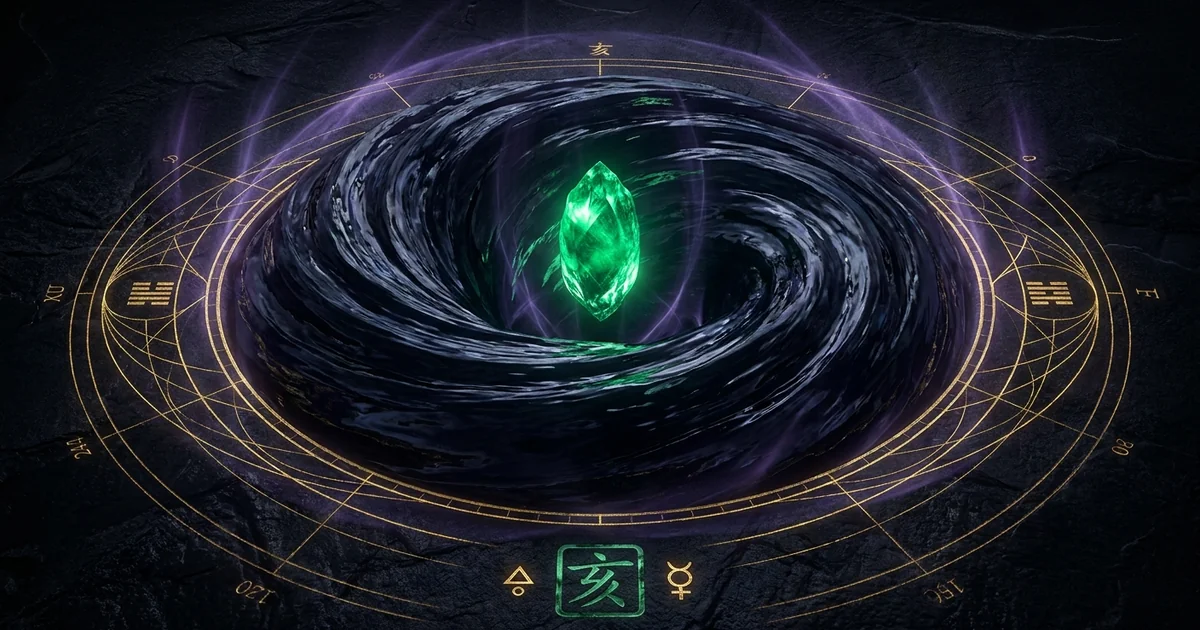
Earthly Branch Pig: Chinese Zodiac Water Yin - Guide
Archetypal Thesis & Systemic Paradigm: Hai as the Gestational Abyss
The Dodecanary Omega: Energetic Involution and the Twelfth Sector
Within the mathematical architecture of Chinese chronometry, the twelfth Earthly Branch, Hai (亥)—conventionally mythologized in exoteric culture as the Pig—occupies the terminal coordinate of the dodecanary sequence. Far from designating an inert terminus or an ontological void, Hai represents the point of maximum thermodynamic and psychic involution. In the cosmological engine of the 12 earthly branches systemic guide, the progression through the branches maps the cyclical expansion and contraction of Qi across space and time. Where its polar predecessor Si (巳, the Snake) marks the apex of solar externalization and radiant Yang dispersal, Hai constitutes the structural horizon where dynamic outward movement collapses inward, undergoing compaction into an ultra-dense, potentialized state of latent preservation.
To apprehend Hai strictly as an end-state is to misinterpret the fundamental non-linear cyclicity of Taoist cosmology. In the systemic framework of chronobiology and cosmic cycles, the twelfth sector functions as a gestational womb. The visible universe recedes into silence; macroscopic kinetic expenditure ceases so that the interior substrate of life may be shielded from entropic degradation. The archetypal energy of Hai operates as a cold, oceanic sanctuary—an entropic terminal that simultaneously executes the systemic reset of the entire energetic continuum. It is the systemic compost of the macrocosm, gathering the exhausted particulate of the prior eleven branches and dissolving their crystallized identities within a dark, highly pressurized solvent.
Within this state-space representation, Hai preserves the irreducible quantum of information necessary to reboot the cosmological program. The apparent quiescence of this sector conceals an intensely active computational process: the sorting, filtration, and subterranean re-alignment of fundamental forces. This dynamic reflects the deepest operational axioms of Chinese metaphysics: true rest is never passive stasis, but the deliberate, highly concentrated preparation for genesis. The twelfth branch is thus the dark sea of potentiality from which all form must inevitably re-emerge.
The Paradox of Water Yin Polarity: External Receptivity and Internal Propulsion
The classification of Hai within the five-phase wu xing dynamics introduces an immediate systemic paradox known to classical scholars as the divergence between structural essence (Ti, 體) and dynamic application (Yong, 用). Superficially, Hai is designated as a branch of the Water element governed by Yin polarity. This categorization stems directly from its position as an even-numbered station (twelve) within the sexagenary counting framework, as well as its seasonal correspondence with the commencement of winter, when the terrestrial mantle yields entirely to freezing contraction, darkness, and receptive receptivity.
- Zodiacal Animal Correlate: Pig (猪, Zhu)
- Seasonal Coordinate: Tenth Lunar Month (Meng Dong, Mengdong 孟冬); Early Winter (Solar Terms: Li Dong [立冬] through Xiao Xue [小雪], terminating at Da Xue [大雪])
- Diurnal Chronobiological Station: 21:00 – 23:00 (Hai Hour / Pig Double-Hour)
- Spatial Direction / Azimuth: 330° to 345° (North-Northwest Sector; transitioning toward true North)
- Internal Hidden Stems (Cang Gan):
- Primary Qi: Ren Water (壬, Yang Water) at 70% dignified field density
- Residual / Nascent Qi: Jia Wood (甲, Yang Wood) at 30% dignified field density
- Structural Polarity Paradigm: Structural Yin (Ti / Even Rank) containing Functional Yang (Yong / Pure Yang Hidden Stems)
However, rigorous deconstruction of its internal hidden stems (Cang Gan, 藏干) reveals that the interior of Hai is devoid of Yin substances. Beneath its Yin exteriority churns Ren Water (壬水)—the titanic, restless, and unbound oceanic surge of Yang Water—alongside an embryonic ignition of Jia Wood (甲木), the primal spark of Yang Wood. Consequently, while the branch exhibits absolute stillness and yielding darkness on the phenomenological surface, its noumenal interior is characterized by volatile, forward-thrusting Yang vector mechanics.
This dual architecture renders the Pig branch an engine of tremendous hydraulic force. It does not mirror the stagnant, localized depth of a frozen tarn; rather, it functions like the profound abyssal currents of the pelagic zone, which circulate heat, vital nutrients, and kinetic torque beneath miles of unbroken ocean ice. The Yin polarity of Hai is an externalized membrane—a heavy cloak of containment—that prevents the premature explosion of its internal Yang kinetic drives. Without this containment, the nascent Wood within would freeze, and the surging Water would dissipate into chaotic flooding.
Topographical Mapping: The North-Northwest Gate of Heaven (Qian-Kan Cusp)
In terrestrial cartography and spatial metaphysics, Hai is localized within the North-Northwest quadrant, occupying an exact directional azimuth between 330° and 345°. In the structural geometry of the Later Heaven Bagua (Hou Tian Ba Gua), this precise topographical zone forms the liminal threshold between the Qian (乾, Heaven) trigram and the Kan (坎, Water) trigram. In classical esoteric lore, this boundary is recognized as the Tian Men (天門)—the Northwest Gate of Heaven.
The spatial positioning of Hai across this boundary imbues the branch with profound psycho-spiritual significance. Qian represents the realm of pure metaphysical law, archetypal ideation, crystalline structure, and paternal authority. Kan represents the plunging descent into the chthonic abyss, the instinctual substrate of the unconscious, and the perilous, shape-shifting realm of dynamic emotion. Situated at this threshold, Hai operates as the structural canal through which celestial archetypes descend into subterranean materialization. It is the precise coordinate where the abstract mind of Heaven steps down its energetic voltage to inhabit the primordial water of human incarnation.
The geographic and directional orientation of Hai governs those liminal hours of the night (21:00 to 23:00) when social structures dissolve and the conscious ego surrenders its executive functions to the somatic underworld of sleep. Psychologically and topographically, Hai stands guard over the edge of the known cosmos. It is the border fortress where human civilization ends and the wild, unmapped expanse of the ancestral ocean begins. To navigate this sector within four-pillars bazi mechanics is to stand at the precipice where structured reality dissolves into pure, undifferentiated potential.
Classical Provenance & Textual Lineage: From Oracle Bones to Zi Ping Epistemology
Shang-Zhou Epigraphy and the Astral Geometry of the Northern Dipper
The orthographic genealogy of the character Hai (亥) demonstrates that the branch was decoupled from mundane livestock imagery in its esoteric origins. Shang Dynasty oracle bone epigraphy depicts Hai not as a porcine creature, but as a dual-stroke glyph representing either a swollen human embryo curled within the gestational fluid, or a foundational horizontal support beam cross-braced against entropic collapse. Archaic bronze script variants further emphasize this structural meaning: two horizontal lines crossed by two oblique strokes, representing the radical separation and subsequent re-binding of Heaven and Earth at the terminal axis of the temporal loop.
The conflation of Hai with the domestic pig (Zhu, 猪) was a later exoteric mnemonic formalized during the late Warring States and Han Dynasty consolidations, most visibly popularized in Wang Chong’s (王充) rationalist critique, the Lunheng (論衡, c. 80 CE). Folk astrologers seized upon the pig’s symbolic associations with voracious appetite, reproductive fecundity, and indifferent immersion in muck to explain the branch’s behavioral nuances. Yet in sacred cosmology, the branch remained bound to the celestial movements of Tian Gang (天罡)—the structural handle of the Northern Dipper (Beidou, Ursa Major). As the Dipper swept across the celestial sphere, its orientation toward the Hai azimuth during the tenth lunar month marked the precise cosmological moment when the terrestrial Qi retreated into the deep marrow of the earth, signaling the death of the agrarian cycle and the ascension of the subterranean forces.
Shang-Zhou Archaic Glyphs:
  [Embryonic Coiling / Cross-Brace Architecture]
                        │
                        ▼
Warring States / Han Consolidation:
  [Astral Dipper Synchronization: North-Northwest Azimuth]
                        │
                        ▼
Exoteric Mnemonic Adaptation:
  [The Porcine Zoological Mask (Pig)]
Classical initiates understood that Hai was not a biological pig, but an astral gate. The porcine metaphor persisted because the pig represents an animal that transforms refuse, decayed matter, and visceral waste into sustained physical mass—a biological recapitulation of the Hai function, which transmutes the entropic waste of the preceding cycle into the dense fertile ground of the future.
The Huainanzi Cosmological Engine and Spatialization of the Branches
The foundational codification of the branches as an interlocking energetic field is crystallized in Chapter Three of the Huainanzi (淮南子, Tianwenxun / Treatise on the Patterns of Heaven), compiled under Liu An in the second century BCE. The Huainanzi maps the twelve branches onto an absolute cosmographic instrument, aligning seasonal thermoclines, acoustic pitch-pipes (Lüxue, 律學), and the directional vectors of terrestrial space. Within this classical schema, Hai is paired with the acoustic pitch-pipe known as Yingzhong (應鐘, “The Responding Bell”).
Yingzhong produces a low, resonant, sub-harmonic sonic vibration that corresponds to the initial frost of early winter. The Huainanzi asserts that when the sun resides in the sector of Hai, the Yang Qi has completely submerged into the interior regions of the Earth, leaving the surface cold, crystalline, and silent. Terrestrial moisture contracts, water bodies solidify into mirrors of ice, and life-forms enter suspended animation. The text identifies this sector as an operational fulcrum: it is precisely when the earthly acoustic register reaches this sub-audible, deeply internal tone that the universe begins to vibrate in resonance with the subterranean stirrings of the unborn year.
The Huainanzi permanently spatialized Hai as the sector of cosmic liquidation. The branch was formally categorized as the realm where the rigid hierarchies of the summer elements (Fire and Metal) surrender to the unifying, solvent power of deep Water. Here, the energetic field ceases its differentiation; titles, accomplishments, historical forms, and solar assertions collapse into an archetypal continuum.
Codification of Hidden Stems (Cang Gan) in Song and Ming Metaphysics
During the transition from classical ritual cosmology to the rigorous analytical framework of Zi Ping BaZi during the Song (960–1279 CE) and Ming (1368–1644 CE) dynasties, the branch Hai was systematically dismantled and reconstructed as a multi-tiered molecular matrix. Master astrologers realized that treating an Earthly Branch as an indivisible monolithic entity led to grave prognostic errors. In seminal texts such as Xu Ziping’s Yuan Hai Zi Ping (淵海子平) and Liu Bowen’s attributed commentary in the Di Tian Shui (滴天髓), the doctrine of Hidden Stems (Cang Gan) was refined to articulate the internal phase dynamics governing each branch.
“Hai belongs to the absolute apex of Water, yet it contains the hidden vitality of Jia Wood. Why is this so? Because when Water reaches its ultimate depth, it naturally gives birth to Wood; when extreme Yin reigns, Yang stirs at its core. Thus, Hai is designated as the Birth Stage (Chang Sheng, 長生) of Jia Wood. The presence of Ren Water within it represents the great ocean that shelters the seed. Although the wind of winter is bitter and the frost blankets the wild, the interior vitality remains unbroken. Those who read fate without discerning the hidden Jia within Hai mistake the cradle of life for a barren grave.”
This breakthrough, exhaustively codified by Wan Minying in the San Ming Tong Hui (三命通會), redefined Hai as an engine of elemental synthesis. The revelation that Hai housed Ren Water alongside Jia Wood explained why the branch exhibited an inherent affinity toward growth, philosophical expansion, and imaginative daring, rather than mere cold lethargy. In the structural matrix of Ming Dynasty destiny analysis, Hai was permanently enshrined as the “Birth Station” (Chang Sheng, 長生) of the Wood phase within the Twelve Stages of Life (Shi Er Chang Sheng), cementing its position as the ultimate bridge between systemic death and organic resurrection.
Structural Mechanics & Symbolic Geometry: Phase Dynamics and Network Topology
The Hidden Stem Matrix: Yang Water (Ren) and Embryonic Yang Wood (Jia)
The precise systemic operations of Hai are dictated by the quantified dynamics of its internal hidden stems. Unlike branches such as Zi (子) or Mao (卯), which possess a monolithic energetic purity, Hai houses an asymmetric binary elemental engine:
- Ren Water (壬水) — Primary Qi (Ben Qi, 本氣): Accounting for roughly 70% of the branch’s internal energetic density, Ren Water is macrocosmic, kinetic, oceanic, and vast. It represents the unchecked hydro-dynamics of massive bodies of water, atmospheric moisture corridors, and torrential subterranean flows. Within Hai, Ren functions as the dominant matrix, establishing an environment of deep storage, emotional intelligence, profound instinctual depth, and philosophical broadness.
- Jia Wood (甲木) — Middle/Nascent Qi (Zhong Qi, 中氣): Accounting for the remaining 30% of the branch’s energetic field, Jia Wood exists as a germinal, embryonic shoot suspended within the dark womb of Ren Water. Jia is Yang Wood—the tall pine, the structural timber, the upright vertical spine of aspiration. Its presence inside Hai proves that the water of this branch is fundamentally fertile.
Because Water naturally engenders Wood according to the generative cycle of the five-phase wu xing dynamics, Hai executes an internal cycle of self-generation. The dominant Ren Water continuously feeds, nourishes, and protects the embryonic Jia Wood. This structural dynamic protects Jia Wood from the freezing temperatures of early winter.
This hidden mechanical alliance makes Hai the precise coordinate where the Wood element is conceived. While the Wood element does not break above the surface of the soil until the arrival of the Tiger branch (Yin, 寅) in the first month of spring, its initial cellular architecture is synthesized in the dark, warm oceanic interior of the Pig branch.
Relational Graph Theory: The Hai-Mao-Wei Wood Frame vs. The Hai-Si Polar Axis
Within the network graph of four-pillars bazi mechanics, Hai enters into complex systemic relationships that alter chart dynamics: the San He (Three Harmonies) Wood Frame and the Liu Chong (Six Clashes) Fire-Water Polar Axis.
The San He (三合) Wood Frame connects Hai (亥), Mao (卯), and Wei (未) in an elemental circuit:
- Hai (亥): The stage of Birth (Chang Sheng, 長生). The germinal seed gathers the necessary moisture, raw mineral reserves, and biochemical architecture within the subterranean womb.
- Mao (卯): The stage of Imperial Prosperity (Di Wang, 帝旺). The Wood element reaches pure vernal expression, exploding upward into verdant foliage, trunks, and outward expansion.
- Wei (未): The stage of Storage / Tomb (Mu, 墓). The Wood cycle concludes, depositing its refined essence and genetic code into the warm dry Earth of late summer.
When Hai encounters Mao and Wei in an astrological chart, the Water characteristic of Hai dissolves into the collective mission of Wood. Its oceanic inertia yields to vegetative growth; its reflective stillness transforms into creative output, dynamic ideation, and humanistic benevolence.
Conversely, the Liu Chong (六沖) Axis pits Hai in diametrical opposition against Si (巳, the Snake). This interaction represents a structural clash between Water and Fire, the North-Northwest and South-Southeast, the Gate of Heaven (Tian Men) and the Earthly Door (Di Hu). The Hai-Si clash destabilizes both branches:
$$\text{Clash Interaction: } [Hai(\text{Ren } 70%, \text{Jia } 30%)] \longleftrightarrow [Si(\text{Bing } 60%, \text{Geng } 20%, \text{Wu } 20%)]$$
In this structural confrontation, the Ren Water within Hai strikes the Bing Fire inside Si, while the hidden Geng Metal inside Si severs the embryonic Jia Wood within Hai. As both branches serve as the “Traveling Horse” (Yi Ma, 驛馬) stars of their respective seasons, their collision precipitates sudden geographic displacement, psychological agitation, nervous system stress, and the violent rupture of entrenched realities.
Hexagram Correlation: Pure Yin (Kun) and the Dialectics of Stripping (Bo) to Return (Fu)
In the systemic mapping of the I Ching (Book of Changes) through the Twelve Tidal Hexagrams (Xiao Xi Gua, 消息卦), the branches are coordinated with the energetic expansion and recession of Yin and Yang lines. The branch Hai corresponds unequivocally to the Tenth Lunar Month and is traditionally mapped to Hexagram 2: Kun (坤, The Receptive)—six broken Yin lines:
$$\text{Hexagram 2: Kun (坤)} = \left[ \begin{array}{c} \text{-- --} \ \text{-- --} \ \text{-- --} \ \text{-- --} \ \text{-- --} \ \text{-- --} \end{array} \right]$$
However, an advanced reading of the calendar cycle demonstrates that Hai occupies the energetic threshold connecting Hexagram 23: Bo (剝, Splitting Apart / Stripping Away) and Hexagram 24: Fu (復, Return / The Turning Point).
In Hexagram 23 (Bo), five Yin lines rise from the base, pushing the final solitary Yang line to the apex of the structure. This represents the late autumn period (governed by the Dog branch, Xu), where form, vitality, and external structures are systematically stripped away. When the system shifts into Hai, Hexagram 2 (Kun) establishes an interface of pure Yin receptivity. Here, the final Yang line of Bo appears to have been annihilated.
Yet the internal mechanics of Hai dictate that this Yang presence has not been destroyed; it has descended into the subterranean underworld, taking up residence in the interior of the earth as embryonic Jia Wood and dynamic Ren Water. Hexagram 2 represents the absolute containment field required to incubate that spark until it ascends at the winter solstice as the foundational Yang line of Hexagram 24 (Fu).
Psychological Dynamics & Operational Praxis: The Archetypal Shadow and Latency
Jungian Depth Analysis: The Gestational Unconscious and Night-Sea Journey
Through the lens of analytical psychology, the Earthly Branch Hai personifies the Nekyia—the archaic mythological descent into the underworld, or what Carl Jung designated the “Night-Sea Journey” (Nachtmeerfahrt). It is the structural coordinate of the deep, somatic, undifferentiated unconscious. The individual whose psyche is anchored by a prominent Hai branch exhibits an instinctive orientation toward archetypal depths, intuitive subterranean currents, and the pre-rational substrates of human consciousness.
Individuals with strong Hai signatures operate with a high degree of latent processing capacity. Like the deep ocean, their outer personality displays an expansive, accommodating, and occasionally passive demeanor. They absorb atmospheric tensions, psychic currents, and interpersonal dynamics without immediate reaction. Their psychic architecture acts as an emotional sink: complex experiences are pulled below the conscious threshold where they are broken down, digested, and distilled into instinctual wisdom.
However, this architecture carries substantial psychological peril. If the ego-consciousness lacks sufficient structural stability, immersion in the Hai field can induce profound psychic inertia, agoraphobic withdrawal, and solipsistic isolation. The individual risks becoming paralyzed by the sheer volume of unconscious material washing through the psyche, mistaking the gestational pause for existential cessation.
Hai-Hai Self-Penalty (Zi Xing): Psychopathological Entanglement and Rumination
A critical diagnostic phenomenon in Zi Ping BaZi is the Zi Xing (自刑), or Self-Penalty, which occurs when specific branches encounter their own operational matrix. Hai is one of the four branches subject to this internal mechanical conflict (alongside Chen, Wu, and You). When a natal chart contains two or more Hai branches, or when a native Hai encounters another Hai through the decennial Luck Pillars (Da Yun) or annual transit (Liu Nian), the Hai-Hai Self-Penalty is activated.
$$\text{Hai-Hai Configuration: } [Ren \text{ Water} + Jia \text{ Wood}] \times 2 \implies \text{Hydraulic Over-Saturation / Root Rot}$$
Psychologically, the Hai-Hai Self-Penalty manifests as a recursive, closed-loop feedback mechanism of emotional rumination, self-sabotaging suspicion, and paralysis through over-analysis. Because Hai contains massive oceanic Ren Water, the doubling of the branch creates a condition of catastrophic flood. The internal Ren Water overwhelms the delicate Jia Wood, transforming fertile moisture into cold rot (Shui Duo Mu Fiao, 水多木漂—“Excess Water drifts the Wood”).
Clinically, this configuration corresponds to states of melancholy, chronic psychic fatigue, addictive escapism, and destructive dependencies on substances or behavioral patterns designed to numb psychic over-sensitivity. The individual constructs their own psychological traps, obsessing over past injuries, projecting dark motives onto others, and sabotaging their own forward momentum out of an irrational fear that any emergence into the sunlight will bring vulnerability. The remedy for this self-induced pathology requires introducing the dry structural Earth of Wu (戊) or the catalytic Fire of Bing (丙) to build dams and warm the freezing current.
Natal Analysis and Decisional Praxis: Navigating Clashes and Combinations in BaZi
In the practical delineation of a Four Pillars chart, the deployment of the Hai branch provides the metaphysical analyst with clear operational markers regarding fate trajectory, psychological disposition, and somatic vulnerabilities.
Harmonized Hai Architecture
- Philosophical Breadth: Possesses profound capacity for abstract thought, systemic integration, and macro-historical insight.
- Emotional Containment: Functions as a stabilizing, empathetic vessel; capable of holding intense trauma without fracturing.
- Latent Incubation: Master of developmental timing; executes protracted, secretive preparation before launching complex initiatives.
- Subconscious Fluency: Intuitive apprehension of hidden patterns, psychological motives, and metaphysical laws.
Pathological / Afflicted Hai Architecture
- Recursive Rumination: Bound to cyclical grievance loops; suffers from cognitive flooding and chronic indecisiveness.
- Psychic Dissipation: Lacks structural boundaries; succumbs to addictive escapism, emotional drift, and lethargic avoidance.
- Destructive Cynicism: Projects unintegrated shadow material outward; views reality through a lens of existential futility.
- Somatic Stagnation: Susceptible to fluid retention, endocrine exhaustion, lymphatic sluggishness, and reproductive dampness.
When assessing chart combinations, the placement of Hai dictates specific strategic adaptations:
- The Hai-Yin (Pig-Tiger) Six Harmony Alliance (Liu He, 六合): This interaction represents one of the most powerful relational dynamics in Chinese astrology. Hai (Water) forms an affinity bond with Yin (Wood/Tiger). Here, the oceanic depths of the Pig willingly sacrifice their formless autonomy to feed and animate the ferocious, directional ambition of the Tiger. The nascent Jia Wood within Hai finds its externalized champion in Yin. This combination transmutes dark latency into brilliant executive strategy and pioneering action.
- The Hai-Si (Pig-Snake) Dynamic Clash (Liu Chong, 六沖): As detailed, this represents an existential axis of rupture. If Hai resides in the Year Pillar and clashes with an incoming Si transit, the native faces structural upheaval in their external environment, ancestral ties, or career foundations. If situated in the Day Pillar (the Palace of the Spouse), this clash precipitates radical identity restructuring and destabilizes intimate partnerships through conflicting perspectives on fundamental values.
Philosophical Synthesis & Macrocosmic Correspondence: Hermetic Polarity and Cybernetic Entropy
The Hermetic Axiom of Rhythm: Inversion Points of Maximal Yin
The metaphysical behavior of the Earthly Branch Hai provides an eastern cosmological demonstration of the Hermetic Principle of Rhythm, as articulated in western esoteric traditions: “The measure of the swing to the right is the measure of the swing to the left; rhythm compensates.” Within the Taoist mechanical framework, this principle is codified as Wu Ji Bi Fan (物極必反)—“When a phenomenon reaches its absolute extreme, it must invert into its diametrical opposite.”
Maximum Yang (Si / Hexagram 1: Qian)
         │
         ▼  [Progressive Entropic Involution]
Terminal Yin (Hai / Hexagram 2: Kun)
         │
         ▼  [Hermetic Inversion Fulcrum]
Subterranean Genesis of Yang (Jia Wood Ignition / Movement toward Fu)
Hai constitutes the structural fulcrum of this macrocosmic inversion. It is the architectural chamber in which the absolute consolidation of Yin forces a systemic phase shift. If Yin were allowed to achieve terminal stagnation without an internal counter-weight, the cosmos would collapse into irreversible entropic death. To prevent this systemic failure, macrocosmic law has engineered Hai with a built-in counter-measure: the subterranean inclusion of Jia Wood.
The branch is thus a living embodiment of esoteric mechanics: when the darkness is at its most absolute, the light is secretly conceived. The Pig branch does not fight the cold; it yields completely to the winter thermocline, and through that total surrender, it generates the very energetic friction required to spark the following spring.
Systemic Chronobiology: The Hai Double-Hour and Biological Detoxification
In the systemic mapping of traditional Chinese chronobiology (Zi Wu Liu Zhu, 子午流注—Midnight-Noon Ebb and Flow), the Earthly Branches govern the circadian energetic distribution through the twelve primary acupuncture meridians. The Hai double-hour (21:00 to 23:00) is governed by the San Jiao (三焦, The Triple Burner / Triple Energizer) meridian.
The Triple Burner is not an isolated anatomical organ, but a meta-systemic physiological network governing fluid metabolism, thermoregulation, cellular communication, and the interstitial connective tissues across the three primary cavities of the torso. The alignment of the Hai hour with the Triple Burner reveals deep biological intelligence:
- Parasympathetic Induction: Between 21:00 and 23:00, the organism initiates its decisive pivot from sympathetic solar engagement (digestion, muscular exertion, conscious labor) to parasympathetic regeneration. The metabolic fires are dampened, blood pressure drops, and core body heat migrates inward to protect the visceral organs.
- Lymphatic and Interstitial Drainage: Under the governance of Hai (the vast, cleansing ocean of Ren Water), the body executes its primary filtration operations. Cellular waste products are gathered through the lymphatic network, metabolic acids are neutralized, and the fluid matrices of the body are balanced.
- Endocrine Calibration: As light fully withdraws from the environment, the pineal gland ramps up melatonin synthesis, cascading downstream commands through the endocrine axis. This hormonal shift corresponds to the embryonic Jia Wood resting within the Ren Water: out of the dark, chemically altered ocean of the resting body, the molecular codes for tomorrow’s physical energy are synthesized.
To violate the qualitative demands of the Hai hour through excessive psychological stimulation, blue-spectrum light exposure, or heavy food intake disrupts this delicate cellular reset, sabotaging the generative cycle before it can manifest.
Cosmogenetic Synthesis: The Pig as the Black Sun of the Chinese Zodiac
In the western alchemical lexicon, the concept of the Sol Niger—the Black Sun—represents the crucial stage of Nigredo: the dark putrefaction, decomposition, and radical reduction of the prima materia without which the manufacture of the Philosopher’s Stone is impossible. The Earthly Branch Hai functions as the Sol Niger of the Chinese zodiac.
“Time, as conceived in ancient divination systems, is not a uniform, empty continuum, but a qualitative continuum. Each moment possesses its own specific psychic and cosmic charge… The terminal phases of temporal cycles consistently exhibit an archetypal atmosphere of dissolution, a necessary return to the chaotic state of the original uncarved block, wherein the seeds of new psychic orientations are constellated beneath the threshold of awareness.”
As the Black Sun, Hai pulls the luminous solar pretensions of the cycle down into its abyssal waters, stripping away transient forms, historical narratives, and egoic delusions. It is the systemic compost of consciousness. The exoteric mind recoils from this sector, perceiving only darkness, winter cold, and mortality. Yet the metaphysical cartographer recognizes Hai as an engine of cosmic renewal.
By operating as the dark cradle that shelters the unborn Jia Wood within the infinite depths of Ren Water, the Pig branch ensures that the cosmological architecture of the universe never collapses into permanent oblivion. It is the unmovable, gestational bedrock upon which the cosmic cycle relies to resurrect the world.
Frequently Asked Questions: Technical Clarifications on the Pig Branch
Why is Hai Designated as Yin Polarity when its Primary Hidden Stem is Yang Water?
This structural nuance is governed by the classical dichotomy between Ti (體, Body/Essence) and Yong (用, Function/Application), an essential interpretive key across all branches in four-pillars bazi mechanics.
- The Level of Ti (Structural Body): Hai is the twelfth branch. Within the sequence of the twelve branches, it occupies an even-numbered, feminine/receptive station ($2, 4, 6, 8, 10, \mathbf{12}$). Furthermore, in the seasonal calendar, it governs the Tenth Lunar Month, when the external environment is dominated by cold, darkness, and the pure Yin of Hexagram 2 (Kun). Therefore, in terms of its structural essence and seasonal categorization, Hai is categorically classified as Yin Water.
- The Level of Yong (Dynamic Application): When we penetrate the interior of the branch to analyze its functional, operative mechanics (Cang Gan), it contains 70% Ren Water (壬水) and 30% Jia Wood (甲木). Both of these hidden stems are Yang in polarity.
Therefore, Hai operates as a Yin vessel housing Yang dynamic forces. In chart delineation, a practitioner treats the external demeanor, defensive posture, and seasonal baseline of the native as Yin (yielding, observing, internalizing, accommodating), while their operational instinct, intellectual processing, and strategic execution express the unyielding, expansive, and kinetic qualities of Yang.
How Does the Hai-Si (Pig-Snake) Clash Affect Chart Dynamism?
The structural clash (Liu Chong, 六沖) between Hai (亥) and Si (巳) constitutes an explosive energetic axis within Chinese metaphysics, operating across the North-Northwest / South-Southeast dimensional plane. This clash is inherently volatile because it pits the absolute extreme of Water against the absolute extreme of Fire:
$$\text{Structural Vector Clash: } [Hai \ (\text{Water Yin} \ / \ \text{Gate of Heaven})] \longleftrightarrow [Si \ (\text{Fire Yang} \ / \ \text{Earthly Door})]$$
Because both Hai and Si are structural Traveling Horse Stars (Yi Ma, 驛馬), their interaction destabilizes physical foundations, inducing an acute state of mobility and psychic friction. At an operational level, this clash manifests through:
- Geographic and Spatial Disruptions: Abrupt relocations, frequent international travel, sudden career shifts, or the physical restructuring of one’s living environment.
- Psychological and Neurological Tension: A systemic conflict between instinctual, emotional depths (Hai) and rational, perceptual brilliance (Si). This dynamic can produce acute mental restlessness, insomnia, anxiety states, and philosophical crises.
- Physical Vulnerabilities: Energetic friction centered on the cardiovascular system (Si / Fire) and the renal, reproductive, or urinary systems (Hai / Water).
If a chart possesses strong supportive Earth elements (such as Chou or Chen) to absorb the excess hydraulic force, the Hai-Si clash transforms into an engine of breakthrough, shattering stagnation, uprooting entrenched dependencies, and generating the kinetic momentum required to pioneer innovative systems.
What is the Significance of Hai Being the ‘Birthplace’ of Wood?
In the structural mechanics of the Twelve Stages of Life (Shi Er Chang Sheng, 十二長生), Hai is formally designated as the stage of Chang Sheng (長生, “Nourishing Life” or “Birth”) for the element of Wood (Jia Wood).
This designation reflects profound ecological and energetic insight:
- Ecological Mechanics: During the tenth lunar month, plant life appears entirely dead to macroscopic observation; leaves have fallen, branches are bare, and vegetation has withered. However, beneath the frozen topsoil, the sap and vital moisture retreat into the root systems. The subterranean water acts as a protective thermal blanket, shielding the plant’s essential genetic code and energetic core from freezing.
- Energetic Synthesis: Hai possesses 70% Ren Water, which provides the immense hydraulic and mineral pressure necessary to catalyze the dormant 30% Jia Wood nested inside it. Water naturally generates Wood (Shui Sheng Mu, 水生木).
To identify Hai as the birth station of Wood is to recognize that life does not begin when the green shoot ruptures the soil in the spring (Yin branch, Month 1). Life begins months earlier in the dark, silent depths of winter, when the macrocosm quietly synthesizes the embryonic blueprint within the subterranean ocean of consciousness. Consequently, the presence of a healthy Hai branch in a natal BaZi chart serves as an internal reservoir of resilience, guaranteeing that no matter how severe the native’s external circumstances become, an unbreakable spark of organic renewal remains sheltered within their psychic depths. :::