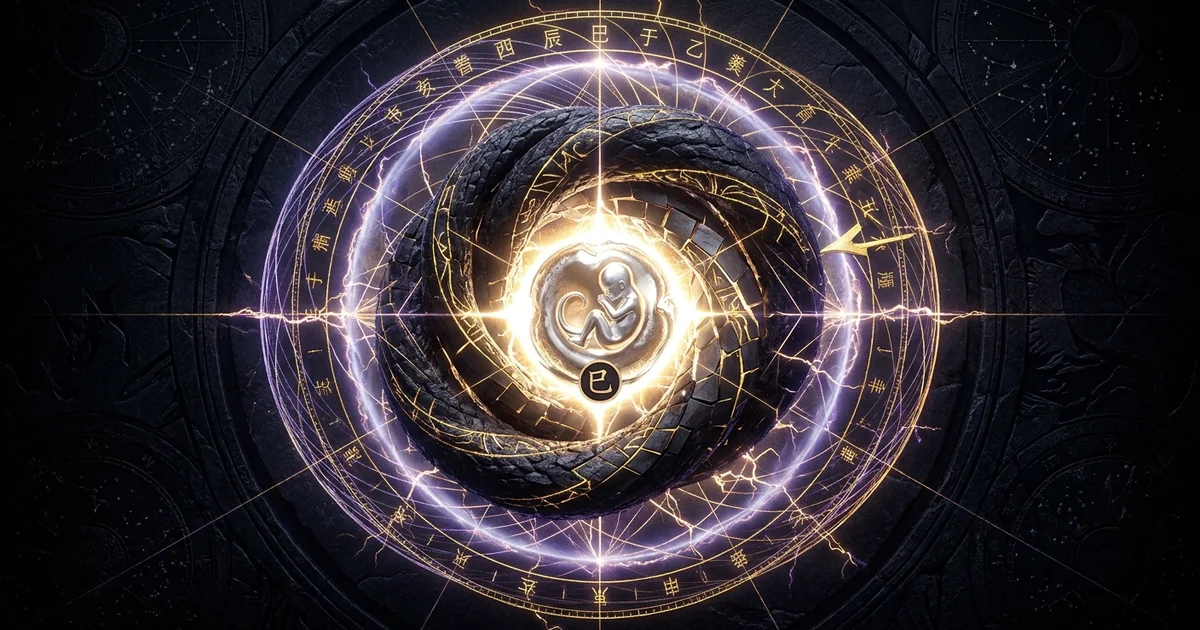
Earthly Branch Snake: Chinese Zodiac Fire Yin - Guide
Archetypal Thesis & Systemic Paradigm: The Serpentine Paradox of Yin Fire
The Earthly Branch Si (巳), designated in vernacular parlance as the Snake, occupies one of the most structurally complex and thermodynamically paradoxical coordinates within the traditional Chinese sexagenary cosmological matrix. Positioned as the sixth station within the cyclical progression of the twelve earthly branches, Si functions as an ontological fulcrum. While it is formally categorized under the polarity of Yin Fire (丁火, Ding Huo) due to its even-numbered positioning along the duodecimal ecliptic wheel, its internal energetic substrate operates as an engine of ascending, radiant Yang. This dual condition establishes the Snake not as a static elemental signifier, but as an alchemical pressure vessel wherein embryonic potential is synthesized, compressed, and prepared for systemic manifestation.
[ Branch Si (巳) ]
               Nominal Yin Fire Gateway
                          |
     +--------------------+--------------------+
     | (60%)              | (23%)              | (17%)
     v                    v                    v
[ Primary Qi ]      [ Residual Qi ]     [ Embryonic Qi ]
  Bing Fire            Wu Earth           Geng Metal
(Radiant Yang) (Stationary Void) (Nascent Ingot)The Thermodynamics of Si (巳) within the Sexagenary Coordinate System
In the thermodynamic modeling of the sexagenary calendar, Si corresponds to the fourth lunar month (Meng Xia, 孟夏), marking the solar term of Li Xia (立夏, the “Establishment of Summer”). At this seasonal threshold, ambient solar radiation intensifies across the Northern Hemisphere, driving biomass accumulation and thermodynamic acceleration across terrestrial ecological systems. The elemental attribution of Fire (Huo, 火) within the Chinese Five Elements framework describes an upward-dispersing, thermal vector characterized by luminosity, expansion, and energetic acceleration.
Yet the designation of Si as a vehicle of Yin polarity introduces an immediate cybernetic constraint upon this expansive phase. Yin inherently implies consolidation, inward gravitational pull, structural cohesion, and systemic latency. Consequently, the thermodynamics of the Snake earthly branch do not manifest as the chaotic, open-air conflagration associated with its structural counterpart, Wu (午, Horse). Instead, Si represents thermal containment: an intensely pressurized, internalized fusion reaction. In the language of modern nonequilibrium thermodynamics, the Snake operates as an isolated thermodynamic system holding a superheated state under immense boundary tension, allowing chemical, psychic, and structural transformations to occur without premature energetic entropy.
Deconstructing Folk Zoomorphism: The Branch as a State-Space Vector
Folkloric interpretations within popular Chinese astrology have long reduced the Earthly Branch Si to anthropomorphized animal traits, attributing to those born under its governance a predisposition toward secrecy, cunning, physical sensuality, and deceptive intelligence. While these behavioral phenotypes mirror certain psychological dynamics, such readings sever the branch from its mathematical foundation within the cosmological apparatus of BaZi. The serpent, within this rigorous cosmological context, does not operate as a behavioral diagnostic or superstitious totem. It serves as a state-space vector within an integrated dynamic system.
The serpentine form itself was selected by ancient Han astrologers and Shang-Zhou natural philosophers as a biological analogue for the physical behavior of contained, concentrated energy. A serpent generates locomotion through lateral undulation, gathering its muscular mass into coiled potential before striking with kinetic speed that violates ordinary observational thresholds. This biological architecture directly mirrors the cybernetic properties of the branch: potential energy held in spatial stasis, calculating trajectories through an internal navigational framework, and executing transitions through rapid, non-linear intervention. When parsed through the mechanics of the Taijitu, the Snake marks the precise coordinate where ascending Yang energy reaches maximum velocity beneath a crystalline sheath of Yin structural control.
The Hidden Stems (Cang Gan) as Latent Multidimensional Operators
The resolution of the apparent contradiction between the nominal Yin categorization of Si and its functional Yang propulsion lies within the doctrine of the Hidden Stems (Cang Gan, 藏干). Classical Chinese astrology posits that while the Earthly Branches represent terrestrial topology and spatio-temporal coordinates, they act merely as houses or structural containers for the dynamic celestial energies represented by the Heavenly Stems (Tian Gan, 天干). The internal energetic composition of Si is uniquely heterogenous, comprising three distinct elemental drivers:
- Bing Fire (丙火, Primary Qi / Ben Qi, 60%): Bing Fire is Yang Fire in its purest thermodynamic expression—the blinding radiance of the mid-morning sun, vast, illuminating, and outward-directed. The presence of Bing as the dominant Hidden Stem within an ostensibly Yin branch proves that the operational engine of Si is fundamentally Yang. It provides the intellectual acuity, intense perceptive capability, and visionary scope endemic to the branch.
- Wu Earth (戊土, Residual Qi / Yu Qi, 23%): Wu Earth represents solid, dry, mountainous geological stability. Within the internal architecture of Si, Wu Earth functions as the ceramic kiln wall. It insulates and bounds the immense heat of Bing Fire, preventing it from consuming the chart prematurely while serving as a heavy, protective anchor that fosters emotional containment and strategic restraint.
- Geng Metal (庚金, Embryonic Qi / Chang Sheng, 17%): Most critically, Si represents the developmental stage known as Chang Sheng (長生, “Nursery” or “Embryonic Birth”) for Geng Metal, the archetype of raw, unrefined ore and structural steel. Within the seasonal cycle, summer Fire is structurally understood to destroy (Ke, 剋) Metal through thermal liquefaction. Yet, at this precise spatial coordinate, the intense, enclosed heat of Bing Fire, insulated by Wu Earth, creates the exact foundry conditions required to synthesize and precipitate nascent Metal from the cosmic matrix.
This triadic arrangement transforms Si into a sophisticated energetic reactor. It does not simply burn; it smothers, cooks, and tempers, serving as the biological and psycho-spiritual forge where structural forms (Metal) are birthed directly out of the fusion of solar heat (Fire) and mineral density (Earth).
Classical Provenance & Textual Lineage: From Shang Oracle Bones to Ming Dynastic Codices
The epistemological history of the Earthly Branch Si traces an arc spanning over three millennia, migrating from early divinatory inscriptions carved into pyromantic plastrons to the analytical codifications of high imperial BaZi literature. Tracing this historical and philological lineage reveals how early observations of embryology and solar mechanics gradually coalesced into an overarching metaphysical science of human destiny and chronobiology.
Paleographic Evolution of Glyph 巳: Fetal Gestation and Solar Climax
In the corpus of Shang Dynasty oracle bone inscriptions (Jiaguwen, 甲骨文, c. 1200 BCE), the pictograph for Si (巳) demonstrates an unmistakable anatomical isomorphism with a human embryo or an uncoiled serpent with a prominent cranial vault. Paleographers note that in archaic epigraphy, the glyphs for Si (巳, the sixth branch), Zi (子, the child or first branch), and Tai (胎, the fetus) frequently shared overlapping graphical components. In the bronze inscriptions (Jinwen, 金文) of the Zhou Dynasty, the glyph stabilized into an enclosed upper loop resting upon an undulating downward tail—a direct visual representation of an organism whose head and spine have consolidated within the womb, yet whose limbs have not yet separated from the biological core.
Oracle Bone (c. 1200 BCE)       Bronze Script (c. 800 BCE)       Seal Script (c. 200 BCE)
       [Glyph: 𢀚]                        [Glyph: 𢀛]                     [Glyph: 巳]
(Undifferentiated Embryo)         (Cranial Vault Formed)        (Coiled, Closed Vector)
The foundational etymological dictionary Shuowen Jiezi (說文解字), compiled by Xu Shen during the Han Dynasty (121 CE), confirms this developmental interpretation:
“巳,巳也。四月,陽氣巳出,陰氣巳藏,萬物見,成文章,故巳爲蛇,象形。”
(Si means finished/arisen. In the fourth month, the Yang Qi has fully exited, the Yin Qi has concealed itself, and all things are visible, forming pattern and design. Therefore, Si is the Snake; it is an ideographic form.)
The character Si serves as a homophonic and structural cognate to Si (已, “already completed” or “to stop”). It signifies the teleological climax of early vegetative growth: life has reached an irreversible threshold of manifested identity. The internal Yang forces have driven the organism out of chaotic emergence into an explicit, articulate geometric pattern (Cheng Wen Zhang, 成文章). The serpent glyph thus preserves both the anatomical memory of embryonic gestation and the functional mechanics of a force that has achieved structural containment.
Doctrinal Codification in the San Ming Tong Hui and Di Tian Sui
During the Song, Yuan, and Ming dynasties, the metaphysical system of BaZi transitioned from simplistic mantic divination toward rigorous systemic analysis. The foundational Ming Dynasty compendium San Ming Tong Hui (三命通會, The Compendium of Three Destinies), authored by Jinshi scholar Wan Minying (万民英, 1578), categorizes the Earthly Branch Si within the geographical and spatial framework of “The Large Stove” (Da Lu, 大爐), explicitly designating it as the cosmic metallurgical forge.
“巳為大爐。大爐者,旺火也。四月之時,陽氣已極,萬物盛長,草木皆已發華,非大爐之氣何以至此?巳中藏丙,丙為大火,又藏庚金,金在其中長生,非爐鎔金而何?故曰大爐。”
(Si is the Great Crucible. The Great Crucible represents flourishing, concentrated Fire. During the fourth month, Yang Qi reaches its absolute peak; all living things flourish and grow to their limits, trees and grasses burst forth in radiant bloom. Were it not for the operational Qi of the Great Crucible, how could this be achieved? Si conceals Bing, and Bing is great, illuminating Fire. Yet it also conceals Geng Metal, and Metal finds its Chang Sheng—its embryonic birth—within this very locus. Is this not the forge smelting the raw metal? Hence it is designated the Great Crucible.)
Wan Minying’s exposition established an essential doctrinal paradigm: Si cannot be evaluated as an ordinary, destructive combustive agent. It is a generative crucible. This principle is reinforced in the classical BaZi manual Di Tian Sui (滴天髓, The Heavenly Marrow), traditionally attributed to the Yuan-Ming strategist Liu Bowen (劉伯溫). The Di Tian Sui warns that when reading the branch of Si, the practitioner must immediately isolate whether the furnace serves to purify raw elemental structures or collapse them under unregulated heat. The text observes that the presence of water (Shui) within a chart containing Si does not merely extinguish the fire; it initiates a volatile dynamic between the furnace walls (Wu Earth) and incoming hydro-dynamic shocks, forcing the embedded Geng Metal into sudden, violent structural precipitation.
Chronomedical Cartography: The Spleen Meridian in the Huangdi Neijing
Beyond natal horoscopy and macrocosmic metaphysics, the Earthly Branch Si plays an integral role in traditional Chinese chronobiology and systemic medicine. Within the theoretical architecture of the Zi Wu Liu Zhu (子午流注, “Midnight-Noon Ebb and Flow”), the diurnal cycle is partitioned into twelve two-hour segments (Shi Chen, 時辰), each corresponding to one of the Earthly Branches and serving as the operational temporal peak for one of the twelve primary organ channels (Zang-Fu).
The Si hour spans the morning corridor of 09:00 to 11:00. This diurnal coordinate is governed by the Foot Taiyin Spleen Meridian (Zu Taiyin Pi Jing, 足太陰脾經). The canon of classical medicine, the Huangdi Neijing Suwen (黃帝內經素問, The Yellow Emperor’s Inner Classic), defines the physiological function of the Spleen/Pancreas network as that of the “Official of the Granary” (Cang Lin Zhi Guan, 倉廩之官), tasked with the extraction, chemical refinement, and metabolic dispersion of nutrients (Yun Hua, 運化).
The esoteric congruence between the Spleen and the Earthly Branch Si is profound. The Spleen is categorized as Earth (Tu), yet its operative capacity relies entirely upon the foundational metabolic warmth generated by the systemic pilot light—the Ming Men Fire (命門火). During the Si hour (09:00–11:00), the post-natal digestive furnace peaks. Food substances ingested earlier in the morning are subjected to thermal breakdown within the Stomach, allowing the Spleen to separate the clear essence (Qing) from the turbid residue (Zhuo). The clear essence is propelled upward to the Lungs and Heart to generate defensive Qi and Blood.
This physiological process precisely mirrors the sub-elemental mechanics of Si: Wu Earth provides the physical chamber of the gastrointestinal tract, Bing Fire supplies the metabolic heat of enzymatic decomposition, and the resulting purified output precipitates as Geng Metal—the raw mineral vitality of the corporeal organism. When the Si branch suffers affliction or structural clash in a personal chart, chronomedical diagnostics anticipate pathologies centered upon digestive stagnation, metabolic failure, systemic dampness, and cognitive fatigue derived from spleen-pancreatic depletion.
Structural Mechanics & Symbolic Geometry: Combinations, Clashes, and Hidden Stems
To comprehend the operation of the Earthly Branch Si within applied divination and metaphysical mapping, it is necessary to transition from qualitative archetypes to structural geometry. The twelve branches do not exist in linear isolation; they constitute a closed, non-Euclidean feedback loop characterized by intricate angular relationships, harmonic triangulations, and diametric collisions.
The Tri-Harmonious Metal Combination (Si-You-Chou)
One of the most consequential structural mechanics in BaZi is the San He (三合), or Three-Harmonies Frame. The dynamic progression of each of the four classical elements (Fire, Water, Wood, Metal) across the twelve branches is mapped via an equilateral triangle connecting three specific terrestrial nodes: the site of Birth (Chang Sheng, 長生), the site of Peak Maturity (Di Wang, 帝旺), and the site of Storage or Entombment (Mu, 墓).
[Si (巳)]
         Birth of Metal (Chang Sheng)
               /           \
              /             \
             /               \
            v                 v
       [You (酉)] <-------> [Chou (丑)]
    Peak of Metal         Tomb of Metal
      (Di Wang)              (Mu)
The Metal Tri-Harmony Frame is anchored by the triad: $$\text{Metal Frame} = {\text{Si (巳)}, \text{You (酉)}, \text{Chou (丑)}}$$
In this geometric configuration, Si acts as the generative matrix where Metal is first synthesized. You (酉, Rooster), positioned at the western autumn equinox, represents the crystallization and peak of pure Yin Metal (Xin Metal). Chou (丑, Ox), positioned at the terminus of winter, provides the cold, damp subterranean storage vault wherein the structural form of Metal is preserved and sealed.
The inclusion of Si—a branch structurally governed by Fire—as the generative origin of Metal presents a profound alchemical insight. Classical Five-Element dynamics state that Fire controls or destroys Metal through cyclical suppression ($Huo \xrightarrow{Ke} Jin$). However, in the deeper systemic mechanics of the San He networks, Fire does not function as an executioner, but as a midwife.
Without the specific thermodynamic crucible provided by Si, raw metallic ore remains diffuse and bound within the inert geology of the earth. Si delivers the thermal energy necessary to smelt, refine, and release the molten potential of Geng Metal. When a chart synthesizes Si, You, and Chou simultaneously, the nominal Fire identity of Si is entirely subsumed: its boundary dissolves, and its latent internal Geng Metal is drawn forward, transmuting the entire triad into an engine of unyielding, highly organized Metal Qi.
The Clash of Opposites: Si-Hai (Snake-Pig) Fire-Water Axis
Directly opposite the position of Si along the spatial axis of the cosmological dial lies the Earthly Branch Hai (亥, Pig). This spatial alignment creates the foundational energetic collision known as the Si-Hai Clash (巳亥相沖).
[Si (巳)]                                [Hai (亥)]
Nominal Yin Fire                        Nominal Yin Water
Primary: Bing Fire (60%)                Primary: Ren Water (70%)
Secondary: Wu Earth (23%)               Secondary: Jia Wood (30%)
Embryonic: Geng Metal (17%)
          \                                  /
           \                                /
            ===> [ HYDRO-THERMAL CLASH ] <===
This interaction is not merely an opposition between two mythological animals; it is a hydro-thermal detonation. When Si and Hai confront one another within a natal framework or during dynamic temporal cycles (such as a Da Yun Major Life Phase or Liu Nian Annual Pillar), their respective Hidden Stems engage in total mutual warfare:
- The Primary Dynamic: The deep, abyssal Ren Water (壬水) residing within Hai strikes violently against the solar Bing Fire (丙火) of Si, creating sudden psychological instability, perceptual confusion, and disruptions to systemic homeostasis.
- The Secondary Dynamic: The embryonic Geng Metal (庚金) of Si engages in direct combat with the nascent Jia Wood (甲木) housed within Hai. As Metal shears Wood, the integrity of planning, visionary expansion, and structural stability is severed.
- The Tertiary Insulation: The Wu Earth (戊土) within Si attempts to dam and control the deluge of Ren Water, but because Hai is cold, slippery, and relentless, the earth dissolves into mud, compromising structural resilience.
The Si-Hai clash routinely registers in clinical practice as an acute disruption of the individual’s spatial reality. Because both Si and Hai are classified as “Traveling Horses” (Yi Ma, 驛馬)—branches explicitly responsible for kinetic dispersion, physical relocation, vehicular mechanics, and international transit—their mutual collision destabilizes physical geography. The clash triggers sudden vehicular accidents, uncalculated geographic flights, abrupt career amputations, and cardiovascular or gastrointestinal ruptures. It represents the structural fracturing of the furnace under a high-pressure deluge.
Branch Si (巳) - The Incipient Furnace
- Structural Polarity: Nominal Yin (even branch); Internal Dynamic Yang (Bing Fire 60%).
- Temporal Station: Meng Xia (First Month of Summer, solar term of Li Xia).
- Sub-Elemental Matrix: Contains Wu Earth (23%) and Geng Metal (17%) alongside Bing Fire (60%).
- I Ching Sovereign Hexagram: Qian (䷀, Hexagram 1) - Pure, saturated, unbroken Yang Qi.
- Dynamic Functionality: Generative crucible; initiates the Chang Sheng (Embryonic Birth) of Metal.
- Psychological Expression: Calculated, introverted intuition; profound observational patience; latent kinetic striking capacity.
Branch Wu (午) - The Solstitial Conflagration
- Structural Polarity: Nominal Yang (odd branch); Internal Dynamic Yin (Ding Fire 70%, Ji Earth 30%).
- Temporal Station: Zhong Xia (Mid-Summer, solar term of Xia Zhi / Solstice).
- Sub-Elemental Matrix: Stripped of Metal; contains pure thermal Fire moderated only by soft, ductile Ji Earth.
- I Ching Sovereign Hexagram: Gou (䷫, Hexagram 44) - A single Yin line breaks through at the base of five Yang lines.
- Dynamic Functionality: Climax and exhaustion of thermal energy; initiation of the downward return of Yin.
- Psychological Expression: Radiative, expressive, extroverted theatricality; rapid dispersion of thermal output; zero structural retention.
The 12 Sovereign Hexagrams: Qian (䷀) and the Paradox of Pure Yang
The systemic sophistication of the Earthly Branch Si is most fully realized through its integration with the 12 Sovereign Hexagrams (Shi Er Pi Gua, 十二辟卦), a cosmological system mapping the seasonal progression of Yang and Yin lines through the structure of the I Ching.
The fourth lunar month, governed by Si, corresponds directly to Hexagram 1: Qian (乾, The Creative / Pure Yang).
Hexagram 1: Qian (䷀)
Line 6: ―――――― (Yang)
Line 5: ―――――― (Yang)
Line 4: ―――――― (Yang)
Line 3: ―――――― (Yang)
Line 2: ―――――― (Yang)
Line 1: ―――――― (Yang)
[All Six Lines Solid: Absolute Yang Saturation]
This alignment reveals the ultimate structural paradox of the Snake earthly branch:
While classified as Yin Fire within the elementary duodecimal nomenclature, the Snake month represents the one and only point in the entire annual cycle where Yang Qi achieves total, unbroken saturation. In Hexagram Qian, all six lines are firm, luminous, and unbroken. Not a single Yin line has pierced the structure.
How can a station characterized by pure, unadulterated Yang be denominated as Yin Fire?
The mechanics of the Yin-Yang Taijitu balance provide the solution. Pure Yang in a state of absolute structural saturation cannot expand outward any further without instigating systemic thermodynamic collapse. Therefore, the moment Yang achieves absolute density (Qian), it must instantaneously invert its behavior: it assumes an external Yin posture. The absolute, blinding solar power of Bing Fire seals itself behind an impenetrable exterior shell of stillness, reserve, and cold analytical observation.
The apparent Yin of the Snake is not a deficiency of Yang; it is the ultimate containment of Yang. It is the tactical armor worn by absolute solar potential to keep from incinerating its own field of existence, waiting for the precise seasonal coordinate where it can smelt form from void.
Psychological Dynamics & Operational Praxis: BaZi Chart Synthesis and Individuation
When transposed from cosmological theory to depth psychology and clinical BaZi chart analysis, the Earthly Branch Si emerges as a clear cognitive and psychological archetype. Operating under the influence of this branch, the human psyche configures itself as an epistemological sentinel—a mind defined by acute observational capacities, structural skepticism, and a profound, often excruciating dedication to systemic self-preservation.
Analytical Intuition, Suspicion, and Strategic Reticence
In the framework of Carl Gustav Jung’s archetypal typology, the energetic mechanics of Si map directly to the functioning of Introverted Intuition (Ni) supported by an auxiliary of Introverted Thinking (Ti).
Because Si conceals blazing Bing Fire beneath a Yin, subterranean boundary, individuals marked by this branch in their natal charts rarely express their cognitive processes in direct, overt declarations. They perceive their environments through non-linear pattern recognition. The high thermal energy within the branch drives an acute, laser-like perceptual apparatus that registers micro-expressions, systemic vulnerabilities, and hidden teleological trajectories in others.
However, because this thermal apparatus is enclosed within Wu Earth, the Si native does not immediately act upon this data. They store it. They exhibit what classical Chinese physiognomy terms the “serpentine eye”: an unblinking, sustained appraisal of systemic dynamics that remains detached from immediate emotional engagement.
The natural shadow of this architecture is deep, endemic suspicion. The psyche assumes that just as it conceals an enormous, volatile furnace beneath an exterior of calculated composure, all other external agents must similarly be harboring concealed agendas. Left unintegrated, this dynamic devolves into operational paranoia, structural alienation, hyper-vigilance, and an emotional coldness that repulses intimacy. The individual becomes an impenetrable fortress, suffocating their own internal human warmth to avoid the vulnerability of an external breach.
The Si-Shen-Yin Ungrateful Punishment (San Xing): Shadow Integration
The most demanding structural configuration involving the Snake within personal astrology is its participation in the Ungrateful Punishment (En Wang Zhi Xing, 恩妄之刑), an asymmetric triad formed when Si intersects with the branches Yin (寅, Tiger) and Shen (申, Monkey).
[Yin (寅) - Tiger]
         Wood / Fire Birth
            /          \
           /            \
          v              v
    [Si (巳) - Snake] <---> [Shen (申) - Monkey]
    Fire / Metal Birth        Metal / Water Birth
$$\text{Ungrateful Punishment Triad} = {\text{Yin (寅)}, \text{Si (巳)}, \text{Shen (申)}}$$
Unlike the San He combinations, which synthesize harmonic unity, the San Xing constitutes an abrasive mechanical grind. Each member of this triad represents the Chang Sheng (Birth) station of a dynamic element:
- Yin is the birth of Fire (containing Jia Wood and Bing Fire).
- Si is the birth of Metal (containing Bing Fire and Geng Metal).
- Shen is the birth of Water (containing Geng Metal and Ren Water).
When these three dynamic forces are brought into simultaneous activation, their competitive, aggressive Hidden Stems lacerate one another in an unceasing struggle for dominance. Si attacks Shen (Fire assaults Metal), Shen attacks Yin (Metal saws through Wood), and Yin attacks Si (Wood overwhelms the control parameters of the furnace).
Psychologically, this punishment is termed “Ungrateful” because it operates through interpersonal betrayal, structural unfaithfulness, and the sudden severance of ancestral or professional pacts. The native feels that their most profound devotions are met with systemic abandonment, or conversely, the native systematically sabotages their closest alliances out of a pre-emptive defense mechanism.
In clinical shadow work, resolving the Si-Shen-Yin punishment demands that the individual confront their own unacknowledged capacity for calculating cruelty and instrumentalizing relationships. The individual must dismantle their profound subconscious belief that survival requires the cold liquidation of vulnerability. Integration occurs when the native ceases using intellect as a weapon of pre-emptive emotional dismemberment, converting their strategic foresight into a protective shelter for others rather than an engine of exploitation.
In professional BaZi natal synthesis, practitioners frequently encounter a structural failure state wherein a Day Master (日主) of Ding Fire (丁火, Yin Fire) is confronted with multiple Si branches across the earthly supports (e.g., a Si Month Pillar alongside a Si Day or Hour Pillar).
- Etiology of Pathology: Although Ding Fire matches the nominal polarity of Si, Ding Fire is an exquisitely delicate, ambient, candle-like or starlight frequency. An excess of Si branches floods the chart with the brutal, blinding, furnace-grade Bing Fire residing within the Hidden Stems. This generates the dangerous diagnostic condition known as Bi Jie Duo Cai (比劫奪財, “Rob Wealth Usurping the Direct Wealth”), where structural boundaries are incinerated, generating manic impulsivity, severe legal entanglements, volatile hyper-inflation of the ego, and the complete destruction of economic liquidity (Metal).
- Systemic Intervention: Direct application of Water (Ren or Gui) to extinguish the blaze frequently backfires, as it triggers a catastrophic Si-Hai or Bing-Ren hydro-thermal explosion. The correct operational protocol requires the insertion of Wet Earth—specifically the branches Chou (丑, Ox) or Chen (辰, Dragon).
- Mechanical Resolution: Wet Earth acts as an alchemical sink. Its moist, fertile structure absorbs the blinding heat of Bing Fire without combusting, safely draining the runaway thermal excess and directing that energy into the generation and refinement of pure, actionable, and stable Metal resources.
Diagnostic Rules for Chart Interpretation Across the Four Pillars
To precisely decode the manifestation of the Earthly Branch Si within an individual life trajectory, its position within the Four Pillars (Si Zhu, 四柱) must be rigorously delineated:
- The Year Pillar (Ancestral Root & Social Outer Sphere): When Si governs the Year of birth, the individual is born from an ancestral lineage characterized by rigorous survival mechanisms, financial pragmatism, or deep socio-political caution. The public persona projects calculated reserve, aristocratic distance, and enigmatic authority. The individual is recognized in broad collective networks as someone who observes everything while disclosing nothing, naturally attracting roles requiring intelligence-gathering, surveillance, or long-term strategic administration.
- The Month Pillar (Parental Nexus, Career Core, & Seasonal Mandate): Located in the Month Pillar—the absolute center of gravitational weight within a BaZi chart—Si dictates that the native’s primary operational environment is competitive, intellectually demanding, and strategically intensive. The career path typically unfolds within financial systems, high-level technology, intelligence agencies, surgical medicine, or esoteric research. The native’s parental dynamic was frequently marked by conditional validation predicated upon structural perfection, creating a life-long drive toward absolute professional self-sufficiency.
- The Day Pillar (The Self Core & Spousal Palace): When Si sits within the Day Branch (directly beneath the Day Master), the internal spousal palace is governed by high thermal tension. The native requires a partner who possesses formidable intellect and who respects an absolute boundary of psychological autonomy. Marriage can easily devolve into an unspoken cold war if suspicion is left unmanaged. If the Day Master is Xin Metal (辛金) sitting on Si, the relationship forms an exquisite instance of the Guan Yin Xiang Sheng (官印相生, “Official and Seal mutually generating”) dynamic, yielding a personality of monumental administrative discipline and an almost monastic ethical precision.
- The Hour Pillar (Offspring, Interior Sanctuary, & Ultimate Legacy): In the Hour Pillar—governing the final third of life, deep unconscious ideation, and the cultivation of intellectual or biological offspring—Si manifests as a late-blooming, secretive creative output. The native’s twilight years are rarely conventional or tranquil; they are dedicated to the relentless completion of a masterwork, the codification of esoteric treatises, or the accumulation of concentrated, non-correlated financial assets. The internal life remains sharp, analytical, and uncompromisingly lucid until the physical vessel dissolves.
Philosophical Synthesis & Macrocosmic Correspondence: Hermetic Fire and the Ouroboros
The symbolic structure of the Earthly Branch Si crosses civilizational boundaries, finding profound structural resonance within the high Western esoteric traditions, particularly Alexandrian Hermeticism, Renaissance alchemy, and the sacred anatomy of the yogic systems.
[ Hermetic Ouroboros ]  <=======>  [ Earthly Branch Si (巳) ]
     Head devouring its own Tail         Yin boundary enclosing Yang Core
                 \                                     /
                  \                                   /
                   ===> [ ALCHEMICAL CRUCIBLE ] <====
                          Fire transmutes to Stone
                         Bing Fire smelts Geng Metal
The Ouroboric Continuum: Self-Devouring Fire and Regeneration
The classical Hermetic archetype of the Ouroboros—the serpent devouring its own tail, forming an unbroken circular continuum—mirrors the thermodynamic mechanics of the Earthly Branch Si. In the alchemical treatise Chrysopoeia of Cleopatra (c. 3rd Century CE), the Ouroboros is accompanied by the inscription Hen to Pan (Ἓν τὸ πᾶν, “One is the All”). The emblem captures the profound alchemical mystery of systemic conservation: nature consumes itself, refines itself, and births itself anew through thermal distillation.
This is the precise function of Si. As the Great Crucible (Da Lu), Si devours its own primary elemental energy—it burns Bing Fire, cushions the reaction via Wu Earth, and through this self-consuming combustion, yields an indestructible crystalline core: the infant Geng Metal. The serpent does not perish in its fire; it sheds its skin. It performs the seasonal miracle of physical and spiritual ecdysis. The old exterior (the decaying wood of spring) is digested in the serpentine belly of early summer, transforming its life force into the dense, enduring mineral consciousness of the philosopher’s stone.
“The serpent is an extraordinarily frequent image of the archetype of the unconscious, which expresses the dangerous, fascinating, and healing properties of the instinctual depths… It is both the poison that destroys and the panacea that redeems. As the dragon or snake that dwells within the earth, it guards the precious treasure—the gold that has not yet been forged by the conscious will. In its cold-blooded nature lies precisely the objective, crystalline insight that the human ego so desperately fears and so profoundly requires for the realization of the Self.”
Cross-Systemic Mapping: The Western Scorpio-Taurus Axis and Kundalini Circuitry
Within the spatial architecture of Western tropical astrology, the attributes of Si divide and map across the Scorpio-Taurus Axis, with a decisive anchor in the sign of Scorpio.
While Chinese astrology maps Si to early summer, its psychological mechanics—intensity, profound containment, obsession with hidden mechanics, penetrative perceptual depth, and capacity for sudden shedding of identity—run parallel to classical Plutonian and Martial Scorpio. Furthermore, the presence of embryonic Geng Metal and Wu Earth links Si to the structural, fixed earth of Taurus, capturing the metallurgical alchemy of transmuting raw base matter into golden currency.
In the subtle anatomy of the Indian Tantric traditions, the Earthly Branch Si correlates structurally with the Kundalini Shakti (कुण्डलिनी शक्ति), the primordial evolutionary current visualized as a serpent sleeping coiled three and a half times around the Muladhara chakra at the base of the spine.
Kundalini is universally described as a sleeping, potential fire (Agni). When awakened through rigorous yogic discipline, this serpent rises through the central axis of the Sushumna Nadi, burning away the calcified conditioning of the mind, systematically transforming the raw, biological vitality of the lower somatic centers into the diamond-hard, unyielding radiance of the crown chakra (Sahasrara).
This yogic ascension mirrors the structural formula of Si: the fire in the darkness of the earth smelting the divine metal within the core of man.
Cybernetic Feedback Loops: The Snake as an Entropy Transducer
Viewed through the lens of modern systems architecture and cybernetics, the Earthly Branch Si functions as an entropy transducer. In complex systems, an organism or network survives by extracting negentropy from its surrounding environment, processing chaotic, raw inputs, and converting them into organized, low-entropy structural stability.
Si absorbs the chaotic, escalating, and potentially catastrophic thermal expansion of early summer (Yang Fire) and immediately channels it into an integrated containment system. The external Yin boundary traps the energy; the internal Wu Earth acts as an insulating buffer; and the embryonic Geng Metal crystallizes the excess energy into permanent, structured code.
The Snake is nature’s mechanism for ensuring that growth does not terminate in a flash-fire of unbridled entropy. It is the cosmic compression algorithm: taking the blinding, dispersed radiance of the universe and writing it into the dense, indestructible, and beautiful calligraphy of materialized existence.
Frequently Asked Questions: Structural Clarifications on the Snake Earthly Branch
What is the ontological basis for categorizing Si as Yin Fire despite its internal Yang Fire composition?
The systemic methodology of Chinese metaphysics makes a fundamental operational distinction between Ti (體, Essence or Structural Substrate) and Yong (用, Functional Application).
In its Ti (essence and numerical order), Si is the sixth earthly branch. Because the number six is an even number within the fundamental numerology of the Luo Shu and the sexagenary calendar, Si is formally assigned a Yin polarity, and its nominal elemental frequency is designated as Yin Fire (Ding Fire).
However, in its Yong (applied function), the actual operational energy driving the branch consists of its primary Hidden Stem, Bing Fire (丙火), which commands 60% of the branch’s internal Qi and is purely Yang.
Therefore, Si is technically categorized as: $$\text{Si} = \text{Yin in Essence (體), Yang in Application (用)}$$
This polarity inversion is the structural inverse of the Earthly Branch Hai (Pig), which is even-numbered (twelfth) and nominally Yin Water, yet functionally operates through the roaring Yang of Ren Water. Recognizing this bifurcation between structural form and energetic behavior is essential for advanced BaZi synthesis.
How does the Fire within Si act as the embryonic birth (Chang Sheng) of Metal rather than its destruction?
Standard Wu Xing (Five Elements) elemental cycles state that Fire controls or melts Metal ($Huo \xrightarrow{Ke} Jin$). However, this basic rule describes the relationship between fully manifested, static elements. The Shi Er Chang Sheng (Twelve Stages of Life) model describes the cyclical phase transitions of energy across space-time.
For raw metal ore to be released from its geological matrix and tempered into a functioning structural implement (Geng Metal), it cannot remain cold. It requires concentrated, insulated heat within an enclosed environment.
The Earthly Branch Si is precisely that insulated environment:
- The Wu Earth (戊土) provides the kiln chamber or the geological crust.
- The Bing Fire (丙火) provides the foundational thermal energy to liquefy and extract the raw ore.
- The resulting phase transition precipitates Geng Metal (庚金) in its embryonic, highly moldable form.
Thus, within the branch of Si, Fire does not destroy Metal; it forges it. Destruction only occurs if the fire breaches its ceramic boundary (excessive external fire with zero Earth insulation), which would vaporize the nascent Metal.
How should a BaZi practitioner navigate and remediate a Si-Hai clash occurring during an annual cycle (Liu Nian)?
When an individual encounters an annual pillar that forms a Si-Hai clash with their natal chart (e.g., a person with a Si branch in their chart encountering a Hai Year, or vice versa), the hydro-thermal collision requires immediate systemic management to avert erratic disruptions:
[Si-Hai Clash] ---> Apply Mediating Element: [Yin Wood (Yin / Mao)]
                     /                                  \
                    /                                    \
[Hai Water absorbs into Wood] [Wood fuels and smooths Si Fire]- Introduce the Wood Element as a Kinetic Buffer: The fundamental clash is between Water (Hai) and Fire (Si). The optimal systemic mitigation is the introduction of Wood (Mu), specifically through the earthly branches Yin (寅, Tiger) or Mao (卯, Rabbit). Within the cyclical chain of Five Elements, Water naturally feeds Wood, and Wood naturally feeds Fire ($Shui \rightarrow Mu \rightarrow Huo$). Wood acts as a diplomatic bridge, absorbing the violent surge of Ren Water from Hai and transforming it into constructive fuel for the Bing Fire of Si, pacifying the hydro-thermal war.
- Mitigate Kinetic Disruptions (The Traveling Horse Axis): Because both Si and Hai are Yi Ma (Traveling Horse) stars, this clash will destabilize physical space. Practitioners advise clients to take proactive, calculated journeys during a clash year—such as planned international relocations, business travels, or structural domestic renovations—to deliberately discharge the kinetic mandate of the branches.
- Medical Vigilance: Clients should be directed to conduct preventive medical diagnostics targeting the cardiovascular system and the eyes (governed by the Bing Fire of Si) as well as the kidneys, urinary tract, and reproductive system (governed by the Ren Water of Hai), while implementing dietary adjustments to safeguard the spleen-pancreatic system from metabolic collapse.