Nakshatra Hasta: Sacred Vedic Lunar Mansion - Guide
Archetypal Thesis & Systemic Paradigm: The Biomechanics of Conscious Volition
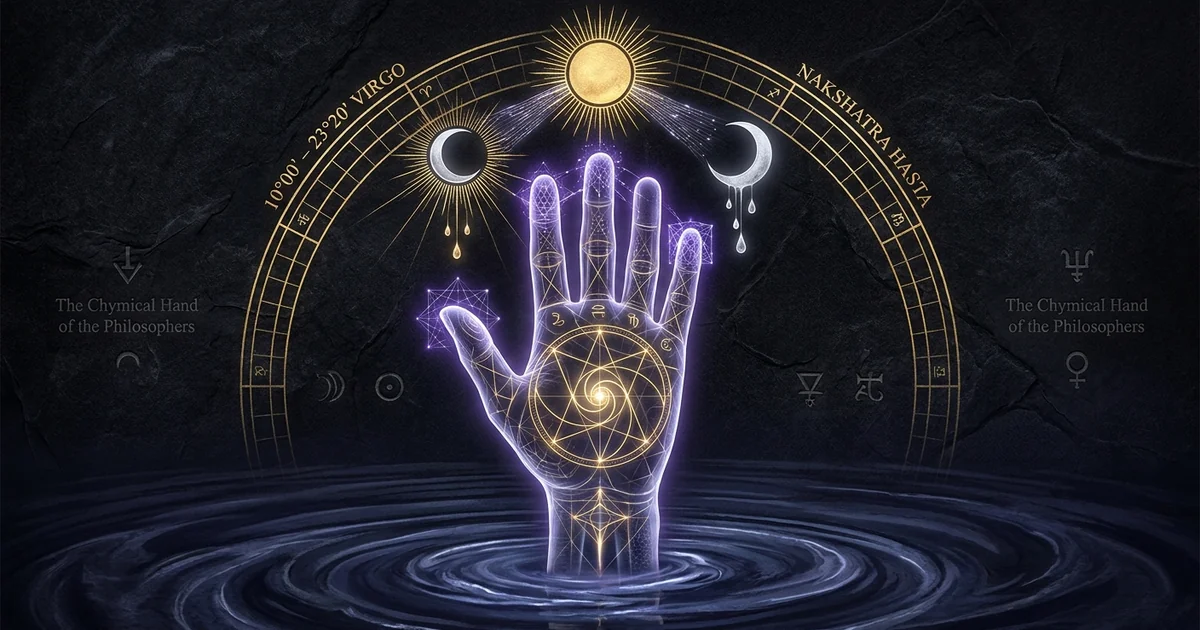
Occupying the exact span of 10°00’ to 23°20’ sidereal Kanya (Virgo), Hasta Nakshatra operates as the psycho-cosmic nexus where unmanifest solar-volitional consciousness condenses into empirical, tactile manifestation. In the broader taxonomy of the complete guide to the 27 lunar mansions, this asterism represents the structural developmental node wherein cosmic intent achieves fine-motor agency. Governed by the solar divinity Savitr and presided over by the planetary ruler Chandra (the Moon), Hasta reconciles two seemingly divergent cosmic poles: the self-luminous, outward-radiating potency of the central spiritual sun, and the plastic, reflective, rhythmically oscillating consciousness of the lunar mind (manas). This synthesis creates an ontological bridge between abstract intentionality and physical execution, casting the thirteenth asterism as the primary seat of human craftsmanship, psycho-somatic coordination, and somatic alchemy.
Taittiriya Brahmana (III.1.1.8): “स॒वित्रा हस्त॒मुपै॑ति सं॒युतं॑ । दे॒वो य॑याव॒भि सं॑प्रय॒च्छन् । वि॒शोकं॑ नो अस्तु य॒शस॒मावि॑शन् । सु॒हस्तं॒ देवः॑ सवि॒ता द॑धातु ॥” Translation: “Through Savitr, one approaches the united Hasta; the radiant God arrives, bestowing, extending, distributing. May our undertaking become free from grief, entering into glorious realization; may the divine Savitr bestow upon us auspicious, skilled, and luminous hands.”
Savitr as the Vivifying Solar Motor and Dawn Intellect
In the Vedic pantheon, Savitr is fundamentally distinct from Surya. Where Surya represents the manifested solar orb illuminating the physical cosmos, Savitr is the pre-dawn, incisive, and invisible quickening agency—the divine instigator (preraka) that awakens sleep-bound consciousness and commands cosmic motion. Within the technical paradigm of Hasta, Savitr acts as the dynamic spark of intentionality that stirs the buddhi (higher discriminative intellect) from latency into creative activity.
Under the operational matrix of Hasta, this vivifying solar force does not remain trapped in the ether of speculative philosophy. Instead, it descends through the nervous system to terminate in the hands, which function as the primary karmendriya (organ of action) of human self-actualization. Savitr provides the initial vector of will—the primordial flash of design—which is subsequently seized by the lunar mind, measured by Mercurial discernment, and translated into precision physical movement. Consequently, the native aligned with this stellar frequency possesses an innate instinct to manipulate, shape, and calibrate external reality through focused manual dexterity and kinetic calculation.
The Open Hand versus the Clenched Fist: Polarity of Grasping and Benediction
The primary glyph of Hasta is the hand, alternately depicted as an open, radiating palm (hasta-mudra) extending benediction, or a tightly closed, grasping fist. This dual iconography encapsulates the central psychological and spiritual dialectic of the asterism: the perpetual tension between generative surrender (dana) and possessive acquisition (parigraha).
The open palm represents the pure, unimpeded channel of solar transmission. It is the emblem of the healer, the reiki practitioner, the artisan, and the sovereign who dispenses resources without attachment, trusting in the inexhaustible abundance of the Savitr stream. Conversely, the clenched fist denotes the involution of this energy into defensive territoriality, kleptomania, micromanagement, and neurotic control. In the lower registers of hasta nakshatra vedic astrology meaning, the closed fist signifies an ontological terror of scarcity, where the analytical intellect weaponizes its dexterity to trap, manipulate, and hoard material forms. The evolutionary trajectory of the Hasta archetype necessitates the conscious opening of the fist—transforming a desperate grasping mechanism into an instrument of cosmic benediction and sacred craft.
The Sidereal Virgo Matrix: Mercurial Discrimination Governed by Lunar Flux
Hasta resides wholly within the earth sign Kanya (Virgo), ruled by Budha (Mercury). This placement situates the asterism at the convergence of prithvi-tattva (the earth element) and high-frequency analytical discrimination. However, the Nakshatra itself is ruled by Chandra. This produces a unique psychological tension: the cool, rational, systematic scrutiny of Mercury is perpetually washed over by the tidal, intuitive, emotionally responsive currents of the Moon.
This lunar-mercurial cross-pollination generates a distinct form of pragmatic intellect. The native does not process empirical inputs through dry, detached logic alone; rather, they register environmental data through somatic intuition and kinetic memory. The mind functions like the fingers of a watchmaker: extraordinarily precise, capable of detecting microscopic imperfections, yet fueled by a deeply personal, protective, and domestic need to establish order out of primordial chaos. Through the prithvi-tattva matrix of Virgo, the lunar-impelled imagination receives the friction and stability required to produce tangible, enduring artifacts.
Classical Provenance & Textual Lineage: Savitr, the Gayatri, and Astronomical Mapping
The textual lineage of Hasta Nakshatra within the historical canon of Jyotisha reveals a consistent association with divine invocation, technological precision, and commercial agility. Far from being merely a passive lunar station, classical authorities treated Hasta as an active, initiating asterism categorized under the Kshipra (swift or light) nature, uniquely qualified for enterprises that demand both immediate velocity and immaculate accuracy.
- Sidereal Arc: 10°00’ to 23°20’ Kanya (Virgo).
- Astronomical Body: The constellation Corvus (The Crow).
- Key Fixed Stars: Alpha Corvi (Alchiba), Beta Corvi (Kraz), Gamma Corvi (Gienah), Delta Corvi (Algorab), and Epsilon Corvi (Minkar).
- Planetary Ruler: Chandra (Moon).
- Rashi Lord: Budha (Mercury).
- Caste: Vaishya (Merchant/Pragmatist).
- Orientation: Tiryang Mukha (Facing Forward / Horizontal Movement).
Vedic Lineage of Savitr and the Esoteric Architecture of the Gayatri Mantra
The spiritual core of Hasta Nakshatra is inextricably linked to the most sacred meter of the Vedic corpus: the Savitri or Gayatri Mantra recorded in Rigveda (III.62.10). The invocation—Tat Savitur Varenyam Bhargo Devasya Dhimahi Dhiyo Yo Nah Prachodayat—is not an adoration of external sunlight, but an ignition of the solar motor within the human organism. Savitr is beseeched specifically to stimulate, impel, and steer the dhi (the visionary intelligence, the perceptive core of the mind).
"तत्सवितुर्वरेण्यं भर्गो देवस्य धीमहि धियो यो नः प्रचोदयात्"
Within the esoteric mechanics of the 27 nakshatras jyotish, Hasta is the precise point in the zodiacal continuum where this Gayatri transmission achieves functional embodiment. The solar deity does not simply illuminate abstract metaphysical truths; he animates the nervous architecture through which human action (karma) is negotiated. The Taittiriya Samhita explicitly describes Savitr as possessing golden hands (hiranyahasta), an appellation celebrating the deity’s power to repair broken limbs, reassemble severed sacrificial structures, and impart the miraculous capacity of craftsmanship to mortal hands.
Classical Jyotish Codices: Varahamihira, Parashara, and Kalyanavarman
The classical astrological compendiums evaluate Hasta through its functional socio-economic output. In Chapter XV of the Brihat Samhita, the polymath Varahamihira defines the occupational and psychological parameters of the asterism:
“In Hasta reside thieves, elephants, chariot-makers, artisans, sculptors, men of resourcefulness, physicians, merchants, those engaged in the performance of Vedic rituals, and those possessing dexterity of hand.”
Varahamihira’s inclusion of both “thieves” and “Vedic priests” within the same stanza underscores the fundamental value-neutrality of Hasta’s mechanical dexterity. The asterism endows the native with the ability to execute complex operations with such rapid precision that the boundary between magic, sleight of hand, mechanical engineering, and ritual liturgy becomes permeable.
Similarly, Vaidyanatha Dikshita in the Jataka Parijata (Chapter IX) and Kalyanavarman in Saravali observe that individuals born with Chandra in Hasta are inherently industrious, eloquent, inclined toward mercantile ventures, skilled in the fine arts, yet susceptible to a deeply concealed melancholia or unsteadiness of purpose caused by the Moon’s mutable governance over an earth sign.
Astronomical Correlates: The Stellar Constellation Corvus (The Crow)
Modern western astronomy maps Hasta directly to the constellation Corvus, a compact stellar cluster situated south of the celestial equator. The five primary stars of this constellation—Alchiba, Kraz, Gienah, Algorab, and Minkar—delineate a distinctive, irregular quadrilateral topped by an off-axis star, bearing an unmistakable resemblance to the five extended fingers of a human hand or the silhouette of a perched, vigilant crow.
The association with Corvus imports a profound symbolic dimension. In global mythologies, the crow is an animal of razor-sharp opportunistic intelligence, hyper-vigilance, and scavenging resourcefulness. The crow does not create matter ex nihilo; rather, it gathers pre-existing fragments of the world and repurposes them with startling mechanical ingenuity. The star Algorab (Delta Corvi), possessing a complex binary nature, introduces an edge of strategic cunning and self-preservation into the asterism, ensuring that the solar illumination of Savitr remains anchored in the survival instincts of material existence.
Structural Mechanics & Symbolic Geometry: Padas, Tattvas, and Anatomical Circuits
To fully grasp the functional dynamics of Hasta, the astrologer must dissect its systemic anatomy across multiple divisional layers. The 13°20’ arc of the asterism fractures into four distinct quarters (padas), each mapping to a specific quadrant of the Navamsha D9 divisional chart that alters the terrestrial expression of the root archetype.
Quaternary Division: Analysis of the Four Navamsha Padas
Pada 1 (10°00’ to 13°20’ Kanya): Mesha Navamsha
Governed by Mangala (Mars), the first pada introduces a surge of kinetic friction and pioneering heat into an otherwise cool, mercurial terrain. Here, the intellectual precision of Virgo is coupled with martial decisive action. This is the domain of the surgeon, the metalsmith, the industrial engineer, and the military strategist. The native exhibits exceptional manual strength and an aggressive drive to dissect, manipulate, and master raw matter. The danger of this pada lies in impatience and a tendency toward blunt force when delicate calibration is required.
Pada 2 (13°20’ to 16°40’ Kanya): Vrishabha Navamsha
Governed by Shukra (Venus), the second pada stabilizes the lunar energy within a grounded, aesthetic, and opulent frame. This pada constitutes the zenith of material craftsmanship. Here, the dexterity of the hand is directed toward beauty, sculpture, fine cuisine, architectural drawing, and financial accounting. The native possesses an instinctual grasp of proportions, texture, and tangible value. It is the most financially prosperous of the four padas, conferring an innate ability to extract concrete wealth from manual skill, although it risks descent into aesthetic fastidiousness and possessive accumulation.
Pada 3 (16°40’ to 20°00’ Kanya): Mithuna Navamsha
Governed by Budha (Mercury), the third pada is a Vargottama-like hyper-amplification of Mercurial energy, as both rashi and navamsha fall under the sway of the planet of commerce and intellect. This pada produces extreme mental agility, linguistic wit, cryptographic ability, and comedic brilliance. The hands are impossibly fast, finding natural expression in writing, coding, technical drawing, instrumental music, or prestidigitation. The shadow of this placement is profound: it is the primary locus for the con-artist, the master of deceptive accounting, and the individual who weaponizes intellect to evade accountability.
Pada 4 (20°00’ to 23°20’ Kanya): Karka Navamsha
Governed by Chandra (Moon), the fourth pada brings the Nakshatra to its point of structural completion by harmonizing the sign ruler (Mercury) and the mansion ruler (Moon) within a water Navamsha. The analytical edge of Virgo is softened by empathy, somatic intuition, and psychological insight. This pada governs manual healing, culinary alchemy, community medicine, and the protection of the vulnerable through domestic craftsmanship. The native uses their hands to soothe, repair, and shelter. However, emotional vulnerability is acute here; the mind is hypersensitive to external criticism and prone to paralyzing psychological absorption.
Guna, Tattva, and Animal Totem (The Female Buffalo): Energy Dynamics
At the level of elemental and qualitative taxonomy, Hasta is classified as Rajasic at the primary level, Tamasic at the secondary level, and Rajasic at the tertiary level. This energetic stack confirms that Hasta is fundamentally oriented toward relentless, driving activity (Rajas), which temporarily plunges into dense material form (Tamas) to manipulate physical reality, before emerging again into active kinetic expression. Its primary elemental affiliation is Vayu (Air) operating within the macro-environment of Prithvi (Earth), explaining why its manifestations are characterized by physical labor that is nonetheless exceptionally light, rapid, and airborne.
Its animal totem is the Female Buffalo (Mahisha). In Indian cosmology, the buffalo is an animal of immense physical endurance, capable of laboring through thick, unyielding mire that would immobilize other beasts. The buffalo’s connection to Yama (the deity of death and cosmic law, whose mount is the buffalo) indicates that beneath Hasta’s outward playfulness and intellectual flexibility lies an unyielding, stubborn resilience and an innate understanding of natural cycles of exhaustion and renewal. It also exposes a latent shadow: an explosive, intractable temper when driven past the threshold of tolerance.
Subtle Body Correspondence: Hasta Mudras, Prana Vayu, and the Manipura-Anahata Bridge
In esoteric physiology, Hasta directly governs the hands and the five fingers, operating as external extensions of the human energetic core. The human hand is not an inert claw, but an intricate biological transceiver where the major nadis terminate.
[ Manipura (Solar Will / Digestion) ]
       │
       ▼ (Via Samana & Udana Vayu)
[ Anahata (Relational Outreach / Prana) ]
       │
       ▼ (Via Vyana Vayu)
[ Karmendriyas: The Five Fingers of Hasta ]
  ├── Angustha (Thumb) ──────> Agni (Fire)
  ├── Tarjani (Index) ───────> Vayu (Air)
  ├── Madhyama (Middle) ─────> Akasha (Ether)
  ├── Anamika (Ring) ────────> Prithvi (Earth)
  └── Kanishtha (Little) ────> Jala (Water)
Through the practice of mudras as subtle energy circuits, the individual conscious agent uses the fingers to short-circuit, direct, or expand internal flows of prana vayu. Hasta serves as the dynamic anatomical conduit connecting the Manipura Chakra (the solar plexus, seat of individual will, digestive heat, and transformative fire) with the Anahata Chakra (the heart center, seat of relational consciousness).
When the Manipura fire is balanced, it ascends to the heart and pours through the arms via Vyana Vayu, emerging from the palm centers as the power to heal, sculpt, calibrate, and blessing-confer. When obstructed, this circuit collapses into the stomach, producing digestive neurosis, chronic anxiety, and somatic armoring across the wrists and forearms.
Psychological Dynamics & Operational Praxis: The Archetype of the Artificer and Prestidigitator
From the viewpoint of depth psychology, Hasta encapsulates the Archetype of the Divine Artificer—the classical Daedalus, Hephaestus, or the Hermes Trismegistus of manual transmutation. It represents the psyche’s drive to make internal fantasies objectively visible through concrete manipulation of raw materials.
Integrated Artificer (Conscious Savitr)
- Operative Mode: Consecrated craftsmanship, surgical accuracy, somatic attunement.
- Psychic Stance: Surrender to divine solar intelligence through humble manual labor.
- Manifestation: Transmutation of raw earth into sacred architecture, healing touch, lucid humor.
- Ethical Core: Transits beyond parigraha (non-possessiveness); freely circulating resources.
Shadow Prestidigitator (Deviant Mercury/Moon)
- Operative Mode: Sleight of hand, neurotic micromanagement, cynical pragmatism.
- Psychic Stance: Chronic insecurity compensated by compulsive control of the environment.
- Manifestation: Con-artistry, intellectual theft, bureaucratic obstruction, kleptomania.
- Ethical Core: Weaponized cleverness; grasping the world in an unyielding, fearful fist.
The Shadow of Hasta: Trickery, Kleptomania, and Cynical Pragmatism
Every Nakshatra contains an inverse psychological abyss. For Hasta, this shadow emerges when the native’s immense intellectual and manual facility is severed from moral purpose, devolving into pure, unadulterated opportunism. Because the Hasta native sees so clearly how systems, mechanisms, and human behavioral patterns fit together, they are acutely aware of how easily these systems can be picked, manipulated, or dismantled.
This shadow can manifest as literal kleptomania, but far more frequently, it displays as emotional and intellectual sleight of hand. The native becomes the cynical prestidigitator who uses words, micro-agreements, and technical ambiguities to outmaneuver rivals. They may suffer from a pervasive imposter syndrome, believing that because their output comes with such effortless speed and dexterity, it must inherently be a “trick” or a counterfeit.
Under stress, this psychological pattern collapses into neurotic micromanagement. The individual cannot trust the natural unfolding of events; they must keep their fingers continuously in the gears, resulting in nervous system exhaustion, insomnia, gastrointestinal distress, and repetitive strain pathologies.
Diagnostic Natal Placements: Lagna, Moon, Sun, and Budha in Hasta
Lagna (Ascendant) in Hasta
When the ascendant falls within Hasta, the physical body reflects the lightness and kinetic readiness of the mansion. The native typically possesses expressive, unusually articulate hands, a lean and adaptable physical carriage, and an unblinking, observant gaze reminiscent of the crow. The personality is polite, pragmatic, socially adroit, and quietly ambitious, possessing an inherent sense of irony and a dry, sophisticated wit. These individuals are compulsive problem-solvers who immediately scan any space they enter for functional inefficiencies.
Chandra (The Moon) in Hasta
With the Moon residing in its own Nakshatra, the emotional architecture of the individual is profoundly shaped by the Savitr impulse. The native possesses immense psychological empathy and somatic intuition, often sensing what others need before it is articulated. However, the emotional state is subject to cyclic fluctuation. If the intellect is not engaged in demanding, detailed work, the mind turns against itself, generating acute health-related anxieties and hypochondriacal projections. There is a deep, instinctual need to be useful, and self-worth is dangerously linked to manual productivity.
Surya (The Sun) in Hasta
The Sun in Hasta sits in a complex position: residing in the asterism of its morning counterpart (Savitr), but located in the neutral-to-inimical sign of Mercury. The ego seeks realization through practical competence, administrative mastery, and technical authority. These natives make superb executives, surgeons, architects, and state administrators. They lead not through charismatic theatricality, but through an indisputable grasp of operational details. Their challenge lies in delegating authority; they fundamentally believe that no one else can execute a task with the required precision.
Budha (Mercury) in Hasta
Mercury is exceptionally exalted and dignified within the sign of Virgo, and its placement within Hasta marks the pinnacle of analytical, mathematical, and cryptographic ability. This placement generates the master programmer, the philologist, the watchmaker, the forensic accountant, and the brilliant satirist. The interface between cognitive processing (buddhi) and motor execution (karmendriya) is instantaneous. The primary therapeutic imperative for this placement is cognitive quieting; the computational engine runs at such a high rpm that the nervous system risks chronic sympathetic hyper-arousal.
Remedial Praxis: Gayatri Japa, Hastakara Sadhana, and Pranic Direction
To transmute the lower frequencies of Hasta into its divine solar expression, classical Jyotisha and Tantric traditions prescribe specific operational remedies designed to recalibrate the Savitr-Moon-Mercury circuit:
- Savitri Gayatri Recitation: Daily japa of the classical Gayatri Mantra during the Sandhya periods (dawn, noon, and sunset), specifically orienting consciousness toward the awakening of internal discernment (dhi), rather than material acquisition.
- Hastakara Sadhana (Consecration of Handcraft): Engaging in a dedicated manual craft—calligraphy, woodworking, pottery, surgical training, or instrument playing—wherein the act of manual labor is consciously stripped of egoic ambition and offered as a devotional sacrifice (yajna).
- Mudra Chikitsa and Pranayama: Utilizing directional hand seals (such as Prana Mudra or Chin Mudra) combined with Nadi Shodhana to clear obstructions within the subtle nadis of the arms and chest, releasing somatic armoring stored in the wrists, elbows, and shoulders.
- Conscious Charity (Aparigraha Dana): Actively countering the instinct to grasp by physically distributing food, medical supplies, or hard currency using the open, extended right hand directly to the recipient, breaking the psychological hold of scarcity anxiety.
Philosophical Synthesis & Macrocosmic Correspondence: Hermetic Hand and Cosmic Loom
The metaphysical architecture of Hasta extends far beyond practical horoscopy; it reflects an ontological truth recognized across ancient initiatory traditions: the hand of the individual human being is the micro-cosmic reflection of the Divine Artificer’s creative engine.
Carl Gustav Jung, Symbols of Transformation (1956, par. 180): “The solar libido, in descending into the sphere of human limitation, must necessarily take on the form of the instrument through which creation becomes self-aware. It is not sufficient for the light to shine; it must fashion. The transformation of raw psychic energy into cultural artifact occurs precisely at the point where the hand seizes the material world and imposes upon it the structural geometry of the conscious mind.”
Macrocosmic Resonance: The Hand of God in Hermetic and Qabalistic Doctrine
In Western Hermetic philosophy, the macrocosmic formula As Above, So Below finds its most concrete biological proof in the discipline of cheiromancy (palmistry). The palm of the hand is literally inscribed with the mounts of the planets: the Mount of the Sun beneath the ring finger, the Mount of Mercury beneath the little finger, the Mount of Venus at the base of the thumb. The hand is an astrological chart made of living flesh.
[ THE HERMETIC HAND OF HASTA ]
                 Madhyama
                (Saturn/Lead)
                 ┌───────┐
     Tarjani     │   │   │     Anamika
  (Jupiter/Tin)  │   │   │   (Sun/Gold)
     ┌───────┐   │   │   │   ┌───────┐
     │   │   │   │   │   │   │   │   │    Kanishtha
     │   │   │   │   │   │   │   │   │  (Mercury/Quicksilver)
     │   │   │   │   │   │   │   │   │   ┌───────┐
     │   │   │   │   │   │   │   │   │   │   │   │
     └───────┴───┴───────┴───┴───────┴───┴───────┘
       Mount of    Mount of    Mount of    Mount of
       Jupiter     Saturn        Sun       Mercury
     ─────────────────────────────────────────────
               PLANE OF HIGHER INTELLECT (Dhi)
     ─────────────────────────────────────────────
        Mount of                               Mount of
        Mars Positive                          Mars Negative
             \                                     /
              \                                   /
     Angustha  \                                 /
     (Fire/Will) [ Mount of Venus ] [ Mount of Moon ]
       ┌───────┐      (Vitality)         (Intuition)
       │   │   │           \                 /
       │   │   │            [ RASSETTE LINES ]
       └───────┘            (Root Prana Loop)</code></pre>
In the Qabalistic Tree of Life, Hasta corresponds structurally to the path connecting Hod (Intellect, Splendor, the sphere of Mercury) with Tiphereth (the Solar Heart, the seat of radiant self-consciousness). It is the agency through which the pristine, central solar light of Tiphereth is translated into the communicative, multi-faceted, technical instruments of Hod. The hand is revealed to be the anatomical tool of the divine will—the physical mechanism through which the cosmic architect weaves the tapestry of manifest phenomena.
I Ching and Human Design Intersections: Gate 46/18 and the Art of Refinement
Cross-referencing the sidereal coordinates of Hasta with the hexagrams of the I Ching and the body-graph of Human Design illuminates shared structural themes:
- Hexagram 18 (Ku / Work on What Has Been Spoiled): Occupying a significant portion of this zodiacal territory, this hexagram addresses the diagnostic repair of decayed systems. It is the archetype of fixing ancestral trauma, remedying systemic errors, and meticulously weeding out corruption through patient, methodical labor.
- Hexagram 46 (Sheng / Pushing Upward): Covering another sector of the Virgo arc, this hexagram governs advancement through physical effort, devotion to the task at hand, and somatic alignment. It emphasizes the wisdom of the body and the effortless grace that emerges when labor is consecrated to the cosmic order.
Both hexagrams confirm Hasta’s essential function: it is not the station of theoretical idealism, but the clinic, the laboratory, and the restoration workshop of the cosmos. It does not avert its eyes from the rot, brokenness, or confusion of the material world; instead, it rolls up its sleeves and applies its craft to the arduous work of correction and refinement.
Karmic Stewardship: The Transformative Transmutation of World-Clay
The ultimate metaphysical mystery embedded within Hasta is the doctrine of karmic stewardship. In the Vedic understanding, matter (Prakriti) is not evil, nor is it an illusion to be discarded with ascetic disgust. It is the malleable, sacred clay of the Divine Mother.
Hasta represents the soul’s realization that its hands have been fashioned by the cosmos to tend this garden of form. The native who masters the high octave of this asterism ceases to view their skills as personal intellectual property to be deployed for petty egoic hoarding. They realize that they are an instrument through which the universe touches, repairs, shapes, and beautifies itself. When the hand works with consecrated awareness, every stroke of the pen, every incision of the scalpel, every movement of the needle, and every strike of the chisel becomes an act of ritual worship—dissolving the boundary between the mortal artisan and the eternal, golden-handed Savitr.
Frequently Asked Questions: Technical and Operational Clarifications
How Does Hasta Differ from the Preceding (Uttara Phalguni) and Succeeding (Chitra) Asterisms?
The progression of these three asterisms traces the evolutionary cycle of social and material construction within the zodiac:
[ Uttara Phalguni ] ────> [ Hasta ] ───────────> [ Chitra ]
  Contractual Will          Operational Craft      Aesthetic Architecture
  Patronage & Alliance      Somatic Execution      Transcendent Form
  (The Contract Signed)     (The Tool Applied)     (The Masterpiece Built)
In Uttara Phalguni, the individual establishes the social contract, the legal alliance, and the philanthropic mandate. It is ruled by Aryaman, the god of societal integrity and patronage; it forms the formal commitment to build. Hasta takes that social mandate and builds the practical workshop, forging the physical tools and executing the grueling, day-to-day manual and technical labor required to fulfill the contract.
Finally, Chitra nakshatra, ruled by the celestial architect Tvashtar, takes the raw physical craft manufactured in Hasta and polishes it into an exquisite, dazzling, and transcendent aesthetic masterpiece. Uttara Phalguni provides the intention, Hasta provides the sweat and mechanics, and Chitra reveals the finished jewel.
Why is Savitr the Presiding Deity Rather than Surya?
The classical tradition distinguishes sharply between the various solar Adityas. Surya represents the fully manifested, blazing midday sun—the supreme witness, the ruler of sovereign power, the soul’s visible nobility (Atmakaraka), which operates from a stance of central, unmoving splendor.
Savitr, by contrast, is the awakening, dynamic, quickening aspect of the sun associated with the dawn, twilight transitions, and the invisible pranic currents that stimulate growth. Hasta requires Savitr because manual craft, intellectual discrimination, and the movement of the fingers are not static monuments; they require a continuous, subtle, and fluid ignition. Savitr is the impetus, the divine electrical current that leaps across the synaptic gap to command physical action, making him the only solar divinity appropriate for an asterism ruled by the plastic, fluctuating Moon and situated in the discriminating sign of Mercury.
What Are the Karmic Implications of Malefics Transiting Hasta?
When major transiting malefic planets—specifically Shani (Saturn), Rahu, or Ketu—traverse the degrees of Hasta, significant macrocosmic and microcosmic disruptions occur across the domains governed by this asterism:
- Saturn Transiting Hasta: Demands an exhaustive, often painful auditing of global labor structures, manufacturing systems, supply-chain mechanics, and healthcare operations. The native experiences severe tests of patience involving their manual output; hands or joints may suffer from stiffness or injury, forcing an inner reorganization of work habits. Karmic debts associated with the exploitation of labor or manipulative intellectual business practices come due for balancing.
- Rahu Transiting Hasta: Amplifies the “Shadow Prestidigitator” archetype on a collective scale. It coincides with explosive developments in synthetic technologies, deepfakes, algorithmic sleight of hand, financial speculation, and the weaponization of information. The native must guard against obsessive, hyper-rational anxiety, tech-addiction, and the temptation to take shortcuts that compromise personal integrity.
- Ketu Transiting Hasta: Initiates a profound karmic process of detachment from the fruits of manual labor and intellectual cleverness. Systems fail unexpectedly, forcing reliance on pure spiritual intuition rather than mechanical control. Individuals may experience an apathy toward material craftsmanship or encounter strange, karmic ailments in the hands and wrists that refuse conventional allopathic diagnosis.
In all cases, malefic transits across Hasta strip away the ego’s illusions of absolute technical control, compelling the native to relinquish the clenched fist of personal calculation and open the hand to the higher, sovereign intelligence of Savitr. :::