Nakshatra Punarvasu: Sacred Vedic Lunar Mansion - Guide
Archetypal Thesis & Systemic Paradigm: The Mechanics of Eternal Restoration
The Sidereal Threshold: Bridging Mithuna and Karkata
In the structural cartography of sidereal Jyotish, Punarvasu occupies an indispensable evolutionary nexus spanning from 20°00’ Mithuna (Gemini) to 03°20’ Karkata (Cancer). This span marks the cosmological transition from intellectual dispersion to emotional containment, transitioning the human psyche across an elemental borderland between mutable Air and cardinal Water. Within the evolutionary taxonomy codified in the complete guide to the 27 nakshatras, Punarvasu functions as the thermodynamic counter-stroke to the entropic storm that precedes it.
Where the sixth lunar mansion, governed by the storm-god Rudra, shatters ego-coherence through existential crisis (detailed extensively in the analysis of Ardra nakshatra and Rudraic transformation), Punarvasu intervenes as the homeostatic engine of the zodiac. Its operational mandate is reconstitution, renewal, and systemic reclamation: punah signifying repetition or return, and vasu denoting the light, the good, or the indwelling indriyan substance of consciousness itself.
Punarvasu (20°00' Gemini – 03°20' Cancer)
├── Padas 1–3 (Gemini / Mercury-ruled): Mental organization, cognitive retrieval
└── Pada 4 (Cancer / Moon-ruled): Psycho-emotional containment, Vargottama singularity
The psychic crisis induced by Ardra’s torrential lightning fractures the subject’s cognitive apparatus into disjointed fragments. Punarvasu gathers these dispersed remnants, subjecting them to a process of archetypal distillation.
Astronomically anchoring this mansion are the twin stars Castor (Alpha Geminorum) and Pollux (Beta Geminorum), which gaze across the threshold of cosmic space, signifying the reunification of polarities after catastrophic rupture. Punarvasu does not merely suggest passive recovery; it constitutes an active ontological reorganization. It reclaims scattered mental prana and directs it toward evolutionary integration, a foundational dynamic within the synthesis of Jungian archetypes and Vedic cosmology.
Aditi and the Geometry of Boundless Potentiality
The presiding intelligence of Punarvasu is Aditi, the primordial Vedic goddess of boundless space, cosmic infinity, and unconditioned maternal protection. Etymologically derived from the privative a- (non) and diti (bound, divided, or severed from the root do), Aditi represents the indivisible continuum that predates dualistic partition.
In early Vedic cosmogony, Aditi is the mother of the twelve Adityas—the solar sovereign deities who govern cosmic order (Rita). Her mythic topology is devoid of margins; she is the unconditioned canvas across which the cosmos projects itself and into which all exhausted forms return for regeneration.
[ ADITI: Unconditioned, Boundless Space (Akasha) ]
                               │
               ┌───────────────┴───────────────┐
               ▼                               ▼
       [ Transpersonal Reserve ]      [ Cosmic Receptacle ]
       Pre-egoic substrate of         Subsumes temporal trauma
       inexhaustible potentiality     and reissues purified Prana
Within the diagnostic architecture of the psyche, Aditi embodies the uroboric matrix of the deep unconscious. When consciousness suffers trauma, neurotic regression, or structural collapse within the temporal matrix of Maya, it requires an unconditioned space wherein the ego can dissolve without being destroyed.
Aditi provides this zero-point field. As an archetypal matrix, she secures the psychological capacity to access pre-egoic reserves of creative energy to reassemble the individuated self. Under her tutelage, Punarvasu functions not as a fragile psychic bandage, but as a return to an infinite transpersonal reserve, assuring the native that reality contains an inexhaustible capacity for re-origination.
Thermodynamic Recycling and the Inexhaustible Quiver
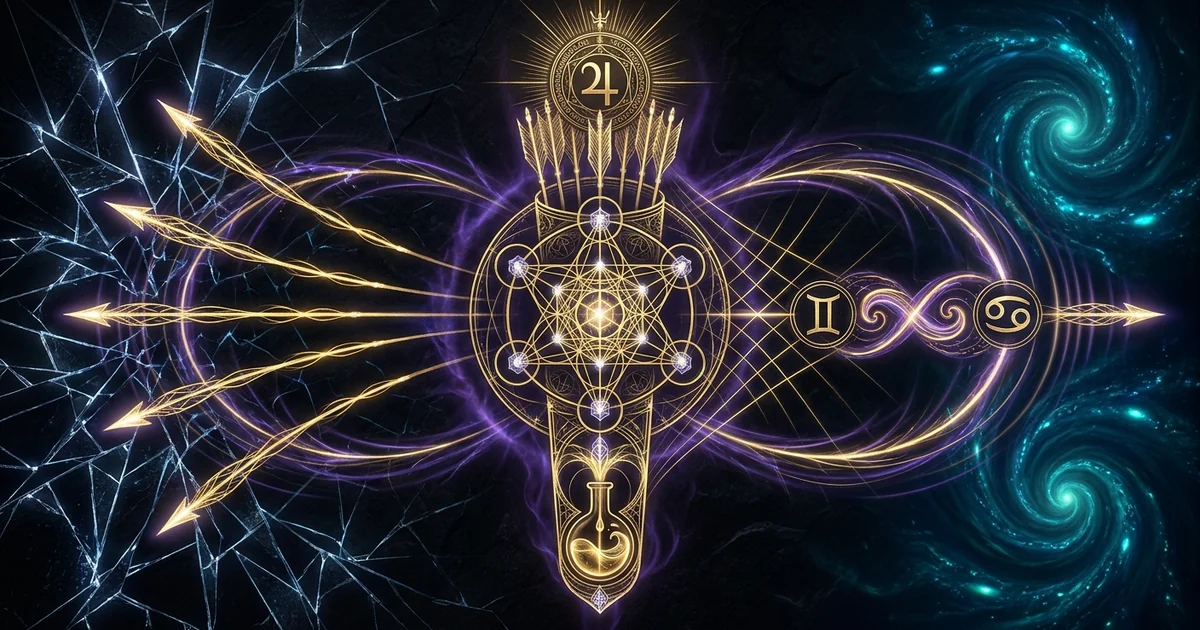
The primary glyph of Punarvasu is the bow and the quiver (tarkash) filled with returning arrows. Unlike the isolated bow of Sagittarius, which releases an arrow toward a singular, transcendent, teleological target, the quiver of Punarvasu contains shafts that, once fired, inevitably return to their source, replenished and sharpened for subsequent flight. This dynamic embodies a closed-loop thermodynamic system of psychic energy:
$$\oint_{\text{Punarvasu}} dS_{\text{prana}} = 0 \quad \longrightarrow \quad \Delta E_{\text{consciousness}} \ge 0$$
Every intentional effort (karma-sankalpa) that misses its mark is retrieved, cleansed of entropic decay, and re-placed within the operational arsenal of consciousness.
This iconography illuminates the teleological trajectory of karmic iteration. In this asterism, repetition is not the neurotic compulsion described by Freud as the death drive (Thanatos), but an evolutionary feedback loop. The soul is afforded multiple iterations to achieve right action.
Under the overarching planetary governance of Guru (Jupiter), the broad philosophical vision of expansion and moral intelligence (sattva) infuses the cyclical return with discernment. Every developmental failure becomes raw epistemic material for subsequent calibration. The arrows return because consciousness cannot deplete its foundational divinity; it only refines its ballistic trajectory until the bullseye of dharma is pierced.
Classical Provenance & Textual Lineage: Vedic Liturgies of the Seventh Asterism
Rigvedic Hymnody: Aditi as the Matrix of the Adityas
In the liturgical stratifications of the Rigveda, Aditi is invoked as both mother and father, as heaven and earth, as that which is born and that which is yet to be generated (Aditir dyauh aditir antariksham aditir mata sa pita sa putrah). She represents the undivided ground of cosmic generation. In hymns addressing the solar deities, the seers do not entreat Aditi for martial conquest, but for the removal of enas (sin, metaphysical debt, or moral fragmentation) and the restoration of light:
$$\text{Aditi} \iff \text{Akhanda-Tattva} \quad (\text{Indivisible Reality Prior to Cosmological Parturition})$$
The Adityas—Varuna, Mitra, Aryaman, Daksha, Bhaga, and their brethren—emerge directly from her oceanic womb, designating Punarvasu as the asterism responsible for sustaining cosmic law. Classical commentators identify the star cluster of Punarvasu with the cosmic dwelling place of these solar principles.
In this Vedic architecture, the asterism functions as an anchor point where celestial order re-manifests following seasonal and cosmic dissolutions. Aditi’s maternal architecture is devoid of possessiveness; she releases her sons into the differentiated cosmos to maintain justice, yet retains the primordial cord through which they draw their structural integrity.
Taittiriya Brahmana: The Sacrificial Architecture of Renewal
The Taittiriya Brahmana (I.5.1) formalizes the liturgical assignment of the lunar mansions to their corresponding devatas, consecrating Punarvasu to Aditi and designating it under the auspicious epithet Punya, meaning fundamentally pure, virtuous, or sanctified. The text delineates the ritual technology through which the Vedic priest re-consecrates the sacred fire (Agnyadheya) when the initial oblation falters or becomes defiled:
पुनर्वसू नक्षत्रम्। अदितिर्देवता। पुनरुत्सन्नं यज्ञमन्वायच्छेते। अदितिर्वे देवानां प्रतिष्ठा। प्रति पुनर्वस्वोस्तिष्ठति। पुनर्नवैति य एवं वेद।
Punarvasū nakṣatram. Aditirdevatā. Punarutsannaṃ yajñamanvāyacchete. Aditirve devānāṃ pratiṣṭhā. Prati punarvasvostiṣṭhati. Punarnavaiti ya evaṃ veda.
“The Nakshatra is Punarvasu. The deity is Aditi. They re-establish the sacrifice that has been dismantled or interrupted. Aditi, verily, is the firm foundation (pratishta) of the gods. He who knows this takes his firm stand in Punarvasu; he returns anew to life and purpose.”
This liturgical formulation establishes that Punarvasu operates as the pratishta (firm spatial foundation) of the cosmos. When the ritual fire fails or the spiritual trajectory of the aspirant is interrupted, Punarvasu provides the altar of cosmic restoration.
The Taittiriya Brahmana underscores that this mansion possesses the specific power known as Charani Shakti—the capacity to achieve stability through righteous movement, renewal, and ethical re-establishment. Through this power, the dismantled sacrifice (utsanna yajna) is realigned with universal Rita.
Hellenistic Syncretism: Castor and Pollux in Sidereal Jyotish
The mapping of Punarvasu to Alpha and Beta Geminorum invites a comparative synthesis between Indo-Aryan sky-religions and classical Mediterranean astrology. In the Hellenistic mythos, Castor and Pollux (the Dioscuri) embody the polarity between the mortal human frame and the immortal soul. Castor, fathered by the mortal Tyndareus, is subject to physical corruption; Pollux, fathered by the immortal Zeus, partakes of ambrosial eternity. When Castor is slain, Pollux bargains with Zeus to share his immortality, creating a cycle where both alternate between the subterranean realm of Hades and the celestial heights of Olympus.
In the sidereal system of Jyotish, as codified by Varahamihira in the Brihat Samhita (Chapter XV) and Parasara in the Brihat Parasara Hora Sastra, this polarity is synthesized through the lens of karmic reincarnation (punarjanma). The twins are not frozen in tragic schism. Instead, through the mediating vessel of Aditi, mortal decay (Mithuna, Air, intellect) is progressively sublimated into immortal spiritual endurance (Karkata, Water, devotion).
Varahamihira classifies Punarvasu as a Chara (movable or transient) mansion imbued with Sattva Guna, indicating that its external mutability is guided by internal spiritual clarity. Its primary socio-cosmic orientation is Artha (material and functional stability), but this wealth is directed toward the maintenance of the sacrificial hearth rather than barren accumulation.
Structural Mechanics & Symbolic Geometry: Spatial Partitioning and Pada Dynamics
The Zodiacal Pivot: The Elemental Shift from Air to Water
The spatial layout of Punarvasu spans a critical zodiacal divide:
[ 20°00' Gemini ] ─────── Air / Budha (Mercury) ───────> [ 00°00' Cancer ]
                                                                 │
                                                       (Qualitative Pivot)
                                                                 ▼
[ 00°00' Cancer ] ────── Water / Chandra (Moon) ───────> [ 03°20' Cancer ]
The first three padas reside within Mithuna (Gemini), a sign ruled by Budha (Mercury). Here, the cognitive apparatus processes reality through analytical categorization, intellectual agility, communicative interchange, and speculative exploration. The final pada crosses the threshold into Karkata (Cancer), ruled by Chandra (the Moon), where the focus shifts toward internal psycho-emotional containment, subjective resonance, and instinctual belonging.
This spatial distribution generates an esoteric dynamic:
$$\text{Rulership Hierarchy} = \underbrace{\text{Guru (Jupiter)}}_{\text{Nakshatra Lord}} \quad \times \quad \begin{cases} \text{Budha (Mercury)} & \text{Padas 1, 2, 3 (Gemini)} \ \text{Chandra (Moon)} & \text{Pada 4 (Cancer)} \end{cases}$$
The friction between Mercury’s dualistic logic and Jupiter’s non-dualistic wisdom (vijnana) is resolved within the first three quarters through intellectual restructuring. However, in the fourth quarter, Jupiter’s transpersonal vision harmonizes directly with the Moon’s reflective consciousness, producing an integrated balance between intellect, emotion, and divine law.
Mercurial Gemini Padas (1–3)
- Zodiacal Span: 20°00’ to 30°00’ Mithuna (Gemini).
- Elemental Modality: Mutable Air (Vayu); analytical, relational, communicative.
- Governing Planetary Dyad: Jupiter (Nakshatra) / Mercury (Rashi).
- Navamsha Trajectories:
- Pada 1: Aries (Mars) – Kinetic initialization of renewal.
- Pada 2: Taurus (Venus) – Material consolidation of resources.
- Pada 3: Gemini (Mercury) – Intellectual categorization of experience.
- Psychological Field: Externalized retrieval of identity; iterative problem-solving; cognitive and discursive processing of trauma.
Lunar Cancer Pada (4)
- Zodiacal Span: 00°00’ to 03°20’ Karkata (Cancer).
- Elemental Modality: Cardinal Water (Jala); absorbent, oceanic, unifying.
- Governing Planetary Dyad: Jupiter (Nakshatra) / Moon (Rashi).
- Navamsha Trajectory:
- Pada 4: Cancer (Moon) – Vargottama and Pushkara Navamsha.
- Psychological Field: Internal emotional synthesis; containment within the Great Mother; psychic regeneration through somatic integration and heart-centered balance (Hridaya).
Analytical Pada Taxonomy: Navamsha Trajectories (Aries to Cancer)
The four padas of Punarvasu construct an evolutionary journey through the initial four archetypes of the zodiacal wheel, tracking the progress of consciousness from kinetic ignition to psychic integration:
[Pada 1: Aries Navamsha]   ──> Kinetic Will & Strategic Mobilization
        │
[Pada 2: Taurus Navamsha]  ──> Material Anchoring & Structural Coherence
        │
[Pada 3: Gemini Navamsha]  ──> Discursive Intellect & Hermeneutic Synthesis
        │
[Pada 4: Cancer Navamsha]  ──> Transpersonal Integration & Maternal Sanctuary (Vargottama)
Pada 1 (20°00’–23°20’ Mithuna: Mesha Navamsha)
Governed by Kuja (Mars), this quarter injects fiery, kinetic determination into an airy, Mercurial environment. The arrow is loosed from the quiver with aggressive forward momentum.
Psychologically, this produces individuals who process recovery through direct action, pioneering campaigns, and strategic mobilization. The intellectual agility of Gemini is here wedded to the operational courage of Aries, prioritizing swift adaptation over prolonged reflection.
Pada 2 (23°20’–26°40’ Mithuna: Vrishabha Navamsha)
Governed by Shukra (Venus), this pada anchors restorative energy within the sensory, material realm. The trajectory of the arrow stabilizes, seeking functional manifestation, aesthetic refinement, and fiscal durability.
The analytical turbulence of Gemini is tempered by the stabilizing inertia of Taurus, predisposing this pada toward the material reconstitution of resources, domestic preservation, and the cultivation of enduring value systems (artha).
Pada 3 (26°40’–30°00’ Mithuna: Mithuna Navamsha)
Governed by Budha (Mercury), this pada constitutes a Vargottama Navamsha within the sign of its rashi ruler. This dynamic intensifies intellectual activity, discursive dialogue, and systemic cataloging.
Here, the focus shifts toward hermeneutic restoration: the rewriting of personal narrative, the repair of broken communications, and the intellectual codification of philosophical systems. It produces potent literary, mathematical, and linguistic capacity, though it can risk hyper-rationalization if disconnected from visceral feeling.
Pada 4 (00°00’–03°20’ Karkata: Karkata Navamsha)
Governed by Chandra (the Moon), this pada represents an energetic climax within the asterism, operating as both Vargottama and Pushkara Navamsha. Here, intellectualization yields to deep emotional containment.
The arrow returns to rest within the quiet darkness of the quiver. It shifts from mental calculation to intuitive communion, establishing a direct conduit to the non-dual maternal sanctuary of Aditi, where deep-seated psychological wounds achieve spontaneous integration.
Pushkara Navamsha and Vargottama Mechanics in Pada Four
The esoteric potency of Punarvasu’s fourth pada rests on its double-sanctification within the technical architecture of Parashari Jyotish. Because it resides between 00°00’ and 03°20’ Karkata in both the Rashi (D1) and Navamsha (D9) charts, it achieves Vargottama status—a condition granting exceptional stability, purity of expression, and resilience to the graha situated therein.
Simultaneously, this precise arc constitutes a Pushkara Navamsha, an astrological zone that confers extraordinary nourishment, regenerative grace, and the capacity to transmute severe karmic affliction into spiritual illumination.
PUNARVASU PADA FOUR: 00°00' - 03°20' KARKATA
  ┌───────────────────────────────────────┴───────────────────────────────────────┐
  ▼                                                                               ▼
[ Vargottama Status ]                                                   [ Pushkara Navamsha ]
Rashi (D1) = Cancer                                                     Nourished by the subtle
Navamsha (D9) = Cancer                                                  waters of Pushkara-Bhaga;
Indicates unwavering structural coherence                               regenerates structural debility
and non-corruptible identity.                                           into self-healing agency.
In the mechanics of predictive Jyotish, any planet occupying this 3°20’ zone—even one afflicted or inherently malefic—undergoes functional redemption:
$$\text{Graha}_{\text{afflicted}} + \text{Punarvasu Pada 4} \xrightarrow{\text{Vargottama} ,+, \text{Pushkara}} \text{Transmuted Functionality} \quad (\text{Negentropic Regeneration})$$
The celestial waters of Cancer, filtered through the spiritual discernment of nakshatra-lord Jupiter, neutralize psychological toxicity. This pada functions as a self-clearing karmic portal.
It preserves the continuity of consciousness across severe elemental transitions, allowing the soul to navigate psychic crises without losing its foundational link to the divine source.
Psychological Dynamics & Operational Praxis: The Archetype of the Eternal Return
The Wounded Healer and the Regenerative Instinct
From the vantage point of clinical analytical psychology, the native structured by Punarvasu possesses an innate, resilient psychological architecture. This disposition manifests as an archetypal refusal to accept structural finality, bankruptcy, or defeat.
Where other psychic typologies succumb to nihilistic surrender when faced with catastrophe, Punarvasu mobilizes an instinctual certainty that the situation can be redeemed, reconstructed, and purified.
“The archetype of renewal represents an unconscious healing process which sets in when conscious adaptation has failed. In these moments, the psyche falls back upon the maternal ground—not in a regressive escape from reality, but to re-contact the creative matrix from which new forms of life may be crystallized. The ego is restored precisely because it has touched an unconditioned stratum of the collective unconscious.” — Marie-Louise von Franz, The Problem of the Puer Aeternus (1970)
This psychological dynamic aligns directly with the mythic architecture of Aditi. The Punarvasu consciousness recognizes that failure is simply an incomplete developmental trajectory.
However, this architecture carries its own shadow. The compulsion to rehabilitate, rebuild, and re-attempt can trap the individual in cycles of unproductive perseverance. When unresolved, it manifests as an inability to accept legitimate endings, predisposing the native to tolerate dysfunctional relationships, bankrupt enterprises, and outworn belief systems under the assumption that yet another redemptive effort will magically restore structural harmony.
   [ Latent Trauma / Crisis ]
               │
               ▼
   [ Psychological Fallback to Aditi Matrix ]
               │
       ┌───────┴───────┐
       ▼               ▼
[ Mature Integration ]  [ Shadow Pathology ]
Conscious renewal and   Compulsive rehabilitation,
evolutionary return.    denial of finality, and the
                        sunk-cost trap.
Ego-Reconstitution: Escaping the Sunk Cost Fallacy
A primary existential hurdle for the Punarvasu native is navigating the psychological friction between cyclical renewal and the sunk cost fallacy. Because the foundational mythos of the mansion promises that the arrow will return, the ego often assumes that all investments—emotional, financial, or philosophical—are inherently redeemable.
This generates a psychological vulnerability where individuals waste vital prana attempting to revitalize necrotic systems that ought to be consigned to the transformative fires of Rudra.
Maturation under this asterism requires recognizing that the quiver of Aditi returns purified potential, not historical forms:
$$\text{Trajectory of Return} \neq \text{Reproduction of Past Forms} \quad \longrightarrow \quad \text{Sublimation into Higher Epistemic Paradigms}$$
The individual must learn conscious disidentification. The arrow returns to the quiver, but the archer must release the expectation that it must be aimed at the identical, failed target.
When this threshold of psychological integration is crossed, the native ceases running cyclical rescue missions for obsolete identities. Instead, they become an agile, unattached agent of authentic renewal, moving through the world with lighthearted simplicity (saralata) and profound internal stability.
Interpretive Diagnostic: Grahas Tenanted in Punarvasu
When evaluating planetary dynamics within Punarvasu, the Jyotishi must trace how the specific planetary energy interacts with this restorative current:
Surya (Sun) in Punarvasu
The ego-ideal reconstitutes through crises of identity. The father figure or authority dynamic undergoes a cycle of dissolution followed by moral elevation.
The native possesses an innate capacity to rebuild social standing, executive sovereignty, and professional trajectory following public or vocational collapse, leaning on personal integrity and spiritual grace.
Chandra (Moon) in Punarvasu
The emotional apparatus (manas) is tuned to profound somatic and psychological self-repair. These natives make exceptional counselors, psychoanalysts, and holistic healers, as their subjective emotional equilibrium is sustained by the maternal waters of Aditi.
The primary shadow involves emotional boundary dissolution and prolonged maternal codependency.
Mangala (Mars) in Punarvasu
Martial aggression and strategic intent are gentled by Jupiterian ethics. The warrior archetype does not fight for sadistic conquest, but for the restitution of righteous boundaries and the defense of the defenseless (dharma-yuddha).
Physical energy demonstrates cyclical patterns: periods of concentrated output alternating with restorative withdrawals.
Budha (Mercury) in Punarvasu
Exceptional intellectual architecture, linguistic dexterity, and hermeneutic intelligence. Highly favorable for scholars, coders, translators, and logicians who must debug fragmented architectures.
The mind excels at structural synthesis, organizing fractured data points into coherent philosophical or technical models.
Guru (Jupiter) in Punarvasu
Residing in its own nakshatra, Jupiter displays its highest philosophical clarity and benevolent agency, particularly when transitioning into Pada 4 (where it meets its sign of exaltation in Cancer).
The native acts as a spiritual sanctuary for others, dispensing deep ethical wisdom, transpersonal guidance, and intellectual hospitality without dogmatic rigidity.
PLANETARY MANIFESTATIONS IN PUNARVASU:
Surya   ──> Sovereign Reconstitution & Reputational Resurgence
Chandra ──> Deep Psychic Self-Repair & Instinctual Sanctuary
Mangala ──> Ethical Boundary Defense & Calibrated Martial Prana
Budha   ──> Hermeneutic Synthesis & Structural System Debugging
Guru    ──> Supreme Transpersonal Wisdom & Boundless Ethical Grace
Philosophical Synthesis & Macrocosmic Correspondence: Hermetic Rhythm and Cybernetic Feedback
The Principle of Rhythm: Compression and Decompression of Cosmic Prana
At the philosophical summit of esoteric analysis, Punarvasu expresses the Hermetic Principle of Rhythm: “The measure of the swing to the right is the measure of the swing to the left; rhythm compensates.” Within the macrocosmic architecture, the severe psychic compression, existential dread, and perceptual fragmentation experienced in Ardra necessitates a corresponding decompression into grace, light, and integration within Punarvasu.
$$\Delta \Phi_{\text{Ardra}} \ (\text{Entropy/Rupture}) \quad \xrightarrow{\text{Hermetic Compensation}} \quad \Delta \Phi_{\text{Punarvasu}} \ (\text{Negentropy/Renewal})$$
This oscillation represents the heartbeat of the cosmos—the systolic expulsion of divine consciousness into differentiated material manifestation, and the diastolic drawing back of that dispersed prana into the unconditioned maternal center.
Punarvasu proves that spiritual evolution is not a Euclidean straight line, but a spiral. Consciousness loops backward across previous coordinates, not to remain trapped in regression, but to integrate neglected fragments of the self before initiating its next ascent.
It provides an experiential encounter with apavarga—the release from karmic accumulation achieved when the soul recognizes that every descent into density contains an encoded route back to unconditioned space.
The Bow as Cybernetic Trajectory: Feedback Loops of Karma
From the vantage point of cybernetic metaphysics, Punarvasu operates as an automated feedback correction mechanism. The human nervous system, moving through physical reality, constantly emits outputs—actions, volitions, desires (karma-sankalpa).
These outputs navigate an entropic, noisy external environment where they inevitably encounter systemic friction, drift, and structural distortion:
[ ARCHER: Intentional Soul / Sankalpa ]
               │
        (Initial Volition)
               ▼
[ ARROW: Kinetic Trajectory through Samsara ]
               │
    (Noise, Resistance, Drift)
               ▼
[ TRAJECTORY DEFLECTION: Incomplete Realization ]
               │
    (Aditi-Vessel Retrieval)
               ▼
[ QUIVER: Realignment, Calibration, & Cleansing ]
               │
       (Re-Release Cycle)
               ▼
[ REFINED TARGETING: Evolution toward Dharma ]
In an unbuffered metaphysical ecosystem, erroneous action yields compound errors, accelerating systemic breakdown. Punarvasu acts as the cybernetic buffer. It collects deflected intentionality, runs it through Aditi’s maternal diagnostic field, eliminates corrupting karmic noise, and returns the vector to the conscious agent.
The returning arrow demonstrates that karma is fundamentally an educational feedback loop rather than a punitive mechanics of damnation. Consciousness is structurally supported to calibrate its aim until action aligns seamlessly with cosmic law.
Macrocosmic Position in the 27 Nakshatra Evolutionary Spiral
Within the broad evolutionary arc mapped out across the zodiac, Punarvasu represents the ultimate threshold of individualized personality integration. The first six asterisms—from the primordial spark of Ashwini through the transformative crucible of Ardra—track the emergence, materialization, and eventual destabilization of the individualized ego.
Punarvasu serves as the cosmic harbor where this battered, individuated self is repaired, integrated, and blessed by the divine mother before stepping across the threshold into Pushya nakshatra’s spiritual nourishment.
[ Ashwini to Mrigashira ] ──> Primordial Emergence & Sensory Differentiation
           │
[ Ardra ]                 ──> Traumatic Destabilization of the Ego-Complex
           │
[ PUNARVASU ]             ──> Homeostatic Repair, Reconstitution, & Divine Sanctuary
           │
[ Pushya ]                ──> Organic Spiritual Crystallization & Communal Nourishment
Without the regenerative sanctuary provided by Punarvasu, consciousness would enter Pushya in a state of exhaustion, incapable of sustaining the communal and spiritual responsibilities governed by Brihaspati. Punarvasu ensures that the vessel is structurally resilient, clean, and filled with inexhaustible light.
It functions as the cosmic quarantine zone where temporal wounds are bathed in eternal awareness, preparing the initiate for mature spiritual realization within the macrocosmic order.
- Zodiacal Coordinate: 20°00’ Gemini (Mithuna) to 03°20’ Cancer (Karkata)
- Presiding Divinity: Aditi (Cosmic Mother, Goddess of Boundless Space)
- Vimshottari Planetary Lord: Guru (Jupiter / Brihaspati)
- Symbolic Glyphs: Bow and Quiver of Returning Arrows; Architectural Dwelling / Hearth
- Primary Guna Classification: Sattva (Sub-attributes: Rajas-Sattva)
- Purushartha Focus: Artha (Righteous Material Stability and Functional Manifestation)
- Elemental Attribution: Vayu (Air - Padas 1–3) transitioning to Jala (Water - Pada 4)
- Yoni (Animal Archetype): Marjara (Female Cat - Indicating Independence, Domestic Grace, Elastic Agility)
- Physiological Systems: Fingers, Nose, Respiratory Tract, Intercostal Musculature, Pericardium
- Directional Orientation: Chara (Movable / Ephemeral, Supporting Dynamic Renewal)
- Esoteric Sound Vibrations (Padas 1–4): Ke (के), Ko (को), Ha (हा), Hee (ही)
Frequently Asked Questions: Resolving Advanced Esoteric Paradoxes
How does the mortality-immortality split of Castor and Pollux reconcile with Aditi’s non-dual space?
The apparent tension between the dualistic Greek mythos of Castor and Pollux and the non-dualistic Vedic framework of Aditi dissolves when examined through the lens of Adhyatmic hermeneutics. Castor represents the mortal body (annamaya-kosha), which belongs to the transient, mutable winds of Gemini. Pollux represents the immortal witness consciousness (atman), anchored in the transpersonal waters of Cancer.
Aditi does not obliterate this polarity; she provides the boundless space (akasha) within which this dialectic can unfold without tearing the psyche apart:
$$\text{Mortal Form (Castor)} \ \oplus \ \text{Immortal Witness (Pollux)} \quad \subset \quad \mathcal{H}_{\text{Aditi}} \ (\text{The Boundless Whole})$$
Instead of an irreconcilable conflict between flesh and spirit, Punarvasu organizes them into an alternating dance of conscious evolution. The mortal mind regularly journeys down into the underworld of material trial, gathers experiential wisdom, and returns to share that ambrosia with the immortal self.
Aditi is the cosmic womb that holds both the mortal son and the immortal god. She resolves dualistic tension by demonstrating that both the perishable vessel and the eternal witness serve the self-revelation of the Divine.
       ADITI'S NON-DUAL VESSEL
  ┌────────────────┴────────────────┐
  ▼                                 ▼
CASTOR: The Perishable Frame      POLLUX: The Immortal Witness
(Mutable Air / Annamaya Kosha)     (Cardinal Water / Atmanic Light)
  │                                 │
  └───────────────┬─────────────────┘
                  ▼
         Dynamic Synthesis:
The temporal experience of mortal trial
  sublimated into transpersonal wisdom.
What is the operational distinction between the regenerative mechanics of Rohini and Punarvasu?
While both Rohini and Punarvasu are classified as deeply generative and restorative mansions, their structural mechanics operate through entirely distinct cosmogenic channels:
ROHINI (Generative Fertility)          PUNARVASU (Architectural Restoration)
Deity: Prajapati / Brahma              Deity: Aditi
Vector: Linear, organic proliferation   Vector: Circular, homeostatic retrieval
Domain: Primary creation from seed     Domain: Re-creation from ruins
Energy: Sensual, luxuriant, earthly    Energy: Ethical, architectural, transcendent
Rohini is ruled by Prajapati (the Creator) and governed by the Moon within its earthy exaltation sign of Taurus. Its fertility is organic, biological, vegetative, and luxuriant. Rohini generates de novo; it sprouts primary creative energy, drawing souls down into the intoxicating beauty of material embodiment and sensory enjoyment (kama).
Conversely, Punarvasu is ruled by Aditi and governed by Jupiter. Its fertility is architectural, ethical, and reconstructive. Punarvasu does not generate primary material manifestation; it reconstitutes forms that have been broken, defiled, or dismantled by existential crisis.
Rohini is the fresh blossom bursting from rich spring soil; Punarvasu is the arrow retrieved from the battlefield, washed clean of blood, straightened, and placed back in the quiver. Rohini operates through sensual attraction; Punarvasu operates through spiritual renewal and homeostatic recalibration.
Why is Pada Four considered fortified rather than destabilized by its elemental cusp position?
In standard Jyotish mechanics, the threshold between an air sign and a water sign can occasionally introduce psychological destabilization, especially when nearing absolute junction boundaries. However, Pada Four of Punarvasu (00°00’ to 03°20’ Cancer) avoids this volatility because it does not cross a true Gandanta point.
The severe, perilous Gandanta borders are exclusively reserved for the transitions from Water to Fire (Cancer-Leo, Scorpio-Sagittarius, Pisces-Aries), where the psychic structure experiences a radical elemental dissolution without intermediate support:
$$\text{Gandanta Dissolution} \iff \text{Water} \longrightarrow \text{Fire} \quad (\text{Jala-Agni Junction})$$
$$\text{Punarvasu Transition} \iff \text{Air} \longrightarrow \text{Water} \quad (\text{Vayu-Jala Marriage})$$
Instead of encountering an entropic firestorm, Pada Four of Punarvasu transitions from the mental air of Gemini into the nourishing waters of Cancer. This marks the descent of analytical intellectual concepts into the clarifying waters of felt emotional realization.
Furthermore, this specific pada secures both Vargottama status (occupying Cancer in both D1 and D9) and Pushkara Navamsha sanctification. The potential instability of the planetary shift from Mercury to the Moon is held firmly within Jupiter’s overarching nakshatra rulership.
Far from being weakened, this borderland functions as a fortified esoteric portal. In this quiet harbor, the fractured, discursive intellect dissolves into the deep, maternal oceanic matrix of Aditi, achieving profound, spontaneous, and lasting psychological integration.