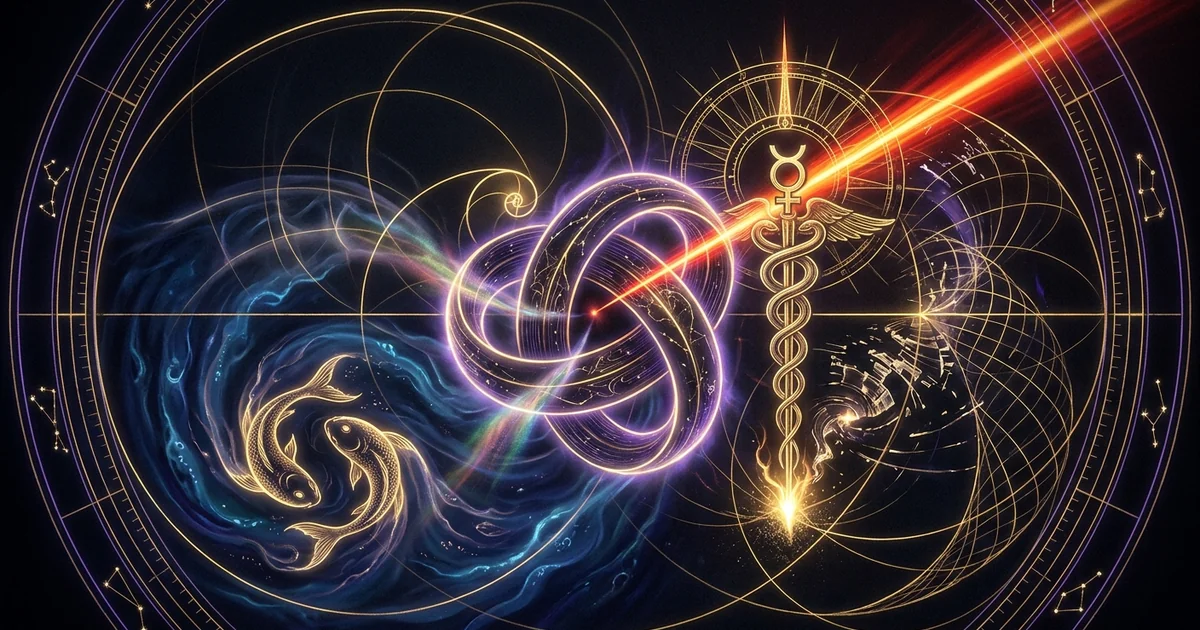
Nakshatra Revati: Sacred Vedic Lunar Mansion - Guide
Archetypal Thesis & Systemic Paradigm: The Terminal Matrix of Consciousness
The 27th Vector: Teleology of the Sidereal Zodiac
Positioned between 346°40’ and 360°00’ of the sidereal ecliptic within the sign of Pisces (Meena), Revati operates as the definitive terminal coordinate of the lunar zodiac. In the structural topology of the 27 nakshatras jyotish, this mansion does not signify a passive cessation of momentum, but rather the psycho-cosmic threshold of thermodynamic entropy and teleological convergence. The word Revati derives from the Sanskrit root Revat, denoting wealth, abundance, and luminous transcendence; yet, within the esoteric architecture of Vedic cosmology, this wealth is not mundane capital, but the spiritual harvest accumulated across the soul’s transmigratory trajectory through the prior twenty-six lunar mansions.
As the terminal locus of the zodiac, Revati governs the structural dissolution of the crystallized ego-matrix. Where individual consciousness underwent differentiated physical emergence at the zero-point of the ecliptic, Revati executes the absolute surrender of individual form back into the primordial waters of the unmanifest continuum. In understanding the revati nakshatra vedic astrology meaning, the adept must recognize that this coordinate functions as a cosmic recycling mechanism: an archetypal digestive chamber where systemic inputs (karmas, vasanas, and samskaras) are refined, distilled, and evaluated before the ontological ignition of a subsequent evolutionary cycle.
The teleology of this 27th vector enforces an irrepressible drive toward unity consciousness. Planetary energies situated within this terminal sector lose their terrestrial rigidity, trading operational utility for transpersonal communion. The ego encounters its ultimate horizon here; the localized narrative constructed through preceding signs collapses under the weight of universal empathy, rendering this station both extraordinarily liberating for the spiritual aspirant and radically destabilizing for the psyche tethered to empirical certainty.
Revati spans precisely 346°40’ to 360°00’ (or 16°40’ to 30°00’ Meena/Pisces) within the sidereal zodiac, calculated using the standard Chitra Paksha (Lahiri) Ayanamsha. It occupies the final quadrant of the water triplicity (Jala Tattva) and belongs entirely to the Sattvic guna quadrant of the third evolutionary cycle (from Moola to Revati).
- Zodiacal Span: 346°40’ – 360°00’ Sidereal Longitude.
- Ruler (Graha): Budha (Mercury).
- Ruler of Sign (Rashi Lord): Guru (Jupiter).
- Presiding Divinity: Pūṣan (Pushan).
- Primary Element: Akasha (Ether).
- Navamsha Harmonic Sequence: Dhanu (9°00’–10°00’ Jupiter), Makara (10°00’–11°00’ Saturn), Kumbha (11°00’–12°00’ Saturn), Meena (12°00’–13°20’ Jupiter / Vargottama).
The Mercurial-Jupiterian Interface: Analytical Logos in the Unbounded Ocean
The functional tension within Revati stems from its layered planetary rulership. While embedded completely within the expansive, non-dual, Jupiterian maritime field of Meena, the nakshatra itself is governed by Budha (Mercury)—the deity of analytical discernment, commerce, transactional linguistics, and neural pathway calibration. This juxtapositional interface establishes a profound paradox: the planetary representative of discrete categorization and finite logic (Budha) is forced to execute its operations within the boundless, unquantifiable waters of the cosmic ocean (Guru).
In conventional astrological taxonomy, Mercury suffers its planetary depression or debilitation (Neecha) at 15° Pisces, terminating immediately prior to the ingress into Revati at 16°40’. Far from a cosmic error, this positional dynamic indicates that the profane, calculating intellect must undergo a ritual death before entry into Revati’s higher sanctum. Within this nakshatra, Mercury’s capacity for analytical categorization is transmuted into hyper-dimensional synthesis and intuitive gnosis. The transactional Logos no longer computes exchange values between discrete commodities; instead, it tracks the interpenetration of all phenomena across the karmic matrix.
This intersection yields an exceptional psychic apparatus. When Budha operates through Revati, the nervous system becomes an ultra-sensitive transducer of transpersonal fields. The native possesses an instinctual capacity to translate subtle metaphysical states, symbolic visions, and emotional currents into coherent linguistic or artistic structures. If the Jupiterian matrix lacks sufficient structural ballast, this same interface risks overwhelming the cognitive centers, producing dissociative states, neurochemical exhaustion, and severe boundary permeability where the pain of the collective unconscious is involuntarily processed through the subject’s biological substrate.
Threshold Mechanics of the Final Moksha Station
Vedic astrology organizes the human experience along four fundamental Purusharthas—Dharma, Artha, Kama, and Moksha. Revati represents the absolute apex of the Moksha houses and constellations, functioning as the fourth and final Moksha nakshatra within the terminal water triplicity (following Ashlesha, Jyeshtha, and completing with Revati). In each of these water mansions, an evolutionary crisis occurs: Ashlesha initiates the crisis of personal ego-attachment to the astral plane; Jyeshtha demands the renunciation of worldly authority and individual sovereignty; Revati enforces the systematic annihilation of the existential illusion of separation itself.
This threshold mechanism processes the deepest strata of Sanchita Karma (the total reservoir of unmanifest actions accumulated over incarnations). At Revati, the soul is presented with its cosmological balance sheet. The governing modality is pastoral, gentle, and deeply restorative, operating under the cosmological law of reconciliation. The soul does not conquer this threshold through martial force or intellectual contestation, but through total surrender (Prapatti). It is the surrender of the drop returning to the ocean, an ontological transition that necessitates the absolute shedding of personal history.
Consequently, planets situated within Revati are compelled to act as agents of transpersonal release. A natal Sun here dissolves autocratic pride into collective service; a natal Moon experiences the ecstatic yet agonizing sensitivity of universal suffering; a natal Saturn dismantles physical architectures to reveal the impermanence of material form. Revati demands that the individual recognize their life as an ephemeral chapter within a vast, unfolding macrocosmic drama, bringing the karmic ledger to zero before the next genesis.
Classical Provenance & Textual Lineage: The Pushan Mystery and Vedic Cosmography
The Rigvedic Epithets of Pushan: Psychopomp and Solar Shepherd
The classical foundation of Revati is anchored in the Vedic divinity Pushan (Pūṣan), an ancient solar entity distinguished from the fiery, martial radiance of Surya or the world-measuring sovereignty of Vishnu. In the Rigveda Samhita, Pushan is invoked with distinct, intimate epithets: he is the shepherd of the cosmos, the master of lost things, the guardian of travelers, and the divine psychopomp who escorts departed souls across the treacherous abysses separating the realms of mortals, ancestors, and the devas.
“1. Connect us, Pūṣan, with a guide who knows the path, who will not stray, who leads us straight to our desire.
2. Pūṣan goes alongside our cattle; Pūṣan preserves our steeds; Pūṣan gathers for us the spiritual store.
3. Let no one perish, Pūṣan; let no creature fall into a pit; let nothing be harmed; return what was lost safely to our fold.”
— Rigveda Samhita, Mandala 6, Sukta 54 (Trans. Academic Archival Lineage)
Pushan is fundamentally the solar deity of pastoral preservation and safe passage. Unlike other solar deities who burn with blinding, unilateral intensity, Pushan’s light is diffuse, protective, and tender—a golden twilight illumination suited for guiding the disoriented. Classical hymns depict him as toothless, consuming a simple gruel of crushed grains (Karambha), an iconographic detail of immense esoteric significance: Pushan represents an aspect of divine power stripped of all predatory, devouring capacity. He does not consume the soul; he nurtures it, gently sustaining biological and psychic vitality through the darkest transitional passages of existence.
As the archetypal psychopomp, Pushan mirrors planetary archetypes across Indo-European traditions, functioning simultaneously as Hermes Psychopompos and Anubis. In Vedic funeral liturgies, it is Pushan who is supplicated to grasp the hand of the deceased and guide them over the great, trackless waters of death. He possesses knowledge of the hidden, celestial pathways (Devayana and Pitriyana), ensuring that the traveler does not deviate into the astral void. This primary theological role explains why Revati nakshatra governs physical travel, deep oceanic voyages, trans-dimensional meditations, and the terminal transition out of physical embodiment.
Taittiriya Brahmana and the Nakshatra Ishti Rites
In the liturgical protocols of the Taittiriya Brahmana (3.1.2), the sacrificial system allocates specific Ishtis (offerings) to each lunar mansion to harmonize the terrestrial ecosystem with cosmological intelligences. The Brahmana explicitly prescribes offerings to Pushan under the auspices of Revati for the purpose of preserving cattle (Pashu), securing safe pasture, and safeguarding caravans traversing wild landscapes.
Within the esoteric hermeneutics of the Brahmanas, the term Pashu carries a double meaning. While exoterically signifying bovine livestock—the primary metric of pastoral wealth in Vedic culture—esoterically, Pashu denotes the individual human soul bound within the cords of worldly illusion. By performing sacrifices to Pushan during Revati ascendance, the Vedic priests were not merely asking for the protection of biological cows, but were supplicating the supreme guardian to maintain the spiritual coherence of bound souls undergoing the disorienting migrations of existence.
       [ Vedic Pashu: The Bound Soul ]
                      │
           (Encounters Maya/Void)
                      ▼
[ Invocation of Pūṣan / Revati Nakshatra Ishti ]
                      │
           (Safe Navigation Across Waters)
                      ▼
     [ Cosmic Integration / Mukti (Moksha) ]
The liturgical texts delineate Revati’s energetic character as Kshirakshira (flowing with milk), emphasizing an inexhaustible maternal nourishment. The Taittiriya Brahmana aligns Revati with the power of Poshana Shakti—the structural capacity to foster nourishment, flourishing, and universal sustenance. This power operates at an elemental level: Revati is the fertile silt deposited at the delta of the cosmic river, containing all the nutritive essences generated by the preceding nakshatras, ready to nourish the seed that will be cast into the void of the Aries ingress.
Puranic and Medieval Commentaries: From Parasara to Varahamihira
Medieval astrological literature codifies the observations of the early Vedic rishis into functional predictive parameters. In the Brihat Parashara Hora Shastra (BPHS), Sage Parashara assigns the rulership of Revati to Mercury, classifying it as a Mridu (soft, tender, gentle) nakshatra. Parashara dictates that this mansion is eminently suited for creative consecration, musical performance, wearing new ornaments, marriage rituals, beginning journeys, and administering restorative medicines. Parashara’s framing highlights Revati’s role as the preserver of life’s refined, peaceful, and harmonious aspects.
Concurrently, Acharya Varahamihira, in his seminal Brihat Samhita (Chapters 14 and 15), assigns Revati to the geographical governance of maritime regions, fishermen, port workers, aquatic products, long-distance navigators, traders, and scholars of complex metaphysical sciences. Varahamihira emphasizes the dual nature of Revati’s manifestations:
“Under the dominion of Revati fall the aquatic animals, sea merchants, pearls and sea products, perfumes, flowers, and all those who guide travelers on long pathways.”
— Brihat Samhita, Ch. 15, v. 22 (trans. M.R. Bhat)
However, Varahamihira injects a note of technical caution into this benign image. While categorized as Mridu, the concluding degrees of Revati are classified as one of the most perilous junctures in the zodiac—the Riksha Sandhi or Nakshatra Gandanta. Medieval commentators on the Jataka Parijata and Phaladeepika echo this polarity: while Revati provides affluence, aesthetic sensitivity, and high moral character, an afflicted placement near the boundary brings severe constitutional frailty, susceptibility to infectious water-borne diseases, psychological disorientation, and profound disruptions during early childhood.
Structural Mechanics & Symbolic Geometry: Glyphs, Padas, and the Gandanta Cusp
The Swimming Fish and the Mridanga: Dual Symbols of Cyclical Dissolution
The esoteric architecture of Revati is preserved in its traditional symbols: the fish swimming / pair of drumsticks symbol. The predominant glyph portrays two fish swimming in counter-directional unity—a symbol shared with the broader sign of Pisces, yet elevated within Revati to its ultimate harmonic resolution. The fish represents the biological entity perfectly submerged within the waters of consciousness, navigating the unmanifest depths without drowning.
       (Primordial Waters / Void Continuum)
                      ▲
     ◄── [ Fish A ] ────── [ Fish B ] ──►
     (Descending/Karmic)  (Ascending/Evolutionary)
                      ▼
           [ Cosmic Ocean of Meena ]
The dual directionality of the swimming fish illustrates the cosmic tension between Pravritti (the path of worldly engagement and soul descent) and Nivritti (the path of inward renunciation and soul return). One fish navigates downward into the material density of manifestation, bearing the evolutionary memories of the entire cycle; the other swims upward toward the transcendent origin point, carrying the distilled nectar of consciousness back to the source. Together, they form a closed loop of continuous karmic renewal, preventing the dissolution of the soul from becoming a catastrophic annihilation, preserving its essential spiritual blueprint across the oceanic void.
The secondary symbol, the Mridanga (a double-headed classical drum), or kellaku (a pair of percussion sticks used to keep time), alters the interpretive lens from spatial ocean to temporal cadence. The drum is the instrument of Tala (rhythm) and Kala (cosmic time). In Hindu cosmogony, the dissolution of the universe is accompanied by the beat of Shiva’s Damaru, marking the cessation of the Mahayuga. The drumsticks of Revati indicate that the rhythm of the cosmic dance has arrived at its final bar. The drum announces the final cadence: the measure of all experiences across the 27 lunar mansions has concluded, the final chord resonates, and the dancer pauses in the silence preceding the primordial strike that initiates a new cosmic day.
Padas 1 through 4: Harmonic Trajectories Across the Final Navamshas
A rigorous astrological assessment requires deconstructing Revati into its four constituent Padas (quarters), each occupying an arc of 3°20’ and projecting the primary energy into a distinct ninth-harmonic division (Navamsha). These Padas delineate a process of spiritual distillation, taking the psyche through a four-stage process of cosmic release:
[ Revati: 16°40' - 30°00' Meena ]
  ├── Pada 1: 16°40' - 20°00' Meena (Sagittarius Navamsha) ──> Expansion & Right Action
  ├── Pada 2: 20°00' - 23°20' Meena (Capricorn Navamsha)   ──> Material Structure & Duty
  ├── Pada 3: 23°20' - 26°40' Meena (Aquarius Navamsha)    ──> Altruism & Gnostic Transmission
  └── Pada 4: 26°40' - 30°00' Meena (Pisces Navamsha)      ──> Vargottama Absolute Dissolution
-
Pada 1 (16°40’ – 20°00’ Pisces): Sagittarius Navamsha. Governed by Jupiter. This quarter imbues the native with an elevated, optimistic sense of Dharma. The intellect of Mercury merges with the foundational wisdom of Sagittarius, creating an expansive philosophical consciousness. Individuals with strong placements here display exceptional philanthropic impulses, an innate affinity for classical sciences, and an enthusiastic trust in the protective agency of providence. It represents the active, righteous distribution of accumulated spiritual wealth.
-
Pada 2 (20°00’ – 23°20’ Pisces): Capricorn Navamsha. Governed by Saturn. Here, the unbounded oceanic nature of Revati encounters structural containment and material limitation. This Pada introduces an intense sense of systemic responsibility, structural pragmatism, and karmic reckoning. Individuals with planets here are tasked with grounding Revati’s mystical compassion into functional institutions, palliative hospices, and disciplined philanthropic work. It counteracts the chronic floatiness of Pisces, demanding that the native honor earthly time and structural duty before transcendence is granted.
-
Pada 3 (23°20’ – 26°40’ Pisces): Aquarius Navamsha. Governed by Saturn and Uranus (in transpersonal astrology), this quarter operates as a matrix of collective altruism, metaphysical analysis, and intellectual non-attachment. The analytical nature of Mercury functions here with detached precision, viewing human struggle through a systemic, historical lens. This is the Pada of the mystic scholar, the social reformer, and the occultist who operates without personal ego, distributing knowledge and resources for the upliftment of the collective.
-
Pada 4 (26°40’ – 30°00’ Pisces): Pisces Navamsha (Vargottama). Governed by Jupiter. This terminal Pada constitutes the most spiritually profound—and materially hazardous—sector of Revati. Being Vargottama (occupying the sign of Pisces in both the Rashi and Navamsha charts), its energetic potency is concentrated to an absolute degree. This quarter demands total ego-dissolution. Planetary energies here are stripped of physical anchor points; they function entirely within transpersonal, psychic, and devotional realms. It produces visionary mystics, prophetic artists, and profound renunciants, but carries an acute risk of systemic disassociation, extreme biological fragility, and complete detachment from worldly affairs.
The Abhukta Moola / Revati-Ashwini Gandanta: The Void Boundary
The concluding degree of Revati’s fourth Pada (specifically the final 48 arcminutes, spanning 29°12’ to 30°00’ Pisces) constitutes the critical Rashi-Nakshatra Gandanta—the dangerous spiritual node where the terminal water sign and lunar mansion meet the initial fire sign and nakshatra of the next cycle (Ashwini in Aries). This juncture represents an absolute spatial, elemental, and temporal discontinuity:
The Gandanta is a void boundary—an untamed, non-dimensional fissure in the fabric of the sidereal zodiac. Here, the element of Water (Jala) is annihilated by the emergence of the primordial Fire (Agni). In the physical body, this interface corresponds to the transition between the soles of the feet (governed by Pisces) and the crown of the head (governed by Aries) in the universal Kalapurusha—a cyclical interface where the cosmic entity loops back upon itself.
Planets positioned precisely within this Gandanta zone, historically termed Abhukta Moola when associated with structural family karma, face severe evolutionary trials. The biological matrix undergoes an existential recalibration: the native may feel like an alien to terrestrial survival, experiencing acute anxiety, physical sensitivities, or sudden structural upheavals in early life.
The individual’s life trajectory inevitably demands a radical sacrifice: an old lineage pattern, psychological identity, or ancestral burden must be fully experienced, processed, and buried. Only through this conscious death can the transcendent, non-local intelligence of Pushan guide the soul safely across the abyss into the dynamic creative spark of Ashwini.
Psychological Dynamics & Operational Praxis: Archetypal Integration and Clinical Manifestation
The Rescuer-Martyr Complex: Pathological Boundary Permeability
Within the clinical paradigm of depth astropsychology, individuals exhibiting dominant Revati placements (particularly the Ascendant, Moon, or personal planetary clusters) frequently present with severe boundary permeability. Because Revati dissolves the discrete psychic borders that differentiate the personal ego from the collective unconscious, these natives absorb environmental affect, transgenerational trauma, and systemic grief without conscious awareness.
[ External Environment / Collective Unconscious ]
                 │
                 ▼  (Unfiltered Influx of Astral/Emotional Affect)
[ Permeable Ego-Boundary of Revati Native ]
                 │
                 ├─► Pathological Response: Martyrdom, Codependency, Somatic Illness
                 │
                 └─► Integrated Response: Transpersonal Empathy, Pastoral Holding
This structural vulnerability frequently materializes as a complex dialectic between the Rescuer and the Martyr. Governed by Pushan’s pastoral mandate to guide and preserve all lost creatures, the unintegrated Revati native feels an omnipotent, subconscious responsibility to redeem every broken individual who crosses their path. They attract individuals suffering from psychological fragmentation, substance dependency, or systemic victimization, attempting to heal these souls through unconditional self-abnegation.
Inevitably, this operational dynamic leads to biological and psychological depletion. Because the individual has not instituted functional, Saturnian ego-boundaries (such as those indicated in Revati’s second Pada), the continuous influx of astral pollution triggers neurochemical burnout, chronic immune dysregulation, and profound psychological disillusionment. The native then collapses into the Martyr archetype, resentful of the very beings they set out to save, bewildered by the reality that their limitless compassion was met with exploitation.
True clinical integration demands that the Revati native recognize a fundamental metaphysical law: one cannot substitute one’s own human nervous system for the cosmic ocean. Pushan preserves all beings, but Pushan is a divine psychopomp, not a finite biological ego.
“The symbol of the fish, swimming in the depths of the ocean, depicts the self plunged into the primordial unconscious… At the end of the Platonic month of the Fishes, we witness not merely an ideological shift, but a transformation of the conscious threshold itself. The soul is forced to confront its own oceanic dissolution, wherein the boundaries of the discrete ego are washed away in preparation for a new aeonic birth. It is precisely in this sacrificial surrender of identity that the individual encounters the numinosum—an experience that either shatters the brittle persona or elevates the intellect to divine empathy.”
— C.G. Jung, Aion: Researches into the Phenomenology of the Self (Collected Works Vol. 9, Part 2, Ch. 6)
Pushan as the Inner Psychopomp: Dream Navigation and Active Imagination
When integrated, the consciousness of Revati awakens the internal psychopomp, configuring the native as an exceptional navigator of the subconscious and unconscious realms. Just as Pushan guides travelers along dark, physical paths and retrieves stolen livestock, the integrated Revati native possesses an innate capacity for active imagination, oneiric cartography, and the psychological retrieval of fragmented soul-parts.
In clinical therapeutic settings, individuals with strong Revati placements function with remarkable efficacy as depth psychologists, dream analysts, and palliative caretakers. They are uniquely comfortable with the process of dying—both the literal death of the physical body and the symbolic death of obsolete psychic structures. They can sit beside profound psychological suffering without attempting to prematurely fix, rationalize, or flee from it; they provide a calm, sacred containment within which the dying structure can disintegrate safely.
This operational capacity is directly linked to the myth of Pushan finding “that which was lost.” Psychologically, this manifests as an instinctual radar for repressed memories, unacknowledged creative potential, and split-off complexes lurking in the personal and collective shadow. Through deep meditation, hypnotherapy, or artistic creation, the Revati native descends into the personal underworld, identifies the fragmented, wandering parts of the psyche, and guides them safely back to the central conscious ego, orchestrating profound experiences of psychic wholeness.
Delineative Protocols in Natal and Electional (Muhurta) Astropsychology
Operationalizing Revati in natal delineation requires a rigorous examination of the structural disposition of both Budha (Mercury) and Guru (Jupiter). The dynamic integrity of this nakshatra depends entirely upon the relationship between its ruler and the sign ruler.
[ Planetary Diagnostics of Revati ]
                           │
         ┌─────────────────┴─────────────────┐
         ▼                                   ▼
 [ Budha (Intellect/Signaling) ]     [ Guru (Cosmic Matrix/Coherence) ]
  • If Afflicted: Cognitive           • If Strong: Spiritual Anchor,
    Escapism, Psychosomatic Drain       Metaphysical Synthesis
  • If Fortified: High Gnostic        • If Afflicted: Directionless
Intuition, Artistic Precision Sentimentality, Disillusion- Condition of Budha (Mercury): If Mercury is well-placed (such as in an angular house or forming favorable aspects with stabilizing planets like Saturn), the Revati native can translate profound, oceanic insights into concrete, coherent forms. They excel as writers, spiritual teachers, musicians, and systemic strategists. If Mercury is heavily afflicted (combust, hemmed by malefics, or poorly aspected), the cognitive signaling apparatus becomes overwhelmed by the Jupiterian field, resulting in escapism, addiction, communication disorders, or chronic psychosomatic complaints.
- Condition of Guru (Jupiter): As the host of Revati, Jupiter’s planetary dignity provides the ethical, spiritual, and philosophical matrix within which the Mercury-Revati dynamic operates. An exalted or well-placed Jupiter provides a profound spiritual anchor, allowing Revati’s boundless empathy to be deployed with wisdom, discernment, and transpersonal maturity. An afflicted Jupiter leaves Revati without an anchor, causing the individual to drift into directionless sentimentality, boundary-less relationships, and susceptibility to spiritual deception.
In Muhurta (Electional Astrology), Revati is regarded as one of the most auspicious Mridu (soft/gentle) mansions for initiating journeys, especially those involving crossing bodies of water or long pilgrimages. It is exceptionally well-suited for commencing spiritual retreats, purchasing luxury items, studying higher philosophy, taking medicinal concoctions designed to replenish vitality, and performing rites of reconciliation.
However, ancient authorities explicitly warn against selecting the final Pada—and especially the final 48 arcminutes—of Revati for any worldly enterprise where enduring material structure, physical construction, or mundane stability is required, as the gandanta currents will inevitably dissolve the material architecture of the endeavor into the void.
Philosophical Synthesis & Macrocosmic Correspondence: Hermetic Gnosis and the Uroboric Return
The Esoteric Synthesis of Water and Logos: The Hermetic Hydor
The philosophical core of Revati mirrors the profound Hermetic doctrine of the Hydor Divinum—the divine water of the alchemists. In the Corpus Hermeticum, the cosmos is born from a luminous Word (Logos) descending upon the chaotic, dark, oceanic abyss (Hydor). Revati represents the precise structural moment where these two primordial principles achieve total, conscious reconciliation: the Logos (embodied by Mercury) is dissolved back into the Divine Water (embodied by the Jupiterian ocean of Pisces), transforming analytical logic into pure salvific Gnosis.
This is the alchemical operation of Solutio at its most refined, transcendent octave. In traditional alchemy, Solutio involves the dissolution of a rigid, calcified compound in a universal solvent so that it may be purified and reconstituted. Revati is the universal solvent of the sidereal zodiac. It breaks down the rigid concepts, dogmatic structures, and personal grievances that have accumulated over the soul’s transmigratory journey. The intellect (Budha) willingly surrenders its autonomy, allowing its categories to melt within the infinite waters of being, realizing that the ultimate goal of wisdom is not the cataloging of phenomena, but conscious identification with the totality.
Through this lens, Revati manifests as the celestial bridge between the human mind and the mind of God. Profane science observes the universe through the lens of separation, cataloging individual components; Revati’s Mercurial vision observes through the lens of communion, apprehending the living, interconnected fabric of the cosmos. It reveals that every creature, path, and particle is held within the maternal embrace of the divine intelligence, transforming mundane anxiety into radical spiritual trust.
Comparative Cosmogony: Revati and the 12th House / Pisces Constellation
In the Western astrological paradigm, the archetype of Pisces and the Twelfth House is frequently characterized through themes of self-undoing, psychological exile, institutional isolation, and passive escapism—an energetic terrain ruled modernly by Neptune and traditionally by Jupiter. This construction often carries a somber, fatalistic overtone, viewing the final zodiacal sector as a site of inevitable suffering and tragic ego-collapse.
Western Paradigm: Pisces / Neptune / 12th House
- Core Archetype: The dissolving ego, self-undoing, tragedy, institutional confinement, and martyrdom.
- Governing Dynamic: Passive dissolution within the collective ocean; potential for escapism, addiction, and psychic paralysis.
- Cosmological Vector: Linear culmination or tragic fall from personal agency; boundaries dissolve into an indifferent void.
- Soteriological Goal: Transcendent longing, artistic sublimation, or unmediated psychic surrender to the collective unconscious.
Vedic Paradigm: Revati / Mercury-Jupiter / Pushan
- Core Archetype: The protected crossing, intentional karmic distillation, the divine shepherd, and pastoral abundance.
- Governing Dynamic: Active guidance via Pushan; preservation of the soul’s essential spiritual wealth (Poshana Shakti).
- Cosmological Vector: Cyclical, uroboric threshold; dynamic bridge reconciling the end of a cycle with immediate rebirth.
- Soteriological Goal: Moksha (liberation) accomplished via conscious surrender (Prapatti) and systemic balance-sheet resolution.
The Vedic operationalization of Revati significantly enriches this archetypal territory by introducing the active, pastoral intelligence of Pushan and the cognitive processing power of Mercury. Revati is not a passive swamp of existential resignation; it is a meticulously coordinated spiritual transition. The dissolution of the ego is not an accidental tragedy or an arbitrary self-undoing, but a sacralized and heavily protected initiation.
Where the Western perspective observes the lonely, isolated voyager adrift in an uncaring sea, the Vedic tradition perceives the traveler as accompanied by an omniscient celestial guide. Pushan is intimately aware of every drop of suffering, every wandering step, and every lost aspiration. The dispossession of worldly goods and titles that characterizes this sector is recognized not as an act of cosmic cruelty, but as the merciful shedding of unnecessary baggage before boarding the vessel that crosses the final ocean.
The Uroboros Closed: The Return of the 27th Mansion to the Primordial Point
The cycle of the 27 nakshatras jyotish forms an unbroken, multidimensional Uroboros—the cosmic serpent biting its own tail. Revati does not merely constitute the terminal tip of the serpent’s tail; it is the jaw itself, clasping the primordial snout of Ashwini. In the grand architecture of sidereal time, the end is inexorably bound to the beginning, establishing an eternal circuit of evolutionary emergence, consolidation, dissolution, and regeneration.
┌────────────────────────────────────────┐
         │                                        │
         ▼                                        │
[ Revati Nakshatra ] ──> (Gandanta Void) ──> [ Ashwini Nakshatra ]
(Terminal Dissolution)                     (Primordial Spark)
  360°00' Sidereal                           00°00' Sidereal
Without Revati’s terminal purification, the fire of Ashwini would explode into cosmic madness, ungrounded by the distilled wisdom of the past. Revati serves as the cosmic sanctuary where the memories, achievements, and lessons of the entire cycle are concentrated into an imperishable, metaphysical seed. This seed is sustained in the womb of Pushan across the chaotic waters of the Gandanta void, ensuring that when the electrical impulse of creation fires in the first degree of Aries, the new cosmos emerges not from meaningless randomness, but as a sophisticated continuation of an evolutionary trajectory.
Thus, Revati completes the divine circuit. It is the sanctum sanctorum where the weary pilgrim rests, washed clean of the dust accumulated across twenty-six stations of striving, longing, and building. In the tender, golden light of Pushan, the soul recognizes that it has never truly been separated from the infinite source; it has merely been traveling a sacred, winding path—a path known, mapped, and protected from the very beginning.
Frequently Asked Questions: Analytical Decodings of Revati Nakshatra
Interpreting the Meena-Mesha Gandanta Cusp
Planets positioned in the terminal arc of Revati (specifically from 29°12’ to 30°00’ Pisces) occupy the Meena-Mesha Gandanta, an area demanding careful interpretive protocols. In natal delineation, this point acts as an energetic quicksand for material pursuits. When a planet occupies these terminal arcminutes, its worldly significations (karakatwas) undergo disruption, forcing an inward, spiritual reallocation of the planet’s power.
For instance, if Venus occupies the Gandanta degree of Revati, the native will experience sudden karmic completions, disillusionment, or abrupt transitions in personal relationships and material assets. The psyche is compelled to surrender the fantasy of personal romantic fulfillment in favor of universal, transpersonal love. Astrologers must evaluate this placement not as a curse, but as an advanced initiation: the planet has completed its terrestrial agenda and is being prepared for cosmic integration.
Remedially, these natives require quiet, contemplative environments, energetic hygiene, and disciplined boundaries to stabilize their sensitive biological systems against psychic shocks originating from the collective ether.
Mercury’s Debilitation Dynamics in Revati
A frequent point of technical confusion among students of Jyotish is the paradox of Mercury: how can Budha be the ruling planet of Revati while Pisces (Meena) simultaneously represents the sign of its planetary debilitation (Neechata)?
The resolution lies in the distinction between analytical processing and gnostic illumination. Mercury is classically debilitated at 15° Pisces—a degree situated in the preceding nakshatra, Uttara Bhadrapada—because its pragmatic, transactional, and dryly empirical faculties cannot function effectively within the oceanic, non-linear medium of Jupiter’s sign. However, when the soul crosses the threshold into Revati at 16°40’ Pisces, Mercury undergoes an alchemical resurrection.
In Revati, the debilitation of the linear intellect becomes the mandatory sacrifice required to activate higher, prophetic intelligence. Mercury’s capacity for linguistic translation and neural signaling is no longer used to catalog worldly phenomena; it becomes the vehicle for expressing ineffable, transpersonal truths. The native’s intellect operates via direct, intuitive knowing, claircognizance, and profound poetic synthesis. Far from being intellectually impaired, an integrated Mercury in Revati produces brilliant mystics, visionary mathematicians, and inspired artists who perceive reality as a unified, harmonic continuum rather than an assemblage of fragmented objects.
Remedial and Meditative Alignments for Revati Placements
To harmonize the sensitive, porous energetic matrix of Revati, classical texts and lineages prescribe specific, targeted remedial methodologies (Upayas):
- Mantra and Liturgical Invocations: Chanting the Vishnu Sahasranama (The Thousand Names of Vishnu) is considered the supreme palliative remedy for Revati placements, particularly for individuals experiencing mental anxiety, cognitive disorganization, or boundary dissolution. The recitation stabilizes the planetary vibration of Budha while harmonizing it with the protective, organizing intelligence of Vishnu. The specific Rigvedic mantra to Pushan (Om Pushne Namah or Rigveda 6.54.1) should be invoked before commencing journeys or when attempting to recover lost items or resolve existential disorientation.
- Charitable and Behavioral Actions (Karma Yoga): Emulating Pushan’s pastoral archetype, the native should engage in the direct care, feeding, and protection of animals, especially stray dogs, abandoned livestock, and aquatic life. Providing nourishment and safe passage to wandering travelers, pilgrims, and unhoused individuals aligns the native’s actions with Revati’s Poshana Shakti.
- Meditative Contemplation: Practicing oceanic meditation—visualizing the individual mind dissolving safely into a calm, luminous, infinite ocean of golden light—helps train the nervous system to navigate ego-dissolution without triggering biological panic. Regular grounding practices, walking barefoot on the earth, and anchoring the daily routine with Saturnian discipline are essential counterweights to prevent the unintegrated dispersal of the native’s psychic energy into the void.