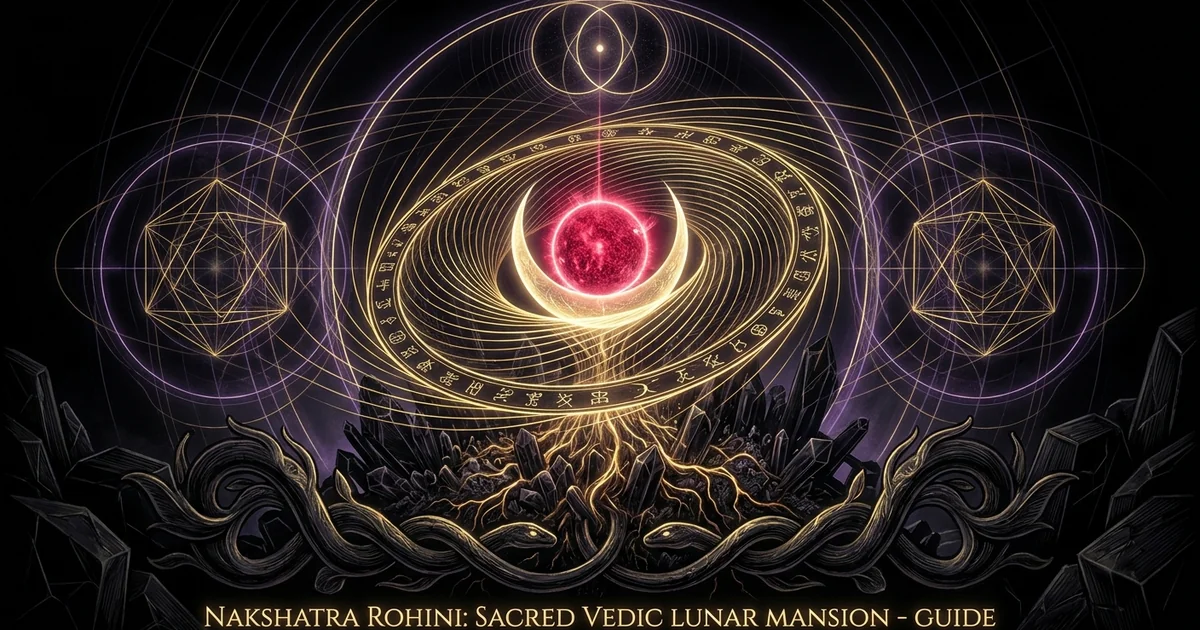
Nakshatra Rohini: Sacred Vedic Lunar Mansion - Guide
Archetypal Thesis & Systemic Paradigm: The Biomorphic Matrix of Rohini
Within the foundational mechanics of sidereal astrology, Rohini constitutes the primary cosmological engine of materialization. Spanning from 10°00’ to 23°20’ of sidereal Taurus (Vrishabha), this fourth lunar mansion orchestrates the critical ontological phase shift wherein undifferentiated celestial potential condenses into physical form, biological fecundity, and sensory aesthetics. While the preceding asterism, Krittika, operates through the purifying, incinerating solar brilliance of Agni—clearing the psychic field of primordial detritus—Rohini marks the arrival of structural stability, vegetative growth, and the generative mechanics of nature (Prakriti). In the broader map of the 27 Nakshatras of Jyotish, Rohini represents the macrocosmic womb where transcendent cosmic will becomes bound to terrestrial substance.
The Condensation of Kama: From Primordial Void to Sensory Manifestation
The operational teleology of Rohini is fundamentally governed by the Kama purushartha—the legitimate human and cosmic pursuit of desire, passion, aesthetic pleasure, and creative generative union. This is not merely human eroticism, but the metaphysical gravity that pulls spirit into matter. In classical cosmogony, desire (kama) is the initial disturbance in primordial balance that compels the unmanifest Brahman to project outward into multifaceted biological existence. Rohini acts as the sensory matrix where this impulse achieves physical containment.
Through the alchemical process of coagulatio, psychic energy transforms into solid biological architecture. The diffuse, electric vitality present in the early zodiacal wheel settles here into fixed earth, initiating the cycle of biological growth. Within this sector, sensory experience ceases to be a theoretical faculty and instead becomes an autopoietic feedback loop: the eye delights in proportion, the skin registers tactile variation, and the tongue experiences the sweetness of vital fluid (rasa). Rohini’s internal mechanics anchor consciousness into the somatic vessel, ensuring that the human organism becomes intimately attuned to the material ecosystem it inhabits.
The Lunar Exaltation Continuum (10°00’ to 23°20’ Sidereal Taurus)
The definitive planetary ruler of Rohini is Chandra (the Moon), the significator of the sensory mind (Manas), memory, somatic equilibrium, and emotional fluidity. At exactly 03°00’ Taurus—within the neighboring matrix of Krittika—the Moon reaches its point of maximum astronomical and symbolic exaltation (Paramochha). However, it is within Rohini (10°00’ to 23°20’ Taurus) that Chandra attains its absolute structural stability, psychological peace, and fertile potency, as elaborated in the lunar exaltation mechanics in Taurus.
In Rohini, the Moon escapes the solar instability of the Sun-ruled Krittika and fully inhabits its own nature. The lunar mind achieves sovereign integration with the physical senses. This degree-arc operates as an unyielding attractor basin within the sidereal zodiac, harmonizing mental fluctuations (chitta vritti) into sustained, generative focus. Because Taurus is an earth sign governed by Shukra (Venus), the Moon-Venus synthesis within Rohini yields an aesthetic, artistic, and deeply biological consciousness. Here, reflective consciousness (Chandra) is clothed in the balanced adornments, sensual elegance, and material symmetry of Venusian craftsmanship.
Cosmological Coordinate Mapping within the 27 Nakshatras of Jyotish
The precise astronomical and metaphysical coordinates of Rohini configure it as a fixed, earthly, female asterism. Its directional alignment is southern, facing downward (Adho Mukha), signifying subterranean growth, agricultural sowing, deep psychological excavation, and the hidden root systems that anchor life. In classical Jyotish classification, it is ascribed to the artisan-labor caste (Shudra), highlighting its intimate connection to raw biological work, physical construction, and the direct manipulation of earthly materials.
The three primary qualitative modalities (gunas) are distributed across Rohini in a unique energetic hierarchy: primary Rajas (dynamic creative passion), secondary Tamas (material inertia, density, and physical form), and tertiary Rajas (expressive, communicative output). This specific triad explains why the creative urge (Rajas) in Rohini deliberately utilizes material density (Tamas) rather than fleeing from it; it requires material weight to chisel, cultivate, and construct visible beauty.
- Sidereal Longitude: 10°00’ to 23°20’ Vrishabha (Taurus)
- Ruling Graha: Chandra (Moon)
- Presiding Devata: Brahma / Prajapati (The Universal Architect)
- Cosmic Purushartha: Kama (Aesthetic, Creative, and Erotic Fulfillment)
- Guna Hierarchy: Rajas (Primary) – Tamas (Secondary) – Rajas (Tertiary)
- Primary Caste Attribution: Shudra (Physical Craftsmanship, Grounded Manifestation)
- Elemental Attribution: Earth (Prithvi)
- Geometric Symbols: The Chariot (Ratha), The Cart, The Banyan Tree (Nyagrodha)
- Astronomical Core: Alpha Tauri (Aldebaran)
Classical Provenance & Textual Lineage: Prajapati and the Mythos of the Red One
The historical lineage of Rohini reveals an ancient continuity stretching from the early liturgical hymns of the Vedas to the encyclopedic compilations of classical Jyotish masters such as Varahamihira and Sage Parasara. Across these corpora, Rohini is consistently venerated as the radiant pinnacle of the lunar mansions, intimately associated with both the architecture of cosmic creation and the dangers of unmoderated desire.
[ PRIMORDIAL KAMA ]
            (Desire to Manifest the Many)
                          │
                          ▼
            [ PRAJAPATI / BRAHMA ENGINE ]
            (Presiding Intelligence of Rohini)
                          │
         ┌────────────────┴────────────────┐
         ▼                                 ▼
[ THE CHARIOT (Ratha) ]          [ THE BANYAN (Nyagrodha) ]
  Technological Mastery,           Subterranean Roots,
  Commerce & Civilization          Shelter & Endless Fecundity
         │                                 │
         └────────────────┬────────────────┘
                          ▼
            [ SOMATIC MATERIALIZATION ]
        (Coagulatio into Fixed Sidereal Earth)
Vedic Liturgy: Prajapati’s Generative Urge in the Taittiriya Brahmana
In the Taittiriya Brahmana (c. 1000 BCE), the devata assigned to Rohini is not an elemental spirit or atmospheric storm god, but Prajapati himself—the primordial Father of Creation, later synthesized into Brahma the Demiurge. The Vedic liturgists recognized that within Rohini, the divine architect finds the fertile matrix required to populate the macrocosm. In the sacrificial mechanics of the Yajna, Rohini was invoked to ensure agricultural success, abundant progeny, and the continuity of life.
“प्रजापतिः रोहिणीम् अग्रेऽसृजत्… रोहिणी देवता प्रजापतिर् अधिपतिः।” Translation: “Prajapati created Rohini at the very head of cosmic generation… Rohini is the sacred luminous vessel, and Prajapati is the presiding sovereign lord.” The liturgical manual establishes that whoever offers the sacred oblation under the asterism of Rohini obtains all desired forms (rupa), secures continuous biological lineage, and manifests creative projects without systemic decay.
The text clarifies that Prajapati selected Rohini as his vehicle because of her intrinsic capacity to reflect divine splendor into material form. The term Rohini is derived from the Sanskrit verbal root Ruh, signifying “to ascend,” “to sprout,” “to grow,” and “to blossom.” Concurrently, it carries the explicit connotation of the Red One or the Red Cow, an ancient Vedic symbol for the crimson dawn, biological blood, somatic nourishment, and the fertile surface of the earth awakening under the life-giving warmth of the cosmos.
Classical Delineations: Varahamihira’s Treatises on Royal Auspiciousness
By the classical era, the encyclopedist Varahamihira (c. 505–587 CE) articulated the psychological, economic, and sociopolitical influence of Rohini in both the Brihat Samhita and the Brihat Jataka. In his astrological frameworks, Rohini stands as an extraordinarily auspicious station for civilian prosperity, coronation, coronation infrastructure, urban development, and long-term agricultural enterprise.
In the Brihat Jataka (Chapter 16, Sloka 4), Varahamihira details the psychological signature of a native possessing the natal Moon in Rohini:
“One born with the Moon in Rohini will be truthful, pure in conduct, sweet-tongued, of steady mind, handsome in appearance, highly skilled in mercantile affairs, and possessing an innate charm that naturally attracts patrons and lovers.”
Varahamihira observed that the influence of this lunar mansion naturally inclines human behavior toward sensory refinement and aesthetic grace. Yet he also noted in the mundane astrology sections of the Brihat Samhita that Rohini’s sensitivity makes it vulnerable. Because it governs the global food supply, agricultural stability, and economic liquidity, any celestial affliction—such as the transit of malefic planets through the asterism—directly heralds famines, severe price volatility, and imperial crises.
The Curse of Daksha: Chandra’s Erotic Fixation as an Archetypal Allegory
The central mythological drama concerning Rohini is the foundational Puranic account of Chandra’s marriage to the twenty-seven daughters of Daksha Prajapati, each representing one of the 27 Nakshatras of Jyotish. Despite his vow to distribute his attention equitably among all mansions, Chandra became entirely consumed by the physical beauty, emotional charm, and generative grace of Rohini, lingering obsessively in her palace to the total exclusion of her twenty-six sisters.
Daksha, observing this systemic imbalance, cursed the Moon to suffer from Kshaya—the wasting disease of consumption (symbolized physically by tuberculosis and cosmologically by the dark lunar phase). Chandra’s vitality withered, throwing the oceans, plant life, and animal reproductive cycles into biological chaos. Only through the intervention of Shiva, who placed the waning Moon upon his forehead (Chandrashekhara), was the Moon partially revived, establishing the cyclical rhythm of waxing (Shukla Paksha) and waning (Krishna Paksha).
This narrative serves as a profound psychoanalytic and cosmological allegory:
- Systemic Disequilibrium: Total fixation on pure sensory beauty, material abundance, and aesthetic perfection disrupts the wider rhythm of life.
- The Danger of Erotic Stagnation: Unchecked pleasure leads to decay. Rohini’s vegetative power must ultimately be integrated with the other archetypes of the zodiac to sustain health.
- The Necessity of Time: Life cannot exist in an uninterrupted spring of material abundance; the waning phase is structurally required to purge systemic toxicity.
Structural Mechanics & Symbolic Geometry: Chariot, Banyan, and Quadripartite Padas
The symbolic geometry of Rohini operates through two primary emblems: the Chariot (Ratha or agricultural cart) and the Banyan Tree (Nyagrodha). Both symbols mirror the deeper paradox of Rohini: the coexistence of dynamic technological/commercial movement with profound vegetative rootedness.
[ Primary Symbol: THE CHARIOT / CART (Ratha) ]
  • Mastery over the physical beast (Taurus the Bull)
  • Agricultural efficiency, logistics, and trading networks
  • Human craft harnessing raw natural vitality

[ Secondary Symbol: THE BANYAN TREE (Nyagrodha) ]
  • Endless subterranean vegetative expansion
  • Unshakeable organic anchoring into material reality
  • The archetypal Mother Matrix providing communal shelter
The Chariot (Ratha) and the Banyan Tree (Nyagrodha): Mobility and Deep Rootedness
The Ratha—traditionally depicted as a two-wheeled cart drawn by oxen—signifies humanity’s mastery over raw biological vitality. The ox represents the dense, stubborn, and powerful energy of Taurus; the cart represents the human intellect (Chandra-Manas) directing this energy toward economic logistics, civil engineering, trade, and agricultural cultivation. Rohini does not leave nature in its wild, untamed state; it refines, channels, and extracts value from it. The cart is the foundational vehicle of civilization, enabling the distribution of grain, artistic goods, and luxuries across cultural centers.
Conversely, the Banyan Tree (Nyagrodha) represents the vegetative principle of subterranean expansion. The banyan drops aerial roots from its branches, forming secondary trunks that anchor deep into the earth, eventually creating an entire self-sustaining forest from a single seed. This mirrors the psychological nature of Rohini: the impulse to establish deep, unshakeable roots, to protect one’s progeny, and to build an enduring dynasty. The banyan provides immense shade, symbolizing the maternal, protective sanctuary Rohini creates for all living entities under its shelter.
Navamsha Pada Calculus: The Archetypal Journey across Aries to Cancer Sub-Frequencies
The 13°20’ arc of Rohini is divided into four equal padas (quarters) of 3°20’ each, which generate the internal fractal architecture of the Navamsha (D9) Chart. These padas map an evolutionary passage through the elements, transitioning from dynamic Martian fire to the receptive waters of the Moon.
Pada 1: 10°00’ to 13°20’ Taurus (Aries Navamsha)
Governed by Mars (Mangala), this pada acts as the catalytic spark within the dense earth of Taurus. The creative energy here is fast, visceral, and intensely passionate. It represents the raw generative drive of Prajapati pursuing the act of creation. The individual possesses tremendous stamina, physical courage, and a rapid, impulsive pursuit of desires, though they risk burnout if sensory urges override strategic planning.
Pada 2: 13°20’ to 16°40’ Taurus (Taurus Navamsha - Vargottama)
Governed by Venus (Shukra), this is the Vargottama pada of Rohini, where the sign and the navamsha are identical. This is the apex of Rohini’s structural power. The individual exhibits unmatched aesthetic refinement, material stability, exceptional beauty, and financial acumen. It represents the fully matured garden, where physical luxury and somatic balance achieve complete expression. Its shadow lies in profound stubbornness, luxury-induced lethargy, and resistance to change.
Pada 3: 16°40’ to 20°00’ Taurus (Gemini Navamsha)
Governed by Mercury (Budha), this pada shifts Rohini’s dense physical energy into the communicative and analytical sphere. Here, sensory pleasure is intellectualized. The native excels in linguistics, poetry (Kavya), vocal articulation, sophisticated marketing, and artistic design. The earthy inertia of Taurus is lightened by Mercurial curiosity, transforming raw sensory appetites into refined social engagement and commercial ingenuity.
Pada 4: 20°00’ to 23°20’ Taurus (Cancer Navamsha)
Governed by the Moon (Chandra), this final pada dissolves material possessiveness into emotional and psychic receptivity. It represents maternal nurturing, domestic sanctuary, and unconditional protective love. It is deeply connected to biological fertility, water resources, milk, and somatic nourishment. The primary challenge here is excessive vulnerability, psychic mood swings, and a tendency to smother loved ones within an overprotective emotional cocoon.
Somatic and Energetic Anatomy: Aldebaran, the Eye of the Bull, and Sensory Organs
Astronomically, Rohini corresponds to the brilliant red giant star Aldebaran (Alpha Tauri), marking the fiery, expressive eye of the Bull (Vrishabha). With an apparent visual magnitude of 0.85, Aldebaran is historically categorized as one of the four Royal Stars of ancient Persia, symbolizing sovereign authority, public leadership, and passionate creativity.
In the Kalapurusha (the cosmic anatomical human body), Rohini governs the head, face, eyes, neck, tongue, throat, and vocal cords. It is directly linked to the endocrine system, salivary glands, and lymphatic fluids that sustain bodily health. Because Rohini presides over the facial features and the voice, natives with significant placements here often possess symmetric facial proportions, deep, captivating eyes, and a resonant, melodic vocal cadence.
When afflicted by malefic transits or harsh natal aspects, these somatic sectors manifest specific vulnerabilities: thyroid imbalances, metabolic lethargy, throat infections, lymphatic stagnation, and ailments of the jaw and teeth. Energetically, Rohini centers on the throat chakra (Vishuddha) and the heart center (Anahata), mediating the tension between emotional longing and articulate creative expression.
Psychological Dynamics & Operational Praxis: Navigating Aesthetic Seduction and Creative Potency
The inner psychological life of a Rohini-dominant consciousness is defined by an ongoing negotiation with the material world. To inhabit Rohini is to inhabit a psychic landscape where the world is encountered primarily through physical sensation and form.
Unintegrated / Shadow Rohini
- Somatic Narcissism: The ego over-identifies with physical beauty, youth, and outer aesthetics, producing acute terror of aging and physical decay.
- Possessive Fixation: Pathological clinging to partners, material assets, and comforts; treats relationships as territorial commodities.
- Manipulative Seduction: Weaponizes charm, vulnerability, and beauty to exploit others economically and emotionally.
- Consumption & Stagnation: Descends into sensory hedonism, overeating, consumer debt, and lethargic avoidance of demanding work.
Integrated / Sovereign Rohini
- Effortless Fecundity: Generates material and artistic abundance naturally without exploitative manipulation or psychic anxiety.
- Grounded Somatic Wisdom: Treats the human body as a sacred biological temple, displaying deep attunement to physical health and nature.
- Generous Patronage: Uses material wealth and social influence to support artists, shelter the vulnerable, and fund creative spaces.
- Civilizing Craft: Channels raw emotional and sexual vitality (Kama) into enduring, high-order artistic, architectural, or social works.
The Shadow of Possessiveness: Erotic Enmeshment and Material Stagnation
The fundamental shadow of Rohini emerges from its secondary Tamasic nature: the instinct to preserve, hoard, and freeze reality within an eternal, unchanging garden of delight. When afflicted—particularly by Saturn’s cold constriction, Rahu’s voracious hunger, or Mars’s aggressive passion—Rohini’s natural appreciation for form curdles into territorial possessiveness.
The individual can become trapped within an eroticized materialism. Romantic relationships are no longer experienced as dynamic unions of two evolving subjects, but as aesthetic possessions that must not change, depart, or decay. This shadow expresses itself as chronic romantic jealousy, manipulative emotional guilt, and an insatiable hunger for luxury items (Māyā). If the passage of time threatens their somatic youth or social status, the unintegrated Rohini consciousness can descend into bitterness, deploying passive-aggressive strategies to maintain control over its environment.
Analytical Psychology: Rohini as the Sensual Anima/Animus Conduit
In the terminology of Jungian Archetypal Psychology, Rohini is the vivid embodiment of the Anima in its second and third developmental stages: the aesthetic, romantic, and maternal muse. As Carl Jung observed in Symbols of Transformation (CW 5):
“The mother is the vessel of life, the earth that bears all things… The chariot and the tree are equivalent mother-symbols representing the devouring and sheltering aspect of the unconscious, which pulls the solar hero down into tangible matter.”
Rohini functions as the archetypal nourishing mother (Magna Mater) who simultaneously attracts the ego through seductive vegetative allure. The soul projected into Rohini encounters the archetype of pure Eros. If the conscious ego lacks psychological maturity, it drowns in the unconscious waters of sensory gratification, enacting Chandra’s historical curse.
Conversely, when an individual consciously integrates the Rohini archetype, this lunar mansion serves as a bridge to deep creative inspiration. The Anima ceases to be a dangerous, enchanting siren and becomes an inner generative wellspring—an autopoietic partner that births painting, literature, architecture, and enduring cultural institutions.
[ SOUL INITIATION ]
                              │
                              ▼
                 [ ENCOUNTER WITH ROHINI ]
                  The Allure of the Senses
                              │
         ┌────────────────────┴────────────────────┐
         ▼                                         ▼
[ UNCONSCIOUS EGO ]                       [ CONSCIOUS EGO ]
Erotic Enmeshment,                        Active Individuation,
Possessive Fixation,                      Artistic Sublimation,
Consumption & Decay                       Somatic & Cultural Fecundity
(The Curse of Daksha)                     (The Blessing of Prajapati)
Jyotish Remedial Architecture: Transmuting Attachment into Aesthetic Refinement
To balance and direct the potent, often destabilizing energies of Rohini, classical Jyotish prescribes exact therapeutic protocols. Because Rohini’s core challenge is the descent of generative desire (Kama) into stagnant attachment (Moha), remedial architecture focuses on sublimation and conscious circulation of energy.
-
Devotional Sublimation via Saraswati and Brahma: Because Brahma (Prajapati) is the presiding devata, the worship of the creative matrix is paramount. However, since historical ritual rarely worships Brahma directly, propitiation shifts toward Saraswati—the goddess of wisdom, learning, arts, and speech. By invoking Saraswati, Rohini’s raw sensory and reproductive drives are transmuted into high-order creative pursuits: classical music, calligraphy, fine art, and sacred architecture.
-
Chandra-Shiva Remediation: To counter the Puranic curse of somatic consumption and emotional volatility, honoring Lord Shiva as Chandrashekhara (the one who wears the crescent Moon) provides the foundational remedy. The pouring of pure milk or clear spring water over the Shiva Linga during Rohini transits or on Mondays calms the fiery, desirous undercurrents of the lunar mind.
-
Color, Gemstone, and Environmental Protocols: The primary gem corresponding to Rohini’s ruling planet is natural, unblemished Pearl (Mukta), set in silver, worn to soothe the nervous system and steady the emotional waters. Secondary gems include Diamond or White Sapphire to honor the Venusian sign ruler. Environmentally, Rohini natives require regular contact with lush biological spaces: botanical gardens, agricultural land, and natural water bodies, which discharge built-up psychic congestion.
Philosophical Synthesis & Macrocosmic Correspondence: Hermetic Generation and Biological Architecture
Rohini serves as a primary conceptual bridge between Eastern Vedic cosmology and Western esoteric Hermeticism. The mechanics governing this lunar mansion exemplify the overarching structural laws through which the immaterial universe weaves the fabric of living matter.
“The alchemical Terra is not mere dead matter; it is the living body of the world, the maternal matrix (matrix vitae) wherein the celestial seeds take root. It corresponds to the principle of Salt, which coagulates the fleeting volatile spirit into an enduring, solid substance. Without this saline fixation, the spiritual light dissolves into formless abstraction.”
The Hermetic Principle of Gender and the Alchemical Coagulatio
The Hermetic Axiom of Generation—“Gender is in everything; everything has its Masculine and Feminine Principles; Gender manifests on all planes”—finds precise expression in Rohini. Prajapati represents the masculine generative impulse, the active seed of intention (Bija), while Rohini provides the feminine receptive matrix, the biological field (Kshetra).
In alchemical operations, Rohini corresponds to Coagulatio. Spirit (Chaitanya), which is fundamentally subtle, non-local, and fluid (Solutio), must be fixed, condensed, and crystallized into a tangible vessel. Rohini is this cooling and solidifying vessel. The Rajasic urge initiates, but the secondary Tamasic quality provides the necessary weight and resistance. Without Rohini’s coagulating power, cosmic energy would remain a diffuse, unmanifest mist, incapable of experiencing the textures, contrasts, and triumphs of physical incarnation.
Chronobiological Epigenetics: The 27 Lunar Stations as Developmental Cycles
When viewed through the lens of modern chronobiology and systems theory, the 27 lunar stations operate as a sequence of epigenetic developmental phases. If Ashwini represents the first spark of life and initial cell division, Bharani the embryonic confinement within the maternal womb, and Krittika the traumatic severing of the umbilical cord through fire and air, then Rohini represents the baby’s first intake of milk, the stabilization of physical homeostasis, and the sensual awakening to the material environment.
It is the phase in human and cosmic life where the organism learns that survival is pleasurable. The release of dopamine, the tactile comfort of maternal warmth, and the rhythmic nourishment of food build the fundamental biological confidence of the psyche. In adult life, whenever a project, enterprise, or philosophical system reaches its “Rohini phase,” it transitions out of experimental insecurity and into sustainable operational efficiency, securing its institutional funding, physical infrastructure, and sensory appeal.
The Fractal Geometry of the Banyan: Interconnected Spacetime
The emblem of the Banyan Tree (Nyagrodha) serves as an ancient, intuitive model of non-linear fractal geometry and interconnected spacetime. A mature banyan tree defies the classical botanical boundary between a single trunk and an external branch. By sending roots downward from its limbs, it creates an expanding network of self-reinforcing pillars.
This geometry mirrors the structure of human culture, biological lineage, and collective consciousness. Rohini demonstrates that genuine security is not achieved through defensive walls, but through expansive, grounded replication. Just as the banyan roots itself repeatedly into the soil, Rohini roots conscious intention into the physical world over and over, building a dense, sheltered biosphere where life can flourish, create art, and reflect on its own beauty.
Frequently Asked Questions Concerning Rohini Nakshatra
Why is Rohini Considered the Most Auspicious Mansion for Material Ventures?
Rohini is ruled by the Moon (Chandra) and resides entirely within the fixed earth sign of Taurus (Vrishabha), ruled by Venus (Shukra). This unique convergence marries the psychological stability of an exalted lunar mind with the material abundance, aesthetic refinement, and tactile balance of Venus. Furthermore, its presiding devata is Prajapati (Brahma), the cosmic architect whose sole function is the structural generation of living systems.
Consequently, any enterprise inaugurated under a strong Rohini transit—such as laying architectural foundations, launching corporate entities, executing agricultural sowings, or entering financial partnerships—inherits an innate propensity toward steady, organic growth, public favor, and longevity. However, its intense materializing focus makes Rohini less ideal for radical ascetic renunciation (Sannyasa), which requires the severing of material ties rather than their cultivation.
What Distinguishes the Creative Force of Rohini from Ashwini or Chitra?
While all three nakshatras are powerfully creative, they operate via fundamentally distinct mechanisms:
- Ashwini (Ruled by Ketu / The Ashwini Kumaras): Its creative force is catalytic, sudden, and initiatory. It acts as an electrical jolt or spontaneous medicinal breakthrough, bursting forward without prior warning, but it often lacks the endurance to sustain what it initiates.
- Rohini (Ruled by the Moon / Prajapati): Its creativity is biological, vegetative, and dynastic. It behaves like a seed growing in nutrient-dense soil, gathering nutrients over time and maturing into a lush, self-sustaining organism. It is somatic, sensual, and foundational.
- Chitra (Ruled by Mars / Tvashtar/Vishwakarma): Its creativity is architectural, industrial, and intensely deliberate. It works through tools, mathematics, high design, and the conscious manipulation of hard, inorganic matter to produce dazzling optical illusions, intricate machinery, and aesthetic monuments.
How Does Rohini Function When Hosting Ketu, Mars, or Saturn?
When planets that operate counter to fertility, moisture, and sensory indulgence enter Rohini, the psychic dynamics shift into tension:
- Ketu in Rohini: Ketu is the significator of monastic detachment, formlessness, and spiritual liberation (Moksha). Thrust into Rohini’s sensual and material garden, Ketu feels profoundly alienated. This placement often creates deep disillusionment with physical beauty, sensory burnout, or an intentional renunciation of luxury after realizing its impermanence.
- Mars in Rohini: Mars brings raw fire into a delicate, fertile earth environment. While this can provide tremendous entrepreneurial energy, charismatic magnetism, and athletic stamina (particularly in Pada 1), it can also trigger volcanic emotional tempers, sexual possessiveness, and inflammation in the throat, face, and reproductive tract.
- Saturn in Rohini: Saturn represents cold structural reality, time, delay, and ascetic restraint. In Rohini, Saturn acts as a severe cosmic governor, restricting early material comfort, creating delays in real estate or commercial ventures, and demanding rigorous, disciplined effort rather than passive reliance on charm. If integrated, it produces immense, unshakeable wealth later in life through disciplined craftsmanship.
What is the Deeper Esoteric Meaning of the Shakata Bhedana (Piercing of the Cart)?
The Shakata Bhedana is an ancient, highly feared astronomical and mundane omen recorded in classical Jyotish texts, including the Surya Siddhanta and the Brihat Samhita. It occurs when a malefic planet—specifically Saturn (Shani) or Mars (Mangala)—transits through the narrow sidereal configuration of Rohini, symbolically “piercing” the celestial cart or chariot formed by the primary stars of the Hyades cluster and Aldebaran.
Esoterically, this event signifies the structural rupture of the cosmic womb. When the cart is pierced, the protective container that shelters human civilization breaks open. Historically, classical astrologers observed that this transit correlated with devastating multi-year droughts, the collapse of global trade routes, wide-scale famine, and the overthrow of royal lineages. In modern mundane terms, it correlates with structural crises in international supply chains, global food crises, economic depressions, and major environmental events that directly threaten biological life. It is the stern cosmic reminder that even the most abundant, self-sustaining garden remains vulnerable to the inexorable passage of cosmic time. :::