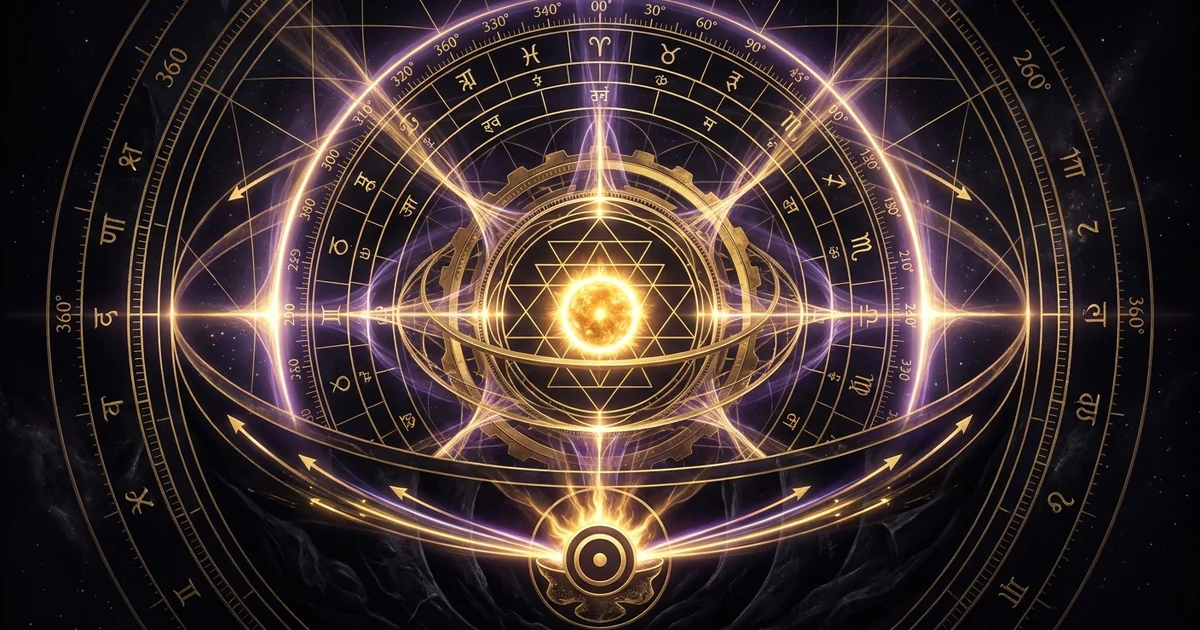
Surya: The Divine Solar Soul Atmakaraka in Jyotish
Archetypal Thesis & Systemic Paradigm: The Solar Axis and the Ontological Self
The Coordinate Physics of Surya as Naisargika vs. Chara Atmakaraka
In the psycho-cosmological coordinate framework of Jyotish, Surya operates as both the non-contingent cosmic ground of the soul and the supreme structural sovereign across the planetary pantheon. Within classical Vedic mechanics, every horoscope demonstrates a dual systemic architecture: the invariant, archetypal structure of universal significations (Naisargika) and the variable, individualized momentum of incarnational momentum (Chara). As the Naisargika Atmakaraka, the Vedic Sun is the perpetual signifier of the transcendent Self (Purusha), the uncreated light that illuminates empirical reality without being exhausted by it. It signifies the primary life-force (Prana), the immutable divine spark embedded within the matrix of time, and the ontological baseline from which all phenomenal experience emerges. In this universal role, the jyotish graha surya maintains an absolute cosmic baseline; irrespective of sign placement, house jurisdiction, or divisional dignity, it anchors the biological and metaphysical viability of the incarnation.
When Surya simultaneously assumes the mantle of the Chara Atmakaraka—achieved when it reaches the highest longitudinal degree within any given rashi (zodiacal sign) among the seven classical planets—a profound ontological convergence occurs. Here, the universal witness collapses into the singular, empirical locus of a human life’s primary karmic curriculum. The Chara Atmakaraka functions as the temporal soul-significator, charting the precise vector through which the jiva (individualized living entity) must navigate its existential debt and realize its teleological objective. Under the mechanics detailed within the /astrology/jaimini-chara-karakas-system, Surya assuming this role indicates an incarnation wherein the macrocosmic center of consciousness directly superimposes itself upon the microcosmic theater of human will, demanding the systemic surrender of the personal ego to the dictates of the divine sovereign.
Surya as Naisargika Atmakaraka (Universal Cosmic Purusha)
- Systemic Role: Invariant macrocosmic signifier of existence, divine will, and ontological vitality across all charts.
- Functional Locus: Anchors the absolute cosmic principle of the divine self (Atman); operates as the ontological axis of the Kalapurusha.
- Karmic Dynamism: Represents non-negotiable spiritual baseline and general psycho-physical vitality (Prana-shakti).
- Psycho-Spiritual Telos: Directs the soul toward the immutable reality of pure consciousness beyond individual life circumstances.
Surya as Chara Atmakaraka (Incarnate Soul Vector)
- Systemic Role: Conditional temporal signifier extracted via highest longitudinal degree progression within a rashi.
- Functional Locus: Serves as the precise navigational vector of the incarnating jiva, focusing ancestral and individual karma.
- Karmic Dynamism: Generates hyper-specific crises surrounding ego, sovereignty, executive power, and personal validation.
- Psycho-Spiritual Telos: Demands the voluntary abdication of empirical hubris (Ahamkara) to achieve unmediated Self-realization.
Ahamkara versus Atman: The Tension of Solar Individuation
The fundamental psycho-spiritual crisis of the human condition, viewed through the diagnostic lens of Jyotish, is the chronic conflation of the Atman (the authentic, non-dual Self) with Ahamkara (the empirical “I-maker” or ego-construct). Modern Western psychological astrology frequently reduces the Sun to the conscious ego, the socialized persona, or the individual’s drive toward secular self-actualization. In stark contrast, classical Jyotish designates the Sun as the radical ground of being—the silent witness that precedes all cognitive constructs, affective states, and social roles. Ahamkara is an evolute of Prakriti (nature), an instrumental interface generated to navigate spatio-temporal survival; the Atman is unconditioned light.
When the surya atmakaraka vedic astrology sun dominates the chart as the Chara Atmakaraka, this ontological tension reaches a threshold of acute friction. The native is endowed with a commanding solar core, an innate drive toward sovereignty, and an inescapable sense of destiny. However, because the personality operates within the terrestrial sphere, the ego inevitably attempts to co-opt this divine sovereignty for its own aggrandizement. The empirical mind mistakenly assumes that it is the author of the light rather than its mirror. This misidentification creates severe psycho-spiritual pathology: an inflated ego-structure that demands reverence, displays tyrannical inclinations, or falls victim to intense isolation. The evolutionary mandate of an individual with an atmakaraka soul planet in the solar seat is to undergo a continuous, often agonizing process of solar sublimation, systematically disidentifying with the secular manifestations of power, lineage, and prestige until the ego acts merely as a transparent prism for the transcendent Atman.
The Sun as the Psycho-Spiritual Gravitational Singularity
In astronomical physics, the Sun serves as the gravitational anchor of the heliocentric system, curving the space-time manifold to dictate the orbital trajectories of all subordinate planetary bodies. In the cybernetic coordinate system of the natal chart, Surya operates as an identical metaphysical singularity. As the primal source of longitudinal propulsion, the position of the Sun defines the parameters of solar time (Sauramana), orchestrates the seasonal shifts that govern physiological equilibrium, and acts as the informational clearinghouse for ancestral karma (Pitri Karma).
The longitudinal progression of Surya through the rashis functions as a thermodynamic transformer. It absorbs the dense, calcified historical imprints of the paternal lineage—hereditary guilt, unfulfilled aspirations, structural dogmas—and subjects them to the intense nuclear fusion of pure consciousness. Where Surya is placed, particularly as the Chara Atmakaraka, ancestral momentum demands redemption. The native cannot merely replicate inherited patterns; they must burn away the dross of unconscious lineage habits to reveal the golden residue of transpersonal truth. By anchoring the chart’s energetic economy, the solar atmakaraka enforces a rigorous psycho-spiritual teleology, systematically drawing every disparate aspect of the native’s life—relational, professional, and somatic—into the orbital pull of spiritual individuation.
Classical Provenance & Textual Lineage: Transmission of the Solar Imperative
Rigvedic Hymns to Savitr and the Gayatri Metaphysics
The archetype of the divine solar soul in Jyotish is grounded within the deepest stratifications of the Vedic revelation. In the Rigveda, the solar principle is not understood as a crude ball of physical combustion, but is articulated through a multifaceted triad of divinities: Surya (the visible, manifest cosmic body), Mitra (the harmonizing, social contract of light), and Savitr (the divine, unmanifest stimulator of inner vision and primordial awakening). The celebrated Savitri Gayatri Mantra, embedded within the Third Mandala of the Rigveda (RV 3.62.10), crystallizes this metaphysical paradigm: Tat savitur vareṇyaṃ bhargo devasya dhīmahi dhiyo yo naḥ pracodayāt. The prayer implores not physical wealth or longevity, but the direct illumination of the dhiḥ—the meditative intellect and internal visionary faculty—by the supreme effulgence of the solar creator.
Within this classical lineage, the Sun represents the cosmic eye (Chakshu) of the Kalapurusha, the primordial Cosmic Man whose dismemberment forms the operational universe. As recorded in the Purusha Sukta (RV 10.90.3): Cakṣoḥ sūryo ajāyata (“From His eye, the Sun was born”). Consequently, to analyze Surya within a nativity is to assess the native’s capacity for objective spiritual perception. When Surya functions as the atmakaraka soul planet, the individual inherits an ancient Rigvedic imperative: they are metaphysically obligated to act as a clear lens through which the transcendent light of Savitr descends into gross matter. Their spiritual evolution is directly tied to the mastery of the Gayatri principle, wherein mundane intellect is systematically upgraded into intuitive, unmediated perception of cosmic order (Rta).
“Surya is the soul of all the planets; Chandra is the mind; Mangala is the strength; Budha is the speech; Guru is knowledge and happiness; Shukra is semen (reproduction); while Shani is grief… From among the Grahas, the one which advances to the highest longitudinal degree in a Rashi becomes the Chara Atmakaraka, the principal significator of the soul, whose desires dictate the conditions of the Jiva’s embodiment.” — Maharishi Parashara, Brihat Parasara Hora Shastra, Ch. 3, Slokas 11-13; Ch. 32, Slokas 1-3.
Parashara’s Classical Treatises: The Royal Graha and the King’s Anatomy
In the foundational codex of predictive astrology, the Brihat Parasara Hora Shastra (BPHS), Maharishi Parashara formalizes the structural anatomy of the jyotish graha surya, placing it at the apex of the planetary hierarchy. Parashara defines the Sun as possessing a Pitta (fire/bile) constitutional matrix, having an amber-eyed, square-bodied, dignified physical form, operating with steady valor, and presiding over the Kshatriya (warrior/ruler) caste. In the bodily schema of medical astrology, Parashara attributes the governance of Asthi Dhatu (skeletal framework and bone tissue) directly to Surya. This structural attribution is deeply esoteric: bones represent the most durable, enduring, and unyielding material within the transient biological vessel, mirroring the immutable, eternal endurance of the Atman amidst the fluctuating tides of mental and physical transformation.
Surya Metaphysical Matrix:
Constitutional Dosha : Pitta (Solar Metabolic Fire)
Biological Substrate : Asthi Dhatu (Skeletal Architecture)
Psychosomatic Center : Hridaya (Cardiac Interior / Seat of Purusha)
Societal Function    : Raja / Kshatriya (Sovereignty and Dharma)
Furthermore, Parashara assigns the cardiovascular core, the Hridaya (heart), as the somatic throne of the Sun. In Vedic anatomy, the heart is not merely a mechanical pump; it is the physical coordinate of the Hridaya-guha—the secret cave wherein the infinitesimal spark of the Atman resides. As the prime monarch of the horoscope, Surya commands the central executive function. If the King is strong, the realm (the entire planetary ecosystem of the nativity) retains cohesion, stability, and purpose. If the King is compromised, impoverished, or afflicted, even the most auspicious planetary combinations (Yogas) collapse into chaos, just as a nation dissolves into factional warfare when the central authority disintegrates.
The Jaimini Upadesha Paradigm: Mathematical Degrees as Karmic Density
The structural transition from general Parashari principles to the esoteric mechanics of the Jaimini Upadesha Sutras represents a shift from general typological assessment to hyper-specific karmic vectoring. Maharishi Jaimini restructured predictive technique by deprioritizing fixed, static house rulers in favor of the variable Chara Karakas (movable significators). In the Jaimini paradigm, planets are not merely passive actors on a stage; they are living containers of accumulated karma, their longitudinal progression through a 30-degree arc of a sign representing the depth of their immersion within the material matrix.
Under this system, the planet that attains the highest mathematical degree—reaching the pinnacle of its sign trajectory, up to 29°59’59"—is designated as the Chara Atmakaraka. This high longitudinal degree does not represent exhaustion; rather, it signifies karmic saturation. A planet at the apex of its degree has run the gamut of the zodiacal sign’s elemental tests and now bears the concentrated burden of the jiva’s primary evolutionary task. When the vedic sun achieves this apex, the native is born with a soul-contract revolving entirely around the correct exercise of authority, divine will, authenticity, and ego-sacrifice. The Jaimini mechanics stipulate that the Chara Atmakaraka becomes the ultimate arbiter of destiny, superseding even the Ascendant lord in determining the soul’s trajectory toward bondage (Bandhana) or ultimate liberation (Moksha).
Structural Mechanics & Symbolic Geometry: Dignity, Shadbala, and the Karakamsa
Longitudinal Apex and the Extraction of Karakamsa in Navamsha (D9)
The operational potency of Surya as the Atmakaraka cannot be deciphered solely through the primary natal chart (Rashi D1). Its deeper spiritual architecture is encrypted within the ninth divisional harmonic: the Navamsha (D9). The specific sign occupied by the Chara Atmakaraka within the D9 chart is technically designated as the Karakamsa. The Karakamsa is the spiritual command post of the incarnation, mapping the native’s unconditioned soul-instincts, inherent spiritual capabilities, and the specific archetype of divinity (Ishta Devata) through which liberation is achieved.
To access the mechanics of the Karakamsa, the practitioner executes a precise coordinate translation. If the Chara Atmakaraka Surya occupies 28°45’ in Simha (Leo) in the natal chart, it falls within the ninth Navamsha of Simha, which corresponds to the Mesha (Aries) Navamsha. Consequently, Mesha becomes the Karakamsa. By projecting this sign back as the primary ascendant of the soul (Karakamsa Lagna), an entirely new energetic matrix emerges. For an exhaustive breakdown of this harmonic translation, see /astrology/navamsha-d9-esoteric-decoding. The houses measured from the Karakamsa reveal the true teleological motivations of the jiva. If benefic planets flank this point, the soul advances smoothly toward transcendent realization; if malefics cast harsh geometric aspects, the path to liberation is forged through intense internal conflict and structural ego-collapse.
Planetary Dignity Metrics: Moolatrikona, Uccha (Exaltation), and Neecha (Debilitation)
The functional expression of Surya as Atmakaraka is radically calibrated by its essential dignity, which dictates whether its soul-lessons manifest as sovereign grace or punitive crises of identity.
Surya Dignity Mechanics:
00°00' - 10°00' Mesha (Aries)  : Param Uccha (Deep Exaltation Point)
00°00' - 20°00' Simha (Leo)    : Moolatrikona (Operational Command Zone)
20°01' - 30°00' Simha (Leo)    : Swakshetra (Own Sign / Stable Home)
00°00' - 10°00' Tula (Libra)   : Param Neecha (Deep Debilitation Point)
In the state of exaltation (Uccha), peaking at 10° of Mesha, Surya operates within the cardinal fire of Mars. Here, the solar Atmakaraka expresses unconditioned, primordial will. The soul incarnates with absolute spiritual clarity, possessing an intrinsic capacity for executive leadership, fearless adherence to truth (Satya), and an unwavering alignment with transcendent purpose. However, the latent danger of an exalted solar Atmakaraka is supreme pride—a subtle, titan-like hubris wherein the native equates their personal judgment with absolute cosmic law.
Conversely, the debilitation of Surya (Neecha), reaching its mathematical nadir at 10° of Tula, presents a severe structural crisis of the soul. In the cardinal air of Venus, the solar sovereign is forced into the marketplace of negotiation, compromise, and external validation. The native whose Atmakaraka is a debilitated Sun experiences an existential friction regarding self-worth. They consistently surrender their personal sovereignty to relational demands, struggle with deep-seated feelings of inadequacy or illegitimacy, and suffer authority crises with paternal figures. Yet, from an esoteric perspective, Neecha Surya as Atmakaraka possesses monumental liberation potential: it forces the ego to endure repeated humiliations, systematically dismantling superficial vanity until the native discovers an internal authority that is completely independent of worldly status or social praise.
Geometric Rays and Shadbala: Digbala in the Tenth House Zenith
To quantify the absolute operational capacity of Surya, Jyotish relies on the multi-dimensional algorithm of Shadbala (six-fold strength), detailed within the framework of /astrology/planetary-dignities-vedic-shadbala. Among these algorithmic inputs, directional strength (Digbala) is paramount for the solar sovereign. Surya attains maximum Digbala precisely at the zenith of the celestial sphere—the cusp of the tenth house (Madhyalagna).
The tenth house represents midday, the point where the Sun casts no shadow, radiating maximum illumination and heat across the visible hemisphere. When Surya as Atmakaraka is situated in the tenth bhava, its capacity to execute its karmic mandate is maximized. It endows the native with natural executive mastery, immense administrative capacity, and an unshakeable sense of societal duty (Karma Yoga). At this directional apex, the solar rays permeate the entire horoscopic architecture, banishing the psychological obscurations of the lower houses.
Conversely, when Surya is positioned in the fourth house (midnight), its Digbala drops to zero. Here, the solar king is shrouded in nocturnal obscurity. As Atmakaraka, this nocturnal placement internalizes the soul’s journey. The native cannot easily rely on external worldly accolades for validation; they are forced into an inward, contemplative pilgrimage to discover the hidden light shining within the subterranean depths of the subconscious mind.
Psychological Dynamics & Operational Praxis: Archetypal Confrontation with the Ego
The Shadow of the Solar Sovereign: Hubris, Despotism, and Nihilistic Blindness
The psychological terrain traversed by an individual with Surya as their Atmakaraka is fraught with archetypal pitfalls. Because the Sun signifies the sovereign, its primary psychological shadow manifests as the Tyrant or the Abdicating Monarch. When the native identifies completely with the solar archetype without having integrated their personal shadow, the resulting inflation (hubris) breeds a destructive form of narcissism. The native operates under the subconscious conviction that they are the absolute center of their social ecosystem, viewing other human beings merely as satellites orbiting to sustain their personal illumination.
Archetypal Trajectory of the Solar Atmakaraka:
Inflation (Ahamkara Hubris)
       --> Existential Catastrophe (Loss of Worldly Authority)
       --> Melancholia / Spiritual Eclipse
       --> Metanoia (Solar Sublimation)
       --> Sovereign Integration (Atman as Servant-Leader)
This solar inflation inevitably evokes a corresponding compensatory catastrophe. The cosmos, operating through the cyclical transits of Saturn (the great leveler and mythological son-adversary of Surya), systematically engineers circumstances designed to break the native’s pride. These crises typically manifest as public dethronement, reputational collapse, betrayal by subordinates, or profound paternal alienation. If the native resists this humbling process, the shadow deepens into cynical despotism or nihilistic blindness—a condition wherein the individual, unable to dominate reality, retreats into bitter isolation, declaring that the world is unworthy of their light.
Jungian Individuation via Solar Sublimation and the Anima-Animus Axis
Through the analytical psychology of Carl Gustav Jung, the planetary coordinate of the solar Atmakaraka can be read as the direct horoscopic signature of the Archetype of the Self. In Jung’s structural topography of the psyche, the ego stands in relation to the Self as the Earth stands in relation to the Sun. The process of individuation demands that the ego consciously abdicate its illusion of total psychological mastery, recognizing that it is merely an operational satellite of a far vaster, transpersonal psychic center.
“The ego cannot help at first identifying with the newly emerged archetype of the Self. This identification leads inevitably to psychic inflation, a hubristic state wherein the individual imagines themselves to be the author and sovereign master of the objective psyche’s inexhaustible numinosity. Only the tragic collision with external reality, or the painful descent into the underworld of the personal shadow, can sever this link, freeing the archetype of the King from the petty tyranny of the empirical ego.” — Carl Gustav Jung, Symbols of Transformation, Collected Works Vol. 5, Princeton University Press, 1956, pp. 112–115.
When Surya acts as the atmakaraka soul planet, the individuation trajectory is characterized by continuous encounters with the solar shadow. The native must consciously differentiate between their functional social authority (the King archetype) and their unvarnished humanity. Cross-referenced with the work of Marie-Louise von Franz, the solar Atmakaraka demands an integration of the Anima (for a male native) or Animus (for a female native) that does not subvert the central solar core, but rather complements it. The feminine lunar and venereal functions—relationality, emotional receptivity, somatic attunement—must be elevated to sit beside the solar king as equal sovereigns. Without this alchemical marriage (coniunctio oppositorum), the solar Atmakaraka remains a barren, scorching desert, sterilizing the native’s emotional life through an excess of dogmatic clarity and unyielding pride.
Vedic Remedial Cybernetics: Aditya Hridayam, Surya Namaskar, and Gold/Ruby Integration
Remedial measures (Upayas) in Jyotish are not superstitious attempts to appease an external, wrathful deity; they are precise psycho-acoustic, bio-chemical, and neuro-somatic feedback loops designed to recalibrate the native’s energetic subtle body. When the solar Atmakaraka is afflicted, debilitated, or burdened by difficult karmic placements, classical tradition prescribes an integrated remedial cybernetic protocol.
Systemic Remedial Matrix for Surya Atmakaraka:
Psycho-Acoustic Protocol : Aditya Hridayam Stotra (Valmiki Ramayana)
Somatic-Kinaesthetic     : Surya Namaskar at Astronomical Dawn (Brahma Muhurta)
Electromagnetic / Lithic : Unheated, untreated Ruby (Manikya) set in pure 24k Gold
Ethical / Dharmic Praxis : Voluntary service to paternal archetypes; absolute truthfulness (Satya)
The primary psycho-acoustic intervention is the recitation of the Aditya Hridayam Stotra, the sacred hymn transmitted by the sage Agastya to Lord Rama on the battlefield of Lanka when Rama was physically and mentally exhausted before his final confrontation with Ravana. The stotra operates as an energetic tuning fork, systematically resetting the cardiac nervous plexuses and restoring heroic Sattva to a depleted mind. Somatically, this is coupled with the physical discipline of Surya Namaskar (Sun Salutations) executed at astronomical dawn, exposing the pineal gland and the ocular retina to the specific wavelengths of dawn sunlight, thereby resetting the endocrine and circadian clocks.
From a mineralogical perspective, classical remediation leverages the high refractive index and crystalline lattice of the Ruby (Manikya), mounted in gold and worn on the ring finger (Anamika). Gold is the alchemical metal of the Sun, while the natural ruby acts as a coherent crystalline filter for the cosmic red ray of the solar spectrum. When applied correctly, this lithic therapy strengthens the solar aura, reinforcing the native’s internal sense of authority and dissipating debilitating self-doubt. However, these physical remediations remain utterly inert without the corresponding ethical practice: an individual with Surya as Atmakaraka must commit to radical truthfulness (Satya) and the daily renunciation of petty interpersonal vanity.
Philosophical Synthesis & Macrocosmic Correspondence: The Hermetic Sol and the Koshas
Hermetic Sol Invictus and Vedic Surya: The Monadic Singularity
The psycho-cosmological correspondence between the Western Hermetic tradition and the metaphysical architecture of Jyotish reveals an extraordinary systemic symmetry. In Hermetic Kabbalah, the central Sephirah on the Tree of Life is Tiphereth (Beauty, Harmony, and Healing), situated directly on the Middle Pillar. Tiphereth is ruled by the celestial sphere of the Sun (Sol), operating as the indispensable mediator between the transcendent triune supernals (Kether, Chokmah, Binah) and the dense, material manifestation of Malkuth. For a comprehensive cross-system analysis of this coordinate, consult /tarot/the-sun-tiphereth-hermetic-correspondences.
- Vedic Jyotish: Surya Graha | Hridaya (Anahata Chakra) | Atman/Purusha | Gold
- Hermetic Kabbalah: Sephirah Tiphereth | Ra/Michael/Sol | Ruach Core / Higher Genius | Solar Gold
- Tarot Archetype: Arcanum XIX (The Sun) | Unconditioned Consciousness | Archetypal Awakening
- Human Biology: Suprachiasmatic Nucleus (Master Clock) | Sinoatrial Node (Cardiac Metronome)
Surya, like the Hermetic Sol and the Sephirah Tiphereth, is the monadic singularity of the cosmological diagram. Both systems recognize that the Sun is the sole celestial body that shines by its own intrinsic light; all other planets are reflective mirrors, dynamic prisms that break down and modify the undivided solar radiance into specialized planetary frequencies. When Surya operates as the Atmakaraka, it fulfills precisely the function of the Hermetic “Knowledge and Conversation of the Holy Guardian Angel”—the awakening of the autonomous internal guide that bridges the chasm between mortal, historical human existence and the immortal, unconditioned realm of the divine monad.
The Vijnanamaya and Anandamaya Koshas: Sheaths of Solar Light
Vedantic metaphysics conceptualizes the human architecture not as a monolithic body, but as a series of five concentric, interpenetrating energetic sheaths (Pancha Koshas). While lower terrestrial planets govern the denser sheaths—the Moon and Saturn presiding over the Annamaya Kosha (the physical food-sheath), and Mercury and Mars dominating the Manomaya Kosha (the reactive sensory-mind sheath)—Surya operates in the luminous upper register of human subtle anatomy.
Pancha Kosha Hierarchy & Planetary Domains:
[Anandamaya Kosha]    <--- Transcendent Bliss / Pure Being (Solar Singularity / Atman)
[Vijnanamaya Kosha]   <--- Intellect / Discernment / Higher Will (Surya Atmakaraka Axis)
[Manomaya Kosha]      <--- Sensory Mind / Affective Reactions (Chandra, Budha, Mangala)
[Pranamaya Kosha]     <--- Bio-energetic / Circadian Matrix (Surya as Naisargika Prana)
[Annamaya Kosha]      <--- Gross Biological Form / Skeletal Frame (Surya as Asthi Dhatu / Shani)
The solar Atmakaraka anchors its primary operations within the Vijnanamaya Kosha (the sheath of higher intellect, spiritual discernment, and intuitive wisdom) and directly opens into the Anandamaya Kosha (the causal sheath of pure bliss and undifferentiated consciousness). When Surya is integrated as the soul-planet, it activates Buddhi—the capacity of the intellect to reflect divine reality without distortion. The native ceases to be a victim of the reactive, emotional fluctuations of the Manomaya Kosha. Instead, they operate from a tranquil, diamond-hard center of spiritual discernment, utilizing the mind not as a master, but as a specialized instrument to execute cosmic will (Dharma) on the physical plane.
Macrocosmic Chronobiology: The Sun as the Metronome of Cosmic Time (Kala)
Surya is classically invoked as Kala-Purusha—the embodiment of Cosmic Time itself. In the metaphysical mechanics of the Surya Siddhanta, the diurnal and orbital passage of the Sun creates the divisions of time, ranging from the infinitesimal Truti (approx. 29.6 microseconds) to the colossal sweep of the Maha Yugas spanning millions of solar years. In the human organism, this macrocosmic metronome is mirrored through the science of chronobiology. The Sun’s daily trajectory directly calibrates the master circadian pacemaker located within the suprachiasmatic nucleus (SCN) of the hypothalamus, orchestrating the temporal synthesis of melatonin, cortisol, and cellular repair protocols.
At the level of the soul’s incarnation, the solar Atmakaraka operates as a spiritual chronometer. It governs the precise timing of karmic maturation (Vipaka). When a native enters the planetary periods (Dashas) associated with their solar Atmakaraka, the subjective experience of time frequently warps. Casual, horizontal historical time is pierced by the vertical, transformative emergence of kairological time—moments of absolute, crisis-driven decision making wherein the native’s spiritual authenticity is rigorously tested. The solar Atmakaraka demands synchronization with macrocosmic order; resistance to this synchronization manifests as chronic somatic fatigue, hormonal dysregulation, and existential paralysis, which persist until the individual realigns their daily life with the cosmic rhythms of the Sun.
Frequently Asked Questions: Technical and Esoteric Nuances of Surya Atmakaraka
Resolving Discrepancies in the 7 vs. 8 Karaka Systems
A central technical debate within the Jaimini lineage concerns the deployment of the 7-Chara Karaka system versus the 8-Chara Karaka system. The foundational texts present two computational variations:
- The 7-Karaka System utilizes only the seven classical visible planets: Surya, Chandra, Mangala, Budha, Guru, Shukra, and Shani.
- The 8-Karaka System incorporates the lunar ascending node, Rahu, alongside the seven classical grahas, calculating Rahu’s longitudinal advance from the end of the sign backward (due to its perpetual retrograde motion).
The scholarly consensus within the prestigious Sri Achyuta lineage, popularized by Sanjay Rath, resolves this discrepancy through functional contextualization. The 7-Karaka system maps the human incarnation, reflecting the seven primary Dhatus (bodily tissues) and the seven chakras along the cerebrospinal axis; it is primarily designed to assess individual, embodied human karma. The 8-Karaka system is deployed specifically for assessing collective, institutional, or mundane horoscopy, or when two planets share identical degrees and minutes, requiring a tie-breaker.
Crucially, Surya’s designation as the Chara Atmakaraka in the 7-Karaka system possesses unique stability. Because Rahu represents the ultimate shadow-point, the eclipse of solar consciousness, and the archetype of illusion (Maya), admitting Rahu into direct competition for the Atmakaraka seat can introduce profound confusion regarding the soul’s primary driver. When Surya secures the highest longitudinal degree among the seven physical planets, its status as the Atmakaraka remains mathematically and metaphysically impervious to nodal subversion. It indicates that the native’s primary spiritual curriculum is clean, direct, and focused on unadulterated solar themes—integrity, sovereignty, truth, and ego-sacrifice—rather than the serpentine, obsessive, and disruptive evolutionary vectors associated with Rahu.
Mathematical Degree Verification Table (Sample Extraction):
Planet   | Longitude       | 7-Karaka Role | Functional Status
---------|-----------------|---------------|--------------------------
Surya    | 29°12'44" Simha | Atmakaraka    | Highest Degree: Soul Ruler
Shani    | 27°04'12" Kumbha| Amatyakaraka   | Second Degree: Minister
Guru     | 18°30'05" Dhanu | Bhratrikaraka  | Third Degree: Siblings/Guru
Chandra  | 14°22'18" Vrish | Matrikaraka    | Fourth Degree: Mother
Mangala  | 09°45'50" Makara| Putrakaraka   | Fifth Degree: Children/Mind
Budha    | 04°11'02" Kanya | Gnatikaraka    | Sixth Degree: Obstacles
Shukra   | 01°02'30" Meena | Darakaraka     | Seventh Degree: Spouse
Effects of Combustion (Asta) When the Planet is Surya Itself
Planetary combustion (Asta) is a major mechanical affliction in Jyotish, occurring when a planet moves into close longitudinal proximity with the Sun, causing its physical and symbolic qualities to be incinerated by the intense solar heat. This dynamic raises a fundamental technical paradox: What occurs when Surya itself is the Atmakaraka? Can the Sun suffer combustion from its own light?
The astronomical answer is an absolute negative: the Sun is the universal combustor and cannot, under any mathematical or physical metric, combust itself. However, an Atmakaraka Surya can experience a state of profound metaphysical obscuration through severe malefic conjunctions, which functions as an energetic inversion of combustion. When Surya as Atmakaraka is conjoined within intimate orb (less than 5 degrees) by Rahu or Ketu (inducing a literal eclipse condition, Grahana Yoga), or when it is bound to Saturn in exact conjunction (Shani-Surya Yoga), the solar soul planet enters a state of deep spiritual occlusion.
Mechanics of Solar Obscuration (The Inverted Combustion Matrix):
Standard Combustion   : Planet X + Surya (Solar fire vaporizes the external planet's visibility)
Eclipse Obscuration   : Surya (AK) + Rahu/Ketu (The nodal shadow swallows the soul's light)
Adversarial Coldness  : Surya (AK) + Shani (The solar father is constrained by the freezing son)
In this obscured state, the native experiences the psychological equivalent of a perpetual eclipse. The internal sovereign is systematically starved of warmth and illumination. When conjoined with Rahu, the native battles imposter syndrome, compulsive identity shifting, and radical uncertainty regarding their existential authenticity. When conjoined with Saturn, the soul’s solar light must pierce a heavy leaden veil of ancestral guilt, structural delay, and crushing duty. These combinations do not destroy the Atman—which is indestructible (Akhanda)—but they require the native to undertake profound alchemical work to excavate their authentic Self from beneath the sediment of familial and social programming.
Determining the Ishta Devata from Surya’s Karakamsa
One of the most profound and practically vital applications of the Jaimini system is the precise identification of the native’s Ishta Devata—the specific divine archetype through whose contemplation and grace the individual soul realizes its liberation from the wheel of transmigration (Samsara).
The classical protocol for determining the Ishta Devata centers upon the twelfth house from the Karakamsa Lagna in the Navamsha (D9) chart. The twelfth house is the house of Moksha (liberation and final dissolution). The planetary forces occupying, ruling, or aspecting this twelfth sector from the Karakamsa indicate the specific form of the Divine that calls the jiva home.
When Surya governs or aspects the 12th house from the Karakamsa Lagna, classical treatises identify three primary archetypal emanations of the Divine:
Ishta Devata Mapping (Surya in/ruling 12th from Karakamsa):
Primary Vedic Archetype   : Shiva (The Absolute, Transcendent Destroyer of Illusion)
Dharmic Avatar Archetype  : Lord Rama (The Embodiment of Righteous Solar Sovereignty)
Primordial Mother Matrix  : Gayatri / Savitr (The Unconditioned Divine Light of Illumination)
- Lord Shiva: As the ultimate ascetic and destroyer of ignorance, Shiva represents the supreme, unconditioned reality of the Atman. Surya as the ruler of the twelfth from Karakamsa demands the contemplation of the Divine as absolute, austere stillness, entirely free from the entanglements of worldly delusion.
- Lord Rama: As the Suryavanshi (solar lineage) avatar, Rama exemplifies the absolute fulfillment of Dharma and sacred duty, regardless of personal cost. If the 12th house from the Karakamsa is influenced by a strong, benefic-associated Sun, the native’s spiritual path is the path of Rama: heroic integrity, unyielding adherence to truth, and the transformation of the personal will into an instrument of cosmic order.
- The Gayatri Archetype: When Surya’s influence on the twelfth from the Karakamsa is mediated by benefic aspects from Mercury or Jupiter, the Ishta Devata often manifests as the primordial solar mother, Gayatri or Matangi. The path to Moksha is forged through the continuous, internal repetition of psycho-acoustic mantras, meditation upon the inner sun, and the systematic sublimation of the sensory mind into the radiant, all-pervading light of cosmic consciousness.