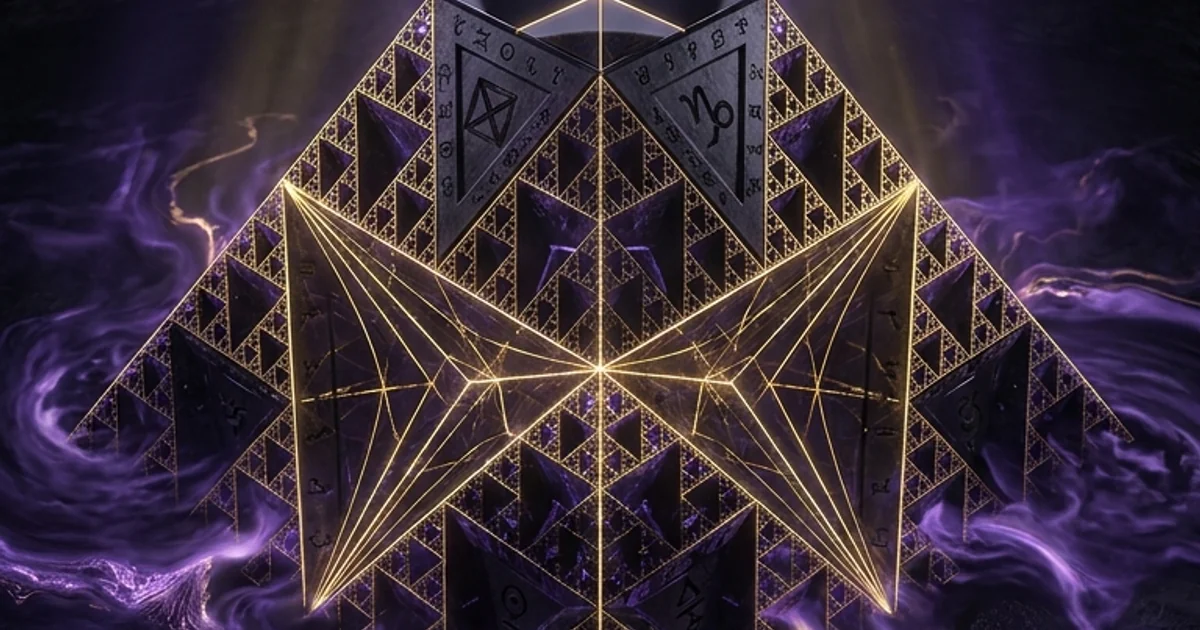
Capricorn: Cardinal Earth and the Mountain of Mastery
Archetypal Thesis & Systemic Paradigm: The Crystallization of Consciousness
The tenth sign of the tropical zodiac is routinely subjected to exoteric reductionism, dismissed in popular astrology as the mere signifier of bureaucratic ambition, social climbing, and institutional inertia. When examined through the rigorous lenses of Hermetic philosophy, classical astrology, and analytical psychology, the Capricorn archetype reveals itself not as passive fossilization, but as an indispensable thermodynamic crucible. It is the energetic engine through which volatile psychic intent undergoes phase-change into enduring structural reality. Capricorn represents the formalization of the cosmos: the cosmological threshold where the unformed, chaotic currents of consciousness confront the unyielding demands of physical manifestation.
The Cardinal Earth Vector: Dynamic Condensation
Within astrological mechanics, the earth element is frequently misunderstood as entirely static or inert. However, when mediated through the cardinal modality, earth sheds all passivity. Cardinality signifies dynamic emergence, vector-driven initiation, and the catalytic rupture of a prior equilibrium. Whereas Fixed Earth (Taurus) maintains mass and density, and Mutable Earth (Virgo) analyzes and recalibrates structural components, Cardinal Earth acts as a gravitational compressor. It is the kinetic process of petrification in the original metallurgical and geological sense: the sudden, catastrophic application of pressure that transforms loose carbon into an unyielding diamond lattice.
The Cardinal Earth vector constitutes a teleological imperative. It takes the expansive, theoretical visions conceived in the preceding fire of Sagittarius and demands their immediate engineering into load-bearing vessels. This vector is intimately tied to the geometry of the hexahedron, as explored in the study of Platonic solids and the cubic architecture of earth. The Cardinal Earth modality does not merely interact with physical matter; it constructs the very metric of spacetime within which matter is forced to negotiate gravity, friction, and entropy. In the human psyche, this vector operates as the cognitive demand for crystallization, compelling the individual to abandon vague abstractions and submit their will to the rigorous friction of practical execution.
The Solstitial Ingress: Gateway of the Transpersonal Gods
The temporal coordinate of Capricorn is bound to the astronomical winter solstice in the Northern Hemisphere—the zero-point of declination where the Sun reaches its southern maximum and appears to stand still (sol sistere). Classical Neo-Platonism and Hermetic astrolatry distinguished this point as the Janua Coeli, the “Gateway of the Gods,” contrasting it with the summer solstice in Cancer, the Janua Inferni or “Gateway of Men.” While the Cancerian gateway oversees the descent of the soul into embryonic waters and mortal incarnation, the Capricornian portal governs the ascending soul’s extrication from the cycle of biological compulsion toward transpersonal, celestial order.
At the winter solstice, solar light is diminished to its annual nadir, plunging the terrestrial sphere into peak darkness. Yet, precisely at this moment of absolute exhaustion, the solar arc undergoes an inflection: the light does not extinguish, but reverses course, initiating a slow, vertical ascent. Capricorn is thus structurally twinned with this paradoxical pivot. It is the crucible of the longest night, demanding maximum psychological fortitude precisely when systemic support is absent. The archetype teaches that vertical elevation does not begin in triumphant light, but in the midnight of the solar cycle, wherein the embryonic seed of solar sovereignty is forged beneath the cold crust of the earth.
Morphological Paradox: The Sea-Goat as Abyssal Origin and Mountain Apex
The glyph and classical icon of Capricorn—the composite Sea-Goat (Aegokeros or Suhurmashu)—presents an intentional ontological paradox. The creature joins the forequarters of a terrestrial, horned caprine with the serpentine, scaly tail of an abyssal fish. This morphological synthesis prevents the archetype from degenerating into a purely utilitarian emblem of worldly ambition. The goat’s horns ascend the arid, windswept precipices of the mountain apex, while its aquatic tail remains submerged within the unfathomable depths of the primordial ocean.
This composite anatomy binds the chaotic, fertile unconscious of the primordial waters directly to the unyielding verticality of the mountain summit. The Sea-Goat demonstrates that true psychological mastery cannot be achieved by repressing the archaic, affective oceanic depths; rather, those abyssal currents must provide the hydrostatic pressure that fuels the upward ascent. The caprine forelimbs claw into sheer stone, translating deep unconscious instinct into conscious, vertical ambition. Mastery is revealed not as the denial of the primal waters, but as their absolute sublimation into architectural form.
Classical Provenance & Textual Lineage: From Enki to the Domicile of Chronos
Tracing the lineage of the Capricorn archetype requires unearthing its Mesopotamian foundations, following its mathematical formalization in Hellenistic treatises, and mapping its operational application in medieval and Renaissance talismanic grimoires. Across every historical iteration, the tenth sign retains its functional identity: the cosmic administrator that converts primordial chaos into institutional and cosmic law.
Mesopotamian Genesis: Enki and the Suhurmashu in Cuneiform Astrometry
The earliest extant iconographic and textual attestations of Capricorn emerge in the cuneiform tablets of the Babylonian Enuma Anu Enlil and the star catalogues of the MUL.APIN (compiled circa 1000 BCE). Here, the constellation is catalogued as MULSUḪUR.MAŠ—the “Goat-Fish.” Far from being an arbitrary zoological hybrid, the Suhurmashu was the sacred zoomorphic avatar of Enki (the Akkadian Ea), the paramount deity of subterranean freshwater (the Abzu), divine artisanry, magic, and the preservation of the me—the immutable blueprints of civilization.
In Mesopotamian theology, Enki was not a remote, sky-dwelling ruler, but an operational god of practical ingenuity who dredged the earth out of the primeval waters and instituted the social technologies of irrigation, kingship, temple architecture, and measurement. The Suhurmashu served as the physical conduit of this divine ordering capacity. It signified the emergence of structural civilization directly out of the abyssal reservoir of potential. When the Sun entered the constellation of the Goat-Fish, the ancients did not perceive a cold, barren sign, but rather the annual renewal of cosmic foundation stones, where divine mechanics were applied to human civil governance.
Hellenistic Formulations: Ptolemaic Tropic and the Nocturnal Domicile of Saturn
With the transmission of astrometry into the Hellenistic Mediterranean, the archetype was systematically codified within the mathematical framework of the Thema Mundi. Hellenistic astrologers classified Capricorn (Aegokeros) as the nocturnal domicile of Kronos/Saturn, cold and dry by nature, melancholic, feminine (nocturnal/receptive), and occupying the southern tropical pivot. In his foundational Anthologiae, Vettius Valens designates Capricorn as an earthy, barren, commanding sign, attributing to it properties of labor, deep contemplation, hidden enterprise, and political authority derived from severe self-denial.
“The southern one, however, which is directed toward the south and is called the winter tropic, is that of Capricorn, because the sun, when it is in it, turns back toward the north and causes the winter solstice… To Saturn again are allotted Capricorn and Aquarius, because he is cold and dry, of a nature contrary to heat and life-giving moisture, and because he is placed in the highest sphere, furthest from the luminaries. Therefore he is assigned the signs that are opposite the luminaries—namely, Cancer and Leo—with Capricorn serving as his nocturnal domicile, where he reigns through cold contraction.” — Claudius Ptolemy, Tetrabiblos, Book I, Ch. 17 (trans. F.E. Robbins, 1940)
Claudius Ptolemy’s formulation explicitly links the seasonal behavior of the winter tropic with the natural philosophy of the Aristotelian elements. As the nocturnal domicile of Saturn, Capricorn expresses the internalized, cohesive dimension of the planet’s governance. Whereas Saturn’s diurnal domicile, Aquarius, utilizes fixed air to systematize conceptual frameworks and ideological collectives, Capricorn utilizes cardinal earth to establish the physical boundaries of society: law codes, masonry, taxation, structural hierarchies, and the explicit recognition of ananke (cosmic necessity). The archetype operates as the ultimate boundary marker, reminding incarnated consciousness of the immutable reality of physical limits, mortality, and the passage of measured time (Chronos).
The Picatrix and Agrippan Decanic Geometry: The Mechanics of Coagulation
During the medieval Islamic translation movement and its subsequent reception in Renaissance Europe, the operational mechanics of the Capricorn archetype were preserved in astromagical compendia such as the Gāyat al-Ḥakīm (the Picatrix) and Heinrich Cornelius Agrippa’s De Occulta Philosophia Libri Tres (1533). These manuals ceased to treat the sign merely as a passive indicator of character, analyzing it instead as a set of dynamic mathematical decans suitable for talismanic manipulation to induce physical crystallization and enduring stability.
Agrippa details the decanic geometry of Capricorn as an instrument of coagulation—the alchemical coagulatio. In the Agrippan cosmological model, the images associated with the decans of Capricorn synthesize images of fierce determination, deep excavation, and political sovereignty. Talismans engraved under the influence of Capricorn were explicitly invoked to secure cities against sieges, construct long-lasting buildings, secure inheritances, and protect against the erosion of authority. The Renaissance magus recognized that Capricorn possessed the singular capacity to bind volatile planetary spirits into dense, physical substrates, establishing an unbreakable tether between the celestial hierarchy and the terrestrial matrix.
Structural Mechanics & Symbolic Geometry: Coordinate Space and Decanic Architecture
The operational potency of the Capricorn archetype is directly inscribed in its celestial coordinates, its fine-grained decanic subdivisions, and its exact placement upon the esoteric schemata of the Hermetic tradition. It is within these geometric specifications that the mechanics of Cardinal Earth reveal their mathematical symmetry.
[ 0° CAPRICORN: WINTER SOLSTICE ]
                      │
   ┌──────────────────┼──────────────────┐
   ▼                  ▼                  ▼
Decan I            Decan II          Decan III
(0° - 10°)        (10° - 20°)       (20° - 30°)
Ruler: Jupiter    Ruler: Mars       Ruler: Sun
[Blueprinting]  [Excavation/Labor]  [Imperial Seal]
   │                  │                  │
2 of Pentacles    3 of Pentacles     4 of Pentacles
Astronomical Coordinates: The Winter Solstice Zero-Point and the Tropic of Capricorn
Geometrically, Capricorn occupies the arc from 270° to 300° of ecliptic longitude. The 270° mark corresponds precisely to the winter solstice, marking the point where the ecliptic reaches its maximum southern distance from the celestial equator:
$$\delta = -23.44^\circ = -23^\circ 26’$$
This astronomical coordinate defines the Tropic of Capricorn on the terrestrial sphere—the southernmost latitude at which the Sun can appear directly overhead at solar noon.
In celestial mechanics, this point represents an absolute kinematic deceleration in the declination axis ($d\delta/dt = 0$). For several days, the midday solar altitude remains stationary before slowly reversing course. This orbital pause is the physical embodiment of the archetype’s functional mechanics: total systemic braking, the cessation of forward dispersion, and the concentration of systemic inertia. Capricornian mechanics operate as a universal dampener of erratic momentum, forcing celestial and psychic bodies to consolidate their gains, establish a zero-baseline, and re-anchor themselves to fundamental laws before initiating a new operational cycle.
Decanic Sub-Divisions: Mars, the Sun, and Mercury across the 30-Degree Arc
The 30-degree arc of Capricorn is segmented into three distinct decanic operations of ten degrees each. According to the classical Chaldean order of planetary rulership—which descends through the celestial spheres from Saturn down to the Moon—the decans of Capricorn are governed by Jupiter, Mars, and the Sun, respectively:
- First Decan (0°–10° Capricorn / Jupiter): This face manifests the initial consolidation of executive vision. Governed by Jupiter, the expansive impulse of the preceding sign is compressed into a definitive social blueprint. It operates as the decan of the legislator and the architect, combining Jupiterian vision with Saturnian terrestrial permanence.
- Second Decan (10°–20° Capricorn / Mars): Here, Mars finds the sign of its exaltation. The Martian drive, often erratic and destructive in other signs, is harnessed by the cold, dry constraint of Saturnian earth. This produces inexhaustible endurance, disciplined labor, and the deliberate application of force to overcome the density of matter. It is the decan of mechanical engineering, heavy excavation, and relentless military or operational strategy.
- Third Decan (20°–30° Capricorn / Sun): Governed by the solar core, this decan represents the apex of worldly accomplishment and institutional crystallization. Light is fused directly into stone, signifying the absolute consolidation of legacy, imperial decrees, and enduring monuments that withstand the ravages of time.
| Decan Arc | Chaldean Ruler | GD Title / Tarot Card | Sephiric Ray | Operative Essence |
|---|---|---|---|---|
| 0° – 10° | Jupiter | Two of Pentacles (Harmonious Change) | Chokmah in Assiah | Structural Blueprinting & Equilibrium |
| 10° – 20° | Mars | Three of Pentacles (Material Increase) | Binah in Assiah | Disciplined Execution & Skilled Labor |
| 20° – 30° | Sun | Four of Pentacles (Earthly Power) | Chesed in Assiah | Sovereign Crystallization & Boundary Defense |
Esoteric Correspondences: The Qabalistic Path of Ayin and the Major Arcana
In the Hermetic Qabalah, the Capricorn archetype is assigned to the 26th Path on the Tree of Life, corresponding to the Hebrew letter Ayin (meaning “Eye”). This path connects Sephira 6 (Tiphereth, the solar seat of Beauty and integrated consciousness) with Sephira 8 (Hod, the seat of Mercurial intellect and structural form). The Path of Ayin represents the descending ray of spiritual light attempting to comprehend and operate within the dense, mechanical structures of the material universe.
The tarot Trump assigned to this path is Trump XV: The Devil. Far from signifying simplistic theological evil, this arcanum is the direct visual embodiment of the Sea-Goat’s mechanical trap and ultimate salvation. The Devil portrays the bondage of consciousness to material form when matter is perceived as the sole, ultimate reality. The figures chained to the cubic pedestal are bound loosely; their enslavement is an optical illusion born of identification with the material container.
The Path of Ayin is the “Path of the Architect-Trickster,” demanding that consciousness gaze with an unblinking, objective “Eye” into the raw material conditions of the cosmos. For a comprehensive analysis of this dynamic, examine the structural role of /tarot/the-devil-path-of-ayin. Mastery on this path requires that one neither worship the material form nor retreat from it into escapist spiritualism. True liberation is achieved by mastering the mechanics of the cubic stone, fulfilling the demands of time and form so thoroughly that the material matrix transforms from a prison into a sacred temple of living consciousness.
Psychological Dynamics & Operational Praxis: The Senex Archetype and the Transmutation of Lead
Within analytical and archetypal psychology, Capricorn provides the operational territory for the Senex—the archetype of the Wise Old Man, the Judge, the Hermit, and the King. When split from its evolutionary teleology, this archetype precipitates the most severe neuroses of the ego; when integrated, it provides the structural load-bearing capacity necessary for complete psychic individuation.
The Shadow of Petrification: Melancholia, Rigidity, and the Tyrannical Senex
When the Capricornian dynamic operates unconsciously, it produces the pathology of psychic calcification. The ego, terrified of the chaotic, devouring nature of the oceanic unconscious (the goat’s tail), overcompensates by erecting hyper-rigid psychic defenses. This manifests clinically as chronic melancholia, anhedonia, obsessively structured control dynamics, and pathological cynicism.
The unintegrated Senex equates vulnerability with annihilation. It builds massive institutional and psychological ramparts, weaponizing duty and tradition to preemptively crush any spontaneous psychic emergence. Under this shadow, life becomes an endless penal colony governed by cold efficiency, where the individual acts as their own unyielding jailer. This petrification represents the failure of the Cardinal Earth dynamic: instead of actively structuring psychic energy, it traps that energy in a leaden sarcophagus, inducing depressive stagnation—the psychological equivalent of absolute zero.
Unintegrated Pathological Senex
- Defensive Strategy: Petrification, hyper-bureaucracy, and emotional numbing.
- Perception of Chaos: Paranoia; existential dread of affective eruptions.
- Structural Dynamic: Authoritarian tyranny; dogmatic clinging to obsolete structures.
- Psychic Core: Profound unworthiness masked by a brittle armor of worldly status.
- Relationship to Time: Paralyzing dread of decay, age, and mortality.
Integrated Sovereign Senex
- Defensive Strategy: Conscious boundary demarcation; ethical self-containment.
- Perception of Chaos: Recognition of the deep Abzu as the matrix of renewal.
- Structural Dynamic: Generative mentorship; stewardship of living, evolutionary institutions.
- Psychic Core: Genuine stoic autonomy forged through voluntary confrontation with necessity.
- Relationship to Time: Transpersonal pacing; legacy building; mastery over cycles of duration.
The Senex-Puer Dialectic: Integrating Boundless Inspiration with Temporal Form
The psychological health of the Capricorn archetype is contingent upon resolving the tension between the Senex and the Puer Aeternus (the Eternal Youth). As explored extensively in the study of the /jungian-psychology/senex-puer-dialectic, these two figures represent a singular archetypal continuum broken into psychological polarity.
The Puer embodies absolute potential, volatile inspiration, and the dream of flight unhindered by gravity. However, without the Senex, the Puer remains an infantile, unmanifested phantom, endlessly planning masterworks but incapable of submitting to the labor of material execution. Conversely, the Senex without the Puer becomes a desiccated, bitter husk, enforcing rules whose original spiritual meaning has long since evaporated.
The Sea-Goat’s ascent of the mountain demands the conscious synthesis of these polarities. The mature individual must utilize the discipline of the Senex to build a vessel capable of housing the divine fire of the Puer. The boundaries imposed by Capricorn are not designed to execute the youth, but to channel its volatile electricity into kinetic, functional work. Without the resistance of the leaden vessel, the golden fire of inspiration simply dissipates into the void.
Operational Praxis: Psychological Alchemization of Saturnian Gravitas
Transforming the lead of Saturnian depression into the gold of psychological autonomy requires a deliberate clinical and operational praxis. This alchemy is achieved not through positive thinking or escapism, but through the deliberate adoption of the reality principle:
- Conscious Voluntary Limitation: The psyche ceases to mourn the loss of infinite, abstract possibilities and willingly selects a specific vector of manifestation. By voluntarily accepting limitation, the individual ends the neurosis of uncommitted potential and initiates structural incarnation.
- Befriending the Lead (Nigredo): In classical alchemy, the work begins with the nigredo—the blackening of the matter, governed by Saturn. Clinically, this requires leaning directly into the experience of weight, delay, and resistance. Rather than treating depressive gravity as an enemy to be chemically eradicated, the practitioner interrogates it as a structural diagnostic, identifying where the ego has built its house on ungrounded illusions.
- Architectural Somatics and Boundaries: Establishing rigorous behavioral, cognitive, and relational boundaries. The practitioner consciously operationalizes the Saturnian boundary-making capacity, cataloged in /astrology/saturn-archetype-cosmic-boundaries, saying “no” to secondary distractions in order to say an absolute, irrevocable “yes” to the primary transpersonal work.
Philosophical Synthesis & Macrocosmic Correspondence: Hermetic Architecture and Systemic Cybernetics
Expanding beyond individual psychology, the Capricorn archetype functions as a macrocosmic principle of cosmic design. It represents the structural spine of reality—the metaphysical architecture that prevents the created cosmos from collapsing back into undifferentiated chaos.
The Law of Restriction: Form as the Prerequisite for Transcendent Manifestation
In Hermetic ontology, unconstrained freedom is an illusion that leads inevitably to total entropy. True manifestation is fundamentally impossible without the principle of restriction. This truth is encoded in the Qabalistic understanding of the Sephira Binah (the Great Mother/Cosmic Saturn), which receives the undifferentiated, radiant force of Chokmah and restricts it, shaping it through cosmic law into distinct, coherent forms.
Limitation is therefore not an evil imposed upon spirit; it is the morphogenetic catalyst of spirit. A river cannot possess power, depth, or direction without the unyielding resistance of its stone banks; without them, it degenerates into a stagnant, shallow swamp. The Cardinal Earth of Capricorn operates as these very banks. By imposing the conditions of space, time, matter, and causal consequence, it grants consciousness the friction it requires to achieve self-awareness. The Mountain of Mastery is the physical terrain where the spirit learns its own strength precisely by wrestling against the resistance of the stone.
“Saturn is the principium individuationis itself, the leaden weight of physical reality without which no psychic integration can occur. As Marie-Louise von Franz demonstrates in her analysis of the Puer Aeternus, the refusal of the Saturnian challenge is the refusal of incarnation itself. When the ego shrinks from the dark, cold demands of the Senex, it chooses the illusory paradise of the nursery over the tragic, noble reality of the individuation process. Chronos devours his children only so long as those children insist on remaining irresponsible phantoms; once they claim their own structural sovereignty, Chronos yields the cosmic scepter.” — Carl Gustav Jung, Aion: Researches into the Phenomenology of the Self (CW 9/II), cross-referenced with Marie-Louise von Franz, Puer Aeternus (1970)
Cybernetic Feedback and Negentropy: Capricorn as Systemic Order
Through the lens of modern systems theory and cybernetics, Capricorn can be precisely defined as the cosmic mechanism of negentropy (negative entropy). The Second Law of Thermodynamics dictates that closed systems naturally degenerate into disorder, noise, and maximum entropy over time. Capricorn represents the systemic counter-vector: the intentional input of energy, regulatory feedback loops, and structural governance designed to preserve, organize, and elevate systemic complexity.
[ Ambient Systemic Entropy / Noise ]
                 │
                 ▼
┌─────────────────────────────────┐
│     CAPRICORN / CARDINAL EARTH   │
│   Cybernetic Boundary Layer     │
│   • Regulatory Feedback Loops   │
│   • Load-Bearing Architecture   │
│   • Negentropic Structural Work │
└─────────────────────────────────┘
                 │
                 ▼
[ Organized Institutional Form / Signal ]
In cybernetic terms, Capricorn operates as the systemic governor. It monitors the output of the systemic engine, compares it against the fundamental parameters of survival and duty, and applies immediate, corrective friction when the system diverges into unsustainable excess. It is the institutional memory of a civilization, the immune system of an organization, and the cognitive error-correction mechanism of the mind. By enforcing accountability to systemic constraints, it guarantees that complex systems retain their functional integrity against the corrosive baseline of environmental entropy.
The Ethos of the Axis Mundi: Stewardship and Transpersonal Duty
At the apex of the Mountain of Mastery stands the realization of the true nature of authority. In the lower octaves of the archetype, authority is sought for the ego’s aggrandizement—the paranoid king sitting upon an isolated throne, hoarding power against the terror of obsolescence. At the transpersonal octave, however, authority is experienced entirely as structural servitude.
The sovereign who reaches the true summit of Capricorn does not find a playground of unbridled privilege, but the central pillar of the world—the Axis Mundi. Here, the ruler recognizes that their position exists solely to bear the gravitational weight of the collective structure. The crown is forged of lead and thorns before it is plated in gold. This is the ethos of transpersonal stewardship: the profound, sobering realization that the highest structural authority is duty-bound to maintain stability, justice, and protection for the entire matrix beneath it. To master Capricorn is to become a living foundation stone—unshakable, silent, and entirely dedicated to upholding the temple of human civilization against the howling winds of time.
Frequently Asked Questions: Resolving Paradoxes of the Tenth Archetype
Why is an Earth sign symbolically represented as half-aquatic?
The half-aquatic morphology of the Sea-Goat (Suhurmashu) embodies the essential Hermetic doctrine that material structure cannot survive without access to its unconscious, primordial origins. If Capricorn were depicted purely as a terrestrial animal, it would symbolize a closed, desiccated system—brittle, sterile, and incapable of systemic regeneration.
By retaining the serpentine fish-tail submerged within the abyssal waters (Abzu), the archetype demonstrates that true structural mastery requires the continuous dredging and alchemical transmutation of deep affective and instinctive currents. The terrestrial caprine forequarters derive their upward climbing torque from the hydrostatic pressure of the unconscious depths. The archetype reveals that institutional and personal authority are fundamentally hollow unless rooted in the deep psychic well of collective human experience.
How does Capricorn’s Cardinal modality differ from Fixed Taurus and Mutable Virgo?
The three signs of the Earth triplicity represent three fundamentally different mechanical operations upon physical matter, as detailed in the overview of the /astrology/four-elements-cardinal-signs:
- Cardinal Earth (Capricorn): Acts as the initiator and architect of form. It dynamicizes earth, utilizing pressure and structural planning to manifest new institutions, erect boundaries, and drive vertical ambition. It is concerned with the systemic hierarchy, authority, and teleological destiny of matter.
- Fixed Earth (Taurus): Acts as the sustainer and accumulator of form. It stabilizes matter, maximizing physical density, sensory continuity, and resources. Taurus does not construct hierarchies or seek vertical ascent; it deepens roots, securing somatic stability and material wealth.
- Mutable Earth (Virgo): Acts as the analyst and refiner of form. It disassembles material structures into their constituent functional parts, inspecting them for systemic error, inefficiency, and contamination. Virgo prepares matter for functional utility through craft, service, hygiene, and iterative recalibration.
Is the Saturnian influence inherently malefic, or is it an engine of individuation?
The designation of Saturn as the “Greater Malefic” (Infortuna Major) in classical Hellenistic and medieval astrology reflects the primitive ego’s terror of limitation, delay, aging, and death. Because the ego is naturally pleasure-seeking and expansive, it perceives any boundary condition, disciplinary demand, or material obstacle as an external evil.
In transpersonal and Jungian psychology, however, Saturn’s cold, drying, and restricting influence is recognized as the supreme engine of individuation. Without the confrontation with Saturnian necessity (ananke), consciousness remains in an undifferentiated, infantile state of psychic inflation. Saturn forces the subjective spirit into the objective crucible of physical reality. The hardships, isolations, and delays administered by the Saturnian archetype are not gratuitous cruelties; they are structural diagnostics. They systematically burn away the ephemeral, ungrounded fantasies of the false self, leaving behind only the adamantine, incorruptible core of the true, sovereign individual.