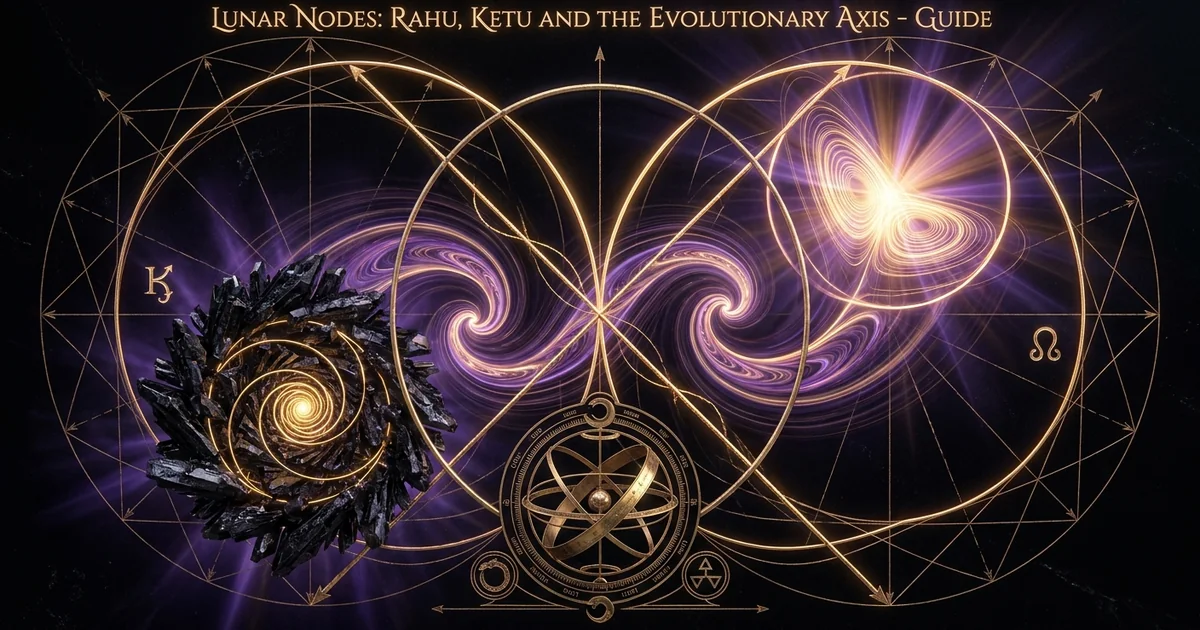
Lunar Nodes: Rahu, Ketu and the Evolutionary Axis - Guide
Archetypal Thesis & Systemic Paradigm: The Nodal Vector in Consciousness
The Orbital Intersect: Ecliptic Purpose vs. Somatic Reflex
Within celestial mechanics, the lunar nodes are not corporeal masses possessing physical volume or albedo. Rather, they are mathematical intersections: the two points in space where the inclined orbital plane of the Moon (tilted at approximately 5°09′ relative to the background framework) crosses the ecliptic-plane, the apparent annual path of the Sun as viewed from our geocentric observation platform. This spatial intersection represents an encounter between two fundamentally distinct principles of human existence. The ecliptic-plane embodies the solar principle—the teleological thrust of conscious individuation, solar will, creative vitality, and the emergent trajectory of identity unfolding across time. Conversely, the lunar orbit delineates the nocturnal, instinctual matrix—the realm of somatosensory conditioning, emotional feedback loops, ancestral habitus, and the biological memory of the organism.
When these two non-parallel orbital pathways bisect one another, they produce a directional axis that coordinates celestial mechanics with psychic developmental architecture. In the lexicon of evolutionary astrology, this axis constitutes the primary psycho-cosmological coordinate system through which the personality negotiates the tension between inherited instinct and conscious development. The South Node, or Cauda Draconis, marks the descending node where the Moon crosses from the northern ecliptic hemisphere to the southern; the North Node, or Caput Draconis, marks the ascending node where the Moon moves north. This geometric bisection establishes an energy pathway through which solar intentionality must actively integrate, refine, and metabolize the inertial mass of instinctual memory.
                  [ North Node / Caput Draconis / Rahu ]
                                    ▲
                                   / \
                                  /   \
  Ecliptic Plane (Solar Teleology) ---- Solar-Lunar Intersect ---- Lunar Orbit (Somatic Habitus)
                                  \   /
                                   \ /
                                    ▼
                  [ South Node / Cauda Draconis / Ketu ]
Rather than operating as inert geometric artifacts, these nodes function as systemic regulators within the natal architecture. The ascending node operates as an intake portal for evolutionary material, whereas the descending node functions as an exhaust and stabilization valve for behavioral patterns that have crystallized over prolonged generational and personal timeframes. The interplay between these points governs how an individual processes the demands of their internal psychic economy against the pressures of somatic homeostasis.
Rahu and Ketu as the Cybernetic Vector of Individuation
In archetypal psychology, the rahu-ketu axis functions as a dynamic cybernetic feedback mechanism operating within the human psyche. Carl Gustav Jung demonstrated that the ego tends toward unilateral inflation or regressive inertia unless confronted by compensatory dynamics emerging from the unconscious. The South Node (Ketu) delineates the ego’s psychological baseline—the automatic behavioral defaults, reactive cognitive structures, and affective defense systems developed to preserve stability. Because these patterns have been executed repeatedly across ancestral and developmental history, they exhibit profound neural and psychic efficiency. They demand minimal psychic expenditure to operate, functioning as the cognitive line of least resistance.
Conversely, the North Node (Rahu) represents the teleological vector of individuation. It introduces systemic disturbance into the psychic architecture, confronting the native with evolutionary material that feels alien, complex, and cognitively dissonant. The North Node behaves as an evolutionary attractant: a high-entropy horizon that compels the ego to expand its operational boundaries beyond its comfortable repertoire. Through the lens of cybernetics, this dynamic constitutes an open feedback system where the South Node acts as the stabilizing negative feedback loop (maintaining systemic equilibrium and resisting deviation), while the North Node acts as a positive feedback loop (amplifying deviation, driving phase shifts, and forcing the system toward higher states of organization).
To identify the lunar nodes astrology north south node karma purely with deterministic fate is to misunderstand the psycho-spiritual architecture of the horoscope. The nodal axis does not impose an unalterable narrative; rather, it delineates the primary developmental axis along which an individual’s conscious will must engage unconscious habit. This systemic movement mirrors the alchemical operation of separatio and conjunctio, wherein the native must decouple their identity from the compulsive instinctual safety of the South Node without severing access to its foundational mastery, thereby directing that distilled psychic capital toward the unrealized potential symbolized by the North Node.
The Evolutionary Axis: Transcending Fatalistic Astrological Dogma
Traditional and early medieval astrologies frequently reduced the lunar nodes to moralistic caricatures, interpreting the Head of the Dragon as an indiscriminate amplifier of fortune or greed, and the Tail as an agent of catastrophic loss, penury, and psychological destabilization. While these historic delineations preserve vital symbolic insight regarding the phenomenology of excess and renunciation, contemporary evolutionary astrology reconceptualizes these points as a holistic metabolic circuit. The psyche cannot evolve solely through acquisition, nor can it sustain integrity through perpetual negation.
The nodal axis articulates the biological and metaphysical law of metabolism: ingestion must be balanced by assimilation, elimination, and evacuation. Rahu/North Node governs the ingestion of novel psychic experience, perceptual paradigms, and systemic roles necessary to break calcified psychological forms. Ketu/South Node governs the elimination of outworn behavioral constructs, while simultaneously serving as the storehouse of integrated, ancestral competencies. Pathological development occurs when this axis becomes asymmetric. Over-identification with the North Node induces chronic dissatisfaction, insatiable ambition, and manic alienation from one’s organic roots, as seen in pathological manifestations of ungrounded ambition. Conversely, retreat into the South Node generates psychic stasis, existential stagnation, and progressive neurosis born of refusing the evolutionary demands of the self.
By shifting our analytical framework from deterministic external events to systemic internal dynamics, the nodal axis reveals how fate is operationalized psychology. The challenges encountered at the North Node are not external punishments delivered by a retributive cosmos; they are the necessary friction generated when a living organism expands into uncharted cognitive and spiritual territory. The soul destiny chart is fundamentally an anatomical blueprint of this inner friction, delineating the specific archetypal crucible in which the base lead of conditioned somatic habit is transmuted into the refined gold of self-realized agency.
Classical Provenance & Textual Lineage: From Chaya Grahas to the Dragon’s Axis
Vedic Cosmogony and the Samudra Manthan: The Severed Serpent
The foundational mythology of the lunar nodes finds its most profound metaphysical exposition in the Vedic narrative of the Samudra Manthan, the churning of the primordial ocean of milk detailed in the Mahabharata, Vishnu Purana, and Srimad Bhagavatam. In this cosmogonic drama, the Devas (forces of light and order) and the Asuras (forces of primordial desire and chaos) cooperate to churn the cosmic waters using Mount Mandara as a churning rod and the great serpent Vasuki as the rope, seeking to extract Amrita, the nectar of immortality. When the nectar emerges, the Asura Svarbhanu infiltrates the assembly of the Devas, assuming their form to consume the divine draught. Before the nectar can pass fully through his digestive tract, Surya (the Sun) and Chandra (the Moon) discern the deception and alert Lord Vishnu.
Vishnu immediately unleashes the Sudarshana Chakra, decapitating Svarbhanu. However, because the Amrita had touched the entity’s lips, both severed halves achieve immortality. The severed head becomes Rahu, while the headless torso and tail become Ketu. Granted status as Chaya Grahas (shadow planets) by Brahma, they are cast into the celestial mechanics of the cosmos as the eternal adversaries of the luminaries. Rahu, retaining the sensory apparatus, the mouth, and the capacity for perception, possesses an insatiable, unquenchable desire to consume the cosmos, yet lacks a stomach to digest or retain what it ingests; it swallows the Sun and Moon during eclipses, only for them to pass unimpeded through its severed neck. Ketu, the headless body, represents sensory deprivation, radical detachment, the severed tail that seeks dissolution (moksha) from the cycle of material existence (samsara).
[ Svarbhanu Ingests Amrita ]
             │
   (Vishnu Decapitates)
             │
 ┌───────────┴───────────┐
 ▼                       ▼
[ Rahu: Severed Head ]   [ Ketu: Severed Torso ]
- Mouth without Stomach   - Body without Head
- Voracious Desire        - Sensory Deprivation
- Material Obsession      - Radical Liberation (Moksha)
This narrative provides an acute structural metaphor for the operations of consciousness. Rahu encapsulates the blind, primal hunger of the ego to experience material phenomena—it is the driving force of incarnation itself, the projection of desire into the matrix of spacetime. Ketu, conversely, embodies the exhaustion of desire, the traumatic severing from material illusion, and the subsequent longing for transcendence. In Vedic jyotish, Rahu is the smoke that obscures discernment (maya), propelling the individual into karmic entanglements, while Ketu is the fire that burns through illusion, signifying the painful process of spiritual liberation, asceticism, and final emancipation from the wheel of temporal recurrence.
“Rahu is not a bodily entity possessing a head and a tail, nor does he traverse the zodiacal circle as a physical mass; rather, the ancient masters declare Rahu to be the shadow of the Earth cast upon the Moon, or the shadow of the Moon cast upon the Earth at the precise moment of their intersection… it is this Chaya (shadow) that causes the obscuration of the luminary during an eclipse.” — Varāhamihira, Brihat Samhita, Chapter V, Slokas 4–8 (c. 6th century CE)
“The Head of the Dragon (Caput Draconis) is of the nature of Jupiter and Venus, having a masculine, diurnal quality that amplifies, increases, and fortifies every fortune or misfortune of the planet with which it is joined… The Tail of the Dragon (Cauda Draconis) is contrary unto it, being of the nature of Saturn and Mars, diminishing, severing, and bringing down all matters to ruin, emptiness, and decay.” — Guido Bonatti, Liber Astronomiae, Tractatus 3 (c. 1277 CE)
Hellenistic and Medieval Arabic Astrological Lineage: Caput and Cauda Draconis
The translation of the draconic axis into Western astrological doctrine reveals a continuous process of structural preservation combined with shifting interpretive lenses. Claudius Ptolemy, writing in second-century Alexandria, addressed the nodes within his Tetrabiblos (Books I and III) primarily through the lens of astronomical utility and eclipse geometry, noting their capacity to alter planetary motions and generate significant atmospheric and constitutional variations. Hellenistic astrology referred to these points as the Anabibazon (ascending node) and Katabibazon (descending node), treating them not as individual planetary agents, but as points of planetary amplification and diminution.
During the Islamic Golden Age, scholars such as Abu Ma’shar (Kitāb al-milal wa-l-duwal, 886 CE) and Al-Biruni integrated Persian, Indian, and Hellenistic currents, refining the mathematical precision of draconic cycles and solidifying the nomenclature of Al-Jauzahar (the celestial dragon). Abu Ma’shar utilized the secular cycles of the Caput and Cauda Draconis to calculate macro-historical shifts, civilizational epochs, and the rise and fall of religious dynasties, recognizing that the slow retrograde procession of the nodes across the zodiac correlated with systemic historical ruptures.
When these Arabic treatises were translated into Latin in the twelfth and thirteenth centuries, they shaped the European medieval paradigm codified by authorities such as Guido Bonatti and later William Lilly. In this framework, the Head of the Dragon (Caput Draconis) was designated as essentially benefic, possessing an expansive quality akin to an amalgamation of Jupiter and Venus. It inflated the dignity, status, and material fortunes of any planet it configured. The Tail (Cauda Draconis), conversely, was regarded as deeply malefic, exhibiting the harsh, severing attributes of Saturn combined with the inflammatory nature of Mars. It indicated structural failure, spiritual affliction, deception, and the loss of material assets. Yet even within this rigid medieval framework, a deeper esoteric understanding survived: the Tail was recognized as propitious for spiritual contemplation, monastic retreat, and the renunciation of secular ambitions, retaining a subtle connection to its Vedic origins as the karaka of moksha.
The Transpersonal Shift: 20th-Century Evolutionary Cartography
The mid-twentieth century marked a watershed reorientation of Western astrological praxis, catalyzed primarily by the transpersonal psychology movement and the pioneering formulations of Dane Rudhyar. In The Astrology of Personality (1936), Rudhyar severed the interpretation of the lunar nodes from the remnants of medieval fatalism, reframing them through the lens of dynamic organismic balance and Jungian psychology. Rudhyar posited that the nodal axis constitutes the primary structural axis of destiny, linking it directly to the integration of the total human personality. In Rudhyar’s model, the South Node is the point of automatic habit, structural retention, and physiological inheritance; the North Node is the point of conscious integration, self-actualization, and structural destiny.
Following Rudhyar, the evolutionary astrology movement—articulated late in the century by thinkers such as Jeffrey Wolf Green and Steven Forrest—further refined this psycho-spiritual cartography. In this contemporary framework, the South Node ceases to be an omen of deterministic ruin, becoming instead the accumulated repository of the soul’s prior evolutionary cycles, incorporating both hyper-developed talents and unresolved psychological trauma. The North Node is understood as the evolutionary corrective: the specific archetypal antidote required to liberate the native from their repetitive psychic paralysis. The rahu ketu axis was thus transformed from an external dynamic of fated blessings and curses into an internal landscape of evolutionary developmental psychology, tracking the structural movement of consciousness as it maneuvers from the gravitational pull of its past toward the realization of its emergent potential.
Structural Mechanics & Symbolic Geometry: Orbital Physics, Eclipses, and Polarity
Astronomical Calculation: Mean Node vs. True Node Oscillations
The operational delineation of the nodal axis demands an understanding of the divergence between the “Mean” Node and the “True” (or Osculating) Node. Because the Moon’s orbit is subject to the gravitational influences of the Sun, the Earth, and, to a lesser degree, the major planets, its orbital plane does not maintain a static spatial orientation; rather, it wobbles, precesses, and oscillates continuously.
The Mean Node is a smoothed mathematical idealization. It calculates the position of the nodal axis based on an averaged, steady retrograde motion, completing one full circuit of the zodiac in approximately 18.5996 years (roughly 6,793.5 days), moving at an average rate of 3 minutes and 10.6 seconds of arc per day. It presents the nodes as moving uniformly in backward motion through the signs, serving as an archetypal baseline that filters out short-term celestial turbulence.
Conversely, the True Node calculates the instantaneous, osculating position of the lunar orbit’s intersection with the ecliptic at any given moment, accounting for the gravitational perturbations exerted by the Sun on the Earth-Moon system (such as evection and variation). Because of these gravitational tugs, the True Node does not move at a uniform rate, nor does it move strictly in retrograde. Instead, it exhibits a erratic, stuttering motion: it slows down, halts, and periodically moves in direct motion for several days at a time before resuming its retrograde trajectory. The discrepancy between the True Node and the Mean Node can extend up to 1°45′ of arc.
Caput Draconis (North Node / Rahu)
- Astronomical Nature: Ascending node; Moon crosses ecliptic into northern latitude; vector of northern ascent.
- Psychological Function: Evolutionary attractant; positive feedback loop; conscious assimilation of novel cognitive schemas.
- Shadow Manifestation: Insatiable greed, obsessive ambition, psychic inflation, existential dissatisfaction, ungrounded hunger.
- Evolutionary Mandate: Stepping into unfamiliar archetypal territory; embracing vulnerability; cultivating novel psychic competencies.
Cauda Draconis (South Node / Ketu)
- Astronomical Nature: Descending node; Moon crosses ecliptic into southern latitude; vector of southern descent.
- Psychological Function: Instinctual repository; negative feedback loop; crystallization of past mastery and somatic habitus.
- Shadow Manifestation: Compulsive habituation, neurosis, stagnation, emotional paralysis, unconscious inertia.
- Evolutionary Mandate: Purging calcified behavioral loops; transmuting instinctual skill into conscious service; psychic non-attachment.
For the astrological researcher, this technical divergence presents an interpretive choice. The Mean Node represents the persistent evolutionary current—the deep, archetypal baseline of the soul’s teleological vector. The True Node reflects the phenomenological reality—the immediate, fluctuating friction experienced as the native navigates this evolutionary vector through real-time somatic conditions. The choice of coordinate system can shift aspects to natal planets—particularly within the micro-geometries of /astrology/planetary-aspects-geometry—and can even alter the house placement of the nodes along cuspidal boundaries calculated through /astrology/houses-derived-systems.
The Saros Cycle, Draconic Month, and Syzygy Eclipse Windows
The lunar nodes are structurally inseparable from the phenomenon of eclipses. An eclipse can only occur when a syzygy—a New Moon (solar eclipse) or a Full Moon (lunar eclipse)—transpires within close angular proximity to the nodal axis. The draconic month (the period of time it takes for the Moon to return to the same node, approximately 27.2122 days) does not align evenly with the synodic month (the cycle of lunar phases from New Moon to New Moon, lasting approximately 29.5305 days). This geometric discrepancy ensures that eclipses do not occur every month, but only during specific “eclipse seasons,” which arrive approximately every 173.3 days (roughly every six months), when the Sun approaches within approximately 15° to 18° of either node.
       [ Synodic Month: 29.53 Days ]  ≠  [ Draconic Month: 27.21 Days ]
                                     │
                     (Periodic Geometric Alignment)
                                     ▼
                      [ Eclipse Season: ~173.3 Days ]
                                     │
                        (Harmonic Phase Lock)
                                     ▼
                      [ Saros Cycle: 18 Years, 11.3 Days ]
Over extended timeframes, these alignments form the saros-cycle, a periodicity of approximately 6,585.32 days (18 years, 11 days, and 8 hours). Discovered by ancient Chaldean astronomers, a Saros series consists of a family of eclipses separated by this precise interval, during which the geometry of the Sun, Earth, and Moon returns to nearly identical spatial configurations. Because of the extra eight hours, each successive eclipse in a Saros series is shifted approximately 120 degrees westward on the Earth’s surface, requiring three Saros cycles (the Exeligmos, lasting 54 years and 1 month) to return to the same geographic longitude.
These eclipse windows represent concentrated evolutionary disruptions. While the daily transit of the nodal axis through the zodiac operates as a persistent developmental background, an eclipse falling directly upon a natal nodal axis or configuring personal planets functions as an evolutionary accelerator. The alignment of the solar, lunar, and terrestrial planes temporarily severs customary energetic flows, breaking static behavioral routines and driving radical life transitions. In the architecture of the soul destiny chart, eclipses upon the nodal axis act as evolutionary catalysts, dissolving obsolete psychological patterns and precipitating the emergence of latent North Node qualities.
Axial Polarity: 180-Degree Complementarity in the Chart Architecture
Because the lunar nodes are locked in an exact, invariant 180-degree opposition, they must never be analyzed as isolated, disparate entities. They constitute a single energetic dipole, an unbroken continuum of consciousness spanning across opposing signs, houses, and elements. In systemic geometry, a line cannot exist without both its terminal endpoints; altering the tension or position of one point instantaneously reverberates across the entirety of the vector.
Pathological astrological delineation frequently falls into the trap of ethical dualism, framing the South Node as an intrinsic evil to be abandoned or eradicated, and the North Node as an absolute good to be pursued to the exclusion of all else. Such approaches violate the fundamental Hermetic law of polarity. If an individual attempts to sever or completely suppress their South Node, they amputate their instinctual roots, their hard-won ancestral gifts, and their baseline physiological security. The inevitable consequence of such repression is psychic enervation and neurotic collapse, leading to an unconscious, catastrophic regression into the worst manifestations of the South Node archetype.
[ South Node: 0° ] <──────────── Evolutionary Continuum ────────────> [ North Node: 180° ]
     (Root / Foundation)                                              (Telescopic Horizon)
              │                                                                 │
              └─── Excessive Repression ────> [ Enantiodromic Rebound ] <───────┘
The proper operational praxis consists of using the South Node as an engine of stability, service, and grounding, through which the high-voltage archetypal demands of the North Node can be safely channeled. The South Node is the platform from which the leap of faith into the North Node is launched; it is the root system that nourishes the emerging flower of the evolutionary mandate. Polarity integration demands that the native discover the hidden synthesis between the opposing signs and houses, achieving a state of dynamic equilibrium where the gifts of the past continuously feed the evolutionary imperatives of the future.
Psychological Dynamics & Operational Praxis: Interpreting the Soul Destiny Axis
The South Node Habit Loop: Ancestral Imprints and Pathological Safety
The South Node represents the individual’s psychological default setting: the complex array of coping strategies, relational habits, and cognitive heuristics that have become so deeply etched into the psyche that they operate automatically, largely below the threshold of waking consciousness. This point denotes areas where the native possesses an effortless, innate fluency. A native with the South Node in Virgo, for example, displays an intuitive grasp of systemic organization, analytical critique, and somatic containment; an individual with the South Node in the Seventh House possesses a hyper-developed capacity to perceive the needs of the other and maintain relational equilibrium.
However, this inherent mastery contains an evolutionary trap. Because these operational modes are accompanied by minimal cognitive friction, they become psychological comfort zones. When confronted by external stress, existential anxiety, or systemic crisis, the ego instinctively retreats into its South Node behaviors, executing them with compulsive rigidity. In this mode, the Virgo South Node devolves into obsessive micromanagement, paralyzing hypochondria, and neurotic perfectionism; the Seventh House South Node regresses into codependency, loss of personal sovereignty, and a chronic inability to exist outside the validating gaze of a partner.
These habit loops represent ancestral and developmental conditioning that has outlived its functional utility. The native remains trapped in an operational loop, deploying past solutions to resolve fundamentally novel psychological challenges. Over time, exclusive reliance upon the South Node results in existential stagnation, spiritual apathy, and a pervasive sense that life has lost its dynamic vitality. The mastery of the South Node, when divorced from evolutionary forward motion, inevitably rots into psychic atrophy.
The North Node Attractant: Navigating Cognitive Dissonance and Novelty
The North Node presents an operational profile that is the exact inverse of the South. The sign and house occupied by the North Node delineate psychological capabilities, relational styles, and archetypal domains in which the native feels profoundly unpracticed, awkward, and vulnerable. Entering this territory requires the conscious suspension of established ego defenses. A native with the North Node in Pisces must abandon the safety of hyper-analytical control to navigate the unbounded waters of trust, ambiguity, and transpersonal surrender; an individual with the North Node in the First House must step away from comfortable diplomatic accommodation to assert raw, unmitigated personal agency and self-definition.
To systematically delineate the operational architecture of the nodal axis in a natal chart, follow this four-tier analytical sequence:
- Calculate and Map the Dispositors: Identify the planetary rulers of both the North Node and the South Node (the nodal dispositors). The South Node dispositor indicates the vehicle through which past conditioning is expressed and integrated; the North Node dispositor indicates the engine through which evolutionary growth must be materialized. Delineate their signs, houses, and essential dignities.
- Assess Mutual Aspects Between Dispositors: Determine if the two dispositors form an aspect to one another. A harmonious aspect (trine/sextile) facilitates an organic flow between past mastery and future integration. A stressful aspect (square/opposition) indicates significant intrapsychic tension, requiring conscious effort to prevent the past from sabotaging future emergence.
- Analyze Planets Conjunct the Nodal Axis: Any planet within an 8° orb of conjunction to either node profoundly colors the axis:
- Conjunct South Node: Represents a complex archetypal inheritance—a capacity that is hyper-instinctual but carries unresolved karmic or ancestral trauma that must be consciously refined and purified.
- Conjunct North Node: Operates as an evolutionary gatekeeper—an archetypal energy that must be actively embraced, developed, and integrated as a prerequisite for fulfilling the soul’s teleological mandate.
- Identify and Resolve Skipped Steps (Planetary Squares): Any planet forming an approximate square (within 5°–7° orb) to the nodal axis constitutes an evolutionary skipped-step. This planet represents an archetypal complex that has been split off or suppressed in the native’s development. Evolutionary forward movement along the nodal vector remains intermittent or blocked until this squaring planet is addressed, integrated, and consciously expressed.
Because the North Node demands behavioral modalities that have not yet been stabilized through habit, the initial approach to this pole inevitably generates significant cognitive dissonance and performance anxiety. The ego experiences the North Node not as an alluring adventure, but as an existential threat to its curated sense of competence. Consequently, individuals frequently develop elaborate psychological compensations to resist North Node integration, feigning disinterest or projecting negative attributes onto the archetypal themes of that sign and house.
Yet, paradoxically, the North Node exerts a steady teleological pull. Whenever the native willingly embraces the vulnerability demanded by the North Node, they experience a surge of systemic vitality, self-respect, and existential meaning. The North Node does not promise ease or instantaneous tranquility; rather, it offers psychological integration. It is the evolutionary medicine that counterbalances the toxicity of chronic South Node reliance, providing the native with the specific developmental experiences required to forge an expanded, resilient, and differentiated self.
Operational Synthesis: Planetary Rulers and Nodal Aspects
A sophisticated astrological delineation must look beyond the signs and houses of the nodes to examine their planetary rulers, known as the nodal dispositors. The nodes are not physical bodies; they must route their archetypal energies through the planetary rulers that govern the zodiacal signs they occupy. The condition, essential dignity, house placement, and aspect network of these dispositors reveal the concrete mechanisms through which the nodal dynamic operates in temporal reality.
The dispositor of the South Node reveals the underlying psychic architecture of the native’s past patterns. If the South Node is in Taurus and its ruler, Venus, is positioned in Scorpio in the Twelfth House forming a square to Saturn, the native’s South Node comfort zone is not merely a generalized desire for material comfort; it is rooted in deep-seated, unconscious anxieties regarding survival, catastrophic betrayal, and structural deprivation. The dispositor of the North Node, conversely, indicates the planetary vehicle through which evolutionary progress can be actualized. If the North Node is in Scorpio and its traditional ruler, Mars, is situated in Capricorn in the Second House, the path toward emotional depth and psychological regeneration must be anchored through disciplined, tangible labor, self-reliance, and the establishment of sovereign material boundaries.
The analytical process becomes even more critical when planets form aspects to the nodes themselves. Planets forming trines or sextiles to the nodal axis provide supportive, stabilizing bridges between past and future. However, planets in hard aspect—particularly the conjunction and the square—demand rigorous clinical focus. A planet conjunct the South Node acts as a massive anchor, binding the consciousness to instinctual reflexes, while a planet conjunct the North Node functions as an evolutionary beacon that demands immediate integration. Most critically, planets squaring the nodal axis represent the primary developmental ruptures of the personality, demanding systematic resolution before the individual can move freely along their evolutionary trajectory.
Philosophical Synthesis & Macrocosmic Correspondence: Hermetic Polarity and Time Loops
The Ouroboric Continuum: Time as a Closed-Loop Cybernetic System
At the macrocosmic level, the lunar nodes correspond to the primordial esoteric glyph of the Ouroboros—the serpent biting its own tail. Found throughout Hellenistic magical papyri, ancient Egyptian funerary texts, and alchemical treatises, the Ouroboros is the ultimate symbol of the cyclical continuity of time, the conservation of energy, and the systemic feedback loops of the cosmos. In the draconic axis, this serpent is mapped across the vault of heaven: the head (Caput) perpetually hungers for, ingests, and incorporates the future, while the tail (Cauda) excretes, dissolves, and stabilizes the past, feeding back into the cycle to sustain the evolutionary architecture of the self.
       ┌───────────────────────┐
       ▼                       │
[ Ingestion: Rahu ] ──> [ Evacuation: Ketu ]
This archetypal architecture demonstrates that temporal progression is not a naive linear arrow, but a closed-loop cybernetic system. The linear experience of time is a perceptual construct of the localized ego; from the systemic perspective of the total psyche, the future (North Node) and the past (South Node) exist in a state of reciprocal co-creation. The South Node creates the dynamic conditions, debts, and foundational competencies that summon the North Node into manifestation; the North Node serves as the teleological attractant that pulls the consciousness forward out of South Node inertia.
Viewed through this lens, the soul does not simply journey from the past to the future; rather, the future continually reaches back to reorganize, redeem, and metabolize the past. The Ouroboros reminds the practitioner that the North Node cannot exist in the absence of the South Node. The head of the dragon cannot sever its connection to its tail without destroying its own systemic existence. Evolutionary development is not an escape from one’s history, but the conscious, ouroboric recycling of that history into the structural fuel required for sustained psychological and spiritual evolution.
Teleology, Enantiodromia, and the Jungian Self
The systemic mechanics of the nodal axis find a precise modern parallel in the analytical psychology of Carl Gustav Jung, specifically his foundational concepts of teleology and enantiodromia. Classical Freudian psychoanalysis operated primarily through a causal-reductive lens, seeking to explain all psychological phenomena through past historical traumas and infantile biological fixations. Jung, while recognizing the reality of these historical complexes, insisted that the human psyche is equally governed by a teleological, prospective orientation: the psyche is drawn forward by an emergent image of wholeness, orchestrated by the transpersonal archetype of the Self.
The nodal axis mirrors this psychological dichotomy. The South Node encapsulates the causal-reductive matrix—the accumulated instincts, conditioning, and archetypal complexes that exert a gravitational pull upon the ego. The North Node embodies the teleological pull of the Self. When an individual persistently refuses to heed this teleological vector, remaining willfully entrenched in South Node safety, the psychic energy (libido) dams up in the unconscious.
“The Self, like the unconscious, is an a priori existent out of which the ego evolves. It is, so to speak, an unconscious prefiguration of the ego. It is not I who create myself, rather I happen to myself… The system of the psyche is an open system that maintains its stability not through stasis, but through dynamic, compensatory regulation between opposing archetypal forces.” — Carl Gustav Jung, Aion: Researches into the Phenomenology of the Self, CW 9ii, §115 (1951)
“An open system can attain a state independent of time, a so-called steady-state (Fließgleichgewicht), in which the system remains constant as a whole and in its phases, though there is a continuous flow of the component materials… The characteristic of the steady state is that it can actively overcome disturbances and re-establish equilibrium through negative feedback, while evolving toward higher degrees of order through systemic amplification.” — Ludwig von Bertalanffy, General System Theory, Chapter 5 (1968)
This damming up of libido inevitably triggers the operation of enantiodromia—the ancient Heraclitean principle rediscovered by Jung, wherein any psychological position held to a one-sided, pathological extreme inevitably transforms into its diametric opposite. In chart dynamics, an individual who chronically clings to South Node behaviors will eventually experience an unconscious, catastrophic enantiodromia: the South Node life structure collapses under the weight of its own evolutionary obsolescence, plunging the native into a profound crisis that forces an abrupt, involuntary confrontation with their North Node imperative. The evolutionary demand of the chart cannot be permanently evaded; it will manifest either internally as conscious psychological development, or externally as fated, disruptive circumstance.
Cross-System Parallels: Human Design Nodal Environments and the I Ching Axis
The structural significance of the lunar nodes as an environmental framing mechanism extends into contemporary synthesis systems, notably the Human Design System and its roots in the I Ching. In Human Design, the lunar nodes are differentiated completely from planetary activations: while the Sun and Moon define personal identity, conscious mind, and somatic drive, the Nodal Gates calculate the environmental field within which the native’s life script unfolds.
In this framework, the South Node gate defines the experiential landscape, perceptual backdrop, and relational framing of the first half of the native’s life (up until the Uranus Opposition, approximately ages 38–44). It is the stage upon which the young ego plays out its conditioning. Following this mid-life developmental phase shift, the environmental field transitions into the North Node gate, systematically rearranging the native’s external circumstances, peer group, and socio-perceptual matrix to cultivate the higher developmental tasks of the mature personality.
Birth to Mid-Life (Age ~38-44)           Mid-Life to Elderhood
───────────────────────────────────► │ ◄───────────────────────────────────
      [ South Node Environment ]     │      [ North Node Environment ]
     Perceptual Field: Historical    │     Perceptual Field: Emergent
This structural architecture aligns directly with the dynamic polarity of the I Ching (the Book of Changes). Each hexagram exists in an intimate, mathematical relationship with its inverted pair or its direct complementary opposite (all six lines changed from Yin to Yang or vice versa). The nodal axis reflects this hexagrammic complementarity: moving between the South and North Nodes is equivalent to shifting the dynamic balance of Yin (receptivity, habitus, form) and Yang (action, mutation, spirit). The nodes do not merely indicate internal psychological attributes; they map the dynamic interface between the subjective consciousness of the native and the macrocosmic, environmental field of reality. They determine what the individual is capable of witnessing, encountering, and metabolizing within the temporal drama of their incarnation.
Frequently Asked Questions: Technical Inquiries and Advanced Delineation
Mean Node versus True Node: Which Coordinates Possess Greater Empirical Validity?
The debate between the utilization of the Mean Node and the True Node represents one of the most contentious technical dialogues in contemporary astrological practice. To determine empirical validity, the investigator must understand the mathematical reality underlying both calculations. The True Node incorporates the complex, short-term gravitational tugs exerted by the Sun and the Earth upon the Moon’s orbit, resulting in a calculated coordinate that captures the physical Moon’s precise osculating intersect with the ecliptic at any given second. As a result, the True Node oscillates erratically, moving retrograde, stationary, and direct across brief windows.
The Mean Node, on the other hand, is a mathematical formula that averages these gravitational perturbations across time, treating the nodal journey as a steady, uninterrupted, retrograde continuum of approximately 19.3 degrees per year. Proponents of the True Node argue that astrology must maintain absolute adherence to observational physics: if the Moon’s real-time plane intersection wobbles, the astrological chart must register that empirical fact. True Node calculations are particularly vital in horary astrology, precise eclipse path mappings, and exact timing methods derived through /astrology/progressions-directions.
Conversely, proponents of the Mean Node argue that the lunar nodes are fundamentally non-material, archetypal axes, and that the smoothing of astronomical perturbations reflects the deep, metaphysical current of the soul’s evolutionary trajectory, uncontaminated by localized gravitational noise. In clinical practice, both coordinate sets possess diagnostic utility. However, the researcher must avoid conflating them: when analyzing subtle aspects or planetary conjunctions within an orb of less than two degrees, the practitioner must test both coordinates against the native’s biographical history. Often, the Mean Node maps the underlying transpersonal narrative, while the True Node registers the precise, erratic crises through which that narrative is experienced in material, somatic reality.
What Occurs During the Nodal Return (Age 18.6, 37.2, 55.8) and Nodal Opposition?
The retrograde precession of the nodal axis across the 360 degrees of the zodiac establishes a precise bio-psychological developmental clock, cycling through two distinct phases of structural realignments: the Nodal Return and the Nodal Opposition (or Reverse Nodal Return).
[ Age 0: Baseline ] ──> [ Age 9.3: Opposition ] ──> [ Age 18.6: 1st Return ]
                              │                            │
                              ▼                            ▼
                      Reorientation Crisis          Evolutionary Emergence
The Nodal Return occurs approximately every 18.6 years (at ages 18.6, 37.2, 55.8, 74.4, and 93.0), marking the exact alignment of transiting Rahu with natal Rahu, and transiting Ketu with natal Ketu. These milestones represent developmental audits. At age 18.6, the native experiences the biological and social transition out of adolescent familial dependence into the initial assertion of personal autonomy. At age 37.2, the second nodal return operates with profound intensity, coinciding with the broader mid-life transition; here, the universe demands an accounting of the native’s North Node progress. Illusions of borrowed purpose are stripped away, and systemic pressures compel the individual to align their external professional and relational structures with their evolutionary mandate. The return at age 55.8 initiates the entry into elderhood and the transpersonal dissemination of the native’s gathered wisdom.
The Nodal Opposition occurs at the half-cycle mark, approximately every 9.3 years following a return (specifically at ages 9.3, 27.9, 46.5, and 65.1). During this transit, transiting Rahu conjoins the natal South Node, while transiting Ketu conjoins the natal North Node. These periods represent times of significant psychological tension and reorientation. The past (South Node) is illuminated by the transiting evolutionary force (Rahu), often drawing historical behavioral patterns, ancestral entanglements, or past individuals back into the native’s field of experience for final evaluation and integration. Simultaneously, the emergent future (North Node) is touched by the transiting force of dissolution and renunciation (Ketu), testing whether the individual’s evolutionary trajectory is rooted in authentic spiritual integration or merely in egoic ambition. The nodal opposition serves as a diagnostic course-correction, ensuring that the trajectory toward the North Node has not severed its connection to its foundational roots.
How Do Planets Squaring the Nodal Axis (‘Skipped Steps’) Disrupt Evolutionary Trajectory?
In evolutionary astrology, a planet that forms a square (a 90-degree aspect, typically within an orb of 5 to 7 degrees) to the lunar nodes is classified as an evolutionary skipped-step. The geometry of the square creates a structural bind: the planet occupies a position of maximum friction halfway between the South Node and the North Node, dragging the native’s consciousness out of the functional flow of the nodal continuum and into a state of archetypal crisis.
[ Skipped-Step Planet ]
                                ▲
                               / \
                              /   \
                             / 90° \
                      90°   /       \
                           /         \
 [ South Node: Past Habitus ] <-----> [ North Node: Future Teleology ]
A skipped-step indicates an archetypal capability, drive, or psychological function that was abruptly interrupted, traumatized, or left unresolved in prior developmental or ancestral cycles. Because this material was never fully integrated into the personality, it acts as a psychological sinkhole. The native oscillates erratically between the South Node and the North Node, attempting to move forward into evolutionary growth, only to find their efforts repeatedly sabotaged by the eruption of unresolved themes associated with the squaring planet.
For example, if Mars forms a square to the nodal axis, the native may suffer from a fractured relationship with assertiveness, sovereignty, anger, and direct action. When they attempt to lean into their North Node, the unintegrated Mars energy erupts as either passive-aggressive paralysis or uncalibrated, destructive rage, destroying their progress and throwing them back into South Node regressive defense mechanisms.
To resolve a skipped step, the native cannot bypass the squaring planet; they must pause forward momentum along the nodal axis to consciously integrate the archetypal demands of that planet. The squaring planet must be recognized as the missing evolutionary link. By consciously healing, refining, and giving mature, constructive expression to the planetary archetype—often requiring deep shadow work and therapeutic intervention—the native unlocks the energy previously trapped within the square. Once integrated, the skipped-step planet ceases to be an obstacle, transforming into the primary engine of personal mastery that bridges the South and North Nodes, allowing the evolutionary continuum to resume its natural development.