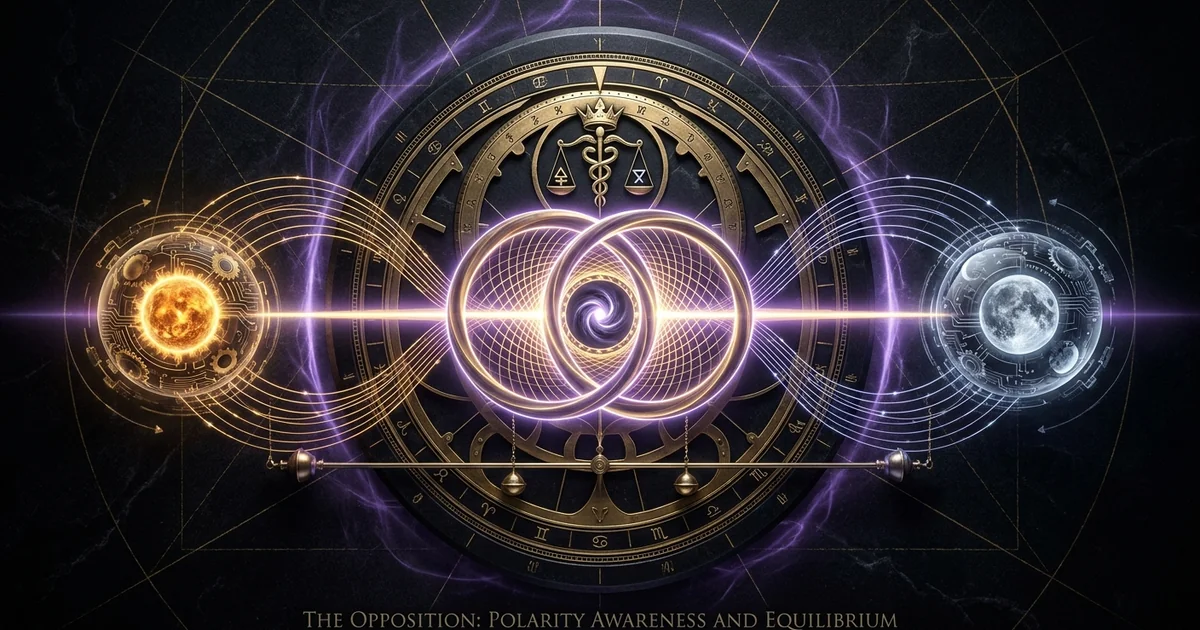
The Opposition: Polarity Awareness and Equilibrium
Archetypal Thesis & Systemic Paradigm: The Dyad and the Mechanics of Splitting
The 180° Diameter as the Bifurcation of Consciousness
In the sacred calculus of archetypal cosmography, the 180° opposition aspect constitutes the fundamental division of the circle ($360^\circ / 2 = 180^\circ$). Where the conjunction represents the unmanifest, undifferentiated potential of the Monad, the opposition enacts the ontological rupture of the Dyad. This geometric diameter splits the psychic horizon into two diametrically polarized hemispheres, terminating the pre-reflective innocence of unity and initiating the structural conditions necessary for self-reflective consciousness. In the language of coordinate geometry and analytical psychology, consciousness cannot observe itself without an exteriorized vantage point. The opposition establishes precisely this baseline of psycho-cosmic distance.
By bisecting the ecliptic through an irreconcilable line of sight, the opposition aspect astrology polarity balance creates an acute state-space representation within the psyche. The native is compelled to occupy an experiential coordinate that stands in structural antagonism to its trans-zodiacal counterpart. This axial tension does not merely represent external interpersonal friction; rather, it formalizes the division of the subjective apparatus itself. The ego-complex instinctively identifies with the planetary archetype closest to its conscious persona or luminary core, while relegating the opposing planetary principle to the peripheral wilderness of the unintegrated psyche. Through this bifurcation, the circle of the self ceases to be an unmediated continuum and becomes a dynamic vector field governed by radical complementation and mutual exclusion.
[ Planetary Archetype A ]
                     ^
                     |
            180° Axial Tension
                     |
                     v
          [ Planetary Archetype B ]
Enantiodromia and the Cybernetics of Shadow Projection
Because the human psychic economy is bounded by the conservation of libidinal energy, any hyper-identification with one pole of an axial tension automatically charges its counter-pole with an equivalent energetic intensity. In the psychological framework established by Carl Gustav Jung, this systemic dynamic culminates in enantiodromia—the inexorable emergence of the unconscious opposite when a conscious attitude reaches its absolute extreme. When an individual pathologically over-identifies with the solar, self-assertive, or structural demands of a planet at one end of the 180 degree aspect, the repressed qualities of the opposing archetype do not vanish. Instead, they undergo autonomous subterranean constellating.
Deprived of direct conscious expression, the repressed pole is cast outward through the mechanics of shadow projection. The native experiences the opposing planetary archetype not as an internal capacity, but as a predatory, alien, or disruptive agency operating through the phenomenological proxy of the relational mirror. The external world—specifically the sphere of the intimate partner, the business associate, or the open adversary—is conscripted by the unconscious to play out the unacknowledged planetary script. Interpersonal conflict thus reveals itself as a cybernetic feedback loop. The externalized “other” behaves with the exact behavioral profile required to challenge the native’s one-sided conscious posture, forcing the disowned systemic material back into field awareness through the crucible of relational collision.
“The grand plan on which the unconscious life of the psyche is constructed is so totally different from the conscious processes that it would not be surprising if a thorough examination of the unconscious revealed a state of affairs which appears fundamentally perverse to the conscious mind… Heraclitus called this enantiodromia, a running counter to, by which he meant that sooner or later everything runs into its opposite. The more one-sided an attitude is, and the more it seeks to establish itself as absolute, the more it calls forth the unconscious counter-position.” — Carl Gustav Jung, Aion: Researches into the Phenomenology of the Self (CW 9ii, §423)
From Malefic Discord to Homeostatic Regulation
The systemic purpose of the opposition is not perpetual warfare, but the stabilization of homeostatic equilibrium. Traditional astrological taxonomy classified the opposition among the hard aspects, frequently coding it as intrinsically malefic, obstructive, and destabilizing. A rigorous psychodynamic and systemic re-appraisal reveals this categorization as an artifact of ego-preservation. The conscious ego desires inertia; it prefers absolute reign over a singular, monolithic domain. The opposition systematically frustrates this desire for unilateral control by introducing an unyielding dialectical counterweight.
To achieve psychological equilibrium along an opposition axis, the native must transition from binary reactivity to homeostatic regulation. Binary reactivity is characterized by continuous swinging between the poles: oscillating between unilateral Martian assertion and total Venusian capitulation, or swinging wildly between Saturnian hyper-vigilance and Lunar emotional regression. Homeostasis, conversely, does not eradicate the polarity; it suspends the native within the tension of the opposites. By acknowledging that each pole operates as a corrective regulator for the excesses of the other, the psyche constructs a higher-order regulatory system. The opposition ceases to function as a severed baseline of conflict and transforms into an electromagnetic axis along which psychic energy flows with coherent, generative vitality.
Classical Provenance & Textual Lineage: From Ptolemaic Malice to Harmonic Polyphony
Hellenistic Diametros: Hostility, Castration, and Adversarial Geometry
In Hellenistic astrology, the opposition was known as diametros (διάμετρος) or katadiametron (κατὰ διάμετρον), conceptualized as an aspect of open hostility, systemic enmity, and irrevocable severance. Vettius Valens, writing in the second century, consistently associated diametrical configurations with separation, violence, alienations from kin, and structural crises. This interpretive severity was rooted in the fundamental physics of Hellenistic optical theory, wherein planets cast rays (aktinobolia) toward one another across the celestial sphere. In a diametrical aspect, two planetary bodies meet each other directly across the vast diameter of the cosmos, staring down one another in a direct, unblinking glare known as confrontation (enantiosis).
“Of the aspects, the diameter is the greatest, because it is made across two right angles, or six signs, containing one hundred and eighty degrees… The opposition is inimical because the signs configurated by diameter are diametrically opposed, and are contrary in their seasonal power and their natures; for their risings and settings, their cold and heat, their moisture and dryness, are entirely opposite and destructive to each other.” — Claudius Ptolemy, Tetrabiblos (Book I, Ch. 13: “The Aspects of the Signs”, trans. Robbins, 1940)
Classical authors linked the opposition directly to the nature of Saturn, the outermost, coldest, and most obstructive of the classical wanderers. Just as the square (the 90° quartile) was linked to the violent, cutting heat of Mars, the opposition was viewed as operating through the freezing, separating, and alienating agency of the Greater Infortune. Hellenistic mythologems preserved this geometric violence through motifs of castration, familial betrayal, and political exile. The diameter was understood as a line that cleaves the body of heaven in twain, rendering the two opposing signs incapable of sympathetic co-existence due to the complete absence of shared elemental or seasonal characteristics.
Ptolemaic Foundations: The Polarities of the Solar and Lunar Hemispheres
Claudius Ptolemy’s systematization in the Tetrabiblos provided the physical and environmental rationale for this classical hostility. Ptolemy mapped the zodiacal architecture around two fundamental axes of symmetry: the Solstitial axis (running from 0° Cancer to 0° Capricorn) and the Equinoctial axis (running from 0° Aries to 0° Libra). These axes cleaved the celestial sphere into the Solar and Lunar hemispheres, establishing the classical planetary domiciles. In this scheme, the luminaries—the Sun and the Moon, rulers of Leo and Cancer respectively—occupied the summer zenith of light and heat, while the domicile of Saturn (Aquarius and Capricorn) occupied the winter nadir of darkness and cold.
[ Summer Zenith: Cancer (Moon) / Leo (Sun) ]
                           ^
                           |
             Axis of Light and Darkness
                           |
                           v
      [ Winter Nadir: Capricorn (Saturn) / Aquarius (Saturn) ]
Ptolemy argued that the 180 degree aspect derived its nature from this absolute antipathy between the archetypal source of life (the luminaries) and the archetypal principle of entropy (Saturn). Signs configured by diameter represent seasonal reversals: midsummer opposed to midwinter, vernal germination opposed to autumnal harvest and decay. Because the elemental qualities of heat, cold, moisture, and dryness stand in direct contradiction across any 180° span, Ptolemy concluded that planets in diametrical configuration systematically undermine each other’s operations. The aspect was not conceived as a dialectic awaiting psychological synthesis, but as an existential zero-sum game played out across the structural boundaries of the cosmos.
Keplerian Harmonic Theory: The Musically Divided Monochord
This fatalistic paradigm endured until Johannes Kepler radically reorganized aspect theory in his 1619 treatise, Harmonices Mundi (The Harmony of the World). Kepler dismissed the Ptolemaic reliance on the zodiacal signs and their traditional associations, seeking instead an empirical, geometric, and musical foundation for astrological influence. Grounding his cosmology in the Pythagorean division of the monochord, Kepler argued that the efficacy of planetary configurations stems from the innate harmonic resonance between planetary angles and the archetypal geometry of the human soul.
Kepler demonstrated that dividing the circle ($360^\circ$) by the primary integer 2 produces the 180° opposition, which corresponds structurally to the string divided in half: the ratio $1:2$. In musical acoustics, the $1:2$ ratio is the diapason, or the octave—the most fundamental, pure, and consonant interval in the entire harmonic spectrum. Through this mathematical stroke, Kepler elevated the opposition from an accidental, malicious cosmic assault into the primary consonance of the manifest universe.
He maintained that the opposition feels subjectively intense and objectively challenging precisely because of its pure resonance. It acts not as a cosmic curse, but as an energetic polarization that vibrates the soul with such acute clarity that the native cannot remain indifferent to its frequency. The Keplerian perspective reframed the 180° diameter as polyphonic counterpoint: two independent, diametrically positioned voices sounding simultaneously, generating a profound structural resonance that demands active integration within the conscious ear of the native.
Structural Mechanics & Symbolic Geometry: Axial Invariants across the Modalities
The Six Archetypal Polarities: Coordinate Geometries of Zodiacal Complements
The ecliptic circle hosts six fundamental axial polarities. Each polarity is bounded by identical modalities (Cardinal, Fixed, or Mutable) and linked by elemental complementarities (Fire with Air, Earth with Water). This structural invariant ensures that every opposition shares an operational tempo (its quadruplicity) while approaching reality from complementary perceptual modes:
- Aries–Libra (Cardinal Fire / Cardinal Air): The Relational Identity Axis. The friction between raw, unilateral self-actualization (Aries) and mediated, consensual social symmetry (Libra). It is the archetypal tension between the sword of autonomy and the scales of diplomacy.
- Taurus–Scorpio (Fixed Earth / Fixed Water): The Axis of Form and Metamorphosis. The polarity between material embodiment, visceral possession, and somatic stability (Taurus) versus psychological dissolution, energetic bonding, and catastrophic transmutation (Scorpio).
- Gemini–Sagittarius (Mutable Air / Mutable Fire): The Epistemological Axis. The dialectic between empirical, granular data-collection (Gemini) and synoptic, teleological cosmological synthesis (Sagittarius). It balances the inventory of the imminent world against the search for transcendent meaning.
- Cancer–Capricorn (Cardinal Water / Cardinal Earth): The Structural Nurturance Axis. The polarized dynamic between private emotional sanctuary, ancestral lineage, and infantile vulnerability (Cancer) versus public institutional authority, secular duty, and structural crystallization (Capricorn).
- Leo–Aquarius (Fixed Fire / Fixed Air): The Creative Sovereignty Axis. The tension between individualistic creative ego-sovereignty (Leo) and decentralized, egalitarian collective consciousness (Aquarius). It opposes the divine right of the monarch against the decentralized sovereignty of the network.
- Virgo–Pisces (Mutable Earth / Mutable Water): The Functional Transmutation Axis. The dialogue between granular physical discernment, ritualized labor, and somatic purification (Virgo) versus oceanic surrender, ego-dissolution, and archetypal redemption (Pisces).
Cardinal Opposition (Dynamic Teleological Conflict)
- Mechanics: Aries-Libra, Cancer-Capricorn. Initiatory force meeting structural counter-thrust.
- Psychological Expression: Overt, crisis-driven behavioural enactment. The native experiences dramatic, external life disruptions and catalytic relational collisions.
- Pathology: Unilateral, volatile action followed by sudden retreat; acute interpersonal warfare and rapid shifts between dominance and surrender.
- Resolution Pathway: Developing conscious, collaborative leadership where purposeful action directly incorporates the objective systemic context.
Fixed Opposition (Static Cathexis and Structural Impasse)
- Mechanics: Taurus-Scorpio, Leo-Aquarius. Unyielding structural entrenchment and libidinal fixation.
- Psychological Expression: Silent, chronic, internal standoffs. Energetic siege mentality where neither planetary archetype will concede territory.
- Pathology: Psychosomatic somatization, deep-seated resentment, obsessive control dynamics, and paralysis through mutual systemic cancellation.
- Resolution Pathway: Conscious surrender of the ego’s demand for absolute sovereignty; transmuting possessive fixation into dynamic energetic flow.
Sign-Based Polarity versus Degree-Based Orbs and Out-of-Sign Stresses
A critical distinction in technical aspect calculation rests between whole-sign polarity and exact degree-based configuration. A sign-based opposition operates as a broad thematic backdrop. When Planet A resides in late Aries and Planet B occupies early Libra, they share the Cardinal Fire/Air axis, operating within an established field of structural comprehension. However, the true phenomenological fury of the aspect activates through degree-based isopsephy: the tight orb of configuration.
Standard Sign Opposition:
[ Aries: Fire ] <==============================> [ Libra: Air ]
(Complementary Elemental Polarity: Intuition vs. Intellect)

Out-of-Sign / Dissociated Opposition:
[ Pisces: Water ] <============================> [ Libra: Air ]
(Elemental Disjunction: Emotional Dissolution vs. Cognitive Symmetry)
As the orb tightens toward partile ($0^\circ00’$), the axial tension maximizes. The two planetary nodes lose their capacity to drift into compartmentalized expressions; their operational frequencies lock into direct phase-interference.
Conversely, the out-of-sign (or dissociated) opposition represents a serious systemic rupture. If Planet A resides at $29^\circ$ Pisces and Planet B resides at $1^\circ$ Libra, they are geometrically opposed within an orb of $2^\circ$, yet their sign environments are Pisces (Mutable Water) and Libra (Cardinal Air). Here, the complementary elemental baseline (Water-Earth or Fire-Air) is shattered. The planets lack a common linguistic syntax. The psychic apparatus struggles to establish equilibrium because the cognitive clarity of the Cardinal Air sign is blind to the oceanic, non-linear currents of Mutable Water. The dissociated opposition demands complex psychological scaffolding: the native must build an artificial translation bridge across signs that share neither modality, element, nor gender.
Dynamic Interventions: T-Squares, Kites, and Focal Discharge Points
An isolated opposition exists as an ungrounded high-voltage line, oscillating incessantly between two poles without a designated terminal for energy discharge. The axial tension often remains trapped in reciprocal paralysis unless integrated into larger aspect geometry. The most potent of these geometric configurations is the T-Square, formed when a third planetary body casts a dual square ($90^\circ$) to both ends of the opposition.
The apex planet of the T-Square serves as the dynamic focal discharge point for the opposition’s latent friction. The intolerable axial tension between the opposed bodies is forced into the sign and house occupied by the apex planet, compelling the native to undertake aggressive, externalized activity to alleviate the cognitive dissonance. While the opposition alone may languish in passive-aggressive projection, the T-Square converts this potential energy into kinetic force, making it the most reliable engine of worldly ambition and systemic accomplishment in the natal chart.
[ Apex Planet ]
               /             \
             90°             90°
             /                 \
[ Planetary Pole A ] <--- 180° ---> [ Planetary Pole B ]
In contrast, the Kite configuration introduces a stabilizing, highly integrated circuit. Here, one pole of the opposition forms the spine of the Kite, flanked by two planets forming trines ($120^\circ$) and sextiles ($60^\circ$) to the opposite terminal, completing a Grand Trine.
While an isolated Grand Trine often sinks into indolent self-satisfaction, the opposition spine provides the necessary systemic friction to activate the trine’s latent talents. The planet receiving the harmonious trine and sextile rays functions as a profound harmonizer, giving the native the psychological resilience and resource-rich environment necessary to resolve the opposition’s ancestral demands without being shattered by its raw polarity. For further exploration of these complex configurations, see our technical analysis on the sacred geometry of planetary aspects.
Psychological Dynamics & Operational Praxis: Interrogating the Relational Mirror
The Epistemology of the Projected Other
In clinical astrological consultations, the 180 degree aspect functions as the primary diagnostic indicator of unconscious splitting. The individual does not experience the opposition as an internal debate; they experience it as an external trial. This is the epistemology of the projected other. If an individual possesses an opposition between Mars in the 1st House and Saturn in the 7th House, they will routinely disown the Saturnian archetype, identifying entirely with the righteous, direct, Martian urgency of the 1st House ego. Consequently, the Saturnian principle—boundary-setting, skepticism, institutional authority, cold judgment, structural delay—is externalized onto the environment.
The native complains that partners, employers, and legal authorities are unreasonably punitive, obstructive, and hyper-critical. They fail to perceive that their own unmodulated, reckless Martian impulses continually construct the exact environment that necessitates Saturnian containment. The relational mirror reflects the native’s disowned archetypal capacity back to them with surgical, mathematical precision. The partner is not an accidental bystander; they are an energetic participant summoned by the unconscious to enact the opposing planetary frequency. Until the native recognizes this isomorphism between the external tormentor and their own internal, repressed architecture, the relational pattern will endlessly recur with different actors in identical costumes.
Dialectical Decoupling: Clinical Chart Synthesis Techniques
To remediate this pathology, the consulting practitioner must employ clinical techniques of dialectical decoupling. The primary objective is to liberate both planetary nodes from their entangled, projective codependency.
The practitioner must first conduct an inventory of archetypal identification. By assessing planetary dignity, proximity to the Ascendant or Midheaven, and solar/lunar aspects, the practitioner determines which pole of the opposition is currently ego-syntonic (claimed by the native) and which is ego-dystonic (cast into the shadow).
Once this map of identification is delineated, the practitioner guides the native through an interrogation of their somatic and emotional reactions to their “adversaries.” When the native complains about a partner’s emotional coldness (e.g., an unintegrated Saturn or Moon-Saturn opposition), the practitioner systematically leads the native to locate their own internal coldness, their own covert desire for emotional boundaries, and their repressed need for structural autonomy.
Through this praxis, the planetary qualities are disentangled from the bodies of external people. The native begins to observe the aspect not as an interpersonal curse, but as an internal polarity requiring continuous conscious mediation. A deeper examination of these interpersonal dynamics can be reviewed in the comprehensive analysis of synastry and relational mechanics.
Active Imagination and the Synthesis of Polarized Archetypes
The ultimate therapeutic resolution of the opposition lies in the cultivation of the transcendent function, achieved through Jungian active imagination. Because the opposition consists of two diametrically opposed archetypal vectors, standard cognitive-behavioral resolution often proves insufficient; the analytical mind cannot solve a structural paradox at the level of the paradox itself. The two planets must be personified and allowed to encounter one another within the theater of the imaginal realm.
The practitioner instructs the native to enter an altered, hypnagogic state, visualizing the planetary archetype at Pole A (for instance, Jupiter in Sagittarius) seated across a table from Pole B (Mercury in Gemini). The native does not direct the dialogue, but acts as an objective recorder and witness. Jupiter delivers its grandiose, sweeping cosmological visions; Mercury counters with its empirical critiques, technical discrepancies, and practical logistical demands.
[ Conscious Observer / Transcendent Function ]
              /                      \
    Imaginal Dialogue          Imaginal Dialogue
            v                          v
[ Personified Pole A ] <-----> [ Personified Pole B ]
As the dialogue matures over successive sessions, the two figures cease their adversarial bickering and begin to negotiate terms of coexistence. Mercury agrees to serve as the scribe and logistical architect for Jupiter’s philosophical expeditions, while Jupiter grants Mercury’s granular observations a coherent teleological purpose. This psychological reconciliation corresponds directly to the alchemical coniunctio—the sacred marriage of opposites wherein the dualistic war of the Dyad is synthesized into a higher-order, unified third term.
Philosophical Synthesis & Macrocosmic Correspondence: Polarity as the Engine of Manifestation
Hermetic Polarity and the Kybalion Principle of Rhythm
The operational mechanics of the astrological opposition find their philosophical justification in the fourth Hermetic axiom detailed in The Kybalion: The Principle of Polarity. This principle declares that:
“Everything is Dual; everything has poles; everything has its pair of opposites; like and unlike are the same; opposites are identical in nature, but different in degree; extremes meet; all truths are but half-truths; all paradoxes may be reconciled.”
The opposition aspect astrology polarity balance confirms this Hermetic insight. Aries and Libra are not two completely unrelated substances; they are the two terminal expressions of a singular continuum: the phenomenon of relationship. Aries is the individual within relationship; Libra is the relationship between individuals. Taurus and Scorpio are the two faces of substance: Taurus is its physical, bio-chemical consolidation; Scorpio is its subterranean, energetic, and molecular transmutation.
Hermetic Dimensional Continuum:
[ Low Frequency / Negative Pole ] <--------------------> [ High Frequency / Positive Pole ]
                        (Difference in Degree, Not in Essence)
The accompanying Hermetic Principle of Rhythm explains why natives experience the opposition as an ongoing pendulum swing: “The measure of the swing to the right is the measure of the swing to the left; rhythm compensates.” Without conscious equilibrium, the individual is helplessly swept along by this cosmic tide, swinging from the hyper-rationalism of an Aquarius Sun to the theatrical, emotionally demanding excesses of a Leo Moon opposition. Mastery does not consist in arresting the pendulum by sheer force of will, but in rising above the swing through the Hermetic art of Mental Transmutation, neutralizing the rhythm by anchoring consciousness in the immovable central axis of the Self.
BodyGraph and I Ching Axial Geometries: Genetic and Hexagram Complements
In contemporary esoteric synthesis, particularly within the Rave Mandala of Human Design, the 360° celestial sphere is mapped directly onto the 64 Hexagrams of the I Ching. This spatial arrangement reveals that any two planetary activations separated by a 180 degree aspect activate hexagrams that stand in profound structural symmetry across the wheel. In many instances, these opposing hexagrams form King Wen complementary pairs or complete electromagnetic channels within the human BodyGraph.
When two opposing gates are activated simultaneously by planetary transit or natal placement—for example, Gate 20 (Contemplation, Hexagram 20) in Sagittarius opposed to Gate 34 (The Power of the Great, Hexagram 34) in Gemini—they bridge the Throat Center and the Sacral Center, forming the Channel of Charisma.
The Rave Mandala maps the 64 hexagrams across the 360° circle, producing an exact geometric alignment: each gate stands directly opposite another gate with which it shares an archetypal complementation. In genetic terms, these oppositions frequently correspond to complementary stop-and-start codon sequences, illustrating that the 180° aspect serves as an electromagnetic channel-completer. What appears in traditional chart analysis as an adversarial aspect operates in definition and circuitry synthesis as the structural architecture that facilitates functional bio-energetic consciousness.
The opposition does not indicate a fracture in the circuit; rather, it creates the circuit. Without the axial tension across the wheel, the channel cannot close, and the bio-energetic current cannot achieve sustained manifestation. The opposition is literally the electromagnetic bridge across which cosmic vitality moves from dormant potentiality into manifest form.
The Cosmic Systole and Diastole: Equilibrium as Non-Dual Attunement
In her seminal work Number and Time, Jungian scholar Marie-Louise von Franz demonstrates that the number two (the Dyad) is not merely a numerical quantifier, but an archetypal rhythm: the rhythm of movement, division, and symmetry. Two introduces the possibility of doubt, of hesitation, and of moral discrimination, but it is simultaneously the fundamental rhythm of life itself—the cosmic systole and diastole, inhalation and exhalation, light and shadow.
Cosmic Systole (Contraction)
                   |
                   v
    [ Polar Coordinate Oscillation ]
                   ^
                   |
       Cosmic Diastole (Expansion)
To view the astrological opposition as an unfortunate defect in an otherwise harmonious chart is to fundamentally misapprehend the nature of manifest existence. Without polarity, the cosmos would collapse back into the undifferentiated, unreflective inertia of the Monad. Polarity is the engine of manifestation. Equilibrium is not the passive, anemic compromise of the middle ground; it is the non-dual attunement of the dynamic aerialist who maintains perfect balance precisely through constant, subtle calibrations to the opposing gravitational forces acting upon the wire.
The native who integrates an opposition does not eliminate the tension between their planets. They become the sovereign ringmaster of that tension, transforming what was once a site of chronic neurosis into a profound psycho-cosmic battery that powers their individuation process.
Frequently Asked Questions: Advanced Astrological & Systemic Inquiries
Epistemological and Technical Nuances of the 180° Configuration
How does a dissociated or out-of-sign opposition alter the psychodynamic processing of the aspect?
A dissociated opposition occurs when two planets are configured within an orb of geometric opposition ($180^\circ \pm \text{orb}$), but occupy signs that are not in natural zodiacal opposition. For example, a planet at $29^\circ$ Leo opposed a planet at $1^\circ$ Pisces. Under standard conditions, Leo and Aquarius share Fixed modality and Fire-Air complementarity, providing a shared psychological terrain. However, in the Leo-Pisces dissociated opposition, the Fire-Water friction combines with a Fixed-Mutable structural dissonance.
Psychodynamically, the out-of-sign opposition creates a profound elemental blind spot. The native does not experience the predictable, clean polarization of self-expression versus collective contribution (Leo-Aquarius); instead, they experience an erratic, ungrounded tension between the proud, solar, dramatic demands of Leo and the oceanic, boundlessness, and martyrdom of Pisces. The relational mirror functions with a distorted lens. The native cannot easily categorize the nature of their projections because the “other” appears to speak a totally alien symbolic dialect.
Integration requires the native to consciously construct an artificial interpretive interface. The client must first master the archetypal grammar of each sign independently before attempting to reconcile the aspectual line of tension, deliberately avoiding the unconscious assumption that elemental harmony will spontaneously occur.
What criteria determine which planet functions as the active projector versus the projected archetype?
Determining which planetary pole is claimed by the ego and which is cast into the relational mirror relies on a systematic evaluation of accidental and essential dignity:
- Angular Proximity: A planet conjunct the Ascendant, Midheaven, or residing within an angular house (1st, 10th, 7th, 4th) possesses immense structural priority over a planet buried in a cadent house (6th, 12th, 3rd, 9th). A planet on the Ascendant is woven directly into the native’s instinctual persona, while the planet on the Descendant is almost automatically experienced as the partner or open rival.
- Sect and Luminary Affiliation: In a diurnal chart, the Sun and diurnal planets (Jupiter, Saturn) are more readily claimed by the conscious ego-complex; in a nocturnal chart, the Moon and nocturnal bodies (Venus, Mars) are more naturally integrated. A planet that forms a close aspect to the luminary of sect will typically be claimed over an isolated planet at the opposite end of the axis.
- Essential Dignity and Rulership: A planet residing in its domicile or exaltation possesses systemic sovereignty; it operates with conscious agency. A planet in its fall or detriment lacks structural resources and is frequently disowned, making it exceptionally vulnerable to externalization and shadow projection.
Determining Factors for Archetypal Claim:
       Angular Proximity  --> Domicile / Dignity --> Luminary Alignment
                 |                      |                     |
                 v                      v                     v
       [ Ego-Syntonic Pole ] <====================> [ Ego-Dystonic Shadow Pole ]
How does a synastry opposition differ fundamentally from an opposition in the natal chart?
A natal opposition represents an internalized, intra-psychic structural tension that belongs entirely to the individual’s psychological architecture. The native must solve the paradox within the boundaries of their own individuation journey; external partners merely serve as temporary mirrors reflecting the disowned pole. The responsibility for equilibrium remains undivided.
In synastry, however, an opposition forms across two separate charts—for instance, Person A’s Mars at $14^\circ$ Scorpio opposing Person B’s Venus at $14^\circ$ Taurus. Here, the polarity is not an artifact of an individual psyche’s splitting, but an objective, interpersonal electromagnetic channel between two separate sovereign operating systems.
While the psychological mechanics of projection are immediately triggered, the resolution pathway cannot be achieved through individual active imagination alone. It requires conscious interpersonal negotiation, boundary maintenance, and relational attunement. In synastry, the opposition generates undeniable sexual, intellectual, or operational magnetism, yet it poses the acute danger of intractable standoffs.
Unlike the natal opposition, which can achieve permanent homeostatic synthesis within an individuated consciousness, the synastric opposition remains permanently dynamic—a live wire requiring ongoing energetic recalibration throughout the duration of the relationship.