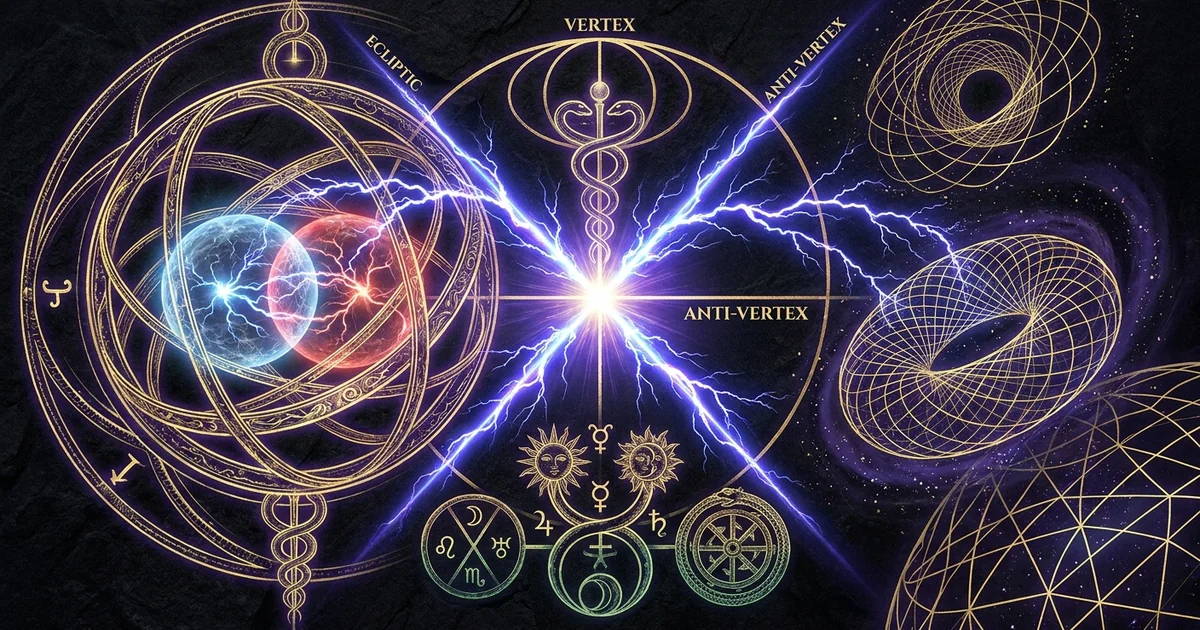
Vertex Contacts: Karmic Fated Encounters in Synastry
Archetypal Thesis & Systemic Paradigm: The Electric Axis as an Individuation Gateway
The Phenomenological Topology of Fated Relational Encounters
Within the mechanics of synastric analysis, interpersonal phenomena frequently resist neat reduction to classic Ptolemaic aspect configurations. Practitioners and clinical psychoanalysts operating at the intersection of symbolic systems encounter specific interpersonal events characterized by an overwhelming affect of inevitability, acute psychological compulsion, and permanent structural rupture. These episodes—traditionally colloquially termed “destiny encounters” in popular nomenclature—are technically cataloged in astrological research as planetary activations of the Vertex-Anti-Vertex axis. In the vernacular of vertex synastry fated relationship astrology, these inter-chart alignments signal an ontological turning point rather than simple erotic or temperament affinity.
The phenomenological impact of a Vertex contact bypasses the negotiated diplomacy of the native’s conscious ego-structure. While harmonious trines or sextiles between reciprocal personal planets foster organic comfort and consensual behavioral coordination, a conjunction to the Vertex operates as an exogenous invasion of psychic territory. The individual whose Vertex is contacted experiences the planetary transitor not merely as an external partner with discrete idiosyncrasies, but as an embodied archetype carrying numinous, non-negotiable gravity. The relational encounter presents as an objective manifestation of kairos—the qualitative, rupture-prone moment in classical time-philosophy wherein absolute vertical meaning punctures the mundane horizontal continuity of chronological duration (chronos). The subjective consequence is an acute feeling of non-negotiated familiarity, a psycho-spiritual magnetism that simultaneously promises radical self-realization and threatens total destabilization of the extant ego-identity.
ZENITH (Above)
                     |
                     |  Prime Vertical
                     |
WEST (Descendant) ---+--- EAST (Ascendant)  [Horizon]
                     |
          VERTEX <-- * (Intersection of Prime Vertical & Ecliptic in West)
                     |
                   NADIR (Below)
The Electric Axis vs. The Magnetic Axis: Space-Coordinate Differentiation
To understand the systemic function of the Vertex, it must be differentiated from the other cardinal axes of the local horizon and celestial sphere. The Ascendant-Descendant vector constitutes the horizon axis—the spatial boundary separating the visible hemisphere from the invisible subterranean cosmos, operating astrologically as the theater of relational awareness and primary environmental orientation. The Medium Coeli-Immum Coeli (MC-IC) vector delineates the meridian axis, connecting the zenith to the nadir and serving as the vertical spine of individuated socio-structural destiny and ancestral origin.
In contrast, the Vertex and Anti-Vertex emerge from the intersection of the prime-vertical with the ecliptic. As the prime vertical descends from the local zenith through the true mathematical east and west points of the horizon, its western intersection with the apparent path of the Sun designates the Vertex, while the eastern intersection marks the anti-vertex. In early twentieth-century technical frameworks, this intersection was formally designated the electric-axis, contrasting directly with the magnetic-axis (the horizon) and the gravity-axis (the meridian).
+------------------+-----------------------------+-------------------------------+
| Axis System      | Celestial Coordinate Basis  | Astrological / Psychic Metric |
+------------------+-----------------------------+-------------------------------+
| Magnetic Axis    | Horizon (Ecliptic-East/West)| Ego-Orientation / Relational  |
| Gravity Axis     | Meridian (Zenith-Nadir)     | Individuation Spine / Origin  |
| Electric Axis    | Prime Vertical (West/East)  | Unassimilated Archetypal Fate |
+------------------+-----------------------------+-------------------------------+
Because the prime vertical directly relates to local geographical space and an observer’s immediate verticality, its ecliptic intersections represent points where purely local, somatic existence is struck by cosmic solar geometry. While the Descendant represents the relational partner one consciously selects or negotiates with through projection and attraction, the Vertex represents the partner one is compelled to encounter through environmental force majeure. It is a coordinate where choice is stripped of its conventional illusions, demanding an immediate response to evolutionary crises generated outside the conscious will. For further spatial-trigonometric mechanics, see Celestial Coordinate Frameworks.
Jungian Anamnesis and the Involuntary Transference Dynamic
In archetypal psychology, the subjective sense of absolute recognition experienced during Vertex conjunctions is understood as anamnesis—the sudden, visceral remembering of split-off psychic contents. When an individual’s conscious personality has ossified into rigid identification with the persona, unintegrated materials coalesce within the unconscious shadow and the contra-sexual soul-images: the Anima in men and the Animus in women. These autonomous complexes are incapable of remaining permanently dormant; by cybernetic imperative, an unbalanced psychic system seeks homeostatic re-equilibration.
“The archetype acts as a psychic organ, autonomous and capable of generating numinous projections that override the conscious intentionality of the ego. When such an activation occurs, the subject does not merely observe an object; the subject suffers an encounter with a living reality that compels psychological surrender, operating through synchronicity to produce an outer event indistinguishable from internal teleology.” — C.G. Jung, Collected Works, Vol. 8: The Structure and Dynamics of the Psyche (Princeton University Press, 1960, §438–441).
When a synastric partner’s personal planet falls within a tight orb of the native’s natal Vertex, that planet acts as a physical talisman or lightning rod for this dormant archetypal complex. The Vertex native does not see the other person with empirical detachment. Instead, the native experiences the other through the lens of intense Anima/Animus Projection. The encounter is perceived as predestined precisely because the unconscious mind has found an external mirror capable of reflecting its most urgent, unassimilated evolutionary necessity. The compulsion is not generated by mystical predetermination written upon a slate, but by the relentless operational dynamics of the unconscious seeking individuation through externalized relational confrontation.
Classical Provenance & Textual Lineage: From Johndro’s Electrodynamics to Jayne’s Destiny Gate
L. Edward Johndro’s Mathematical Formulation of the Ecliptic Coordinates
The formal technical discovery and mathematical calculation of the Vertex axis did not originate within traditional astrological divination, but emerged from twentieth-century inquiries into terrestrial radio-wave propagation, geophysics, and celestial mechanics. L. Edward Johndro, an electrical engineer and mathematically rigorous astrological researcher, systematically laid down the foundation for the coordinate in his seminal 1932 volume, The Earth in Aspect. Johndro was fixated on reconciling mundane events and celestial transits with terrestrial electrodynamic fields, positing that the Earth behaves as a rotating spherical armature generating distinct electrical, magnetic, and gravitational wave-fronts.
Johndro observed that the standard horizon and meridian planes accounted for gravitational and magnetic vectors, but left the electrodynamic field of the earth unrepresented in chart calculations. By calculating the intersections of the prime vertical—the great circle perpendicular to both the meridian and the horizon—with the apparent path of the ecliptic, Johndro isolated a mathematical point that he designated the “electrical pole” or “electric ascendant.” His empirical tracking revealed that when radio emissions experienced atmospheric disruption or when terrestrial seismic phenomena occurred, these electrical intersections registered acute planetary activity. In Johndro’s early cosmological schemata, this electric axis represented high-voltage discharge points where energy could neither be stored nor resisted, but had to complete a circuit through immediate materialization.
Johndro (1932)                   Jayne (1975)                    Modern Praxis
[ Terrestrial Electrodynamics ] ---> [ The Third Angle ] ---> [ Relational Individuation ]
    Prime Vertical Pole             Karmic Synastry Gate            Cybernetic Catalyst
Charles Jayne’s Empirical Syntheses on Synastric Nodes and the Vertex
While Johndro supplied the terrestrial physics and spatial trigonometry, it was the pioneering American astrologer Charles A. Jayne Jr. who transferred the coordinate from physical geophysics into the realm of human psychology and esoteric synastry. In the 1940s and 1950s, through the research publications of the Astrological Bureau in Monroe, New York, Jayne initiated exhaustive empirical testing across thousands of verified nativities. Jayne formally named the western intersection the “Vertex” (from the Latin vertere, meaning “to turn”) and its eastern complement the “Anti-Vertex,” recognizing this axis as fundamentally distinct from the classical angles.
“The Vertex-Anti-Vertex axis constitutes the third angle of the horoscope, functioning as a primary axis of destiny. Unlike the Ascendant, which represents the conscious presentation of the self, and the Midheaven, which represents conscious outer achievement, the Vertex indicates events and relationships over which the individual possesses zero conscious control. It is an axis of compulsive, fate-dictated transformation, activated almost exclusively by conjunctions within exceedingly close orbs.” — Charles A. Jayne, The Vertex: The Third Angle (Astrological Bureau, 1975, pp. 4–12).
Jayne’s empirical field observations revealed that the Vertex behaves as a gateway of involuntary transformation. In synastric configurations, he noted that tight conjunctions (consistently under two degrees of arc) between one native’s personal planets or nodes and another native’s Vertex coincided with dramatic life alterations. These interpersonal meetings consistently signaled the termination of an existing biographical epoch and the non-negotiable inauguration of another, cementing the Vertex’s reputation as the primary indicator of karmic turning points in synastry.
+--------------------------------------------------------------------------------+
|           Charles Jayne's Historical Synthesis (1940–1975)                     |
+--------------------------------------------------------------------------------+
| 1. Empirical validation across 800+ documented biographical case studies.       |
| 2. Narrowed functional orb tolerances to <= 2°00' of true ecliptic arc.        |
| 3. Classified Vertex as an angle of involuntary external manifestation.         |
| 4. Demonstrated synastric planet-to-Vertex contacts as markers of major life   |
|    restructuring events.                                                       |
+--------------------------------------------------------------------------------+
Esoteric Reception: From Mathematical Oddity to Psycho-Karmic Coordinate
Throughout the mid-to-late twentieth century, the mainstream astrological community initially marginalized the Vertex, viewing it as an unnecessary mathematical abstraction in an already overcrowded chart landscape. However, the rise of modern psychological astrology, catalyzed by Dane Rudhyar’s integration of depth psychology and holistic philosophy in The Astrology of Personality (1936), created fertile conceptual ground for the Vertex’s resurgence. Rudhyar postulated that every geometric factor in a nativity corresponds to a specific structural dimension of human consciousness.
As psychological astrologers began to adopt Jayne’s empirical findings, the Vertex underwent an esoteric reappraisal. It was no longer conceptualized merely as an electrical coordinate or a deterministic marker of disaster, but as a psycho-karmic aperture. The axis was integrated into the broader architecture of Western esoteric thought as the point where the Soul encounters those structural debts, contracts, and necessary developmental crises that the biological ego would otherwise actively avoid. The reception history of the Vertex thus mirrors the broader evolution of esoteric cartography: transitioning from early twentieth-century materialist and mechanistic electrodynamic models to sophisticated twentieth-first-century models of psycho-spiritual transformation and systemic consciousness.
Structural Mechanics & Symbolic Geometry: Spatial Trigonometry of the Prime Vertical
The Astronomical Mechanics: Prime Vertical, Meridian, and Ecliptic Intersections
The precise calculation of the Vertex requires an understanding of spherical astronomy and the interaction of three distinct great circles in the local celestial sphere: the celestial meridian, the horizon, and the prime-vertical. The celestial meridian passes through the north celestial pole, the zenith directly above the observer, the south celestial pole, and the nadir directly below. Perpendicular to this meridian lies the prime vertical, which passes directly from the zenith through the true east point of the horizon, down through the nadir, and up through the true west point of the horizon.
The Vertex is calculated by determining the ecliptic longitude of the western intersection of the prime vertical. In mathematical terms, this requires setting the local azimuth to $90^\circ$ (true West) and solving for its intersection with the ecliptic plane based on the observer’s terrestrial latitude ($\phi$) and local sidereal time ($\theta$). The standard trigonometric conversion is given by:
$$\tan \lambda_V = \frac{-\cos \theta}{\sin \theta \cos \varepsilon + \tan \phi \sin \varepsilon}$$
where $\lambda_V$ is the ecliptic longitude of the Vertex, $\varepsilon$ is the obliquity of the ecliptic, $\theta$ is the local sidereal time, and $\phi$ is the geographic latitude of the native. Because the prime vertical is tilted relative to the equator and ecliptic, the Vertex is mathematically constrained to the western hemisphere of the astrological chart, falling almost exclusively between the 5th and 8th astrological houses.
Because of this spatial constraint, the Vertex is inextricably anchored to the houses of relational commitment, creative expression, existential crises, and psychological transformation. It can never appear on the Ascendant or in the eastern houses of the horoscope; its celestial geometry forces it to manifest exclusively in the domains where the self is necessitated to confront, merge with, and be transformed by the “Other.”
Anti-Vertex vs. Vertex Polarities: The Dialectic of Self-Initiation and Other-Catalysis
Like all astrological axes, the electric axis cannot be understood through one pole in isolation. The Anti-Vertex and the Vertex form an unbroken 180-degree dialectic of psychological integration. The Anti-Vertex, located at the eastern intersection of the prime vertical and the ecliptic, carries an operational signature parallel to an elevated, esoteric Ascendant. It represents the point of self-directed intention, internal psychic causation, and that which the individual must consciously generate from within their own spiritual core.
       ANTI-VERTEX                                     VERTEX
  (Eastern Prime Vertical)                    (Western Prime Vertical)
-----------------------------               -----------------------------
* Individual Initiative                     * Environmental Impact
* Conscious Soul Impulse                    * Involuntary Relational Catalyst
* Internal Causation                        * Externalized "Fated" Other
* What the Self Must Manifest               * What the Self Must Endure/Integrate
Conversely, the Vertex represents the point of relational reception and external catalysis. It designates the thematic arena where the individual possesses minimal autonomy to prevent the encounter. The dynamic between them operates as an enactive feedback loop: the Anti-Vertex provides the internal, evolutionary impetus toward individuation, while the Vertex attracts the precise external characters, relationships, and systemic shocks required to shatter the native’s defensive structures. When a synastric planetary conjunction occurs on the Anti-Vertex, the planet person acts as a fuel source for the native’s conscious agency and self-actualization; when it occurs on the Vertex, the planet person arrives as an emissary of the unalterable outside world, demanding total psychic re-negotiation.
Orb Tolerances and Harmonic Multipliers in Synastric Conjunctions
In conventional astrological chart analysis, soft aspects such as sextiles and trines, as well as wide orb thresholds (ranging from 6 to 10 degrees), are routinely accepted. However, research into the spatial geometry of the prime vertical indicates that these standard rules fail completely when applied to the Vertex. Because the Vertex is an intersection point of theoretical great circles rather than a physical planetary body possessing an electromagnetic mass or core, its field of influence is exceptionally concentrated.
Empirical evidence demonstrates that the Vertex functions almost exclusively through direct hard contact: conjunctions, oppositions (conjunctions to the Anti-Vertex), and the ninety-degree square. Harmonic minor aspects (such as the semi-sextile, quintile, or sesquiquadrate) exhibit zero statistically significant efficacy in synastry. Furthermore, the operational orb tolerance for a synastric conjunction to the Vertex is extraordinarily narrow. The active threshold rarely exceeds $2^\circ 00’$ of arc, reaching its maximum qualitative intensity when within $0^\circ 45’$ of exactitude.
Beyond an orb of two degrees, the phenomenological experience of “fated compulsion” rapidly decays into ordinary, manageable relational dynamics. For a wider treatment of mathematical aspect boundaries, consult Synastry Aspect Geometry.
Orb Intensity Gradient (Vertex Conjunctions)
========================================================================
[0°00' - 0°45'] : Absolute Kairos / Acute Archetypal Compulsion (Maximum)
[0°46' - 1°30'] : Strong Systemic Rupture / Noticeable Destabilization
[1°31' - 2°00'] : Moderate Activation / Operates during Major Transits
[> 2°00']       : Ineffective / Reverts to Standard Synastric Mechanics
========================================================================
Psychological Dynamics & Operational Praxis: Synastric Activation Catalogs
Luminaries and Personal Planets on the Vertex: The Ego-Stripping Encounter
When a personal planetary body in Synastry forms a conjunction within two degrees of another native’s natal Vertex, a specific archetypal theater is instantly established. The type of energy that enters the Vertex native’s psychological landscape depends entirely upon the planetary archetype acting as the external trigger.
- Sun Conjunct Vertex: The Sun person illuminates the core, unintegrated creative center of the Vertex person. The Vertex native experiences the Sun individual as a magnetic, almost blinding sovereign authority. This encounter inevitably forces the Vertex person to confront their own unlived authenticity and path of individuation, often stripping away superficial persona masks in the blaze of the Sun person’s essential identity.
- Moon Conjunct Vertex: This alignment triggers instant, subterranean emotional exposure. The Moon person activates the Vertex native’s deepest somatic memories, infantile dependency patterns, and maternal archetypes. The Vertex native experiences an immediate, non-verbal sense of ancestral belonging (anamnesis), rendering emotional detachment impossible and precipitating deep psychological regressions that demand conscious maturation.
- Mercury Conjunct Vertex: The Mercury individual functions as an intellectual disruptor, breaking through the cognitive defenses and rigid mental paradigms of the Vertex native. Communication between the two is characterized by obsessive intellectual exchange, perceptual shifts, and the introduction of transformative philosophies that permanently alter the Vertex native’s worldview.
- Venus Conjunct Vertex: Frequently observed in major, life-altering romantic obsessions. The Venus person perfectly embodies the Vertex native’s unconscious aesthetic and erotic ideal (the unintegrated Anima/Animus). The Vertex person experiences an involuntary surrender of value systems, often abandoning existing social and relational commitments to pursue the numinous ideal represented by the Venus individual.
- Mars Conjunct Vertex: The encounter is marked by raw, instinctual friction, acute somatic urgency, and systemic boundary violations. The Mars person acts as a volatile catalyst, forcing the Vertex person to confront repressed rage, primal desire, and personal agency. The dynamic is frequently volatile, compelling the Vertex native out of complacency through conflict or physical activation.
Outer Planet Transits and Natal Vertex Triggers as Kairos Timers
The natal Vertex does not exist in an inert vacuum; it functions as a highly sensitive temporal trigger within the ongoing transits and progressions of the biographical narrative. An interpersonal synastric contact often remains dormant or functions as an underlying, subtle tension until an outer planetary transit (Saturn, Uranus, Neptune, or Pluto) makes a hard aspect to the synastric conjunction.
[ TRANSITING OUTER PLANET ]
                                             |
                               (Hard Aspect: Conjunction/Square)
                                             |
                                             v
[ Synastric Conjunction: Partner Planet (e.g., Venus) <--> Native Natal Vertex ]
                                             |
                                             v
                             [ SYSTEMIC PSYCHIC COLLAPSE ]
                                             |
                                             v
                           [ Non-Negotiable Individuation Crisis ]
When transiting Uranus crosses a synastric Venus-Vertex conjunction, the latent attraction explodes into radical, unpredictable behavioral realignments, often shattering conventional domestic structures overnight. When transiting Saturn contacts this point, the relationship encounters severe, karmic boundary tests and institutional responsibilities, demanding the structural solidification or final evolutionary termination of the connection.
Transiting Pluto across a synastric Vertex contact represents total psychic death and rebirth: the planet person acts as an agent of the Underworld, stripping the Vertex native of outdated ego-identifications and forcing a descent into the unconscious. In this manner, the Vertex contact functions within the macrocosmic framework as an exact temporal clock—a cybernetic feedback switch that flips only when the broader developmental conditions for psychic reorganization have been achieved.
The Nodal Axis Versus the Electric Axis: Telos versus Catastrophe
In modern evolutionary and karmic astrology, the lunar nodes and the Vertex are frequently conflated under the generic rubric of “karmic markers.” This conceptual flattening obscures an essential distinction in metaphysical mechanics. The Lunar Nodal axis represents the intersection of the Moon’s orbital plane with the ecliptic, tracing the gradual, evolutionary development of the soul over time. The South Node embodies accumulated ancestral and past-life habit patterns, while the North Node represents the developmental telos—the distant, prospective horizon of conscious spiritual growth. The Lunar Nodes operate as an iterative, chronological progression: an unfolding school of behavioral corrections and slow-building wisdom. For an exhaustive breakdown of nodal mechanics, see The Lunar Nodes Evolutionary Axis.
In direct contrast, the Vertex-Anti-Vertex axis operates not through evolutionary telos, but through structural catastrophe. The electric axis does not negotiate gradual development; it operates through sudden, non-linear system state transitions. The Lunar Nodes represent the path one travels; the Vertex represents the lightning strike that obliterates the path entirely, demanding an immediate evolutionary pivot. While the Nodal Axis is biological, organic, and rooted in the lunar matrix of memory, the Vertex axis is electric, immediate, and utterly disconnected from mundane temporality.
Nodal Axis Dynamics (Evolutionary Telos)
- Astronomical Origin: Lunar Orbital Plane $\cap$ Ecliptic Plane.
- Temporal Modality: Chronological, iterative, gradual developmental continuity.
- Psychological Function: Incremental integration of ancestral conditioning and soul purpose.
- Synastric Experience: Familiarity, pedagogical guidance, progressive relational maturation.
- Egoic Response: Negotiated integration, conscious educational effort, slow habit transformation.
Vertex Axis Dynamics (Structural Catastrophe)
- Astronomical Origin: Prime Vertical $\cap$ Western Ecliptic Plane.
- Temporal Modality: Kairos, sudden rupture, non-linear discontinuous state shifts.
- Psychological Function: Forced assimilation of split-off shadow and Anima/Animus complexes.
- Synastric Experience: Irresistible compulsion, numinous awe, destabilizing existential confrontation.
- Egoic Response: Surrender to external circumstances, stripping of persona defenses, acute crisis.
Philosophical Synthesis & Macrocosmic Correspondence: Hermetic Axioms and Enactive Perception
The Hermetic Axiom of Inversion: As Within, So Without in Interpersonal Field Dynamics
The operational reality of the Vertex in synastry provides an empirical demonstration of the second Hermetic principle formulated in the Emerald Tablet: “That which is Below corresponds to that which is Above, and that which is Above corresponds to that which is Below, to accomplish the miracles of the One Thing.” In depth-psychological terms, this Hermetic axiom finds its modern formulation in the law of psychic inversion: whatever remains unconscious within the subject will inevitably be met as an external fate.
When an individual refuses to acknowledge, integrate, or embody an internal archetypal reality—whether that reality is the sovereign creative force of the Sun, the boundary-dissolving ecstasy of Neptune, or the deep instinctual power of Pluto—the unconscious psychically charges the objective environmental field. The prime vertical, representing the native’s immediate somatic space, maps this unintegrated internal charge directly onto the western ecliptic horizon: the Vertex.
The external “fated” encounter with the synastric partner is therefore revealed to be an inevitable act of Hermetic correspondence. The partner is drawn into the native’s experiential field not by mystical accident, but because the partner’s planetary blueprint matches the precise harmonic frequency of the native’s split-off psychological architecture. The “Other” is simply the “Self” returning in objective, embodied form.
+---------------------------------------------------------------------------------+
|                         THE HERMETIC FEEDBACK CIRCUIT                           |
|                                                                                 |
|   [ Unintegrated Internal ] --------(Unconscious Projection)-------> [ Relational]
|   [    Psychic Complex    ]                                         [   Field    ]
|          ^                                                                |     |
|          |                                                                |     |
|          +------------(Encounter with Synastric Partner)------------------+     |
|                               (Via Natal Vertex)                                |
+---------------------------------------------------------------------------------+
Autopoiesis and Cybernetic Feedback Loops in Astrological Systems
To rescue the interpretation of Vertex contacts from the fatalism of medieval astrology, the phenomenon must be reframed through modern systems theory and cybernetics. A human consciousness operates as an autopoietic system: an open, self-maintaining, and self-referential organizational network that preserves its identity by processing continuous energy exchanges with its environment. However, autopoietic systems possess an inherent homeostatic inertia; they resist voluntary disorganization, preferring to maintain existing mental models and ego-structures even when those models are neurotically dysfunctional.
In the language of non-linear dynamics, an individual’s psychic system can become trapped in a suboptimal “attractor basin”—a repetitive cycle of conscious stagnation. Within this framework, a synastric Vertex contact operates as a high-magnitude “strange attractor.” The partner, arriving with their personal planet conjunct the native’s Vertex, introduces a systemic perturbation so intense that the existing homeostatic set-points of the native’s ego collapse.
The resulting crisis—the intense emotional obsession, the existential terror, the disruption of biographical trajectories—is not an act of punitive external fate. It is a necessary cybernetic feedback loop designed to drive the unstable consciousness system through a bifurcation point, forcing it to reorganize at a higher level of complexity, self-awareness, and psychological individuation.
Transcending Fatalism: The Vertex as an Instrument of Self-Transcendence
The ultimate metaphysical realization generated by a rigorous examination of Vertex synastry is the transcendence of vulgar determinism. The feeling of being “fated” or “victimized by destiny” during a Vertex encounter is proportional to the ego’s resistance to internal expansion. To the degree that an individual clings to a narrow, hyper-rationalized persona, the relational encounter enabled by the Vertex will be experienced as a violent, coercive, and catastrophic external imposition.
Conversely, for the practitioner of conscious self-transcendence, the Vertex is recognized as an evolutionary gateway. It reveals the precise structural joints where personal will must yield to transpersonal reality. The encounter with the synastric partner on the electric axis serves as an alchemical crucible. By consciously accepting the planetary archetype embodied by the other person—not through codependent enmeshment or obsessive possession, but through deep internal assimilation—the native completes the circuit of the electric axis. The projection is withdrawn, the split-off complex is integrated into the totality of the Self, and the external “destiny encounter” fulfills its sacred function as an instrument of authentic psychological liberation.
Technical & Interpretive Dilemmas in Vertex Synastry
Asymmetry of Experience: Who Feels the Contact More Intensely?
One of the most frequent interpretive dilemmas in professional synastric practice concerns the energetic asymmetry inherent in planet-to-Vertex conjunctions. Practitioners consistently observe that the experience of the encounter is profoundly unequal in its immediate psychological impact.
ASYMMETRY OF THE ENCOUNTER
=============================================================================
VERTEX PERSON:  * Experiences systemic shockwave.
                * Suffers acute feeling of fated, life-altering kairos.
                * Undergoes non-negotiable psychic destabilization.

PLANET PERSON:  * Embodying their natural, innate planetary nature.
                * May feel deeply flattered, energized, or totally neutral.
                * Often bewildered by the intense reactions of the Vertex native.
=============================================================================
The Vertex person almost invariably experiences the phenomenological shockwave with far greater existential intensity. Because their natal Vertex represents an unconscious void—an open spiritual aperture waiting to be filled—the arrival of the partner’s planet feels like a thunderbolt that reorders their reality. They perceive the planet person as a mythic figure, an archetype stepped out of dreamtime.
In sharp contrast, the planet person is merely expressing their intrinsic biological and psychological energy. A person whose natal Venus sits on another’s Vertex is simply radiating their habitual aesthetic values, social charm, and relational desires; they do not necessarily experience the encounter as a cosmic crisis. The planet person may feel flattered, magnetically drawn, or even deeply overwhelmed by the Vertex native’s intense projection, but they retain conscious sovereignty, whereas the Vertex native is thrown into an existential crucible.
Vertex vs. Anti-Vertex Conjunctions: Distinguishing Receptivity from Projection
A critical technical error in amateur chart interpretation is the failure to distinguish between a synastric conjunction occurring on the Vertex versus one occurring on the Anti-Vertex. Because both points sit precisely 180 degrees apart along the electric axis, any aspect activating one point inevitably polarizes the other. However, the vector of psychological causality is radically distinct between the two poles.
When a partner’s planet conjoins the native’s Vertex (Western Prime Vertical):
- The catalytic agency arrives entirely from the external relational field.
- The Vertex native is positioned as the recipient, undergoing an involuntary crisis through the actions, identity, and decisions of the partner.
- The encounter demands surrender, endurance, and the assimilation of qualities that the native feels they completely lack.
When a partner’s planet conjoins the native’s Anti-Vertex (Eastern Prime Vertical):
- The dynamic is one of projective initiation and internal activation.
- The planet person does not feel like an invasive external shock, but rather an immediate mirror for the native’s own autonomous spiritual agency.
- The contact stimulates the Anti-Vertex native to actively generate new creative, social, or structural paths.
- The Anti-Vertex individual is energized rather than stripped, using the presence of the planet person as an evolutionary spring-board to project their own will into the external world.
Orb Decay and Transit-Triggered Activations in Secondary Progressions
A major technical question in predictive synastry is how to treat a natal Vertex contact that has an orb slightly outside the ideal threshold (e.g., between 2°00’ and 3°30’), or how to explain Vertex contacts that remain seemingly dormant for years before abruptly exploding into relational crises.
The resolution to this dilemma lies in the tracking of secondary progressions and solar arc directions. An inactive or wide synastric Vertex contact can be permanently altered over chronological time through the continuous movement of the progressed chart:
[ Wide Synastric Conjunction: Partner Planet at 14° Scorpio <--> Native Vertex at 17° Scorpio ]
                                  (Orb: 3°00' - Dormant Phase)
                                             |
                                             | [Time Progression: ~3 Years]
                                             v
[ Progressed Vertex Moves from 17° to 14° Scorpio: Orb Becomes Exact (0°00') ]
                                             |
                                             v
      [ IMMEDIATE RUPTURE / TRANSFORMATION PHASE: KAIROS TRIGGERED ]
When the Progressed Vertex forms an exact conjunction (within minutes of arc) to a synastric partner’s natal planet, the dormant potentiality instantly shifts into active manifestation. Similarly, an individual may pass years in benign companionship with a partner whose personal planet sits near their natal Vertex, until an epoch-defining transiting outer planet stations retrogradely on that precise degree. The transit acts as a bridge, synthesizing the wide orb and triggering the latent electric axis. Therefore, the synastric Vertex must never be read as a static, two-dimensional snapshot; it is a hyper-sensitive, dynamic psycho-cosmic aperture that waits for exact geometric triggers to precipitate its karmic turning points.