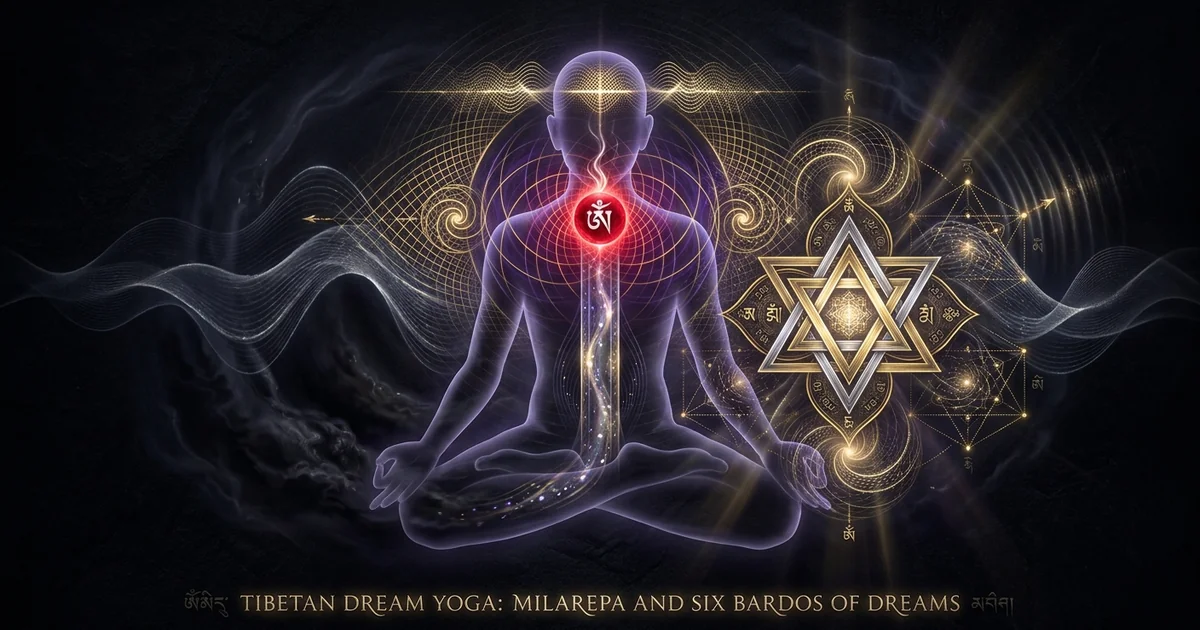
Tibetan Dream Yoga: Milarepa and Six Bardos of Dreams
Protocol Overview & Neurophysiological Thesis: The Bardo of Dream and Clear Light
The Six Bardos Architecture and the Milam Episteme
In the esoteric taxonomy of the Vajrayāna and Dzogchen lineages, conscious experience is categorized into six transitional intervals, or bardos (bar-do): the waking state (kyenay bardo), the dream state (milam bardo), the meditative absorption state (samten bardo), the dying process (chikhai bardo), the luminous reality of dharmatā (chönyid bardo), and the transmigration toward rebirth (sidpa bardo). Within this structural topology, the dream state occupies a privileged epistemological position. Rather than a byproduct of synaptic consolidation or an unstructured psychological playground, the milam bardo functions as a laboratory for unmasking cognitive reification. In the milam bardo, the habituated mind continuously projects endogenous karmic traces (vāsanās) into an externalized, spatio-temporal simulation, treating immaterial cognitive artifacts as solidly existing external entities.
The systematic praxis of Tibetan Dream Yoga (rmi-lam rnal-'byor) deconstructs this default reification. By cultivating continuous metacognitive vigilance during the sleep cycle, the practitioner exposes the illusory nature of phenomenal experience, known as māyā (sgyu-ma). This realization is not intended solely to facilitate recreational dream control or lucid self-indulgence. Instead, the protocol acts as a simulation training chamber for the dying process: recognizing the illusory, ungrounded nature of the milam bardo directly prepares the practitioner to navigate the terrifying sensory apparitions of the chönyid bardo and avert involuntary rebirth in the sidpa bardo. By dissolving karmic illusion in the dream, consciousness is prepared for its ultimate objective: the unconditioned ground of reality.
Milarepa’s Cave Practice: Radical Asceticism and the Subversion of Samsaric Reification
The historical archetype of this soteriological mastery is the 11th-century yogi Jetsun Milarepa (Mi-la-ras-pa). Practicing in the extreme, barren high-altitude caves of the Tibetan plateau, Milarepa approached nocturnal practice not as an interruption of contemplative discipline, but as its ultimate crucible. In The Hundred Thousand Songs of Milarepa, he details how the sensory deprivation, extreme cold, and ascetic isolation of high-altitude retreat accelerate the inward withdrawal of the coarse physical winds (prāṇa-vāyu). For Milarepa, diurnal appearances and nocturnal dreams were ontologically identical: both are cognitive fabrications arising from ignorance (avidyā) and the grasping at dualistic phenomena (grāhya-grāhaka).
Milarepa’s transmission establishes that dream lucidity is a transitional bridge rather than an end in itself. When an adept learns to transmute the elements within a dream—walking through stone walls, flying across cosmic domains, multiplying a single dream body into countless emanations—they are not indulging in magical realism. They are systematically subverting the neurological and cognitive operational models that construct the consensus hallucination of waking reality. The culmination of this trajectory is the cessation of dream fabrication altogether: the state of Clear Light sleep ('od-gsal), wherein the illusory dream matrix collapses into primordial emptiness (śūnyatā), revealing the non-dual, unconditioned radiance of intrinsic awareness (rigpa).
“In a dream, one may create anything, but whatever is created has no intrinsic existence. If you recognize this during the dream state, the habitual illusion of daytime life is simultaneously unmasked. The Clear Light is not a dream; it is the fundamental ground from which both dreams and waking reality arise.”
— Chögyal Namkhai Norbu, Dream Yoga and the Practice of Natural Light (1992)
“Day and night, appearances arise as friends;
All external forms dissolve into the nature of the mind;
The mind itself dissolves into the Clear Light of the unborn.”
— Jetsun Milarepa, The Hundred Thousand Songs of Milarepa, translated by Garma C. C. Chang (1962)
Target Neurodynamics: The Dissociation of Metacognition from Somatosensory Input
From a neurophysiological perspective, the transition from ordinary karmic dreaming to Dzogchen dream practice requires a fundamental reorganization of sleep neurodynamics. In standard Rapid Eye Movement (REM) sleep, the brain is characterized by widespread aminergic demodulation, leaving cholinergic transmission unchecked. This results in desynchronized electroencephalographic (EEG) activity accompanied by profound muscular atonia induced by descending glycinergic and GABAergic inhibition from the brainstem to somatic motor neurons. Concurrently, the dorsolateral prefrontal cortex (dlPFC) and the frontopolar cortex remain largely deactivated, explaining the absence of metacognitive scrutiny, temporal orientation, and voluntary agency in ordinary dreams. Phenomenal experience proceeds as an associative narrative constructed by limbic, paralimbic, and visual association cortices, fully decoupled from executive oversight.
Tibetan Dream Yoga targets a precise dissociation: the selective reactivation of executive metacognition while preserving descending somatic motor atonia and sensory thalamocortical gating. The adept induces an atypical neurodynamic state characterized by high frontoparietal gamma-synchrony (specifically oscillating within the 38–42 Hz band) superimposed on either the desynchronized theta baselines of REM or the slow-wave delta (0.5–2 Hz) dynamics of deep non-REM (NREM) sleep. In this configuration, the frontoparietal control network (FPN) and the default mode network (DMN) engage in a rare state of high functional connectivity, permitting the self-reflexive realization “I am dreaming” without disrupting the ascending reticular activating system’s sleep-maintenance thresholds. The brain remains physiologically asleep, yet metacognitively vigilant.
Biophysical Mechanisms & Brainwave Dynamics: The Red Bindu and Thalamocortical Synchrony
    Gross Respiratory Winds (Left / Right Channels: Pingalā & Iḍā)
                                   │
                                   ▼
          Vagus Nerve & Carotid Compression (Lion Posture)
                                   │
                                   ▼
        Focal Activation: Throat Chakra (Viśuddha / Red Bindu)
                                   │
                                   ▼
             Central Channel Ingress (Avadhūtī / Suṣumṇā)
                                   │
                                   ▼
            Thalamocortical Sensory Decoupling (Sleep Atonia)
                                   │
                                   ▼
   Frontoparietal 40 Hz Gamma Coherence Nested in Delta Baselines (Ösel)
The Throat Chakra (Viśuddha) and Subtle Prāṇa-Vāyu Hydraulics
The bioenergetic foundation of Tibetan Dream Yoga relies upon the subtle energy anatomy (rtsa-rlung-thig-le). According to the tantric physiology inherited by Milarepa and articulated by contemporary masters, the human subtle body comprises three primary channels (nāḍīs): the central channel (avadhūtī, dbu-ma), the right channel (pingalā, ro-ma), and the left channel (iḍā, rkyang-ma). During normal waking consciousness, the subtle winds (prāṇa-vāyu) circulate through thousands of secondary lateral pathways, reinforcing dualistic mental constructs, discursive thought (rnam-rtog), and emotional reactivities. In deep sleep, these coarse winds naturally withdraw; however, in an untrained individual, they pool within the heart and navel centers in an unstructured, unconscious manner, resulting in the darkness of ignorance (moha).
Dream Yoga intercedes in this biological habit by directing the concentration of vāyu directly into the throat chakra (viśuddha, mgrin-pa’i 'khor-lo). The throat center, visualized as an inverted red four-petaled lotus, houses the subtle essence known as the red bindu (thig-le). This red droplet corresponds to the primordial maternal energetic matrix, governing phenomenal transformation, luminosity, and speech. Concentrated visual and somatic focus on this localized nexus prevents the coarse winds from scattering into the lateral karmic channels. Instead, the focus draws the subtle winds into the central channel at the level of the throat, mechanically shifting neuro-vegetative balance. This concentrated bio-oscillation prevents the total drop into unconsciousness, holding awareness at the precise threshold of internal perceptual generation.
Spectral Stratification: Frontoparietal 40 Hz Gamma Bursts on Slow-Wave Baselines
Contemporary quantitative electroencephalography (qEEG) illuminates the neural correlates of this subtle energetic containment. When an adept focuses awareness on the throat center while transitioning across hypnagogia into REM sleep, the brain exhibits a signature pattern of spectral stratification. Unlike non-lucid REM, which is dominated by low-voltage, mixed-frequency theta (4–8 Hz) activity alongside bursts of rapid eye movements and pontine-geniculate-occipital (PGO) spikes, the practice of dream yoga generates pronounced elevations in high-frequency gamma power (38–42 Hz).
This gamma-synchrony is localized within the bilateral dorsolateral prefrontal cortices, the frontopolar cortex (BA 10), and the bilateral temporoparietal junctions (TPJ). Crucially, this high-frequency oscillatory coherence does not reflect micro-arousals or muscular artifact. Laboratory recordings show that this 40 Hz gamma activity is functionally nested within underlying slow-frequency carriers. In the ultimate realization of Dzogchen Clear Light sleep ('od-gsal), this dynamic manifests within non-REM stage 3 (N3) slow-wave sleep: high-amplitude delta waves (0.5–2 Hz) operate concurrently with frontally distributed, highly coherent 40 Hz gamma oscillations. This spectral stratification allows the brainstem and primary sensory cortices to remain functionally offline, while higher-order associative and executive circuits maintain stable self-luminous presence.
Standard REM Dreaming (Karmic Projections)
- Aminergic/Cholinergic Ratio: Low aminergic tone (serotonin/norepinephrine near zero); maximally elevated cholinergic tone.
- dlPFC and Frontopolar Activation: Profoundly hypoactive; loss of metacognitive evaluation, executive agency, and secondary self-awareness.
- Spectral Power Distribution: Desynchronized theta (4–8 Hz) and alpha attenuation across cortical areas; complete absence of frontoparietal gamma coherence.
- Epistemological Status: Complete reification of subjective mental imagery; phenomenal illusions are perceived as external and absolute.
Lucid Dream Yoga & Clear Light Sleep (Metacognitive Coherence)
- Aminergic/Cholinergic Ratio: Cholinergic dominance preserved; subtle, selective adrenergic/noradrenergic baseline balance maintained via executive networks.
- dlPFC and Frontopolar Activation: Robustly hyperactive; sustained functional connectivity between frontopolar cortex and temporoparietal association areas.
- Spectral Power Distribution: Robust 38–42 Hz gamma-band power nested atop theta rhythms (REM lucidity) or synchronized slow-wave delta (Clear Light).
- Epistemological Status: Spontaneous non-reification; phenomenal apparitions are recognized as self-arisen mental constructs (śūnyatā).
Neurochemical Pivots: Acetylcholine Surges versus Aminergic Suppression
Underpinning these macro-level electrophysiological signatures is an intricate neurochemical dynamic governed by the ascending brainstem nuclei. The initiation of typical REM sleep is mediated by REM-on cholinergic neurons located in the pedunculopontine tegmental nucleus (PPT) and the laterodorsal tegmental nucleus (LDT). As these structures increase their firing rates, they release acetylcholine (ACh) into the thalamus and reticular formation, desynchronizing the EEG and generating the vivid, sensory-rich phenomenology of the dream matrix. Concurrently, the aminergic systems—specifically the noradrenergic locus coeruleus (LC) and the serotonergic dorsal raphe nucleus (DRN)—fall virtually silent. This aminergic silencing compromises working memory, executive planning, and reality testing.
The Tibetan Dream Yoga protocol modulates this neurochemical baseline. Through focused attentional training and breath retention protocols, the practitioner stabilizes cortical tone against total aminergic collapse. By maintaining metacognitive intention, the adept triggers an endogenous modulatory shift: cholinergic activation from the PPT/LDT remains saturated—sustaining the endogenous dream engine—while minimal, targeted frontoparietal noradrenergic and dopaminergic signaling is preserved. This precise neurochemical milieu prevents the dorsolateral prefrontal and anterior cingulate cortices from descending into amnesic torpor, enabling the dual-state processing required for conscious dream yoga.
Step-by-Step Experiential Protocol: Dzogchen Dream Practice & Karmic Dissolution
Phase I: The Lion Posture (Seng-ge’i Nyal-stabs) and Throat Visualization
The execution of Tibetan Dream Yoga begins with somatic alignment. The practitioner assumes the Lion Posture (seng-ge’i nyal-stabs), resting on the right side of the body. The legs are extended with the left leg resting directly atop the right, knees slightly bent. The right hand supports the right cheek, with the right thumb placed behind the right earlobe and the right index and middle fingers lightly compressing the right carotid sinus and external jugular pathways. The left arm rests straight along the left flank, covering the left thigh.
       [ Left Arm Along Flank: Covers Left Thigh ]
                           │
                           ▼
 [ Lion Posture: Right Lateral Decubitus, Knees Slightly Flexed ]
                           │
                           ▼
[ Right Hand Supports Cheek: Digits Compress Carotid & Jugular ]
                           │
                           ▼
     [ Left Nostril Dominance Induced: Dampens Discursive Wind ]
This structural configuration carries precise biophysical and bioenergetic implications:
- Mechanical Compression and Autonomic Shift: Gentle compression on the right cervical vessels stimulates baroreceptors within the carotid sinus, increasing vagal tone and lowering blood pressure and systemic heart rate. This facilitates the autonomic transition into sleep while preventing premature hyperarousal.
- Nasal Cycle Modulation: By resting on the right side, the right nostril is partially occluded, mechanically shifting airflow dominance to the left nostril (iḍā). In tantric physiology and modern ultradian biology, left-nostril dominance corresponds to the activation of the parasympathetic nervous system and the cooling, receptive lunar channel, dampening coarse discursive linguistic loops (pingalā/solar wind).
- Seed-Syllable Focusing: With somatic stillness established, the practitioner anchors attention at the throat chakra. Within this nexus, visualize a luminous red, four-petaled lotus. At its center stands a radiant red seed-syllable “Ah” (ཨ), composed of pure, unsolidified light, glowing with the brilliance of a burning ruby. The practitioner merges conceptual consciousness entirely with this red Ah, engaging in gentle vase breath (bum-can), softly retaining the breath without strain to gather the vāyu into the throat.
Nocturnal Schedule:
- Segment 1 (00:00–03:00): Deep somatic restoration. Sleep in the Lion Posture with the throat visualization; allow primary descent into NREM delta.
- First Awakening (03:00 AM): Micro-arousal. Sit upright for 180 seconds. Expel stale air (rlung-ro) through three complete exhalations. Re-visualize the red Ah at the throat with amplified radiance. Return to the right side. This aligns with the onset of extended late-night REM phases.
- Second Awakening (04:30 AM): Re-engage Lion Posture. Transition visualization: the red Ah shifts to a white pearl of light (bindu) at the third eye (ājñā), promoting rapid, lucid transition directly from hypnagogia into endogenous REM sleep.
- Breath Metric: Maintain a soft 4-4-4 rhythm (4 seconds subtle inhalation, 4 seconds suspended retention, 4 seconds relaxed release) during hypnagogic descent.
Phase II: The Fourfold Transmutation: Multiplication, Projection, Transformation, and Non-Reification
Upon entering the milam bardo and attaining initial lucidity, the practitioner does not indulge in conventional egoic scenarios. The practitioner immediately executes the traditional Fourfold Transmutation Protocol, designed to structurally dissolve the neural and cognitive structures that enforce consensus perceptual limits:
[ Phase II: Fourfold Transmutation ]
  │
  ├── 1. Multiplication (P'el-ba)
  │      └── Replicate single object into thousands -> Disrupts unitary perceptual bounds
  │
  ├── 2. Transformation (Gyur-ba)
  │      └── Transmute elements (Fire <-> Water) -> Neutralizes amygdalar threat response
  │
  ├── 3. Projection & Travel (Yul-bkyod)
  │      └── Instantaneous relocation across realms -> Eradicates Euclidean spatial logic
  │
  └── 4. Non-Reification (Māyā/Śūnyatā)
         └── Direct self-inquiry: "What is this?" -> Collapses dream matrix into voidness
- Multiplication (p’el-ba): The practitioner identifies an object within the dream architecture—such as a rock, a tree, or the dream body itself. Metacognitively commanding multiplication, the single entity is split into two, four, sixteen, hundreds, and thousands, expanding until the phenomenal field is saturated. This systematically breaks down the perceptual schema that assumes phenomena are inherently unitary or discrete.
- Transformation (gyur-ba): The practitioner identifies hostile, threatening, or intractable environmental elements and forces their structural transmutation. Terrifying fire is transformed into pristine, refreshing water; solid rock faces are converted into liquid light or porous space through which the practitioner steps; demonic or frightening figures are transformed into forms of the guru, peaceful deities, or light. This neutralizes autonomic threat-reactivity modulated by the amygdala, replacing defensive limbic fight-or-flight signatures with radical equanimity.
- Projection and Travel (yul-bkyod): The practitioner dislocates the dream body from its apparent environmental locus, deliberately willing instantaneous travel to impossible geographies: deep space, the interior of atoms, pristine pure lands, or distinct historical epochs. By intentionally disrupting spatial and temporal continuity, the mind’s hardwired spatial mapping (processed by the posterior parietal cortex) is decoupled from standard Euclidean assumptions.
- Non-Reification and Essential Inquiry: The adept pauses all active manipulations and directly confronts the fabric of the dream itself. The practitioner looks straight into the phenomena of the dream and asks: “Of what is this substance made? What is the ontological basis of this appearance?” The dream elements are recognized as self-luminous, empty displays of mind, having no more reality than an optical reflection or an echo.
Phase III: Dissolving the Phantasmagoric Form into the Substrate Clear Light
The ultimate stage of Tibetan Dream Yoga involves transmuting lucid dreaming into unconditioned Clear Light sleep ('od-gsal). After executing the Fourfold Transmutation, the practitioner systematically withdraws attention from the narrative and spatial elements of the dream. Rather than continuing to project forms, the adept focuses inward upon the ultimate nature of the observer.
The practitioner consciously releases the illusory body (māyādeha, sgyu-lus). The multiplied forms, transformed elements, and spatial geometries of the dream are drawn inward, coalescing back into a single point of light at the heart center (anāhata). The dream imagery begins to pixelate, destabilize, and vanish, much like a projection fading when the light source changes. The practitioner maintains stable non-dual awareness (rigpa), refusing to panic as the dream visual field drops into total sensory blackness.
As the dream architecture collapses, consciousness does not cross into somatic awakening or deep unconsciousness. Instead, it transitions into the pure, non-referential substrate: the primordial Clear Light. In this state, phenomenal duality dissolves. Subject and object, self and world, merge into unconstructed awareness. The practitioner rests in naked awareness, free of spatial orientation, cognitive narration, or visual imagery—a direct, experiential preview of the dharmakāya realization occurring at the threshold of biological death.
Subtle Energetic Architecture: Resonance Coupling and Bio-Oscillatory Workflows
The Phonic Seed Syllables: Acoustic Resonance of ‘Ah’, ‘Om’, and ‘Hūṃ’
Within the subtle energy architecture of Dzogchen, sound and consciousness are non-dual aspects of the same operational matrix. The vocalization and silent internal resonance of seed syllables (bījas) are physical and bio-oscillatory tools calibrated to induce specific mechanical tissue vibrations and subtle energetic alignments. The primordial syllable “Ah” (ཨ) represents the uncreated, unborn nature of reality (anutpāda). Phonemically, the open, unconstructed vocalization of “Ah” produces a low-frequency sonic envelope that coordinates mechanical tissue vibrations in the pharynx, larynx, and upper chest, directly stimulating the vagal afferents of the throat and driving down autonomic arousal.
[ Seed Syllable Sound Engine ]
         │
         ├── "Om" (Crown/Head)  ──> High-frequency Cranial Micro-pulsations
         │
         ├── "Ah" (Throat)      ──> Vagal Afferent Modulation & Vāyu Ingress
         │
         └── "Hūṃ" (Heart)      ──> Deep Cardiopulmonary Rhythm Entrainment
When integrated with the visualization of the red bindu, the resonance of the internal “Ah” works as a selective acoustic filter, dampening the rapid beta-range internal monologue generated by Broca’s and Wernicke’s areas. The syllables “Om” (associated with the crown) and “Hūṃ” (associated with the heart) serve secondary balancing functions: “Om” provides a high-frequency focus that purifies mental agitation, while “Hūṃ” anchors the subtle winds into the central heart channel, stabilizing the cardiopulmonary rhythm. Mastery over these phonemic resonances transforms the somatic vocal tract into an acoustic transducer that directs the movement of the subtle vāyu.
Frequency Following Response (FFR) and Binaural Gamma Induction
Modern contemplative science can interface with these traditional sound modalities by pairing bioacoustic awareness with the neurophysiological mechanism known as the Frequency Following Response (FFR). When two coherent acoustic sine waves of slightly differing frequencies are delivered dichotically to each ear through stereophonic isolation, the superior olivary complex within the brainstem integrates the inputs, producing a subjective internal beat equal to the mathematical difference between the two carriers.
To support the rapid induction of metacognitive gamma coherence during dream yoga, precise psychoacoustic protocols can be deployed:
$$\Delta f = |f_{\text{right}} - f_{\text{left}}| = |240,\text{Hz} - 200,\text{Hz}| = 40,\text{Hz}$$
Left Ear:  200 Hz Sine ──┐
                         ├─> Superior Olivary Complex ──> 40 Hz Binaural Beat (FFR)
Right Ear: 240 Hz Sine ──┘
A base carrier frequency of $200\text{ Hz}$ in the left channel combined with a $240\text{ Hz}$ tone in the right channel yields an auditory steady-state beat of precisely $40\text{ Hz}$. The carrier frequency of $200\text{ Hz}$ is intentionally selected for its low pitch, minimizing cognitive arousal and avoiding the suppression of slow-wave sleep dynamics. As the brainstem processes this phase differential, cortical networks synchronize to the $40\text{ Hz}$ modulation, generating an artificial scaffold for the frontoparietal gamma-synchrony required to sustain dream lucidity. Practitioners can integrate this approach with /sound-cymatics/binaural-beats-acoustic-physics to stabilize sleep-maintenance thresholds and reinforce the /consciousness/lucid-dreaming-gamma-entrainment dynamic during targeted REM transitions.
The Systematic Dissolution Sequence (Thim-rim) in Hypnagogia
The process of falling asleep during Tibetan Dream Yoga is understood as a conscious replication of the death dissolution sequence (thim-rim). Rather than passively slipping into sleep, the adept observes the systematic collapse of the psychophysical elements:
- Earth Dissolves into Water: The physical body feels extraordinarily heavy, sinking downward as if pulled by gravity. Coarse somatic control is lost; motor output drops away. The internal sign is a shimmering, mirage-like visual distortion.
- Water Dissolves into Fire: The sensation of bodily heaviness yields to dryness. Salivary production decreases, and sensory awareness of the environment ceases. The internal sign is an apparition of floating smoke or mist within the visual field.
- Fire Dissolves into Air (Wind): Thermal sensation fades; peripheral bodily warmth begins to withdraw toward the core. The mind loses awareness of physical boundaries. The internal sign is a luminous display resembling fireflies or glowing sparks in darkness.
- Air Dissolves into Consciousness: The subtle breath ceases its coarse movement. The last vestiges of somatic proprioception dissolve. The internal sign is the steady, unmoving radiance of an oil lamp sheltered from wind.
- The Three Subtle Appearances: Awareness sequentially traverses three subtle thresholds: the white appearance (snang-ba), marked by pure, radiant white light (dissolution of anger and masculine essence); the red increase (mched-pa), marked by rich ruby radiance (dissolution of attachment and feminine essence); and the black near-attainment (ngar-thob), marked by a descent into profound, immaculate darkness (dissolution of fundamental ignorance).
- The Emergence of the Clear Light: If the practitioner remains fully lucid as the black near-attainment clears, the unconditioned, primordial Mother Clear Light shines forth. If subtle dualistic grasping remains, the mind instead bifurcates into the milam bardo, projecting the vivid sensory architecture of the dream matrix, ready for immediate lucidity.
Operational Safety, Contraindications & Biofield Grounding
Prāṇa Pathology: Somatic Wind Disorders (Srog-rlung) and Affective Instability
The intense manipulation of subtle energetic currents (rlung) through visualization and breath suspension carries genuine neuro-somatic risks when performed without adequate preparation. In Tibetan medicine (gSo-ba Rig-pa), the most dangerous consequence of incorrect practice is the induction of a life-force wind disorder (srog-rlung). This pathology occurs when subtle energetic winds are forcefully pulled upward through the central channel and become trapped in the heart (anāhata) or crown (sahasrāra) centers, unable to redistribute smoothly throughout the somatic biofield.
Clinical Indicators of Subtle Wind Disturbance (Srog-rlung):
- Cardiovascular/Autonomic: Unexplained resting tachycardia, chest tightness, unstable blood pressure fluctuations, and sensations of internal heat in the cranium.
- Psychological/Affective: Acute existential dread, intractable insomnia, spontaneous panic attacks, depersonalization/derealization episodes, and persistent emotional volatility.
- Contraindications: Practice is strictly contraindicated for individuals diagnosed with schizophrenia, dissociative identity disorders, bipolar I disorder, or active severe clinical depression. Those experiencing unmanaged psychosocial stress must defer intense throat-chakra focus until baseline autonomic stability is restored.
When a practitioner forces the subtle winds into the throat chakra during high-stress states, the sympathetic nervous system is driven into a state of hyper-arousal. The mind attempts to navigate sleep while trapped in high-vigilance fight-or-flight signaling, resulting in distressing sleep paralysis, hypnagogic nightmares, somatic tremors, and lasting affective dysregulation.
Epileptogenic Thresholds in Neuro-Acoustic and Photic Entrainment
The modern integration of exogenous entrainment modalities—such as $40\text{ Hz}$ binaural audio beats, isochronic pulses, or stroboscopic photic stimulation—introduces specific neurological risks. While $40\text{ Hz}$ gamma stimulation can promote frontoparietal coherence, driving the brain at this frequency lowers the seizure threshold in susceptible individuals.
External rhythmic driving can trigger photosensitive epileptic seizures, psychomotor temporal-lobe episodes, or complex-partial seizure states. This risk is amplified during hypnagogic and hypnopompic transitions, where natural thalamocortical pacing is destabilized. Practitioners must avoid exogenous $40\text{ Hz}$ entrainment if they or their immediate family have a history of idiopathic seizure disorders, unexplained nocturnal awakenings with confusion, or abnormal electroencephalograms. The use of audio-visual stimulation must remain moderate and conservative, serving merely as an occasional aid rather than an indispensable crutch for lineage practices.
       [ Upward Subtle Wind Pathologies: Srog-rlung Manifestations ]
         │
         ├── Upward Constriction into Crown/Heart
         │      ├── Resting Tachycardia & Precordial Pain
         │      ├── Severe Depersonalization & Dissociative States
         │      └── Chronic Early-Insomnia & Panic Attacks
         │
         └── Somatic Grounding Counter-Protocol (Mitigation)
                ├── Complete Cessation of Throat/Crown Visualizations
                ├── Kinesthetic Focus to Lower Dantian / Sole of Feet
                └── 0.1 Hz Resonant Breathing (6 Breaths Per Minute)
Somatic Anchoring: Biofield Recalibration and Lower Dantian Grounding
To prevent and remediate the emergence of srog-rlung, the adept must understand how to ground their subtle bioenergetics. Whenever symptoms of wind disturbance manifest—such as racing thoughts upon waking, chest tightness, or ungrounded cognitive disassociation—all visual and meditative concentration at the throat and crown must be ceased immediately.
The corrective protocol requires dropping the intentional center of gravity to the lower body:
- Spatial Re-anchoring: The practitioner brings conscious awareness down from the cranium to the lower abdomen (the lower dantian or navel center, maṇipūra) and the soles of the feet (kṣitigarbha points). Focus on visualizing a dense, heavy, dark-blue or black sphere of lead resting securely at the base of the pelvis or deep within the center of the earth.
- Resonant Diaphragmatic Pacing: The breath is transitioned to deep, low-abdominal diaphragmatic cycles paced at precisely $0.1\text{ Hz}$ (approximately 6 breaths per minute: 5-second inhalation, 5-second exhalation). This pacing induces maximum Heart Rate Variability (HRV) coherence, restoring high vagal tone and signaling immediate biological safety to the limbic system.
- Tactile Earth Contact: In persistent cases, the practitioner should engage in direct physical contact with the earth, consume dense, nourishing foods (such as warm soups, root vegetables, and healthy fats), and suspend all nocturnal lucid dream practice until somatic equilibrium and restorative sleep patterns are fully re-established.
Phenomenological Correlates & Veridical Evidence: Laboratory Polysomnography and Lineage Records
Polysomnographic Validation of Stable Prefrontal Lucidity
Over the past four decades, laboratory polysomnography has transformed lucid dreaming from an esoteric curiosity into a validated neurodynamic state. The foundational breakthrough achieved by Stephen LaBerge using pre-agreed intentional Left-Right-Left-Right (LRLR) ocular saccade signaling demonstrated that dreamers could communicate in real time from within verified REM sleep. Polysomnographic recordings during these events confirmed the presence of typical REM sleep hallmarks—low-voltage, mixed-frequency EEG paired with complete chin electromyographic (EMG) atonia—alongside conscious agency.
Voss, U., Holzmann, R., Hobson, A., et al. (2014). Induction of self-awareness in dreams through frontal low current stimulation of gamma activity. Nature Neuroscience, 17(7), 990–992.
Key Laboratory Finding: Demonstrates that frontolateral transcranial alternating current stimulation (tACS) applied at 40 Hz during REM sleep selectively induces reflective self-awareness (lucidity) in dreams, accompanied by an elevation of endogenous frontoparietal gamma power.
Baird, B., Castelnovo, A., Gosseries, O., & Tononi, G. (2018). Frequent lucid dreaming associated with increased functional connectivity between frontopolar cortex and temporoparietal association areas. NeuroImage, 187, 82–89.
Key Laboratory Finding: Confirms through functional magnetic resonance imaging (fMRI) that frequent lucid dreamers exhibit structurally and functionally elevated connectivity between the anterior prefrontal cortex (BA 10) and temporoparietal association networks, corroborating the neural network profile targeted by Tibetan dream yoga lineages.
These neuroimaging and polysomnographic discoveries confirm that the phenomenological awakening cultivated in Tibetan Dream Yoga matches an objective biological substrate: an atypical hybrid state characterized by simultaneous executive frontoparietal activation and ascending sensory gating. For detailed integration with external laboratory frameworks, explore /consciousness/monroe-gateway-focus-levels-obe to observe how cross-lineage Western protocols attempt to elicit functional equivalents of this hybrid state.
Milarepa’s Songs of Realization: Transforming Illusory Elements as Physical Epistemology
Centuries before the invention of polysomnography, Jetsun Milarepa documented the phenomenological topography of these hybrid states in The Hundred Thousand Songs of Milarepa. In his poetic encounters with both demonic entities and disciples, Milarepa describes manipulating the fabric of dreams not as a display of personal power, but as a practical epistemic test of non-duality.
When demons and spirits assaulted his retreat caves in the high Himalayas, Milarepa did not mount a defensive counterattack. Instead, recognizing that external appearances and the nocturnal dream world are composed of identical cognitive processes, he entered their terrifying apparitions, identifying completely with the primordial empty nature of the phenomena. In one account, when confronted by a terrifying five-headed demoness, he sang:
“The father is the mind, the mother is the void,
The child is the luminous awareness that sees them as one.
If you do not recognize that this demon is your own mind,
How will you conquer the illusions of the world?”
For Milarepa, physical reality and the dream state were entirely porous. Lineage biographies recount instances where, resting in the unconstructed Clear Light of the sleep state, he would walk directly through granite cliff-faces or appear simultaneously across disparate geographic locations. Phenomenologically, these accounts point to the total de-hypnotization of the nervous system from ordinary consensus perceptual filters. When the mind ceases to reify sensory data into an objective, external “world” and a subjective, isolated “self,” the reified boundaries that seem to govern physical reality reveal their ungrounded nature.
Clear Light Non-Duality: EEG Suppression without Loss of Conscious Presence
While ordinary lucid dreaming occurs predominantly within the neurochemical and electrophysiological landscape of REM sleep, the pinnacle of Tibetan Dream Yoga—the realization of Clear Light sleep ('od-gsal)—operates across a different neurodynamic domain: stage N3 slow-wave sleep (SWS). In deep SWS, the typical human brain presents high-amplitude, highly synchronized slow waves (delta, 0.5–2 Hz) across the neocortex, generated by the bistability of cortical neurons switching between hyperpolarized down-states (neuronal silence) and depolarized up-states. For the untrained individual, this electrophysiological configuration corresponds to total unconscious oblivion.
In advanced practitioners of /meditation/dzogchen-rigpa-nondual-awareness, this pattern changes dramatically. When a master rests in the Clear Light during deep NREM sleep, polysomnography reveals high-amplitude delta activity coexisting with sustained, low-voltage fast rhythms, including continuous bursts of gamma synchrony. The subject does not report dream imagery, hallucinations, internal narratives, or spatio-temporal self-location.
Instead, upon waking, the practitioner reports an unfragmented continuum of clear, self-luminous presence that endured without interruption throughout the night. The sensory environment is shut out; discursive mental processes are silent; yet the baseline of consciousness—the unconditioned dharmakāya—remains luminous and awake. This represents the ultimate integration of neurophysiology and contemplative realization: the maintenance of waking awareness across the deep, regenerative stillness of slow-wave sleep.
Frequently Asked Questions: Technical Precision in Tibetan Dream Yoga
Differentiating Psychological Lucidity from Genuine Dzogchen Clear Light Sleep
[ Mental Processing Stratification ]
  │
  ├── Ordinary Lucid Dreaming (Manovijñāna Domain)
  │      ├── Dualistic Subject/Object Framework Intact
  │      ├── Active Cognitive Architecture Manipulation
  │      └── Karmic Substrate Unbroken (Samsāric Loop)
  │
  └── Dzogchen Clear Light Sleep (Rigpa Domain)
         ├── Complete Collapse of Dualistic Boundaries
         ├── Total Cessation of Spatial-Temporal Narratives
         └── Ground State Luminosity (Dharmakāya) Realized
To conflate Western psychological lucid dreaming with the realization of Clear Light sleep is a category error. Ordinary lucid dreaming remains embedded within dualistic consciousness (manovijñāna). In a standard lucid dream, the waking ego-identity simply reclaims agency inside the nocturnal theater, manipulating dream objects, flying, exploring sexual scenarios, or solving creative problems. In this state, the dualistic framework of subject versus object—“I” who am dreaming, and the “dream” that is being controlled—remains intact. While psychologically rewarding, it leaves the deep roots of karmic reification undisturbed.
In stark contrast, Dzogchen dream practice uses initial lucidity merely as an exit point from mental fabrication. The goal is not the manipulation of forms, but the realization of the empty, self-luminous nature of the entire display (rigpa). In genuine Clear Light sleep ('od-gsal), all phenomenal projections—images, environments, spatial coordinates, and the “dreamer” construct itself—dissolve back into primordial awareness. Consciousness rests nakedly in its unconditioned state, free of narrative and duality. Ordinary lucid dreaming is a manipulation of cognitive contents; Clear Light sleep is the direct recognition of the Ground of Being from which all contents arise and into which they dissolve.
Navigating Sleep Paralysis and the Ingress of the Central Channel
Sleep paralysis is an involuntary threshold phenomenon occurring when the brainstem’s descending glycinergic and GABAergic motor inhibition remains active while the ascending reticular activating system and cortex achieve wakefulness. To the untrained individual, this state is terrifying: unable to move, with respiratory sensations restricted by deep somatic atonia, the mind often projects frightening hypnagogic figures (the “incubus” or shadow-figure hallucination) mediated by acute amygdalar panic.
In the lineage of Tibetan Dream Yoga, sleep paralysis is viewed through a different lens. Far from a pathological condition, it is recognized as a profound physiological threshold indicating that the coarse respiratory winds have withdrawn from the external motor pathways and are beginning to gather into the central channel (avadhūtī). When sleep paralysis strikes, the adept does not struggle against the paralyzed musculature or feed the panicking narrative.
Instead, the practitioner applies three specific internal adjustments:
- Somatic Relinquishment: Surrender muscular effort completely. Recognize that involuntary autonomic respiration continues without requiring deliberate motor intervention.
- Afference Decoupling: Shift attention away from the somatic perimeter and place focus directly into the red Ah at the throat center or the luminous white bindu at the heart.
- Equanimous Launch: Recognize the vibrating, buzzing sensations and auditory rushing tones (nāda) of sleep paralysis as the sonic and energetic signatures of subtle vāyu moving into the central channel. By relaxing into these sensations, the practitioner uses the paralysis as a natural catapult, stepping directly from conscious immobility into an unclouded lucid dream or the radiant openness of Clear Light sleep.
Acoustic Calibration: Is Binaural Gamma Necessary for Lineage Practices?
The contemporary application of neuro-acoustic protocols—such as dichotic $40\text{ Hz}$ binaural gamma stimulation—is an optional scaffold rather than a traditional necessity. The historic lineages of Dzogchen and the Six Bardos produced generations of accomplished masters, including Milarepa, long before the invention of electroacoustic frequency generators, oscilloscopes, or stereo transducers. Their methods relied entirely upon endogenous subtle-body mastery: physical postures that modulate autonomic tone, targeted respiratory suspension (kumbhaka), precise internal visualization, and the physical resonance of chanted seed syllables.
Exogenous acoustic entrainment can assist modern practitioners who have difficulties developing stable inner focus or who face stubborn cognitive fatigue. By utilizing precise carrier differentials (such as $200\text{ Hz}$ and $240\text{ Hz}$), binaural gamma acts as a training wheel, establishing an exogenous neuro-electrical baseline that helps the thalamus stabilize high-frequency coherence during hypnagogic descent.
However, relying entirely on external frequencies can create a biological dependency, leaving the practitioner unable to achieve lucidity without digital equipment. Authentic mastery requires internalizing the practice. The external beat should serve solely to familiarize the nervous system with the target internal state, after which the practitioner must rely on internal vāyu dynamics, breath control, and unbroken awareness. The ultimate objective of Tibetan Dream Yoga is absolute freedom from all external conditions, waking and sleeping alike.