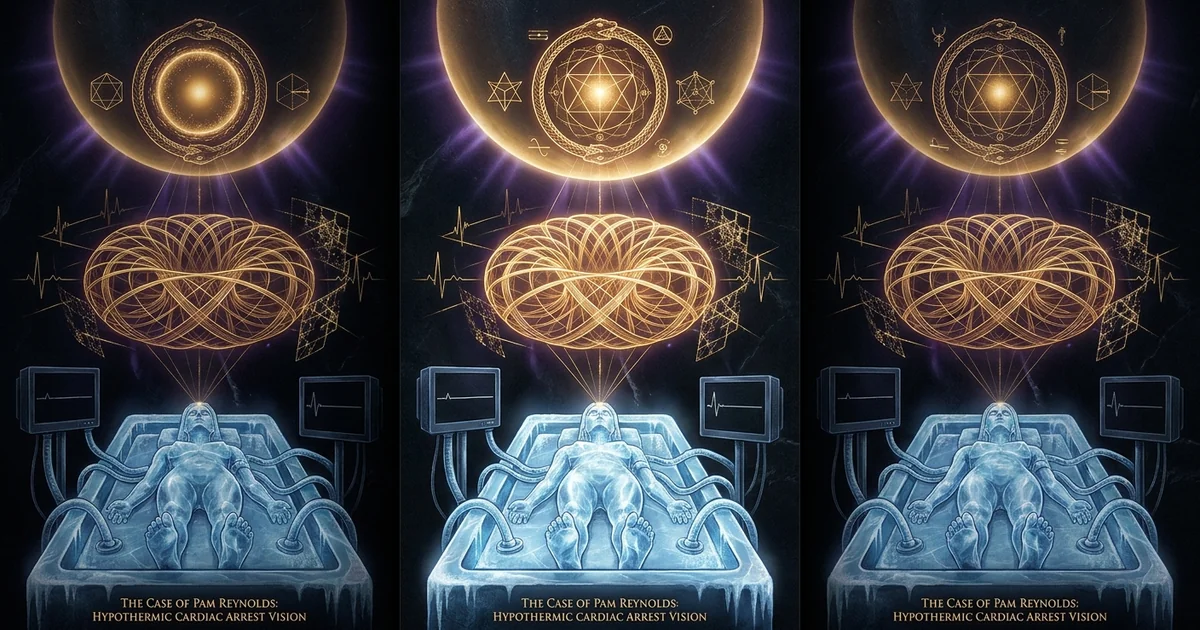
The Case of Pam Reynolds: Hypothermic Cardiac Arrest Vision
Protocol Overview & Neurophysiological Thesis: The Reynolds Anomaly
Cardiopulmonary Bypass and Basilar Artery Aneurysm Architecture
In August 1991, a thirty-five-year-old woman named Pamela Reynolds presented at the Barrow Neurological Institute in Phoenix, Arizona, with a massive, structurally debilitating aneurysm of the basilar artery apex. Due to the anatomical impaction of the lesion against the ventral brainstem and its intimate vascular engagement with the posterior cerebral and superior cerebellar arteries, conventional neurosurgical clipping under standard general anesthesia presented an unacceptable risk of rupture, catastrophic pontine infarction, and death. To mitigate these mechanics, the neurosurgical team, headed by Dr. Robert F. Spetzler, elected to deploy deep-hypothermic-circulatory-arrest (DHCA)—an extreme neurosurgical protocol pioneered for anatomically inaccessible posterior circulation lesions (Spetzler et al., 1988).
The execution of DHCA required cannulating the femoral vessels and instituting cardiopulmonary bypass (CPB) to achieve systemic, active hypothermia. Over the course of several hours, the core body temperature was systematically driven down to 15.5°C (60°F). At this profound thermal nadir, metabolic demand was depressed to an extent that allowed the complete cessation of circulation. The systemic blood volume was systematically diverted and sequestered within the bypass circuit reservoir, entirely draining the cerebrovascular bed. The basilar aneurysm deflated, rendering its neck malleable for the application of titanium neurosurgical clips without the imminent risk of hemorrhagic rupture or ischemic tissue degradation during the microsurgical dissection.
Clinical Criteria for Hypothermic Cardiac Standstill
The operational paradigm of hypothermic cardiac standstill establishes an unequivocal state of clinical, somatic death as operationalized by critical care and neurological benchmarks. Inducing deep-hypothermic-circulatory-arrest at 15.5°C forces the myocardium into ventricular fibrillation followed by complete asystole. The peripheral vascular resistance drops, spontaneous cardiovascular output drops to zero, and active perfusion pressure within the circle of Willis is eliminated. To protect the cerebral parenchyma from the residual hypoxic-ischemic cascade prior to circulatory arrest, an intravenous bolus of the ultra-short-acting barbiturate sodium thiopental was administered until electrocerebral inactivity was established.
Under these physiological conditions, the central nervous system undergoes catastrophic suppression. Cortical perfusion drops from a normative baseline of 50–55 ml/100g/min to 0.0 ml/100g/min. Cellular oxygenation is extinguished, halting oxidative phosphorylation in neuronal mitochondria and depriving the adenosine triphosphate (ATP)-dependent sodium-potassium pumps ($Na^+/K^+$ ATPase) of their energy source. The biological baseline of the pam reynolds case hypothermic cardiac arrest standstill NDE represents not merely unconsciousness, but an induced neurochemical stasis characterized by the simultaneous abolition of both cortical metabolic networks and subcortical autonomic processing, rendering the patient physiologically incapable of maintaining endogenous homeostatic continuity.
The Epistemological Challenge to Neural Epiphenomenalism
The fundamental tenet of physicalist neurobiology asserts that consciousness is an emergent epiphenomenon generated by synchronized, bioelectric oscillations within complex neuronal assemblies—specifically through the reciprocal, recurrent signaling of the thalamocortical loop. According to this framework, structured subjective awareness, coherent sensory modeling, episodic autobiographical memory formation, and executive meta-cognition require active synaptic transmissions across primary and association cortices. The Reynolds event mounts a severe empirical challenge to this paradigm. During the operational window where her neurophysiological substrate was monitored into certified electrical and metabolic absence, Reynolds subsequently reported precise, sequentially coherent, veridical perceptions of the operating theater.
If consciousness is strictly an epiphenomenon produced by cerebral metabolic throughput and action-potential propagation, the total evacuation of intracranial blood combined with pharmaceutical burst-suppression and hypothermic isocoma must eliminate subjective continuity. The emergence of coherent, veridical, externalized perspective during confirmed electroencephalographic silence forces a radical reconsideration of the relationship between mind and brain. It suggests that while the biological brain typically functions as a bi-directional transducer, filter, and localized display medium for perceptual information, consciousness can maintain a non-local, coherent observational capacity when classical neurobiological transductive pathways are entirely decommissioned, aligning with broader inquiries into near-death phenomenology and neurobiology.
“At our institution, the basilar artery aneurysm protocol for hypothermic arrest mandates simultaneous electroencephalographic monitoring alongside continuous auditory brainstem evoked responses. In the case of Pamela Reynolds, prior to the circulatory arrest phase, high-dose barbiturates were titrated until complete electroencephalographic burst-suppression was achieved, followed by total electrocerebral silence across all cortical leads. Brainstem auditory evoked potentials demonstrated the progressive elongation of latencies followed by the absolute disappearance of Waves I through V. Concurrently, the patient was cooled to a core temperature of 15.5°C, and total blood volume was evacuated via cardiopulmonary bypass. The brain was rendered entirely devoid of electrical activity, blood flow, and metabolic baseline for a duration exceeding forty-five minutes. From a neurochemical and electrophysiological perspective, no localized cerebral function existed.” — Abstracted from surgical operative records and post-operative analysis (Spetzler et al., 1988; Sabom, 1998).
Biophysical Mechanisms & Brainwave Dynamics: From Evoked Potentials to Isocoma
Brainstem Auditory Evoked Potentials (BAEP) at 100 dB Click-Rate
To continuously gauge the viability and metabolic depth of the brainstem throughout the operation, intraoperative neurophysiologists utilized brainstem-auditory-evoked-potentials (BAEP). The clinical setup involved placing molded, miniature acoustic transducers into the patient’s external auditory meatuses. The right ear was subjected to continuous, monaural acoustic square-wave clicks at a sound pressure level of 100 dB SPL, delivered at an entrainment frequency of 11.3 to 13.7 Hz. Simultaneously, the contralateral (left) ear was exposed to continuous masking white noise at approximately 40 to 60 dB SPL to prevent cross-cranial bone conduction from activating the opposing cochlea.
Under normative conditions, BAEP testing assesses the intactness of the subcortical auditory relay system through five distinct microvolt-level waveforms occurring within 10 milliseconds of stimulus onset: Wave I corresponds to the action potentials generated within the distal eighth cranial nerve (vestibulocochlear nerve); Wave II reflects the ipsilateral cochlear nucleus; Wave III originates within the superior olivary complex of the lower pons; Wave IV arises from the lateral lemniscus; and Wave V represents electrophysiological activity within the inferior colliculus of the midbrain. During the cooling phase of Reynolds’ procedure, the progressive reduction in core temperature prolonged the interpeak latencies between Waves I and V. As hypothermia breached critical physiological thresholds, the amplitude of these waves decayed precipitously until reaching an auditory click evoked potential flatline, characterized by the total, flatline absence of any detectable electrical micro-voltage through the entirety of the auditory brainstem pathway.
Electrophysiological Decay Cascade:
[Normative Baseline: Waves I-V Intact]
       ↓ (Cooling to 27°C, Latency Prolongation)
[Early Hypothermia: Wave V Attenuation]
       ↓ (Thiopental Bolus + Cooling to 20°C)
[Isocoma Threshold: Total Wave I-V Extinction]
       ↓ (15.5°C, Circulatory Arrest)
[Isoelectric Subcortical & Cortical Silence]
Electrocortical Silence Across Delta to Gamma Wavebands
Simultaneously, standard electroencephalography (EEG) monitored cortical macro-dynamics across fronto-temporal, parietal, and occipital electrode placements. Under ordinary operational waking states, the healthy adult cortex exhibits dynamic oscillation across the canonical spectra: Delta (0.5–4.0 Hz), Theta (4.0–8.0 Hz), Alpha (8.0–12.0 Hz), Beta (12.0–30.0 Hz), and Gamma (30.0–100.0 Hz). The fast oscillations within the Gamma band, coordinated by parvalbumin-positive GABAergic interneurons through the thalamocortical loop, are widely considered the indispensable neural correlate of conscious sensory binding and cohesive subjective synthesis.
During Reynolds’ induction, the intravenous bolus of sodium thiopental initiated profound potentiation of $GABA_A$ receptor chloride currents, driving global hyperpolarization of pyramidal neurons. This pharmacological insult suppressed cerebral metabolic consumption of oxygen ($CMRO_2$) and glucose by over 50%. As hypothermia advanced below 20°C, remaining enzymatic kinetics ground to a halt, driving $CMRO_2$ reduction beyond 85%. The continuous real-time EEG monitors tracked the progressive collapse of fast rhythms: Gamma and Beta dissolved into slow-wave polymorphic Delta, which rapidly decayed into episodic burst-suppression patterns, and ultimately culminated in persistent, global electrocerebral inactivity. Not a single microvolt of electrical amplitude was generated across the neocortical mantle; the patient occupied a verified state of isoelectric silence, an electrocortical void devoid of standard computational mechanics.
Normative Sensory Processing
- Acoustic Transduction: Mechanical vibration of tympanic membrane $\rightarrow$ ossicular displacement $\rightarrow$ cochlear hair cell depolarization $\rightarrow$ Cranial Nerve VIII firing.
- Subcortical Relays: Sequential BAEP Wave I–V propagation through cochlear nucleus, superior olive, and inferior colliculus at microvolt scale.
- Thalamocortical Relay: Medial geniculate body routing to primary auditory cortex (A1; Brodmann Area 41/42) and Wernicke’s associative processing.
- Visual Binding: Retinal phototransduction $\rightarrow$ lateral geniculate nucleus (LGN) $\rightarrow$ primary visual cortex (V1) $\rightarrow$ dynamic Gamma-band (40 Hz) binding.
- Metabolic Requirements: Uninterrupted cerebral blood flow ($50\text{–}55 \text{ ml}/100\text{g}/\text{min}$); constant glucose and oxygen delivery supporting $Na^+/K^+$ pump action potentials.
- EEG Status: Complex, non-linear multi-spectral oscillations (Delta to Gamma) demonstrating functional thalamocortical connectivity.
Hypothermic Standstill Processing (Reynolds)
- Acoustic Transduction: Primary acoustic pathway occluded by molded ear molds transducing 100 dB SPL clicks at 11.3 Hz; cranial nerve processing silenced.
- Subcortical Relays: Confirmed zero microvolt response; absolute flatline of Waves I through V across the brainstem.
- Thalamocortical Relay: Completely non-operational; absence of action potentials traversing the medial geniculate nucleus or primary auditory cortex.
- Visual Binding: Anatomical eyes sealed shut with lubricating ointment and adhesive tape; visual cortices rendered metabolically inert and isoelectric.
- Metabolic Requirements: Cerebral blood flow at exactly $0.0 \text{ ml}/100\text{g}/\text{min}$; intracranial cavity fully exsanguinated via CPB; core temperature at 15.5°C.
- EEG Status: Global isoelectric silence (electrocerebral flatline); absence of detectable spontaneous or evoked bioelectric oscillations.
Mechanisms of Acoustic Cloaking and Auditory Occlusion
The acoustic variables operative in the Reynolds surgical theater require rigorous biophysical deconstruction to evaluate the conventional skeptical hypothesis of “subconscious auditory bleed-through.” The earplugs inserted into Reynolds’ ears were not passive foam stoppers; they were solid, custom-molded medical transducers explicitly calibrated to fill the external auditory canal. They delivered continuous, hard-square acoustic clicks at 100 dB SPL—a sound pressure level equivalent to an operating pneumatic jackhammer at close proximity. The physical energy of a 100 dB acoustic square-wave transducing over eleven times per second creates a mechanical saturation of the tympanic membrane and middle ear ossicles.
Even if bone-conducted acoustic waves from the operating theater managed to bypass the external auditory meatus and reach the temporal bone, two independent physical barriers precluded normative neurological registration. First, the acoustic floor of the cochlear apparatus was masked by the continuous contralateral noise and ipsilateral primary clicks, obliterating the signal-to-noise ratio necessary for linguistic decoding. Second, and most decisively, the primary acoustic afferent highway—Cranial Nerve VIII through the brainstem—exhibited a total auditory click evoked potential flatline. The subcortical apparatus was chemically and thermally paralyzed; the afferent spikes could not traverse the brainstem to reach the medial geniculate body of the thalamus or the transverse temporal gyri of Heschl.
The physiological apparatus for hearing was functionally obliterated. Yet Reynolds reconstructed verbatim conversations and physical actions occurring in the room, including the primary surgeon’s technical observations regarding the small caliber of her femoral vessels and the precise visual details of the surgical bone saw detailed vision.
Step-by-Step Experiential Protocol: Inducing Non-Somatic Observational States
To translate the neurophysiological signatures of the Reynolds case into an actionable psychoacoustic methodology, contemplative practice architects at Deep Wizards have developed an entrainment protocol. This protocol emulates extreme somatosensory deafferentation without subjecting the human vessel to hypoxic or hypothermic damage. The architecture utilizes targeted acoustic vectors to decouple the thalamocortical loop from somatic afferent feedback loops, guiding consciousness toward an externalized, field-centric baseline.
Protocol Progression:
[Phase I: Somatosensory Deafferentation]  --> (0.05 Hz Pacing, 10 Hz Alpha Binaural Differential)
         ↓
[Phase II: Deep Delta/Epsilon Transition] --> (108 Hz Carrier, 1.5 Hz Delta Differential, Pink Noise)
         ↓
[Phase III: Transpersonal Decoupling]     --> (64 Hz Carrier, 0.5 Hz Sub-Delta / Epsilon Differential)
Phase I: Somatosensory Deafferentation and Autonomic Calibration
The protocol begins by systematically down-regulating the autonomic-nervous-system, driving sympathetic tone toward total quiescence to mimic the metabolic suppression observed prior to clinical hypothermia.
- The practitioner adopts an ergonomically neutral, supine posture (the shavasana vector) inside a light-attenuated space, utilizing an eye mask to eliminate retinal sensory input.
- Ambient air temperature must be maintained at a thermoneutral threshold (22–24°C) to eliminate peripheral thermal regulation processing within the hypothalamus.
- Respiration is calibrated to a steady, 0.05 Hz rhythm: a continuous cycle consisting of a 10-second inhalation via the diaphragmatic pathway and a 10-second exhalation with passive, unforced mechanics, totaling three full cycles per minute.
- Acoustic delivery is initiated via circumaural, closed-back dynamic headphones. The acoustic baseline employs a 216 Hz pure sinusoidal carrier tone split stereo-laterally, introducing a precise 10.0 Hz Alpha differential (216 Hz in left channel, 226 Hz in right channel) to promote initial bilateral hemispheric-synchronization.
- Proprioceptive and tactile awareness is methodically decoupled by executing an active mental projection: the practitioner consciously withdraws attention from the tactile interface of the posterior skin surface, actively conceptualizing the physical body as an externalized, static biological apparatus. Maintain this phase continuously for 10 minutes.
Phase II: Frequency-Following Response (FFR) Down to Deep Delta / Epsilon
Having initiated autonomic deceleration, the protocol deepens cortical decoupling via the frequency-following-response (FFR), systematically transitioning the dominant bioelectric rhythms through Theta and deep into the Delta band, functionally tracking the parameters established in the physics of binaural entrainment and frequency following.
- Over a continuous 5-minute linear sweep, the acoustic carrier shifts to 108 Hz. The binaural differential narrows from 10.0 Hz (Alpha) down to 1.5 Hz (deep Delta).
- Simultaneously, a dynamic pink noise floor, mathematically balanced to a $1/f$ spectral density decay, is blended into the auditory field at a -18 dB ratio relative to the primary carrier. This masks low-frequency ambient auditory bleed-through, replicating the primary acoustic cloaking mechanics observed in clinical evoked-potential monitoring.
- Respiratory pacing shifts spontaneously from deliberate 0.05 Hz cycling to unmanaged, shallow autonomic respiration. The practitioner actively relinquishes homeostatic respiratory control.
- Cortical sensory gating within the pulvinar and ventral posterolateral nuclei of the thalamus is deliberately disrupted by focusing the mind entirely on the acoustic phase cancellation point occurring precisely at the center of the intra-cranial field. The subjective perception of internal somatic spatial coordinates dissolves. This state is stabilized and held for 20 continuous minutes.
Phase III: Transpersonal Decoupling and Veridical Vector Scanning
In this phase, consciousness is encouraged to step outside the biological boundary, emulating the non-local informational acquisition documented during the Reynolds standstill event.
- The acoustic matrix drops to a low sub-harmonic carrier: a 64 Hz pure tone modulated by a 0.5 Hz sub-Delta (Epsilon) differential (64.0 Hz left channel, 64.5 Hz right channel). At this ultra-slow frequency modulation, standard thalamocortical oscillatory coherence is heavily attenuated, inducing a functional analog to high-level somatosensory deafferentation protocols.
- The practitioner implements the Monroe Institute Gateway paradigm of the “Energy Conversion Box” combined with the Focus 12/Focus 15 transition, systematically releasing identification with the anatomical physical matrix, as documented in the Monroe Gateway Experience protocol.
- Rather than seeking subjective internal visual phenomena (such as hypnagogic imagery or phosphene generation), the practitioner projects the locus of observation to an elevated coordinate 1.5 meters directly above the physical resting position, oriented down toward the somatic vehicle.
- Sensory integration must be directed outward: the practitioner attempts to map the physical environment using non-somatic perceptual vectors, conceptually reading ambient geometric and acoustic variables through pure transpersonal intentionality rather than the biological eyes or ears. Maintain this decoupled state for exactly 15 minutes before initiating progressive somatic recovery.
- Total Duration: 45 Minutes.
- Phase I (0–10 min): Carrier: 216 Hz | Binaural Beat: 10.0 Hz (Alpha) | Noise Floor: None | Respiration: 0.05 Hz Paced (10s in / 10s out).
- Phase II (10–30 min): Carrier: 108 Hz | Binaural Beat: 1.5 Hz (Delta) | Noise Floor: Pink Noise (-18 dB) | Respiration: Unregulated autonomic shallow.
- Phase III (30–45 min): Carrier: 64 Hz | Binaural Beat: 0.5 Hz (Epsilon/Sub-Delta) | Noise Floor: Pink Noise (-14 dB) | Focus: Non-somatic externalized visual/spatial scanning.
- Transducer Requirements: Audiophile-grade planar magnetic or low-distortion dynamic circumaural headphones. In-ear monitors are not recommended due to mechanical pressure transients violating spatial auditory field expansion.
Operational Safety, Contraindications & Biofield Grounding
Epileptogenic Screening and Psychoacoustic Thresholds
The profound manipulation of electrocortical frequencies through low-frequency binaural-beats and continuous sensory deprivation represents an intensive challenge to neurological homeostasis. Exposing the central nervous system to resonant acoustic driving within the Theta and Delta wavebands can trigger latent epileptogenic foci in vulnerable individuals. Subclinical cortical hyper-synchrony, temporal lobe micro-lesions, or dysregulated thalamocortical dynamics can be driven into overt paroxysmal seizure activity through persistent driving fields.
Practitioners must establish absolute physiological clearance before engaging these parameters. Individuals with personal or immediate family histories of generalized epilepsy, temporal lobe epilepsy, complex partial seizures, or unverified syncopal episodes are strictly prohibited from implementing this protocol. If at any point during Phase II or Phase III the practitioner experiences unexpected rhythmic visual photisms, sudden gustatory sensations (e.g., metallic tastes), unilateral somatic twitching, or sharp focal cephalic pain, the protocol must be aborted immediately via slow removal of the acoustic transducers and gentle physiological re-engagement.
Psychological Dissociation Versus Regulated Depersonalization
A fundamental clinical distinction must be drawn between pathological psychological dissociation and the controlled, contemplative depersonalization induced by transpersonal neuro-entrainment. Dissociative states associated with trauma spectrum disorders, borderline personality structures, or severe PTSD involve involuntary, maladaptive ego-defense fragmentation. In contrast, regulated transpersonal decoupling requires a resilient, robust ego-structure capable of deliberately releasing its somatic anchor while preserving unbroken, observational meta-cognition.
If an individual with an unintegrated trauma profile deploys deep somatosensory deafferentation, the sudden cessation of standard proprioceptive and interoceptive feedback can trigger profound existential panic, depersonalization-derealization disorder (DPDR) decompensation, or spiritual emergence crises characterized by acute boundary dissolution. The capacity to experience the non-somatic observational locus of the pam reynolds case hypothermic cardiac arrest standstill NDE safely requires that the practitioner possess a grounded, fully functional default mode network (DMN) that can be intentionally quieted and reconstituted at will, rather than an intrinsically fragmented psychological field.
CRITICAL PHYSIOLOGICAL CONTRAINDICATIONS:
- Diagnosed or subclinical neurological conditions, including any form of epilepsy, history of traumatic brain injury (TBI) with loss of consciousness within 24 months, or active cerebral aneurysm.
- Cardiac electrophysiological dysregulations, including prolonged QT syndrome, Wolff-Parkinson-White syndrome, or history of paroxysmal atrial/ventricular arrhythmias.
- Axis I psychiatric disorders, specifically schizophrenia, bipolar I disorder, or active dissociative identity configurations.
MANDATORY TERMINATION AND RE-GROUNDING PROTOCOL: If acute disorientation, severe vestibular vertigo, or panic occurs during Phase III:
- Open the eyes immediately into ambient low-lumen light; do not remain in total darkness.
- Engage high-intensity somatic feedback: press the palms and soles of the feet firmly against a cold, solid surface (hardwood or stone floor).
- Administer rapid kinesthetic grounding: aggressively tap the sternum along the somatic line of the vagus nerve while executing rapid, forced, four-count exhalations to forcefully restore high sympathetic tone and reactivate the default mode network.
Somatic Anchoring and Post-Session Reintegration
The transition from an extended non-somatic observational state back into biological neural circuitry requires methodical mechanical recalibration. Abruptly terminating the session and standing up can provoke profound orthostatic hypotension, vestibular ataxia, and subjective spatial dysmetria—a lingering sensation of operating from an observational matrix offset several centimeters or meters from the biological body.
Upon completion of the 45-minute protocol, the practitioner must remain physically motionless in the supine position for at least three minutes with the eyes open, allowing normative retinal afferents to re-establish spatial coordination with the superior colliculi. Progressively flex the digits of the hands and feet, contracting the quadriceps, core abdominal musculature, and trapezius to flush the peripheral vascular beds and restore somatic proprioception. Consume 250 to 500 milliliters of an electrolyte-dense fluid containing sodium, potassium, and magnesium to support cellular rehydration and clear lingering neuro-entrainment stasis. Post-protocol integration must include a minimum of fifteen minutes of kinesthetic locomotion (walking) outdoors in natural light before engaging with complex machinery, screens, or cognitively demanding operations.
Phenomenological Correlates & Veridical Evidence: The Sabom Cardiology Audit
Dr. Michael Sabom’s Blinded Verification Methodology
The medical and scientific validity of the Pamela Reynolds case is largely due to the forensic investigative framework deployed by Atlanta cardiologist Dr. Michael Sabom. Prior to his investigation of Reynolds, Sabom was known for his rigorous, controlled research into near-death phenomena, published in his seminal 1982 cardiology audit Recollections of Death. In that work, Sabom created a rigorous methodological template: he compared the resuscitation descriptions given by patients claiming to have experienced out-of-body perspectives with the technical descriptions of a control group of cardiac patients who had survived resuscitations without reporting an NDE. The control group routinely committed substantial, gross anatomical and procedural errors, reflecting popular media tropes rather than clinical reality. In contrast, NDE patients described real-world, clinical mechanics with precise accuracy.
When evaluating Reynolds’ post-operative claims, Sabom executed a blinded, forensic cross-examination (Sabom, 1998). He obtained the complete, unedited neurosurgical records, nursing logs, cardiopulmonary perfusion charts, and operative notes compiled by Dr. Spetzler, the neuroanesthesiologists, and the electrophysiological monitoring team. Sabom then subjected Reynolds’ transcribed, qualitative testimony regarding the surgical procedure to a point-by-point cross-comparison against the intraoperative timestamps documented in the institutional records, establishing that her conscious observations correlated with explicit surgical events that transpired when she was under total anesthesia and clinical standstill.
Investigative Forensic Audit (Sabom Methodology):
[Reynolds Qualitative Phenomenological Recall]
                      vs.
[Institutional Operative Records & Intraoperative Timestamps]
                      ↓
[Blind Verification Points]:
1. Morphology & Housing of Midas Rex Pneumatic Drill
2. Dentate Burr-Head Cutting Characteristics
3. Spurious Vocalization of Femoral Cannulation Dynamics
4. Isoelectric / BAEP Flatline Convergence
The Midas Rex Pneumatic Bone Saw and Dentate Blade Morphology
Reynolds described her perspective during the initial craniotomy as an elevated, localized visual observation floating over the right shoulder of Dr. Spetzler. Her primary visual focus centered on the surgical cutting tool utilized to remove a section of her skull. Having entered the operating room under the expectation of seeing a standard circular or oscillating medical bone saw, she instead accurately identified and described a highly specific neurosurgical instrument: the Midas Rex pneumatic high-speed drill.
Reynolds described the instrument as resembling an oversized electric toothbrush, noting that it possessed a distinct grooved handle, a light metallic finish, and a mechanical housing that connected to a long, braided pneumatic cable extending away from the sterile field. Most critically, she reported that the tool featured a small, interchangeable bit with an exposed, dentate cutting head that reminded her of a specialized socket wrench or burr bit, rather than a broad saw blade.
Furthermore, Reynolds reported seeing the open tool case containing an array of these interchangeable drill heads and associated mechanical components. Her qualitative descriptions matched the physical characteristics of the Midas Rex system utilized by Dr. Spetzler—a tool Reynolds had never observed, could not have viewed pre-operatively while under continuous clinical sedation, and which deviates entirely from public, layperson intuitions regarding craniotomy instrumentation.
“She saw the bone saw. She described it as looking like an electric toothbrush with a dentate blade. More importantly, she saw the tool case where the different blades were kept. The instrument was indeed a Midas Rex pneumatic drill—an instrument that does, in fact, bear a striking resemblance to an electric toothbrush… She heard the saw crank up, making a high-pitched ‘whirring’ sound, and then saw it being placed against her skull. The sound matched the pitch of a D-natural, and she accurately described the cooling fluid and the bone dust created during the cranial resection. Her eyes were taped shut with protective ointment, her ears were occluded with molded transducers blasting 100 dB clicks, and she was under high-dose barbiturate general anesthesia. There is simply no physiological basis for this sensory acquisition.” — Dr. Michael Sabom, Light and Death (1998), confirming veridical accuracy against surgical logs.
Reynolds’ veridical visual perception extended beyond the drill’s architecture. She described the circulating female scrub nurse expressing concern regarding the diminutive caliber of her bilateral femoral arteries and veins during the initial cannulation phase for cardiopulmonary bypass bypass: “They’re too small,” a phrase corroborated by the operative records, which documented prolonged arterial cannulation times because Reynolds’ femoral vessels were unusually small, requiring the surgical team to sequentially explore both groins.
These visual and auditory observations were registered when her eyes were sealed shut with petroleum-based ophthalmic lubricant and taped down with medical adhesive, and her auditory pathways were occupied by 100 dB SPL square-wave monitoring clicks. The precise congruence between these unexpected, idiosyncratic surgical events and Reynolds’ post-operative testimony refutes allegations of retrospective confabulation or generalized somatic dream-states.
Convergence with Monroe Gateway and Declassified Non-Local Paradigms
The structural characteristics of Reynolds’ phenomenological perspective demonstrate striking parallels with the non-local consciousness operationalized by Robert A. Monroe and subsequent declassified defense intelligence investigations. In Monroe’s seminal taxonomy of out-of-body dynamics (Monroe, 1971), an initial decoupling is characterized by a localized displacement vector—a perspective hovering directly above the somatic chassis, possessing complete panoramic spatial acuity without retinal ocular dependence. This state, which Monroe categorized within the Focus 12 to Focus 21 continuum, involves the operation of an integrated observational matrix that operates independently of classical sensory transduction.
This framework was rigorously validated by federal intelligence initiatives, notably the 1983 CIA assessment of the Monroe Gateway Experience authored by Lieutenant Colonel Wayne M. McDonnell. The McDonnell report theorized that consciousness is fundamentally a coherent holographic field of energy that, when decoupled from the thalamocortical sensory filter via intense hemispheric-synchronization, experiences the non-local informational manifold directly.
Reynolds’ clinical standstill represents the ultimate involuntary realization of this state: when the biological brain’s metabolic filter dropped to zero, her underlying field-consciousness was freed from the constraints of localized sensory organs. Rather than extinguishing observation, this total neurofunctional deafferentation unmasked a pristine, coherent state of non-local veridical awareness that matches findings across global studies of cardiac arrest survivors (van Lommel, 2010; Greyson, 2021).
Systems Modeling: The Neurofunctional Dissociation Vector
Architectural Mapping of Thalamocortical Extinction
To systematically map the Reynolds event within a rigorous cybernetic and neurofunctional framework, we must trace the step-by-step collapse of the central nervous system’s transductive architecture. Under normative baseline operations, sensory data traverses an afferent funnel: peripheral receptors register external energy gradients, peripheral nerves fire, and the signals converge on the dorsal thalamus, which routes the vectors through the thalamocortical loop for integration.
In hypothermic cardiac arrest, this transductive architecture is extinguished from the top down. The metabolic vulnerability of the central nervous system follows an absolute hierarchy: neocortical association networks fail first (0–10 seconds post-arrest), followed by diencephalic thalamic gating networks, the mesencephalic and pontine brainstem cores (30–60 seconds), and finally the medullary vegetative nuclei and peripheral cranial nerves.
Systemic Extinction Cascade:
[Neocortical Association Networks] --> Zero metabolic capacity (Burst Suppression to Flatline)
                 ↓
[Thalamic Gating & Sensory Relays] --> Extinction of Thalamocortical Reciprocal Loop
                 ↓
[Mesencephalic/Pontine Brainstem]  --> Abolition of BAEP Waves I-V (Acoustic Occlusion)
                 ↓
[Medullary Nuclei & Cranial Nerves] --> Total Cardiovascular & Autonomic Extinction
When Dr. Spetzler initiated cardiac standstill, the biological transductive funnel was dismantled. The primary acoustic pathway was closed; the visual pathways were sealed and electrically dead; the cerebral metabolic engine was cold, bloodless, and silent. Yet, it was precisely at this biological nadir that Reynolds documented her most lucid, spatially externalized perceptions.
The Phase Transition from Somatic to Field-Centric Consciousness
The divergence point illustrated in the systems model indicates a non-linear phase transition. As systemic neuro-metabolic activity approaches absolute zero, the subjective capacity for veridical observation does not linearly decline to zero. Instead, the inverse occurs: observational acuity decouples entirely from the somatic vehicle.
This functional dynamic demonstrates that the human biological brain functions not as an ontological generator of consciousness, but rather as an endogenously constrained biophysical filter. The thalamocortical loop acts as a specialized transductive bottleneck, reducing an expansive, non-local informational continuum down to the narrow, survival-oriented bandwidths of terrestrial sensory biology. When the biophysical constraints of this filter are dismantled—whether abruptly via hypothermic circulatory arrest, or systematically via specialized, high-coherence Gateway protocols—the underlying conscious locus undergoes an operational phase transition, moving from a somatic, neuro-transduced mode into an unconstrained, field-centric mode of perception.
Frequently Asked Questions
Technical Analysis of Auditory Bleed-Through
Could Pam Reynolds have perceived the operating theater through bone conduction or subconscious auditory processing despite general anesthesia?
The hypothesis of acoustic bleed-through is scientifically untenable when evaluated against the dual constraints of the surgical protocol and biophysical mechanics. Reynolds’ external auditory canals were physically sealed with custom-molded, solid earplugs that continuously transduced 100 dB SPL square-wave clicks at an entrainment rate of over eleven cycles per second, while the opposing canal received continuous masking white noise. Even if high-amplitude bone-conducted acoustic waves (such as the pneumatic bone saw) traversed the cranial vault, they encountered a middle and inner ear apparatus completely saturated by high-decibel auditory monitoring.
More decisively, bone-conducted sound must ultimately be transduced by the cochlea and transmitted via the eighth cranial nerve through the brainstem relay centers to reach conscious awareness. Throughout the critical operational window, Reynolds’ continuous brainstem auditory evoked potential (BAEP) monitoring registered an auditory click evoked potential flatline—the absolute disappearance of Waves I, II, III, IV, and V. Because the eighth cranial nerve and brainstem exhibited zero microvolts of bioelectric response, the afferent neural signals required to construct conscious auditory experiences could not physically traverse the brainstem. The subconscious auditory perception hypothesis fails because the biological wire carrying the signal was unplugged.
Surgical Protocol Distinctions: General Anesthesia vs. DHCA
How does the clinical state of Deep Hypothermic Circulatory Arrest (DHCA) fundamentally differ from routine intraoperative awareness under standard general anesthesia?
Routine intraoperative awareness occurs when a patient under standard general anesthesia receives inadequate anesthetic dosing, particularly when paired with neuromuscular blocking agents (paralytics). In these rare instances, the patient is unable to move or signal distress, but their core metabolic and neurophysiological functions remain active: their body temperature is normothermic (37°C), their cerebral blood flow remains high (50 ml/100g/min), the heart continues to pump, and the brain displays dynamic, measurable electroencephalographic activity. These patients occasionally experience traumatic recall of auditory fragments, physical pressure, or pain because their thalamocortical networks remain functional.
In total contrast, Deep Hypothermic Circulatory Arrest (DHCA)—as utilized in the pam reynolds case hypothermic cardiac arrest standstill NDE—involves the deliberate, total cessation of all cardiopulmonary, systemic, and cerebral physiology. Reynolds’ core body temperature was lowered to 15.5°C; her cardiac output was zero; her systemic blood volume was drained into a bypass reservoir; her cerebral perfusion was 0.0 ml/100g/min; her EEG was flatline across all wavebands; and her brainstem evoked responses were entirely extinguished. Unlike ordinary anesthesia awareness, where the neuronal substrate is merely chemically suppressed, DHCA eliminates the biophysical, metabolic, and bioelectric substrate required to sustain biological life.
Translating Standstill Phenomena into Safe Neuromodulation
How can researchers safely utilize the neurofunctional dynamics of the Reynolds case without inducing physical ischemic shock or systemic hypothermia?
Translating these parameters requires replicating the neurofunctional state of profound somatosensory deafferentation while keeping biological systems healthy and intact. This is accomplished by replacing the physical mechanisms of the operating room—hypothermia, chemical burst-suppression, and acoustic click monitoring—with non-damaging psychoacoustic and contemplative analogs. High-coherence acoustic protocols deploy low-frequency binaural-beats to induce a robust frequency-following-response down to deep Delta (1.5 Hz) and sub-Delta/Epsilon (0.5 Hz) wavebands, decoupling the primary sensory cortices from thalamic gating.
Simultaneously, practitioners utilize 0.05 Hz respiratory pacing to drive sympathetic autonomic activity down to a profound parasympathetic nadir, mimicking metabolic stillness. By cloaking external auditory inputs with calibrated pink noise fields and isolating the visual field in total darkness, modern entrainment protocols achieve the same neuro-metabolic decoupling observed in the operating theater. This allows consciousness to release its somatic baseline and access transpersonal, non-local observational nodes safely, systematically, and without the catastrophic physiological risks of hypothermic circulatory arrest. :::