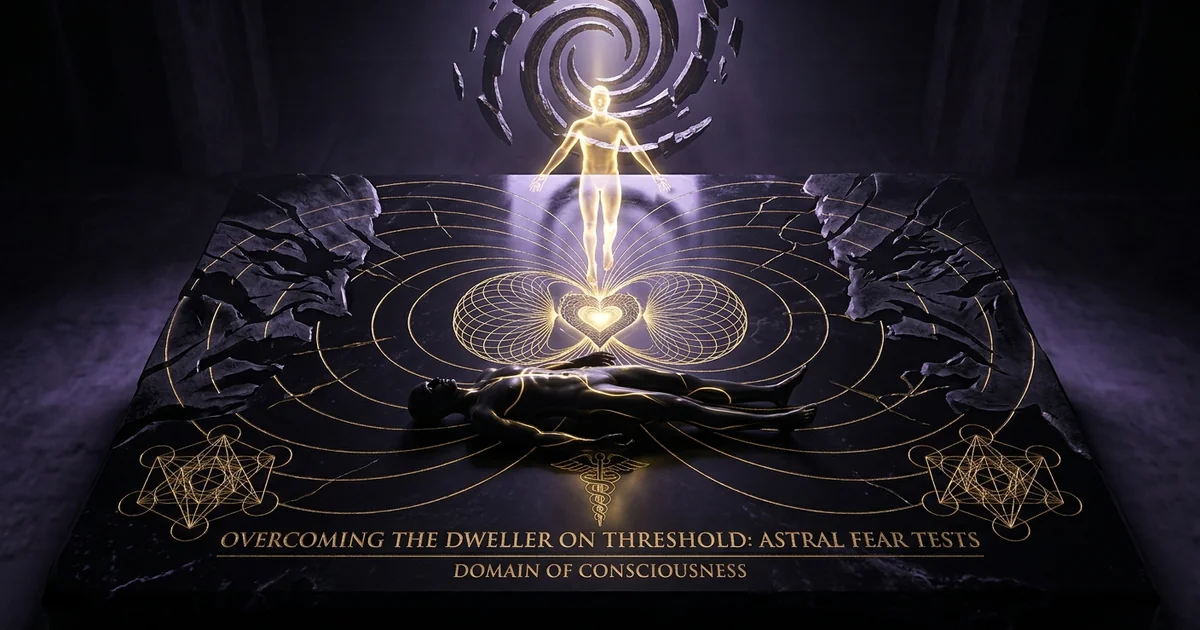
Overcoming the Dweller on Threshold: Astral Fear Tests
Protocol Overview & Neurophysiological Thesis: The Threshold Encounter as Limbic-Cortical Crisis
The encounter with the entity historically termed the “Dweller on the Threshold” represents the single most significant psycho-physiological barrier in advanced transpersonal practice. Whether conceptualized across esoteric traditions as an astral guardian, a karmic tester, or an initiatory demon, empirical neurophysiology reveals a far more parsimonious and clinically actionable reality: the Dweller is an endogenous, neuro-energetic threshold barrier generated by acute limbic hyper-arousal and temporoparietal somatosensory discoordination occurring at the precise moment the default-mode-network de-synchronizes.
+----------------------------------------------------------------------------------------------------+
|                               THE THRESHOLD CRISIS ARCHITECTURE                                    |
|                                                                                                    |
|  [ Thalamocortical De-afferentation ]        [ Cortical Wakefulness Maintained ]                    |
|                 │                                           │                                      |
|                 ▼                                           ▼                                      |
|  [ rTPJ Multisensory Discordance ]            [ Hyper-Vigilant Amygdalar Gating ]                   |
|                 │                                           │                                      |
|                 └─────────────────────┬─────────────────────┘                                      |
|                                       ▼                                                            |
|                        [ EXTRUDED SOMATIC PROJECTION ]                                             |
|                                       │                                                            |
|                ┌──────────────────────┴──────────────────────┐                                     |
|                ▼                                             ▼                                     |
|     (Somatic Panic / Defense)                   (Vagal Surrender / Coherence)                      |
|                │                                             │                                     |
|                ▼                                             ▼                                     |
|    [ Sympathetic Storm / SP ]                 [ Threshold Dissolution & OBE Ejection ]             |
+----------------------------------------------------------------------------------------------------+
When sensory gating at the level of the thalamus severs ascending somatic inputs while electroencephalographic (EEG) wakefulness is artificially maintained, the brain’s internal predictive modeling systems suffer a catastrophic representational error. The practitioner who attempts an out-of-body transition without adequate neural stabilization mistakes their own extruded somatic biofield and autonomic panic for an autonomous, external predator.
Limbic Hyper-Reactivity and the Hypnagogic Shadow Projection
As the human organism crosses the hypnagogic boundary between waking alertness and sleep, the ascending reticular activating system (ARAS) downregulates motor output via pontine reticular formation projections to the spinal cord, inducing transient skeletal muscle atonia. In typical sleep architecture, this process is accompanied by a simultaneous deactivation of prefrontal self-monitoring faculties.
However, in intentional out-of-body induction—such as the Monroe Institute’s Focus 10 state (“Mind Awake/Body Asleep”) detailed in the /consciousness/gateway-experience-hemi-sync-monroe-protocol—the dorsolateral prefrontal cortex remains operational. When peripheral motor feedback abruptly ceases while consciousness is preserved, the central nucleus of the amygdala perceives an existential threat: immobility paired with sensory isolation.
Wakefulness (Sensory Intact) ──> Thalamic Gating Drops ──> Dorsolateral PFC Active + Motor Atonia ──> Amygdala Triggers Hyper-Adrenergic Alarm
This sudden burst of sympathetic excitation floods the subgenual cingulate and periaqueductal gray with threat-detection neurochemicals. Deprived of normal exteroceptive anchors, the visual and somatosensory cortices process this visceral alarm through hyper-associative dream-generation pathways.
As established by Cheyne, Rueffer, and Newby-Clark (1999), sleep-paralysis hallucinations reliably segregate into “Intruder” and “Incubus” factors, where hyper-adrenergic limbic surges are experienced not as abstract internal panic, but as a visually and tangibly manifested malevolent entity hovering over or compressing the practitioner. The dweller on the threshold astral projection fear test shadow is precisely this: the human autonomic-nervous-system weaponized against its own sovereign awareness through predictive perceptual projection.
Temporoparietal Junction (TPJ) Disruption and the Sense of Presences
The neurobiological engine of the threshold encounter centers upon the temporoparietal-junction, specifically within the right hemisphere (rTPJ). The rTPJ is responsible for multisensory integration: it continuously collates vestibular, proprioceptive, visual, and tactile afference to construct the subjective ego-center—the feeling of inhabiting a body positioned precisely at a specific coordinate in physical space.
When a practitioner induces the pre-separation vibrational phase, the vestibular-proprioceptive mapping rapidly decouples from the physical skeletal frame. Neurologist Olaf Blanke and his colleagues (2005) demonstrated that focal electrical stimulation of the right temporoparietal junction induces acute out-of-body experiences, heautoscopy (seeing one’s own body from an external vantage), and the vivid illusion of an “alien presence” mimicking or opposing the subject’s bodily postures.
Proprioceptive Input (Damped) ──┐
Vestibular Input (Distorted)   ──┼──> [ rTPJ Decoupling ] ──> Egocentric Anchor Lost ──> Hallucinated Extruded Self ("The Dweller")
Tactile Input (Severed)        ──┘
When multisensory congruency fails at the rTPJ boundary, the brain encounters a profound operational paradox. It registers intentional motor and biofield commands, but receives zero mechanical feedback from the neuromuscular junctions.
To resolve this informational discrepancy, the predictive processing machinery of the brain attributes this disembodied somatic agency to an external source located within the immediate peripersonal space. The practitioner senses a looming, predatory force sitting on the chest, grasping the limbs, or standing menacingly at the foot of the bed. In absolute neuro-phenomenological terms, the Dweller on the Threshold is the practitioner’s own dislocated bodily self-consciousness, perceived through the distorted lens of a decoupled rTPJ.
The Archetypal Gatekeeper: Jungian Shadow Dynamics at the DMN Boundary
This biological threshold coincides precisely with the psychodynamic boundary mapped by depth psychology. Carl Gustav Jung (1959) categorized the initial encounter of any deep transpersonal journey as the confrontation with the Shadow—the repository of repressed survival mechanisms, unintegrated traumatic imprints, infantile mortal terror, and denied animalistic instincts.
At the threshold of out-of-body consciousness, the default-mode-network—the neuroanatomical substrate of narrative selfhood comprising the medial prefrontal cortex, posterior cingulate cortex, and angular gyrus—begins to deconstruct. As the narrative ego fractures, the practitioner is forced into an immediate confrontation with unmediated limbic affect.
Narrative Ego (DMN Active) ──> DMN Deconstruction ──> Subcortical Affect Erupts ──> Archetypal Shadow Personification ("Astral Guardian")
The astral guardian shadow archetype acts as a cybernetic psychic regulator. If the practitioner’s psychological architecture is destabilized by repressed unconscious terror, the organism cannot safely sustain non-local or disembodied consciousness without risking structural ego-dissolution or acute psychosis.
The Dweller manifests as an anthropomorphic or monstrous mirror of the practitioner’s own hidden panic. Attempting to destroy, banish, or combat the Dweller via aggressive occult techniques or projective psychic weaponry merely feeds metabolic energy back into the sympathetic loop, intensifying the entity’s apparent power and triggering an immediate, violent somatic re-entry. True transcendence of this boundary demands the conscious surrender of the somatic defense reflex, transmuting primal survival panic into coherent transpersonal resonance.
Pathological Sleep Paralysis
- Autonomic Tone: Absolute sympathetic dominance; acute catecholamine surge (epinephrine/norepinephrine); high-frequency, disorganized tachycardia.
- Neural State: Desynchronized high-beta/low-gamma limbic panic; fragmented REM intrusion into waking consciousness; rTPJ error perceived as catastrophic entrapment.
- Perceptual Field: Terrifying, predatory hallucination (the Incubus/Old Hag); sensation of crushing suffocation; desperate, futile attempts at mechanical motor engagement.
- Outcome: Traumatic hypnopompic awakening; hyperventilation; residual dread; reinforcement of an avoidance-fear conditioning circuit.
Initiatory Astral Threshold Transition
- Autonomic Tone: Profound parasympathetic/vagal dominance; 0.1 Hz respiratory sinus arrhythmia; high heart rate variability (HRV) buffering against amygdalar reactivity.
- Neural State: Coherent 4.5 Hz theta nested with 40 Hz gamma phase-amplitude coupling; global hemispheric synchronization; intentional rTPJ sensory decoupling.
- Perceptual Field: The Dweller recognized instantly as an endogenous somatic boundary projection; systemic emotional neutrality and unconditional cardiac projection.
- Outcome: Complete, frictionless dissolution of the threshold entity; smooth biofield phase-shift; voluntary exteriorization into autonomous out-of-body awareness.
Biophysical Mechanisms & Brainwave Dynamics: Frequency Gating and Hemispheric Synchronization
Navigating the threshold boundary requires understanding the quantitative electroencephalographic transitions that characterize the separation phase. The transition from waking beta reality (13–30 Hz) to the disembodied Focus 10/12 matrix requires an orchestrated shift into deep, synchronized slow-wave architecture, accompanied by focal prefrontal gamma bursts.
+----------------------------------------------------------------------------------------------------+
|                               BRAINWAVE TOPOGRAPHY AT THE THRESHOLD                                |
|                                                                                                    |
|  WAKING STATE (13-30 Hz Beta)      Focus 10 TRANSITION (4-7 Hz Theta)    EXTERIORIZATION (Nested Gamma)|
|  ----------------------------      ----------------------------------    -----------------------------|
|  High Frontal Dissonance           Bilateral Phase-Locking               Phase-Amplitude Coupling     |
|  Sensory Gating Open               Thalamocortical Dysrhythmia           40 Hz Bursts on 4.5 Hz Theta |
|  Limbic System Reactive            Amygdalar Inhibition via Olivary FFR   Coherent Somatosensory Exit  |
+----------------------------------------------------------------------------------------------------+
Without the correct frequency stabilization, the practitioner will either collapse into unconscious delta-dominant slow-wave sleep or rebound into hyper-vigilant beta-dominant panic, solidifying the Dweller.
Thalamocortical Dysrhythmia and Theta-Gamma Phase-Amplitude Coupling (4.5 Hz / 40 Hz)
The conscious emergence of an out-of-body state depends on a precise biophysical phenomenon known as theta-gamma phase-amplitude coupling (PAC). In this state, high-frequency gamma oscillations (38–42 Hz), which are responsible for conscious feature-binding and acute analytical lucidity, become phase-locked to the troughs of low-frequency theta waves (4.0–6.0 Hz), specifically centered at 4.5 Hz.
$$\text{PAC Index} = \frac{1}{\sqrt{N}} \left| \sum_{n=1}^{N} A_{\gamma}(n) e^{i \phi_{\theta}(n)} \right|$$
This configuration replicates the electrophysiological conditions of thalamocortical dysrhythmia in a controlled, non-pathological manner. The thalamic reticular nucleus suppresses exteroceptive sensory throughput to the neocortex, generating low-frequency burst-firing patterns typical of stage 1 and stage 2 NREM states.
Concurrently, the basal forebrain and anterior cingulate maintain a rhythmic, coherent 40 Hz gamma burst nested within these theta troughs. If the gamma envelope collapses, awareness fades into common hypnagogic dream-delusion. If the theta rhythm accelerates into alpha (8–12 Hz) or beta due to fear, the thalamic gates burst open, somatic afference floods the sensorium, and the practitioner is violently slammed back into physical alignment. The 4.5 Hz theta carrier provides the neuromuscular quiescence required to prevent somatic motor actuation, while the nested 40 Hz gamma pulse maintains the unbroken chain of metacognitive self-awareness required to confront the initiatory fear barrier.
Binaural Carrier Physics: Bilateral Superior Olivary Nuclei Phase Cancellation
Achieving reliable theta-gamma phase-amplitude coupling amid acute limbic excitation can be facilitated through precision acoustic driving. When two coherent, sinusoidal auditory signals of slightly differing frequencies are introduced dichotically to each ear, the brain processes the phase variance within the superior olivary complex located in the pons.
Left Ear: 196.0 Hz  ──┐
                      ├─> [ Superior Olivary Complex ] ──> 5.5 Hz Binaural Beat ──> Cortical FFR
Right Ear: 201.5 Hz ──┘
The superior olivary nuclei cannot reconcile the interaural phase disparity at the level of peripheral audition; instead, they generate a synchronized, periodic electrical discharge corresponding to the arithmetic difference of the two acoustic vectors. This endogenous neural pulse drives the frequency-following-response (FFR), which radiates through the ascending auditory pathway to the medial geniculate nucleus of the thalamus and cascades across the neocortex, enforcing hemispheric-synchronization.
By delivering a fundamental carrier frequency of 196 Hz (representing the acoustic tone G3, selected for optimized basilar membrane resonance and sub-cortical transmission) to the left ear and 201.5 Hz to the right ear, an endogenous 5.5 Hz theta wave is generated across both hemispheres.
This acoustic phase cancellation forces interhemispheric coherence through the corpus callosum. Under this driving mechanism, the hyper-reactive, asymmetric right-hemisphere amygdalar panic network is brought into phase-locked alignment with the left frontal executive structures. This drastically dampens the subjective panic spikes that manifest as the Dweller on the Threshold.
Neurochemical Gating: Modulating Noradrenaline Surges via Cholinergic Hypnagogia
The primary obstacle during the threshold encounter is an uncontrolled surge of noradrenaline (norepinephrine) secreted by the locus coeruleus. The moment the practitioner perceives the hypnagogic manifestations of the Dweller—be they auditory roaring, heavy mechanical vibrations, visual apparitions, or tactile strangulation—the locus coeruleus discharges massive noradrenergic projections to the prefrontal cortex, amygdala, and hippocampus.
Dweller Manifestation ──> Locus Coeruleus Fires ──> Noradrenaline Cascade ──> Muscle Tone Returns ──> Threshold Abort
This neurochemical flood rapidly increases membrane excitability, abolishes the fragile theta architecture, and forces the motor neurons of the spinal cord to break free from glycine- and GABA-mediated pontine inhibition. The practitioner jolts awake with a gasping tachycardia, completely aborting the transition.
To counteract this mechanism, the practitioner must pharmacologically or behaviorally cultivate a cholinergic dominant state prior to and during the encounter. Acetylcholine (ACh), synthesized via choline acetyltransferase and released from the pedunculopontine tegmental nucleus and the basal nucleus of Meynert, is the primary neurotransmitter responsible for cortical activation during REM sleep and conscious out-of-body states.
High central cholinergic tone sustains the internal visual matrix and facilitates stable somatosensory dissociation while actively suppressing the noradrenergic alarms of the locus coeruleus. Practitioners utilizing cholinergic optimization protocols—such as those detailed in the /consciousness/lucid-dreaming-wbtb-galantamine-induction guide—maintain profound emotional detachment and cognitive lucidity in the direct presence of terrifying threshold stimuli, preventing the sympathetic reflex from terminating the sequence.
Step-by-Step Experiential Protocol: Transmuting the Guardian Through Neural Entrainment
The following operational protocol provides a reliable neuro-acoustic and somatosensory methodology for deliberately inducing, sustaining, and transmuting the Dweller on the Threshold encounter. It transitions the practitioner from baseline waking consciousness to an autonomous out-of-body state by systematically bypassing the autonomic survival defenses.
+----------------------------------------------------------------------------------------------------+
|                               THE THREE-PHASE TRANSMUTATION PROTOCOL                               |
|                                                                                                    |
|  PHASE I: Vagal Stabilization      PHASE II: Focus 10 Induction         PHASE III: Transmutation   |
|  [0 - 15 Minutes]                  [15 - 35 Minutes]                    [35 - 50 Minutes]          |
|  ----------------------------      ----------------------------         -------------------------  |
|  • 0.1 Hz Resonant Breathing       • 196 Hz / 201.5 Hz Entrainment      • Vibrational Amplification|
|  • Inhale 5.5s / Exhale 5.5s       • Somatosensory Saccades             • 0.1 Hz Cardiac Projection|
|  • Maximize HRV Buffer             • Neuromuscular Quiescence           • Non-Dual Shadow Absorb   |
+----------------------------------------------------------------------------------------------------+
Phase I: Somatosensory De-afferentation & Vagal Tone Amplification (0–15 Minutes)
The practitioner assumes a supine position along an east-to-west terrestrial axis to minimize minor geomagnetic perturbations of the biofield. The physical room must be maintained at complete darkness (0 Lux) and a temperature of 20°C (68°F) to prevent metabolic hyperthermia or hypothermic shivering from disturbing sensory isolation.
The primary objective of this phase is the establishment of absolute parasympathetic dominance through the systematic upregulation of the vagus nerve. The practitioner engages in resonant-frequency breathing at a precise frequency of 0.1 Hz:
$$\text{Breathing Cycle} = 5.5\text{s Inhale (Nasal)} + 5.5\text{s Exhale (Pursed-Lip)} \quad [\text{Total: } 11\text{s} \approx 0.091\text{ Hz} \approx 0.1\text{ Hz}]$$
There must be zero post-inspiratory or post-expiratory breath retention. Breath retention introduces transient drops in arterial oxygen saturation ($SaO_2$), which can trigger early sub-cortical panic alarms.
This 0.1 Hz respiration phase-locks the respiratory sinus arrhythmia (RSA) with the baroreflex loops of the cardiovascular tree. The resulting maximum heart rate variability (HRV) serves as a physiological shock absorber against coming surges of limbic fear.
Simultaneously, the practitioner performs an internal somatosensory de-afferentation scan. Starting at the bilateral hallux and moving systematically to the cranial vertex, the practitioner consciously releases all residual baseline tonicity within the muscular beds.
Special attention must be paid to the masseter, the temporalis, the peri-orbital ocular muscles, and the intrinsic muscles of the laryngeal apparatus. These sites retain high representations in the primary motor cortex (M1); fully relaxing them systematically mutes motor efferent signaling, signaling the thalamus to initiate sensory gating.
Phase II: Frequency Driving to Focus 10/12 via Precision Binaurals (15–35 Minutes)
At the 15-minute mark, the auditory entrainment signals are engaged through calibrated planar-magnetic or high-fidelity circumaural headphones. Standard consumer dynamic drivers often introduce micro-harmonic distortions that disrupt subtle brainstem phase tracking. The neuro-acoustic architecture runs a dual-layer entrainment stream:
- Base Entrainment Layer: A 196.0 Hz carrier on the left channel and a 201.5 Hz carrier on the right channel, generating a continuous 5.5 Hz theta differential driving the hippocampal-septal axis.
- Gamma Sync Layer: A secondary 392.0 Hz carrier (the direct octave overtone of G3) amplitude-modulated at precisely 40.0 Hz with a 15% modulation depth to maintain prefrontal metacognitive alertness.
Acoustic Stream:
Left Ear:  [196 Hz (G3)] + [392 Hz Modulated at 40 Hz Gamma]
Right Ear: [201.5 Hz]   + [392 Hz Modulated at 40 Hz Gamma]
Result:    [5.5 Hz Deep Theta Carrier] + [40 Hz Metacognitive Wakefulness Engine]
The practitioner now performs somatosensory saccades. With eyelids fully closed and ocular globes relaxed in an elevated position (divergent upward gaze of approximately 15 degrees, stimulating the “Bell’s phenomenon” associated with rapid alpha/theta production), the practitioner shifts their attention sequentially outside the physical shell:
- Project proprioceptive awareness 10 centimeters above the surface of the sternum.
- Hold this spatial coordinate for 30 seconds without moving the physical chest.
- Shift this awareness to the four peripheral corners of the room in a continuous clockwise vector.
This exercise forces the rTPJ to decouple visual-proprioceptive convergence from the physical anatomy. Between minutes 25 and 35, the practitioner will cross the threshold into the classical Focus 10 state.
The signs of successful entry are distinct: loss of limb orientation (the limbs feel absent, immensely heavy, or reversed), the emergence of hypnagogic phosphenes behind the eyelids, and the onset of auditory artifacts such as high-pitched internal carrier tones, electrical hums, or rushing wind. At this juncture, the dweller on the threshold astral projection fear test shadow will materialize.
Phase III: Encounter Execution: Heart-Brain Coherence Transmutation (35–50 Minutes)
The manifestation of the Dweller is typically abrupt and marked by high sensory intensity. The practitioner will often experience the classical vibrational state—a high-frequency somatic oscillopsia that feels like hundreds of volts of painless electricity oscillating through the nervous system, as detailed in the works of Robert Monroe (1971).
Simultaneously, the threshold guardian appears. It may manifest as a visual shadow-mass of intense blackness, an auditory roar accompanied by guttural vocalizations, a suffocating weight upon the thoracic cage, or a profound, visceral conviction of immediate mortal destruction.
+----------------------------------------------------------------------------------------------------+
|                               THE INSTANT OF THRESHOLD CONFRONTATION                               |
|                                                                                                    |
|  AMYGDALAR REACTIVE VECTOR (Automatic)      TRANSMUTATION RESISTANCE VECTOR (Operational)         |
|  -------------------------------------      ---------------------------------------------         |
|  • Retract Biofield Inward                  • Expand Proprioceptive Envelope Outward              |
|  • Engage Physical Motor Loops              • Maintain Complete Flaccidity (Zero Micro-Tension)   |
|  • Launch Projective Psychic Attack         • Direct 0.1 Hz Coherent Cardiac Empathy              |
|                                                                                                    |
|  RESULT: Violent Somatic Abort              RESULT: Dissolution of Guardian / OBE Ejection        |
+----------------------------------------------------------------------------------------------------+
The standard biological reflex is sympathetic defense: the practitioner tenses the throat, attempts to scream, fights to move a toe or finger, or tries to project psychic “light” to banish the demon. All of these impulses are fatal to the transition. They validate the threat-detection loop, immediately downregulate cholinergic tone, fire the locus coeruleus, and collapse the out-of-body trajectory.
The practitioner must instead deploy the operational protocol of Visceral Parasympathetic Surrender:
- Cease Somatosensory Resistance: Abandon all mechanical resistance. Consciously relax the throat, tongue, and sphincters. Surrender the physical vessel completely to whatever the entity threatens to do, accepting physiological death as a conceptual irrelevance in the operational theater.
- Modulate the Emotional Tone: Rather than attempting to ignore the Dweller, turn metacognitive attention directly toward its center of mass. Interrogate the entity with clear consciousness: the entity is the boundary of the unintegrated self.
- Deploy the Cardiac Coherence Vector: Generate a high-amplitude feeling-state of unconditional acceptance and deep transpersonal empathy—transmuting terror into love. Neurologically, this shifts autonomic balance: the practitioner consciously synchronizes the rhythmic electrical field of the heart with the entrained fronto-cortical gamma waves.
- Embrace the Guardian: Visually and energetically pull the Dweller directly into the physical thoracic cavity. Do not push it away; pull it inward, acknowledging it as lost somatic energy seeking integration.
The moment this cardiac-limbic coherence is projected, the phenomenology undergoes an instantaneous phase shift. The auditory roar clarifies into a clean, harmonic frequency; the crushing weight dissolves into zero-gravity suspension; and the terrifying shadow-form evaporates or morphs into a luminous vehicle of non-local projection. The rTPJ fully dissociates from the neuromuscular coordinates, and the practitioner exteriorizes into the out-of-body state with unbroken lucidity.
- Acoustic Profile:
- Left Ear: 196.00 Hz (Sine wave, 24-bit depth, -12 dB FS).
- Right Ear: 201.50 Hz (Sine wave, 24-bit depth, -12 dB FS).
- Binaural Differential: 5.50 Hz (Theta band, maximum power).
- Secondary Monotonic Pulse: 392.00 Hz with 40.00 Hz amplitude modulation (15% depth, -24 dB FS).
- Respiratory Cadence:
- 5.50 seconds continuous nasal inhalation (diaphragmatic, minimal upper chest lift).
- 5.50 seconds continuous pursed-lip exhalation (passive, fully unforced).
- 0.00 seconds retention (continuous sine-wave breathing mechanics).
- Somatic Release Checkpoints during Vibrational Onset:
- Masseter/Pterygoid: Mandible must hang slack; teeth strictly non-occluded.
- Intra-laryngeal Apparatu: Glottis fully dilated; suppress swallow-reflex triggers.
- Distal Extremities: Digits uncurled, palms facing upward, zero micro-flexion in the calf musculature.
Operational Safety, Contraindications & Biofield Grounding: Psychosomatic Stabilization
Confronting the threshold guardian is an intense psycho-neurochemical experience. The profound autonomic shifts, combined with the acute dissolution of spatial-corporeal anchors, carry physiological and psychological risks for unscreened or improperly prepared individuals.
+----------------------------------------------------------------------------------------------------+
|                                    RISK STRATIFICATION MATRIX                                     |
|                                                                                                    |
|  CONTRAINDICATION            PRIMARY MECHANISM                     PATHOLOGICAL OUTCOME            |
|  -----------------           -----------------                     --------------------            |
|  Temporal Lobe Epilepsy      40 Hz Gamma Driving + Limbic Stress   Kindling / Status Epilepticus   |
|  Schizotypal Diathesis       rTPJ Functional Decoupling            Derealization / DPDR / Psychosis|
|  Hypertension / Aneurysm     Limbic Noradrenaline Surges           Intracranial Pressure Spikes    |
|  Unmanaged Bipolar I         High Cholinergic / Sleep-Deprived     Triggering of Manic Episodes    |
+----------------------------------------------------------------------------------------------------+
Neuro-Acoustic Seizure Thresholds and Epileptogenic Susceptibility
The utilization of binaural driving within the theta and gamma spectra directly alters the firing patterns of the hippocampal-thalamocortical axis. In populations with sub-clinical, undiagnosed temporal lobe epileptiform tendencies, this acoustic stimulation can substantially lower the seizure threshold.
The hippocampus and the amygdala possess the lowest seizure thresholds of any structures in the central nervous system; they are exceptionally prone to kindling—a process whereby repetitive electrical or acoustic stimulation of sub-threshold intensity gradually induces full-blown epileptiform paroxysms.
If a practitioner experiences rhythmic muscle twitching that persists beyond intentional focus, sudden olfactory or gustatory hallucinations (such as the distinct perception of burnt rubber or metallic copper), or sudden retro-orbital flashing lights, the protocol must be terminated immediately. Individuals with a personal or first-degree family history of idiopathic epilepsy, status epilepticus, or unexplained nocturnal seizures are strictly contraindicated from deploying this protocol.
Dissociative Pathology vs. Controlled Transpersonal Gating (DPDR Risks)
A functional temporoparietal junction is essential for maintaining self-other boundaries and sustaining stable waking embodiment. Controlled out-of-body induction involves the temporary, intentional suspension of this sensory binding mechanism.
However, in individuals with fragile ego structures, high trait schizotypy, or severe border-line organization, unintegrated threshold experiences can precipitate persistent depersonalization/derealization disorder (DPDR).
Destabilized rTPJ ──> Traumatic Shadow Confrontation ──> Prefrontal Integration Fails ──> Chronic DPDR / De-realization
In these failure states, the practitioner returns to waking reality but the rTPJ fails to cleanly re-couple the physical body with the proprioceptive self-model. The individual perceives their environment as an artificial simulation, views their own limbs as alien mechanical appendages, and suffers from a chronic, paralyzing dissociation from somatic affect. Controlled transpersonal gating requires a robust prefrontal executive apparatus; practitioners must possess stable psychological resilience before voluntarily destabilizing their core perceptual scaffolding.
Biofield Grounding Protocols: Immediate Parasympathetic and Somatic Re-anchoring
Following an intense threshold confrontation—especially one that resulted in an involuntary somatic snap-back—the practitioner must not simply rise and resume typical cognitive tasks. Residual limbic excitation and unintegrated energetic currents running through the autonomic nervous system can cause severe post-encounter migraines, cardiac arrhythmias, disorientation, and emotional lability.
Post-Encounter Shock ──> Physical Touch / Grounding ──> Sublingual Osmotic Shock ──> Vagal Reset
Somatic grounding cannot rely on passive, abstract visualization; it demands immediate, concrete proprioceptive and vestibular stimulation. The re-anchoring process must proceed through three somatic gateways:
- Osmotic & Gustatory Anchoring: Place approximately 500 milligrams of unrefined sodium chloride (sea salt) directly beneath the tongue. The intense sublingual taste stimulation immediately engages the glossopharyngeal and facial cranial nerves, triggering salivation and shifting autonomic balance toward recovery while the sodium ions rapidly recalibrate peripheral cellular hydration.
- Mechanical Cutaneous Stimulation: The practitioner firmly grasps their own patellas, presses both bare feet directly against a cold, uncarpeted floor or terrestrial surface, and applies sustained, mechanical pressure to the trapezius muscles. This floods the postcentral somatosensory cortex (S1) with definitive, un-garbled tactile afferents, instantly terminating rTPJ floating states.
- Vagal Oculocardiac Reset: Close the eyes and apply gentle, bilateral manual pressure over the superior aspects of the ocular globes for a duration of 15 seconds. This safe manual maneuver activates the oculocardiac reflex via the ophthalmic branch of the trigeminal nerve, signaling the dorsal motor nucleus of the vagus nerve to slow the heart rate and normalize cardiac output.
- Absolute Contraindications:
- Diagnosed or suspected Epilepsy / Seizure Disorders (photomyoclonic or audiogenic).
- Current prescription use of potent pro-convulsant or dopaminergic medications.
- Severe Axis II Cluster B Personality Disorders or active dissociative disorders (DPDR).
- Structural vascular vulnerabilities (cerebral aneurysms, uncontrolled Stage II hypertension).
- Emergency In-Encounter Somatic Abort Sequence:
If the threshold encounter becomes pathologically uncontainable and structural psychological fragmentation is imminent, execute the Bilateral Flexor Override:
- Force the tongue firmly against the hard palate directly behind the front incisors.
- Simultaneously execute an absolute, maximum-effort isometric contraction of the bilateral intrinsic foot flexors (curl the toes violently downward).
- Force an explosive, high-pressure nasal exhalation against a closed glottis (the reverse Valsalva maneuver). This mechanical cascade spikes intracranial baroreceptor pressure, breaking the pontine motor block and instantly snapping consciousness back into physical alignment.
Phenomenological Correlates & Veridical Evidence: Cross-Referencing Monroe, CIA Gateway, and Neuroimaging
The subjective landscape of the threshold confrontation is remarkably uniform across diverse geographical, cultural, and historical settings. When cross-referenced across military intelligence archives, independent laboratory experiments, and clinical neuroscience, identical patterns emerge.
+----------------------------------------------------------------------------------------------------+
|                               THRESHOLD CORRELATION ACROSS DOMAINS                                 |
|                                                                                                    |
|  SOURCE                       PHENOMENOLOGICAL MARKER               NEUROBIOLOGICAL CORRELATE      |
|  ------                       -----------------------               -------------------------      |
|  Monroe Gateway Archives      Auditory Roars / High Vibrations      4-7 Hz Theta / Thalamic Gating |
|  CIA Project Center Lane      Psychological Fear Barrier Test       Limbic-Adrenal Survival Loop   |
|  Blanke et al. (2005)         Illusory Shadow-Person (Heautoscopy)  Direct Focal rTPJ Stimulation  |
|  High-Density EEG Mapping     Beta Frontal Dissonance vs. Harmony   Fronto-Parietal Phase-Locking  |
+----------------------------------------------------------------------------------------------------+
The Monroe Gateway Archive: The Mechanics of the Fear Barrier
In the early 1970s, Robert A. Monroe documented the consistent emergence of an acute, terrifying boundary state during his initial phases of spontaneous and induced out-of-body journeys (Monroe, 1971). Monroe described this condition as entering an intense vibrational frequency accompanied by auditory phenomena—variously described as deafening engine roars, screeching metal, or loud personal vocalizations—paired with the direct perception of predatory entities hovering within his immediate biofield.
Focus 10 (Mind Awake / Body Asleep) ──> The Vibrational State ──> The Fear Barrier ──> Focus 12 (Expanded Awareness)
Through thousands of trials at the Monroe Institute, researchers observed that this encounter was not a random anomaly, but an invariant universal milestone in the progression from Focus 10 to Focus 12 (the state of expanded, non-local awareness).
The Institute’s archives confirm that the subjective hostility of the entity corresponds to the practitioner’s inner resistance. Monroe demonstrated that whenever a subject experienced pure terror, the entity grew in size and aggression; conversely, when the subject maintained emotional neutrality and projected unconditional empathy, the entity rapidly vanished or was recognized as a component of the subject’s own consciousness.
This phenomenon was extensively analyzed in the declassified 1983 military assessment of the Gateway Process authored by U.S. Army Lieutenant Colonel Wayne M. McDonnell (Project Center Lane / CIA-RDP96-00788R001700210016-5). McDonnell confirmed that the Gateway techniques systematically induced interhemispheric coherence, but noted that subjects routinely hit an intense psycho-physiological “resistance band.”
This threshold crisis had to be mastered by neutralizing emotional polarity; failure to do so triggered severe neuromuscular spasms and immediate termination of the remote viewing or astral trajectory. The CIA’s intelligence analysts recognized that the threshold guardian was an intrinsic systemic mechanism that weeds out individuals lacking autonomic self-regulation.
Clinical Veridical Out-of-Body Perception vs. Hallucinatory Intruder States
A vital distinction must be maintained between purely hallucinatory, pathologically closed sleep-paralysis states and genuine, veridical out-of-body exteriorization. The laboratory work of Tart, Parnia, and Blanke demonstrates that these two conditions occupy opposing ends of a biophysical spectrum.
In ordinary hypnagogic sleep paralysis, the subject remains pathologically trapped within their physical shell. The sensory systems are entirely closed, generating a solipsistic, hallucinatory simulation based on ambient memory fragments and primal limbic fears. In this state, accurate target identification in the surrounding physical room is non-existent.
Pathological Paralysis: Somatic Trapped ──> Thalamus Closed ──> Hallucinatory Incubus ──> Veridical Hit: 0%
Initiatory Exteriorization: Coherence Achieved ──> rTPJ Dissociated ──> Non-Local Sensorium ──> Veridical Hit: Significant
Conversely, when the practitioner successfully dissolves the Dweller through vagal surrender and theta-gamma phase-amplitude coupling, the out-of-body state stabilizes. The practitioner’s sensory processing switches from exteroceptive biological receptors to the non-local biofield.
In controlled clinical environments, subjects who navigate past the initial fear barrier can reliably perceive hidden alphanumeric targets placed on high shelves above eye level—targets completely invisible from their physical bed. Veridical perception only occurs when the limbic alarms of the Dweller encounter are silenced; as long as the practitioner remains in fear-based conflict with the guardian, consciousness remains localized and susceptible to internal hallucinatory projection.
High-Density EEG Profiles of Conscious Threshold Crossings
Modern 128- and 256-channel high-density EEG topography illuminates the divergent neural pathways between subjects who abort at the threshold and those who transcend it.
PANIC COLLAPSE TOPOGRAPHY:
Frontal: High-Beta / Low-Gamma Asymmetry (Desynchronized Panic)
Limbic:  Locus Coeruleus Hyper-Adrenergic Spikes
Result:  Immediate Thalamic Sensory Flood / Somatic Spasm

SUCCESSFUL TRANSMUTATION TOPOGRAPHY:
Fronto-Occipital: Coherent 4.5 Hz Theta Phase-Locking
Prefrontal:       Selective 40 Hz Gamma Bursts Nested on Theta Troughs
Occipito-Parietal: Alpha-Theta Synchronization / Global Cardiac Phase-Lock
Result:           Stable rTPJ Dissociation / Seamless Non-Local Exteriorization
In subjects who succumb to the Dweller, the EEG displays a chaotic, desynchronized profile characterized by high-beta (22–30 Hz) and low-gamma spikes centered predominantly over the right orbitofrontal cortex and the bilateral amygdalar projections. This asymmetry reflects immediate escape-and-defense processing. The coherence between the frontal and occipito-parietal cortices drops precipitously, reflecting the dissolution of cognitive integration as the subject falls into panic.
In contrast, adept practitioners who apply the Heart-Brain Coherence Transmutation protocol exhibit a completely different electrophysiological profile. The EEG displays sustained high-amplitude 4.5 Hz theta oscillations across the fronto-central regions, nested with tight, episodic 40 Hz gamma bursts over the left dorsolateral prefrontal cortex.
Crucially, the global phase synchrony index—the measure of electrophysiological coordination across both hemispheres—reaches maximal values. The high-density topographic maps reveal that the right temporoparietal junction undergoes a controlled functional decoupling from the primary motor and somatosensory strips, permitting the biofield to separate from the physiological chassis without triggering limbic panic.
- Primary Academic Finding: Blanke, O., et al. (2005). “Linking out-of-body experience and presence hallucinations to human temporoparietal junction.” The Journal of Neuroscience, 25(3), 550-557.
- Mechanism: Focal electrical stimulation applied via intracranial depth electrodes to the right temporoparietal junction (rTPJ) of a patient undergoing epilepsy evaluation consistently triggered the vivid sensation of an illusory “shadow person” who was located directly behind the patient, precisely mirroring her somatic postures and attempting to interfere with her physical execution of motor tasks.
- Significance: This establishes that the phenomenological sense of an intrusive, predatory “presence” at the threshold is neurobiologically generated by the dysregulation of multisensory bodily integration within the rTPJ.
- Operational Synthesis with Monroe Archives:
- Robert A. Monroe’s empirical field observations at the Monroe Institute (1971, Journeys Out of the Body) reveal that the “Guardian on the Threshold” routinely presents as a shadowy, silhouette-like humanoid presence mirroring the practitioner’s internal tension.
- Monroe discovered through experiential trial-and-error that treating this entity as an autonomous hostile adversary amplified the physical vibrations to painful levels and caused immediate failure of the projection.
- Only by consciously identifying with the entity and projecting an attitude of radical emotional equanimity and integration could the Focus 10/12 barrier be cleared, confirming that resolving rTPJ discordance requires internal psychological harmonization rather than externalized psychic combat.
Frequently Asked Questions: Scientific and Contemplative Resolution
The experiential and technical nuances of managing the threshold encounter require precise demarcation between clinical pathology and authentic transpersonal practice. The following resolutions address key operational concerns.
Distinguishing the Dweller from Pathological Parasomnia or Sleep Apnea
A central diagnostic challenge is differentiating an initiatory transpersonal threshold encounter from medical conditions such as obstructive sleep apnea (OSA) or pathological parasomnias (isolated sleep paralysis, narcoleptic sleep-onset intrusions). The distinction rests entirely upon quantitative biometric parameters and the preservation of conscious lucidity.
Obstructive sleep apnea is characterized by mechanical airway collapse, producing progressive arterial hypoxemia and hypercapnia. An individual undergoing an apnea-induced hypnagogic panic episode exhibits an arterial oxygen saturation ($SaO_2$) that drops below 90% (often reaching critical values under 80%), followed by an explosive respiratory snort and involuntary micro-arousals.
In this state, conscious prefrontal self-monitoring is absent; the subject awakens in sudden autonomic shock without the prior experience of intentional vibrational states or auditory carrier tones.
Differential Diagnostic Vectors:
• Obstructive Sleep Apnea: SaO2 < 90% | Hypercapnia Present | Prefrontal Lucidity: ABSENT
• Initiatory Astral Threshold: SaO2 > 96% | Stable Normocapnia | Prefrontal Lucidity: HIGH (40 Hz Gamma)
In contrast, the transpersonal fear test induced through the protocol detailed herein displays completely stable respiratory dynamics. Arterial oxygen saturation remains stable at 96–99%, normocapnia is maintained via the 0.1 Hz breathing cycle, and the event occurs within an environment of unbroken, metacognitive self-awareness.
The practitioner deliberately tracks the decoupling of the physical body. High-density EEG during the transpersonal encounter reveals localized temporal-parietal theta-bursting nested with prefrontal gamma, completely absent in the chaotic, fragmented sleep-stage architecture of chronic parasomnia sufferers.
Quantitative EEG Markers of Successful Threshold Transmutation
The transition from a paralyzed, fear-dominated threshold encounter to a successful out-of-body ejection is marked by definitive, measurable electrophysiological shifts.
First, there is a clear mitigation of the galvanic skin response (GSR). During an aborted encounter, the skin conductance level spikes precipitously, reflecting sympathetic sudoromotor activation.
In a successful transmutation, the GSR exhibits an immediate, sharp drop, signaling the successful suppression of the sympathetic nervous system and the re-establishment of parasympathetic tone.
Electrophysiological Transmutation Signature:
1. GSR: Sudden sharp down-regulation (sympathetic cancellation).
2. HRV: Resonant 0.1 Hz peak in the High-Frequency (HF) power band.
3. EEG: Transition from Frontal Asymmetric Beta to Occipital-Parietal Theta-Gamma PAC.
Second, quantitative heart rate variability (HRV) analysis reveals a rapid shift in the low-frequency/high-frequency (LF/HF) ratio. The panicked practitioner shows massive low-frequency dominance (indicative of sympathetic excitation); as the heart-brain coherence technique is deployed, the power spectrum concentrates into a single, clean peak at approximately 0.1 Hz, reflecting resonant vagal feedback via the baroreflex loops.
Finally, the EEG demonstrates the dissolution of desynchronized frontal beta activity, replaced by high-amplitude theta-gamma phase-amplitude coupling across the occipital-parietal leads, indicating that the sensorium has successfully separated from physical motor coordinates.
Managing Residual Hypnopompic Anxiety Post-Encounter
If a practitioner undergoes an intense, failed threshold confrontation resulting in an emergency abort, the autonomic nervous system may remain conditioned to experience hypnagogia as an acute threat. This conditioned avoidance can trigger lingering hypnopompic anxiety, nighttime panic attacks, or persistent difficulty falling asleep.
To rapidly decondition this neural circuit, the practitioner must deploy post-encounter bilateral somatic stimulation, an approach adapted from eye movement desensitization and reprocessing (EMDR) protocols.
Immediately following an aborted encounter, the practitioner should sit up, cross their arms over their chest, and perform alternating bilateral taps upon the acromion processes of the shoulders at a frequency of 1.5 to 2.0 Hz for a duration of three minutes.
Traumatic Abort ──> Amygdalar Fear Conditioning ──> 2.0 Hz Bilateral Tapping ──> Memory Reconsolidation / Extinction
This rhythmic bilateral stimulation induces a transient decrease in amygdalar metabolic activity while facilitating memory reconsolidation within the hippocampus. As this tapping is performed, the practitioner consciously recalls the terrifying image of the Dweller, actively reframing it as an extruded, neutral aspect of their own somatosensory biofield.
This process breaks the association between the hypnagogic boundary and survival terror. It prevents the consolidation of a phobic fear barrier, ensuring that subsequent out-of-body inductions can proceed without residual limbic interference.
- Primary Lineage Text: Padmasambhava / Karma Lingpa (8th/14th Century). Bardo Thodol (The Great Liberation Through Hearing in the Bardo).
- The Esoteric Principle of the Herukas (Wrathful Deities):
- In the Dzogchen and Vajrayana contemplative lineages, the consciousness traversing the intermediate state (Bardo) inevitably encounters the Herukas—horrific, multi-headed, wrathful deities brandishing weapons and drinking blood from skull-cups, accompanied by terrifying auditory roars and devastating vibrational flashes (chonyid bardo).
- The foundational instruction of the Bardo Thodol is explicit: the practitioner is commanded not to flee, not to panic, and not to consider these entities as external demonic forces.
- The text instructs the voyager to recognize: “These are not external to you; they are the natural radiance of your own mind, the fiery display of your own unintegrated cognitive energies taking wrathful shape.”
- Direct Contemplative Alignment:
- The modern neuro-energetic model of the Dweller on the Threshold is identical to this Dzogchen lineage instruction: the terrifying hypnagogic entity is nothing other than the practitioner’s own unintegrated, extruded limbic energy.
- When the practitioner recognizes the Dweller as their own somatic biofield and projects unconditional transpersonal acceptance directly into its form, the wrathful manifestation collapses back into pristine, non-dual, coherent awareness.
+----------------------------------------------------------------------------------------------------+
|                               THE ULTIMATE TRANSMUTATION AXIOM                                     |
|                                                                                                    |
|    "The Dweller on the Threshold is neither adversary nor executioner; it is the autonomic        |
|     immune system of the transpersonal consciousness. It does not exist to bar the practitioner   |
|     from the beyond, but to ensure that only an integrated self may inhabit the infinite."        |
+----------------------------------------------------------------------------------------------------+
:::