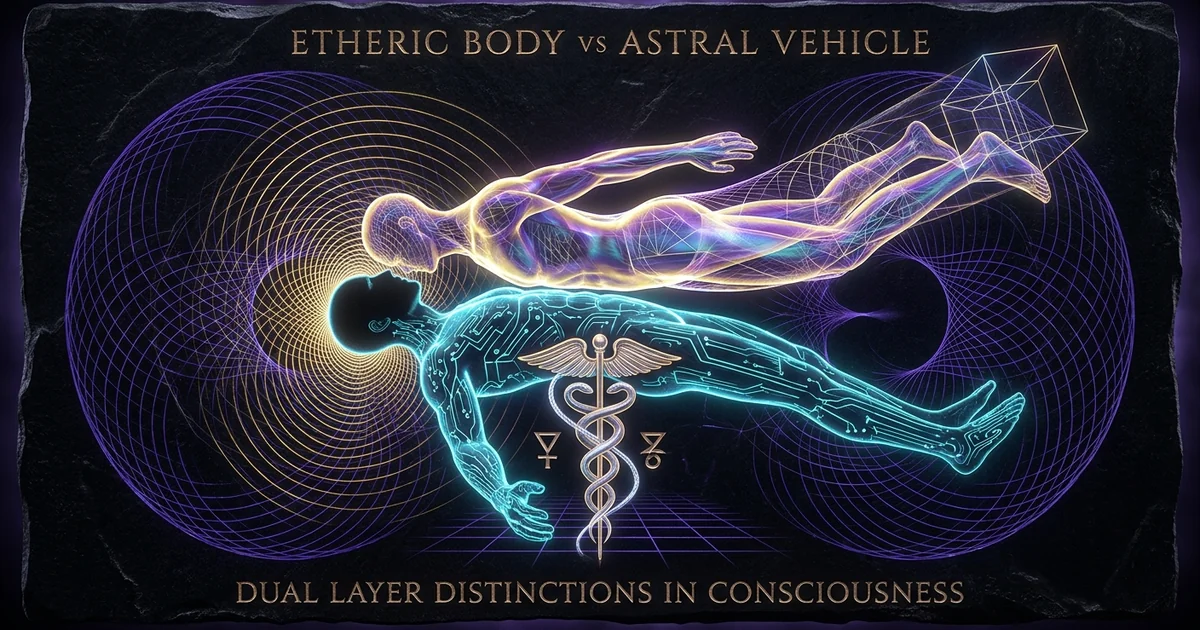
Etheric Body vs Astral Vehicle: Dual Layer Distinctions
Protocol Overview & Neurophysiological Thesis: Subtle Anatomy Stratification
The scientific and esoteric delineation between somatic vitality and trans-spatial mentation demands a rigorous re-examination of subtle body taxonomy. In Western occultism and Eastern transpersonal psychology, significant confusion persists regarding the functional boundaries separating the etheric body from the astral vehicle. Within the framework of etheric body vs astral body vehicle subtle anatomy, these two constructs operate upon distinct ontological, biophysical, and spatial registers. The etheric body represents the biophysical, electrodynamic architecture of the physical soma—the morphogenetic template mediating cellular vitality, physiological homeostasis, and local energetic conductivity. Conversely, the astral vehicle constitutes the plastic, trans-spatial instrument of affective-ideational consciousness, entirely liberated from spatial proximity constraints to the biological chassis.
+-----------------------------------------------------------------------------+
|                           CONSCIOUSNESS MATRIX                              |
|                                                                             |
|   +---------------------------------------------------------------------+   |
|   | MANOMAYA KOSHA (Astral Vehicle)                                     |   |
|   | * Trans-spatial / Non-local coordinate space                        |   |
|   | * Plastic, affective-ideational ideomorphic projection              |   |
|   | * Infinite operational range; decoupled from somatic chassis        |   |
|   +---------------------------------------------------------------------+   |
|                                      |                                      |
|                       [ Silver Cord Transduction ]                          |
|                       [  Quantum Coherent Channel]                          |
|                                      v                                      |
|   +---------------------------------------------------------------------+   |
|   | PRANAMAYA KOSHA (Etheric Double / Burr's L-Field)                   |   |
|   | * Localized electrodynamic template (10-15 ft spatial boundary)     |   |
|   | * High-density biophotonic / electromagnetic matrix                  |   |
|   | * Drives cellular morphogenesis and homeostatic regulation          |   |
|   +---------------------------------------------------------------------+   |
|                                      |                                      |
|                       [ Neuromuscular Junctions ]                           |
|                       [ Somatosensory Afference ]                           |
|                                      v                                      |
|   +---------------------------------------------------------------------+   |
|   | ANNAMAYA KOSHA (Dense Physical Soma)                                |   |
|   | * Carbon-based biological substrate and neural architecture         |   |
|   +---------------------------------------------------------------------+   |
+-----------------------------------------------------------------------------+
Pranamaya Kosha vs. Manomaya Kosha: Morphogenetic Energy Matrix vs. Extracorporeal Vehicle
Classical Vedantic psychology stratifies the incarnate human entity into five nested sheaths (pancha koshas). In this stratification, the distinction of pranamaya kosha vs manomaya kosha provides a precise parallel to contemporary biofield science. The pranamaya kosha (vital breath sheath) corresponds directly to the etheric vehicle. It is not an independent vehicle of trans-spatial motility, but rather an energetic boundary layer composed of prana (subtle bio-energetic currents, or nadis) that translates environmental and ideational inputs into biochemical and bioelectric phenomena within the annamaya kosha (physical body). Groundbreaking research by Harold Saxton Burr (1972) at Yale University demonstrated the existence of electrodynamic “Life fields” (L-fields), which precede, sculpt, and govern physical tissue architecture. The etheric matrix is identical with this macroscopic biofield—an organized, measurable lattice of voltage gradients and biophotonic emissions.
In stark contrast, the manomaya kosha (mental sheath) constitutes the true astral vehicle. It functions as the psychological and sensory repository of desire, emotional memory, and ideomorphic imagination. Often mislabeled as an “emotional dream body vs etheric” double, the astral vehicle represents an ontologically distinct phase of matter-consciousness integration. While the etheric matrix cannot dissociate more than several feet from the physical organism without inducing acute somatic deterioration, cellular senescence, or clinical death, the astral vehicle is innately non-local. It moves through mental coordinate spaces, uninhibited by the classical inverse-square law of electromagnetism. The astral matrix is plastic; it adopts form directly through the teleological pull of consciousness, configuring itself as a humanoid phantom, an amorphous sphere of lucent awareness, or an omnidirectional observational node.
SUBTLE LAYER DELAMINATION
Dense Physical Soma (Annamaya Kosha)
========================================================================
      |
      |  [ 4.0-4.5 Hz Theta-Delta Entrainment ]
      |  [ Neuromuscular Tonus Abolition       ]
      v
Etheric Matrix Expansion (Pranamaya Kosha / Burr's L-Field)
========================================================================
* High-viscosity "heaviness" & electromagnetic resistance
* Vibrational roaring & somatosensory paresthesias
* Bound within 10-15 ft radius of the organism
      |
      |  [ rTPJ De-gating & Vestibular Suppression ]
      |  [ Rotational / Transverse Kinetic Vector  ]
      v
Astral Exteriorization (Manomaya Kosha / Extracorporeal Vehicle)
========================================================================
* Low-viscosity, non-local kinematic velocity
* 360-degree non-retinal spheroidal vision
* Trans-spatial motility unbounded by physical coordinates</code></pre>
The Temporoparietal Junction (TPJ) and Biofield Phase Shifts
The neural mediation of these layered vehicles rests upon the complex integration of multi-sensory input, centered structurally at the temporoparietal junction (TPJ). Neurobiological investigations into autoscopy and out-of-body experiences (OBEs) indicate that the right temporoparietal junction (rTPJ) acts as a central gating processor for vestibular, proprioceptive, and visual somatosensory integration. When the rTPJ experiences functional decoupling—whether via focal micro-stimulation, targeted frequency entrainment, or profound yogic sensory withdrawal (pratyahara)—the subjective locus of selfhood dissociates from the biological coordinates of the brainstem and thalamus.
This neuro-anatomical decoupling reveals a dual-stage phenomenon. In partial dissociation, the practitioner experiences autoscopy or the “ghostly physical double,” looking down at the biological vessel from an adjacent vantage point within the immediate room. This state reflects an autoscopic etheric projection, bounded by a 10 to 15-foot radius of the physical organism, accompanied by intense electromagnetic resistance, sensations of heavy viscosity, and localized vestibular turbulence. True astral exteriorization, however, requires complete metabolic and neural de-gating of the rTPJ. Under complete de-gating, the somatosensory processing architecture is entirely bypassed, allowing the manomaya kosha to sever its spatial alignment with the biological soma. The perceptual field then shifts from a perspective confined by physical optical logic to an unconstrained, non-local awareness, moving beyond the physical room entirely.
Sensory Attenuation and Extracorporeal Somatosensory Mapping
The transition between these subtle vehicles is characterized by distinct tactile and vibrational transitions. The etheric vehicle’s proximity to the neuromuscular architecture means that any premature attempt at extracorporeal projection results in severe kinetic drag. Practitioners routinely misinterpret this high-density electromagnetic resistance as sleep paralysis or an external demonic presence pinning the torso. The phenomenon is entirely endogenous: it is the resistance of the pranamaya kosha still tethered to the physical musculature via alpha-motor neuron loops and baseline neuromuscular tone.
The mechanics of /consciousness/sleep-paralysis-hypnagogic-gateway-mechanics illuminate this operational threshold. The etheric double exhibits a tangible tactile density, described by subjects as walking through water, intense electric buzzing, or sudden surges of internal heat. The astral vehicle, conversely, exhibits negligible viscosity. Once decoupled from the etheric sheath, the astral vehicle navigates without physical friction, reacting instantaneously to volumetric intentionality and mental vectors. To understand the operational divergence between these layers, one must contrast their biophysical and phenomenological properties systematically.
Etheric Body (Pranamaya Kosha / Ghostly Double)
- Spatial Constraint: Strictly localized to somatic perimeter; projects maximum 10–15 feet before biofield instability triggers physical collapse.
- Primary Frequency Signature: 1.5 Hz to 4.5 Hz (Delta-Theta transition zone) coupled to high-amplitude somatic gamma transients.
- Perceptual Modality: Somatosensory paresthesia, localized physical-spectrum vision, autoscopy of dense soma, auditory rushing/roaring.
- Energetic Substrate: Electrodynamic L-field (Burr), biophotonic emissions, ionized cellular charge, mitochondrial gradient currents.
- Autoscopic Characteristics: Mirrors physical anatomy identically; subject appears as an electrostatic, blue-white, dense phantom tethered to the bed.
Astral Vehicle (Manomaya Kosha / Emotional Body)
- Spatial Constraint: Trans-spatial and non-local; operates unhindered across planetary, non-physical, or multidimensional coordinates.
- Primary Frequency Signature: Global hemispheric phase-locking with pronounced 40 Hz to 60 Hz coherent gamma oscillations over a suppressed baseline.
- Perceptual Modality: 360-degree spherical non-retinal ideation, direct emotional-affective resonance, telepathic informational ingestion.
- Energetic Substrate: Psychotropic, mental-affective non-matter; operates beyond the electromagnetic spectrum in subtle, non-physical coordinate space.
- Autoscopic Characteristics: Highly plastic ideomorphic form; capable of structural variation ranging from a sphere of light to a kinetic vector point.
Biophysical Mechanisms & Brainwave Dynamics: Endogenous Fields and Hemispheric Coherence
Transitioning the locus of conscious awareness from the physical-etheric complex into the autonomous astral vehicle requires precise, non-invasive neuro-acoustic driving. Unassisted natural decoupling typically occurs under extreme physical trauma, acute exhaustion, or sporadic hypnagogic anomalies. However, systematic laboratory protocols utilize acoustic entrainment to engineer this phase shift predictably. The target is the deliberate induction of hemispheric synchronization, driving cortical oscillation patterns into the hypnagogic delta-theta threshold while retaining unbroken, wakeful executive metacognition.
NEURO-ACOUSTIC DRIVING ARCHITECTURE
Left Auditory Input: 196.0 Hz  ----

±->  Superior Olivary Nucleus: 4.0 Hz ASSR
Right Auditory Input: 200.0 Hz ----/                    |
v
Binaural Frequency-Following Response
|
±----------------------±----------------------+
|                                               |
v                                               v
Rostral Cortical Drive                             Caudal Brainstem Gating
* Inter-hemispheric Coherence                      * Locus Coeruleus Suppression
* Bilateral Phase-Locking                          * Pontine Reticular Formation
* Metacognitive Wakefulness preserved              * Somatosensory Gating Achieved
Frequency Following Response (FFR) and Precise Binaural Beat Tuning
The neurophysiological foundation of this protocol rests upon the Auditory Steady-State Response (ASSR) and the Frequency Following Response (FFR). When two coherent acoustic waveforms of slightly varying frequencies are presented dichotically to each ear, the brain’s superior olivary complex processes the mathematical phase difference, generating an internal neural oscillation known as a binaural beat. For deep subtle layer decoupling, precision acoustic engineering is mandatory. Broad-spectrum or uncalibrated audio fails to induce the necessary inter-hemispheric phase-locking.
Carrier Wave (Left Ear):    f_1 = 196.0 Hz  (G3 note)
Carrier Wave (Right Ear):   f_2 = 200.0 Hz
Beat Differential:          Delta f = |f_1 - f_2| = 4.0 Hz  (Theta Base)
The selected carrier frequency of 196 Hz (corresponding to the musical note G3) is tuned specifically to maximize skull bone conduction, basilar membrane resonance, and vestibulocochlear signal transduction without inducing acoustic fatigue. As demonstrated in technical analyses of the /consciousness/monroe-gateway-experience-frequency-analysis, a 4.0 Hz beat differential stimulates a theta-band FFR throughout the temporal lobes. This rhythmic pacing forces pyramidal neurons within the neocortex to fire in synchronous spatial cascades. Over a prolonged 20 to 30-minute entrainment ramp, this acoustic pacing drives global inter-hemispheric coherence, unifying the left analytical hemisphere with the right spatial-intuitive hemisphere, an electroencephalographic signature historically documented as Hemi-Sync.
EEG Dynamics Across the Delta-Theta Transition Threshold (1.5 Hz to 4.5 Hz)
To cleanly delaminate the manomaya kosha from the pranamaya kosha, the subject’s electroencephalographic profile must occupy the razor-thin border between waking consciousness and Stage 1 non-REM sleep: the 1.5 Hz to 4.5 Hz delta-theta transition zone. Operating above this threshold (5.0 Hz to 7.0 Hz) retains too much cognitive and neuromuscular tension, anchoring awareness directly to the somatic envelope. Conversely, slipping beneath 1.5 Hz into deep, unmetered delta slow-wave sleep causes instantaneous loss of executive functioning, plunging the practitioner into unconscious metabolic recovery.
Within this narrow 4.0 Hz window, a striking neuro-dynamic phenomenon emerges: the “vibrational state.” While the slow-wave baseline reflects heavy somatosensory inhibition, quantitative EEG arrays reveal intense, high-frequency gamma bursts (40 Hz to 60 Hz) localized over the frontal and temporoparietal cortices. This dual-frequency morphology—high-amplitude gamma nested within a slow 4.0 Hz carrier—is the biophysical marker of the subtle body preparing for extraction. The etheric matrix is vibrating at its dynamic limit, losing its phase-coherence with the somatic neuromuscular junctions, allowing the higher-order mental vehicle to rupture free from the biofield’s local spatial enclosure.
“Electrocortical mapping via subdural electrode arrays across the right temporoparietal junction demonstrates that artificial interference with multimodal vestibular-somatosensory integration induces distinct autoscopic illusions, ranging from duplicated bodily phantoms to full out-of-body transformations (Blanke et al., 2004). This clinical finding converges directly with the pioneer electroencephalographic telemetry conducted by Charles T. Tart (1968) on the subject Miss Z. Tart recorded unambiguous episodes of extracorporeal target identification coinciding precisely with a rapid drop in occipital alpha rhythms, replaced by a low-voltage, un-aroused theta pattern (4.0–4.5 Hz) devoid of the rapid eye movement (REM) or muscular atonia signatures characteristic of standard oneiric dream states.” — Synthesized from Blanke et al. (2004), Brain, and Tart (1968), JASPR.
Neurochemical Modulations: GABA-B Up-Regulation and Glutamatergic Down-Regulation
This electroencephalographic reconfiguration is mediated at the synaptic level by precise neurochemical cascades. The acoustic driving of the brainstem via /sound-cymatics/binaural-entrainment-theta-states down-regulates the ascending reticular activating system (ARAS). This suppresses monoaminergic transmission—specifically norepinephrine from the locus coeruleus and serotonin from the dorsal raphe nucleus—inducing profound muscular catalepsy analogous to sleep paralysis, but managed metacognitively.
Simultaneously, the thalamus orchestrates widespread gamma-aminobutyric acid (GABA) ergic inhibition. The up-regulation of slow, metabotropic GABA-B receptors across the dorsal horn of the spinal cord suppresses sensory afference, preventing somatic tactile and proprioceptive data from reaching the primary somatosensory cortex ($S1$). Paralleling this inhibitory flood is a significant down-regulation of N-methyl-D-aspartate (NMDA) glutamatergic signaling within the hippocampus and posteromedial cortex. This biochemical decoupling strips the brain’s internal perceptual modeling software of its physical somatic anchoring. The pranamaya kosha’s energetic lines detach from the nervous system’s endogenous electromagnetic fields, opening the gateway for extracorporeal projection.
Step-by-Step Experiential Protocol: Phase-State Subtle Layer Decoupling
Executing intentional phase decoupling requires an unyielding, methodical adherence to somatic stabilization, biofield charging, and directional kinematic extraction. The following laboratory protocol is engineered for practitioners seeking to bypass the etheric “double” entirely, launching directly via the astral vehicle into non-local operational parameters.
CHRONOLOGICAL PROTOCOL PHASES
T = 00m T = 50m
|--------------------|-----------------------------|-------------------------|
Phase 1: Phase 2: Phase 3:
Pranic Charge Somatosensory Gating Astral Ejection
(00m to 15m mark) (15m to 35m mark) (35m to 50m mark)
- 4-7-8 Pranayama * 4.0 Hz Entrainment * Rotational Rollout
- L-Field Saturation * Somatosensory Gating * Decoupling from Etheric
- Micro-motor Stillness * Vibrational Roar Onset * Trans-spatial Motility
Phase 1: Pranic Densification and Etheric Charging (Minutes 0–15)
The protocol begins with the subject placed in a supine position (Savasana), ensuring zero arterial compression across the limbs, with the cranium oriented along the local geomagnetic North-South axis to reduce perpendicular electromagnetic drag across the pineal-thalamic axis. The room must be pitch-black ($0\text{ lux}$) and maintained at a thermoneutral $21^\circ\text{C}$ to $22^\circ\text{C}$ to prevent thermoregulatory shivering from disrupting the neuromuscular shutdown.
The subject initiates a modified hypercapnic-hypocapnic respiratory sequence derived from classical pranayama: a rhythmic 4-second inhalation through the nasal mucosa, a 7-second breath retention (kumbhaka), and an 8-second slow, unforced exhalation through parted lips. This exact 4-7-8 cadence, sustained over 15 minutes, achieves two distinct biological results: it optimizes vagal nerve tonus by driving heart rate variability (HRV) into hyper-coherent resonance, and it rapidly charges the morphogenetic biofield. By saturating the organism with oxygen while intermittently allowing slight arterial carbon dioxide accumulation, the practitioner floods the subtle channels of the pranamaya kosha with pranic force, causing the L-field to expand slightly beyond the biological dermis, creating the foundational biofield pressure gradient necessary for subsequent vehicle separation.
Phase 2: Somatosensory Gating and the 4.0 Hz Vibrational State (Minutes 15–35)
At the 15-minute mark, respiratory modulation ceases entirely; breathing transitions to automatic, shallow vegetative tidal flow. Dichotic acoustic stimulation is introduced via circumaural headphones: an exact 196 Hz carrier tone in the left channel and a 200 Hz tone in the right channel, delivering an uncompromising 4.0 Hz theta entrainment field at an acoustic pressure of 55 dB SPL. Absolute neuromuscular immobility is strictly mandatory; any voluntary micro-movement of the ocular muscles or extremities resets somatic afference, instantly anchoring the locus of awareness back into the physical substrate.
Between the 25th and 35th minutes, somatosensory gating completes. The ascending sensory signals from the body are severed at the thalamic level. At this juncture, the subject crosses the threshold into sleep paralysis and encounters the “vibrational state.” Phenomenologically, this phase manifests as intense auditory phenomena—a surging white-noise roar, wind-tunnel acoustics, or high-voltage metallic buzzing—accompanied by whole-body paresthesia resembling an electric current running along the spine. This is the biophysical marker of the etheric vehicle delaminating from the physical neuromuscular network. The practitioner must maintain complete psychological neutrality, recognizing these violent somatic phenomena as mere sensory artifacts generated by uncoupled auditory and vestibular nuclei processing uninhibited baseline noise.
- Carrier Frequency (Left Ear): 196.00 Hz (G3 acoustic wave, uncompressed sinusoidal format).
- Carrier Frequency (Right Ear): 200.00 Hz (Phase-locked sinusoidal format; absolute beat differential = 4.00 Hz).
- Audio Intensity: Calibrated precisely to 50–55 dB SPL; avoid dynamic compression or algorithmic normalization.
- Physical Posture: Supine Savasana; cervical spine supported by an orthotic cervical roll to keep airway unimpeded; head oriented precisely toward geomagnetic North.
- Respiratory Sequence (Phase 1): 4-7-8 ratio (4s inhalation, 7s retention, 8s exhalation) held at approximately 4 cycles per minute for 15 unbroken minutes.
- Sensory Anchors During Catalepsy: Focus continuous attention entirely upon a dynamic mental target point located exactly 30 centimeters vertically above the glabella (nasion), completely ignoring tactile feedback from the paralyzed physical limbs.
Phase 3: Astral Ejection via Rotational Vector Mechanics (Minutes 35–50)
Once the vibrational state stabilizes and internal auditory roaring peaks, the practitioner must execute extraction. Attempting to lift “straight up” activates residual proprioceptive motor maps, which invariably triggers physical muscular contraction, aborting the separation. The correct vector is rotational or transverse.
ASTRAL EJECTION VECTORS
    [ INCORRECT VECTOR: Direct Vertical Lift ]
    Locus tries to pull directly up -> Fires Somatosensory Motor Maps
    -> Activates Residual Muscle Tonus -> Aborts Decoupling.

    [ CORRECT VECTOR: 180-Degree Longitudinal Roll ]
    Axis: Spine / Central Channel (Sushumna)
    +-------------------------------------------------------+
    |  Physical Soma / Etheric Matrix: Anchored to Bed      |
    +-------------------------------------------------------+
                 O  Rotational Momentum (Angular Velocity)
                / \
               |   |  Astral Vehicle pivots along longitudinal axis
                \ /
    +-------------------------------------------------------+
    |  Astral Vehicle: Ejected out of alignment into space  |
    +-------------------------------------------------------+</code></pre>
The practitioner consciously projects the internal gravitational locus 90 degrees outward, executing an immediate, decisive 180-degree roll along the body’s longitudinal axis, as though rolling off the edge of the mattress. Because the physical body is paralyzed by pontine reticular inhibition, this non-physical angular momentum acts exclusively upon the subtle vehicles. The high-viscosity etheric double remains anchored to the mattress, while the low-viscosity astral vehicle pivots out of phase-alignment. The practitioner instantly breaks free from the sensory roar, emerging into total, sudden silence and boundless coordinate freedom. Immediate directional acceleration away from the somatic chassis (minimum 20 meters distance) must be executed within the first ten seconds of ejection to escape the strong electromagnetic dipole pull of the physical-etheric field.
Operational Safety, Contraindications & Biofield Grounding
The deliberate separation of subtle operational layers is a profound intervention into the psychophysiological homeostatic balance of the human organism. Treating this discipline lightly or forcing entrainment through pharmacological or unmonitored acoustic methods carries distinct clinical and energetic hazards that can severely disrupt normal cognitive and physiological functioning.
+-----------------------------------------------------------------------------+
|                      BIOFIELD RE-ENTRY TRAJECTORY                           |
|                                                                             |
|      Astral Vehicle (Manomaya Kosha)                                        |
|      * Distal navigation across coordinate space                            |
|             |                                                               |
|             v  [ Intentional Saccadic Focus on Somatic Derm ]               |
|      Etheric Interface Boundary (Pranamaya Kosha)                           |
|      * Re-entry into 10-15 ft electrostatic envelope                         |
|             |                                                               |
|             v  [ Longitudinal Co-axial Realignment ]                        |
|      Physical Substrate (Annamaya Kosha)                                    |
|      * Immediate 7.83 Hz Schumann Entrainment                               |
|      * Forearm Cold-Water Immersion / Plantar Compression                   |
|      * Somatosensory Gating Inversion (Sensory-Motor Restitution)            |
+-----------------------------------------------------------------------------+
Neurological and Psychological Contraindications
Acoustically driven phase decoupling is strictly contraindicated for individuals with diagnosed epileptogenic foci, unmanaged bipolar spectrum disorders, or borderline structural dissociation. The continuous 4.0 Hz entrainment drive, especially when targeting hemispheric synchronization, markedly lowers the cortical seizure threshold. In brains prone to temporal lobe paroxysms, this dynamic can ignite full-scale epileptiform discharges instead of benign extracorporeal states.
Furthermore, individuals with poor ego-boundary coherence or latent psychosis risk decompensating into persistent depersonalization/derealization disorder (DPDR). If the conscious mind is prematurely detached from the sensory feedback of the flesh before internal executive resilience has matured, the return process may fail to reintegrate the self-model into somatic neural circuitry. The patient is left lingering in an ungrounded state, perceiving their biological physical shell as an alien, mechanical automaton.
Mitigating Depersonalization, Derealization, and Boundary Dissolution
When subtle extraction is improperly managed—particularly if the practitioner lingers within the high-density etheric layer without cleanly projecting into the astral or cleanly aborting—the result is commonly termed “etheric bleeding.” In this compromised state, portions of the morphogenetic L-field remain extended beyond the physical perimeter while waking neurological consciousness returns.
The symptoms are clinically unambiguous: deep somatic chill (hypothermia driven by biofield dissipation), severe lethargy, orthostatic hypotension, and an inability to perceive tactile boundaries accurately. This state must not be romanticized as spiritual transcendence; it is a bioenergetic lesion caused by incomplete phase restitution. The practitioner remains partially dislocated from the annamaya kosha, causing baseline autonomic dysregulation and profound psychological vulnerability.
- Absolute Contraindications: Absolute medical prohibition applies to individuals with epilepsy (focal or generalized), cardiac arrhythmias requiring pacemaker regulation, schizophrenia or active schizotypal ideation, severe dissociative identity disorders, and clinical pregnancy (wherein the morphogenetic field is actively sustaining fetal organogenesis).
- Emergency Abort Signal: If the vibrational state destabilizes into tachycardia, chest constriction, or uncontrolled autonomic panic, immediately cease resisting the catalepsy. Abandon rotational or projective vectors entirely. Drive physical intent exclusively into the distal tip of the right index finger or big toe. Producing a single physical millimeter of motor movement across a peripheral extremity sends a massive somatosensory reafferentation wave up the spinal cord, collapsing the 4.0 Hz state and restoring normal motor tone instantaneously.
- Physical Grounding Procedure (Post-Return): Upon re-entry, under no circumstances should the practitioner immediately stand up. Remain supine for 180 seconds. Vigorously rub the palms of the hands together to re-establish biophotonic and piezoelectric friction. Drink 250 mL of high-mineral saline water. Immerse the hands and forearms into cold water ($10^\circ\text{C}$ to $15^\circ\text{C}$) for 60 seconds, followed by firm plantar compression of the bare feet against the earth or hardwood flooring to ground residual static charges back into the terrestrial substrate.
Biofield Grounding Mechanics and Somatic Re-Anchoring Protocols
To re-seat the subtle bodies within somatic tissue, a systematic re-anchoring process must follow every operational session. This protocol begins by converting the acoustic environment from the decoupled 4.0 Hz theta band directly to the 7.83 Hz fundamental Schumann resonance frequency for an 8-minute cool-down phase. This frequency shift guides the global brain architecture out of hypnagogic catalepsy and back into wakeful, somatically integrated alpha rhythms.
Physically, re-anchoring requires deliberate reactivation of the sensory-motor loop. The primary somatosensory cortex must be re-saturated with proprioceptive signals. This is achieved through distal-to-proximal muscle flexion: curling the toes, articulating the ankles, flexing the quadriceps, and slowly swallowing to clear pharyngeal stasis. This physical reafferentation collapses the residual electrodynamic expansion of the pranamaya kosha, pulling the L-field back into dense alignment with the physical epidermis and re-establishing normal baseline homeostasis.
Phenomenological Correlates & Veridical Evidence: Empirical Validation of Non-Local Vehicles
The distinction between the local etheric double and the trans-spatial astral vehicle is not merely theoretical; it is substantiated by decades of empirical research within parapsychology, neurotheology, and declassified military operations. A careful reading of primary laboratory archives reveals that the physical sensor interactions observed during out-of-body events depend entirely upon which vehicle is actively exteriorized.
                     PHENOMENOLOGICAL BIFURCATION ARCHITECTURE

     [ ETHERIC PROJECTION / GHOSTLY DOUBLE ]        [ ASTRAL VEHICLE / NON-LOCAL ]
     ---------------------------------------        ------------------------------
     * Operational Limit: ~10 to 15 feet            * Operational Limit: Trans-spatial / Infinite
     * Visual Mode: Linear, optical-like, frontal   * Visual Mode: 360-degree spheroidal ideation
     * Sensor Effects: Deflects PMTs, magnetometers * Sensor Effects: Purely non-local informational
     * Kinematics: High-viscosity "heavy swimming"  * Kinematics: Zero inertia, instantaneous intent
     * Target Space: Local terrestrial environment  * Target Space: Trans-temporal coordinates
Monroe Institute Gateway Archives and Military Remote Viewing Protocols
During the Cold War, the United States Intelligence Community heavily scrutinized the operational utility of altered states of consciousness through Project Stargate and specialized intelligence assessments of the Monroe Institute of Applied Sciences. These investigations yielded concrete distinctions regarding human subtle anatomy.
“Fundamentally, the Gateway Process is a training system designed to bring enhanced strength, focus, and coherence to the amplitude and frequency of brainwave output between the left and right hemispheres, so as to alter consciousness, moving it outside the physical sphere so as to ultimately escape even the restrictions of time and space… The user who has achieved this state can project his consciousness (the astral vehicle, or non-material energy pattern) out into the time-space continuum to perceive realities otherwise closed to him… This vehicle must be distinguished from the physical double, which remains intimately linked with the electrical baseline of the physical organism and operates only within immediate spatial proximity to the body.” — Lieutenant Colonel Wayne M. McDonnell, Analysis and Assessment of Gateway Process (1983), US Army Intelligence and Security Command.
The findings preserved in these declassified records confirm that human consciousness can separate into two fundamentally different operational states. In the first state—the local etheric projection—the individual remains closely bound to the physical room, perceiving local objects through a haze of visual noise and high electromagnetic tension. In the second state—true astral externalization—the subject slips entirely outside the local space-time continuum, navigating distant, trans-temporal targets via non-linear coordinate viewing.
Autoscopic Etheric Double vs. Deep-Space Veridical Astral Perception
The visual and cognitive phenomenology of the etheric double mimics physical sensory dynamics almost point-for-point, albeit degraded by the lack of physical retinal inputs. When a subject hovers in the etheric double, they consistently report viewing the physical room from a directional perspective: they see “forward” within a roughly 120-degree cone of vision, their perspective is distorted by room lighting, and they experience acute distress if they attempt to pass through structural walls, describing an experience of suffocating in dense cement or experiencing severe electrical shocks.
The astral vehicle, conversely, operates under entirely non-retinal, holographic sensory dynamics. Upon successful exteriorization of the manomaya kosha, the visual cone of vision dissolves into an omnidirectional, 360-degree spherical sphere of total comprehension. The astral traveler does not “turn their head” to view a coordinate; to direct intent toward an object is to perceive it in its entirety—inside, outside, and its historical temporal continuum simultaneously. Structural physical barriers present zero energetic resistance to the astral vehicle, as it operates in a frequency domain orthogonal to dense physical matter.
Double-Blind Target Identification and Physical Sensor Deflections
The physical-interface nature of the etheric double is powerfully verified by its measurable effects on physical instrumentation. In laboratory settings, when an exteriorized subject is tethered in close proximity to their biological shell (etheric state), sensitive laboratory apparatuses reliably register localized environmental changes. Shielded photomultiplier tubes (PMTs) detect statistically significant surges in biophotonic activity directly above the physical subject’s cranium. Highly sensitive fluxgate magnetometers and electrostatic voltmeters register distinct field oscillations—phenomena documented extensively in early biofield research by Harold Saxton Burr regarding the structural dynamics of /physics-electromagnetism/morphogenetic-fields-burr-l-fields.
When the subject successfully transitions into full astral exteriorization, however, these proximal physical instrument spikes cease entirely. The localized energetic signature vanishes from the room because the manomaya kosha has departed physical space-time. Instead, empirical validation shifts to double-blind, non-local veridical target identification at remote coordinate sites. As demonstrated in Charles Tart’s seminal laboratory trials with the subject Miss Z, an exteriorized subject can accurately identify five-digit randomized numerical targets placed on an elevated shelf visible only from the ceiling—a task visually impossible from the bed—at the exact moment their EEG profile displays the 4.0 Hz theta signature, completely decoupled from physical somatosensory response mechanisms.
Systems Architecture: Structural Uncoupling of Somatic and Extracorporeal Nodes
To precisely comprehend how these complex systems uncouple without causing systemic failure or physical demise, one must inspect the energetic topology mediating the somatic, etheric, and astral vehicles. This biofield architecture relies on a specialized energetic transduction channel capable of managing phase differences across high-impedance matter and low-impedance subtle non-matter.
The Silver Cord Transduction Mechanism: Biophysical Interface
Esoteric literature across every advanced lineage identifies a structural connector—traditionally termed the “silver cord” (sutratma in Sanskrit)—linking the physical body to the roaming subtle vehicles. Rather than a literal metallic cord, this construct is an electro-magnetic and quantum-coherent umbilical line. It represents a continuous topological funnel or wormhole-like torsion dynamic, translating vitality from the ambient morphogenetic field directly into the central nervous system.
SILVER CORD TRANSDUCTION TOPOLOGY
  ASTRAL SHEATH (Manomaya Kosha)
  [ Trans-spatial node; non-local coordinate mobility ]
                \                 /
                 \   Dynamic     /
                  \  Diameter   /   Extended Range: Thinning cord (hyper-coherence)
                   \ Torsion   /    Proximal Range: Thick cord (high voltage)
                    \  Wave   /
                     \       /
                      |     |
                      |     |   Quantum-Coherent Torsion Conduit
                      |     |   Transfers Biophotonic Data & Vital Current
                      |     |
                     /       \
                    /  Chakra \
                   / Anchoring \
                  /   Points    /
                 /             \
  +-------------------------------------------------------------+
  |  PHYSICAL-ETHERIC COMPLEX (Annamaya & Pranamaya Koshas)     |
  |  * Primary: Pineal-Epithalamic Axis & Medulla Oblongata     |
  |  * Secondary: Cardiac Ganglion & Solar Plexus               |
  +-------------------------------------------------------------+</code></pre>
The biophysical anchors of the silver cord are situated precisely at major neuroendocrine and biofield junctions: primarily the pineal gland/medulla oblongata complex, and secondarily the cardiac ganglion and solar plexus. As long as this quantum-coherent bridge remains intact, the astral vehicle can traverse infinite distances without severing the physical body’s autonomic survival functions. Information, sensory impressions, and somatic warnings are continuously transduced back to the biological thalamus via non-local phase-locking. If the physical organism is physically touched or distressed, the silver cord instantly acts as an elastic energetic tether, pulling the astral vehicle back into somatic alignment via a violent re-entry shock.
Sequential Energy Vector Decoupling Across Morphogenetic Fields
The process of exteriorization does not occur all at once; it proceeds through a sequential energy vector decoupling across morphogenetic field gradients. This process must follow a strict developmental pathway through distinct operational stages, moving methodically from dense neuromuscular inhibition to complete trans-spatial extraction.
- Neuromuscular Stasis: The physical motor-cortex output is shut down via pontine reticular inhibition. Voluntary muscle groups are paralyzed; the biological body enters catalepsy.
- 4.0 Hz Hemispheric Synchronization: The acoustic FFR stabilizes neocortical activity at the delta-theta threshold, aligning both hemispheres into phase-locked coherence.
- Etheric Expansion & L-Field Swell: The pranamaya kosha saturates with pranic charge, swelling beyond the physical epidermis and generating intense vibrational roaring and electro-static friction.
- TPJ Multi-Sensory De-Gating: The right temporoparietal junction severs the integrated vestibular-proprioceptive map. Somatosensory awareness detaches from physical anatomical coordinates.
- Astral Vehicle Vector Ejection: Rotational angular velocity is applied, peeling the plastic manomaya kosha away from the paralyzed, high-density etheric template.
- Trans-Spatial Consciousness Mobility: Awareness stabilizes within the autonomous astral sheath, transitioning from local physical coordinates into non-local holographic space.
Frequently Asked Questions: Navigating Etheric Stasis and Astral Transitions
Overcoming Catalepsy and the ‘Vibrational Roar’ Phase
The onset of full-body catalepsy and the vibrational roar is the single greatest hurdle for contemplative practitioners. When the ascending reticular system inhibits the motor channels while executive lucidity is intact, the human amygdala reflexively misinterprets the paralysis as imminent asphyxiation or metabolic death. This biological threat appraisal triggers a massive sympathetic adrenaline dump, immediately spiking heart rate and tearing the practitioner out of the 4.0 Hz theta window.
To navigate this successfully, the practitioner must implement radical cognitive reappraisal. The auditory roaring—which can reach subjective amplitudes equivalent to an industrial jet turbine—must be recognized as an entirely non-physical acoustic illusion. It is the sensory consequence of the primary auditory cortex processing un-gated baseline micro-shunts across the vestibulocochlear nerve during hemispheric synchronization. When the roar strikes, the practitioner must not resist, fight, or attempt to breathe deeply. Surrender all somatic resistance; relax the pharynx, let the respiratory rhythm run on autonomic autopilot, and view the roaring not as a danger, but as the acoustic propellant indicating that the subtle vehicle is fully charged and primed for spatial decoupling.
Diagnostic Markers: Etheric Projection vs. Lucid Dreaming vs. Astral Flight
Differentiating these three distinct states of decoupled consciousness is critical for both clinical tracking and esoteric mastery. Practitioners frequently conflate ordinary lucid dreaming with genuine astral exteriorization, obscuring the neurophysiological and energetic boundaries separating them.
                      ONEIRIC VS. EXTRACORPOREAL DIAGNOSTIC TAXONOMY

             LUCID DREAMING                    ASTRAL EXTERIORIZATION
             (Internal Endogenous Matrix)      (External Non-Local Reality)
             ----------------------------      ----------------------------
  Neural:    Standard REM sleep architecture;  Low-voltage 4.0 Hz Theta + Frontal Gamma;
             Thalamocortical loops active.     Suppression of classical REM saccades.

  Substrate: Endogenous memory reconstruction  Decoupled Manomaya Kosha moving through
             and affective ideation.           objective non-local informational fields.

  Physics:   Environment warps to direct       Environment exhibits fixed objective
             subconscious expectation.         invariants; immune to personal whim.

  Veridical: Zero external veridical target    Confirmed double-blind target retrieval
             data acquisition.                 at distant physical/trans-temporal sites.
- Lucid Dreaming: Operates entirely within the endogenous neural simulation architecture of the sleeping brain during rapid eye movement (REM) sleep. The perceptual world is constructed solely from synaptic memory traces, personal psychological symbols, and uninhibited emotional associations. If the dreamer focuses on altering a physical object—such as turning a stone into an apple—the environment immediately yields to direct ideation. Lucid dreams generate zero external veridical data and cause no physical sensor deflections.
- Etheric Projection: Involves the physical detachment of the pranamaya kosha double, bounded strictly to the local physical environment (maximum 10–15 feet from the bed). The environment is an identical, real-time replica of the physical room. Physical objects cannot be morphed by thought; they appear dense, heavy, and static. Sensory perception is accompanied by heavy, viscous drag, intense electric paresthesias, and the ability to interact faintly with physical sensors (photomultiplier tubes, EMF meters).
- Astral Exteriorization: The conscious locus occupies the manomaya kosha, fully separated from both the physical body and the local etheric matrix. Consciousness operates non-locally; the practitioner can visit distant geographic locations, explore trans-temporal events, or perceive non-physical dimensions. The perceptual architecture is omnidirectional and holographic (360-degree vision). Physical matter does not warp to personal expectation, nor does it present a physical obstacle; the practitioner perceives reality through an objective, non-material informational lattice, capable of precise veridical reporting confirmed by double-blind controls.
EEG Indicators Confirming Subject Extraction
In controlled clinical environments, distinct quantitative EEG signatures indicate when a practitioner has successfully extracted the subtle vehicle versus merely drifting into deep sleep or active fantasy:
[ Phase 1: Pranic Charging ]     Alpha Synchrony (8-12 Hz) with stable occipital dominant rhythm.
                                      |
                                      v
[ Phase 2: Somatosensory Gating ] Occipital Alpha Drops; Low-Voltage 4.0-4.5 Hz Theta emerges;
                                  Absence of sleep spindles (12-14 Hz) or slow delta waves.
                                      |
                                      v
[ Phase 3: The Vibrational Roar ] Co-activation: High-amplitude Gamma Bursts (40-60 Hz) superimposed
                                  directly upon the 4.0 Hz Theta carrier wave.
                                      |
                                      v
[ Phase 4: Full Astral Ejection ] Frontal-Occipital phase-locking collapses; Global Hemispheric
                                  Hyper-Coherence across the Gamma band with a suppressed somatic EEG.
The definitive marker of true extraction is this dual-layer paradox: the somatic motor centers of the brain reflect the deep inhibition of Stage 1/slow-wave transitions (dominance of 4.0 Hz theta-delta slow waves), while the higher associative networks within the frontal and temporoparietal cortices simultaneously display intense, coherent gamma bursts (40 Hz to 60 Hz). This remarkable combination reflects a brain whose somatic sensory-motor machinery is completely shut down, while its conscious executive core operates at the peak of transpersonal, non-local lucidity—the operational benchmark of the decoupled astral vehicle.