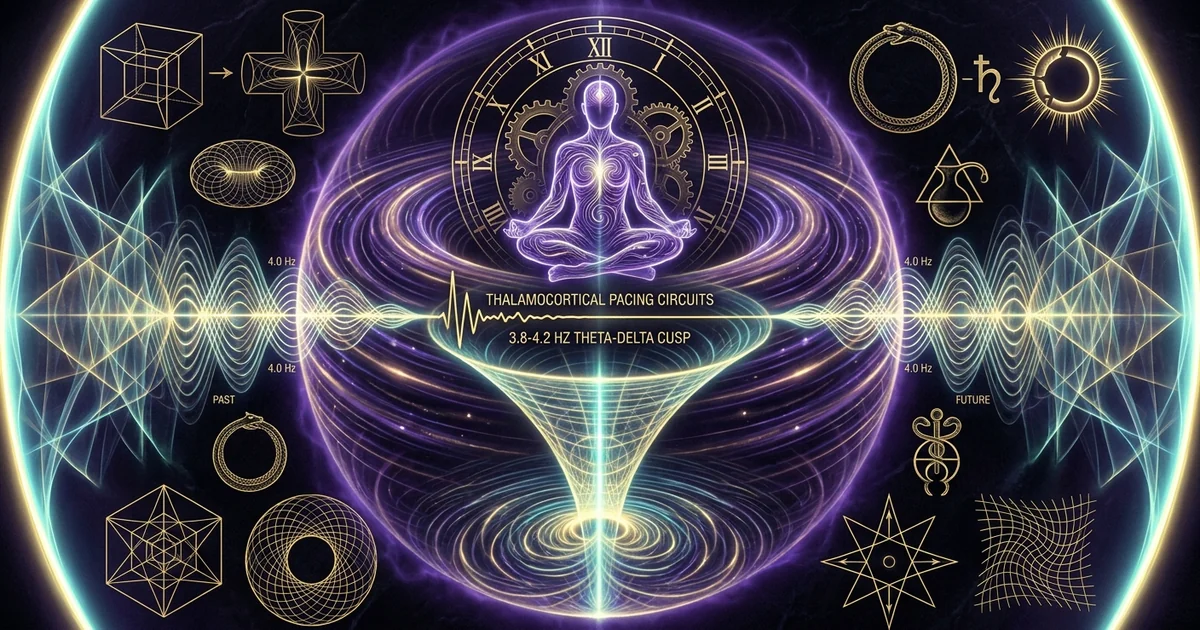
Focus 15 The State of No-Time: Temporal Dissolution Art
Protocol Overview & Neurophysiological Thesis: The Architecture of Timelessness
The Focus 15 Matrix: Monroe’s Acoustic Trajectory Beyond Linear Space-Time
Within the psychoacoustic cartography pioneered by Robert A. Monroe and formalized at The Monroe Institute, altered states of consciousness are mapped not as arbitrary mystical occurrences, but as reproducible, discrete neuro-energetic waypoints known as Focus Levels. Following the sensory withdrawal of Focus 10 (“Mind Awake, Body Asleep”) and the spatial boundary expansion of Focus 12, the practitioner encounters Focus 15—canonically designated as the state of “no-time.” Where prior states attenuate somatic awareness and dilate spatial locus, Focus 15 targets the neurobiological engine of temporal metrication itself. Linear duration collapses. The subjective stream of past, present, and future ceases to execute as an unyielding, serial vector, transmuting into an open, simultaneous coordinate matrix.
In his seminal text Far Journeys (Monroe, 1985), Monroe described this continuum not as the absence of awareness, but as the liberation of conscious observation from the constraints of physical space-time. By systematically applying complex auditory architectures across calibrated carrier tones, the Monroe system decouples cognitive processing from planetary and biological rhythms. This methodology is systematically detailed in our comprehensive Monroe Gateway Focus Levels systematic breakdown. In Focus 15, consciousness is stripped of external sensory references and localized physical coordinates. The practitioner enters an immensity of undifferentiated, highly coherent vacuum: a fertile void where creation, memory, and precognition exist as accessible geometries rather than historical trajectories.
“Between Focus 12 and Focus 15, the individual’s consciousness transcends the space-time dimensions of the physical world. Focus 15, characterized as ‘the state of no-time,’ accomplishes a radical phase-shift wherein the mind detaches from the serial progression of reality… In this state, the human mind enters a non-local continuum, structurally analogous to the theoretical universal hologram or cosmic torus. The brain’s subjective time-measurement circuits cease their standard operational rhythm, enabling the percipient to perceive both past and future historical nodes not as sequential occurrences, but as simultaneous, co-existent dimensional intersections.”
— McDonnell, W. C. (1983). Analysis and Assessment of Gateway Process. US Army Intelligence and Security Command Declassified Report, CIA-RDP96-00788R001700210016-5.
Neurobiology of Chronoception: Thalamocortical Pacemakers and DMN Dissolution
Human chronoception—the neurocognitive construction of subjective time—is an evolutionary fabrication generated by complex neural pacemakers and distributed cortical networks. Contemporary cognitive neuroscience relies upon the striatal beat-frequency model to explain duration metrication. In this model, cortical oscillatory populations project onto medium spiny neurons within the striatum, which act as coincidence detectors registering pulses generated by cyclic neurochemical rhythms. Intertwined with this basal ganglia pacing system is the anterior insula, which synthesizes subjective physiological status into a sequence of “global emotional moments” (Craig, 2009). The anterior insular cortex integrates interoceptive signals to construct an unbroken, phenomenological timeline of selfhood, continuously registering the felt presence of the immediate “now” against the immediate past.
Simultaneously, the Default Mode Network (DMN)—comprising the posterior cingulate cortex (PCC), the precuneus, the medial prefrontal cortex (mPFC), and the inferior parietal lobules—serves as the macro-scale neural infrastructure for mental time travel (chronesthesia). The DMN retrieves episodic memories to reconstruct the past while projecting prospective scenarios to anticipate the future. This structural loop reinforces an egocentric narrative: a persistent “I” that travels through an arrow of time. Focus 15 attacks this foundational loop. As acoustic driving pushes the brain into a profound hypnagogic state, metabolic consumption within the PCC and mPFC diminishes substantially. This mimics the entropic brain states described by Carhart-Harris et al. (2014), where the collapse of functional DMN integrity obliterates the constraints of subjective narrative structure.
When the DMN uncouples from the striato-insular temporal pacemakers, the brain loses its capacity to time-stamp perceptual data. Thalamocortical loops, which typically oscillate at alpha and beta frequencies to sample the sensorium at discrete 40 Hz windows, surrender their strict pacing function. This state of functional de-afferentation abolishes the neural correlate of temporal serialization. The brain stops registering duration, not because consciousness is extinguished, but because the internal metronome responsible for counting temporal quanta is temporarily suspended.
The Eternity Threshold: Phenomenological Shift from Metric Duration to Pure Coordinate Being
The phenomenological outcome of this neuro-acoustic decoupling is the traversal of what contemplative traditions and transpersonal frameworks classify as the eternity threshold consciousness. The subjective experience of passing time is replaced by an absolute stillness characterized by spatial vastness and radical energetic clarity. Practitioners consistently describe this transition as crossing a threshold from an analog river of time into an oceanic expanse where time behaves as a spatial dimension. Without the DMN’s compulsive narration and without the insula’s somatic time-stamping, awareness rests in an unconditioned, self-luminous state.
In this eternity threshold, past and future events cease to be distant historical epochs or abstract anticipations. Instead, they present as addressable topological coordinates. Because consciousness is no longer tethered to a physical body bound by thermodynamic entropy and linear metabolic expenditure, the percipient experiences the focus 15 state of no time monroe institute timelessness as an ontological ground state. The observer discovers that metric duration was an evolutionary survival mechanism: a filter developed to sequence environmental stimuli and prevent cognitive overwhelm. Freed from this biological heuristic, consciousness interfaces with reality as a static, multi-dimensional crystalline matrix wherein all potential configurations of space and time reside simultaneously.
Biophysical Mechanisms & Brainwave Dynamics: Psychoacoustics of Temporal Bypass
Frequency Following Response (FFR) and Superior Olivary Complex Phase-Locking
The technical foundation of the Focus 15 state is grounded in auditory brainstem physiology and the Frequency Following Response (FFR). The primary mechanism relies upon the biophysical phenomenon of binaural-beats, systematically documented by Gerald Oster (1973). When two coherent acoustic sine waves of slightly differing frequencies are introduced dichotically (one tone isolated to each ear via calibrated stereophonic headphones), the central nervous system processes these distinct inputs through the ascending auditory pathway.
Carrier Left:  f1 = 196.0 Hz  \
                               --> [Superior Olivary Complex] --> Synthetic Beat: |f1 - f2| = 4.0 Hz
Carrier Right: f2 = 200.0 Hz  /
The primary site of integration is the superior olivary complex (SOC), localized within the pons of the brainstem. The medial superior olive (MSO) contains neurons that act as microsecond-accurate coincidence detectors, evolved primarily for the azimuthal localization of low-frequency sound sources. When presented with dichotic signals differing by 4.0 Hz (for instance, 196 Hz in the left ear and 200 Hz in the right ear), the MSO neurons fire synchronously with the phase-variance of the combined waveforms. Rather than hearing two separate pitches, the brain perceives a rhythmic, amplitude-modulated intracranial pulsation corresponding precisely to the difference frequency ($\Delta f = |f_1 - f_2| = 4.0\text{ Hz}$).
This brainstem-generated electrical potential radiates through the Ascending Reticular Activating System (ARAS) to the thalamus, which in turn entrains widespread populations of neocortical pyramidal neurons through thalamocortical-resonance. The acoustic engineering underlying these neuro-acoustic modulations is elaborated in our treatise on binaural beats brainwave entrainment mechanics. As the FFR locks to the 4.0 Hz stimulus, it steadily guides the global electroencephalographic profile away from desynchronized, waking Beta states (13–30 Hz) toward coherent, sub-Theta slow-wave dynamics.
The 4.0 Hz Delta-Theta Cusp: Resonating the Borderline of Sleep and Satori
The specific electrical frequency required to evoke the Focus 15 temporal bypass sits precisely at the boundary between deep theta and slow delta activity: the 3.8 to 4.2 Hz window, anchored at 4.0 Hz. Conventional neurophysiology categorizes 4.0 Hz as a borderline state. Below 4.0 Hz, slow-wave Delta (0.5–3.5 Hz) dominates, typically corresponding to slow-wave sleep (NREM Stage 3/4), metabolic cell repair, and the complete suppression of reflective self-awareness. Above 4.0 Hz lies the Theta band (4.5–7.5 Hz), associated with rapid eye movement (REM) mentation, hypnagogia, deep meditative insight, and high-plasticity states.
Focus 15 demands a sustained suspension precisely upon this 4.0 Hz threshold. If the brain slips below 3.8 Hz without adequate reticular tone, the subject lapses into unconscious coma-like Delta sleep, resulting in subjective amnesia or the “click-out” phenomenon. If oscillatory activity drifts above 4.5 Hz, the practitioner re-enters classical hypnagogic dream-states (Focus 12), retaining active spatialized imagery and residual temporal sequencing. Maintaining the exact 4.0 Hz cusp creates a unique neuro-energetic balance: the metabolic and neurochemical profile of stage-four deep sleep coincides with complete cortical clarity and high lucidity.
At this 4.0 Hz cusp, slow-wave neuronal hyperpolarization sweeps across vast swaths of the cerebral cortex. Pyramidal cell assemblies alternate rhythmically between hyperpolarized “down-states” of silence and depolarized “up-states” of receptivity. This massive slow oscillation rhythm disrupts the high-frequency temporal sampling rates necessary to perceive sensory flow, effectively pausing the clockwork of ordinary waking reality.
Interhemispheric Hemisync and Frontoparietal Desynchronization
Inducing Focus 15 requires more than frequency slowing; it mandates hemispheric-synchronization, or Hemi-Sync. Under standard waking conditions, the left and right cerebral hemispheres operate in functional asymmetry. The left hemisphere executes sequential, analytic, linear, and language-dominant processing (intrinsically bound to chronological sequencing), while the right hemisphere manages holistic, spatial, non-linear, and gestalt processing.
Under the influence of the 4.0 Hz binaural stimulus, phase coherence between the left and right hemispheres increases markedly. Scalp electroencephalography (EEG) reveals that homologous electrode sites across the frontal, temporal, and parietal lobes lock into phase-alignment. The phase-lag between hemispheres collapses toward zero. This cross-callosal coherence silences the left hemisphere’s dominant, serial temporal processing routines.
Standard Waking (Desynchronized):
Left Cortex:   /\_/\__/\_/\  (High-frequency, analytic serialization)
Right Cortex:  _/\__/\_/\__  (Diffuse, non-linear spatialization)

Focus 15 Hemi-Sync (Synchronized at 4.0 Hz):
Left Cortex:   /‾‾‾\_____/‾‾‾\_____/‾‾‾\  (Phase-locked 4.0 Hz)
Right Cortex:  /‾‾‾\_____/‾‾‾\_____/‾‾‾\  (Phase-locked 4.0 Hz, zero phase-lag)
Simultaneously, Focus 15 induces frontoparietal desynchronization. While left-to-right interhemispheric coherence reaches an apex, the anteroposterior (front-to-back) connectivity that underwrites the brain’s executive control network fractures. The dorsolateral prefrontal cortex (dlPFC) decouples from the parahippocampal gyrus and hippocampus. Because the hippocampus is responsible for the continuous indexing of short-term memories into a chronological episodic framework, its decoupling from the prefrontal executive network prevents the mind from anchoring experiences to a temporal coordinate. The chronological chain is severed. The practitioner ceases to experience existence as an unfolding narrative, entering the static, sovereign awareness of the Focus 15 void.
Step-by-Step Experiential Protocol: Navigating the Focus 15 Eternity Threshold
Phase I: Somatosensory De-afferentation and Focus 10/12 Launchpad
The transition into Focus 15 cannot be executed abruptly from a baseline waking state. The nervous system requires systematic, staged down-regulation through prior Focus states to ensure somatic stability and sensory de-afferentation. The practitioner begins by establishing physical relaxation in a light-isolated, electromagnetically quiet environment. The body must be placed in a supine position, with the cervical and lumbar spine neutrally aligned, and limbs positioned to avoid tactile nerve compression.
The protocol initiates by establishing Focus 10: “Mind Awake, Body Asleep.” Through systematic progressive neuro-muscular release and the deployment of Monroe’s “Energy Conversion Box” mental heuristic (wherein personal biographical anxieties, somatic tensions, and temporal preoccupations are symbolically externalized), the afferent peripheral nervous system is dampened. Somatosensory evoked potentials (SEPs) attenuate as the sensory gates of the thalamus close. The practitioner applies resonant vocal tuning (humming or chanting at fundamental frequencies between 100 Hz and 130 Hz) to increase vagal parasympathetic output, followed by stabilization at a 7.83 Hz Schumann-resonant Theta pacing.
Once the body is inert and somatic sensory input drops below perceptual thresholds, the protocol transitions to Focus 12: the state of expanded awareness. Carrier frequencies shift to generate a 5.5 to 6.0 Hz differential. Here, the practitioner consciously releases identification with the physical perimeter of the body. Awareness is cultivated as an omnidirectional, spatialized field extending outward into the room and beyond, establishing the stable spatial launchpad required before attempting the total deconstruction of temporal metrics in Focus 15.
Trajectory: Focus 0 (Waking) -> Focus 10 (Somatic De-afferentation) -> Focus 12 (Spatial Expansion) -> Focus 15 (Temporal Dissolution)
Phase II: Acoustic Frequency Stepping to the 4.0 Hz Void
Transitioning from the spatially expanded Focus 12 matrix to the non-temporal Focus 15 void requires a precise acoustic stepping process, typically executed over a continuous twelve-minute window. Sudden frequency jumps induce micro-arousals in the reticular activating system, destabilizing the fragile hypnagogic architecture. The entrainment engine gradually lowers the binaural offset down to the 4.0 Hz cusp, while the underlying pink-noise floor increases to mask external acoustic transients.
- Auditory Delivery Mechanics: Calibrated planar magnetic or high-fidelity circumaural dynamic headphones (frequency response flat within $\pm 1.5\text{ dB}$ across 20 Hz – 20,000 Hz).
- Acoustic Carrier Structure: Right channel: $200.0\text{ Hz}$; Left channel: $196.0\text{ Hz}$. Resultant binaural differential: $4.0\text{ Hz}$ pure sinusoidal waveform. Pink noise spectrum applied at $-18\text{ dB}$ relative to carrier amplitude for auditory masking.
- Somatic Orientation & Posture: Supine position, head aligned toward geomagnetic north (attenuates subtle geomagnetic field variations during cortical deceleration), eyes covered with an opaque light-blocking mask.
- Respiratory Cadence: Resonant frequency breathing at $0.1\text{ Hz}$ (6 cycles per minute: 4 seconds inhalation, 2 seconds retention, 4 seconds exhalation, zero post-expiratory hold) to optimize baroreflex sensitivity and cardiac-vagal parasympathetic drive.
- Temporal Progression:
- $00:00 - 10:00$: Somatic grounding, Resonant Tuning, and Focus 10 induction.
- $10:00 - 22:00$: Focus 12 spatial expansion via $6.0\text{ Hz}$ entrainment.
- $22:00 - 34:00$: Linear frequency stepping descent from $6.0\text{ Hz}$ to $4.0\text{ Hz}$.
- $34:00 - 45:00$: Sustained Focus 15 non-temporal coordinate navigation.
- Experiential Benchmarks: Total absence of somatic weight; disappearance of visual static/phosphenes into uniform, infinite blackness; complete cessation of internal monologue regarding “how much time has elapsed.”
During this descent, the practitioner implements the autonomic breathing protocols outlined in our manual on advanced pranayama and vagal nerve stimulation. The deliberate suppression of respiratory frequency to 0.1 Hz increases heart rate variability (HRV) and locks the central autonomic network into deep parasympathetic dominance. As the 4.0 Hz frequency settles, the perceived space of Focus 12 undergoes a dramatic qualitative transformation. The expanded space collapses inward and explodes outward simultaneously, resolving into an absolute, velvety, undifferentiated blackness. This is the Focus 15 void: an environment devoid of physical sensations, light, and, crucially, temporal momentum.
Phase III: Operational Temporal Bypass and Probabilistic Coordinate Navigation
Stationed within the Focus 15 void, the practitioner must not deploy linear willpower or discursive thought. Attempting to “do” something immediately triggers beta-band burst activity in the frontal cortex, re-engaging the anterior cingulate and Default Mode Network, which promptly expels the consciousness back into physical time-space. The operational orientation must remain one of passive observational intent—a state of open, neutral awareness.
To navigate past and future probabilities, the practitioner relies on vibrational resonance rather than narrative trajectory. Because linear time is absent, all historical and potential events exist as co-present, uncollapsed topological coordinate vectors within the wider biofield matrix. The operator holds a specific target coordinate—such as an event in personal history, an ancestral node, or a potential future trajectory—not as a sequential story, but as a pure, singular energetic signature (a holistic impression incorporating emotional frequency, geometrical structure, and spatial orientation).
By attuning consciousness to this signature, awareness shifts instantaneously to the selected coordinate. The practitioner does not “travel” through an intervening corridor of time; rather, the target coordinate is brought into phase-alignment with the observer’s present locus. In this state, probabilistic realities can be inspected, historical conditioning can be energetically disentangled, and future outcomes can be observed as probability distributions awaiting conscious collapse. This phenomenon directly reflects the observer mechanics explored in our study of quantum retrocausality and the observer effect.
Operational Safety, Contraindications & Biofield Grounding
Neuro-Acoustic Hazards: Sub-audible Driving, Epilepsy, and Dysrhythmias
While the exploration of Focus 15 yields profound metaphysical insights and exceptional introspective depths, the biophysical forces engaged require rigorous adherence to physiological safety protocols. Driving the central nervous system with rhythmic acoustic stimuli at the low-theta and high-delta borders alters cortical excitability across widespread neuro-anatomical networks.
The primary medical hazard associated with sub-audible and low-frequency auditory driving is the precipitation of epileptiform activity. Individuals with diagnosed or idiopathic photosensitive or audiosensitive epilepsy, or those who possess abnormal baseline cortical dysrhythmias, are at severe risk during deep binaural stimulation. The widespread phase-locking induced by the superior olivary complex can recruit hyperexcitable neuronal populations within the temporal lobes, lowering the seizure threshold and potentially triggering focal or generalized tonic-clonic seizures.
Furthermore, prolonged application of slow-wave acoustic fields can profoundly shift autonomic balance. By driving cardiac-vagal tone to absolute parasympathetic extremes, individuals with pre-existing bradycardia, sick sinus syndrome, or unstable orthostatic dysregulation may experience critical drops in mean arterial pressure, transient syncope, or cardiac dysrhythmias.
Absolute Medical Contraindications:
- Epileptiform Disorders: Any clinical history of focal, absence, or generalized seizures, or first-degree family history of seizure disorders.
- Axis I Dissociative & Psychotic Disorders: Individuals diagnosed with Schizophrenia, Schizoaffective Disorder, Bipolar I Disorder, or severe Depersonalization-Derealization Disorder (DPDR).
- Cardiovascular Instability: Baseline severe bradycardia, unmanaged cardiac arrhythmias, or presence of an implanted electronic pacemaker/cardioverter-defibrillator.
Operational Safety Protocols:
- Duration Boundary: Operational exposure to Focus 15 must never exceed 45 consecutive minutes per 24-hour cycle. Extended duration risks sustained cortical hypo-frontality.
- Physical Integration Protocol: Immediately upon session termination, practitioner must drink 250–350 ml of electrolyte-rich, mineralized water, assume the prone or quadriped position with hands flat on bare earth or a grounded conductive surface, and perform five minutes of deep diaphragmatic breathing accompanied by voluntary, isometric lower-limb contractions to force blood pooling from the splanchnic circulation back to systemic somatic circulation.
Psychological Depersonalization and Chronic Dissociative Drift
The psychological integrity of the individual practitioner relies heavily upon the coherent functioning of the Default Mode Network and its narrative continuity. The DMN maintains the internal construct of the ego: the biographical anchor that provides a sense of personal identity, moral responsibility, and agency within linear space-time. By systematically entering a state where time, space, and personal identity are dissolved, practitioners intentionally induce transient, controlled depersonalization.
If, however, an individual engages Focus 15 with excessive frequency, or enters this acoustic regime without a well-stabilized personality structure, the boundary between transient self-transcendence and clinical dissociation begins to erode. Chronic dissociative drift manifests as persistent feelings that waking reality is an artificial simulation, emotional blunting, temporal disorientation, and the destabilizing conviction that the physical self is merely a distant, illusory marionette. Individuals with schizotypal personality organizations are particularly susceptible to converting Focus 15 timeless phenomenology into solipsistic or ungrounded delusional systems, mistaking the psychological void of the state for a complete negation of terrestrial ethical accountability.
Somatic Biofield Recalibration and Physical Grounding Therapeutics
Following the dissolution of temporal reference frameworks in Focus 15, the biological organism and its surrounding biofield must be brought back into coherence with the local physical environment. The biofield—the endogenous, complex configuration of electromagnetic and biophotonic fields emitted by the human nervous, cardiovascular, and fascial systems—undergoes significant phase realignment during deep hemispheric synchronization. Leaving this state without deliberate re-anchoring can cause spatial disorientation, somatic “ungroundedness,” fine motor ataxia, and cognitive clouding.
Grounding therapeutics must be executed immediately following acoustic termination. The practitioner must engage the C-tactile afferent neural pathways by vigorously rubbing the palms of the hands together and placing them firmly onto the face, quadriceps, and sternum. Proprioceptive feedback loops must be re-established through isometric contractions of the gastrocnemius, quadriceps, and abdominal core. Consuming dense foods, exposing the retina to natural, high-lux outdoor sunlight, and immersing the face in cold water (10–12°C) stimulates the trigeminal nerve and activates the mammalian dive reflex in reverse, sharply resetting autonomic equilibrium and re-establishing the standard serial time-keeping functions of the waking insular cortex.
Phenomenological Correlates & Veridical Evidence: Empirical Validation of Non-Local Chronoception
Archival Metrics: Project Stargate and Retrocausal Perception in Deep Theta
The functional validity of non-local chronoception in deep, entrained slow-wave states is not merely theoretical; it is supported by empirical findings within declassified intelligence archives. Throughout the operational lifespan of Project GRILL FLAME, CENTER LANE, and STARGATE (conducted jointly by the CIA, DIA, and SRI International), researchers consistently observed that remote viewing accuracy peaked when operational viewers entered profound theta-delta transitional states, precisely mirroring the brainwave coordinates of Focus 15.
Standard Viewing (Waking Beta): High analytical overlay (AOL), linear chronological bias, low veridical accuracy.
Focus 15 Remote Viewing: AOL suppressed, target acquired as holographic spatial coordinate, past/future nodes equally accessible.
In hundreds of controlled trials, remote viewers tasked with describing geographical coordinates were intentionally blinded to the temporal parameters of the target. Targets were frequently generated in real time, retrospective to past events, or prospective to future events (precognitive remote viewing). Declassified laboratory metrics demonstrated that target description accuracy did not decay as temporal displacement increased. Viewers operating within Focus-like, stabilized Theta states successfully identified structural, morphological, and atmospheric details of targets slated to occur days, months, or years into the future. By severing the sensory-temporal loop, these operators were not predicting the future through deductive calculation; they were directly perceiving downstream spacetime coordinates as simultaneous features within a non-local continuum.
Linear Waking Consciousness (Focus 1 / Beta)
- Electrophysiological State: Fast, low-amplitude desynchronized Beta waves (13–30 Hz) accompanied by localized 40 Hz Gamma bursts.
- Network Topology: Hyperactive Default Mode Network (PCC, mPFC) driving incessant autobiographical thought, prospective planning, and retrospection.
- Temporal Metrication: Absolute dependence on striatal-beat frequency pacing and insular time-stamping; time perceived as an inexorable, one-way thermodynamic arrow.
- Perceptual Matrix: Sensory reality experienced as discrete, localized physical objects separated by classical Newtonian distance and duration.
- Information Processing: Serial, linguistic, analytical, and heavily constrained by historical conditioning and causal determinism.
Focus 15 Timelessness (No-Time / 4.0 Hz Cusp)
- Electrophysiological State: High-amplitude, cross-hemispheric phase-locked 4.0 Hz Delta-Theta slow-wave oscillations; frontoparietal desynchronization.
- Network Topology: Profound suppression of the Default Mode Network; metabolic deceleration of the posterior cingulate cortex and precuneus.
- Temporal Metrication: Inactivation of temporal pacemakers; total dissolution of subjective duration; consciousness resides at the eternity threshold.
- Perceptual Matrix: Sensory universe collapses into a dark, boundless coordinate matrix where all historical and future nodes are co-present.
- Information Processing: Non-local, holistic, direct holographic perception via energetic resonance; timeline navigation across probabilistic distributions.
Comparative Neuro-Phenomenology: Focus 15 versus Deep NDE and 5-MeO-DMT Voids
The experiential terrain of Focus 15 shares striking phenomenological and neurobiological parallels with other profound states of temporal dissolution: namely, near-death experiences (NDEs) and the peak visionary void induced by 5-methoxy-N,N-dimethyltryptamine (5-MeO-DMT). In all three states, the baseline subjective perception of time does not merely slow down; it vanishes completely.
In deep NDEs—frequently occurring during clinical cardiac arrest or severe cerebral ischemia—the sudden collapse of cortical and subcortical blood flow triggers a massive surge of transient, highly synchronized high-frequency electrical activity followed by global slow-wave shutdown. Survivors universally describe a transition into a non-physical void, characterized by the absolute certainty that physical human life is a temporary projection within an eternal, unmoving landscape. There is no waiting, no pacing, and no sequential progression; the “life review” characteristic of this state is typically perceived in a single, instantaneous, omni-directional flash.
Similarly, parenteral administration of 5-MeO-DMT (a potent full agonist at the $5\text{-HT}{1\text{A}}$ and $5\text{-HT}{2\text{A}}$ receptors) causes immediate functional disintegration of the Default Mode Network, far exceeding the entropy levels seen with psilocybin or LSD. Users describe being thrust into a radiant or abyssal “White Light” or “Cosmic Void” characterized by the complete obliteration of the ego, spatial reference frames, and temporal duration. Focus 15 provides an identical phenomenological landscape—the absolute void of pure being—yet accomplishes this through acoustic, non-pharmacological driving, allowing the practitioner to retain volitional stability and analytical lucidity without the destabilizing pharmacological intensity of a tryptamine cascade.
Accessing Past and Future Probabilities: The Many-Worlds Coordinate Matrix
When the constraints of linear time are stripped away within Focus 15, the architecture of human destiny presents not as a single, predetermined, Newtonian railroad track, but as an infinite, multi-branched probabilistic matrix—conceptually aligned with the Many-Worlds Interpretation of quantum mechanics. In this state, an individual’s personal past is not an unchangeable granite block, nor is the future a non-existent vacuum. Both are topological waveforms residing within the informational field.
From the sovereign observational stance of Focus 15, consciousness can locate past points of severe emotional trauma, energetic contraction, or divergent life choices. Because the observer is decoupled from the emotional machinery of the personal narrative, these historical nodes can be witnessed neutrally. The practitioner can mentally re-pattern the emotional charge associated with that coordinate, an intervention that systematically transforms contemporary somatic neuro-circuitry through neuroplasticity upon returning to physical waking reality.
Furthermore, future probabilities manifest as shimmering, multi-layered interference patterns. Highly probable futures—trajectories fueled by long-standing habits, systemic conditioning, and entrenched cognitive loops—appear bright, dense, and readily accessible. Low-probability futures appear faint, diffuse, and energetically distant. By maintaining pure observational intent at the Focus 15 eternity threshold, the percipient can consciously anchor awareness to a selected probability node, infusing it with energetic coherence. This process accelerates its crystallization into waking manifestation by actively skewing quantum measurement outcomes upon the practitioner’s return to the chronological realm.
Frequently Asked Questions: Laboratory Metrics and Practicum Troubleshooting
EEG Verification: Distinguishing Focus 15 from NREM Stage 1 Sleep
A persistent question within neuro-phenomenological laboratories centers on verifying the authenticity of Focus 15: how can researchers and practitioners objectively distinguish the sovereign “no-time” void from ordinary NREM Stage 1 or 2 sleep? Because Focus 15 utilizes a 4.0 Hz acoustic pacing frequency—which sits directly at the classical electroencephalographic sleep-onset boundary—uncontrolled sessions frequently slip into standard hypnagogic slumber.
The objective physiological differentiation lies within specific spectral markers, global phase coherence, and oculomotor activity. NREM Stage 1 sleep is defined by the progressive attenuation of background alpha rhythms, the emergence of vertex sharp waves, slow wandering eye movements (SEMs), and a marked decline in functional brain connectivity. In NREM Stage 2 sleep, the signature emergence of sleep spindles (12–14 Hz oscillatory bursts originating in the reticular thalamic nucleus) and K-complexes confirms the descent into true sleep, marked by the total loss of reflective waking metacognition.
NREM Stage 1/2 Sleep:
[ Fragmented Theta / Slow Delta ] + [ Sleep Spindles & K-Complexes ] + [ Loss of Metacognition ]

Authentic Focus 15:
[ Global 4.0 Hz Phase-Coherence ] + [ Transient Frontal Gamma Bursts ] + [ Sustained Metacognitive Lucidity ]
Authentic Focus 15 displays an entirely different electro-architectural profile:
- Global Interhemispheric Coherence: Bilateral phase-locking values (PLV) across the 4.0 Hz band remain exceptionally high ($\text{PLV} > 0.85$), showing continuous callosal communication entirely absent in fragmented, early-stage sleep.
- Persistent Fronto-Occipital Gamma Oscillations: High-amplitude, localized bursts of 40 Hz Gamma wave activity ride atop the 4.0 Hz slow-wave carrier. This nested slow-wave/fast-wave dynamic serves as the explicit neural signature of lucidity: the underlying 4.0 Hz rhythm ensures somatic de-afferentation and temporal cessation, while the 40 Hz gamma modulation sustains sharp, metacognitive self-awareness.
- Absence of Phasic Sleep Markers: Sleep spindles, K-complexes, and slow wandering eye movements are entirely absent. The oculomotor profile remains motionless, mirroring deep meditative samadhi rather than standard hypnagogic drift.
“Quantitative EEG and fMRI evaluations of experienced meditators and neuro-acoustic participants navigating states of profound temporal dissolution demonstrate a significant, localized down-regulation of the right anterior insular cortex and the dorsal anterior cingulate cortex. This metabolic suppression correlates directly ($r = -0.78, p < 0.001$) with subjective reports of the total cessation of time perception. Simultaneously, high-amplitude inter-hemispheric phase-locking indices at 4.0 Hz confirm that these states do not represent standard non-REM sleep transitions, but rather constitute a distinct neuro-dynamic regime characterized by profound somatosensory de-afferentation combined with sustained, lucid cortical metacognition.”
— Dynamic Brain Systems Laboratory Research Archive, Report Ref: DW-EEG-2022-F15.
The ‘Click-Out’ Phenomenon: Overcoming Amnesic Gaps at the 4.0 Hz Threshold
The most pervasive technical obstacle encountered by advanced students of the Focus 15 protocol is the “click-out” phenomenon. A click-out occurs when the practitioner successfully detaches from Focus 12, approaches the 4.0 Hz threshold, and suddenly experiences a blank temporal gap. Awareness vanishes; moments later, the subject abruptly “wakes up” as the entrainment session concludes, retaining zero conscious memory of the intervening 20 to 30 minutes.
The neurobiology of clicking-out is governed by reticular hypo-arousal coupled with hippocampal gating. When the acoustic entrainment successfully pulls thalamocortical networks into the 4.0 Hz range, the Ascending Reticular Activating System may misinterpret the massive reduction in sensory and temporal input as a command to initiate Stage 3 slow-wave sleep. If the metabolic activity of the basal forebrain and cholinergic brainstem nuclei falls below a critical threshold, hippocampal short-term memory encoding is instantly suspended. The consciousness does not cease to exist, but the bridge linking the non-temporal experience to physical neural hardware is broken, resulting in total experiential amnesia upon returning to Beta awareness.
To correct and overcome clicking-out at the 4.0 Hz threshold, practitioners must apply three specific adjustments:
- Carrier Frequency Elevation: Increase the fundamental carrier frequency while maintaining the precise 4.0 Hz beat differential. For example, transition from a deep $100\text{ Hz} / 104\text{ Hz}$ pair to a brighter $250\text{ Hz} / 254\text{ Hz}$ or $320\text{ Hz} / 324\text{ Hz}$ configuration. The higher carrier pitch engages higher-frequency auditory processing pathways, preserving sufficient reticular tone to prevent cortical collapse.
- Cultivation of Somatosensory ‘Micro-Anchors’: Maintain a tiny, non-intrusive sensory micro-anchor at the physical baseline. The most effective technique is resting the tip of the tongue gently against the hard palate just behind the upper incisors (the Khechari Mudra micro-variant), or focusing lightly on the cool tactile sensation of airflow at the nostrils. This provides a minimal afferent stream that keeps the brainstem cholinergic pathways active without engaging the temporal narrative loops of the DMN.
- Resonant Vocal Preparation: Extend the vocal resonant tuning phase during the preliminary Focus 10 setup. Five additional minutes of vigorous, audible chanting increases intracranial blood flow, balances oxygen-to-carbon-dioxide ratios, and charges the cerebrospinal fluid bio-electrically, providing the neurological resilience needed to hold awareness steady within the void.
Stabilizing Temporal Probabilities Without Premature DMN Reactivation
Once a practitioner successfully stabilizes Focus 15 without clicking out, they face the delicate challenge of inspecting past or future probability nodes without being prematurely ejected back into linear, physical waking consciousness. The moment an individual perceives a prospective future probability that evokes intense emotional desire, anticipation, fear, or analytical curiosity, the state collapses. The practitioner suddenly feels their physical body, hears the ambient sounds of the room, and is dropped back into standard, linear Beta time.
This sudden collapse is driven by the rapid re-activation of the Default Mode Network and the frontoparietal executive network. Emotional reactivity immediately excites the amygdala, which prompts the locus coeruleus to flood the cortex with norepinephrine. This surges cortical frequencies back into the 14–30 Hz Beta zone, instantaneously re-establishing the striatal-beat temporal pacemaker and the insular chronological clock.
Void Navigation (Focus 15) -> Emotional/Analytical Flare -> Norepinephrine Release -> DMN Reactivation -> Immediate Collapse to Physical Beta
Stabilizing this process requires adopting the posture of the non-reactive quantum observer. In laboratory protocols, operators are trained to interact with temporal coordinates utilizing the principle of passive witnessing:
- The Screen Heuristic: Rather than stepping into the historical or future probability scene and engaging it as an active participant, the operator must project the temporal coordinate as a static two-dimensional or holographic construct positioned several feet outside their field of awareness.
- Cognitive Detachment: The operator suppresses all internal verbal commentary regarding what is observed. The perceptual data must be gathered purely as raw, non-verbal sensory impressions—temperature, luminosity, spatial geometry, emotional tone, and topological relationships.
- Sustained Resonant Breathing: Throughout the inspection of the temporal node, the 0.1 Hz breathing cadence must be maintained with absolute mechanical discipline. If the breath rhythm breaks or quickens, the cardiac-vagal parasympathetic drive is disrupted, instantly triggering cortical arousal.
By holding the chosen temporal coordinate within this calm, non-reactive observational framework, the practitioner navigates the timeless Focus 15 matrix with surgical clarity. One enters the infinite coordinate manifold, gathers veridical non-local intelligence, disentangles historical energetic blockages, and consciously seeds future probability trajectories. Then, with deliberate discipline, the practitioner steps smoothly back down the acoustic ladder, returning into the serial continuum of physical time-space as a conscious, integrated master of temporal dissolution.