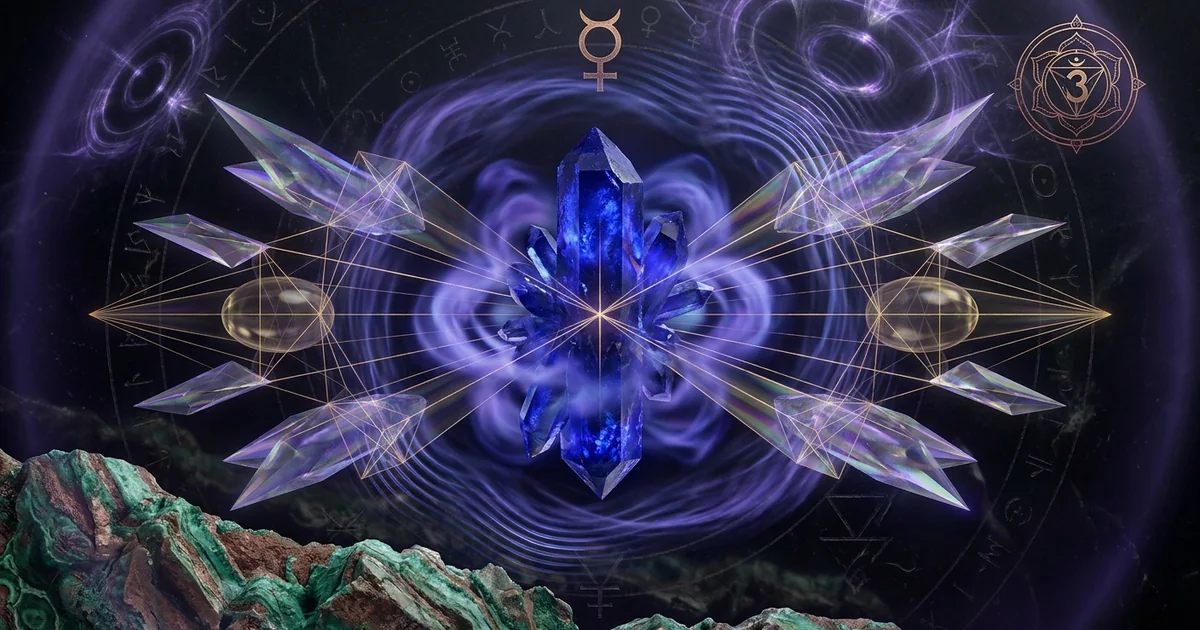
Azurite Properties: Geology & Crystalline Resonance
Mineral Classification & Crystallographic Thesis
Stoichiometric Formula and Structural Classification
Azurite is a basic copper carbonate corresponding to the stoichiometric formula $\text{Cu}_3(\text{CO}_3)_2(\text{OH})_2$. Within systemic mineralogy, as classified by Gaines et al. in Dana’s New Mineralogy (8th Edition), it is categorized among the hydrated carbonates bearing hydroxyl or halogen anions. Structurally, the mineral crystallizes in the prismatic class of the monoclinic system (crystallographic point group $2/m$), exhibiting a severe geometric anisotropy that directly dictates its solid-state behavior and subtle field dynamics. The chemical architecture consists of cupric cations ($\text{Cu}^{2+}$) bonded in two distinct coordination geometries, flanked by planar carbonate groups ($[\text{CO}_3]^{2-}$) and hydroxyl anions ($[\text{OH}]^-$). This structural arrangement produces a tightly packed yet mechanically fragile crystalline lattice characterized by a relatively low Mohs hardness of 3.5 to 4.0 and a measured specific gravity ranging from 3.77 to 3.89 $\text{g/cm}^3$.
The crystallographic classification of azurite underscores a critical divergence between isotropic mineral structures and low-symmetry systems. Operating within the monoclinic-lattice-system, azurite’s vectors of atomic bonding display asymmetrical force constants along its three primary axes. This asymmetry manifests physically through uneven thermal expansion, distinct directional cleavage along the ${011}$ and ${100}$ planes, and an extreme polarization of light within its interior. Rather than dispersing physical or subtle vibrational inputs uniformly, the mineral fractions incoming force vectors along defined crystallographic channels. This basic copper carbonate is an anisotropic solid-state matrix whose internal energetic throughput is governed by the structural constraints of its space group.
Formula: $\text{Cu}_3(\text{CO}3)2(\text{OH})2$ | Space Group: $P2_1/c$ (No. 14) | Lattice Parameters: $a = 5.008\text{ \AA}$, $b = 5.844\text{ \AA}$, $c = 10.345\text{ \AA}$, $\beta = 92.43^\circ$ | Unit Cell Volume: $V = 302.48\text{ \AA}^3$ | $Z = 2$ | Mohs Hardness: 3.5–4.0 | Density: 3.773 $\text{g/cm}^3$ | Optical Birefringence: $\delta = 0.108$ (Biaxial Positive, $n\alpha = 1.730$, $n\beta = 1.758$, $n\gamma = 1.838$). Primary structural verification: Zigan & Schuster (1972); Belokoneva et al. (2001).
Supergene Paragenesis in Silicates and Metamorphic Minerals
The genesis of azurite is restricted to the upper oxidized horizons of base-metal ore bodies, representing an epigenetic phase formed by supergene-enrichment processes. Primary hypogene copper mineralization—typically comprising sulfides such as chalcopyrite ($\text{CuFeS}_2$), bornite ($\text{Cu}_5\text{FeS}_4$), and chalcocite ($\text{Cu}_2\text{S}$)—undergoes continuous chemical weathering via descending meteoric waters enriched with atmospheric oxygen and dissolved carbon dioxide. As sulfuric acid is generated in situ through the oxidative dissolution of co-occurring pyrite ($\text{FeS}_2$), localized acidic solutions mobilize the cupric ions, driving them downward through the vadose zone. The subsequent precipitation of azurite occurs when these acidic, cupriferous fluids encounter host lithologies capable of neutralizing hydronium activity and supplying concentrated carbonate anions.
This paragenetic sequence demands continuous interaction with surrounding silicates and metamorphic minerals. Host strata composed of calcareous skarns, metamorphosed limestones, and complex silicate / oxide matrix environments (frequently including quartzite, chlorite schists, and weathered granite porphyries) serve as both geochemical buffers and structural substrates. When meteoric solutions encounter these aluminosilicate and carbonate matrices, rapid ion exchange alters the local pH from acidic to weakly basic domains ($\text{pH } 6.5–8.0$). Carbonate ions, dissolved from adjacent calcite ($\text{CaCO}_3$) or dolomite ($\text{CaMg}(\text{CO}_3)_2$), saturate the fluid phase, triggering the nucleation of azurite crystals along fractures, vugs, and bedding planes. Without the structural stabilization provided by these silicate wall rocks and their accompanying oxide gossans (principally goethite and hematite), the high-activity chemical gradients necessary to sustain basic copper carbonate nucleation would disperse before structural crystallization could occur.
The Azurite-Malachite Equilibrium Boundary
The thermodynamic phase boundary separating azurite from its sister carbonate, malachite ($\text{Cu}_2\text{CO}_3(\text{OH})2$), represents a classic equilibrium governed by the partial pressure of carbon dioxide ($P{\text{CO}2}$) and the chemical activity of water ($a{\text{H}_2\text{O}}$). The reversible chemical reaction controlling this boundary is expressed as:
$$2\text{Cu}_3(\text{CO}_3)_2(\text{OH})_2\text{ (s)} + \text{H}_2\text{O}\text{ (l)} \rightleftharpoons 3\text{Cu}_2\text{CO}_3(\text{OH})_2\text{ (s)} + \text{CO}_2\text{ (g)}$$
Thermodynamic calculations and experimental paragenetic studies demonstrate that azurite is stable only under conditions of elevated carbon dioxide partial pressure ($P_{\text{CO}2} > 10^{-1.3}\text{ to } 10^{-2.5}\text{ bar}$, depending on temperature and solution salinity). Under ambient atmospheric conditions, where the modern atmospheric $P{\text{CO}_2}$ resides near $10^{-3.4}\text{ bar}$, azurite occupies a metastable state relative to malachite.
Because modern open-air environments exhibit a $P_{\text{CO}_2}$ substantially below the equilibrium threshold, azurite exhibits an intrinsic thermodynamic drive to alter into malachite through continuous topotactic hydration. This transformation occurs via pseudomorphism, wherein the gross macroscopic morphology of the original azurite crystal is preserved while its internal atomic lattice is reconstructed into the monoclinic structure of malachite. This fundamental metastability imparts a distinct kinetic tension to azurite’s solid-state profile. Within the framework of vibrational dynamics, this structural latency renders the mineral an active, non-static crystal matrix. It exists in continuous negotiation with its environmental matrix, acting as a natural catalyst for phase transitions and dynamic structural reorganizations rather than inert stabilization.
Lattice Geometry & Solid-State Physics
       [ Primary Cu-Fe Sulfides (Chalcopyrite/Bornite) ]
                               │
                               ▼
        [ Oxidizing Meteoric Infiltration (CO2-Rich) ]
                               │
                               ▼
     [ Secondary Leaching via Silicate / Oxide Matrix ]
                               │
                               ▼
    [ Metastable Nucleation: Azurite Cu3(CO3)2(OH)2 (P21/c) ]
                               │
                               ▼
    [ Long-Term Hydration / Pseudomorphic Malachite Cu2CO3(OH)2 ]
Monoclinic Unit Cell Geometry and Space Group $P2_1/c$
The crystallographic architecture of azurite was comprehensively solved by Zigan and Schuster (1972) and refined via high-resolution precision electron-density studies by Belokoneva et al. (2001). Azurite crystallizes in the centrosymmetric monoclinic space group $P2_1/c$ (space group number 14), with unit cell dimensions measuring $a = 5.008\text{ \AA}$, $b = 5.844\text{ \AA}$, $c = 10.345\text{ \AA}$, with an axial angle of $\beta = 92.43^\circ$, enclosing a cell volume of $302.48\text{ \AA}^3$ with $Z = 2$ formula units per cell. The crystal structure is delineated by the existence of two non-equivalent crystallographic positions occupied by the copper cations: the $\text{Cu}(1)$ site, which resides on a crystallographic center of inversion ($1/2, 0, 1/2$) possessing site symmetry $\bar{1}$, and the $\text{Cu}(2)$ site, which occupies a general crystallographic position ($x, y, z$) with site symmetry $1$.
The coordination polyhedra surrounding these two copper centers diverge in spatial arrangement. The $\text{Cu}(1)$ cations are coordinated by four coplanar oxygen atoms forming an essentially square-planar configuration, with two further axial oxygen atoms positioned at substantially greater distances, completing a severely elongated $[4+2]$ octahedron. The $\text{Cu}(2)$ cations, by contrast, are coordinated by five oxygen atoms forming a distorted square pyramid, which similarly exhibits pronounced elongation along its apical bond axis. These copper polyhedra are linked into infinite chains running parallel to the $b$-axis by sharing edges composed of hydroxyl groups and carbonate oxygen atoms. The planar $[\text{CO}_3]^{2-}$ groups bridge these cupric polyhedral chains along the $a$ and $c$ directions, creating an integrated, anisotropic three-dimensional framework. The resulting distribution of valence electron density is strongly heterogeneous, concentrating localized electrostatic potentials along the cupric coordination polyhedra and establishing directional channels of dielectric polarization within the solid-state crystallography of the mineral.
Jahn-Teller Distortion within Cupric Octahedra
The structural morphology of the copper-oxygen polyhedra in azurite is governed by the jahn-teller-effect, a fundamental quantum mechanical phenomenon operative in degenerate electronic configurations. The divalent copper cation ($\text{Cu}^{2+}$) exhibits an open-shell electronic configuration of $[\text{Ar}]3d^9$. In an idealized, non-distorted octahedral coordination complex possessing $O_h$ symmetry, the five $3d$ orbitals split into a lower, triply degenerate $t_{2g}$ set ($d_{xy}, d_{xz}, d_{yz}$) and an upper, doubly degenerate $e_g$ set ($d_{z^2}, d_{x^2-y^2}$). In the $d^9$ system of $\text{Cu}^{2+}$, the $e_g$ subshell contains three electrons, resulting in an electronically degenerate ground state $(t_{2g})^6(e_g)^3$.
To eliminate this electronic degeneracy and minimize the overall thermodynamic energy of the crystal lattice, the system undergoes a spontaneous symmetry reduction. The degenerate $e_g$ orbitals split in energy: the $d_{x^2-y^2}$ orbital, containing a single unpaired electron, is elevated in energy as the equatorial metal-ligand bonds shorten, while the $d_{z^2}$ orbital, containing an electron pair, drops in energy as the axial metal-ligand bonds elongate:
        Ideal Octahedral (Oh)          Distorted Octahedral (D4h)

               [ eg ] (dx2-y2, dz2)  ───►  [ b1g ] (dx2-y2)  (Half-filled)
                 ▲                                ▲
                 │ Δ_oct                          │ Δ_JT
                 ▼                                ▼
              [ t2g ] (dxy, dxz, dyz) ───►  [ a1g ] (dz2)     (Fully filled)
                                            [ eg  ] (dxz, dyz)
                                            [ b2g ] (dxy)
In azurite, this Jahn-Teller distortion generates strong tetragonal elongation: the equatorial $\text{Cu}-\text{O}$ bond lengths within the $\text{Cu}(1)$ and $\text{Cu}(2)$ sites fall tightly within the range of $1.93\text{ \AA}$ to $2.01\text{ \AA}$, whereas the axial $\text{Cu}-\text{O}$ distances are extended outward to $2.38\text{ \AA}$ and $2.71\text{ \AA}$, respectively.
This quantum-scale spatial deformation has consequences for both the physical and metaphysical properties of the mineral. Energetically, it creates a directional, half-filled $d_{x^2-y^2}$ orbital oriented precisely within the equatorial plane of each copper site. The electronic absorption spectrum of azurite is dominated by these altered ligand-field transitions, alongside intense ligand-to-metal charge-transfer (LMCT) interactions between the oxygen atoms of the carbonate/hydroxyl groups and the empty hole in the cupric $3d$ shell. These electronic transitions absorb electromagnetic radiation within the yellow-red visible spectrum ($550–700\text{ nm}$), leaving an unabsorbed transmission window in the deep blue and violet regions ($400–480\text{ nm}$). This mechanism generates the intense azure chromophore characteristic of the stone.
Incoming White Light
[ 400nm - 750nm ] ───► [ Jahn-Teller Splitting: d9 Cu2+ ]
                             │
                             ├─► Absorbed: 550nm - 700nm (Yellow-Red)
                             │   (LMCT & Ligand-Field Transitions)
                             │
                             └─► Transmitted: 400nm - 480nm (Deep Blue/Violet)
                                 (Anisotropic Wavefront Propagation)
Beyond raw colorimetry, this orbital elongation establishes deep physical anisotropy throughout the lattice, structuring the stone’s dielectric response according to the principles of sacred geometry and non-cubic mineral physics detailed in analyses of platonic solids and mineral lattices.
Dielectric Anisotropy and Optical Pleochroism
The low-symmetry monoclinic structural lattice and the alignment of the Jahn-Teller distorted cupric polyhedra directly cause azurite’s macroscopic optical and dielectric behavior. Structurally, azurite is an optically biaxial positive crystal exhibiting exceptionally high birefringence, with a measured refractive index difference of $\delta = n_\gamma - n_\alpha = 0.108$. Its principal indices of refraction are $n_\alpha = 1.730$, $n_\beta = 1.758$, and $n_\gamma = 1.838$, accompanied by a large optical axial angle ($2V$) measured between $67^\circ$ and $68^\circ$. This magnitude of birefringence indicates that incident light traversing the crystal lattice is split into two orthogonally polarized wavefronts that propagate at substantially different phase velocities through the unit cell.
Furthermore, the dielectric-constant ($\varepsilon$) of azurite is fundamentally tensorial rather than scalar. The dielectric tensor components ($\varepsilon_{ij}$) display significant variance depending on whether an applied electromagnetic field aligns parallel to the edge-sharing cupric chains along the $b$-axis or perpendicular to them across the carbonate linkages. This internal dielectric disparity gives rise to strong optical pleochroism. When examined under plane-polarized light, azurite shifts dramatically across its optical axes:
- $X$ (vibrating parallel to the $\alpha$ optical direction): Light sky blue to greenish-blue
- $Y$ (vibrating parallel to the $\beta$ direction): Brilliant ultramarine to azure blue
- $Z$ (vibrating parallel to the $\gamma$ direction): Deep indigo to midnight purplish-blue
The spatial fractionation of propagating electromagnetic fields within the crystal acts as a selective polarizing filter. As ambient electromagnetic radiation or localized bioelectric fields pass through the mineral, the lattice separates the wave components, altering their phase angles and redistributing field strength unevenly across space. The physical mechanics of azurite dictate that any vibrational energy crossing its structural boundary undergoes phase transformation and spatial segregation.
Subtle Energetic Dynamics & Resonance Mechanics
                       [ High-Frequency Cranial/Biofield Current ]
                                           │
                                           ▼
      [ Low-Symmetry Monoclinic Lattice Input (Dielectric Anisotropy: P21/c) ]
                                           │
                                           ▼
 [ Paramagnetic Cu2+ (S=1/2) Spin Centers ] ◄──► [ Lattice Acoustic Phonon Modes ]
                                           │
                                           ▼
          [ Polariton-Mediated Resonant Coupling (Gamma Band: 40-80 Hz) ]
                                           │
                                           ▼
          [ Coherent Transduction along Microtubular / Neural Substrates ]
Cupric Ion Field Coupling and Paramagnetic Resonance
At the intersection of solid-state physics and subtle field dynamics, azurite operates as an energetic transducer, driven primarily by the electronic properties of its divalent copper ions. In solid-state theory, the $\text{Cu}^{2+}$ ion acts as a spin-$1/2$ magnetic center due to the single unpaired electron occupying its $d_{x^2-y^2}$ orbital. Consequently, azurite exhibits paramagnetic-resonance behavior governed by an anisotropic Landé $g$-factor ($g_\parallel \approx 2.2–2.4$, $g_\perp \approx 2.05–2.08$). At macroscopic scales, the mineral displays a clear positive magnetic susceptibility ($\chi_m$), which permits weak, highly organized coupling with external magnetic and bioelectromagnetic vectors.
In energetic mineralogy, copper is recognized as the premier conductive element for subtle currents. This property is explored in studies of copper-based mineral resonance. While native metallic copper permits uninhibited charge transit through delocalized conduction-band electrons, the copper ions locked within azurite’s mineral lattice function as discrete, localized electromagnetic resonators. The individual magnetic dipoles of the $\text{Cu}^{2+}$ ions, separated by the intervening diamagnetic carbonate and hydroxyl groups, form an array of magnetically active centers.
When placed within the weak, oscillating magnetic gradients generated by the human biofield (such as cardiac and neurological electromagnetic envelopes), these cupric centers undergo minor spin-precession adjustments. The spatial confinement of these paramagnetically active spins within the $P2_1/c$ monoclinic lattice allows azurite to convert ambient, disorganized energetic noise into coherent, polarized vibrational trajectories.
Phonon-Exciton Modulation of Biofield Harmonics
The transmission of subtle energetic impulses through azurite involves interactions between quantum quasi-particles within its crystal structure. When an environmental subtle field or localized acoustic pressure impacts the crystal, it excites lattice vibrations known as acoustic and optical phonons. Because the bonding within the azurite lattice is anisotropic—stronger covalent bonds define the planar $[\text{CO}_3]^{2-}$ groups, while weaker, more polar bonds characterize the Jahn-Teller elongated $\text{Cu}-\text{O}$ connections—the phonon dispersion curves of azurite exhibit discrete, non-overlapping vibrational modes.
These phonon modes interact with the crystal’s electronic system, particularly with the excitons (bound states of an electron and an electron hole) generated when unbonded or valence electrons are excited within the cupric $d$-orbitals. This electron-phonon coupling creates hybrid quasi-particles termed exciton-polaritons. The frequencies of these polaritonic oscillations, which occupy the terahertz to far-infrared domain, generate beat frequencies and micro-modulations that align precisely with lower-frequency biological rhythms.
Specifically, this exciton-phonon modulation mirrors endogenous gamma-band oscillations ($40–80\text{ Hz}$) in the human cerebral cortex—the precise frequency spectrum associated with neural phase-locking, heightened sensory synthesis, and expanded conscious awareness. By generating a stabilized polaritonic feedback loop, azurite’s lattice acts as an energetic bridge, translating subtle biofield variations into clear, ordered electronic signals.
Transduction Mechanics at the Pineal and Upper Cranial Centers
The physiological interface between azurite’s lattice resonance and the human energetic anatomy centers on the upper cranial meridian network, specifically the sixth (Ajna) and seventh (Sahasrara) chakra vortices and their physical counterpart, the pineal gland. Modern biophysical investigations confirm that the human pineal gland contains calcite micro-crystals that display non-centrosymmetric properties capable of generating piezoelectricity and subtle electromechanical coupling. When azurite is introduced to the near-body field adjacent to the glabellar or crown regions, its directional dielectric polarization acts directly upon the electrodynamic sheath of the cranial nerves.
Azurite: $\text{Cu}_3(\text{CO}_3)_2(\text{OH})_2$
- Crystal System: Monoclinic (Prismatic class, space group $P2_1/c$)
- Dominant Subtle Mode: Cognitive acceleration, high-frequency exciton transduction, pineal/neural field coupling
- Thermodynamic Status: Metastable under modern surface meteoric conditions; prone to pseudomorphic hydration
- Chromophore Mechanics: Charge-transfer transitions shifted into the deep violet-blue continuum ($400–480\text{ nm}$)
- Cleavage & Mechanical Response: Highly brittle, perfect on ${011}$, fair on ${100}$; fractions stress via directional cleavage
Malachite: $\text{Cu}_2\text{CO}_3(\text{OH})_2$
- Crystal System: Monoclinic (Prismatic class, space group $P2_1/a$)
- Dominant Subtle Mode: Somatic grounding, dense etheric shield generation, cellular field stabilization
- Thermodynamic Status: Thermodynamically stable end-member of secondary copper carbonate weathering
- Chromophore Mechanics: $\text{Cu}^{2+}$ ligand field transitions focused strictly within green spectral bandwidths ($500–550\text{ nm}$)
- Cleavage & Mechanical Response: Brittle, basal ${201}$ and ${010}$ cleavage, commonly found as fibrous, highly durable botryoidal crusts
This energetic duality highlights the unique functional profile of azurite. While its paragenetic partner, malachite, acts as a structural anchor that stabilizes dense etheric imbalances—mechanics detailed in the study of malachite structural polarities—azurite acts as an asymmetric oscillator. It disrupts stagnant, low-frequency thought patterns and reduces energetic inertia in the subtler cranial sheaths.
Its low-symmetry monoclinic architecture refuses to anchor energy into static structural loops. Instead, it pulls consciousness toward rapid vibrational reorganization. By applying a focused shear to calcified mental structures, azurite accelerates the transmission of information through neural microtubules, clearing blockages along the upper meridian channels and facilitating lucidity in visionary and transpersonal states.
Historical Lapidary Lore & Traditional Lineage
Greco-Roman Lithica: The Kuanos of Theophrastus and Pliny’s Armenite
The mineralogical lineage of azurite in Western antiquity is obscured by classical nomenclatures that frequently grouped distinct blue minerals based on color rather than chemical stoichiometry. In the earliest formal mineralogical treatise, De Lapidibus (c. 315 BCE), the Greek philosopher and naturalist Theophrastus employed the term kuanos ($\kappa\acute{\upsilon}\alpha\nu\text{o}\varsigma$) to describe both natural basic copper carbonate and artificial blue frit (calcium copper tetrasilicate, or Egyptian blue). Theophrastus explicitly noted that natural kuanos was sourced from copper mines, differentiating it from lapis lazuli by its deeper, unyielding azure tone and its association with secondary copper mineralization. He observed that the mineral possessed an inherent dryness, functioning as an energetic astringent in early lithic classifications.
By the first century CE, the Roman polymath Pliny the Elder categorized natural azurite under the designation lapis armenius (Armenian stone) and caeruleum armeniense in his encyclopedic work Naturalis Historia (Books XXXIII and XXXV). Pliny distinguished armenium from both smalt and lapis lazuli, identifying its origins in the copper-bearing regions of Armenia, Cyprus, and the Iberian Peninsula. Classical lapidaries viewed lapis armenius not as an agent for physical healing, but as a mental purge. It was prescribed to clear the “black bile” of melancholia and sweep discordant, heavy humor from the ocular and cerebral faculties. Roman physicians and esoteric philosophers viewed azurite as an abrasive to mental stagnation, a stone capable of dissolving the heavy, earthbound humors that clouded clear intellectual perception.
Pliny the Elder, Naturalis Historia, Book XXXV, Chapter XII:
“Armenium is a mineral brought from Armenia… it differs from caeruleum (Egyptian blue) by a lighter hue and a delicate softness of substance. The practitioners of natural arts assign it power over the ocular humors, yet warn that its dust provokes swift clearing of the vital spirit, stripping false visions from the eyes of the intellect.”
The Sacred Pigment of Dynastic Egypt and Western Alchemical Synthesis
In dynastic Egypt, natural azurite was ground into a sacred pigment known collectively within temple workshops as chesbet iryt (artificial or processed blue) when synthesized, or simply grouped with natural chesbet (lapis lazuli) when mined directly from copper workings in the Sinai Peninsula and the Eastern Desert. The Egyptian priesthood assigned structural and symbolic significance to azurite pigment. It was deployed extensively in parietal tomb iconography, on the cartonnage of sarcophagi, and applied directly to the forehead of initiates during rites of transfiguration.
Because the color blue was symbolically equated with amun (the hidden, unmanifest divinity of the heavens) and the primeval waters of Nun, azurite was believed to awaken the inner visionary faculty. By painting azurite-based binders upon the third-eye locus, the temple liturgists sought to facilitate the soul’s navigation through the Duat (the underworld), using the mineral’s crystalline resonance as a stabilizing guidepost through non-physical realms.
During the European Middle Ages and early Renaissance, azurite became the foundational blue pigment of illuminated manuscripts and religious panel paintings, typically sourced from the silver and copper mines of Schwaz in Tyrol and Chessy-les-Mines near Lyon (whence the historical lapidary synonym chessylite originated). Within the Western alchemical lineage, as documented in the treatises of Paracelsus and the later chemical philosophers, azurite occupied a unique ontological station. Regarded as an embryonic manifestation of copper that had yet to solidify into dense metallic form, it was linked to the planetary sphere of Venus, but an exalted, spiritualized Venus operating in direct concert with Mercury.
Alchemists classified azurite as a prima materia for psychic transmutation. Its inherent metastability—its tendency to transform gradually into green malachite—was interpreted not as a structural flaw, but as physical proof of the stone’s volatile, living spirit. It demonstrated that rigid matter could undergo internal, structural conversion without passing through total molten destruction.
       Egyptian Temple Initiations (Chesbet Iryt)
       [ Focus: Opening Third-Eye / Transfiguration ]
                            │
                            ▼
        Greco-Roman Lithica (Kuanos / Lapis Armenius)
       [ Focus: Astringent Clearing of Ocular & Mental Humors ]
                            │
                            ▼
        Renaissance Alchemical Philosophy (Chessylite)
       [ Focus: Venus-Mercury Transmutation / Living Volatile Spirit ]
                            │
                            ▼
       Modern Crystalline Resonance & Subtle Mechanics
       [ Focus: Monoclinic Transduction / Biofield Phase-Locking ]
Traditional Tibetan and Mesoamerican Applications in Divinatory Sight
In the high trans-Himalayan plateaus of Tibet, azurite was integrated into Bon and Vajrayana ritual structures as a vehicle for stabilizing divinatory sight and navigating altered states of consciousness. Known colloquially among Tibetan lapidaries as a stone of the upper sky realms, azurite was frequently mounted in silver or copper amulets worn at the throat or crown during long meditative retreats. It was believed to pacify turbulent lung (prana/wind) energies centered within the heart and throat channels, preventing the erratic visionary projections that often emerge during sensory deprivation and advanced deity meditation. Tibetan adepts recognized that the stone, if abused or overexposed to bodily sweat and oils, would lose its luminous color and turn dull green—an outward physical symptom that the stone’s volatile crystalline resonance had grounded into ordinary earthly matter.
Concurrently, within the pre-Columbian civilizations of Mesoamerica, particularly among the Maya and Toltec cultures, azurite was mined from oxidized copper skarns alongside chrysocolla and turquoise. The stone was cut into intricate mosaic ear flares, pectorals, and divinatory mirrors. Priests associated the deep indigo mineral with the nocturnal sun journeying through the underworld and the celestial plumed serpent, Kukulkan/Quetzalcoatl.
Azurite was employed specifically during bloodletting and trance ceremonies to stimulate the inner ocular centers. Mesoamerican diviners used the stone to induce visions of distant geographic events, treating its polished crystalline surfaces as non-distorting energetic lenses that aligned the shaman’s biofield with the magnetic currents of the Earth.
Practical Applications, Calibration & Safety Protocols
Geometric Vectoring: Coupling with Quartz and Silicate Networks
To optimize azurite’s energetic performance within practical subtle field grids, it must be paired with balancing structural minerals. Because azurite possesses a low-symmetry monoclinic structure that generates high-frequency dielectric polarization, unmitigated exposure to raw azurite can over-stimulate the upper chakras, provoking spatial disorientation, headaches, or restless cognitive processing.
To temper these erratic high-frequency discharges, the mineral must be geometrically vectored into an integrated crystalline array using the piezoelectric-transduction-crystals framework:
                          Natural Hexagonal Quartz Point
                                    ▲
                                   / \
                                  /   \
                                 /     \
                                /   ▲   \
                               /   / \   \
                              /   /   \   \
                             /   /     \   \
  Natural Hexagonal Quartz  ◄─── [ Azurite ] ───►  Natural Hexagonal Quartz
           Point                  \       /                  Point
                                   \     /
                                    \   /
                                     \ /
                                      ▼
                        Metamorphic Base: Slate / Schist
By placing azurite at the focal nexus of an equilateral triad composed of natural, prismatic alpha-quartz ($\text{SiO}_2$) points, the high-frequency excitonic output of the copper carbonate is channeled through the trigonal symmetry and piezoelectric framework of the quartz lattice. The quartz network acts as a step-down transformer, translating azurite’s rapid, anisotropic pulses into coherent, biologically compatible waveforms.
Furthermore, grounding the entire mineral circuit onto an aluminosilicate metamorphic foundation—such as a polished slab of regional chlorite schist or slate—simulates the natural paragenetic host environment where azurite nucleates. This matrix integration suppresses erratic electrical discharges and stabilizes the overall resonant architecture of the grid.
Mechanical Vulnerability, Cleavage, and Environmental Degradation
From a lapidary and curatorial standpoint, azurite is an exceptionally fragile mineral that demands rigorous physical safeguards. Its low Mohs hardness (3.5–4.0) makes it vulnerable to abrasive wear from quartz-bearing airborne dust (Mohs 7.0), while its structural cleavage—perfect along the ${011}$ direction and fair along ${100}$—makes it susceptible to catastrophic internal fracturing if subjected to sudden mechanical impact or thermal shocks. azurite must never be cleansed using ultrasonic equipment, as the high-frequency cavitation bubbles will penetrate along its cleavage traces and shatter the polyhedral chains of the crystal lattice. Similarly, steam cleaning must be strictly avoided; the sudden introduction of heat and moisture will trigger rapid dehydration and thermal cracking.
Environmental degradation poses an equal threat to the stone’s physical and subtle integrity. azurite is chemically reactive to changes in its atmospheric envelope:
- Solar Radiation: Extended exposure to direct solar ultraviolet radiation degrades its deep blue color over time, heating the lattice and driving off structurally bound hydroxyl groups.
- Ambient Humidity: Sustained exposure to relative humidity exceeding 45–50% accelerates the topotactic conversion of azurite into malachite, dulling the stone’s surface luster and altering its structural properties.
- Chemical Contaminants: Airborne chemical vapors, acidic cleansers, and the organic acids present in human skin will dissolve the carbonate matrix, producing an etched, chalky surface that destroys its subtle dielectric properties.
Specimens should be preserved in temperature-controlled, low-humidity environments ($<40%\text{ RH}$) shielded from direct actinic light.
Copper Leaching Hazards and Elixir Contraindications
The chemical composition of azurite introduces material safety hazards that must be observed by all practitioners. As a basic copper carbonate, azurite’s mineral matrix readily breaks down in acidic or aqueous solutions, releasing toxic, bioavailable cupric ions ($\text{Cu}^{2+}$):
$$\text{Cu}_3(\text{CO}_3)_2(\text{OH})_2\text{ (s)} + 6\text{H}^+\text{ (aq)} \longrightarrow 3\text{Cu}^{2+}\text{ (aq)} + 2\text{CO}_2\text{ (g)} + 4\text{H}_2\text{O}\text{ (l)}$$
Under no circumstances should azurite be placed directly into water, alcohol, carrier oils, or any solvent intended for internal human consumption or topical application. Ingestion of copper-rich solutions causes severe copper toxicity, characterized by acute gastrointestinal erosion, metallic dysgeusia, nausea, persistent vomiting, hepatic necrosis, and renal failure.
TOXIC METAL HAZARD: Azurite is a basic copper carbonate. Under no circumstances should azurite be placed directly into water, alcohol, or oils meant for internal consumption. Cupric ions ($\text{Cu}^{2+}$) leach rapidly into acidic or aqueous environments, inducing acute copper toxicity, gastric ulceration, and hepatic stress. Cleanse exclusively via dry acoustic vibration (432 Hz / 528 Hz tuning forks) or secondary selenite contact. Protect the mineral from direct sunlight and humidity to avoid pseudomorphic breakdown into malachite.
Practitioners seeking to harness the subtle energetic signature of azurite for vibrational elixirs must rely exclusively on indirect preparation protocols. In this non-contact methodology, the azurite crystal is sealed within an hermetic, sterile borosilicate glass container, which is then immersed in an outer vessel containing pure distilled water.
This ensures that only the subtle field and photonic emissions traverse the dielectric glass barrier, preventing any chemical dissolution or heavy metal poisoning. Lapidary artisans cutting or polishing azurite must run wet-cutting equipment with dedicated ventilation, wear personal N95/N100 respirators, and use eye protection to avoid inhaling toxic particulate copper dust.
Frequently Asked Questions
Metamorphic Host Stability and Pseudomorphism
Why does azurite frequently alter into malachite, and how does this affect its resonance?
The alteration of azurite into malachite is governed by thermodynamic stability in the presence of surface atmospheric fluids. Azurite requires a high partial pressure of carbon dioxide ($P_{\text{CO}_2}$) to remain structurally stable. When an azurite specimen is exposed to open-air atmospheric conditions, where the ambient carbon dioxide concentration is low, the crystal lattice attempts to re-establish chemical equilibrium through hydration.
Over decades or centuries, water molecules replace carbon dioxide groups within the crystal frame, transforming the monoclinic $P2_1/c$ azurite lattice into the monoclinic $P2_1/a$ malachite lattice through topotactic pseudomorphism:
[ Ambient Environment: Low P_CO2, Atmospheric H2O ]
                         │
                         ▼
        [ Hydration & Decarboxylation ]
   2Cu3(CO3)2(OH)2 + H2O  ──►  3Cu2CO3(OH)2 + CO2
   (Metastable Azurite)         (Stable Malachite)
                         │
                         ▼
 [ Structural Shift: P21/c to P21/a Pseudomorphic Matrix ]
                         │
                         ▼
 [ Resonance Shift: High-Frequency Insight ──► Dense Somatic Shielding ]
Vibrationally, this topotactic conversion causes a measurable grounding shift in the stone’s energetic throughput. As pseudomorphism advances, the mineral transitions from a high-frequency, cognitively accelerating transmitter into a dense, grounding shield. A specimen undergoing active pseudomorphic transformation—frequently marketed as “azure-malachite”—exhibits a hybrid resonance. It simultaneously stimulates upper-chakra vision while rooting that perception directly into physical, somatic awareness.
Can azurite be safely stabilized using artificial polymers?
While industrial vacuum-impregnation with epoxy or cyanoacrylate polymers shields friable azurite specimens from atmospheric humidity and mechanical fracture, it alters both its physical and subtle properties.
Polymer stabilization fills the microscopic surface pores and cleavage fractures with synthetic, long-chain aliphatic hydrocarbons. This artificial buffer distorts the mineral’s natural dielectric constant and dampens its phonon-exciton coupling. For rigorous subtle energetic applications, only completely natural, un-stabilized specimens should be used.
Diagnostic Protocols for Natural vs. Synthetic Azurite
How can a mineralogist distinguish natural crystalline azurite from reconstituted imitations?
Natural azurite exhibits distinct diagnostic properties that separate it from reconstituted or dyed imitations:
- Specific Gravity: Authentic azurite has a high specific gravity ($3.77–3.89\text{ g/cm}^3$) due to its copper content. Reconstituted fakes—typically composed of crushed azurite dust, barium sulfate, and blue dyes suspended in plastic resin—exhibit a much lower specific gravity ($2.0–2.6\text{ g/cm}^3$).
- Optical Birefringence and Refractive Index: Authentic monoclinic azurite displays extreme optical birefringence ($\delta = 0.108$) with refractometer readings exceeding $1.730$. Plastic-bonded counterfeits are optically isotropic or show vague, low-index reactions ($n \approx 1.50–1.55$).
- Acid Reaction: Applying a micro-droplet of dilute ($10%$) hydrochloric acid ($\text{HCl}$) to an inconspicuous area of a natural specimen causes immediate effervescence of carbon dioxide gas. Reconstituted dyed silicates or plastics produce zero effervescence.
- Thermal Reaction: Applying a heated testing needle directly to a synthetic specimen melts the binder and releases chemical odors. A natural azurite crystal remains structurally unaffected by local low-temperature thermal pins.
Diagnostic Triage for Azurite Identification:
[ Specimen Under Review ]
│
├─► Specific Gravity Test ────► SG < 3.0? ────────► [ RECONSTITUTED / PLASTIC RESIN ]
│                               SG 3.7 - 3.9? ────► [ PASS: PROCEED TO OPTICS ]
│
├─► Optical Refractometry ────► n ≈ 1.54 (Isotropic) ► [ SYNTHETIC IMITATION ]
│                               n > 1.73 (Birefringent) ► [ PASS: PROCEED TO SOLVENT ]
│
└─► Acetone Surface Swab ────► Dye on cotton swab? ► [ DYED SILICATE / HOWLITE ]
Clean swab? ──────► [ AUTHENTIC NATURAL AZURITE ]
Optimal Resonant Coupling Conditions
What is the most effective protocol for clearing and recharging azurite without degrading the stone?
Because azurite is vulnerable to water, acids, direct sunlight, and heat, conventional mineral cleansing protocols—such as salt soaking, water bathing, or direct solar charging—will degrade its crystalline lattice. The only structurally safe methods are acoustic resonance, dry geometric induction, and exposure to moonlight.
To align an azurite specimen within an energetic matrix without physical harm: Position the crystal at the center of an equilateral triangle formed by natural double-terminated quartz crystals resting on a metamorphic slate or schist base. Expose the specimen to a 512 Hz acoustic calibration tone for 180 seconds. Avoid all liquid immersion, sage smoke particulate accumulation, and sustained ambient humidity exceeding 45%.
Dry acoustic clearing using high-frequency steel tuning forks (particularly $432\text{ Hz}$ or $512\text{ Hz}$) introduces mechanical vibrations that loosen stagnant energetic fields along its monoclinic planes without triggering cleavage fractures. Placing the stone upon a dry bed of crystalline selenite (gypsum, $\text{CaSO}_4\cdot2\text{H}_2\text{O}$) achieves secondary energetic clearing via dielectric coupling, stripping away static surface charges. To recharge the stone’s vibrational resonance, it should be exposed to cold nocturnal lunar radiation during the waxing or full lunar phase. This exposes the stone to ambient electromagnetic fields without risking the thermal breakdown caused by solar ultraviolet radiation.