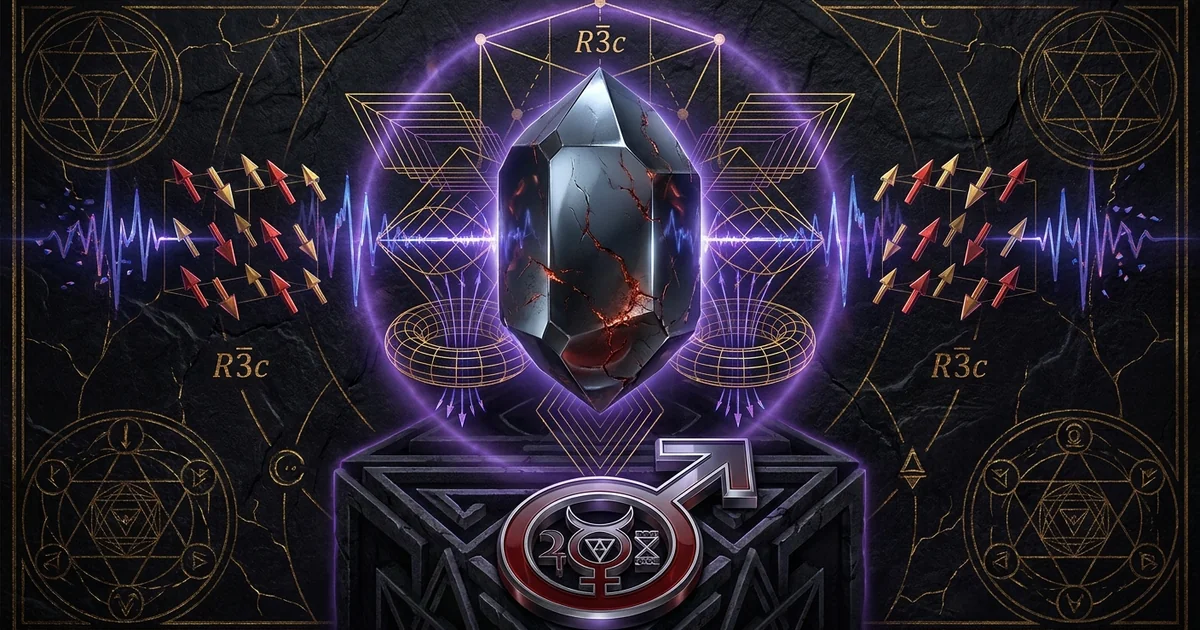
Hematite Properties: Geology & Crystalline Resonance
Mineral Classification & Crystallographic Thesis
Chemical Stoichiometry and Hexagonal Anion Close-Packing
Hematite represents the thermodynamic endpoint of iron sesquioxides, formulated stoichiometrically as $\alpha\text{-Fe}_2\text{O}_3$. Within the broader hierarchy of the oxide mineral class, this compound exhibits complete trivalent iron saturation ($\text{Fe}^{3+}$), establishing a baseline of chemical stability that resists further oxidation under standard planetary surface conditions. The fundamental architecture of the crystal lattice is defined by an approximately hexagonal close-packed (hcp) array of divalent oxygen anions ($\text{O}^{2-}$), stacked along the crystallographic $[0001]$ direction in an alternating $ABAB\dots$ sequence.
Within this close-packed oxygen framework, two-thirds of the available octahedral interstices are systematically occupied by $\text{Fe}^{3+}$ cations, leaving one-third vacant to maintain electrostatic neutrality. This specific distribution is not random; rather, it follows an ordered configuration wherein pairs of $\text{Fe}^{3+}$-centered octahedra share faces along the three-fold axis parallel to $[0001]$, while sharing edges and corners in the basal plane perpendicular to this axis. The electrostatic repulsion between the two highly charged $\text{Fe}^{3+}$ cations across the shared octahedral face induces a significant, measurable displacement of both iron ions away from each other toward the opposing unshared oxygen faces. Consequently, the coordination polyhedra deviate markedly from idealized Euclidean octahedral geometry, establishing intrinsic internal strain and anisotropic bond lengths that govern the material’s solid-state and vibrational responses.
O(1) -------- O(2)
      /   \        /   \
     /     \  Fe  /     \
    O(3) ---+----+----- O(4)   <-- Octahedral Interstice (2/3 Occupied)
     \     /  Fe  \     /
      \   /        \   /
       O(5) -------- O(6)
The macroscopic variability of hematite—manifesting as tabular mirror-like crystals (specularite), radial fibrous botryoidal aggregates (kidney ore), compact microcrystalline masses, or friable earthy ochres—stems from non-equilibrium crystal growth kinetics and varying fluid supersaturation regimes rather than compositional divergence. Across these disparate petrological expressions, laboratory diffraction confirms that the invariant crystallographic kernel remains constant: a rigidly constrained anhydrous lattice operating under tight thermodynamic parameters.
The Corundum-Type R-3c Trigonal System
Crystallographically, hematite is isostructural with corundum ($\alpha\text{-Al}_2\text{O}_3$), belonging to the trigonal crystal system and governed by the centrosymmetric space group $R\bar{3}c$ (International Tables for Crystallography No. 167). When indexed using standard hexagonal axes, the unit cell parameters determined by Blake et al. (1966) resolve to dimensions of $a = 5.038\text{ \AA}$ and $c = 13.772\text{ \AA}$, with an axial ratio of $c/a \approx 2.73$ and a cell volume housing six formula units ($Z = 6$).
The structural topology can be interpreted as alternating planes of oxygen anions and iron cations oriented orthogonal to the three-fold rotoinversion axis ($\bar{3}$). Because the centrosymmetric space group possesses an inversion center at every occupied octahedral site and across the shared octahedral edges, hematite displays no bulk macroscopic piezoelectric lattice dynamics. In contrast to non-centrosymmetric trigonal crystals (such as $\alpha\text{-quartz}$ in space group $P3_121$), the application of uniform uniaxial mechanical stress does not induce a net electric polarization across the macroscopic crystal boundaries.
However, at localized grain boundaries, crystallite surfaces, and within domain wall dislocations, broken inversion symmetry yields microscopic polar moments. The interplay between the trigonal symmetry and the oxygen-framework distortion generates pronounced mechanical anisotropy. The structural parting observed parallel to the ${0001}$ basal plane and the ${10\bar{1}1}$ pseudo-cubic rhombohedral faces is directly attributable to structural twinning (predominantly contact twins on ${0001}$ and lamellar polysynthetic twins on ${10\bar{1}1}$), rather than true cleavage. These crystallographic planes represent vectors of lowest cohesive energy across the distorted octahedra, directly modulating how acoustic, mechanical, and subtle energetic waves propagate through trigonal and rhombohedral lattices.
The Optical Paradox: Specular Metallic Luster vs. Blood-Red Streak
One of the most defining phenomenological characteristics of hematite is the optical divergence between its macroscopic surface reflection and its microscopic transmission profile. Macroscopically, well-crystallized specularite displays an intense, sub-metallic to metallic gray-black luster with a high specular reflectance across the visible spectrum. When the mineral is mechanically crushed, ground, or drawn across an unglazed porcelain streak plate, the resulting particulate powder reveals an invariant, vivid cherry-red to brownish-red streak.
This optical paradox is resolved through solid-state band theory and ligand field mechanics. Hematite is an indirect band-gap semiconductor with an optical band gap ranging between $2.1\text{ eV}$ and $2.2\text{ eV}$. In bulk single-crystal forms, specular reflection dominates the visual appearance due to high refractive indices ($n_o = 3.22$, $n_e = 2.94$ at $\lambda = 589\text{ nm}$) coupled with a notable absorption coefficient ($\alpha > 10^5\text{ cm}^{-1}$) across photon energies exceeding the band gap threshold. Photons within the blue and green spectral regions undergo intense interband transitions, primarily involving charge transfer from the filled $\text{O}^{2-}$ $2p$ valence bands to the unoccupied $\text{Fe}^{3+}$ $3d$ conduction states, alongside localized ligand-field $d\text{–}d$ electronic transitions ($^6A_{1g} \to {}^4T_{1g}$ and $^6A_{1g} \to {}^4T_{2g}$).
When hematite is reduced to sub-micron particulates during streak testing or within natural earthy ochres, specular Fresnel reflection collapses. The high optical path length within individual micro-crystallites permits the transmission of longer wavelengths; the material selectively absorbs photons above $2.0\text{ eV}$ while transmitting wavelengths in the red portion of the electromagnetic spectrum ($\lambda \approx 650\text{–}750\text{ nm}$). This microscopic band edge behavior forms the biochemical and linguistic root of the mineral’s name—derived from the Greek haimatites (blood-like)—and provides the optical signature that has governed its use from Paleolithic ritual pigments to modern lapidary categorization.
Primary laboratory reference metrics for pure stoichiometric single-crystal hematite ($\alpha\text{-Fe}_2\text{O}_3$):
- Crystal System: Trigonal (Hexagonal setting)
- Space Group: $R\bar{3}c$ ($D_{3d}^6$, No. 167)
- Unit Cell Parameters: $a = 5.038\text{ \AA}$, $c = 13.772\text{ \AA}$, $V = 302.72\text{ \AA}^3$, $Z = 6$
- Calculated Density: $\rho = 5.26\text{ g/cm}^3$ (Experimental: $5.25\text{–}5.28\text{ g/cm}^3$)
- Mohs Hardness: $5.5\text{–}6.5$ (anisotropic variation across $[0001]$ vs. ${10\bar{1}1}$)
- Refractive Indices: Uniaxial negative; $n_o = 3.22$, $n_e = 2.94$ ($\Delta n = 0.28$)
- Optical Band Gap: $E_g \approx 2.14\text{ eV}$ (Indirect), $2.6\text{ eV}$ (Direct charge transfer)
- Structural Refinement Source: Blake, R. L., Hessevick, R. E., Zoltai, T., & Finger, L. W. (1966). Refinement of the hematite structure. American Mineralogist, 51(1-2), 123-129.
Lattice Geometry & Solid-State Physics
Cation Octahedral Distortion and Superexchange Interactions
The electronic and magnetic properties of hematite are governed by the exchange interactions operating between the localized $3d^5$ electron shells of adjacent $\text{Fe}^{3+}$ cations. In an isolated, spherically symmetric environment, the five $3d$ electrons of $\text{Fe}^{3+}$ occupy degenerate states with parallel spins ($S = 5/2$), yielding a high-spin ground state ($^6A_1$). Within the distorted octahedral crystal field of the hematite corundum lattice, this orbital degeneracy is lifted into lower-energy $t_{2g}$ triplets ($d_{xy}, d_{yz}, d_{zx}$) and higher-energy $e_g$ doublets ($d_{x^2-y^2}, d_{z^2}$).
Direct quantum mechanical overlap between the $d$-orbitals of adjacent iron cations is prevented by the intervening oxygen ions. Consequently, magnetic order is mediated entirely through indirect superexchange pathways, as formulated by Anderson and Goodenough. The exchange Hamiltonian governing adjacent spins $\mathbf{S}_i$ and $\mathbf{S}_j$ is expressed as:
$$\hat{H}{ex} = -2 \sum{i<j} J_{ij} , \mathbf{S}_i \cdot \mathbf{S}_j$$
where $J_{ij}$ denotes the exchange integral between iron sites $i$ and $j$. The magnitude and sign of $J_{ij}$ depend fundamentally on the $\text{Fe}^{3+}\text{–}\text{O}^{2-}\text{–}\text{Fe}^{3+}$ bond angle and interatomic distance. Across the shared octahedral face along the $c$-axis, where the bond angle approximates $86^\circ$, the direct cation-cation interaction is strongly repulsive, whereas the superexchange interaction across shared octahedral edges and corners (with bond angles spanning $120^\circ$ to $132^\circ$) exhibits strong antiferromagnetic coupling ($J < 0$). This superexchange drives the spins of neighboring iron sheets to align in an antiparallel orientation.
The Morin Transition and Canted Weak Ferromagnetism
The magnetic state of $\alpha\text{-Fe}_2\text{O}_3$ varies significantly across different temperature regimes. Below the critical Morin transition temperature ($T_M \approx 260\text{ K}$ or $-13^\circ\text{C}$), hematite behaves as an ideal, collinear antiferromagnet, as demonstrated by Morin (1950). In this low-temperature regime, magnetic dipolar anisotropy dominates over single-ion magnetocrystalline anisotropy. The magnetic moments of the $\text{Fe}^{3+}$ ions are oriented parallel and antiparallel along the crystallographic $[0001]$ trigonal $c$-axis. In this phase, the net macroscopic magnetization of an undisturbed stoichiometric crystal approaches zero:
$$\mathbf{M}_{net} = \mathbf{M}_A + \mathbf{M}_B = 0$$
As thermal energy increases past $T_M = 260\text{ K}$, hematite undergoes a first-order magnetic phase transition. The single-ion anisotropy changes sign, driving the spins to rotate out of the $[0001]$ axis and into the basal $(0001)$ plane. Within this basal plane, the spins do not remain precisely collinear. Dzyaloshinsky (1958) proved thermodynamically, and Moriya (1960) confirmed microscopically, that the absence of an inversion center between adjacent magnetic sublattices allows an antisymmetric spin-orbit coupling term to emerge:
$$\hat{H}_{DM} = \mathbf{D} \cdot (\mathbf{S}_A \times \mathbf{S}_B)$$
where $\mathbf{D}$ is the Dzyaloshinskii-Moriya (DM) vector oriented along the $[0001]$ direction. This interaction tilts the two antiferromagnetically coupled sublattices ($\mathbf{S}_A$ and $\mathbf{S}_B$) out of strict antiparallel alignment by a minute angle $\theta \approx 1\text{–}2\text{ milliradians}$ (approximately $0.1^\circ$).
This minute canting produces a permanent, spontaneous macroscopic net magnetic moment ($\sigma_s \approx 0.4\text{ emu/g}$ or $\sim 2\times 10^{-3} \mu_B$ per iron atom) localized within the basal plane. This weak, room-temperature ferromagnetism persists until the Néel temperature ($T_N \approx 955\text{ K}$ or $682^\circ\text{C}$), at which point thermal fluctuations overcome the superexchange energy, causing the mineral to become paramagnetic.
Dielectric Permittivity, Complex Impedance, and RF Attenuation
Beyond its magnetic behavior, hematite functions as a lossy, high-permittivity dielectric semiconductor. The dynamic dielectric response of the crystal under an alternating electric field is characterized by its complex relative permittivity:
$$\varepsilon^*(\omega) = \varepsilon’(\omega) - i \varepsilon’'(\omega)$$
where $\varepsilon’$ represents the real permittivity (governing electrostatic energy storage) and $\varepsilon’‘$ represents the imaginary dielectric loss factor (governing the dissipation of electromagnetic energy into heat). Pure single-crystal hematite exhibits a relatively high static real permittivity ($\varepsilon_r’ \approx 25\text{–}30$) parallel to the basal plane at low frequencies ($1\text{ kHz}$ to $1\text{ MHz}$), which decreases monotonically toward an optical dielectric constant of $\varepsilon_\infty \approx 6.5\text{–}7.5$ at gigahertz frequencies.
This dielectric behavior is accompanied by high complex magnetic permeability:
$$\mu^*(\omega) = \mu’(\omega) - i \mu’'(\omega)$$
The concurrent presence of both dielectric loss ($\tan \delta_\varepsilon = \varepsilon’‘/\varepsilon’$) and magnetic loss ($\tan \delta_\mu = \mu’‘/\mu’$) enables hematite to attenuate high-frequency radiofrequency (RF) and microwave electromagnetic radiation. In the range between $100\text{ MHz}$ and $18\text{ GHz}$, electromagnetic wave attenuation inside the mineral matrix is governed by two primary physical processes:
- Space-charge (Maxwell-Wagner) interfacial polarization localized across twin boundaries and defect domains.
- Spin-lattice relaxation and domain wall resonance driven by the canted ferromagnetic moments.
When electromagnetic radiation penetrates the crystal, localized micro-eddy currents are induced in the semi-conductive iron sheets. Energy is absorbed and dissipated as lattice thermal vibrations (phonons), making natural hematite an effective geological RF-damping shield.
Subtle Energetic Dynamics & Resonance Mechanics
The Diamagnetic-Ferromagnetic Boundary and Bio-Magnetic Damping
The subtle energetic properties of hematite reflect its underlying solid-state physics. Living biological systems consist primarily of liquid water, an intrinsically diamagnetic material with a magnetic susceptibility of:
$$\chi_m \approx -9.05 \times 10^{-6} \text{ (SI units)}$$
Endogenous bio-oscillations—including the rhythmic action potentials of the myocardial syncytium, axonal membrane depolarization cascades, and the vascular flow of iron-rich hemoglobin—generate microscopic magnetic flux gradients across the somatic envelope. When this subtle, low-intensity field encounters chaotic exogenous electromagnetic fields (EMF), bio-magnetic coherence can become destabilized. The interaction between human physiology and external magnetic matrices is detailed in our treatise on magnetic susceptibility and the biofield.
Exogenous Parasitic EM Flux (Disordered)
              ~~~~~> \      / <~~~~~
                      \    /
     [ α-Fe₂O₃ Canted Magnetic Dipole Boundary ]
              ======+======+======
                    |      |
                    v      v
      Coherent, Dampened Somatic Vector (Stabilized)
Hematite operates along this interface as a passive biological magnetic flux shunt. Because its canted ferromagnetic moment ($260\text{ K} < T < 955\text{ K}$) emerges directly from a rigid, antiparallel antiferromagnetic substrate, the mineral exhibits high magnetic coercivity ($H_c$) relative to its modest saturation magnetization. Placed within the near-field zone of human physiology (within $0\text{–}15\text{ cm}$), hematite’s basal-plane magnetic dipoles interact with the weak diamagnetic and paramagnetic gradients of biological tissues.
The mineral acts as a localized magnetic damper: erratic, high-frequency bio-magnetic fluctuations induce subtle micro-currents within the hematite matrix, which are subsequently dissipated through spin-lattice relaxation. This damping action stabilizes scattered biofield gradients, consolidating energetic dispersion without imposing an overwhelming exogenous magnetic flux onto cellular systems.
Phonon-Mediated Somatosensory Grounding and Voltage Sinks
The widespread attribution of “grounding” and somatic stabilizing virtues to hematite finds a direct physical analogue in the material’s acoustic phonon spectrum and electronic density of states. Hematite possesses a dense acoustic phonon velocity distribution ($v_s \approx 6.0 \times 10^3\text{ m/s}$ for longitudinal acoustic waves), coupled with a high Debye temperature ($\Theta_D \approx 800\text{–}900\text{ K}$). This indicates that the $\text{Fe}\text{–}\text{O}$ trigonal lattice vibrates with high coherent stiffness, exhibiting exceptional efficiency in transmitting and dispersing high-frequency vibrational energy.
When brought into direct contact with the human dermis, an acoustic and electrical impedance boundary is established. Human osseous tissue (bone) is an intrinsically piezoelectric, collagen-hydroxyapatite composite matrix that generates oscillatory dielectric charges under mechanical stress. Under states of physiological stress, anxiety, or electrostatic accumulation (common in environments permeated by synthetic materials), the body retains excess positive electrostatic surface potentials.
Hematite functions as an extrinsic leaky dielectric drain. The overlapping $d\text{–}d$ electron transfer pathways across octahedral site-vacancies permit small, micro-ampere scale charge migrations. High electrostatic voltages accumulated along the somatic surface encounter a lower-impedance sink in the dense, conductive iron-oxide lattice. The mineral accepts this charge displacement and gradually dissipates it via phonon collisions into the surrounding environment. Somatically, this produces an observable drop in cutaneous electromyographic tension, grounding excessive psychophysiological stress into structural equilibrium.
Chthonic Geometric Coupling: Trigonal c-Axis and the Earth’s Core Resonance
On a planetary scale, hematite serves as an energetic transducer tuned to the Earth’s geomagnetic core dynamics. The Earth’s liquid outer core and solid inner core represent an immense, churning hydromagnetic dynamo dominated by molten and crystallized iron-nickel alloys. This dynamo generates the broad geomagnetic dipole and anchors the planetary magnetosphere, vibrating in resonance with extremely low frequency (ELF) standing waves, most notably the fundamental Schumann resonance modes ($7.83\text{ Hz}$, $14.3\text{ Hz}$, $20.8\text{ Hz}$).
Natural Specular Hematite (α-Fe₂O₃)
- Lattice Topology: Trigonal ($R\bar{3}c$), naturally formed via hydrothermal or sedimentary-metamorphic deposition.
- Magnetic Profile: Weak canted ferromagnetism superimposed upon a dominant antiferromagnetic lattice; active Dzyaloshinskii-Moriya interaction.
- Physical Characteristics: High specific gravity ($\sim 5.26\text{ g/cm}^3$); characteristic cherry-red streak; cold metallic touch with high thermal conductivity.
- Subtle Mechanics: Coherent acoustic phonon dissipation; natural alignment with geomagnetic core frequencies; passive biological flux shunting.
Synthetic Ferrite ("Hematine" / "Hemalyke")
- Lattice Topology: Hexagonal or cubic magnetoplumbite/spinel structures ($\text{BaFe}{12}\text{O}{19}$ or $\text{SrFe}{12}\text{O}{19}$); industrial sintered ceramic.
- Magnetic Profile: Strong, engineered permanent ferrimagnetism; high remanence designed to aggressively pull iron objects.
- Physical Characteristics: Lower specific gravity ($\sim 4.8\text{–}5.0\text{ g/cm}^3$); black, brownish-black, or gray streak; slower thermal dissipation.
- Subtle Mechanics: Overpowers endogenous human biofields; induces magnetic stress via unnatural magnetic dipole intensity; lacks the natural acoustic phonon spectrum.
Hematite’s corundum-type trigonal symmetry is structurally and chemically attuned to these planetary iron dynamics. When the crystallographic $c$-axis $[0001]$ of a natural hematite crystal is oriented along the lines of the local geomagnetic flux vector, the canted basal-plane magnetic dipoles enter a state of phase-locked harmonic resonance.
This alignment establishes a stable, low-frequency energetic anchor. Within esoteric anatomy, this mechanics interfaces directly with the Muladhara (Root) energetic center situated at the base of the spine. By providing a coherent, Earth-coupled frequency reference, hematite attenuates erratic high-frequency mental and astral chatter, anchoring consciousness into somatic, physical presence. To understand the structural divergence between authentic natural formations and laboratory ceramics, review our analysis on synthetic versus natural mineral matrices.
Historical Lapidary Lore & Traditional Lineage
Paleolithic Pigments to Babylonian Glyptic Seals
The human relationship with hematite extends deep into the prehistoric archaeological record, predating written history by tens of thousands of years. Early hominid sites—including Blombos Cave in South Africa, dated to approximately 100,000 BCE, and the Neanderthal occupations of Skhul and Qafzeh in the Levant—reveal deliberate, systematic processing of hematite ochres. Nodules of earthy iron sesquioxide were ground on stone mortars, mixed with animal lipids and marrow, and applied to skeletal remains, mortuary equipment, and subterranean cave walls.
This Paleolithic affinity for hematite was not merely decorative; it was intrinsically sympathetic. The diagnostic crimson hue of pulverized hematite was recognized as a mineral analogue of mammalian blood (haima). In mortuary contexts, applying red ochre was a ritual act of sympathetic restoration, revitalizing the deceased’s physical frame with the durable life-essence of the terrestrial sphere.
[ Paleolithic Ochre Rituals ] -> [ Babylonian Glyptic Seals ] -> [ Classical Bloodstone Amulets ]
     (Sympathetic Blood-Life)        (Administrative Invariance)        (Hemostatic Battle Shields)
By the fourth and third millennia BCE in ancient Mesopotamia, the lapidary utilization of hematite had evolved from powdery ochres to dense, crystallized hardstones. Sumerian, Akkadian, and Babylonian glyptic artisans selected dense, metallic hematite for carving cylinder seals. The stone possessed the ideal combination of physical toughness (Mohs 5.5–6.5) and lack of distinct cleavage, allowing precise intaglio engraving via bronze micro-drills charged with quartz or corundum abrasives.
Beyond its mechanical utility, hematite was favored in Babylonian administrative magic because its high specific gravity and cold, reflective polish signified absolute judicial unyieldingness and legal permanence. When rolled across wet alluvial clay, a hematite seal impressed an indelible mark protected by Shamash—the solar god of justice—imbuing economic and legal covenants with the dense finality of iron oxide.
Classical Greco-Roman Treatises: Theophrastus and Pliny’s Bloodstone
In classical Mediterranean antiquity, systematic natural philosophy began to categorize hematite through proto-scientific observation. The earliest formal mineralogical text, De Lapidibus (On Stones), composed around 315 BCE by Aristotle’s pupil Theophrastus, explicitly describes hematite (haimatites lithos). Theophrastus categorized the stone by its dense texture, dry appearance, and its remarkable capacity to yield a fluid resembling clotted blood when ground with water on a whetstone:
“The stone called haimatites is of a dry nature… it appears as though it were formed of congealed blood… there is also another kind, which when crushed gives the appearance of dried blood.” (De Lapidibus, §37)
Three centuries later, Pliny the Elder expanded upon these observations in his Naturalis Historia (c. 77 CE). Writing during the height of the early Roman Empire, Pliny systematically synthesized lapidary traditions, medical recipes, and metallurgical realities across Books XXXVI and XXXVII. Pliny was careful to distinguish between magnetic iron ores (which he termed magnes or loadstone) and non-magnetic or faintly active haimatites, cataloging five distinct physical varieties based on habit and density.
“Hematite is found in several varieties: the first is called schistos (fissile), which splits into plates resembling wood; the second is haematites proper, which resembles congealed blood and produces a blood-red liquid when dissolved or crushed on a whetstone; the third is boetites, heavy and black; the fourth is androdamas, which possesses a silvery, specular luster and is remarkable for its weight. All these stones possess the virtue of arresting hemorrhages of blood from the eyes and lungs when taken in wine, and they shield the soldier when carried into the conflict, blunting the strikes of iron weapons.” — Pliny the Elder, Naturalis Historia (c. 77 CE), translated by D.E. Eichholz (1962), Loeb Classical Library.
Pliny’s observations demonstrate that early naturalists possessed a clear empirical understanding of hematite’s diagnostic traits: its high specific gravity, fissile parting planes (schistos), specular metallic luster (androdamas), and invariant red streak. The classical world universally deployed the mineral as a topical styptic and an amuletic defense. Roman legionaries carried amulets of specular hematite carved into the likeness of Mars, believing the stone’s sympathetic martial affinity would arrest blood loss, deflect iron blade edges, and prevent fatal hemorrhaging on the battlefield.
Medieval Lapidaries, Marbode of Rennes, and Paracelsian Archidoxes
Throughout the medieval era, lapidary science was preserved and codified through verse treatises that fused classical observations with Christian theological allegories and astrological correspondences. The definitive medieval authority was the Liber Lapidum (Book of Stones), composed in the late 11th century by Marbode, Bishop of Rennes. Marbode reaffirmed hematite’s classical hemostatic virtues while formalizing its psychological and subtle properties:
“The Bloodstone (Haematites) has a name derived from blood… It staunching turns the flow of wounds aside; / It cures the ulcers of the smarting eye, / And drives the humors that within do lie: / Who carries this, if right the verse hath sung, / May walk secure mid treacherous foes among.” (Liber Lapidum, Ch. 34)
In the late medieval and early Renaissance period, lapidary medicine reached its apex in the works of Philippus Aureolus Theophrastus Bombastus von Hohenheim—known to history as Paracelsus. In his Archidoxis Magica and associated spagyric texts, Paracelsus removed mineralogy from passive amuletic superstition, reclassifying minerals by their internal chemical and planetary signatures (signatura rerum).
Hematite was classified as the quintessential terrestrial expression of Mars (Ferrum). Paracelsus asserted that because hematite is an oxidized, condensed martial stone, it possessed the archetypal authority to temper internal planetary disharmonies—specifically the “overflowing of the martial humor,” which manifested physically as acute fevers, vascular inflammation, and internal hemorrhage, or psychologically as destructive rage and paranoia.
Paracelsus prescribed finely levigated hematite powders to “fix” volatile internal humors, erecting an energetic boundary around the astral body. This Paracelsian concept of hematite as an externalized, crystallographic shield remains the foundation of its modern metaphysical application as a mineral boundary-keeper and energetic stabilizer.
Practical Applications, Calibration & Safety Protocols
Geometric Gridding and Axial Vector Alignment
Deploying natural specular hematite within energetic architectural grids or sacred spaces requires attention to its underlying crystallographic and magnetic orientations. Because the room-temperature ferromagnetism of $\alpha\text{-Fe}_2\text{O}_3$ is confined to the basal plane $(0001)$ via Dzyaloshinskii-Moriya spin-canting, the physical orientation of the crystal dictates the geometry of its subtle magnetic boundary.
Local Geomagnetic North
                 ^
                 |  [ [0001] c-axis ]
                 |
       +---------+---------+
       |   Basal (0001)    |  <-- Weak Ferromagnetic Spin-Canting
       |     Plane         |      Expands Horizontally in EW Plane
       +---------+---------+
                 |
                 v
       Local Geomagnetic South
When establishing an energetic boundary or environmental stabilization grid, hematite specimens should be aligned with their crystallographic $c$-axis parallel to the local geomagnetic North-South vector. This allows the basal planes—and their corresponding weak magnetic moments—to expand horizontally along the East-West axis.
This configuration maximizes the mineral’s capacity to intercept and disperse stray, artificial electromagnetic fields (such as $50/60\text{ Hz}$ power line hum and RF radiation), which generally oscillate perpendicular to the Earth’s natural flux lines. In multi-mineral layouts, hematite is placed at the lowermost perimeter nodes (the terrestrial or foundational anchors), grounding the high-frequency vibrations of silicates (such as phenakite, quartz, or tourmaline) and preventing energetic dissonance within the practitioner’s biofield.
Thermodynamic, Chemical, and Cleavage Vulnerabilities
Although hematite exhibits a moderate Mohs hardness of 5.5 to 6.5, making it resistant to surface scratching by typical copper or brass tools, it possesses intrinsic mechanical and thermodynamic vulnerabilities stemming from its lattice dynamics:
- Mechanical Cleavage and Parting Fragility: As noted in solid-state analyses, hematite displays prominent pseudo-cleavage parting along its ${0001}$ basal and ${10\bar{1}1}$ rhombohedral twinning planes. The mineral has low fracture toughness ($K_{Ic} \approx 1.5\text{ MPa}\cdot\text{m}^{1/2}$), rendering it brittle. High-energy mechanical shocks—such as drops onto hard surfaces—will cause it to fracture along these structural planes.
- Thermal Shock Susceptibility: Rapid temperature variations induce severe anisotropic thermal expansion. The linear thermal expansion coefficient parallel to the $c$-axis ($\alpha_c \approx 8.0 \times 10^{-6}\text{ K}^{-1}$) differs from that parallel to the basal $a$-axis ($\alpha_a \approx 10.5 \times 10^{-6}\text{ K}^{-1}$). Rapid heating or localized torch exposure will induce differential stress, fracturing the crystal along interior twin boundaries.
- Acidic Dissolution: Hematite is vulnerable to chemical degradation in the presence of strong acids, particularly hydrochloric acid ($\text{HCl}$) and oxalic acid, which systematically strip iron ions from the lattice via chelation and complexation, etching its specular polish and destroying its subtle surface resonance.
Prohibition of Aqueous Elixirs and Dry Attunement Methods
A critical point of modern lapidary safety concerns the preparation of mineral elixirs. Under no circumstances should hematite be immersed in water intended for internal biological consumption.
Natural hematite ($\alpha\text{-Fe}_2\text{O}_3$) must never be submerged in water intended for human or animal ingestion. While pure iron sesquioxide is chemically stable under dry atmospheric conditions, immersion in aqueous media initiates slow surface hydrolysis, altering the mineral’s boundary layer: $$\alpha\text{-Fe}_2\text{O}_3 + 3\text{H}_2\text{O} \rightleftharpoons 2\text{Fe(OH)}_3 \to 2\alpha\text{-FeO(OH)} \cdot \text{H}_2\text{O}$$ This reaction degrades the specular surface into unstable hydrous iron oxides (limonite/goethite). More critically, natural geological hematite regularly contains trace toxic elements substituted within its octahedral sites or held as microscopic inclusions, including arsenic ($\text{As}$), lead ($\text{Pb}$), cadmium ($\text{Cd}$), and titanium ($\text{Ti}$).
Placing the stone in aqueous solution risks leaching these toxic heavy-metal cations into the fluid, yielding a contaminated, chemically compromised tincture. All subtle energetic preparation involving hematite must employ strictly dry, indirect attunement methods (such as placing the mineral in a sealed external glass vessel isolated from the liquid substrate).
To preserve the surface polish and structural integrity of the crystal while clearing accumulated static charges, practitioners should avoid salt-water baths, acidic rinses, or prolonged moisture exposure. Instead, dry attunement methods are recommended:
- Short exposure to dry, non-iodized sea salt beds (ensuring no ambient humidity triggers galvanic rust).
- Sound entrainment via acoustic instruments.
- Placement on dry crystalline beds of pure rock crystal quartz ($\alpha\text{-SiO}_2$) or amorphous specularite gravel.
Frequently Asked Questions
Discriminating Authentic Hematite from Ferrite Simulants
The commercial mineral and lapidary market is saturated with artificial hematite imitations, typically marketed under trade names such as Hematine, Hemalyke, or Magnetic Hematite. These simulants are not crystalline iron sesquioxide ($\alpha\text{-Fe}2\text{O}3$). Rather, they are synthetic ceramic ferrites—usually barium ferrite ($\text{BaFe}{12}\text{O}{19}$) or strontium ferrite ($\text{SrFe}{12}\text{O}{19}$)—produced by pulverizing iron oxide powders with barium or strontium carbonates, which are then compacted and sintered in high-temperature industrial kilns under powerful magnetic fields.
Discriminating between natural specular hematite and synthetic ferrite ceramics requires three basic physical and diagnostic tests:
- Magnetic Pull Strength: Natural hematite displays weak room-temperature canted ferromagnetism; it exhibits a faint attraction only in the presence of a powerful neodymium-iron-boron (NdFeB) magnet and will never cling firmly to a standard refrigerator magnet, nor will two natural hematite stones attract each other. If a specimen aggressively clings to steel objects or self-adheres to another bead, it is an engineered barium/strontium ferrite.
- Streak Test: Dragging an authentic hematite specimen across an unglazed white porcelain streak plate leaves a diagnostic cherry-red to deep brownish-red streak. Synthetic ferrites leave a black, dark gray, or muddy brownish-black streak due to their different phase composition and altered optical charge-transfer bands.
- Specific Gravity and Thermal Dissipation: Natural hematite possesses a high specific gravity of $5.26\text{ g/cm}^3$, feeling heavy in the hand, and exhibits rapid thermal conductivity, feeling cold to the touch. Synthetic ferrites possess a lower density (typically $4.5\text{–}4.9\text{ g/cm}^3$) and warm up rapidly when held.
Diagnostic Differentiation Flow:
       [ Specimen Encountered ]
                 |
                 +--> Strongly magnetic to fridge? --> YES: Synthetic Ferrite
                 |                                  (Barium/Strontium Ceramic)
                 +--> NO (Weak/inert response)
                           |
                           v
                 [ Unglazed Porcelain Streak Test ]
                           |
                           +--> Black/Dark Gray --> Simulant / Magnetite
                           |
                           +--> Cherry-Red / Rust-Red --> AUTHENTIC α-Fe₂O₃
The Physical Physics of Hematite Grounding
The subjective sensation of “grounding” reported by individuals holding authentic specular hematite can be understood through its solid-state and electrophysiological mechanisms. Hematite functions as an extrinsic leaky dielectric with high real permittivity and low-bandgap semiconductivity ($E_g \approx 2.14\text{ eV}$).
Under normal environmental conditions, the human body acts as an unshielded capacitor, accumulating positive electrostatic surface charges from friction with synthetic textiles, flooring, and ungrounded electrical apparatus. This electrostatic potential can alter cutaneous nerve-ending discharge rates, contributing to autonomic nervous system tension.
When natural hematite is held in the hand, its high-density iron $3d$ electron configurations act as a localized charge reservoir. The mineral’s mobile carriers and structural defect states accept small somatic micro-currents. The excess surface potential of the dermis discharges into the crystal’s conductive $d\text{–}d$ superexchange pathways, dispersing static voltage without inducing thermal pain or tissue damage.
Simultaneously, the acoustic phonon spectrum of the stiff $\text{Fe}\text{–}\text{O}$ corundum lattice provides acoustic impedance matching with the vibrational frequencies of human osseous and muscular tissue. This dissipates mechanical micro-tremors and lowers muscular holding patterns, anchoring the somatosensory system into physical, postural stability.
Cleaning and Recalibrating Without Moisture Exposure
Because hematite degrades in the presence of ambient humidity and corrosive solutions, energetic recalibration requires dry, non-destructive methodologies that preserve the integrity of the anhydrous crystal lattice. The most effective protocol utilizes acoustic entrainment and coherent vibrational resonance.
To recalibrate natural hematite without exposing the anhydrous lattice to corrosive moisture:
- Position the hematite specimen upon a stable, dry natural surface (such as an unvarnished oak plinth or a linen cloth).
- Suspend an unweighted $4096\text{ Hz}$ crystal tuning fork or a $128\text{ Hz}$ Otto tuner approximately $5\text{–}10\text{ cm}$ above the crystal specimen.
- Strike the tuning fork with a rubber activator. Allow the acoustic wavefront to wash over the mineral matrix. Do not strike the crystal directly with the metal fork; impact can initiate parting along its fragile ${0001}$ and ${10\bar{1}1}$ twinning planes.
- The acoustic pressure waves induce resonant mechanical oscillations within the hematite lattice, clearing micro-domain pin-points and static charge build-ups across the twin boundaries via acoustic phonon dispersion.
- Repeat across three distinct acoustic intervals, clearing accumulated electromagnetic noise while preserving the specular surface from hydrolytic oxidation.
In addition to acoustic clearing, dry placement on a high-grade crystalline quartz cluster ($\alpha\text{-SiO}_2$) or a bed of natural iron pyrite ($\text{FeS}_2$) can be employed. The quartz bed establishes a stable piezoelectric reference field that neutralizes localized space-charge polarizations across the hematite’s defect domains, recalibrating the mineral to its baseline state of basal-plane spin-canting without moisture-induced rust. :::