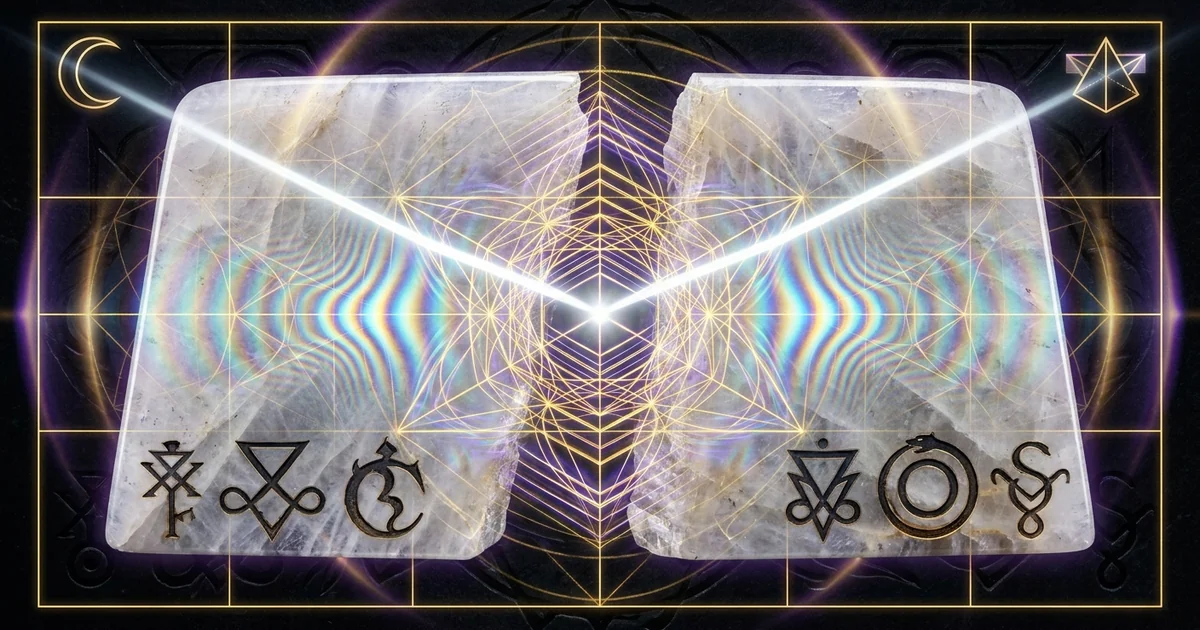
Rainbow Moonstone (White Labradorite) Properties: Geology & Resonant Mineralogy
Mineral Classification & Crystallographic Thesis: Plagioclase Identity vs. Gemological Adularescence
The mineralogical specimen colloquially marketed across the lapidary trade as “rainbow moonstone” represents one of the most pervasive misnomers in contemporary gemology. Within solid-state crystallography and systematic mineralogy, the material is not an alkali feldspar exhibiting adularescence, but rather a transparent-to-translucent calcic-sodic plagioclase feldspar—predominantly white labradorite—situated within the continuous $(\text{Na},\text{Ca})\text{Al}{1-2}\text{Si}{3-2}\text{O}_8$ solid-solution series.
While historical and commercial nomenclature links the stone to classical moonstone due to its pale body color and chromatic reflections, its optical and crystalline architecture deviates sharply from potassium feldspar. Understanding the precise solid-state mechanisms of this material requires untangling its ternary feldspar relationships, crystallographic phase boundaries, and the physics of sub-solidus exsolution.
       CaAl₂Si₂O₈ (Anorthite)
              /\
             /  \
            /    \
           / Bøggild Gap
          / (Labradorite) \
         /        \
        /__________\
NaAlSi₃O₈            KAlSi₃O₈
(Albite)             (Orthoclase)
The Plagioclase Solid-Solution Framework and $(\text{Na},\text{Ca})\text{Al}{1-2}\text{Si}{3-2}\text{O}_8$ Stoichiometry
The plagioclase series forms a coupled substitution network between pure albite ($\text{NaAlSi}_3\text{O}_8$, abbreviated $\text{Ab}$) and pure anorthite ($\text{CaAl}_2\text{Si}_2\text{O}_8$, abbreviated $\text{An}$). This continuous substitution is governed by the simultaneous coupled exchange:
$$\text{Na}^+ + \text{Si}^{4+} \longleftrightarrow \text{Ca}^{2+} + \text{Al}^{3+}$$
This exchange maintains electrostatic neutrality throughout the three-dimensional framework of corner-sharing $[\text{SiO}4]^{4-}$ and $[\text{AlO}4]^{5-}$ tetrahedra. White labradorite falls precisely within the composition range of $\text{An}{50}\text{Ab}{50}$ to $\text{An}{70}\text{Ab}{30}$, meaning that calcium cations occupy 50 to 70 molar percent of the large interstitial $M$-sites within the aluminosilicate scaffolding.
At high magmatic crystallization temperatures exceeding 1100 °C, plagioclase behaves as an ideal, disordered solid solution where sodium and calcium cations, alongside silicon and aluminum tetrahedral distributions, occupy homogeneous, randomized structural states.
As the igneous or metamorphic protolith cools under slow subsolidus thermal regimes, the thermodynamic stability of this disordered lattice degrades. The disparate ionic radii of $\text{Na}^+$ (1.02 Å) and $\text{Ca}^{2+}$ (1.00 Å), combined with the substantially higher valence field strength of $\text{Ca}^{2+}$ and the requisite ordering of $\text{Al}-\text{O}-\text{Al}$ avoidance configurations, forces the crystal lattice toward structural phase separation.
The Bøggild Exsolution Gap: Sub-Microscopic Phase Demixing
The thermodynamic instability inherent to intermediate plagioclase manifests as a defined miscibility gap discovered by mineralogist O. B. Bøggild (1924). The Bøggild miscibility gap occupies the intermediate composition range between roughly $\text{An}{48}$ and $\text{An}{58}$. As temperatures drop through the sub-solidus transition boundary (between 800 °C and 600 °C), uniform plagioclase undergoes spinodal decomposition. This transformation does not rely on classic nucleation and growth kinetics, but instead progresses via spontaneous sinusoidal composition fluctuations throughout the bulk crystal.
This spinodal demixing spontaneously segments the crystal into alternating, planar sub-microscopic exsolution lamellae. These intergrowths alternate between a sodic-rich phase approaching $\text{An}{44}$ and a calcic-rich phase approaching $\text{An}{58}$.
As documented by Ribbe (1983) and further elaborated by Smith and Brown (1988), these lamellar intergrowths remain strictly coherent or semi-coherent along specific crystallographic planes—primarily parallel to the $(010)$ or near-$(30\bar{8})$ lattice vectors. The physical thicknesses of these periodic compositional bands range from 100 nm to 300 nm, an inter-lamellar spatial period that matches the wavelengths of the visible light spectrum.
Resolving the Nomenclature: Labradorite versus Orthoclase Moonstone
The optical consequence of this sub-microscopic architecture is labradorescence, not adularescence. Classical moonstone is derived from the alkali feldspar series, specifically an intergrowth of potassium-rich orthoclase ($\text{KAlSi}_3\text{O}_8$) and sodium-rich albite ($\text{NaAlSi}_3\text{O}_8$), described in detail within orthoclase moonstone mineralogy.
In true adularia-type moonstone, the optical phenomenon called adularescence manifests as a diffuse, milky-white or bluish floating luminescence caused by Rayleigh scattering of light off sub-microscopic cryptoperthitic cryptolamellae. The dimensions of these alkali domains are smaller than the wavelength of incident light, resulting in preferential, non-directional scattering of shorter blue wavelengths.
Conversely, “rainbow moonstone” (white labradorite) produces an intense, directional, multicolored interference flash governed by thin-film constructive interference and Bragg-like scattering. The alternating lamellae generated by the Bøggild gap have distinct indices of refraction ($n_1$ and $n_2$). When polychromatic photons penetrate the transparent mineral surface and cross these phase boundaries, reflection occurs at each successive lamellar interface.
Constructive interference amplifies discrete wavelengths determined by the physical path difference through the lamellae, generating an intense spectral shimmer spanning blue, green, yellow, and occasionally violet or orange.
Plagioclase (White Labradorite)
- Chemical Formula: $(\text{Na},\text{Ca})\text{Al}{1-2}\text{Si}{3-2}\text{O}8$ ($\text{An}{50-70}$)
- Crystal System: Triclinic; space group $C\bar{1}$
- Scattering Mechanism: Constructive thin-film interference (labradorescence) via periodic Bøggild exsolution lamellae (100–300 nm)
- Mean Refractive Index: $n \approx 1.554 - 1.573$
- Birefringence: Higher: $\delta = 0.008 - 0.010$
- Optical Character: Biaxial positive or biaxial negative
- Cleavage Geometry: ${001}$ perfect, ${010}$ good, intersecting at $\approx 86^\circ$
Alkali Feldspar (True Moonstone)
- Chemical Formula: $\text{KAlSi}_3\text{O}_8 - \text{NaAlSi}3\text{O}8$ ($\text{Or}{60-80}\text{Ab}{40-20}$)
- Crystal System: Monoclinic ($C2/m$) to Triclinic ($P\bar{1}$)
- Scattering Mechanism: Rayleigh/Tyndall scattering (adularescence) via cryptoperthitic potassium-sodium segregation (<100 nm)
- Mean Refractive Index: $n \approx 1.518 - 1.526$
- Birefringence: Lower: $\delta = 0.005 - 0.008$
- Optical Character: Biaxial negative
- Cleavage Geometry: ${001}$ perfect, ${010}$ perfect, intersecting at precisely $90^\circ$
Recognizing this distinction is essential. The physical behavior, dielectric resonance in crystalline lattices, and energetic mechanics of rainbow moonstone (white labradorite) crystal properties geology resonance are rooted in the calcic-sodic plagioclase framework rather than the potassic orthoclase matrix.
Lattice Geometry & Solid-State Physics: Triclinic Framework and Optical Interference
The solid state crystallography of white labradorite determines its macroscopic physical properties, anisotropic optical behavior, and subtle vibrational profile. Because plagioclase feldspars lack the orthogonal symmetry axes present in cubic, tetragonal, or orthorhombic materials, their internal energy distribution and directional response to mechanical, thermal, and electromagnetic forces are inherently anisotropic.
      Z (c-axis)
       |
       |  / Y (b-axis)
       | /  β ≠ 90°
       |/_______ X (a-axis)
      α ≠ 90°    γ ≠ 90°
Triclinic Symmetry and the $C\bar{1}$ Space Group Configuration
White labradorite crystallizes within the triclinic crystal system, assigned to the space group $C\bar{1}$ (or $P\bar{1}$ in fully ordered, low-temperature metamorphic states). The unit cell parameters are characterized by non-equal crystallographic axes and non-orthogonal interaxial angles:
$$a \approx 8.18\text{ \AA}, \quad b \approx 12.87\text{ \AA}, \quad c \approx 14.17\text{ \AA}$$
$$\alpha \approx 93.5^\circ, \quad \beta \approx 116.2^\circ, \quad \gamma \approx 90.0^\circ$$
The foundational structural unit consists of a continuous framework of four-membered rings of $[\text{AlO}_4]$ and $[\text{SiO}_4]$ tetrahedra linked into crankshaft-like chains extending parallel to the $a$-axis.
Because the radius of $\text{Ca}^{2+}$ is small relative to the high-coordination interstitial cavities available within the framework, the aluminosilicate scaffold tilts and collapses slightly around these divalent charge centers. This distortion eliminates all mirror planes and rotation axes, leaving only a spatial center of inversion ($\bar{1}$).
This structural distortion creates directional variation throughout the crystal. Chemical bonds, atomic packing densities, and electron polarizabilities vary across every vector of the lattice. This fundamental low symmetry governs how the mineral processes incoming coherent energy, directing both ambient electromagnetic waves and subtle vibrational inputs along asymmetric crystallographic axes. The crystallographic properties of these lower-symmetry frameworks contrast with the isotropic networks examined in platonic solids and crystallographic symmetry.
Polysynthetic Twinning and Lamellar Thickness Dynamics
A structural hallmark of intermediate plagioclase is the ubiquitous development of polysynthetic twinning. White labradorite universally displays albite law twinning, where the twin plane and composition plane align with $(010)$, alongside pericline law twinning, where the twin axis is $[010]$ and the composition plane corresponds to the rhombic section. These polysynthetic lamellae repeat at sub-micron to millimeter scales throughout the specimen.
When albite twinning intersects the sub-microscopic Bøggild exsolution lamellae, a three-dimensional spatial grating forms. The thickness of the individual Bøggild lamellae ($d_1$ and $d_2$) is modulated by the cooling history of the parent rock:
$$\lambda = 2 \left( n_1 d_1 \cos \theta_1 + n_2 d_2 \cos \theta_2 \right)$$
Where:
- $\lambda$ represents the selectively reflected spectral wavelength,
- $n_1, n_2$ are the respective refractive indices of the albite-rich and anorthite-rich phases,
- $d_1, d_2$ represent the physical thicknesses of the alternating layers, and
- $\theta_1, \theta_2$ are the angles of refraction within each respective phase.
If the cooling rate was relatively rapid (as in shallow intrusive dikes or thick volcanic flows), the lamellae remain thin ($100-150\text{ nm}$), producing a bright ultraviolet-to-blue labradorescent flash. Slower cooling across plutonic metamorphic terranes yields broader lamellae ($200-300\text{ nm}$), shifting the interference pattern toward yellow, green, and multi-spectral rainbow distributions across the cleavage face.
Incident Polychromatic Light
        \       / Reflected Wavelength λ (Interference)
         \     /
--------------------------------------- Interface
   Phase 1: Albite-Rich (n₁, d₁)
--------------------------------------- Interface
   Phase 2: Anorthite-Rich (n₂, d₂)
--------------------------------------- Interface
   Phase 1: Albite-Rich (n₁, d₁)
--------------------------------------- Interface
Dielectric Anisotropy, Refractive Indices, and Birefringence Values
The optical indicatrix of white labradorite is biaxial, with principal refractive indices measuring:
$$n_\alpha \approx 1.554 - 1.560, \quad n_\beta \approx 1.559 - 1.565, \quad n_\gamma \approx 1.564 - 1.573$$
The maximum birefringence ($\delta = n_\gamma - n_\alpha$) falls between $0.008$ and $0.010$. This optical double refraction splits unpolarized incident light into two orthogonally polarized rays traveling at different velocities through the crystal.
Empirical Laboratory Crystallographic Profile for White Labradorite:
- Crystal System: Triclinic
- Space Group: $C\bar{1}$
- Unit Cell Constants: $a = 8.175\text{ \AA}$, $b = 12.865\text{ \AA}$, $c = 14.168\text{ \AA}$; $\alpha = 93.52^\circ$, $\beta = 116.25^\circ$, $\gamma = 89.90^\circ$
- Unit Cell Volume ($V$): $\approx 1332.4\text{ \AA}^3$ ($Z = 8$)
- Refractive Indices: $n_\alpha = 1.554$, $n_\beta = 1.560$, $n_\gamma = 1.564$
- Birefringence ($\delta$): $0.010$
- Mohs Hardness: $6.0 - 6.5$
- Specific Gravity: $2.68 - 2.72\text{ g/cm}^3$
- Cleavage: Perfect on ${001}$, good on ${010}$, poor on ${110}$
- Dielectric Permittivity ($\varepsilon_r$): $\approx 6.8$ (measured at 1 MHz along the normal to $(001)$)
- Primary Reference: Ribbe, P. H. (1983). Feldspar Mineralogy. Reviews in Mineralogy, Mineralogical Society of America.
At radio and microwave frequencies, the relative dielectric constant ($\varepsilon_r$) of labradorite hovers around $6.8$ at 1 MHz. However, because of the triclinic symmetry, the dielectric tensor $[\varepsilon_{ij}]$ displays non-diagonal components that reflect spatial variations in polarizability.
The alternating calcium-rich and sodium-rich lamellae create periodic fluctuations in dielectric permittivity across the nanostructure. This periodic dielectric lattice functions as an optical Bragg grating that reflects specific optical frequencies while permitting off-resonance wavelengths to pass through without phase distortion.
Subtle Energetic Dynamics & Resonance Mechanics: Photonic Phase Modulation in the Biofield
The structured physical architecture that produces labradorescence also underpins the mineral’s subtle energetic behavior. In subtle energetic research, crystalline materials are evaluated not as inert masses, but as solid-state transducers capable of interacting with subtle biological fields.
Because the sub-microscopic dimensions of white labradorite’s exsolution lamellae (100–300 nm) match the wavelengths of visible and near-ultraviolet photons, the crystal lattice functions as an energetic filter for coherent biophotonic fields.
Exsolution Boundary Interfaces as Biophotonic Waveguides
Living systems emit ultra-weak biophoton emissions (UPE) characterized by high degrees of coherence, originating primarily from mitochondrial metabolic pathways and cellular DNA unwinding. In states of physical stress, emotional turbulence, or somatic disharmony, this coherent biophotonic output degrades into chaotic, out-of-phase emissions, creating entropy within the localized biofield.
When placed within the near-field range of human biophotonic emission (such as resting upon the dermis or positioned within the coronal field), white labradorite acts as a dielectric boundary array. The coherent lamellar junctions formed by spinodal decomposition within the Bøggild gap create alternating electrostatic potentials. Incoherent biological light entering these planar interfaces undergoes repeated reflection and phase matching:
$$\Delta \phi = \frac{2\pi}{\lambda} \Delta L = 2\pi m \quad (m \in \mathbb{Z})$$
Photons matching the constructive interference criteria emerge as a phase-correlated, organized optical emission, whereas out-of-phase, entropic frequencies are attenuated through destructive phase cancellation. In this manner, white labradorite functions as a passive biophotonic waveguide, transforming scattered biofield noise into structured, polarized photonic emissions.
Phase-Boundary Resonant Scattering and Upper-Chakra Coherence
Traditional metaphysical traditions assign rainbow moonstone to the upper subtle anatomy—specifically the Ajna (sixth/third eye) and Sahasrara (seventh/crown) chakras, extending into the transpersonal auric layers. Translated into biophysical terms, these centers represent regions of high neuro-electrical activity and optical biofield density associated with the cerebral cortex, pineal gland, and cranial microvasculature.
Crown (Sahasrara)  <-- High-frequency biophotonic field
               |
        Third Eye (Ajna)   <-- Neural coherence & melatonin phase
               |
  [ White Labradorite Matrix ] <-- Dielectric lamellar phase matching
               |
     Reflected Phase Coherence
The blue and violet chromatic flashes common to gem-grade white labradorite correspond to energetic frequencies between $680\text{ THz}$ and $750\text{ THz}$ (wavelengths of 400–440 nm). These specific frequencies match the cellular blue-light signaling bands implicated in circadian synchronization, endogenous melatonin release, and cryptochrome activation.
By filtering ambient electromagnetic and bio-plasmic fluctuations through its alternating sub-micron lattice, the crystal presents a stable, high-frequency boundary that entrains surrounding energetic patterns. This entrainment helps reduce noise within overstimulated upper-chakra regions, stabilizing chaotic mental constructs into coherent, contemplative awareness.
Piezo-Optic Coupling with Longitudinal Biological Currents
Although the ideal, fully ordered triclinic feldspar structure possesses a centrosymmetric space group ($C\bar{1}$) that theoretically precludes classical bulk piezoelectricity, real-world white labradorites feature structural lattice strain, stacking faults, and uncompensated boundary charges across semi-coherent lamellar contacts.
At the nanometer scale, the rapid spatial modulation between the calcic anorthite domains and sodic albite domains breaks local inversion symmetry. This strain generates localized piezo-optic and flexoelectric effects.
When the crystal undergoes acoustic vibrations, thermal cycling, or pressure fluctuations from the human body, these strained interfacial boundaries generate localized electric polarization gradients:
$$P_i = d_{ijk} \sigma_{jk} + \mu_{ijkl} \frac{\partial \varepsilon_{jk}}{\partial x_l}$$
Where:
- $P_i$ is the induced subtle electric polarization vector,
- $d_{ijk}$ represents localized non-centrosymmetric piezoelectric coefficients,
- $\sigma_{jk}$ is mechanical stress,
- $\mu_{ijkl}$ is the flexoelectric tensor, and
- $\frac{\partial \varepsilon_{jk}}{\partial x_l}$ represents strain gradients occurring across the lamellar interfaces.
These localized potential gradients couple with longitudinal biological currents traveling along connective tissue fascia and acupuncture meridian networks. The result is a bidirectional energy exchange: biological stress induces minute dielectric variations within the feldspar, and the crystal’s structured, phase-shifted reflections provide a stabilizing informational counter-frequency back into the meridian pathways.
Historical Lapidary Lore & Traditional Lineage: The Lunar Archetype and Paul’s Island Discoveries
The human relationship with optical feldspars spans millennia, shaped by shifts in mineralogical taxonomy, metaphysical paradigms, and lapidary techniques. Because the ancient world lacked X-ray diffraction and optical goniometry, ancient and medieval scholars classified shimmering stones based on their phenomenological behavior and resemblance to natural phenomena.
Classical Selenitis and Medieval Conflation of Optical Feldspars
In classical antiquity, all transparent-to-translucent minerals displaying an internal lunar shimmer were grouped under the Greek term Selenitis (literally “moon stone” or “stone of the moon”), as noted by Theophrastus in his fourth-century BCE treatise De Lapidibus.
Pliny the Elder preserved this archetype in his comprehensive Naturalis Historia (c. 77 CE), recording that Selenitis contained an image of the moon that expanded or contracted in sync with the celestial lunar cycle.
Ancient 'Selenitis' (Phenomenological Classification)
       ├── Gypsum Crystals (Modern Selenite)
       ├── Potassic Orthoclase Moonstone (Adularia)
       └── Sodic-Calcic Plagioclases (White Labradorite / Peristerite)
During this classical period and throughout the Middle Ages, lapidaries conflated multiple distinct mineral species under this lunar umbrella:
- Cleavable, fibrous gypsum (modern selenite, $\text{CaSO}_4 \cdot 2\text{H}_2\text{O}$);
- Adularescent orthoclase feldspar from the European Alps (true adularia);
- Pale, iridescent plagioclase varieties derived from weathered pegmatites and metamorphic schists in modern-day Sri Lanka and India.
Ancient lapidaries valued these stones for their ability to soothe emotional agitation, regulate somatic fluid balances, and enhance intuitive faculties. The continuous shift of optical flash across the crystal’s facets was interpreted as a physical embodiment of cyclical transformation, linking human physiology to wider cosmic rhythms.
Primary Textual Excerpt: Pliny the Elder, Naturalis Historia, Book XXXVII, Chapter 67:
“Selenitis ex candido translucet melleo fulgore, imaginem lunae continens, quae in ea crescere atque decrescere diebus singulis creditur…” (Selenitis is white and translucent with a honeyed brilliance, containing an image of the moon which is believed to wax and wane with each passing day…)
Field Dispatches from Moravian Missionaries (Labrador Peninsula, 1770):
Writing from the mission outpost near Nain on Paul’s Island, Father Adolf Trouper documented the discovery of a dense, dark stone alongside paler, translucent variants: “…when turned against the sun, it presents an astonishing fire of light, flashing not unlike the aurora borealis, spanning azure, emerald, and silver tones, distinct from the quiet adularescent gems of the German Alps.”
Moravian Missionaries and the Mineralogical Isolation of Labradorite
The clear mineralogical separation of labradorescent plagioclase began around 1770 on Paul’s Island, located near Nain on the coast of Labrador, Canada. Moravian missionaries stationed in this subarctic territory collected iridescent feldspar specimens from coastal anorthosite formations and sent them back to Central Europe.
Mineralogists quickly recognized that this material differed fundamentally from the Alpine adularia described by Ermenegildo Pini in 1780. In 1780, Abraham Gottlob Werner officially introduced the term “labradorite” into the geological lexicon.
While early mineralogical interest focused primarily on the dark, melanocratic varieties from Canada, subsequent exploration in southern India, Madagascar, and Sri Lanka uncovered transparent-to-translucent leucocratic (white-base) deposits.
Lapidaries noticed that when these pale plagioclase stones were cut into cabochons, they displayed bright, multi-hued interference colors over a milky or clear background. Gemstone merchants adopted the term “rainbow moonstone” to capitalize on the historical market for orthoclase moonstone, bridging ancient lunar lore with the dynamic optical flash of plagioclase.
Ayurvedic and Rasashastra Paradigms: Soma Cooling and Pitta Regulation
In the Indian lapidary and medical traditions of Ayurveda and Rasashastra, pale iridescent stones are grouped as Chandrakanta Mani (“gem beloved by the moon”). Classical Ayurvedic pharmacopeias describe Chandrakanta Mani as carrying a sweet (Madhura), astringent (Kashaya), and cooling (Sheeta) energetic profile (Virya).
Esoteric physiology maps white iridescent stones directly to the Ida nadi—the subtle energetic channel running to the left of the spinal column that governs parasympathetic activation, mental calming, and the lunar, rejuvenating currents of Soma. Practitioners prescribed these minerals to counter high Pitta dosha, which manifests physically as excess systemic heat, inflammation, and hyper-acidity, and psychologically as irritability, impatience, and emotional fixation.
Holding or wearing a polished white feldspar during meditation was believed to quiet hyperactive metabolic fire (Agni), draw excess heat away from the cranium, and restore equilibrium to the subtle and physiological systems.
Practical Applications, Calibration & Safety Protocols: Cleavage Mechanics and Resonant Tuning
Because white labradorite possesses distinct crystallographic and chemical characteristics, its application in resonance healing, gemological setting, and subtle energetic tuning demands careful adherence to physical and vibrational constraints. Misunderstanding its cleavage dynamics or chemical stability risks damaging the specimen or yielding sub-optimal energetic performance.
              Direction of {001} Cleavage
             ═════════════════════════════►
            ┌───────────────────────────┐
            │                           │
 Direction  │                           │
 of {010}   │       Triclinic Unit      │
 Cleavage   │         Framework         │
    │       │                           │
    ▼       └───────────────────────────┘
Geometric Orientation Along the (001) and (010) Perfect Cleavage Vectors
The name plagioclase derives from the Greek plagios (oblique) and klasis (fracture), describing the characteristic non-orthogonal intersection of its dominant cleavage planes. White labradorite displays:
- Perfect cleavage on ${001}$: Driven by broken $\text{Al}-\text{O}-\text{Si}$ bonds along the weakest link in the tetrahedral framework;
- Good/distinct cleavage on ${010}$: Intersecting the ${001}$ plane at an oblique angle of approximately $86^\circ 24’$.
These cleavage vectors represent physical planes of mechanical weakness as well as preferential pathways for vibrational conduction. When introducing acoustic or scalar vibrational frequencies to white labradorite, the energetic vectors must be directed parallel to the ${001}$ or ${010}$ cleavage planes.
Applying mechanical shock, high-energy ultrasound, or point-load pressure perpendicular to these planes induces immediate micro-flaking or catastrophic structural failure along internal cleavage traces. Energetic practitioners should handle cabochons by their rounded girdles rather than their flat bases, avoiding torsional strain across these natural parting planes.
Dielectric Attunement and Environmental Field Grounding
Due to its high dielectric permittivity ($\varepsilon_r \approx 6.8$) and the anisotropic layout of its Bøggild lamellae, white labradorite readily accumulates static electrostatic charges and localized electromagnetic signatures from its immediate environment. Without routine clearing, this parasitic dielectric loading can disrupt its ability to cleanly phase-modulate incoming biophotonic fields.
Proper calibration and clearing of the mineral should avoid extreme thermal shifts. Methods include:
- Low-Temperature Piezoelectric Cycling: Exposing the specimen to clean, running water with high mineral purity at ambient temperatures ($15-20\text{ }^\circ\text{C}$) to dissipate surface charge accumulations;
- Acoustic Entrainment: Using precision sonic inputs (such as a 432 Hz or 528 Hz tuning fork) held $5-10\text{ cm}$ from the cabochon face to stimulate the lamellar interfaces through acoustic shear waves;
- Scalar Field Grounding: Placing the mineral upon high-density crystalline quartz matrices or grounding plates connected directly to Earth ground. This drains secondary electromagnetic accumulation without placing stress on the crystal’s inter-lamellar boundaries.
Toxicity and Material Fragility Constraints: Aluminum Silicate Stability
From a biochemical perspective, the aluminosilicate matrix of $(\text{Na},\text{Ca})\text{Al}{1-2}\text{Si}{3-2}\text{O}_8$ remains chemically inert under standard physiological conditions. However, the presence of labile calcium ($\text{Ca}^{2+}$) and structural aluminum ($\text{Al}^{3+}$) requires caution within certain wellness paradigms:
- Strict Prohibition on Direct Elixirs: Never place raw or polished white labradorite directly into water meant for internal consumption. Acidic or chemically reactive aqueous solutions can leach aluminum cations ($\text{Al}^{3+}$) from exposed cleavage steps and surface fissures over time. Only indirect preparation methods (where the crystal is sealed in an impermeable glass vessel before submersion) are acceptable.
- Thermal Shock Sensitivity: Plagioclase feldspars feature anisotropic thermal expansion coefficients across their three non-orthogonal axes. Exposure to boiling water, steam cleaners, or sudden temperature swings can cause immediate spallation and fracturing along the Bøggild exsolution boundaries, permanently destroying the stone’s optical interference flash.
- Psychic Disconnection & Uncoupling: White labradorite’s strong focus on upper-chakra and coronal biofields can induce feelings of spatial disorientation, lightheadedness, or energetic ungrounding in sensitive individuals. Always balance its use with high-density, iron-rich grounding minerals (such as black tourmaline or hematite) applied to the lower foundational centers.
Frequently Asked Questions: Mineralogical Nuances and Resonant Integrity
Authenticity Verification: Distinguishing True Adularia from White Labradorite
Determining whether a specimen is true orthoclase moonstone or white labradorite (“rainbow moonstone”) relies on basic gemological and mineralogical testing:
- Refractive Index (RI) Testing: Place the polished flat face on a standard gemological refractometer using refractive index contact liquid. White labradorite displays a higher refractive index range ($n = 1.554 - 1.573$), whereas true adularescent orthoclase moonstone shows a lower index ($n = 1.518 - 1.526$).
- Optical Interference (Schiller vs. Labradorescence): Observe the optical flash under a focused single-point incandescent light source. True orthoclase moonstone exhibits a soft, billowing, predominantly monochromatic (white to soft blue) adularescence visible across a broad range of viewing angles. White labradorite displays an intense, directional, multi-chromatic (electric blue, gold, green, violet) labradorescence that flashes sharply and disappears as the specimen tilts past specific reflection angles.
- Specific Gravity (SG): Perform hydrostatic weighing. White labradorite has a density between $2.68$ and $2.72\text{ g/cm}^3$, noticeably higher than orthoclase moonstone’s density of $2.56 - 2.59\text{ g/cm}^3$.
SPECIFIC GRAVITY / DENSITY
              2.56 g/cm³                       2.70 g/cm³
Orthoclase        |-----------------|
Labradorite                                |-----------------|
              1.520                            1.560
                        REFRACTIVE INDEX (RI)
Structural Vulnerability: Why Rainbow Moonstone Fractures Easily
A common concern among gem cutters and practitioners is the presence of internal lines, planes, and seemingly fragile steps within high-grade rainbow moonstone. These internal features are not structural damage or impact fractures; they are intrinsic crystallographic twin planes and cleavage steps:
            Twin Boundary (Albite Law)
                 │
                 ▼
    ┌───────────┬───────────┐
    │  Lattice  │  Lattice  │
    │  Domain A │  Domain B │  <-- Alternating lamellar orientations
    │           │           │      induce natural cleavage planes
    └───────────┴───────────┘
The presence of polysynthetic albite twinning along $(010)$, combined with perfect ${001}$ cleavage, produces flat structural surfaces within the crystal.
Furthermore, the Bøggild miscibility gap inherently forms distinct compositional bands; the boundary between these anorthite-rich and albite-rich layers represents an area of sub-microscopic lattice strain. These intersecting structural features make plagioclase naturally brittle (Mohs hardness 6.0–6.5), requiring protective jewelry settings and careful handling during energetic applications.
Resonant Field Optimization: Orienting the Schiller Effect in Sacred Layouts
To maximize the biophotonic coupling and subtle resonance effects of white labradorite in practical applications, the stone’s physical orientation must be aligned with the user’s primary biomagnetic emission axis:
- Identify the Interference Plane: Hold the cabochon under a diffuse light source and rotate it until the flash achieves peak chromatic intensity. The flat plane beneath this flash coincides with the internal $(010)$ or near-$(30\bar{8})$ Bøggild exsolution boundary.
- Vector Alignment: Position the stone so this reflective flash face directly opposes the incoming biofield vector (for example, facing directly downward toward the skin when placed upon the third eye or crown center).
- Cleavage Vector Orientation: Align the elongated axis of the cabochon (which usually traces the natural ${001}$ cleavage trace) parallel to the body’s vertical central meridian (Sushumna axis). This orientation allows longitudinal fascia currents to run parallel to the mineral’s primary crystallographic conduction paths, minimizing energetic resistance and optimizing phase coupling.
By grounding metaphysical applications in solid state crystallography and mineral physics, practitioners can engage with rainbow moonstone (white labradorite) crystal properties geology resonance not as an imprecise myth, but as an advanced natural transducer of optical, electrical, and subtle energies. :::