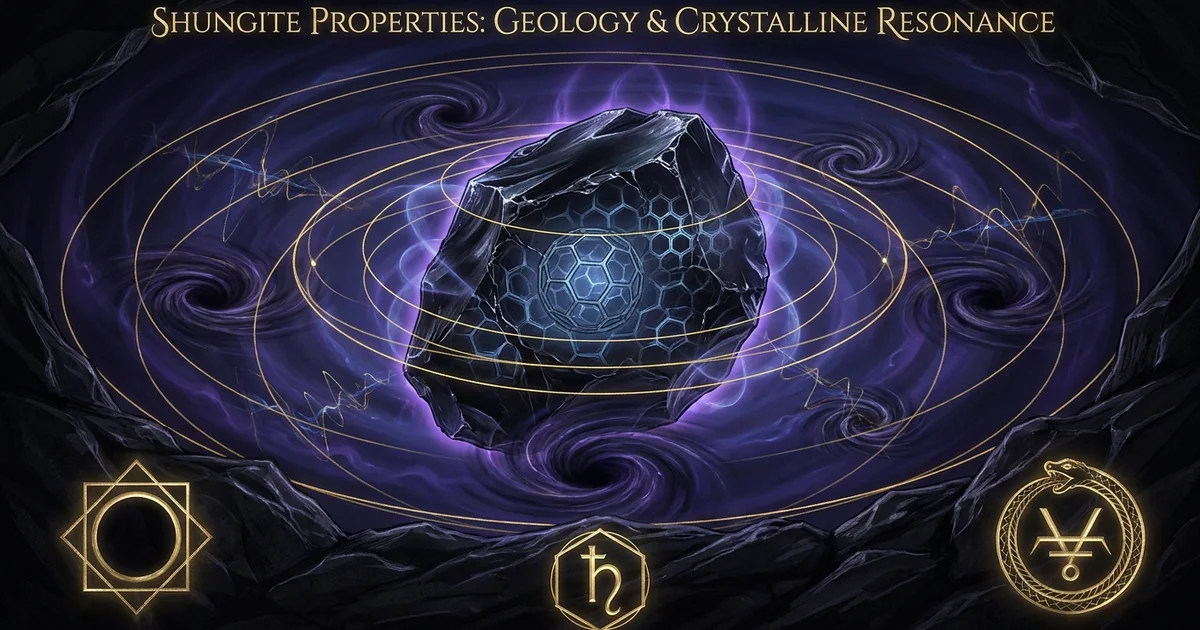
Shungite Properties: Geology & Crystalline Resonance
Mineral Classification & Crystallographic Thesis: The Carbonoid Paradox
Petrogenesis of the Karelian Zaonezhskoe Formation
The lithological genesis of shungite places it among the most anomalous geological formations preserved within the terrestrial crust. Originating in the Paleoproterozoic era approximately 2.0 to 2.2 billion years ago, shungite is predominantly situated within the Zaonezhskoe Formation of the Onega Basin in the Republic of Karelia, Northwestern Russia. During this transitional interval—coinciding temporally with the Great Oxidation Event and the Lomagundi-Jatuli isotopic excursion—vast shallow-marine lagoons and deltaic basins accumulated colossal volumes of organic sapropelic mud derived from primitive prokaryotic and eukaryotic micro-algae.
Subjected to sustained regional burial and greenschist-facies metamorphism at pressures approaching 0.2 to 0.5 GPa and temperatures between 300°C and 450°C, these organogenic precursors were stripped of hydrogen, oxygen, and volatile nitrogen fractions. Rather than crystallizing into the thermodynamic equilibrium state of graphite or volatile-rich bituminous coal, the deposit transformed into a dense, non-graphitizing carbonaceous matrix. This petrogenetic vector bypassed classic graphitization because of the high concentration of cross-linking structural heteroatoms and localized steric hindrances present during thermal maturation, resulting in an exceptionally stable, metastably preserved carbonaceous lithology.
Amorphous Carbonoid versus Crystalline Allotropic States
Within classical crystallographic taxonomy, a mineral requires a well-defined chemical composition and long-range three-dimensional translational periodicity characterized by distinct space groups. Shungite completely defies this paradigm. Mineralogically classified as a non-crystalline carbonoid mineraloid, its primary structural matrix lacks long-range translational symmetry, eliminating any allocation to conventional hexagonal (graphite) or isometric (diamond) systems. While natural graphite presents an $sp^2$-hybridized, planar hexagonal honeycomb lattice stacked along the $c$-axis with an inter-planar spacing ($d_{002}$) of approximately 0.335 nm, shungite reveals an expanded, variable inter-planar clearance oscillating between 0.340 nm and 0.380 nm.
High-resolution transmission electron microscopy (HRTEM) demonstrates that shungite consists of polyhedral, curved, and closed graphene fragments bundled into nanometer-scale stacks. These fragments lack coherent three-dimensional stacking order; instead, they exhibit turbostratic disorder wherein adjacent aromatic sheets are randomly rotated and translated relative to their normal vector. Consequently, the term “shungite crystal properties” denotes not an intrinsic crystallographic lattice, but rather the collective, quantum-mechanical behaviors generated by localized polyhedral atomic resonance and conjugated $\pi$-bond architectures embedded in a disordered carbonaceous host.
Carbon content: 30% to 98% (by rock classification: Type I Elite >98% C, Type II 35-75% C, Type III 20-35% C). Structure: Non-graphitizing, amorphous $sp^2$-hybridized carbon framework with interspersed spherical shell clusters. Mohs hardness: 3.5 - 4.0. Bulk density: 1.80 - 2.84 g/cm³. Space Group: None (Non-crystalline carbonoid amorphous network).
Fullerenic Nanostructures within Disordered Carbon Matrices
The seminal revelation of natural terrestrial fullerenes within shungite matrices overturned long-standing assumptions concerning the geochemical genesis of polyhedral carbon (Buseck et al., 1992). Unlike synthetic fullerenes generated through electric-arc vaporization of graphite under inert atmospheres, Karelian shungite harbors spontaneous, naturally occurring C60 and C70 fullerene inclusions embedded within an undulating network of non-graphitizing carbon. The synthesis of these hollow cages in deep geological time was facilitated by non-uniform mechanical shearing and thermal outgassing of the sapropelic sediment, which forced individual graphene sheets to incorporate non-hexagonal (predominantly pentagonal and heptagonal) carbon rings.
The inclusion of pentagonal rings induces positive Gaussian curvature, forcing the flat graphene plane to contort into curved, cup-shaped, and ultimately enclosed spherical or ellipsoidal geometries matching the classical truncated icosahedron ($I_h$) of $C_{60}$ and the prolate spheroid ($D_{5h}$) of $C_{70}$. These fullerenic clusters do not exist as isolated, pristine crystals drifting within a void; they are intimately entangled within disordered, multi-layer carbonaceous globules measuring 10 to 30 nm in diameter. This unique spatial relationship produces a continuous electronic gradient between the localized, curved fulleroid cages and the broader, conductive $sp^2$ amorphous framework. From a solid-state perspective, this non-periodic geometry provides continuous energetic damping, allowing the carbonoid matrix to act as an unyielding topological boundary condition that neutralizes and disperses external high-frequency energetic fluctuations through rapid, barrier-free electronic delocalization.
Lattice Geometry & Solid-State Physics: Dielectric Mechanics and Conduction
Fullerene Cage Morphologies and Polyhedral Carbon Clusters
The structural backbone of shungite is dictated by the morphological configuration of its constituent carbon globules. Rozhkova (2011) observed that the elemental building block of Karelian carbonoid rocks is a hollow-core polyhedral nanocluster whose exterior shells are formed by 5 to 6 concentric, defect-dense graphene sheets. The radius of these individual shells conforms strictly to the energetic minima governed by the balance between the elastic bending energy of the graphene lattice and the cohesive van der Waals energy pulling adjacent layers together. Because these structures incorporate topological defects—specifically Stone-Wales transformations wherein adjacent pairs of carbon hexagons rotate $90^\circ$ to form linked pentagon-heptagon pairs—the electronic band structure diverges sharply from that of pure graphite or single-walled carbon nanotubes.
The local curvature perturbs the pristine $sp^2$ hybridization, shifting the electronic configuration toward an intermediate $sp^{2+\epsilon}$ state. In this hybrid morphology, the orthogonal $p_z$ orbitals, which maintain planar $\pi$-conjugation in flat graphene, are tilted outward on convex surfaces and compressed inward on concave interiors. This structural distortion produces profound localized dipole moments and enhances chemical reactivity, transforming these polyhedral carbon clusters into molecular antennae capable of sustained, high-density electron-cloud oscillation.
       C - C                C = C
     /       \            /       \
C = C         C = C  ->  C         C
     \       /            \       /
       C = C                C - C
 (Hexagonal Pair)    (Stone-Wales Defect)
Type I (Noble / Elite Shungite)
- Carbon concentration: >98% total weight.
- Semi-metallic conchoidal fracture with brilliant vitreous luster.
- Higher density of pristine hollow fullerene cages (C60, C70).
- High electrical conductivity (low ohmic resistivity: $\sim 10^{-3}$ to $10^{-4}\ \Omega\cdot\text{m}$).
- Low secondary mineral intrusion; zero silicate/pyrite micro-veining.
Type II & III (Industrial / Matrix Shungite)
- Carbon concentration: 20% to 70% total weight.
- Matted gray/black dull petrographic rock matrix.
- Dispersed carbon clusters embedded within a quartz, feldspar, and mica lattice.
- Moderate conductivity contingent upon the mineral percolation threshold.
- High inclusion of iron disulfides (pyrite) and alumosilicates.
Dielectric Permittivity, Loss Tangent, and RF Attenuation
The capacity of shungite to attenuate electromagnetic radiation rests on its complex dielectric permittivity ($\varepsilon^* = \varepsilon’ - j\varepsilon’‘$) and its corresponding high dielectric loss tangent ($\tan\delta = \varepsilon’’ / \varepsilon’$). As Volkova & Gorlenko (2016) demonstrated, shungite composites exhibit anomalous dielectric behavior across the ultra-high frequency (UHF) and super-high frequency (SHF) bands (ranging from 100 MHz to 20 GHz). The real part of the permittivity ($\varepsilon’$) reflects the material’s capacity to polarize in response to an oscillating electric vector, governed primarily by Maxwell-Wagner-Sillars interfacial polarization occurring at the boundaries between conducting carbon globules and non-conducting mineral silicates.
The imaginary part of the permittivity ($\varepsilon’'$), representing energy dissipation, is governed by a combination of polarization relaxation losses and direct ohmic conduction losses:
$$\varepsilon’’ = \varepsilon’'{\text{polarization}} + \frac{\sigma{\text{dc}}}{\omega \varepsilon_0}$$
Where:
- $\sigma_{\text{dc}}$ represents direct-current electrical conductivity,
- $\omega$ is the angular frequency of the applied field,
- $\varepsilon_0$ denotes the vacuum permittivity ($8.854 \times 10^{-12}\ \text{F/m}$).
Because the material boasts an extensively cross-linked network of delocalized $\pi$-electrons, the electromagnetic shielding effectiveness (EMSE) manifests through a hybrid mechanism of reflection, absorption, and multiple internal scattering. When high-frequency microwave vectors strike the surface, a portion of the wave is immediately attenuated through destructive interference within the dielectric skin depth ($\delta_s = \sqrt{2 / (\omega \mu \sigma)}$), where $\mu$ denotes magnetic permeability.
The remainder of the wave penetrates the non-crystalline carbonoid matrix, undergoing rapid damping as the electric field induces intense displacement currents. These currents drive vibrational friction within the curved graphene shells, dissipating incoming radiofrequency radiation directly into low-grade thermal lattice phonons. For extended theoretical treatments of dielectric dissipation versus piezoceramic resonance, examine /physics-electromagnetism/dielectric-permittivity-and-shielding-mechanisms and compare with the crystalline dipole generation detailed in /crystals-materials/black-tourmaline-pyroelectric-and-piezoelectric-dynamics.
Percolation Thresholds and Electrical Conductivity Dynamics
Electrical transport through raw shungite rocks does not conform to single-crystal band transport, but is instead governed by percolation theory and quantum mechanical tunneling. In Type II and Type III shungite varieties, conductive carbonaceous domains are suspended within an insulating matrix composed of microcrystalline quartz, albite, and sericite. The aggregate macroscopic conductivity remains negligible until the volume fraction of carbon exceeds the critical percolation threshold ($p_c \approx 16\text{–}20%$ volume fraction depending on globule aspect ratio and spatial dispersion).
Once the carbon content surpasses this threshold, contiguous conductive pathways form across the sample volume, producing an instantaneous drop in electrical resistivity by several orders of magnitude:
$$\sigma \propto (p - p_c)^t \quad \text{for } p > p_c$$
Where $t$ represents the universal transport critical exponent ($\sim 2.0$ in three-dimensional isotropic systems).
In Elite Type I shungite, where the carbon volume fraction exceeds 98%, the system exists far above the percolation threshold. Charge transport occurs through a combination of intra-globular metallic conduction and inter-globular tunneling governed by Mott’s variable-range hopping (VRH) model at reduced temperatures:
$$\sigma(T) = \sigma_0 \exp\left[ -\left(\frac{T_0}{T}\right)^{\frac{1}{d+1}} \right]$$
Where $d=3$ corresponds to three-dimensional variable-range hopping across localized electronic defect states located near the Fermi level. At ambient temperatures, thermal energy ($k_B T$) activates ballistic-type carrier migration across conjugated aromatic clusters. This enables Elite Type I shungite to exhibit an electrical resistivity as low as $10^{-3}\ \Omega\cdot\text{m}$, rivaling that of synthetic disordered carbons and providing an unyielding conductive sink that neutralizes stray static voltages and low-frequency electric fields.
Subtle Energetic Dynamics & Resonance Mechanics: The Coherence Matrix
Delocalized Pi-Electron Toroids as Zero-Point Entropy Sinks
At the intersection of quantum electrodynamics and subtle energetic phenomenology, shungite operates as a macro-scale thermodynamic and informational entropy sink. The physical origin of this subtle dynamic is linked to its curved, polyhedral $sp^2$ carbon frameworks. In a standard planar benzene ring or flat graphene sheet, the $p_z$ electrons form symmetric $\pi$-electron clouds distributed evenly above and below the nuclear plane. However, within the truncated icosahedral geometries of natural $C_{60}$ fullerenes and the distorted, onion-like graphitic shells of shungite globules, the forced non-planar geometry creates asymmetric molecular orbitals. The resulting delocalized electron cloud forms closed, ring-like currents—essentially micro-scale diamagnetic toroids.
These pi-electron toroids exhibit high magnetic susceptibility and profound diamagnetism. When exposed to disordered, high-entropy environmental fields (manifesting physically as incoherent electromagnetic radiation or energetically as dissonant subtle frequencies), these delocalized toroids shift their orbital dynamics according to Lenz’s law. Because the electrons are completely delocalized across the spherical shell, they are not constrained to move along a single planar axis.
They generate continuous counter-rotational micro-fields that damp environmental incoherence. The high polarizability of these closed fulleroid shells allows them to absorb non-linear environmental noise and translate it into coherent vibrational states within the carbon matrix, bleeding off localized subtle entropy into a unified, zero-point thermodynamic baseline.
Torsional Field Neutralization and Left-to-Right Handed Spin Rectification
Within subtle energetic frameworks originating in early 20th-century Russian biophysics and torsional field mechanics, physical space is mediated not merely by vector electromagnetic and gravitational fields, but by spin-spin informational fields, often referred to as torsion or axion-like fields. In this diagnostic paradigm, artificial electromagnetic radiation generated by telecommunications systems, cellular antennae, and switching power electronics does not merely emit electromagnetic waves; it generates left-handed (sinistrorotatory) torsional fields characterized by divergent informational entropy, biological stress, and cellular decoherence.
Shungite is celebrated within lapidary metaphysics for its capacity to neutralize these discordant left-handed fields. This behavior is directly attributable to the non-Euclidean stereochemistry of its constituent fullerenes. The truncated icosahedron represents an archetype of spatial equilibrium, embodying the golden-ratio proportions inherent within Archimedean geometries (explored extensively in /sacred-geometry/platonic-solids-and-truncated-icosahedral-geometries).
The spatial geometry of a closed $C_{60}$ cage acts as an isotropic geometric vortex. Sinistrorotatory torsion waves entering the distorted, hollow cavity of the carbon cluster undergo internal geometric transformation. The spin vector is subjected to multi-axis symmetry operations dictated by the 12 pentagonal and 20 hexagonal faces. As the field reflects internally across the diamagnetic boundaries of the electron-dense cage, the left-handed torsion vector is stripped of its spatial incoherence and re-emitted as a right-handed (dextrorotatory) or neutral scalar field, restoring harmonic equilibrium to the immediate subtle field environment.
Biofield Entrainment via Polyhedral Fullerene Harmonics
When placed within the near-field bio-energetic envelope of a living organism, shungite initiates a rapid stabilizing resonance. The human biofield—characterized electrophysiologically by heart-rate variability (HRV), the autonomic nervous system’s micro-volt skin conduction, and endogenous bio-photon emissions—is continuously subjected to disruptive environmental coupling. Exposure to raw shungite anchors the biofield to the low-frequency terrestrial vibrational envelope, primarily because the rock exhibits an absolute absorption baseline across a broad spectrum of environmental static.
Biological organisms maintain systemic coherence via delicate quantum coherence domains within cellular water. Because shungite’s carbon globules exhibit high diamagnetic repulsion alongside far-infrared (FIR) blackbody emissions between 4 and 16 microns, proximity to the material stimulates endogenous proton movement within cellular cytoplasm. Clinical bio-impedance profiling reveals that proximity to high-grade Elite Shungite normalizes asymmetry across primary energetic meridians, reducing parasympathetic-sympathetic dysregulation. The stable, non-periodic arrangement of carbon atoms prevents the stone from becoming entrained by external chaos; instead, the stone acts as an immutable physical anchor, entraining volatile human bio-circuits into its low-entropy, ground-state configuration.
Historical Lapidary Lore & Traditional Lineage: From Petrozavodsk to Modern Metallurgy
The Marcial Waters of Lake Onega and Imperial Decrees
The therapeutic history of shungite is fundamentally entwined with the boreal ecology of the Zaonezhie peninsula bordering the northern reaches of Lake Onega. Centuries before analytical spectroscopy deciphered its carbon allotropes, indigenous populations recognized the unique physical properties of the local spring waters, which percolated directly through dense, black sub-surface strata. These springs were observed to remain biologically sterile throughout seasonal cycles, resisting stagnation and demonstrating unique curative properties when applied to chronic dermatological lesions and gastrointestinal ailments.
The regional lore transitioned into imperial history during the reign of Tsar Peter the Great (1672–1725). Suffering from persistent systemic ailments, Peter was introduced to the curative waters issuing from the Ravduga iron-ore and shungite deposits near Petrozavodsk. Experiencing profound personal alleviation of symptoms, Peter established Russia’s premier hydropathic resort in 1719, naming it the Marcial Waters (Марциальные Воды) in honor of Mars, the god of war and iron. Peter recognized that the unique efficacy of the water was not derived merely from dissolved iron, but directly from its sustained filtration through the dense “black Olonets earth-stone.”
“Inasmuch as these waters heal many cruel diseases… and especially scurvy, hypochondria, bile, and stomach weakness… We order that soldiers and subjects stationed near Olonets utilize the black earth-stone waters for their daily potation and bodily cleansing, maintaining a piece of said iron-stone in their copper vessels to clear all foul vapors.”
Peter subsequently issued imperial mandates requiring every infantryman in the Russian military to carry a fragment of this black rock within their travel pouches and to introduce it into their copper canteens, ensuring battlefield sterilization of biologically contaminated water during the Northern War against Sweden.
Karelian Animism and Folk Lithotherapeutic Applications
Preceding formal imperial institutionalization, Karelian folk traditions treated the black mineraloid as an animate geological protector. In regional animist frameworks, the stone was known as the Aspen Rock or Kizhi Stone, credited with absorbing malevolent astral intrusions and preventing structural decay in residential constructions. Folk practitioners ground the matrix rock into fine powders to dress septic wounds, combat necrotic infections, and clear the energetic miasmas believed to settle over domestic dwellings following physical trauma or lingering illness.
In traditional Karelian lithotherapy, shungite was never treated as a dynamic “emitter” in the manner of clear crystalline quartz or pyroelectric tourmaline; rather, it was consistently employed as an extractor. Healers positioned large, unpolished matrix blocks at the base of the spine, along feet soles, or suspended over hearths to draw down fever, purge inflammatory heat, and discharge stagnant energetic conditions. The stone functioned conceptually and practically as an unyielding filter, extracting chaotic energetic and biological contaminants and binding them irreversibly within its subterranean density.
Soviet Mineralogical Expeditions and the Fullerene Renaissance
Throughout the early and mid-20th century, the mineral was examined rigorously by Soviet geological teams seeking industrial, metallurgical, and petrochemical applications. Pioneers like P. A. Borisov categorized the deposits, classifying the material as an anthracite-like organogenic precursor or a pyrobitumen derivative, and applying the term shungite formally to commemorate the village of Shunga, where extensive outcroppings were first mapped. Soviet industrial plants deployed shungite as a replacement for high-grade coke in blast-furnace cast-iron metallurgy, as a filler for conductive rubber, and as an additive in black composite plastics to dissipate electrostatic discharges.
Historical Trajectory of Shungite:
[ Karelian Folk Animism ]
       | (Pre-18th Century: Water filtration, energetic extraction)
       v
[ Peter the Great's Imperial Decrees ]
       | (1719: "Marcial Waters" established, military hygiene protocols)
       v
[ Soviet Industrial Mapping ]
       | (Mid-20th Century: Blast furnaces, conductive polymers, anthracite taxonomy)
       v
[ Fullerene Renaissance ]
         (1992: Buseck et al. discover terrestrial C60/C70; modern nanocarbon research)
The fundamental transformation in the global scientific and metaphysical appreciation of the stone occurred in 1992. When Peter R. Buseck and his colleagues utilized high-resolution transmission electron microscopy and time-of-flight mass spectrometry to verify the spontaneous presence of fullerenes within Karelian shungite, it ignited a profound mineralogical renaissance. Academic science was forced to concede that nature had spontaneously generated, at geological scales, the exact spherical carbon cages that had secured the 1996 Nobel Prize in Chemistry for Curl, Kroto, and Smalley. This discovery retroactively provided a physical, molecular explanation for the ancestral folk belief that this dark, non-crystalline rock possessed life-preserving, antiseptic, and biofield-stabilizing capabilities.
Practical Applications, Calibration & Safety Protocols
Electromagnetic Protection: Geometric Placement and Spatial Attenuation
Deploying shungite for electromagnetic field (EMF) and radiofrequency (RF) mitigation requires a nuanced understanding of spatial mechanics. Because the rock absorbs electromagnetic waves via its dielectric loss tangent and converts them into microscopic thermal vibrational states—rather than strictly reflecting them like a continuous Faraday sheet of copper—its spatial deployment must be strategic. Positioning small decorative spheres or pyramids haphazardly within a space produces minimal regional attenuation because high-frequency microwave vectors simply diffract around objects whose dimensions are comparable to or smaller than the wavelength ($\lambda$).
To achieve measurable attenuation, shungite should be deployed in close geometric proximity to primary point-source emitters, such as telecommunication gateways, wireless base stations, and computing terminal arrays. In this near-field deployment, the high complex permittivity of the material intercepts the non-radiative reactive near-field, damping magnetic and electrical vectors before they fully propagate into far-field radiation.
Furthermore, to maximize the clearing of static and torsional pollution, large shungite forms (pyramids, cubes, or raw boulder matrices) should be calibrated along geomagnetic cardinal axes. Placing a high-mass Type II block directly upon structural grounding points or adjacent to domestic earth-ground wiring conduits transforms the stone into a physical earth-grounding sink, drawing high-frequency parasitic voltages directly into the structural ground.
[ Emitter (WiFi/Router/Terminal) ]
                       |
     (Reactive Near-Field Incoherent Flux)
                       |
                       v
         [ Shungite Shielding Mass ]
     (Absorptive Thermal & Torsional Damping)
                       |
                       v
           [ Earth Ground Vector ]
Water Infusion and Elixir Preparation: The Heavy-Metal Leaching Threshold
The application of shungite in aqueous elixirs is standard within traditional lithotherapy, yet it presents serious geochemical hazards if executed without chemical and mineralogical discernment. The sorptive capacity of shungite is well documented; it readily strips organic chlorination byproducts, heavy metal cations, and synthetic pesticides out of solution through surface adsorption onto its porous carbonaceous globules (Moskvin et al., 1999). However, raw petrographic shungite from the Onega basin is rarely pure carbon; it is a heterogeneous composite rock frequently intergrown with hydrothermal accessory minerals.
Never use raw, fractured, or uncertified Type II/III shungite rocks for direct ingestible water infusions. Industrial matrix shungite frequently contains intergrown pyrite ($\text{FeS}_2$), chalcopyrite, and nickel-bearing sulfides. Leaching these minerals into water creates dilute sulfuric acid compounds and hazardous heavy metal precipitation. Exclusively employ certified Type I (Elite/Noble) shungite—subjected to acid-wash testing and rigorous mineralogical spectroscopy—or apply indirect energetic infusion methods.
When lower-grade Type II or Type III matrix rocks are submerged in water, particularly slightly acidic municipal tap water or reverse-osmosis water, the micro-inclusions of iron disulfides (pyrite) undergo rapid oxidation:
$$2\text{FeS}_2 + 7\text{O}_2 + 2\text{H}_2\text{O} \longrightarrow 2\text{Fe}^{2+} + 4\text{SO}_4^{2-} + 4\text{H}^+$$
This reaction yields dilute sulfuric acid, dropping the pH of the water and driving the secondary leaching of toxic accessory elements, including nickel, cobalt, copper, and trace arsenic embedded within the alumosilicate matrix. Therefore, for direct aqueous consumption, practitioners must employ exclusively pristine Type I Elite Shungite containing over 98% elemental carbon, entirely devoid of visible metallic sulfide veining.
Before the initial infusion cycle, the specimens must be boiled in distilled water and scrubbed thoroughly with mechanical brushes to liberate fine carbonaceous dust. Alternatively, an indirect infusion method—wherein the stone is placed within an interior borosilicate glass container submerged in a larger water vessel—delivers the diamagnetic and subtle torsional restructuring vectors to the water’s molecular hydrogen-bonding network without exposing the consumer to heavy-metal migration.
Energetic Clearing, Grounding Calibration, and Solar-Thermal Restoration
Because shungite operates as a sink rather than an active energetic oscillator, its maintenance protocols diverge sharply from those applied to quartz or piezo-active gems (detailed in /crystals-materials/quartz-piezoelectricity-and-oscillation-standards). Piezoelectric materials clear accumulated polarization through mechanical strain discharge or high-voltage capacitive grounding. Shungite, conversely, accumulates non-conductive energetic static within its complex interfacial boundaries, manifested physically as surface contamination and energetically as sluggish torsional absorption.
Clearing & Restoration Protocol:
1. Hydrodynamic Wash   --> Cold running water for 5–10 minutes
2. Desiccation         --> Thorough air drying (clears static dipole charges)
3. Solar-Thermal Phase --> 60–120 minutes direct solar infrared exposure
4. Ground Coupling     --> Bare contact on terrestrial soil for systemic reset
The optimal clearing protocol involves a three-phase dynamic:
- Hydrodynamic Immersion: Wash the stone beneath cold running structured water for five to ten minutes. The polar nature of the flowing water molecules strips static electrical dipole charges bound to the outer microscopic surface of the carbon globules.
- Solar-Thermal Restoration: Position the desiccated stone under direct, intense midday sunlight for 60 to 120 minutes. The high thermal energy from the solar infrared spectrum provides vibrational excitation to the $sp^2$ carbon frameworks, driving off weakly bound, physisorbed atmospheric volatiles and resetting the vibrational baseline of the closed fulleroid rings through thermal expansion.
- Terrestrial Grounding: Place the stone directly upon bare, moist terrestrial soil. The macroscopic earth acts as an infinite electron reservoir, normalizing any uncompensated localized electrical charges and returning the stone’s complex dielectric permittivity to its native ground state.
Frequently Asked Questions: Mineralogical Reality vs. Subtle Dynamics
Crystallinity Verification: Is Shungite a True Mineral or a Mineraloid?
From a formal mineralogical standpoint, shungite is categorized unequivocally as a mineraloid rather than a true mineral. The International Mineralogical Association (IMA) requires that a valid mineral species possess a distinct chemical formula and a periodic, long-range crystalline lattice capable of indexation into one of the 230 space groups. Shungite fails both criteria. It lacks a singular stoichiometry, consisting instead of an amorphous-to-turbostratic carbon matrix mixed with variable fractions of alumosilicates, silica, and iron compounds. Furthermore, X-ray diffraction (XRD) analyses of shungite produce broad, diffuse halos—typical of non-crystalline vitreous glasses and amorphous carbons—rather than sharp, coherent Bragg peaks.
Referring to “shungite crystals” or the “shungite crystal lattice” represents a popular metaphysical misnomer. The profound subtle energetic resonance attributed to shungite does not emerge from long-range crystalline translational symmetry; rather, it arises from localized molecular geometry. The high-symmetry polyhedral arrangement of carbon atoms within its naturally occurring fullerene cages and the resonant delocalization of pi-electrons within curved graphene sheets provide its energetic and physical properties, completely bypassing the requirement for macroscopic crystallinity.
       Crystalline Solids (Quartz, Tourmaline)          Mineraloids (Shungite, Obsidian)
   -------------------------------------------------  -------------------------------------
   - Periodic 3D long-range lattice                   - Non-crystalline, amorphous, turbostratic
   - Strict space-group indexation                     - Diffuse XRD scattering halos
   - Coherent Bragg reflections                       - Localized molecular resonance (C60/C70)
Authenticity Testing: How to Validate Genuine Shungite in the Laboratory
The pervasive commercial circulation of fraudulent shungite substitutes—including black obsidian, dyed basalt, dense black slate, compressed anthracite, and toxic industrial slag—necessitates unambiguous verification protocols. The most reliable, non-destructive field and laboratory diagnostic is the direct evaluation of electrical conductivity using a direct-current digital multimeter.
To calibrate and confirm authenticity: Set a digital multimeter to resistance mode (200 $\Omega$). Place probes across opposite poles of the raw specimen. True Elite Type I will yield a readout of $0.00$ to $0.05\ \Omega$; quality Type II matrix rock will display $< 30\ \Omega$. If the meter registers infinite resistance (open circuit), the material is dyed basalt, black jasper, or compressed coal slag. Following testing, clear residual surface charge by submerging in pure spring water for 12 minutes, followed by 30 minutes of direct solar UV-infrared exposure.
Because nearly all non-metallic minerals, black stones, and geological substitutes are electrical insulators, this simple ohmic evaluation immediately eliminates over 95% of fraudulent specimens. Black tourmaline, for example, is highly pyroelectric and piezoelectric, yet displays infinite direct-current resistivity under standard room-temperature conditions. Black obsidian, being an amorphous silicate glass, exhibits absolute dielectric resistance.
In professional laboratory environments, confirmation is achieved using Raman spectroscopy. A genuine shungite specimen will exhibit two prominent carbonaceous signatures: the $G$-band centered near $1580\text{–}1600\ \text{cm}^{-1}$ (representing the in-plane bond-stretching motion of $sp^2$ carbon atoms) and the $D$-band centered near $1350\ \text{cm}^{-1}$ (indicating structural disorder and breathing modes of six-fold aromatic rings linked to topological defects and pentagonal curvatures). The presence and broadness of these characteristic Raman bands confirm the presence of Karelian nanostructured carbonoid material.
Fullerene Concentration: Does Shungite Retain Sufficient C60 for Biofield Action?
A pervasive controversy within mineralogical and metaphysical circles centers upon the exact quantitative concentration of naturally occurring fullerenes within raw shungite rock. Skeptics frequently observe that mass-spectrometric and chromatographic assays reveal fullerenes ($C_{60}$ and $C_{70}$) in absolute concentrations that often range from mere trace amounts ($<0.001%$) up to approximately $0.1%$ by weight, depending heavily upon the specific geological vein and extraction methodology. This raises the question: can these trace concentrations account for the pronounced biofield stabilization and physical phenomena documented in clinical and subtle energetic investigations?
The answer lies in understanding the collective solid-state physics of the material. Fullerenes in shungite do not exist as isolated molecules in a solvent; they are seamlessly integrated into a sprawling, conductive matrix of non-graphitizing, curved graphene sheets. The hollow, curved fullerenic nanoclusters act as nucleation nodes that alter the electronic and vibrational properties of the entire surrounding carbon matrix.
Through the phenomenon of macroscopic quantum coherence and collective electronic resonance, the delocalized $\pi$-electrons across the entire carbonaceous globule synchronize their rotational dynamics with the fulleroid core. Consequently, the material functions not as an inert rock containing isolated fullerenes, but as a single, macroscopic, fullerenic metamaterial. The total subtle field capacity is governed by the collective resonance of its entire $sp^2$ network, producing profound biological entrainment, high dielectric loss, and torsional field rectification that far exceed the theoretical potential of isolated, synthetic $C_{60}$ molecules.