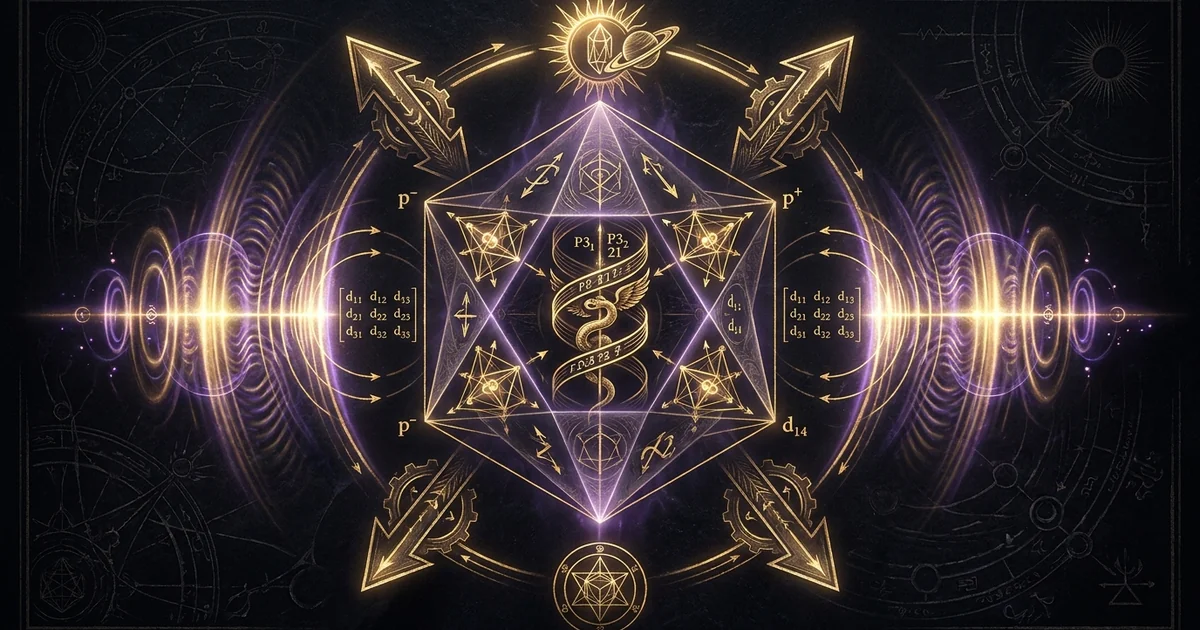
Piezoelectric Effect in Alpha-Quartz: Dipole Mechanics
Mineral Classification & Crystallographic Thesis
Stoichiometry and Low-Quartz Polymorphism
Alpha-quartz ($\alpha\text{-SiO}_2$) constitutes the thermodynamically stable crystalline polymorph of silicon dioxide at temperatures below 573 °C (846 K) under standard atmospheric pressures. Structurally characterized by an unbroken, fully polymerized framework of corner-sharing silicon-dioxide-tetrahedra, the material occupies the trigonal crystal system and crystallizes specifically within the trapezohedral crystal class (Hermann-Mauguin point group $32$). Within this structural framework, every silicon cation ($\text{Si}^{4+}$) is coordinated by four oxygen anions ($\text{O}^{2-}$), and each oxygen atom acts as a bridging node between two adjacent tetrahedra, establishing a continuous three-dimensional network characterized by the stoichiometric formula $\text{SiO}_2$. Unlike high-temperature beta-quartz ($\beta\text{-SiO}_2$), which possesses hexagonal symmetry (point group $622$) and exhibits a higher degree of spatial uniformity, alpha-quartz represents a condensed, structurally tilted derivative. This structural inclination arises from the cooperative rotation of the constituent tetrahedra along the trigonal axes, a thermodynamic stabilization mechanism that reduces internal lattice energy while simultaneously breaking spatial symmetry.
Formula: SiO2 | Crystal System: Trigonal | Class: Trapezohedral (32) | Space Group: P3_1 21 (right-handed) or P3_2 21 (left-handed) | Unit Cell: a = 4.9134 Å, c = 5.4052 Å, Z = 3 | Mohs Hardness: 7.0 | Density: 2.65 g/cm³ | Dielectric Permittivity: ε11 = 4.52, ε33 = 4.64 | Piezoelectric Strain Coefficient: d11 = 2.31 × 10^-12 C/N, d14 = -0.727 × 10^-12 C/N (Nye, 1957; Frondel, 1962).
The structural stability of this low-temperature phase is directly tied to the $\text{Si-O-Si}$ inter-tetrahedral bond angle, which averages approximately 144° in alpha-quartz, as opposed to the more open ~153° angle observed in the hexagonal beta phase. This structural compaction concentrates internal mechanical resistance, yielding a Mohs hardness of 7.0 and a bulk modulus of approximately 37 GPa. Because the tetrahedral linkage contains no dangling bonds or unshared terminal oxygens in pristine crystalline regimes, the physical properties of the crystal are strictly dictated by the geometry of its framework distortion. Understanding the piezoelectric effect alpha quartz crystal dipole mechanics requires recognizing that the mineral’s solid-state physical behaviors do not arise from chemical heterogeneity or defect states. Instead, they proceed directly from the non-centrosymmetric arrangement of these fully saturated, covalently bonded structural units under applied mechanical strain.
Enantiomorphic Space Groups: P3_1 21 versus P3_2 21
Alpha-quartz exhibits structural enantiomorphism, crystallizing into two distinct, non-superimposable space groups: $P3_1 21$ (right-handed, dextrorotatory) and $P3_2 21$ (left-handed, levorotatory). This structural dichotomy is governed by the configuration of the three-fold screw axes ($3_1$ or $3_2$) oriented parallel to the crystallographic $c$-axis ($[0001]$). In the $P3_1 21$ space group, the corner-sharing $[\text{SiO}_4]^{4-}$ tetrahedra follow a right-handed helical progression along the $z$-direction, advancing by one-third of the unit cell parameter $c$ with each 120° clockwise rotation. Conversely, the $P3_2 21$ space group mirrors this geometry through a counter-clockwise, left-handed screw operation. This microscopic structural helicity manifests macroscopically in the phenomenon of optical activity, wherein plane-polarized light traversing the crystal along its optic axis experiences rotational polarization dependent upon the structural chirality of the underlying lattice.
+c [0001] (Optic Axis)
             ^
             |
             |   /\
             |  /  \  Trigonal Helical Chains
             | / /\ \ (Right-Handed: P3_1 21)
             | \ \/ / (Left-Handed:  P3_2 21)
             |  \  /
             |   \/
             +--------------------> +a [11-20] (Electrical Axis)
            /
           /
          v
        +b [1-100] (Mechanical Axis)
The enantiomorphic configuration fundamentally dictates the spatial orientation of the piezoelectric strain tensor. The structural helices align the three polar two-fold symmetry axes ($a_1, a_2, a_3$), which lie perpendicular to the principal three-fold optic axis at angular intervals of 120° within the basal plane. When mechanical stress is applied to a dextrorotatory crystal, the spatial vectors of the displaced ionic sublattices conform to the right-handed geometric frame; in a levorotatory crystal, the resulting polarity is reversed relative to identical crystallographic indices. Consequently, morphological right-handed quartz and left-handed quartz exhibit inverted signs for specific off-diagonal electromechanical coupling coefficients. This enantiomorphic divergence proves that the direct electromechanical response is fundamentally tied to the chiral geometry of the atomic helical chains, which channel mechanical deformation into distinct, vectors of dielectric polarization.
The Non-Centrosymmetric Inversion Dilemma
The fundamental prerequisite for the emergence of the direct piezoelectric effect in any solid-state medium is the absence of a center of inversion symmetry ($\bar{1}$) within its crystallographic point group. In a centrosymmetric crystal lattice, every spatial position designated by coordinates $(x, y, z)$ possesses an identical, symmetry-equivalent atomic site located at $(-x, -y, -z)$ relative to the unit cell origin. Under the influence of a uniform external mechanical stress tensor ($\sigma_{jk}$), the deformation of interatomic bonds within a centrosymmetric medium occurs symmetrically. Any spatial displacement of a positive cation centroid relative to an adjacent anion centroid is matched by an equal and diametrically opposed displacement across the center of inversion. Consequently, the microscopic electric dipoles induced by mechanical deformation cancel out, preventing the emergence of a macroscopic electric polarization vector ($P_i = 0$).
Alpha-quartz, belonging to point group $32$, entirely lacks an inversion center while retaining a single three-fold rotational axis and three polar two-fold axes. In this non-centrosymmetric trigonal lattice, the mechanical displacement of the ionic sublattices cannot be counterbalanced by an inversion-equivalent operation. Asymmetric mechanical shear or compressive strain forces the positively charged silicon cations and the negatively charged oxygen anions into kinematically unequal displacement paths. Because the center of positive charge and the center of negative charge within each constituent unit cell do not coincide under strain, an uncompensated, macroscopic electrostatic potential develops across the crystal boundaries. The lack of an inversion center transforms the quartz crystal into an electromechanical transducer, capable of converting mechanical potential energy into coherent electrostatic and dielectric displacement fields.
Lattice Geometry & Solid-State Physics: Dipole Mechanics
Deformation Dynamics of the [SiO4] Tetrahedron
Within the unperturbed, equilibrium alpha-quartz lattice, the corner-sharing $[\text{SiO}_4]^{4-}$ tetrahedra are intrinsically polarized along individual $\text{Si-O}$ bonds due to the Pauling electronegativity differential between silicon ($\chi \approx 1.90$) and oxygen ($\chi \approx 3.44$). The partially ionic character of the bond (calculated at approximately 50% ionic and 50% covalent) generates local bond dipoles. However, when the crystal lattice resides in a zero-stress state at thermodynamic equilibrium, the spatial orientation of these four bond dipoles within each tetrahedron—and across the three symmetry-equivalent tetrahedra comprising the trigonal unit cell—produces a spatial cancellation. The centroid of the $\text{Si}^{4+}$ cations precisely coincides with the barycenter of the coordinating $\text{O}^{2-}$ anions when projected onto the crystallographic axes, maintaining net macroscopic electrostatic neutrality and preventing spontaneous polarization ($P_s = 0$).
The application of directional mechanical stress alters this equilibrium. When a uniaxial compressive stress is applied along the $x$-axis (the crystallographic $a$-axis or “electrical axis”), the $[\text{SiO}_4]^{4-}$ tetrahedra experience anisotropic strain. Rather than compressing uniformly, the rigid $\text{SiO}_4$ units undergo rotational tilting accompanied by asymmetric bond-angle deformation. The two oxygen atoms situated structurally higher along the $z$-axis shift laterally in a direction opposite to the two lower oxygen atoms, while the central silicon cation is displaced along the two-fold axis. This mechanical distortion disrupts the structural balance between the positive and negative charge centroids. The $\text{Si}^{4+}$ ion moves away from the barycenter of its four coordinating oxygens, creating an uncompensated microscopic dipole moment ($\mu = q \cdot \Delta r$). The collective, coherent summation of these microscopic dipole moments over the volume of the unit cell generates a measurable, macroscopic dielectric displacement across the opposing faces of the crystal plate.
Tensor Formulation: Piezoelectric Strain ($d_{ij}$) and Stress ($e_{ij}$) Equations
The macroscopic electromechanical coupling of alpha-quartz is mathematically governed by the direct and converse piezoelectric constitutive equations, formulated using tensor notation in accordance with the principles codified by Nye (1957) and Cady (1946). The direct piezoelectric effect couples macroscopic polarization $P_i$ (a first-rank vector) to an applied mechanical stress tensor $\sigma_{jk}$ (a second-rank symmetric tensor) through a third-rank piezoelectric strain coefficient tensor $d_{ijk}$:
$$P_i = d_{ijk} \sigma_{jk}$$
Utilizing the condensed Voigt matrix notation, wherein the symmetric stress tensor indices $jk$ are mapped to single indices $j \in {1, 2, 3, 4, 5, 6}$, this relationship simplifies to:
$$P_i = d_{ij} \sigma_j$$
For the trigonal trapezohedral crystal class (point group $32$), the spatial constraints imposed by the three-fold rotation axis parallel to $z$ and the three two-fold rotation axes parallel to $x$ eliminate most components of the $3 \times 6$ matrix. The non-zero coefficients are dictated by crystallographic symmetry, reducing the matrix to:
$$d = \begin{pmatrix} d_{11} & -d_{11} & 0 & d_{14} & 0 & 0 \ 0 & 0 & 0 & 0 & -d_{14} & -2d_{11} \ 0 & 0 & 0 & 0 & 0 & 0 \end{pmatrix}$$
This symmetry reduction reveals critical physical properties of alpha-quartz:
- Polarization along the principal optical axis ($z$-axis, index 3) is strictly zero under any applied mechanical normal or shear stress ($P_3 = 0$), because the third row of the matrix consists entirely of zeros.
- The longitudinal piezoelectric coefficient $d_{11}$ governs both the polarization along the electrical axis ($x$) due to normal stress along $x$ ($\sigma_1$), and the equal but opposite polarization generated by normal stress along the mechanical axis ($y$, $\sigma_2$), such that $d_{12} = -d_{11}$.
- Shear stress within the $y-z$ plane ($\sigma_4$) generates an electrical polarization along the $x$-axis via the coefficient $d_{14}$, while shear stress within the $x-z$ plane ($\sigma_5$) generates a transverse polarization along the $y$-axis via $-d_{14}$.
- Torsional shear in the basal plane ($\sigma_6$) induces polarization along the $y$-axis scaled by the relation $d_{26} = -2d_{11}$.
At 298 K, the experimentally verified values for alpha-quartz are $d_{11} \approx 2.31 \times 10^{-12}\text{ C/N}$ (or $\text{m/V}$) and $d_{14} \approx -0.727 \times 10^{-12}\text{ C/N}$. The converse piezoelectric effect, wherein an applied external electric field $E_k$ induces an elastic strain $\epsilon_{ij}$, is mediated by the transposed tensor:
$$\epsilon_{j} = d_{ij}^T E_i$$
This confirms that applying an electric field along the electrical axis ($E_1$) yields an instantaneous, dimensionally stable physical strain along both the $x$ and $y$ crystallographic axes, a mechanical behavior essential for modern precision frequency standards.
Dielectric Displacement Vector and Spontaneous Polarization
The electrostatic response of alpha-quartz under simultaneous mechanical stress and electric field excitation is fully described by the constitutive dielectric displacement relation:
$$D_i = \varepsilon_{ij}^T E_j + d_{ijk} \sigma_{jk}$$
where $D_i$ represents the components of the dielectric displacement vector, $\varepsilon_{ij}^T$ is the dielectric permittivity tensor evaluated at constant mechanical stress, and $d_{ijk} \sigma_{jk}$ denotes the strain-induced piezoelectric polarization component. In the absence of an applied external electric field ($E_j = 0$), the dielectric displacement is driven entirely by the internally induced dipole field, such that $D_i = P_i$.
Because alpha-quartz is strictly a non-ferroelectric, non-pyroelectric material, it possesses no spontaneous polarization ($P_s = 0$) in the absence of external stress. The point group $32$ contains polar axes within the basal plane, yet lacks a unique polar vector axis along which an uncompensated charge can reside permanently at thermodynamic equilibrium. Consequently, the dielectric displacement vector tracks mechanical strain linearly up to the material’s mechanical fracture limits.
The physical mechanics of this process involve the displacement of the $\text{Si}^{4+}$ ion by mere fractions of an angstrom relative to the surrounding oxygen polyhedra. This structural displacement shifts the dielectric permittivity tensor from its isotropic baseline, generating localized dielectric displacement fields that scale continuously with the applied load. These dynamics show that the piezoelectric effect alpha quartz crystal dipole mechanics represent an ideal, hysteresis-free electromechanical transduction mechanism, which lacks the electrical domain-wall pinning and fatigue characteristics typical of ferroelectric ceramics.
Subtle Energetic Dynamics & Resonance Mechanics
Bio-Acoustic Coupling and the Living Matrix Fascia
The direct electromechanical transduction observed in solid-state alpha-quartz exhibits structural parallels with the biophysical properties of biological connective tissue. As demonstrated by the biophysical investigations of Fukada and Yasuda (1957) and later contextualized within subtle energy medicine by Oschman (2000), the extracellular matrix (ECM) and the human fascial system operate as an interconnected structural continuum termed the “living matrix.” This biological architecture consists predominantly of type-I collagen fibrils. These fibrils form triple-helical, non-centrosymmetric macromolecular assemblies that generate macroscopic piezoelectric potentials when subjected to mechanical shear, tension, or compression.
Alpha-Quartz Matrix
- Inanimate crystalline lattice composed of corner-sharing [SiO4] tetrahedra.
- Operates under space group P3_1 21 / P3_2 21 with high acoustic Q-factor (>10^5).
- Employs macroscopic electromechanical coupling tensors (d_11 = 2.31 pC/N).
- Generates invariant, highly stable resonance frequencies governed strictly by cut angle (AT, BT, Vogel).
Biological Collagen Matrix
- Hydrated triple-helical protein macromolecular liquid crystal.
- Non-centrosymmetric quasi-crystalline fibrillar assembly (piezoelectric coefficient ~1 pC/N).
- Acts as a dynamic, reconfigurable bio-antenna propagating sol-gel transitions.
- Resonates across non-linear biological spectrums, dynamically coupling to micro-displacement currents.
When an alpha-quartz crystal is held or applied in proximity to the human body, an electromechanical and acoustic exchange occurs between the two media. The physiological pressure gradients, pulsatile micro-vibrations, and endogenous bioelectric currents of the human organism exert subtle mechanical stresses upon the quartz lattice, triggering its direct piezoelectric effect. In turn, the quartz crystal undergoes microscopic physical oscillations via the converse piezoelectric effect.
This reciprocal exchange facilitates a phase-locked coupling with the fascial piezoelectricity and biofield resonance network. The crystal functions as an external solid-state stabilizer, transducing ambient, disorganized cellular mechanical noise into coherent, narrow-bandwidth acoustic and dielectric displacement signals that propagate through the hydrated, semiconducting collagen matrix.
+--------------------------+          Direct Piezo Effect          +--------------------------+
|   Living Matrix Fascia   |  --- Mechanical Micro-Pressures --->  |   Alpha-Quartz Lattice   |
| (Collagen Liquid Crystal)|  <-- Coherent Acoustic Phonons -----  | (Corner-Sharing [SiO4])  |
+--------------------------+         Converse Piezo Effect         +--------------------------+
Morphic Field Stabilization via Coherent Phonon Cascades
Within the framework of subtle energetic physics and condensed matter acoustics, the oscillatory motion of the quartz lattice under electrical stimulation does not manifest simply as random thermal motion; it organizes into discrete, quantized lattice vibrations known as acoustic-phonon modes. Because of its extremely high mechanical quality factor ($Q > 10^5$ in natural, clear electronic-grade specimens, and approaching $10^7$ in synthetic crystals), alpha-quartz sustains these acoustic vibrations with minimal internal damping or dissipation. Under coherent excitation, these phonon cascades generate long-range, phase-coherent acoustic wavefields that extend beyond the physical boundaries of the crystal lattice.
These coherent phonon states interact with surrounding morphogenetic and etheric organizing fields. Drawing upon the theoretical formulations of Frohlich (1968) regarding coherent excitations in biological systems, macroscopic order emerges when energy is channeled into a single, low-frequency vibrational mode. The sustained acoustic phonon emission of an oriented alpha-quartz transducer acts as an organizing template, helping damp parasitic, entropy-inducing frequencies within the subtle biofield.
By functioning as a stable physical anchor, the quartz crystal projects an invariant spatial-temporal harmonic field. This field provides a baseline frequency reference that helps entrain disordered biological and subtle energetic matrices into phase alignment.
Biophotonic Modulation and Scalar Potential Inductions
Living organisms continuously emit an ultra-weak intensity flux of photons—termed biophotons—originating from metabolic processes, mitochondrial oxidative phosphorylation, and the relaxation of excited DNA conformations. These biophotonic emissions are characterized by a high degree of coherence, resembling classical optical fields that govern cellular signaling, metabolic synchronization, and systemic homeostatic balance. The cyclically shifting electric dipoles within an oscillating alpha-quartz plate interact directly with this endogenous optical emission.
As the dielectric-displacement vector oscillates within the non-centrosymmetric trigonal lattice, it modulates the local dielectric permittivity of the space immediately adjacent to the crystal boundary. This modulation influences incoming biophotonic fields through dielectric waveguiding and polarization filtering. When coherent acoustic phonons within the crystal interact with the electromagnetic fields of incoming biophotons, opto-acoustic scattering can occur.
Furthermore, the structural cancellation of transverse electric field vectors at specific node points—induced by opposing tetrahedral dipole axes—can yield uncompensated longitudinal electromagnetic potentials, often characterized as scalar wave modes. These subtle longitudinal potentials couple to the morphogenetic biofield without generating destructive thermal interference, supporting energy exchange across the interface between the physical organism and its subtle field architecture.
Historical Lapidary Lore & Traditional Lineage
Theophrastus, Pliny, and the ‘Petrified Ice’ Epistemology
The ancient Mediterranean intellectual lineage viewed quartz crystal through an empirical lens framed by the prevailing cosmological models of their era. In his treatise Peri Lithon (c. 315 BC), the Greek philosopher Theophrastus classified mineral specimens according to their physical actions, thermal susceptibilities, and elemental balances. He cataloged clear quartz under the broad term krystallos (derived from the Greek kryos, meaning icy cold), interpreting the stone as an extreme condensation of water solidified under intense conditions. This mineralogical paradigm was substantially expanded by the Roman naturalist Pliny the Elder in his encyclopedic work Naturalis Historia (c. 77 AD).
‘Crystallus fit gelu vehementiore concreto… Non reperitur nisi ubi maximi hyberni rigores fuerunt, nec aliud esse compertum est quam glaciem, unde et nomen Graeci dedere.’ [Crystal is produced by the action of extreme cold… It is found nowhere else but where the winter snows are most intense; that it is really ice, there can be no doubt, which is why the Greeks gave it that name.]
Pliny documented both the physical traits and the practical applications of quartz, observing that the material was consistently recovered from alpine elevations where sub-zero temperatures persisted. He recorded that despite external ambient heat, the mineral retained an enduring coolness to the touch—an observation attributable to the high thermal conductivity of alpha-quartz relative to glass or standard amorphous minerals.
Pliny also documented early precursors to opto-mechanical manipulation, describing how smooth, spherical cuts of natural crystal were utilized by Roman physicians as cautery lenses. When held against the sun, these stones focused solar radiation to generate the thermal energy required to cauterize surgical wounds. Additionally, lapidaries of the Greco-Roman period recognized the triboluminescent properties of quartz, observing that violently striking two specimens together produced faint flashes of internal luminescence, an early observation of mechanically induced energetic discharge.
Marbode of Rennes and Medieval Lapidary Talismans
During the medieval period, lapidary literature transitioned from observational natural history into systemic, symbolic classifications of mineral metaphysics. A central figure in this lineage was Marbode of Rennes (1035–1123 AD), Bishop of Rennes, whose verse compendium Liber Lapidum (also known as the De Lapidibus) served as the authoritative European text on the metaphysical, medicinal, and apotropaic properties of stones for nearly five centuries. Marbode preserved the classical Greco-Roman perspective regarding petrified ice, while situating quartz crystal within an allegorical and talismanic framework that prefigured modern theories of energetic amplification.
Ancient Classical Era                 Medieval Lapidary Era                  Modern Metrological Era
     (Theophrastus / Pliny)                 (Marbode of Rennes)                  (Jacques & Pierre Curie)
  [ "Crystallus" as Permanent Ice ]  -->  [ Spiritual Light Amplification ]  -->  [ Direct Piezoelectric Discovery ]
  - Cooling thermal inertia               - Talismanic focus                      - Quantitative electrometer metrology
  - Primitive solar optical focus         - Light-holding geometry                - Formal tensor formulation
In Marbode’s writing, the optical clarity and geometric prismatic morphology of alpha-quartz were interpreted as physical manifestations of celestial light. Natural quartz crystals terminating in hexagonal prisms capped by rhombohedral terminations were integrated into ecclesiastical accoutrements, reliquaries, and royal talismans designed to channel divine illumination and clear cognitive distortions.
Medieval lapidaries operated on the philosophical principle that quartz acted as an energetic intermediary, capable of absorbing, concentrating, and projecting subtle spiritual essences. They intuitively employed faceted quartz terminations to direct intention, focusing spiritual attention along axes of symmetry centuries before modern crystallography formally defined the polar electrical properties of the trapezohedral lattice.
The Curie Brothers (1880) and the Genesis of Modern Metrology
The intuitive, empirical observations of classical and medieval lapidary traditions were formalized into quantitative, modern physical science in 1880 through the experimental work of the French physicists Jacques and Pierre Curie. Investigating the pyroelectric phenomena previously observed in minerals such as tourmaline, the Curie brothers hypothesized that mechanical pressure applied directly to crystals possessing specific hemimorphous, non-centrosymmetric morphologies would induce macroscopic electrical polarization. To test this hypothesis, they designed an experiment utilizing hemihedral crystals with inclined faces, focusing their investigations on alpha-quartz, tourmaline, topaz, and Rochelle salt.
Applied Force (F)
         |
         v
+------------------+
| Conducting Plate |
+------------------+
|   Quartz Disc    |  ---> Asymmetric Dipole Shift ---> Surface Charges (+/-)
+------------------+                                            |
| Conducting Plate |                                            |
+------------------+                                            v
         |                                           Electrometer Detection
         |                                           (Charge Measurement Q)
         v
  Rigid Ground Base
The Curies fabricated quartz plates cut along specific crystallographic orientations, mounted them between conducting plates coated with tinfoil, and subjected them to mechanical compressive loads while measuring the resulting electrostatic response with an electrometer. In their seminal publication presented to the Académie des Sciences (Curie & Curie, 1880), they conclusively demonstrated that the accumulated electric charge ($Q$) was directly proportional to the applied mechanical weight ($F$), and that the sign of the accumulated charge reversed when compressive stress was replaced by tensile stress.
This discovery bridged the gap between historical lapidary metaphysics and modern solid-state physics. The curie brothers discovery transformed the metaphysical conception of quartz as a vessel of living light into an empirical reality: alpha-quartz operates as an electromechanical transducer, systematically converting macroscopic kinetic energy into coherent electrostatic and dielectric displacement fields.
Practical Applications, Calibration & Safety Protocols
Geometric Tuning: Vogel-Cut Configurations and Crystallographic Orientation
The macroscopic expression of the direct and converse piezoelectric response in alpha-quartz is dictated by the spatial orientation of the crystal’s cut relative to its primary crystallographic axes. Industrial frequency-control applications utilize precisely oriented, standardized cuts—such as the AT-cut (a plate sheared at an angle of +35°15’ relative to the $c$-axis) to achieve a zero-temperature-coefficient resonator operating through thickness-shear vibration modes. Conversely, subtle energy applications, biofield therapeutics, and biophotonic focus require geometries designed to maximize longitudinal acoustic wave propagation and direct the electrical displacement vector toward an active focal point.
- SILICOSIS DANGER: Mechanical dry-cutting, polishing, or pulverization of alpha-quartz generates respirable free crystalline silica (alpha-SiO2), a Class 1 human carcinogen causing progressive irreversible pulmonary fibrosis. Always utilize continuous wet-grinding and HEPA-rated respiratory containment.
- PHASE BOUNDARY LIMIT: Subjecting alpha-quartz to temperatures ≥573 °C triggers instantaneous inversion to hexagonal beta-quartz (point group 622), resulting in lattice twinning (Dauphiné twins), complete loss of directional piezoelectric coherence, and structural micro-shattering.
- ENERGETIC DETUNING: Energetic overload via high-voltage discharge or persistent subharmonic shock induces micro-acoustic cavitation along growth striations, requiring ultrasonic thermal resetting.
The most refined geometry for this purpose is the faceted configuration developed by IBM research scientist Marcel Vogel (1984). The classical vogel-cut configuration requires faceting a natural alpha-quartz crystal into a double-terminated, multi-sided prism (typically 4, 6, 8, 12, or more symmetric lateral facets) where the internal long axis precisely parallels the crystallographic $c$-axis ($[0001]$).
The receptive, broader basal termination is typically cut to an angle of 52° to 54°—closely tracking the 51°51’14" inter-facial angle of the Great Pyramid of Giza—while the firing, more acute apex is ground to a steeper angle, commonly between 60° and 65°.
Apex Tip (Acute Angle: ~60°-65°)
                  /\
                 /  \      Transmitter / Emitter Pole
                /    \     (Coherent Longitudinal Beam)
               /======\
              |   ||   |
              |   ||   |   Prismatic Body (Multi-Faceted)
              |   ||   |   Optic Axis [0001] Coincident with Length
              |   ||   |
               \======/
                \    /
                 \  /      Receptive Base (Pyramidal Angle: ~52°-54°)
                  \/
This geometric arrangement forces the internal electrical axes ($a_1, a_2, a_3$) to radiate symmetrically through the radial facets, perpendicular to the central transmission axis. As acoustic or electro-dermal pressures are applied to the receptive base, the resulting piezoelectric strain produces dipole displacement waves that travel down the length of the crystal. The decreasing cross-sectional area toward the acute apex compresses the acoustic-dielectric wavepacket, transforming the crystal into a coherent directional emitter of acoustic-dielectric energy.
Thermal and Mechanical Degradation Thresholds (Curie Transition at 573 °C)
Alpha-quartz retains its structural integrity and piezoelectric characteristics only within a specific thermodynamic and mechanical window. The most critical operational boundary is the displacive alpha-to-beta phase transition, which occurs at precisely 573 °C (846 K) under atmospheric pressure ($1\text{ atm}$). As the crystal is heated toward this boundary, the tilted $[\text{SiO}_4]^{4-}$ tetrahedra gradually expand and rotate toward higher symmetry positions. Upon reaching 573 °C, the lattice undergoes a displacive transformation into the hexagonal beta-quartz phase (space group $P6_2 22$ or $P6_4 22$, point group $622$).
This phase transition carries severe consequences for the crystal’s electromechanical properties:
- Point group $622$, while non-centrosymmetric, enforces a lattice symmetry that reduces the non-zero piezoelectric coefficients.
- The phase inversion eliminates the $d_{11}$ coefficient entirely; the remaining $d_{14}$ shear coefficient provides no longitudinal polarization under normal stress.
- Cooling the crystal back down below 573 °C does not restore its original single-crystal performance. Instead, the cooling process induces extensive Dauphiné twinning (electrical twinning), wherein adjacent microscopic domains crystallize with their electrical $x$-axes oriented in opposite 180° directions.
- Because the positive and negative electrical domains cancel each other out macroscopically ($d_{11}^{\text{eff}} \approx 0$), the crystal becomes permanently depoled and electromechanically inert for coherent single-axis operations.
Furthermore, thermal shock induced by heating or cooling rates exceeding 5 °C per minute causes differential expansion along the $a$-axis versus the $c$-axis, triggering mechanical fractures, optical clouding, and internal micro-cracking along cleavage planes.
Handling Precautions: Inhalation Hazards of Particulate Silica and Energetic Saturation
While macroscopic, intact specimens of alpha-quartz are chemically inert, biologically benign, and safe to handle, mechanical modification processes present serious health hazards. Grinding, cutting, lapidary shaping, or ultrasonic drilling of quartz without adequate wet suppression releases respirable crystalline silica (RCS) dust into the surrounding air. These microscopic particles, with aerodynamic diameters $<4\ \mu\text{m}$, bypass the upper respiratory defenses and settle deep within the pulmonary alveoli. The persistent, chemically reactive edges of crystalline silica induce chronic inflammation, cell death, and non-reversible pulmonary fibrosis (silicosis), while significantly elevating long-term risks of lung carcinoma. Lapidary operations must always employ continuous water delivery to suppress dust, combined with certified HEPA-filtered local extraction and fitted elastomeric respirators.
From an energetic perspective, crystalline quartz can also experience physical and vibrational fatigue when subjected to sustained, high-amplitude stress. Persistent high-intensity electrical discharges or exposure to strong electromagnetic fields can introduce defects and micro-acoustic cavitation along the crystal’s natural growth striations. This degradation manifests as a dampening of its acoustic quality factor ($Q$), an accumulation of chaotic surface charge, and a loss of phase-locking precision.
To reset a saturated crystal, it should be immersed in a clean, highly resistive dielectric fluid or deionized water bath. This dissipates residual surface charge accumulation while allowing the lattice to relax to thermodynamic equilibrium.
Frequently Asked Questions
Distinction Between Piezoelectricity in Crystalline Quartz vs. Amorphous Fused Silica
The fundamental distinction between crystalline alpha-quartz and amorphous fused silica (often commercially designated as fused quartz or quartz glass) lies entirely in the presence or absence of long-range crystallographic order. Both materials possess the identical bulk chemical stoichiometry: silicon dioxide ($\text{SiO}_2$). Both are constructed of basic $[\text{SiO}_4]^{4-}$ tetrahedra linked at their corners by covalent bonds with partially ionic characteristics. However, fused silica is synthesized by melting crystalline quartz at high temperatures ($>1710\text{ °C}$) followed by rapid cooling, which prevents the re-establishment of a periodic crystalline lattice.
       Crystalline Alpha-Quartz                      Amorphous Fused Silica
     (Point Group 32: Non-Centrosymmetric)          (Isotropic: Macroscopically Centrosymmetric)
         O          O          O                         O      O       O
          \        / \        /                           \    /         \
           Si --- O   Si --- O                             Si-O     Si    O-Si
          /        \ /        \                           /    \   /  \  /    \
         O          O          O                         O      O-O    O-O     O
    [Long-Range Order -> Direct Piezo Response]     [Randomized Network -> Zero Piezo Response]
In fused silica, the $\text{Si-O-Si}$ bond angles and torsional angles are randomly distributed throughout three-dimensional space, yielding an isotropic, amorphous structural glass. Although individual tetrahedra undergo microscopic dipole polarization when strained, their completely randomized spatial orientations cause these dipole moments to cancel out over sub-micron volumes. Fused silica behaves macroscopically as a centrosymmetric medium ($P_i = 0$ for any applied stress tensor $\sigma_{jk}$), exhibiting zero linear piezoelectric response ($d_{ij} = 0$). Only crystalline alpha-quartz, with its ordered, non-centrosymmetric trigonal lattice ($P3_1 21$ or $P3_2 21$), maintains the spatial coherence necessary to generate macroscopic dielectric displacement and surface charge accumulation under mechanical strain.
To calibrate an alpha-quartz resonator for energetic coupling: (1) Mechanically orient the crystallographic c-axis collinear with the target field vector; (2) Introduce an initial 32.768 kHz acoustic pulse to purge residual Dauphiné twin boundary strain; (3) Cleanse in high-resistivity deionized water to discharge static surface charge accumulation (dielectric displacement dissipation).
Mechanics of the Converse Piezoelectric Effect in Biofield Harmonization
The converse piezoelectric effect describes the process wherein an applied external electric field ($E_i$) induces a proportional, reversible physical strain ($\epsilon_j$) within the crystal lattice, governed by the thermodynamic relation:
$$\epsilon_j = d_{ij}^T E_i$$
When applied to biofield harmonization, the quartz crystal operates as an electromechanical transducer. The human biological field, characterized by electro-dermal potential gradients, heart-rate-variability electromagnetic signatures, and neural oscillations, applies dynamic, multi-frequency electric fields across the facets of the hand-held or strategically placed crystal.
In response to these subtle, variable electric field gradients, the alpha-quartz lattice physically expands and contracts along its electrical and mechanical axes at matching frequencies. This mechanical deformation generates coherent acoustic phonons within the crystal, which propagate back into the surrounding environment as structured, low-amplitude acoustic compression waves.
Rather than allowing physiological micro-currents to disperse chaotically as diffuse electromagnetic noise, the converse piezoelectric effect converts these currents into focused, coherent acoustic oscillations. This mechanical-dielectric feedback helps entrain endogenous biological rhythms, assisting the liquid-crystalline fascial network in restoring harmonic phase relationships across the physical-energetic matrix.
Reversibility and Permanent Depoling in Quartz Crystals
A frequent point of confusion concerns whether an alpha-quartz crystal can be “depoled” by reverse electrical fields or mechanical stress, similar to standard ferroelectric ceramics such as lead zirconate titanate (PZT) or barium titanate ($\text{BaTiO}_3$). In ferroelectric materials, the macroscopic piezoelectric response depends upon the alignment of polar ferroelectric domains that have been oriented using an external electric poling field. Exposing a ferroelectric ceramic to a strong coercive electric field of reversed polarity, or heating it past its Curie point, flips or randomizes these domains, effectively erasing its macroscopic piezoelectricity.
Alpha-quartz is non-ferroelectric; it has no switchable domain states, and its dipole moments cannot be flipped by applying an external electric field. Its piezoelectric coefficients are an intrinsic, permanent consequence of its non-centrosymmetric space group symmetry ($P3_1 21$ or $P3_2 21$).
The electromechanical coupling of quartz is strictly linear and crystallographically fixed. It cannot be depoled by electrical over-voltage, reverse polarity, or physical shock. The only mechanisms that can permanently eliminate the direct piezoelectric response of alpha-quartz are:
- Heating the crystal past its displacive phase transition temperature of 573 °C, which triggers structural conversion to beta-quartz and subsequent Dauphiné twinning upon cooling.
- Introducing structural metamictization via intense, prolonged neutron bombardment, which breaks bonds and renders the lattice amorphous.
- Applying mechanical stresses that exceed the ultimate shear strength of the lattice (~50 MPa), causing macroscopic fracture.
Under normal environmental and therapeutic conditions, the electromechanical dipole mechanics of alpha-quartz remain permanent, invariant, and fully stable over geological timescales.