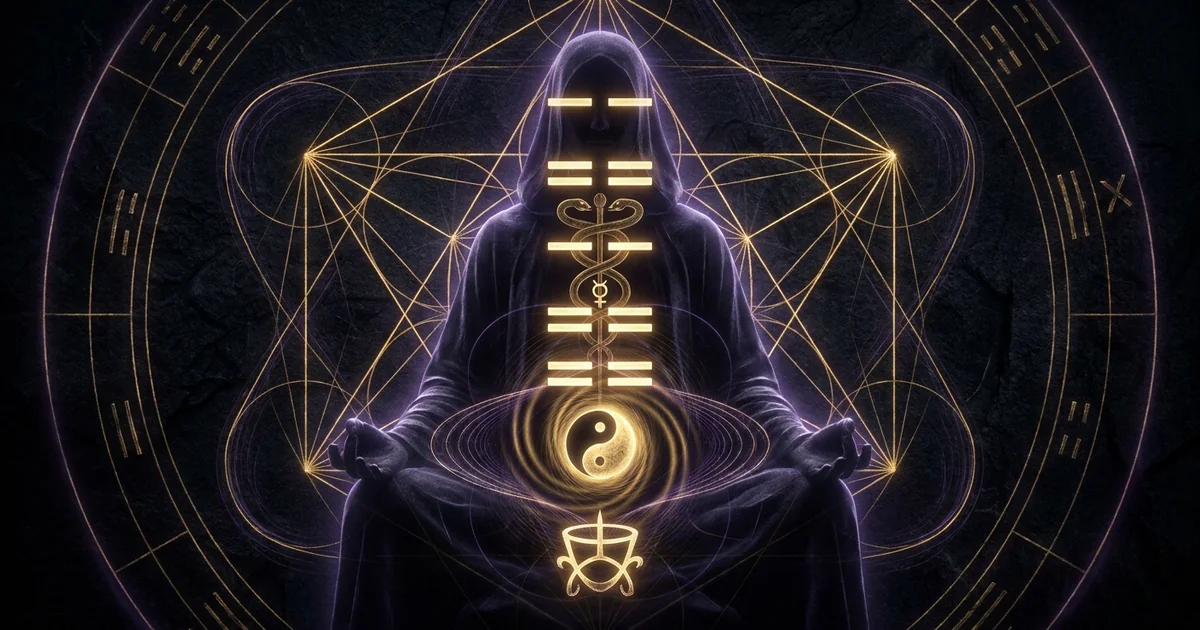
Incubation of the Hexagram: Meditative Integration Path
Archetypal Thesis & Systemic Paradigm: The Hexagram as an Operative State-Space Attractor
Beyond Prognostication: Epistemological Reorientation from Event to State
Conventional approaches to the Zhouyi (I Ching) operate within a strictly linear, transactional paradigm of cleromancy. In this epistemic framework, the querent extracts a symbolic snapshot to forecast an externalized chronological event, reducing a profound psycho-cosmological coordinate framework to crude predictive utility. Such fortune-telling relies on a Cartesian bifurcated reality, wherein an isolated subjective mind queries an objective, deterministic future across an unbridgeable metaphysical divide. This mechanical deployment trivializes the foundational premise of the Book of Changes, which conceives reality not as a sequence of isolated collisions between discrete substances, but as an uninterrupted continuum of dynamic phase shifts.
By contrast, an archetypal and somatic approach to the Zhouyi discards prognostic utility to inaugurate an operative methodology: hexagram incubation. Under this modality, the hexagram ceases to be an external diagnostic label or predictive verdict; it reveals itself instead as a topological state-space attractor within consciousness. Grounded in the structural insights of Richard Wilhelm and Cary F. Baynes (The I Ching or Book of Changes, 1950), the sixty-four hexagrams represent archetypal situations that exhaust the permutations of cosmic and psychic transformation. When shifted from oracular inquiry to contemplative dwelling, the hexagram operates as an intentional boundary condition imposed upon the mind-body matrix, allowing the latent morphology of the moment to reorganize both psyche and soma. Divination is thereby reclaimed not as an effort to discern what will happen, but as an empirical intervention into how the totality of the present is structured.
This epistemological pivot repositions the human subject from a passive consumer of fate into an active field participant. Rather than seeking intellectual certainty through speculative textual interpretation, the practitioner initiates a systematic suspension of conscious preconceptions—a phenomenological epoché directed inward. By approaching the hexagram as a dynamic equilibrium point rather than a fixed pronouncement, the seeker treats the six lines (yao) as an energetic matrix. This matrix crystallizes the qualitative contours of an unfolding existential threshold, rendering visible the subterranean tectonic shifts occurring between the conscious ego and the broader fields of the unconscious.
The Hexagram as a Psycho-Somatic Attractor Landscape
In complex systems theory, a phase space attractor describes a set of numerical values toward which a dynamic system tends to evolve over time, regardless of the initial starting conditions. Within the framework of contemplative divination, a hexagram functions analogously as a psycho-somatic attractor landscape. The human psyche-soma complex operates as an open, non-linear system subject to entropic drift, emotional turbulent flow, and structural habituation. The act of consulting the oracle and meditating deeply upon the received archetype serves to introduce an energetic attractor into this volatile psychic field, constraining its infinite potential trajectories into a coherent, organized vector of psychological and biological self-organization.
The biological substrate through which this archetypal attractor operates is the human nervous system. Far from being a purely cerebral abstraction, the polarity of Yin (broken lines, $–$) and Yang (solid lines, $—$) corresponds to the fundamental oscillatory rhythms of the autonomic nervous system: the receptive, restorative, energy-conserving domain of parasympathetic tone, and the dynamic, outward-directed, energy-expending state of sympathetic activation. Prolonged contemplation of a hexagram’s line distribution acts directly upon these visceral pathways. For instance, dwelling within Hexagram 2 (Kun, The Receptive)—composed entirely of yielding Yin lines—induces a profound down-regulation of sympathetic vigilance, activating vagal pathways and cultivating a physiological state characterized by unconditioned somatic reception. Conversely, Hexagram 1 (Qian, The Creative) serves as an autonomic driver of tonus, mobilizing neuroendocrine resources and orienting the organism toward focused volition and cognitive clarity.
Hexagram Permutation Matrix (Phase Space Coordinate):
[Line 6: Transpersonal Horizon]    --- (Yang) or - - (Yin) -> Apex Dissolution
[Line 5: Archetypal / Autonomous]  --- (Yang) or - - (Yin) -> Executive Will
[Line 4: Psychodynamic / Relational]--- (Yang) or - - (Yin) -> Visceral Interface
[Line 3: Somato-Affective Ego]     --- (Yang) or - - (Yin) -> Diaphragmatic Tension
[Line 2: Enteric / Visceral]       --- (Yang) or - - (Yin) -> Core Somatic Substrate
[Line 1: Proprioceptive Ground]    --- (Yang) or - - (Yin) -> Basal Neural Roots
The hexagram functions as an internal geometric scaffold. By holding the specific configuration of lines within the somatic field, the practitioner invokes what Carl Gustav Jung identified in his seminal 1950 ‘Foreword to the I Ching’ as an archetypal situation that possesses its own inherent dynamic energy. The six lines establish an affective tension pattern in the physical vessel, compelling the somatic musculature, breathing patterns, and visceral responses to calibrate themselves according to the archetypal geometry of the received image. The meditative body thus becomes an isomorphic resonator for the cosmic state represented by the hexagram.
Cybernetic Feedback Loops in Contemplative Divination
When freed from mechanistic fatalism, the meditative engagement with the Zhouyi transforms into an advanced cybernetic feedback loop. Cybernetics, the study of regulatory communication and control mechanisms within closed and open systems, posits that systemic integrity is maintained through recursive feedback processes that modulate ongoing behavior based on structural inputs. In the praxis of somatic hexagram incubation, the ritualized interaction with the oracle does not merely impart descriptive information; it establishes a dynamic, self-correcting feedback mechanism linking the practitioner’s conscious intention, autonomic physiology, and unconscious drive structures.
Through this cybernetic lens, the received hexagram acts as an intentional feedback disturbance introduced into the practitioner’s homeostatic assumptions. The ego invariably approaches an existential crisis with cognitive blind spots, fixed interpretive scripts, and somatic compensations. When the hexagram is introduced not as a final prophecy, but as a mirror reflecting the deeper currents of the psychophysical totality, it disrupts the ego’s calcified narrative loops. The practitioner engages in continuous neuro-affective tracking: observing how the specific tensions, shifts, and symmetries of the hexagram expose unexamined somatic contractions or emotional fixations.
This cyclical recalibration fosters an authentic autopoiesis—a biological and psychological self-generation. As the conscious mind metabolizes the hexagram’s symbolic architecture through focused bodily awareness, systemic equilibrium is dynamically restored at a higher tier of integration. The practitioner is transformed from an externalized questioner pleading for cosmic directives into an endogenous participant within an archetypal field, consciously participating in the autopoietic unfolding of their own psychological morphogenesis. To master this paradigm, one must grasp how this internalizing transition was systematically pioneered across classical lineages.
Classical Provenance & Textual Lineage: From Zhouyuan Cleromancy to Neidan Interiorization
The Zhouyi as Alchemical Blueprint: The Zhouyi Cantong Qi Tradition
The historical trajectory of the Zhouyi charts a continuous interiorization, shifting from archaic bronze-age pyromancy and yarrow cleromancy at the ancestral courts of the Zhou dynasty to an intricate roadmap of internal physiological alchemy. The paramount text marking this profound evolution is the Zhouyi Cantong Qi (The Seal of the Unity of the Three), attributed to the second-century Han dynasty adept Wei Boyang (c. 142 CE; translated by Fabrizio Pregadio, 2011). The Cantong Qi represents the earliest extant treatise synthesizing the cosmology of the Changes with the physiological mechanics of Daoist internal alchemy (Neidan) and operative metallurgy. Within this monumental synthesis, Wei Boyang fundamentally decoupled the hexagrams from trivial mantic prognostication, establishing them as an anatomical, bio-spiritual calendar and energetic circulation manual.
Under the alchemical hermeneutic of the Cantong Qi, the sixty-four hexagrams are recognized as symbolic codifications of energetic phases within the human subtle and physical physiology. The macrocosmic cycles of the solar year and lunar months, traced through the twelve “sovereign hexagrams” (xiaoxi gua), are radically internalized into the micro-circuits of the human organism. The ascent and descent of Yin and Yang lines delineate the exact fluctuations of breath, hormonal secretions, and bio-electric potentials along the Du (Governing) and Ren (Conception) vessels during the Microcosmic Orbit (xiao zhoutian). Hexagram 24 (Fu, Return), with its single solid Yang line stirring beneath five receptive Yin lines, ceased to denote mere social return or seasonal winter solstice; it was redefined as the exact somatic moment when the dormant primordial essence (jing) awakens at the lower abdomen, signaling the initial coagulation of the internal elixir.
Hexagram contemplation, therefore, became an indispensable alchemical discipline. By entering a prolonged somatic meditation upon the received hexagram, the Neidan practitioner utilized the symbolic geometry of the yao-lines to catalyze specific internal heat transitions (huohou, fire phasing) within the three Cinnabar Fields (Dantian). Divination was transformed into contemplative chronobiology: the adept utilized the oracle to ascertain which precise internal alchemical regime was demanded by the systemic state of their psychophysical vessel, aligning subjective inner cultivation with the objective thermodynamic transformations of the Dao.
Wang Bi’s Phenomenological Turn: Forgetting the Images to Grasp the Meaning
During the volatile Three Kingdoms period, the brilliant philosopher Wang Bi (249 CE; translated by Richard John Lynn, 1994) executed an equally radical philosophical reorientation of the Zhouyi tradition. Rebelling against the excessively rigid, pedantic, and externalized cosmological correlations of the Han dynasty Xiangshu (Image and Number) scholastic school, Wang Bi inaugurated the Yili (Meaning and Pattern) hermeneutic through his landmark work, the Zhouyi Lueli (General Remarks on the Changes). Wang Bi’s philosophical revolution was essentially phenomenological: he insisted that the structural components of the Zhouyi—Words (yan), Images (xiang), and Meaning or Intent (yi)—constitute a hierarchical, transitional scaffolding designed to be dissolved once direct intuitive comprehension is achieved.
“The images are what produce meaning; words are what clarify the images. To exhaust meaning, there is nothing like images; to exhaust images, there is nothing like words. The words are born of the images, thus one may follow the words to observe the images. The images are born of the meaning, thus one may follow the images to observe the meaning. The meaning is exhausted by the images, and the images are made clear by the words. Therefore, since words are the means to clarify images, once one gets the images, one forgets the words. Since images are the means to retain meaning, once one gets the meaning, one forgets the images… If one remains bound to the images, what is grasped is not the meaning; if one remains bound to the words, what is grasped is not the images.” — Wang Bi, Zhouyi Lueli, Chapter 4 (trans. Lynn, 1994, pp. 31–32)
Wang Bi’s formulation provides the definitive classical epistemology for meditative hexagram incubation. In his view, remaining fixated upon the literal words of the King Wen judgments or the Zhou Duke line commentaries traps the querent in linguistic fragmentation. Similarly, getting ensnared in rigid structural correspondences of trigram attributes without penetrating the underlying unifying pattern leaves the seeker at the periphery. For the practitioner engaged in somatic meditation, Wang Bi’s instruction to “forget the image once the meaning is obtained” (de xiang wang yan, de yi wang xiang) provides an exact operational protocol. The visual structure of the hexagram is initially held within contemplative concentration to evoke its underlying archetypal tension; once this dynamic pattern registers as an immediate somatic and psychological resonance, the outward visual and linguistic forms must be abandoned, allowing the pure somatic-felt-sense of the archetypal principle to saturate the unmediated field of awareness.
The Yarrow Stalk Hermeneutic: Sacred Delay as Primitive Incubation
The traditional method of manipulating fifty stalks of Achillea millefolium (yarrow) to derive a hexagram represents far more than an archaic calculation mechanism; it is a meticulously engineered ritual of contemplative deceleration. While modern practitioners frequently gravitate toward the rapid casting of coins for instant gratification, the yarrow stalk procedure mandates an elaborate, rhythmically repetitive sequence of division, counting by fours, and physical retention of stalks between the fingers. To derive a single hexagram requires eighteen separate operational passes, demanding an unbroken, meditative presence lasting anywhere from twenty to forty minutes.
This protracted kinetic ritual enforces an intentional sacred delay. In terms of cognitive and somatic psychology, the yarrow stalk operation acts as a profound down-shifting mechanism, moving the nervous system from the hyper-vigilant, goal-oriented beta brainwave state into the synchronized alpha and theta rhythms characteristic of hypnagogic and deep contemplative states. The repetitive somatic movement—the tactile friction of the stalks, the silent arithmetic, the rhythmic engagement of both hands—serves to quiet the verbal, analytical left hemisphere of the brain while mobilizing the spatial, holistic right hemisphere.
The kinetic duration of the yarrow technique acts as an initial threshold of incubation. Long before the final hexagram is fully plotted onto paper, the conscious ego has already been compelled to surrender its compulsive demand for immediate answers. The existential dilemma that prompted the inquiry is held in a state of suspended animation, allowing somatic feedback to emerge from beneath the noise of conscious discursive rumination. The subsequent contemplative incubation is not an arbitrary modern innovation appended to the reading; it is the natural psychological and energetic fulfillment of a process initiated by the rhythmic cadence of the yarrow stalks. Having recovered this lineage of profound inwardness, one can systematically chart the somatic architecture of the hexagram’s structural anatomy.
Structural Mechanics & Symbolic Geometry: Trigram Topology and Somatic Line Vectoring
The Vertical Kinematics of the Six Lines (Yao): From Base to Apex
The architecture of a hexagram is inherently kinematic, directional, and hierarchically organized. A hexagram is never built from the top down; it is constructed from the earth upward, initiating at line 1 and culminating at line 6. This structural reality reflects the fundamental cosmological principle of the Zhouyi: manifestations begin in the dense, concealed, physical depths of material reality and gradually ascend, differentiated and refined, toward conscious visibility and ultimate transpersonal dissolution. Within the somatic incubation path, this bottom-to-top vectoring dictates a precise map of biological organization and neuro-affective integration, tracing the vertical axis of the human organism from basal grounding to transpersonal release.
Six-Line Vertical Somato-Psychological Architecture:
=============================================================================
Line 6 | Transpersonal Apex  | Crown / Epithalamus | Trans-egoic Dissolution
Line 5 | Sovereign Core      | Throat / Third Eye  | Conscious Integration
Line 4 | Affective Boundary  | Heart / Thorax      | Psychodynamic Relation
Line 3 | Visceral Threshold  | Solar Plexus        | Somato-Egoic Tension
Line 2 | Enteric Substrate   | Lower Abdomen       | Instinctual Response
Line 1 | Basal Ground        | Perineum / Feet     | Proprioceptive Base
=============================================================================
Line 1 serves as the basal ground, corresponding somatically to the soles of the feet, the pelvic floor, and the unconditioned proprioceptive interface with the physical environment. It represents instinctual readiness, latent potential, and the earliest somatic stirrings that have not yet crossed the threshold into conscious cognitive registration.
Line 2 ascends into the enteric substrate, localized within the lower abdomen, the pelvic bowl, and the sacral plexus. This is the physiological throne of the gut-brain axis, governing instinctual safety, primary digestive assimilation, and unmodulated raw emotional reactions.
Line 3 represents the visceral threshold, anatomically grounded at the solar plexus, the muscular diaphragm, and the lower rib cage. As the boundary line between the lower and upper trigrams, Line 3 is the structural locus of intense somato-egoic tension. It is here that instinctual impulse collides with conscious intentionality, frequently manifesting as diaphragmatic armoring, respiratory inhibition, or acute somatic vigilance.
Ascending into the upper trigram, Line 4 governs the affective boundary, anchored somatically within the chest, heart space, lungs, and the expressive pathways of the arms and hands. It delineates the threshold of relational reality, governing how the individual manages interpersonal boundaries, social compliance, and the structural tension between external demands and authentic self-expression.
Line 5 occupies the sovereign core, localized within the throat, cervical spine, and frontal neural structures. In classical commentary, this is the ruler’s line; somatically, it signifies integrated executive volition, clear archetypal consciousness, and the balanced harmonization of somatic feedback with coherent spiritual action.
Finally, Line 6 marks the transpersonal apex, corresponding to the crown of the skull, the cranial sutures, and the epithalamus. It represents the boundary where the form of the hexagram exhausts its morphological coherence, opening into the transpersonal field, spiritual exhaustion, or the radical, ungraspable void of non-being before the cycle recurs.
Trigram Polarity and Visceral Mapping: Lower Gua as Somatic Root, Upper Gua as Cognitive Horizon
A hexagram is fundamentally a dynamic binary tension sustained between two primary structural units: the Lower Trigram (Neigua, Inner Gua) and the Upper Trigram (Waigua, Outer Gua). The structural mechanics of contemplative incubation depend upon the practitioner’s capacity to maintain simultaneous, bifocal awareness of this polar geometry. The lower trigram embodies the interior, subjective somatic environment—the visceral baseline of the practitioner’s organism. It reveals how energy is configured beneath the threshold of conscious manipulation, reflecting instinctual orientations, foundational moods, and visceral realities that have yet to be acted out in the social sphere.
The upper trigram, conversely, governs the cognitive horizon, behavioral intentionality, and the environmental interface. It delineates how the organism meets the external world, how the conscious ego negotiates social demands, and the manifest style of tactical action or defense employed by the personality. When an individual’s internal experience diverges sharply from their behavioral strategy, an agonizing psycho-somatic split occurs. Contemplative divination exposes this exact morphological fault line. For instance, receiving Hexagram 36 (Ming Yi, Darkening of the Light)—with Fire (Li) below and Earth (Kun) above—demands a conscious somatic sheltering of one’s internal light and vitality within the dense, yielded exterior of total social compliance. Somatically, the practitioner must learn to cultivate abdominal warmth and mental clarity while maintaining complete passivity in the somatic musculature of the exterior boundaries, directly integrating the esoteric directive to “veil the light.”
| Trigram (Gua) | Element & Dynamic | Somatic Viscera (Zang-Fu) | Autonomic Division | Energetic / Affective Vector |
|---|---|---|---|---|
| Qian (Heaven) | Creative / Tense | Head, Brain, Large Intestine | Sympathetic Adrenergic | Focused, unrelenting cranial drive; hyper-tonus |
| Kun (Earth) | Receptive / Yielding | Spleen, Stomach, Abdomen | Parasympathetic Vagal | Global viscero-somatic surrender; unbounded reception |
| Zhen (Thunder) | Arousing / Shock | Liver, Gallbladder, Tendons | Acute Sympathetic Arousal | Explosive kinetic discharge; upward somatic surge |
| Xun (Wind) | Penetrating / Gentle | Liver, Pelvic Floor, Thighs | Parasympathetic Infiltration | Subtle, pervasive neuro-affective unwinding; endurance |
| Kan (Water) | Abyssal / Peril | Kidneys, Bladder, Adrenals | Sympathetic-Dorsal Vagal | Deep core adrenal vigilance; primordial fear or fluid endurance |
| Li (Fire) | Clinging / Radiance | Heart, Small Intestine, Eyes | Sympathetic Cardio-Vascular | High-frequency affective illumination; relational projection |
| Gen (Mountain) | Keeping Still / Bound | Stomach, Spine, Muscular Shell | Parasympathetic Immobilization | Deliberate somatic cessation; skeletal anchoring; structural boundary |
| Dui (Lake) | Joyous / Open | Lungs, Mouth, Vocal Apparatus | Ventral Vagal Engagement | Resonant respiratory release; communicative vulnerability |
Understanding this somatic-visceral matrix allows the practitioner to bypass purely mental hermeneutics. When meditating upon a received hexagram, one cross-references the lower and upper trigrams against their internal bodily felt states, utilizing the precise organ systems and autonomic polarities mapped above to track where psychic energy is trapped, depleted, or over-concentrated. Detailed analysis of these dynamics connects directly to broader structural mechanics such as those explored in /iching/structural-mathematics-binary-combinatorics, anchoring abstract binary sets into living bodily tissue.
Nuclear Hexagrams (Hu Gua) as Latent Morphic Potentials
Beneath the primary outer hexagram lies a deeper, concealed structural architecture known as the nuclear hexagram (Hu Gua). The nuclear hexagram is derived by extracting lines 2, 3, and 4 to form the lower nuclear trigram, and lines 3, 4, and 5 to form the upper nuclear trigram, fusing them into a secondary six-line matrix. In classical divination, the nuclear hexagram uncovers the hidden dynamic at work within the heart of the situation—the covert vector of transformation that must inevitably play out before the surface hexagram can reach completion. In the meditative praxis of somatic incubation, the Hu Gua exposes the covert vegetative drive and unconscious psychodynamic holding patterns operating beneath the manifest query.
Derivation of Nuclear Hexagram (Hu Gua):
Primary Hexagram:               Nuclear Extraction:
Line 6 [Outer Boundary]
Line 5 [Upper Trigram]  ======> Nuclear Upper Trigram: Line 5
Line 4 [Upper Trigram]  ======> Line 4 (Overlapping Core)
Line 3 [Lower Trigram]  ======> Line 3 (Overlapping Core)
Line 2 [Lower Trigram]  ======> Nuclear Lower Trigram: Line 2
Line 1 [Outer Boundary]
                                Result: Hu Gua Matrix [Lines 2-3-4 / 3-4-5]
The nuclear hexagram represents the visceral belly of the primary archetype. Because lines 3 and 4 form the overlapping core of both nuclear trigrams, the Hu Gua intensely amplifies the somatic tensions situated at the solar plexus, diaphragm, and thoracic boundaries. During incubation, when a practitioner encounters psychological resistance or an inability to anchor the primary hexagram into the body, the structural cause almost invariably resides within the unresolved frictions of the nuclear hexagram.
For example, when meditating upon Hexagram 23 (Bo, Splitting Apart), characterized by five Yin lines collapsing beneath a single Yang line at the apex, the immediate conscious experience is one of terminal disintegration, psychic decay, and severe depletion. However, computing the nuclear hexagram of Bo reveals Hexagram 2 (Kun, The Receptive). This reveals that the covert morphological engine driving the apparent disintegration of Bo is an absolute, subterranean demand for deep, unconditional bodily rest and egoic yield. The splitting apart of the surface structures is precisely what is required to return the somatic organism to the foundational ground of pure Yin receptivity. By shifting contemplative awareness to the nuclear core, the practitioner ceases to fight the disintegrative symptoms and harmonizes with the restorative alchemical current quietly unfolding beneath. These alchemical foundations are detailed extensively in /iching/neidan-internal-alchemy-bagua, providing the bridge between inner alchemy and practical somatic embodiment.
Psychological Dynamics & Operational Praxis: Protocol of Incubation and Somatosensory Calibration
The Seven-Day Domicile: The Praxis of Living with a Single Hexagram
The fatal pathology of contemporary oracular practice is rapid, compulsive casting. The neurotic ego, confronting acute anxiety, subjects the oracle to relentless interrogations regarding superficial daily variables, generating an incoherent flurry of symbols that merely amplifies cognitive fragmentation. Authentic somatic hexagram incubation dismantles this compulsive dynamic by enforcing the classical discipline of the Seven-Day Domicile. Under this protocol, the practitioner casts a single hexagram and commits to establishing residence within its archetypal framework across a full cyclical week, during which no further cleromantic queries are permitted.
To live with a hexagram is to install its six lines as the primary interpretative filter for both diurnal consciousness and nocturnal hypnagogic imagery. The hexagram is inscribed onto a small physical medium and positioned in the contemplative environment; it is also visualized internally during the transitional states between waking and sleeping. Throughout the seven days, every external encounter, somatic symptom, sudden affective eruption, and synchronistic phenomenon is evaluated through the structural lens of the incubated archetype. If one is domiciled within Hexagram 47 (Kun, Oppression/Exhaustion), dry throats, feelings of social confinement, linguistic misunderstandings, and financial anxieties are no longer interpreted as random, irritating setbacks. Instead, they are recognized as the exact experiential texture of the archetype through which psychic gold must be refined.
Transactional Oracular Consumption
- Temporal Horizon: Immediate, ephemeral; discarded as soon as an anxiety-reducing answer is read.
- Somatosensory Locus: Cortical, linguistic, hyper-cerebral; operates through textual interpretation detached from the body.
- Epistemological Stance: Cartesian-dualistic; treats the oracle as an external mantic machine forecasting predetermined events.
- Psychic Function: Reinforces neurotic ego defenses, seeking psychological comfort and illusory certainty.
- Outcome in Consciousness: Addictive dependency, epistemic fragmentation, dissociation from living somatic reality.
Somatic Hexagram Incubation
- Temporal Horizon: Cyclical, prolonged; sustained through the multi-day “domicile” protocol.
- Somatosensory Locus: Visceral, neuromuscular, diaphragmatic; operates through felt-sense anchoring and autonomic shifts.
- Epistemological Stance: Participatory, non-dual, cybernetic; views the hexagram as a dynamic psycho-somatic state attractor.
- Psychic Function: Dissolves egoic calcification, exposing unconscious complexes and somato-visceral holding patterns.
- Outcome in Consciousness: Autopoietic self-regulation, archetypal embodiment, integration of the ego-Self axis.
Living within the hexagram allows its symbolic components to bypass the discursive defense mechanisms of the intellect and slowly permeate the unconscious mind. Over the course of the domicile, the received hexagram undergoes an internal transmutation: starting as an external, objective diagram, it gradually evolves into a nuanced, fluid internal state that coordinates the practitioner’s actions, perceptual shifts, and biological rhythms.
Somatic Focusing and Hexagram Line Resonance: Tracking Somatosensory Shifts
The operational heart of the incubation praxis is the integration of Eugene Gendlin’s methodology of the somatic-felt-sense with the vertical architecture of the hexagram’s yao-lines. In this discipline, the meditator does not merely analyze the philosophical meaning of the lines; they use the lines as a diagnostic grid to scan the biological interior. Sitting in an upright, stable posture with the spine lengthened and the pelvis grounded, the practitioner brings the visual form of the hexagram into mental clarity and then consciously shifts attention from the visual field into the physical body.
Focusing Protocol: Line-by-Line Somatic Resonance Tracking:
Step 1: Basal Ground Scan (Line 1)  -> Soles, perineum, pelvic basin. (Rooted or Disconnected?)
Step 2: Enteric Visceral Scan (Line 2) -> Deep lower abdomen, gut gut-brain axis. (Contracted or Fluid?)
Step 3: Diaphragmatic Scan (Line 3)    -> Solar plexus, breath restriction. (Armored or Open?)
Step 4: Thoracic Scan (Line 4)         -> Heart cavity, pectorals, throat base. (Guarded or Receptive?)
Step 5: Executive Scan (Line 5)        -> Jaw, cranial core, ocular orbit. (Strained or Sovereign?)
Step 6: Transpersonal Scan (Line 6)    -> Skull apex, scalp, trans-somatic field. (Fixated or Dissolved?)
Step 7: Dynamic Line Interrogation     -> Direct inquiry into the changing line locus.
The meditator scans vertically, pausing at each anatomical center corresponding to the six lines. At each station, the practitioner poses an internal inquiry: How does the Yin or Yang quality of this line manifest as a somatic felt-sense within this tissue? A solid Yang line in a given position may register as a dense, hot, muscular contraction, an assertive pulse, or an immovable energetic boundary. A broken Yin line may reveal itself as a hollow, cool, receptive void, a flaccid lack of support, or an open, permeable threshold.
Of paramount importance are the dynamic or “changing” lines (old Yin mutating to Yang, or old Yang mutating to Yin). These changing lines identify the exact operational zones of somatic and psychological crisis. If Line 3 is dynamic, the meditator directs non-judgmental, hyper-attentive awareness directly to the epigastrium and solar plexus. The practitioner observes how the breath catches at the diaphragm, tracking the precise somatic tension without attempting to artificially alter or relax it. By sustaining an unconditioned witness presence directly inside the physical sensation, the held energetic charge bound within the somatic armor is permitted to uncoil. The somatic felt-sense shifts spontaneously, releasing the repressed affect and catalyzing the structural transmutation of the line into its polar opposite.
Active Imagination and Internal Dialogue with the Gua Spirit
When somatic resonance reaches stability, the incubation protocol deepens by deploying Jungian active-imagination. Developed by C.G. Jung as an empirical method for establishing dialogical communication with the autonomous contents of the collective unconscious, active imagination provides the structural bridge connecting biological somatic sensation with archetypal symbolization. In hexagram incubation, this involves animating the received hexagram as an autonomous archetypal presence: the Gua Spirit (Shen).
The meditator descends internally toward the most intense point of somatic contraction identified during the line-by-line focusing scan. Instead of treating this physical sensation as a mere physiological aberration, the practitioner addresses it directly as the physical dwelling place of the hexagram’s archetypal intelligence. The practitioner allows the physical holding pattern to spontaneously project its own morphological imagery: it may crystallize into an animal form, an ancient figure, an elemental landscape of storm or stone, or a non-human geometric entity.
Active Imagination Integration Cycle:
[ Somatic Contraction ]
       │
       ▼ (Permit spontaneous morphic visualization)
[ Imaginal Figure / Gua Spirit ]
       │
       ▼ (Engage in unscripted, direct dialectical inquiry)
[ Confrontational Dialogue ]
       │
       ▼ (Extract latent psychological and behavioral mandates)
[ Concrete Real-World Implementation ]
Once the imaginal figure stabilizes within the internal visual field, the practitioner initiates an unscripted, direct internal dialogue. The conscious ego must not manipulate or script the responses of the entity; it must listen with critical, ethical attentiveness. The practitioner inquires: Why have you seized this sector of my physical body? What psychic imbalance or unilateral conscious orientation has summoned your presence? What sacrifice of egoic control do you demand? The answers received through this method do not arrive as predictable mental deductions, but as visceral revelations, frequently accompanied by involuntary somatic releases, unexpected emotional catharsis, or profound perceptual shifts. By engaging in this dialectic, the unconscious dissociation driving the existential crisis is resolved, transforming an adversarial psychic symptom into an integrated, life-affirming alliance between the conscious ego and the archetype.
Philosophical Synthesis & Macrocosmic Correspondence: Cybernetics, Chronobiology, and Archetypal Morphogenesis
Autopoietic Self-Correction: The I Ching as Biological Homeostat
The systemic brilliance of the Zhouyi resides in its profound structural alignment with the principles governing living systems. In contemporary systems biology, the concept of autopoiesis—pioneered by Humberto Maturana and Francisco Varela—defines living organisms as self-contained systems that continuously regenerate, produce, and maintain their own organizational boundaries. An autopoietic system sustains its structural homeostasis through continuous, self-correcting dynamic transformations that respond precisely to internal and external environmental disruptions.
Viewed through this lens, the Book of Changes functions as a sophisticated biological and psychological homeostat. The system of sixty-four hexagrams models an exhaustive multidimensional phase space that contains every possible configuration of stability, instability, decay, renewal, expansion, and contraction. When the human psyche-soma complex suffers from an acute systemic imbalance—such as manic over-expansion (excessive Yang inflation) or depressive collapse (unintegrated Yin stagnation)—the conscious ego is generally blind to the restorative compensatory movement required to regain internal balance.
Homeostatic Phase Transition in the Autopoietic Cycle:
=============================================================================
Pathology:           Somatic Marker:       Therapeutic Gua:      Correction:
-----------------------------------------------------------------------------
Excess Yang Tension  Arterial Tonus,       Hexagram 2            Parasympathetic
(Manic Expansion)    Diaphragmatic Armor   (Kun / Receptive)     Down-Regulation
-----------------------------------------------------------------------------
Excess Yin Stagnation Visceral Lethargy,   Hexagram 51           Sympathetic Vagal
(Depressive Inertia) Vagal Hypo-Arousal    (Zhen / Thunder)      Discharge / Shock
=============================================================================
The incubated hexagram introduces the precise structural compensation necessary to restore functional equilibrium. If an individual suffering from chronic autonomic hyper-vigilance receives Hexagram 52 (Gen, Keeping Still), the sustained somatic dwelling upon its doubled Mountain trigrams operates as an autonomic homeostatic governor. It enforces stillness throughout the skeletal matrix, down-regulates the sympathetic axis, and stabilizes arterial pressures. Divination shifts from a speculative mental diversion into an empirical therapeutic mechanism of cybernetic homeostatic self-correction, returning the human organism to structural harmony within the universal rhythm of the Dao.
Binary Symmetries and Chronobiological Rhythms: The Hexagram as Circadian Cycle
The mathematical architecture of the sixty-four hexagrams is intrinsically tied to temporal symmetry and chronobiological cyclicity. Over three centuries before Gottfried Wilhelm Leibniz discovered the binary numeral system through the Shao Yong circular arrangement sent to him by Father Joachim Bouvet, the Zhouyi had systematically mapped reality using a rigorous six-bit binary combinatoric framework ($2^6 = 64$). This identical binary structure was discovered by modern molecular genetics to govern the translation of terrestrial life: the sixty-four dynamic mRNA codons that code for the universal amino acids find an exact structural parallel in the sixty-four permutations of Yin and Yang lines (genetic-codon-mapping). These profound parallels are expanded within /human-design/64-gates-iching-codon-architecture, mapping hexagram lines to codon bases and genetic gates.
Binary Code Correspondence to Biomolecular Transcription:
Hexagram Line Vector (6-Bit Word)  <====>  mRNA Triplet Codon (Base-Pair Triplet)
[Line 6: High-Order Bit (0 or 1)]  <====>  Base Position 3 (A, U, C, G)
[Line 5: Mid-Order Bit  (0 or 1)]  <====>  Base Position 2 (A, U, C, G)
[Line 4: Mid-Order Bit  (0 or 1)]  <====>  Base Position 1 (A, U, C, G)
[Line 3: Structural Bit (0 or 1)]  <====>  Amino Acid Translation Trigger
[Line 2: Functional Bit (0 or 1)]  <====>  Polypeptide Folding Trajectory
[Line 1: Ground Bit     (0 or 1)]  <====>  Initiation / Termination Boundary
This structural correspondence demonstrates that the Zhouyi is an intuitive, macro-structural mirror of the fundamental codes that orchestrate material and biological organization. Within the human organism, this binary dynamic manifests across the circadian and ultradian rhythms that modulate biological existence: body temperature oscillations, endocrine release pulses, sleep-wake cycles, and cellular repair processes.
When a practitioner incubates a hexagram through the passage of a complete day and night cycle, they map the archetypal geometry of the hexagram onto these biological rhythms. The twelve sovereign hexagrams directly correlate to the twelve double-hours (shichen) of the Chinese chronobiological clock, governing the systemic movement of Qi through the twelve primary acupuncture meridians. Sustained hexagram meditation serves as an epigenetic, chronobiological tuning fork, entraining fragmented internal biological rhythms back into alignment with the overarching macrocosmic cycles of the planetary environment.
Synchronicity as an Organismic Recognition of Nonlinear Coherence
The conceptual foundation of the Zhouyi hinges upon what Carl Jung and Marie-Louise von Franz defined as synchronicity—an acausal connecting principle wherein an internal, subjective psychological state corresponds meaningfully with an external, objective material event, without any demonstrable physical causal link between them. In common understanding, synchronicity is often degraded into an amusing coincidence. Yet, in the rigorous theoretical formulation articulated by von Franz in On Divination and Synchronicity (1980), synchronicity represents an empirical glimpse into the unus mundus—the transcendental unitary reality underlying both psychic and physical phenomena.
“Natural numbers, viewed from the psychological angle, are archetypal representations of psychic energy… They are not merely human inventions for counting, but are living archetypes of order… The qualitative aspect of number in divination systems like the I Ching acts as a cosmic organizing factor, ordering both the psychological contents of the unconscious and the physical events of the external world into a simultaneous, meaningful pattern within the unus mundus.” — Marie-Louise von Franz, On Divination and Synchronicity: The Psychology of Meaningful Chance (1980, pp. 24–27)
“Autopoiesis identifies the fundamental logic of the living: a continuous production of internal components that recursively regenerate the network of processes that produced them, realizing the system as a concrete unity in space and time.” — Francisco J. Varela, Principles of Biological Autonomy (1979)
When operating within somatic hexagram incubation, synchronicity ceases to be an intellectual concept; it transforms into an immediate, visceral recognition of non-linear systemic coherence. Because the somatic body is continuous with the material fabric of the physical cosmos, a shift in the internal psycho-somatic attractor landscape through hexagram meditation reverberates throughout the surrounding environment. Synchronicity emerges as the natural self-disclosure of this unified psychophysical continuum. The querent discovers that the external occurrences encountered throughout the incubation period are not arbitrary, external collisions of matter, but externalized projections of the very archetypal phase space being integrated in the somatic tissues. A rigorous framework for understanding this unified acausal field is detailed in /divination/synchronicity-jung-quantum-coherence, uniting quantum coherence with Jungian psychology.
The boundary separating the internal meditating subject from the external objective cosmos dissolves into an autopoietic loop: the hexagram acts as the Rosetta Stone translating biological visceral sensation into archetypal cosmic meaning, and external events back into the somatic architecture of the human vessel.
Frequently Asked Questions: Operational Dilemmas in Hexagram Incubation
Managing Somatosensory Resistance to Adverse or ‘Ominous’ Hexagrams
In classical oracular literature, certain hexagrams carry historically terrifying associations: Hexagram 29 (Kan, The Abyssal Water/The Sinkhole), Hexagram 23 (Bo, Splitting Apart), or Hexagram 47 (Kun, Oppression/Exhaustion). The immature practitioner, conditioned by superficial fortune-telling models, responds to these configurations with somatic contraction, panic, and catastrophic psychological projection. Such fear demonstrates an immediate regression into Cartesian dualism, treating the archetype as an external, impending doom rather than a profound internal phase transition.
Operationally, an “ominous” hexagram is an intensive zone of somatosensory friction. When Hexagram 29 is received, it signals that the organism has encountered an acute, subterranean reservoir of primal fear, existential dread, or extreme autonomic depletion—an experience classic Daoist physiology directly associates with the Water element, the Kidneys, and the Adrenal glands. The contemplative protocol for resolving this resistance is straightforward: the practitioner must avoid the temptation to cast an alternative hexagram. Instead, the meditator brings conscious attention directly into the physical centers of alarm: the adrenal beds, the contracted lower back, and the tightened respiratory structures.
Protocol for Somatosensory Resistance:
1. Identify the affective charge: Detect the immediate visceral contraction (panic/avoidance).
2. Suspend intellectual narrative: Drop the King Wen judgment and historical prognostications.
3. Locate the tissue locus: Pinpoint adrenal constriction, lumbar tightness, or solar plexus armoring.
4. Apply the somatic witness: Maintain non-reactive mindful awareness within the center of tension.
5. Transmute the line: Allow the physical holding pattern to resolve naturally into metabolic fluidity.
By refusing to fuel catastrophic cognitive narratives, the practitioner treats the “inauspicious” hexagram as a high-voltage somatic tension. When the meditator breathes directly into this biological friction point, observing its sensations without judgment, the chronic contraction inevitably yields. The apparent adversity dissolves, revealing the profound alchemical vitality locked within the shadow of the archetype.
Resolving Conflicting Dynamic Lines During Prolonged Contemplation
A frequent source of cognitive paralysis in Zhouyi meditation occurs when a cast results in multiple changing lines with contradictory guidance. A hexagram may present Line 2 as auspicious and receptive, while Line 4 advises retreat, and Line 6 warns of arrogant over-extension. In transactional divination, this leaves the analytical mind fragmented, struggling to synthesize conflicting behaviors into a single course of action.
Within somatic incubation, multiple changing lines represent a state of profound dynamic instability—a psycho-somatic system undergoing an active, high-velocity phase transition. The practitioner does not attempt to freeze these lines into static, simultaneous intellectual directives. Instead, the meditator views the six lines as a sequential kinematic chain, tracing the wave of kinetic transformation as it migrates vertically through the somatic architecture. Attention moves through each changing line, recognizing that the lower dynamic line represents an immediate visceral shift that is already destabilizing the upper somatic boundaries.
Kinematic Progression of Multiple Dynamic Lines:
[Primary Hexagram: Initial Attractor Matrix]
       │
       ▼ (Track changing lines as vertical kinetic vectors)
[Line-by-Line Somatic Calibration: From Lower Visceral to Upper Cognitive Centers]
       │
       ▼ (Resolve the internal operational tension)
[Relating Hexagram (Zhi Gua): Emergent Phase Space Equilibrium]
Furthermore, the operational tension between multiple changing lines is resolved by anchoring one’s awareness within the Relating Hexagram (Zhi Gua)—the secondary hexagram produced once all dynamic lines have mutated into their polar opposites. The primary hexagram describes the turbulent, unstable terrain of the immediate moment; the relating hexagram defines the emergent phase space toward which the entire system is evolving. By shifting contemplative focus to the relating hexagram, the meditator anchors the nervous system in the dynamic equilibrium that is preparing to emerge, allowing the turbulent changing lines to complete their evolutionary work.
Recognizing the Kinetic Dissolution of an Incubated State
A vital operational challenge in this contemplative praxis is determining when a hexagram incubation cycle has reached authentic completion. Because the Seven-Day Domicile provides an arbitrary temporal boundary, the practitioner must possess precise internal criteria to recognize the kinetic dissolution of the archetype. Remaining fixated upon a hexagram whose energetic potential has been entirely metabolized traps the practitioner in a synthetic, dogmatic rigidity that violates the foundational principle of constant transformation (Yi).
The authentic termination of an incubation cycle is marked by three unambiguous physiological and psychological indicators:
- Somatic Neutrality and Spontaneous Equilibrium: The specific bodily holding patterns, visceral charges, and neuromuscular tensions originally stimulated by the hexagram’s line geometry naturally dissolve. The physical areas that were previously contracted or over-sensitized return to a state of neutral, unburdened presence.
- Loss of Imaginal and Symbolic Charge: The hexagram loses its luminous, compelling grip on the imagination. The visual symbol, once vibrant and evocative of complex emotional depths, appears ordinary and inert. The archetypal presence (Gua Spirit) has completed its integrative work, releasing the conscious ego from its pedagogical grip.
- Effortless Behavioral Enactment: The conscious actions and ethical responses initially demanded by the hexagram occur spontaneously, without internal deliberation, egoic strain, or moral hesitation. The archetypal pattern has completed its metabolic descent from an external symbolic coordinate into an integrated somatic capacity.
When these criteria are met, the practitioner formally concludes the incubation. The physical hexagram is gratefully retired, returning the consciousness of the meditator to the pristine, unconditioned void of Wuji—the non-differentiated ground from which all sixty-four states arise, and to which all transformations inevitably return. :::