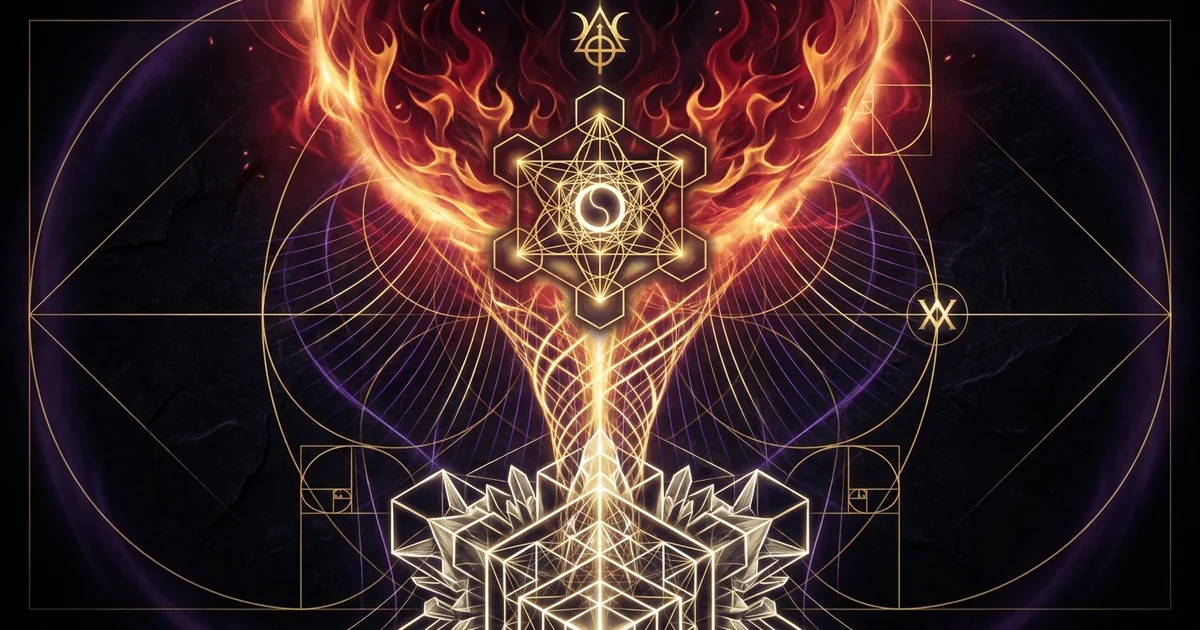
Hexagram 14 Possession in Great Measure (Dà Yǒu): I Ching
Archetypal Thesis & Systemic Paradigm: The Architecture of Sovereign Abundance
Thermodynamics of Dà Yǒu: Transcending Material Accumulation
In the analytical taxonomy of the I Ching, Hexagram 14—known classically as Dà Yǒu (Possession in Great Measure or Great Possession)—is frequently misconstrued through the lens of vulgar exoteric divination as an omen of material accumulation, financial windfall, or static acquisition. A rigorous structural and cybernetic assessment reveals that the hexagram operates on an entirely contrary thermodynamic principle: dynamic throughput. Far from designating an inert reservoir of hoarded assets, Dà Yǒu configures an open thermodynamic system in which energetic generation and radiant expenditure maintain steady-state equilibrium.
The hexagram is constructed of two primary energetic vectors: trigram-qian (☰, Heaven, Creative Power) situated in the lower, interior station, and trigram-li (☲, Fire, Conscious Radiance) ascending in the upper, exterior station. The systemic dynamic is therefore defined as fire over heaven. Qian provides the boundless, non-teleological kinetic drive—the raw generative substratum of the cosmos—while Li acts as the clarifying, discriminating lens of consciousness that organizes, illuminates, and disperses that power across the phenomenal field. The dà yǒu hexagram models an operational architecture where abundance is validated not by retention, but by transmission capacity. If the upward thrust of Heaven is blocked from radiating outward through Fire, the systemic entropy escalates rapidly toward structural failure; true possession is measured strictly by the quantum of force an organism can metabolize and project without destabilizing its core boundary.
       HEXAGRAM 14: DÀ YÕU

       Line 6: ――――― (Yang)
       Line 5: ―― ―― (Yin - Ruler)
       Line 4: ――――― (Yang)
       Line 3: ――――― (Yang)
       Line 2: ――――― (Yang)
       Line 1: ――――― (Yang)
The Sovereign Center: Solar Illumination and Receptive Governance
The core structural anomaly of Hexagram 14 resides in its line composition: five firm, luminous Yang lines submit entirely to the governance of a single yielding Yin line occupying the honored fifth position (Six in the Fifth Place). In classical political philosophy and Jungian archetypal psychology, this configuration represents the paradox of enlightened sovereignty. The five Yang lines, brimming with immense creative potency and aggressive drive, do not fall into civil war or entropic dissipation because they are anchored by a central node of receptive modesty.
The ruler of the hexagram rules not through violent coercion, but through wu-wei—receptive, non-interfering attunement. Six-in-the-Fifth embodies the metaphysical empty center around which peripheral forces naturally orbit. This architectural motif directly mirrors the solar dynamic, wherein the central gravitational well of the Sun holds the immense kinetic inertia of orbiting celestial bodies in frictionless synchronization. True sovereignty, within the framework of the hexagram 14 possession in great measure iching meaning, requires an ego structure that has vacated its own tyrannical impulses. When the ego identifies as an open clearing rather than a defensive fortress, cosmic vitality (mana) flows through it unimpeded, allowing the individual or administrative sovereign to hold “great measure” precisely because they possess nothing for private, idiosyncratic exploitation.
Cybernetic Feedback: Entropy Reversal via Ethical Distribution
From a systems-theoretical standpoint, Hexagram 14 demonstrates how an organization, psyche, or biological organism negates entropy (achieves negentropy) through purposeful distribution. Natural systems collapse when internal distribution loops choke on localized accumulations of resource. Wealth, whether quantified as biochemical ATP, surplus capital, informational dominance, or psychic libido, transforms into toxicity if sequestered behind impermeable boundaries.
The ethical imperative of Dà Yǒu is the deliberate, calculated counter-action to accumulation: the curtailing of parasitic extraction and the direct subsidization of generative growth. This process functions as a cybernetic feedback loop. The upper trigram Li, representing cognitive lucidity and discernment, surveys the macrocosmic terrain from its supreme vantage point above Heaven. It identifies regions of systemic exhaustion, structural deficiency, and evolutionary promise. The power of Qian is then channeled directly into these nodes. Systemic equilibrium is preserved through continuous, enlightened redistribution. Abundance ceases to be a static trophy and becomes an energetic current; the sovereign system acts as an alternating-current transformer, stepping down the infinite voltage of Heaven into actionable, life-sustaining illumination for the collective ecology.
“The unconscious produces contents that are valid not only for the individual, but for others as well, and even for a great number of people… If the ego arrogates to itself the merits of the archetype, it succumbs to inflation, and the consequence is psychic catastrophe. The individual must remain conscious of being an instrument, a vessel, and not the creator of the mana that flows through him. The relation of the ego to the collective unconscious must be maintained as an ethical dialectic between personal limitation and suprapersonal reality.” — C.G. Jung, The Archetypes and the Collective Unconscious, Collected Works Vol. 9i, par. 227–230.
Classical Provenance & Textual Lineage: Exegesis from King Wen to Neo-Confucianism
The King Wen Judgment and the Duke of Zhou Line Statements
The historical foundations of Hexagram 14 within the Western Zhou stratum position it as the essential, stabilizing counterpart to Hexagram 13 (Tóng Rén, Fellowship with Men). The standard sequence of the King Wen arrangement establishes a continuous sociopolitical and ontological progression: after establishing fraternity, covenant, and horizontal cohesion in the wilderness (hexagram-13-tong-ren), human culture requires vertical integration, institutional stability, and sovereign resource allocation.
The original Judgment (Tuan) ascribed to King Wen is striking in its lapidary brevity:
“Possession in Great Measure. Supreme success.”
Unlike hexagrams burdened with cautionary qualifiers—such as “favorable to cross the great water” or “perseverance brings danger”—Dà Yǒu issues a declaration of cosmic sanction (Yuan Heng). This success is predicated on an absence of ideological friction between the rulers and the ruled. The Duke of Zhou’s six line verses articulate the strategic pathway required to sustain this apex condition: beginning with the absolute avoidance of arrogance and entangling alliances at the base (Line 1), progressing through the employment of heavy structural vehicles for resource transport (Line 2), passing through the sacrificial offering of worldly power by princes to the Son of Heaven (Line 3), avoiding the structural friction of competitive rivalry (Line 4), anchoring authority in genuine sincerity and non-coercive majesty (Line 5), and culminating in unconditioned celestial benediction (Line 6).
The Ten Wings (Shi Yi) and Wang Bi’s Ontology of Emptiness
With the composition of the Ten Wings (Shí Yì), Confucian commentators transposed the concrete bronze-age administrative motifs of the Duke of Zhou into a comprehensive metaphysical and ethical doctrine. The Tuan Zhuan (Commentary on the Judgment) explicitly highlights the unique architectural balance of the hexagram:
“The yielding finds the place of honor, the grand center, and the upper and lower correspond with it; this is called Possession in Great Measure. Its virtue is firm and strong, yet clear and bright; it responds to Heaven and acts in accordance with its season; therefore it is said: Supreme success.”
Centuries later, during the Three Kingdoms period, the seminal Xuanxue (Neo-Daoist) philosopher Wang Bi revolutionized the exegesis of the Book of Changes divination traditions by sweeping away the mechanistic omen-based astrology of the Han Dynasty (Xiangshu). Wang Bi focused directly on the ontological nature of Line 5. He posited that Six in the Fifth Place rules the entire hexagram not despite its softness, but exclusively because of its softness. Within Wang Bi’s radical ontology of benwu (fundamental non-being or emptiness), the single Yin line represents pure structural void (xu). The five Yang lines represent substantial reality (you). Because Line 5 possesses no rigid, grasping selfhood, all beings (the five Yang lines) willingly converge upon it. The power of Dà Yǒu is rooted in the sovereign’s total absence of proprietary ambition.
The Judgment (Wilhelm / Baynes): “Possession in Great Measure. Supreme success.”
The Commentary on the Image (Dà Xiàng Zhuàn): “Fire in heaven above: The image of Possession in Great Measure. Thus the superior man curtails evil and furthers good, and thereby obeys the benevolent will of heaven.”
Wang Bi’s Commentary on Six in the Fifth Place: “Occupying the place of honor, it resides in the center of the hexagram. With modesty and compliance, it responds to the firm below. The five Yang lines advance toward it, not because it coerces them with force, but because it embraces them with empty sincerity. Thus, having nothing of its own, it possesses all things in great measure.”
Song Dynasty Commentary: Cheng Yi and Zhu Xi on Righteous Stewardship
During the Song Dynasty renaissance of Neo-Confucianism, the interpretation of Dà Yǒu transitioned into an exacting moral psychology and administrative treatise. Cheng Yi, in his Yichuan Yizhuan, emphasized that “Possession in Great Measure” is an exceedingly dangerous state-space if unmoored from strict ethical discipline. Cheng Yi noted that wealth, talent, and sovereign authority naturally attract the corrupting gravity of moral indolence and hubris.
Cheng Yi and later Zhu Xi framed their analyses around the imperative of the Great Image:
“The superior man curtails evil and furthers good, and thereby obeys the benevolent will of heaven.”
For Cheng Yi, this is not merely an external legalistic decree; it is an interior psychological imperative. The sovereign consciousness, gifted with the penetrating clarity of the upper trigram Li, must relentlessly discern between the micro-eruptions of self-indulgent, egoic pathology (“evil”) and the natural, generative virtues of heaven (“good”). To suppress evil does not mean violent destruction; it signifies the withholding of structural energetic support from parasitic behaviors. To further good means allocating the vast reserves of Qian directly into creative, prosocial channels. Zhu Xi codified this as the realization of the Heavenly Principle (Tianli) over human desire (Renyu). Abundance is legitimate only when it operates under the transparent jurisdiction of cosmic law.
Structural Mechanics & Symbolic Geometry: Trigram Vectors and Nuclear Dynamics
Trigram Vectors: Li (Fire) Ascending Over Qian (Heaven)
The symbolic geometry of Hexagram 14 constitutes an exceptional vertical polarization of elemental potencies. In classical cosmology, Qian (☰) represents pure Yang, creative tension, adamantine hardness, and the zenith of the celestial sphere. Li (☲) represents fire, luminescence, combustion, and visual clarity. The physical paradox of “Fire over Heaven” is profound: Heaven is by definition the uppermost horizon of the visible cosmos; if Fire burns above Heaven, it occupies a trans-cosmic, super-luminal station.
This spatial arrangement indicates that conscious illumination has surpassed raw material existence. In mundane nature, fire requires fuel to combust and naturally flickers upward toward the sky; here, it has taken root in the celestial vault itself, illuminating all things from an absolute verticality that casts zero shadows. The energetic vectors do not collide; they harmonize through directional resonance. Qian’s innate vector is an indefatigable, upward surging drive. Li’s vector is an outward-expanding, omnidirectional radiation of clarity. Therefore, Qian constantly feeds and sustains Li with infinite generative fuel, while Li prevents Qian from becoming a blind, crushing, destructive juggernaut by transmuting its kinetic power into light, order, and systemic consciousness.
The Fifth Station Topology: Six-in-the-Fifth as Cosmic Attractor
To map Hexagram 14 as a state-space representation of consciousness, one must isolate the structural topology of the lines. Lines 1, 2, 3, 4, and 6 are all firm, dynamic Yang vectors. Line 5 is the sole yielding Yin vector. In the mechanics of the Yijing, a single minority line among a majority of the opposite polarity acts as the absolute systemic ruler (Gua Zhu). Line 5 holds the sovereign throne—the position of executive authority, cultural governance, and spiritual transmission.
The systemic consequence of this topology is extraordinary:
- Line 1 (Yang) is the foundational capacity, grounded and insulated from premature involvement.
- Line 2 (Yang) is the heavy operational carriage capable of bearing massive logistical loads.
- Line 3 (Yang) is the aristocratic strength that must be sacrificed upward rather than privatized.
- Line 4 (Yang) is the brilliant executive minister who avoids competitive pride through acute self-differentiation.
- Line 6 (Yang) is the transcendent sage operating beyond formal institutional status, bestowing ultimate cosmic sanction.
All these massive forces converge upon Six-in-the-Fifth. Because Six-in-the-Fifth is Yin, it possesses no mass of its own; it is a gravitational sinkhole, an ontological vacuum. If Line 5 were a rigid Yang line—as it is in Hexagram 1 The Creative—the hexagram would become an unbearable, incendiary clash of six hyper-masculine drives, resulting in cataclysmic ego-inflation and structural fragmentation. By presenting absolute receptivity, Line 5 neutralizes the aggressive volatility of the Yang lines. They do not conquer the ruler; they rest within the sovereign’s spacious neutrality. Line 5 acts as a topological strange attractor, stabilizing the entire chaotic system into a coherent, self-organizing matrix.
Nuclear Matrix and Hexagrammatic Inversions (Gua Relationships)
The inner core of Hexagram 14 reveals its hidden structural tensions through the extraction of its nuclear-hexagram. The lower nuclear trigram (lines 2, 3, 4) is Qian (☰), pure strength. The upper nuclear trigram (lines 3, 4, 5) is Dui (☱), the Lake, representing joyful expression, marshaling of resources, and cutting-edge decisiveness. When combined, the nuclear hexagram of Dà Yǒu is Hexagram 43, Guài (Breakthrough / Resolution).
Hexagram 14 Lines:           Nuclear Breakdown:
Line 6: ―――――
Line 5: ―― ――  (Upper Nuc)   Line 5: ―― ――  \
Line 4: ―――――  (Both Nuc)    Line 4: ―――――   | Upper Trigram: Dui (☱)
Line 3: ―――――  (Both Nuc)    Line 3: ―――――  /
Line 2: ―――――  (Lower Nuc)   Line 4: ―――――  \
Line 1: ―――――                Line 3: ―――――   | Lower Trigram: Qian (☰)
                             Line 2: ―――――  /
                             Nuclear Hexagram: 43 (Guài - Breakthrough)
The presence of Hexagram 43 at the core of Hexagram 14 provides an indispensable diagnostic insight: underlying Great Possession is the non-negotiable requirement for resolute separation from corrupting psychic elements. Guài represents five Yang lines driving upward to eliminate the final, precarious Yin line at the summit; it is the archetype of structural breakthrough and moral housecleaning. This indicates that Possession in Great Measure cannot be maintained through passive benevolence alone. Within the engine room of Dà Yǒu, a continuous, surgical elimination of parasitic entropy is constantly underway. Abundance is maintained only because the system possesses the structural fortitude (Qian) and clarifying joy (Dui) necessary to sever toxic attachments before they metastasize.
Furthermore, analyzing the hexagrammatic inversions illuminates the holistic lifecycle of Dà Yǒu:
- The Inverted Hexagram (Zong Gua): By inverting the entire structure 180 degrees, Hexagram 14 becomes Hexagram 13 (Tóng Rén, Fellowship with Men). This demonstrates their indivisible bilateral symmetry: Tóng Rén gathers people horizontally through cultural affinity; Dà Yǒu organizes and protects those gathered people vertically through illuminated resource stewardship.
- The Opposite Hexagram (Pang Tong Gua): Replacing every line with its opposite yields Hexagram 8 (Bǐ, Holding Together / Alliance), where Water rests over Earth. This demonstrates that the cosmic fire-and-heaven grandeur of Dà Yǒu finds its somatic, physical mirror in the subterranean cohesion of rivers flowing across the maternal earth.
Psychological Dynamics & Operational Praxis: Navigating Line Transitions
The Shadow of Inflation: Scarcity Mindset versus Hubristic Entitlement
In the theater of depth psychology, Hexagram 14 represents the dangerous, threshold encounter with massive unconscious contents and transpersonal archetypal wealth. When an individual undergoes profound individuation, long-suppressed energetic reserves surge upward from the somatic unconscious (Qian) and breach the threshold of conscious awareness (Li). At this juncture, the ego-complex is confronted with two catastrophic structural failure modes: the scarcity neurosis and archetypal-inflation.
The scarcity mindset is the refusal to accept the reality of abundance, characterized by an obsessive, defensive tightening of ego boundaries. The individual attempts to dam the river of Heaven, hoarding psychic energy out of existential dread, which invariably leads to neurosis, somatic illness, and energetic stagnation.
Conversely, and far more insidiously, lies the peril of archetypal inflation. Here, the ego succumbs to the hubristic delusion that it is the author of the divine mana passing through it. The ego claims ownership of the fire of Heaven, declaring: “I am rich; I am brilliant; I am enlightened.” In this instant, the delicate equilibrium of Dà Yǒu is shattered. The firm, aggressive lines run rampant, obliterating the receptive, empty modesty of the Fifth Station. The psychological consequence is severe: an inevitable compensatory reaction from the collective unconscious, typically manifesting as catastrophic external reversals, megalomaniacal paranoia, or acute psychic fragmentation. The ethical orientation of Dà Yǒu requires the conscious ego to maintain the posture of an administrative steward—a fiduciary of cosmic forces, totally stripped of personal proprietary vanity.
Nine at the Beginning: Structural Insulation
- Operational Mode: Conscious withdrawal, rigorous boundary setting, non-entanglement with premature power dynamics.
- Psychological Architecture: Complete absence of pride; intentional self-containment; recognizing that unearned access to abundance corrupts the unformed ego.
- Thermodynamic Function: Preserving foundational integrity; preventing systemic leaks before the internal vessel is tempered to bear high-voltage energy.
- Textual Vector: “No relationship with that which is harmful; there is no blame in this. If one remains conscious of difficulty, one remains without blame.”
Nine at the Top: Transcendent Benediction
- Operational Mode: Effortless alignment with the Tao; action through non-action (Wu Wei); complete cosmic transparency.
- Psychological Architecture: Ego-Self axis fully integrated; the individual operates as an absolute vessel for the transpersonal will, rendering arrogance structurally impossible.
- Thermodynamic Function: Dissipation of entropy through celestial feedback; universal resource exchange; total systemic integration.
- Textual Vector: “He is blessed by heaven. Good fortune. Nothing that does not further.”
Sequential Line Evolution: From Initial Restraint to Transcendent Blessing
The sequential trajectory of the six lines in Hexagram 14 charts the progressive initiation of consciousness into the responsible wielding of transpersonal power.
- Nine at the Beginning: The initiate stands at the threshold of great abundance. The primary directive is insulation from toxic entanglement: “No relationship with that which is harmful.” At this raw stage, the generative power of Qian is subterranean. If the ego rushes forward to capitalize on this latent potential, it will hitch its wagon to destructive forces. By holding back and maintaining acute awareness of operational hazards, errors are neutralized before they materialize.
- Nine at the Second Place: “A big wagon for carrying. One may undertake something. No blame.” The psychic or systemic infrastructure is now fortified. The “big wagon” represents a flexible, capacious psychological container capable of holding vast quantities of energetic tension and logistical complexity without fracturing. Action and enterprise are now sanctioned.
- Nine at the Third Place: “A prince offers it to the Son of Heaven. A petty man cannot do this.” Here occurs the critical test of non-appropriation. The prince (the individualized ego) reaches the summit of the lower trigram—the maximum horizon of earthly power. Rather than declaring autonomy, the prince sacrifices this abundance upward to the Son of Heaven (the Transpersonal Self). A “petty man” (xiao ren) cannot execute this move; his narcissistic fixation compels him to hoard the surplus, triggering his own destruction.
- Nine at the Fourth Place: “He makes a difference between himself and his neighbor. No blame.” The fourth station is the volatile transition point from the lower realm to the upper ruling court. Here, the danger is competitive envy and lateral friction with the sovereign ruler above. The practitioner must practice radical individuation and self-differentiation. One must not rival the center; one clarifies one’s own functional boundary and avoids the trap of ideological or material competition.
- Six in the Fifth Place: “He whose truth is accessible, yet dignified, has good fortune.” The sovereign seat. Power is expressed as authentic, transparent vulnerability (fu - sincerity/inner truth). The ruler does not manipulate through clandestine stratagems. By remaining radically accessible, the collective is won; by maintaining the quiet dignity inherent in the cosmic law, the ruler prevents familiarity from breeding contempt.
- Nine at the Top: “He is blessed by heaven. Good fortune. Nothing that does not further.” Operating at the apex of the hexagram, beyond the seat of administrative governance, sits the sage-sovereign. Having mastered the ethics of stewardship, the individual is enveloped in unconditioned synchronicity. The Great Treatise (Xi Ci) notes of this line: “To bless means to help. Heaven helps the man who is devoted; men help the man who is true.”
Divinatory Mechanics: Moving Lines and State-Space Transformations
In operational consultation, when Hexagram 14 appears, the metaphysical cartographer must trace the vectors of mutability indicated by the moving lines. A static Hexagram 14 indicates a structural state of high potentiality where the system’s primary task is maintaining internal equilibrium through enlightened stewardship and ethical distribution.
However, when specific lines mutate, the systemic phase space shifts into an entirely different evolutionary trajectory:
- If Six in the Fifth Place mutates, Hexagram 14 transforms directly into Hexagram 1 (Qián, The Creative). The yielding center hardens into a pure, undifferentiated dynamic force. The warning here is immense: the receptive container has dissolved into pure kinetic drive; without immediate, rigorous intentionality, the system risks fiery implosion through archetypal-inflation.
- If Nine at the Fourth Place mutates, Hexagram 14 transforms into Hexagram 26 (Dà Chù, The Taming Power of the Great). The competitive tension of the fourth station is resolved through the immense, patient containment of Heaven’s power within the mountain’s bedrock.
- If Nine at the Third Place mutates, the hexagram evolves into Hexagram 38 (Kuí, Opposition). If the ego refuses to sacrifice its worldly gains upward to the transpersonal center, structural polarization and alienation immediately fracture the social or psychic matrix.
- If Nine at the Second Place moves, the structure shifts toward Hexagram 30 (Lí, The Clinging / Radiance), indicating that operational capacity is transmuting entirely into the domain of pure visual discernment and cognitive transmission.
Philosophical Synthesis & Macrocosmic Correspondence: Hermetic, Astrological, and Genetic Parallels
The Solar-Tiphareth Matrix: Hermetic Parallels to Heavenly Fire
Within the cross-traditional taxonomy of the Western Mystery Tradition, Hexagram 14 exhibits an exact structural and functional resonance with the Sephirah Tiphareth (Beauty/Harmony) on the Qabalistic Tree of Life, and the archetypal physics of tiphareth-solar-consciousness. Positioned at the very heart of the Ruach, Tiphareth serves as the mediator between the transcendent supernals and the dense material reality of Malkuth. It is the solar seat of sovereign equilibrium.
TREE OF LIFE: TIPHARETH EQUILIBRIUM
                         [ KETHER ]
                             |
                 [ CHOKMAH ] | [ BINAH ]
                      \      |      /
                       \     |     /
                   [ CHESED ]-[ GEBURAH ]
                        \    |    /
                         \   |   /
                        [ TIPHARETH ]  <--- Structural Mirror of
                        /    |    \         Hexagram 14 (Li over Qian)
                       /     |     \
                   [ NETZACH ]-[ HOD ]
                             |
                         [ YESOD ]
                             |
                        [ MALKUTH ]</code></pre>
Tiphareth maintains systemic stability by balancing the infinite expansiveness of Chesed (Mercy/Abundance) with the ferocious, restrictive severity of Geburah (Judgment/Strength). This is precisely the dialectic of Dà Yǒu: Qian provides the sheer, unbridled expansion of Chesed, while the discerning, discriminating brilliance of Li functions as the luminous severity of Geburah, ensuring that surplus does not devolve into cancerous overgrowth. The sovereign of Tiphareth is the “Sacrificed King”—the ruler whose authority is legitimized solely through the surrender of personal will to the Solar Logos. This identical dynamic is mirrored in the Duke of Zhou’s Line 3, wherein the prince willingly offers his wealth to the Son of Heaven.
In the Hermetic Tarot, this structural state is mapped directly to Major Arcana XIX, The Sun. The Sun card represents the total illumination of the phenomenal world by unclouded supernal light, depicting the innocent, naked child dancing within a walled garden—symbolizing the ego that has returned to radical simplicity and receptivity (Six in the Fifth Place) precisely when endowed with the absolute abundance of the cosmos.
| Systemic Coordinate | Esoteric / Scientific Correspondence | Operational Function in Hexagram 14 Matrix |
|---|---|---|
| Western Astrology | Sun in Leo (Golden Decan / 10°–20° Leo) | Apex solar radiation; sovereign dignity rooted in natural authority; non-defensive generosity. |
| Hermetic Qabalah | Sephirah Tiphareth (Path of Resh / Solar Axis) | Dynamic equilibrium of expansive generative power and discriminating structural clarity. |
| Tarot Arcana | Major Arcana XIX: The Sun | Unclouded perception; conscious assimilation of transpersonal mana; eradication of shadow. |
| Human Design | Gate 14: Power Skills (Sacral Motor) | High-torque mechanical energy generated strictly for the direction of universal purpose. |
| Biomolecular Mapping | Asparagine Codons (AAU & AAC) | Structural integrity in cellular protein synthesis; metabolic homeostasis via open ATP dissipation. |
Human Design Circuitry: Gate 14 and the Sacral Power Channel
In the synthesis of Human Design mechanics, the 64 hexagrams of the I Ching are mapped directly across the bodily architecture of the Bodygraph. Hexagram 14 is codified as Gate 14 Power Skills, located in the Sacral Center. The Sacral Center is the biological motor of generative life-force energy, fertility, and work capacity.
Gate 14 carries the descriptive archetype: “The Gate of Power Skills” or “Sustaining Fire.” It operates as the mechanical engine within the Individual Circuitry group. Gate 14 does not operate in isolation; it gazes across the Tantra Channel (the Channel of the Beat, 14–2) toward Gate 2 (The Higher Self / The Receptive) situated in the G Center. This polarity reveals an astonishing mechanical continuity with the classical I Ching:
- Gate 14 (Sacral) holds the raw, combustible, high-torque generative fuel—the pure energetic power of Heaven (Qian).
- Gate 2 (G Center) represents the magnetic monopole that determines the trajectory, direction, and spatial orientation of the soul—the ultimate yin guidance of Earth/Heaven.
When Gate 14 generates energy without the navigational alignment of Gate 2, it produces hyper-active, entropic exhaustion. When aligned, Gate 14 acts as the systemic fuel pump for the entire vessel. It is defined mechanically as “the key to the material treasury”: energy generated strictly to empower evolutionary, transcendent mutations in human culture, rather than the mundane survival struggles of the petty ego. It dictates that wealth is not capital stored in vaults, but energy available for authentic work that honors the cosmos.
Genetic Codon Mapping: Metabolic Signaling and Epigenetic Abundance
At the microscopic frontier of modern biophysics and esoteric genomics, the 64 hexagrams correlate structurally to the 64 codons of the universal genetic code. The six-line binary sequence of Dà Yǒu (111101, reading from bottom to top) maps mathematically to the codon architecture regulating specific amino acid expressions—specifically correlating to the codons governing Asparagine (AAU and AAC) and neighboring cellular transcription complexes.
Asparagine plays an indispensable, rate-limiting role in the biosynthesis of glycoproteins and the metabolic regulation of cellular homeostasis. Cellular abundance is never an index of how many raw chemical inputs an individual cell can absorb and lock away; a cell that endlessly accumulates glucose or amino acids without metabolizing and secreting target proteins enters a state of oncogenic mutation or metabolic apoptosis.
Living cells maintain vitality through dissipative structures—a term coined by physical chemist Ilya Prigogine. Hexagram 14 is the ultimate genetic glyph of the open dissipative structure. The cell receives an immense inflow of chemical energy (Qian), processes it through the crystalline, discriminating apparatus of the ribosomal and mitochondrial engines (Li), and immediately exports vital enzymes, structural proteins, and electrochemical signals into the extracellular matrix. Abundance, at the cellular level, is the velocity and fidelity of life-affirming throughput. The moment retention surpasses dissipation, the biological system tips into disease; the moment ethical dissipation matches generative production, the organism experiences biological flourishing (Dà Yǒu).
Frequently Asked Questions Regarding Hexagram 14
The Structural Difference Between Hexagram 13 (Tong Ren) and Hexagram 14 (Dà Yǒu)
The structural divergence between Hexagram 13 (Tóng Rén, Fellowship with Men) and Hexagram 14 (Dà Yǒu, Possession in Great Measure) is an exemplar of how hexagrammatic inversion alters systemic mechanics:
- In Hexagram 13, Heaven is the upper trigram and Fire is the lower trigram: Heaven over Fire. Fire, by its very nature, ascends toward Heaven. This symbolizes humanity gathered on earth, looking upward with shared aspirations, ideological harmony, and horizontal, egalitarian fellowship. It is the archetype of the clan, the democratic alliance, and collaborative community organized in the open wilderness.
- In Hexagram 14, the positions are reversed: Fire over Heaven. Here, Fire burns at the cosmic zenith, looking down upon all reality. The egalitarian fellowship of Hexagram 13 is transformed into an illuminated vertical hierarchy. Dà Yǒu is not about communal assembly; it is about sovereign governance, asymmetric capacity, and the systemic responsibility of those who hold the levers of power and capital. Hexagram 13 builds the communal coalition; Hexagram 14 allocates the systemic resources necessary to shelter and sustain that coalition.
Interpreting Six in the Fifth Place as a Moving Line
When Six in the Fifth Place mutates in a consultation of the Book of Changes divination, it carries monumental interpretive weight. Because this single yielding line is the sole organizing ruler of the entire hexagram, its mutation fundamentally upends the systemic architecture.
When Six-in-the-Fifth changes, its Yin receptivity converts into a firm Yang line, causing the entire hexagram to transform into Hexagram 1 (Qián, The Creative):
This shift indicates that the empty, humble, and non-coercive center that held the five dynamic Yang lines in balance has suddenly solidified. The sovereign has ceased to be an open vessel and has instead adopted an active, aggressive posture. The consultant is warned that the danger of catastrophic ego-inflation is now acute. The systemic grace of Dà Yǒu is instantly suspended; the consultant is thrown into the unrelenting, high-voltage crucible of pure Qian, where survival demands superhuman self-discipline, unbending rectitude, and the complete elimination of petty, self-serving ambition.
Material Wealth versus Spiritual Abundance in Divination Consultations
A recurrent pitfall in consulting the I Ching is the reduction of Hexagram 14 to an uncomplicated announcement of imminent financial gain or worldly promotion. While the hexagram certainly does not exclude material success—operating, as it does, on the plane of concrete operational capacity—it strictly subordinates material wealth to spiritual and ethical stewardship.
If an enquirer approaches the oracle with a purely grasping, transactional consciousness, asking how to extract or hoard worldly assets, the appearance of Hexagram 14 acts as an immediate diagnostic mirror and moral challenge. The hexagram affirms that energy, resources, and influence are indeed accumulating in the field; however, it issues a profound systemic warning: this energy does not belong to the ego. It has been provisionally placed within the querent’s administrative sphere by the cosmic order.
If these resources are not immediately mobilized to “curtail evil and further good”—by funding generative enterprises, uplifting collaborators, eliminating structural inefficiencies, and serving the wider ecosystem—the fiery nature of the upper trigram Li will rapidly turn inward, transmuting unspent capacity into psychic conflict, interpersonal resentment, and institutional decay. Possession in Great Measure demands that the possessor become utterly transparent, acting merely as the benevolent hands of Heaven distributing light to the earth.