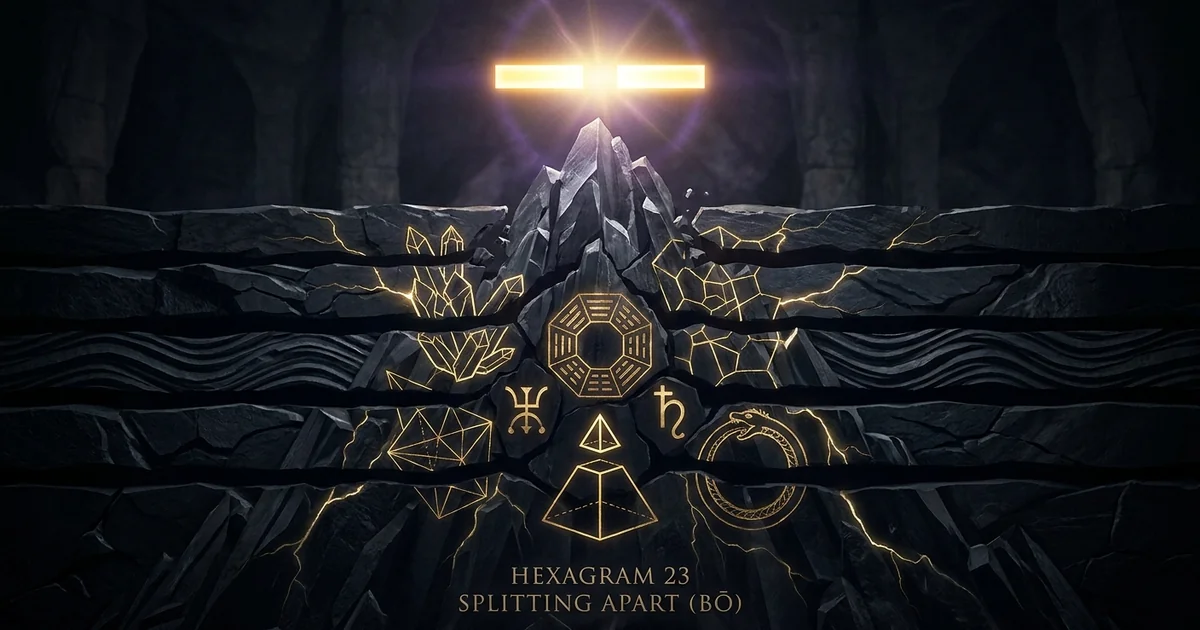
Hexagram 23 Splitting Apart (Bō): I Ching Divination
Archetypal Thesis & Systemic Paradigm: The Entropy of Form
Thermodynamic Degradation and the Metaphysics of Stripping
Hexagram 23, designated in the Received Text of the Zhouyi as 剝 (Bō, Splitting Apart or Flaying), operates within the psycho-cosmological cybernetics of the I Ching as an entropic phase-state. It formally models the structural dissolution, decay, and terminal shedding of outworn cognitive, cultural, and somatic architectures. Positioned within the deterministic flow of systemic evolution, Bō represents the inevitable juncture at which an organized system exhausts its internal negentropy. Rather than signaling an aberrant crisis or catastrophic punishment, the hexagram delineates the lawful thermodynamic degradation of form.
In this cosmic coordinate, the macroscopic scaffolding that once sustained growth can no longer resist the underlying gravitational pull of systemic decay. To interpret Bō through the superficial lens of moralistic failure or bad luck is to fundamentally misapprehend the cyclical mechanics of the Changes. The stripping away is an ontological cleansing: forms petrify when their animating principle recedes, and their subsequent erosion is an indispensable cosmological mechanism that prevents evolutionary stagnation.
::: diagram Hexagram State-Space Evolution


    Hexagram 22: Bi (Grace/Form)
    Hexagram 23: Bō (Splitting Apart/Decay)
    Hexagram 24: Fù (The Return/Seed)


:::
The Binary Calculus: Five Earth Lines and the Solitary Heaven Line
The structural geometry of Hexagram 23 exhibits an extreme configuration within the binary calculus of the sixty-four figures. Five Yin (broken) lines ascend methodically from the base, systematically displacing the primal creative energy and leaving a solitary Yang (solid) line precariously suspended at the apex. This asymmetrical balance illustrates the apex of the dark, receptive, and potentially corrosive principle (yin-yang-polarity) undermining the firmament of heaven.
The five broken lines represent the progressive infiltration of density, subversion, and passive dissolution through the systemic basement. The solitary unbroken line at the top represents the final vestige of structural coherence, ideological authority, or conscious intentionality. It is an unsupported roof resting atop a collapsing foundation. The systemic trajectory is clear: the dark forces do not attack the light head-on; rather, they hollow out its underlying support until the overarching matrix shears under its own accumulated weight.
Ego-Dissolution as an Invariant Phase in Consciousness Evolution
Transposed to analytical and depth psychology, Hexagram 23 serves as a precise cartography of the collapse of the persona and the reduction of the conscious ego. In the psychological framework outlined by C. G. Jung (1950), conscious structures inevitably calcify into rigid dogmas that alienate the individual from the dynamic currents of the unconscious. When these conscious attitudes lose their vitality, an involuntary psychological regression occurs. The ascending Yin lines represent unconscious contents surging upward from the primordial depths, demanding the dismantling of the conscious superstructure.
This process mirrors the alchemical stage of nigredo—the blackening and mortification wherein systemic hubris is forcefully dissolved. To attempt an outward defense against this psychic peeling is to court neurosis; the operational directive of the bō hexagram requires conscious participation in the deconstruction of one’s own false identifications. It is the necessary prerequisite for structural psychic renewal, an archetypal encounter examined in depth within /depth-psychology/archetypal-shadow-dissolution. The ego must endure the terror of structural collapse so that the imperishable germinal nucleus of the Self may survive intact.
Classical Provenance & Textual Lineage: Historical Exegesis of Bō
The King Wen Judgment: Pragmatism in Times of Disintegration
The foundational Judgment attributed to King Wen delivers an unambiguous, terse strategic directive: “SPLITTING APART. It does not further one to go anywhere.” This formulation constitutes a severe warning against dynamic forward momentum, assertive intervention, or structural expansion. When the governing currents of space and time are configured around disintegration, any attempt to erect new fortifications or enforce outdated systems merely compounds vulnerability.
The classical commentators, including Cheng Yi (1099) in his Yichuan Yizhuan, emphasize that this counsel does not encourage resigned fatalism or nihilistic defeatism. Instead, it demands strategic conservation and tactical stillness. In an entropic environment, proactive measures feed the dissipative apparatus; every gesture toward self-preservation through active control is inverted by the prevailing dynamics of the time. The superior individual preserves structural integrity by recognizing the boundaries of action, actively yielding to the prevailing downward momentum without compromising the internal seed of awareness.
‘SPLITTING APART. It does not further one to go anywhere… Mountain rests on the earth: The image of SPLITTING APART. Thus those above can ensure their position only by giving generously to those below.’
The Zhouyi Judgments: Semantic Origins of Bō as Flaying and Stripping
Philologically, the ideogram 剝 (Bō) is rooted in visceral, concrete imagery: it is composed of the radical for a knife (刂) combined with a phonetic component denoting the recording or stripping of skin. Early epigraphic evidence and bronze inscriptions reveal that Bō referred specifically to the acts of flaying an animal carcass for ritual sacrifice, carving meat from bone, or peeling the bark from a tree to expose its core. It is an act of violent, somatic exposure.
Within the archaic context of the Zhouyi, the flaying metaphor carries profound ritualistic weight. It implies the systematic excision of non-essential, external coverings in order to reveal that which is structurally fundamental. The peeling of the outer layers is not a malicious violation, but an organic exposure of raw truth. What falls away during the epoch of Bō was never truly essential; it was merely the scaffolding, the rind, or the flesh that shielded the inner core during preceding phases of incubation.
Wang Bi and Neo-Confucian Hermeneutics: The Superior Man’s Non-Action
In his seminal third-century commentary, Wang Bi (trans. Lynn, 1994) revolutionized the interpretation of Hexagram 23 by shifting the focus away from superstitious omen-reading toward an ontology of metaphysical alignment. Wang Bi asserts that when inferior elements gain momentum, the superior individual (junzi) does not engage in petty recrimination or direct combat. Because the ascending Yin represents a cosmic phase rather than a moral failure, active resistance is fundamentally discordant with the Tao.
Neo-Confucian scholars expanded this hermeneutic, particularly in their readings of the Da Xiang (Great Image). The text asserts: “Mountain rests on the earth: The image of SPLITTING APART. Thus those above can ensure their position only by giving generously to those below.” Rather than clinging to hierarchical privilege as systemic decay accelerates, the leader or enlightened consciousness must disperse accumulated wealth, status, and authority downward. By actively nourishing the base—by distributing the mass of the mountain across the broad foundation of the earth—one prevents a catastrophic landslide and harmonizes with the cyclical demands of book of changes divination.
Structural Mechanics & Symbolic Geometry: Mountain over Earth
           Hexagram 23: Bō

             ———  Line 6 (Yang)
             — —  Line 5 (Yin)
             — —  Line 4 (Yin)
             — —  Line 3 (Yin)
             — —  Line 2 (Yin)
             — —  Line 1 (Yin)

         Upper Trigram: Gen (Mountain)
         Lower Trigram: Kun (Earth)
Trigram Spatial Dynamics: Gen (Mountain) Resting upon Kun (Earth)
The structural architecture of Hexagram 23 is determined by the spatial interaction of its constituent trigrams: the upper trigram is /iching/trigram-gen-mountain (艮, Keeping Still, the Mountain), situated directly above the lower trigram /iching/trigram-kun (坤, The Receptive, Earth). This spatial topography depicts a monumental mass elevated atop a flat, pliant plane. A mountain is by nature an accumulation of earth that has risen high above the base level; when it rests upon simple, soft ground without deep bedrock anchors, its sheer gravitational weight renders it fundamentally unstable.
The energetic relationship between upper Gen and lower Kun is one of precarious load-bearing. Gen represents the threshold of stillness, the boundary, and the termination of movement, while Kun represents yielding compliance and deep receptivity. The earth beneath cannot sustain the concentrated weight of the mountain above. Consequently, the mountain shears away at its foundations, slumping downward in an inexorable landslide that returns the elevated stone to the horizontal expanse of the plain. The symbolic geometry demonstrates that extreme verticality divorced from horizontal grounding cannot maintain structural equilibrium.
Hexagram 23: Bō (Splitting Apart)
Trigrams: Gen over Kun. Five Yin lines subverting a single Yang line from below. Represents structural, organic decay where direct action is impossible; stillness and surrender are mandatory.
Hexagram 33: Dùn (Retreat)
Trigrams: Qian over Gen. Two Yin lines rising beneath four Yang lines. Represents strategic, proactive withdrawal while strength remains intact; an orderly retreat rather than terminal collapse.
The Line Progression: Somatic Metaphors of Collapse from Base to Roof
The internal mechanics of Bō unfold across the six lines through an explicit architectural and somatic metaphor: the progressive collapse of a bed (chuáng). The bed represents the foundational platform of human security, rest, and psychic equilibrium. As entropic decay advances through the hexagram, this platform is methodically dismantled from the lowest points of support upward:
- Initial Six (Line 1): “Splitting apart the bed at the legs. Those who persevere are destroyed.” The decay begins at the absolute foundation, undermining the contact point between the vessel and the earth. To act assertively here is catastrophic because the base is already compromised.
- Six in the Second Place (Line 2): “Splitting apart the bed at the frame. Those who persevere are destroyed.” The decay advances into the structural edges and load-bearing joints. Support diminishes further; the collapse moves from an external condition to an internal systemic structural failure.
- Six in the Third Place (Line 3): “Splitting apart them. No blame.” Positioned at the apex of the lower trigram, this line represents an anomaly. By breaking alignment with the destructive ascent of the other Yin lines and bonding receptively with the solitary Yang above, it escapes systemic culpability through conscious differentiation.
- Six in the Fourth Place (Line 4): “Splitting apart the bed down to the skin. Misfortune.” The destructive wave breaches the physical boundaries of the platform and touches the flesh of the sleeper. The crisis is no longer objective or structural; it directly threatens the vitality of the subject.
- Six in the Fifth Place (Line 5): “A shoal of fishes. Favor comes through the court ladies. Everything is favorable.” Here, near the summit, the Yin forces submit to order. Like a school of fish organized behind a leader, the receptive forces align beneath the solitary sovereign Yang, turning potential chaos into disciplined devotion.
The Sixth Line Anomalous Dynamic: The Great Fruit Uneaten
The climax of the hexagram occurs at the Nine at the Top (Line 6). Here, the mechanics of total decay invert into the seed of regeneration: “A large fruit still uneaten. The superior man receives a carriage. The house of the inferior man is split apart.” The solitary Yang line represents the durable, indivisible core of reality that cannot be decomposed by entropic stripping. It is the terminal fruit hanging from the autumn bough, holding the genetic blueprint of the future within its kernel.
This single Yang line exemplifies the dialectical nature of book of changes divination. For the common, unreflective individual whose identity is anchored entirely in external architecture, the collapse of the house is an absolute catastrophe. But for the superior individual, this final phase-shift brings elevation: the carriage signifies dynamic mobility and liberation from the ruined structure. The form is stripped away, but the essential seed is preserved, preparing the ground for the dawn of /iching/hexagram-24-return-fu.
Psychological Dynamics & Operational Praxis: The Divination Matrix
Diagnostic Decoding in Consultation: Navigating Rupture
When Hexagram 23 emerges in an operational consultation, its diagnostic message is precise: the querent is situated in a systemic environment undergoing irreversible decomposition. Any attempt to preserve the decaying status quo through aggressive intervention, defensive posturing, or structural manipulation will fail. The primary strategic vulnerability in hexagram 23 splitting apart iching meaning stems from identifying with the disintegrating vessel rather than the imperishable seed.
Consultants must evaluate the precise vector of dissolution. In professional and creative enterprises, Bō indicates that an enterprise, partnership, or conceptual model has exhausted its developmental utility. Its continued maintenance consumes more energy than it yields. In interpersonal dynamics, it marks relationships maintained solely through habit, guilt, or outworn obligations. The oracle advises an immediate cessation of repairs: let the collapsing beam fall, let the withered branch snap, and redirect attention toward guarding the essential values that will outlive the immediate collapse.
In ‘On Divination and Synchronicity’, von Franz illustrates that moments of structural psychic collapse (synchronous with Bō) represent the unconscious withdrawing projection from outworn vessels to incubate the new central orientation.
Shadow Integration and the Dismantling of False Identifications
Psychologically, the operation of Bō enforces the involuntary integration of the personal shadow. The five ascending Yin lines represent the return of the repressed—all the marginalized, devalued, and unintegrated components of the psyche that the conscious ego had cast out to construct its idealized persona. As these neglected elements rise from below, they attack the pristine, elevated self-image (the mountain) with devastating effect.
The acute suffering associated with this hexagram is directly proportional to the rigidity of the ego’s defenses. When the individual pathologically identifies with their social titles, intellectual achievements, or material possessions, the stripping of these external assets feels like total psychic annihilation. Yet depth psychology reveals that this flaying is fundamentally curative. By stripping the ego of its artificial defenses, the unconscious reveals the true psychic center. The individual discovers that who they are survives the destruction of what they possess.
Praxis of Non-Resistance: Wu Wei amidst Systemic Failure
The operational praxis demanded by Hexagram 23 is the strict application of wu-wei (effortless action or non-interference). Under the conditions of Bō, conventional notions of strategic problem-solving must be suspended. When a house is in the final stages of structural collapse, running inside to patch the plaster invites crushing trauma; the only rational response is to step back, observe the fall, and secure the perimeter.
This non-resistance is neither passive despair nor emotional dissociation. It is a rigorous, hyper-vigilant containment of energy. The practitioner intentionally withdraws emotional investment from doomed external endeavors, practicing psychological detachment while remaining completely present to the reality of the loss. By refusing to expend psychic capital on impossible rescue efforts, the individual conserves the vital force needed to cultivate the emerging seed. Stillness is not merely a tactical alternative during Bō; it is the singular path toward existential continuity.
Philosophical Synthesis & Macrocosmic Correspondence: Universal Cycles of Return
                          SOVEREIGN CYCLE

                    Hexagram 1: Qian (Summer)
                             │
                             ▼
         Hexagram 33: Dùn  ──────►  Hexagram 23: Bō
         (Early Retreat)           (Late Autumn / Ninth Month)
                                         │
                                         ▼
                               Hexagram 24: Fù
                           (Winter Solstice / Midnight)
The Calendar Hexagrams: The Ninth Lunar Month and Autumnal Terminal Phase
Within the classical cosmological framework of the twelve Sovereign Hexagrams (pi gua), Hexagram 23 marks the ninth lunar month (typically October-November in the solar calendar), the final phase of autumn. This is the period when the solar, Yang energy of the cosmos has receded to a thin band, and the cold, damp, Yin current dominates the landscape. The leaves fall, vegetation decays into the soil, and the organic realm strips down to its skeletal framework.
This macrocosmic rhythm anchors Bō within a broader systemic movement. The ninth month is dark, yet it is mathematically bounded: it directly precedes the tenth month of pure Yin (Hexagram 2, Kun), which immediately gives birth to the winter solstice at Hexagram 24 (Fù, The Return), where the solitary light line re-enters the bottom of the world. Thus, Bō is not an open-ended terminal state; it is a precisely calculated stage within an invariant closed loop. The darkness of the late autumn phase is simply the necessary womb within which the light incubates before its subsequent renewal.
- Sovereign Calendar Month: 9th Lunar Month (late autumn; October-November)
- Trigram Energetics: Upper Gen (Mountain / Stop) + Lower Kun (Earth / Yield)
- Genetic Codon Symmetry: Codon family governing termination and amino acid translation (Schönberger paradigm)
- Operational Vector: Solve (Dissolution) preceding Coagula (Hexagram 24)
Biochemical and Information Symmetry: Codon Mappings of Gate 23
In modern synthesis that bridge the I Ching with biological and information theory, Hexagram 23 reveals deep correspondences to genetic translation and structural simplification. In the molecular biology correlations advanced by Martin Schönberger (1973) in The I Ching and the Genetic Code, the hexagram patterns match the mathematical logic of the 64 DNA/RNA triplets. Hexagram 23 functions analogously to the termination codons—the molecular “stop” signals that arrest the transcription of peptide chains, releasing the synthesized protein into functional existence. Without this deliberate termination, protein synthesis would devolve into non-functional, cancerous sequences.
Similarly, within modern systemic cartographies such as Human Design, Gate 23 (located in the Throat Center, titled “Splitting Apart” or “Assimilation”) governs the translation of complex, dense cognitive patterns into simple, direct expression. Its function is fundamentally reductive: it strips away extraneous intellectual decoration to express the unvarnished essence of an insight. This biological and communicative parallel highlights the core truth of Bō: true evolution relies on the systematic reduction of complexity to maintain structural clarity.
Hermetic Axioms: Dissolution as the Mother of Coagulation
Hexagram 23 constitutes the exact oriental cosmological counterpart to the ancient Western Hermetic axiom: Solve et Coagula (dissolve and coagulate). The Western esoteric tradition recognizes that before any substance, metal, or soul can be elevated to a higher octave of being, its existing structural matrix must be broken down entirely. It must undergo the mortificatio—the dissolution of its rigid temporal bonds.
The bō hexagram is the embodiment of Solve. It melts down the outworn vessel so that the trapped spiritual essence can break free from its calcified shell. If the vessel does not break, the consciousness inside remains bound to an outdated developmental phase. By embracing the stripping of Bō, the adept collaborates with the universal solvent of the cosmos, clearing the sacred vessel so that the regenerative Coagula of Hexagram 24 can crystallize upon a pure, uncorrupted foundation.
Frequently Asked Questions: Advanced Divinatory Nuance
Is Hexagram 23 Unconditionally Inauspicious in Divination?
Hexagram 23 is rarely pleasant in practical divination, but categorizing it as unconditionally inauspicious is an analytical error. The hexagram signifies the rapid, inevitable decay of external structures, projects, or attachments. If the querent insists on preserving these rotting frameworks, Bō indicates misfortune and frustration.
However, if the querent uses the divination to enact conscious release—clearing debts, shedding burdens, cutting away toxic commitments, and stripping life down to its absolute essentials—the hexagram acts as an ally. It accelerates the departure of dead weight that would otherwise poison the psychological ecosystem. In inquiries regarding clinical detox, spiritual renunciation, shadow-work, or the termination of an unsustainable venture, Hexagram 23 is an auspicious signal of long-overdue clearance.
How Does Line 6 Alter the Divination Outcome?
Line 6 alters the divinatory meaning of Bō by introducing the archetype of the indestructible kernel. While Lines 1 through 5 depict the ascending decay of foundations and flesh, Line 6 reveals that the fundamental essence of the matter cannot be destroyed. The phrase “A large fruit still uneaten” guarantees that despite the surrounding wreckage, the core asset, insight, or lineage will survive.
When Line 6 changes, it transforms Hexagram 23 into Hexagram 2 (Kun, The Receptive), completing the transition of the last Yang element into yielding earth. The text declares that the superior person receives a carriage—meaning they gain the capacity to carry and be carried by the emerging reality—while the petty person’s shelter collapses entirely. Receiving this line shifts the divination from a warning of vulnerability to a promise of preservation: you will lose your external accommodations, but you will retain the genetic blueprint for the next cycle.
What Distinguishes Bō (23) from K’an (29) and K’un (47)?
While Hexagrams 23, 29, and 47 all address existential crisis, their operational mechanics are fundamentally distinct:
- Hexagram 23 (Bō - Splitting Apart): The primary dynamic is structural rot and mechanical decay from within. The danger arises from the natural expiration of a cycle. Action is useless because the vessel itself has lost load-bearing capacity; one must stand still and let the breakdown complete its work.
- Hexagram 29 (K’an - The Abysmal Water): The primary dynamic is navigating external turbulence and perilous terrain. The vessel is not necessarily decaying; rather, it is swept up in an objective storm of chaotic forces. Here, survival demands active, courageous navigation, holding fast to the inner heart rather than yielding to collapse.
- Hexagram 47 (K’un - Oppression/Exhaustion): The primary dynamic is confinement and severe energetic depletion. The individual is trapped within a dried-up lake, blocked by limitations and unable to make their words heard. The task in K’un is silent inner endurance under heavy constraints, whereas Bō demands the active, willing surrender of the container itself.