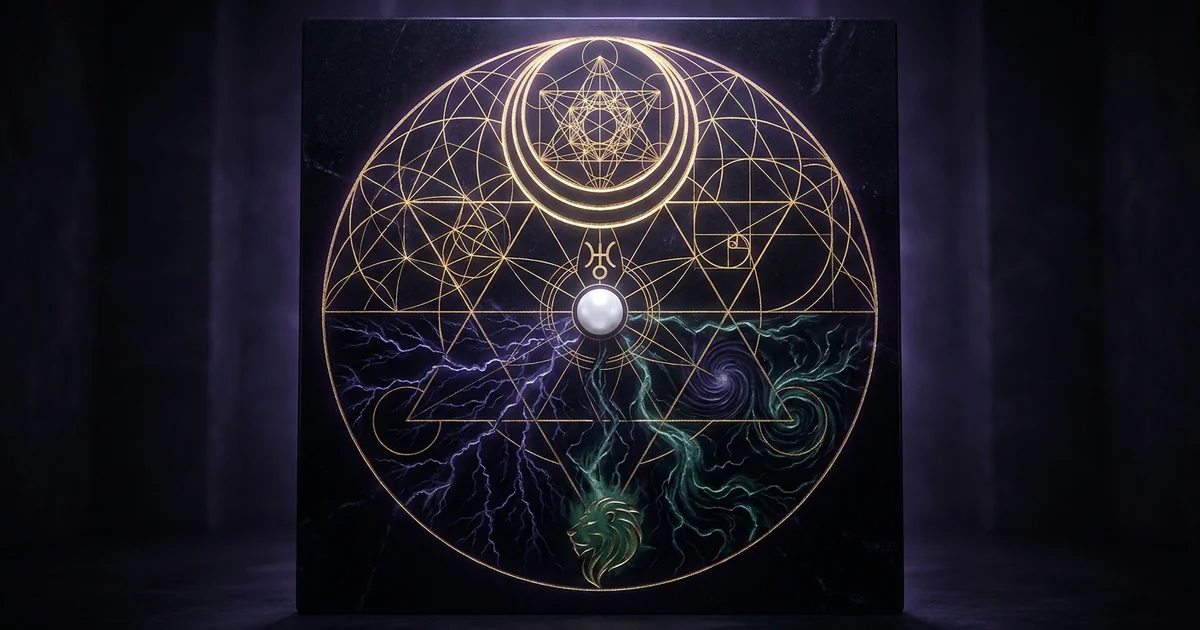
Hexagram 25 Innocence (The Unexpected) (Wú Wàng): I Ching
Archetypal Thesis & Systemic Paradigm: The Ontology of Non-Contrivance (Wú Wàng)
Hexagram 25, designated as 無妄 (Wú Wàng), delineates a critical state-space representation within the psycho-cosmological matrix of the I Ching. Rather than denoting an infantile state of naive passivity, the hexagram establishes the ontological conditions of non-contrivance, spontaneous structural integrity, and existential authenticity. The semantic architecture of Wú Wàng hinges upon the negation of wàng—a character encompassing delusion, aberrant presumption, insincerity, and the calculated manipulation of systemic variables for localized egoic gain. In this analytical schema, “Innocence” constitutes an absolute fidelity to phenomenological reality as it is, stripped of artificial teleological overlays. The hexagram formalizes an operational paradox: human consciousness operates with supreme effectiveness only when it ceases to impose artificial, premeditated designs upon an unfolding cosmic topography, functioning instead via pure uncalculated presence (ziran).
“The psychoid nature of the archetype reveals that synchronistic phenomena are not merely subjective cognitive projections, but the manifestation of an objective meaning existing outside the psyche. In the context of the I Ching, when the conscious mind relinquishes its causal, mechanical prejudices—its delusions of manipulation—it enters into alignment with the unus mundus. The hexagram of Wú Wàng represents precisely this threshold: where the uncalculated act meets the acausal, objective unfolding of cosmic reality.” — Carl Gustav Jung, Foreword to the I Ching (1950)
Vectoring Spontaneity: The Interlocking Dynamics of Zhen and Qian
The energetic tension of the wú wàng hexagram is governed by its constituent trigrammatic polarities: trigram-zhen (Thunder, dynamic excitation) situated beneath trigram-qian (Heaven, structural law and untrammeled celestial kinetic power). This macrocosmic spatial arrangement—often termed heaven over thunder—generates a distinct cybernetic dynamic. Thunder, operating within the interior, represents primordial arousal, movement, and the immediate surge of instinctive agency. However, because this eruptive kinetic impulse is directly capped and guided by Qian above, its momentum cannot dissipate into subjective arbitrariness or chaotic transgression.
The structural imperative of heaven over thunder dictates that movement is legitimate only when it directly mirrors and submits to celestial order. If lower kinetic drive attempts to forge an autonomous, self-aggrandizing path, it ruptures the overarching structural envelope of Qian, precipitating immediate systemic failure. Therefore, the phrase hexagram 25 innocence (the unexpected) iching meaning points not to an absence of power, but to the exact alignment of dynamic momentum with immutable architectural law. The motion of thunder under heaven is cyclical, rhythmic, and natural; it rolls across the landscape without malice, anxiety, or artificial intent.
Teleology versus Emergence: Dismantling Egoic Premeditation
Within classical Western epistemologies, action is almost universally tethered to causal teleology: an agent defines a goal, fabricates an instrument, and calculates probabilistic pathways to manufacture an outcome. Hexagram 25 forcefully dismantles this paradigm. In the state-space representation of Wú Wàng, subjective teleology is diagnosed as an entropic interference pattern. The text warns that the moment an agent acts with an eye toward unearned dividends—plowing the soil while constantly fixating on the harvest—the purity of the act is compromised by wàng (delusive contrivance).
True efficacy in this domain arises through emergence rather than calculation. Operating in resonance with wu-wei, the subject executes action purely as an intrinsic response to systemic necessity. The farmer plows because the season commands plowing; the seed is set because the soil is receptive. When conscious awareness is purged of secondary gains and neurotically anticipated futures, it mirrors the self-organizing dynamics of the cosmos. The outcome is uncoupled from anxiety, allowing the systemic whole to regulate the distribution of energy without psychic drag.
The Phenomenological Meaning of ‘The Unexpected’
The traditional translation of Wú Wàng as “The Unexpected” introduces an essential phenomenological dimension to the hexagram. When an individual operates from uncontrived immediacy, they forfeit the illusory protective shield of mental modeling and predictive control. Consequently, systemic reality confronts the actor in its raw, unmediated unpredictability. The unexpected is not merely an external disruption; it is the natural consequence of stepping outside rigid mental constructs and entering direct contact with the volatile dynamism of open systems.
Simultaneously, the unexpected functions as an objective diagnostic probe. When catastrophic or fortuitous occurrences manifest completely uncoupled from the agent’s intent, the subjective apparatus is subjected to a systemic stress-test. Does the subject relapse into panic, frantic manipulation, and self-justification, or do they sustain radical equanimity? The unexpected strips away the rationalized pretexts of the ego, exposing whether one’s posture of innocence was merely an aesthetic performance or an unshakeable, ontological ground of being.
Classical Provenance & Textual Lineage: Epistemological Stratigraphy of Wú Wàng
The historical and philological evolution of Hexagram 25 reveals a profound epistemological transformation, moving from bronze-age divinatory omens regarding malevolent fortune to an advanced metaphysics of subjective authenticity within Neo-Daoist and Neo-Confucian commentaries. The hermeneutic trajectory of the text preserves the archaic anxieties of ancestral cultures while gradually refining them into an exquisite manual of psychological and metaphysical alignment.
Wilhelm-Baynes Translation: “INNOCENCE. Supreme success. Perseverance furthers. If someone is not as he should be, he has misfortune, and it does not further him to undertake anything.” (The I Ching or Book of Changes, 1950)
Wang Bi’s Neo-Daoist Commentary: “Now, what is wú wàng? It means non-delusion, non-falsehood. If one acts with calculated intent, this is delusion. If one relies on natural spontaneity, this is without delusion. If one possesses calculated motives, even if one preserves sincerity, it cannot be considered wú wàng. Thus, if someone is not as he should be, catastrophe ensues; how could any direction of undertaking prove advantageous?” (The Classic of Changes: A New Translation of the I Ching as Interpreted by Wang Bi, trans. Richard John Lynn, 1994)
Etymological Anatomy of Wàng (妄): Delusion, Falsehood, and Transgression
To master the semantic field of Hexagram 25, one must anatomize the character wàng (妄). The graph combines the radical for “woman” (女, nǚ) with the phonetic and conceptual signifier wáng (亡), meaning “to perish,” “to lose,” or “to disappear.” Historically reflecting archaic patriarchal anxieties regarding disruptive female lineage or irrationality, the composite ideogram wàng crystallized in classical Chinese philosophy to denote wildness, mental aberration, absurd behavior, falsehood, and transgression against natural norms. It signifies the consciousness that has lost its moorings, chasing phantoms and projecting false structures onto the world.
Prefacing this ideogram with the absolute negative particle Wú (無)—signifying primordial absence, non-being, or radical negation—fundamentally shifts the locus of meaning. Wú Wàng is not the simple passive condition of being harmless; it is the active elimination of delusion. It represents the deliberate evisceration of mental projections, contrived motivations, and self-serving deceits. In the context of book of changes divination, achieving Wú Wàng implies entering an epistemic clear space wherein consciousness perceives without refracting reality through subjective anxieties.
King Wen and the Duke of Zhou: The Judgments of Innocence and Folly
The strata of the Western Zhou texts, attributed to King Wen and the Duke of Zhou, frame Wú Wàng with solemn circumspection. The Judgment pronounces: Supreme success; perseverance furthers. If someone is not as he should be, he has misfortune, and it does not further him to undertake anything. The archaic root suggests that under this hexagram, the cosmos is profoundly unforgiving of moral dissonance. Any deviation from absolute structural rectitude (zheng, 貞) incurs an instantaneous systemic penalty.
The commentary of the Duke of Zhou on the moving lines introduces stark, enigmatic scenarios: tethered cattle seized by wandering travelers, unexpected illness resolving without therapeutic intervention, and unwarranted calamity descending upon the blameless. These narratives reflect the early Bronze Age recognition of cosmic ambivalence. The cosmos does not negotiate with human sentimentalism. In the archaic horizon, an individual could be functionally innocent yet still intersect with catastrophe, demanding a worldview that decouples moral action from vulgar guarantees of personal safety.
Wang Bi’s Exegesis: Non-Being, Naturalness (Ziran), and Uncalculated Presence
In the third century CE, the brilliant young philosopher Wang Bi fundamentally reconstructed the hermeneutics of Hexagram 25. Influenced by Daoist ontological categories of benwu (original non-being) and ziran (spontaneous self-so-ness), Wang Bi stripped the hexagram of primitive superstition. He asserted that Wú Wàng constitutes the absence of artificial action. For Wang Bi, the moment calculation enters the heart-mind (xin), the connection to ultimate cosmic principle is severed.
Wang Bi argued that Qian (Heaven) represents the pure operation of cosmic law, and Zhen (Thunder) represents the spontaneous movement that issues directly from that law. If an individual acts, and that action is driven by anything other than spontaneous necessity, it falls into the domain of delusion (wàng). This perspective was later systematically integrated into the Song Dynasty Neo-Confucian framework by Cheng Yi. Cheng Yi posited that Wú Wàng is the state of the heavenly principle (Tianli) operating unimpeded by human selfish desire (Renyu). Innocence, in the Neo-Confucian sense, is the baseline moral mind before it is fractured by the bifurcating impulse of personal gain.
Structural Mechanics & Symbolic Geometry: Heaven Over Thunder
The architectural layout of Hexagram 25 demonstrates an exceptionally rigorous systemic balance. As the twenty-fifth vector in the traditional King Wen sequence, it represents the critical evolutionary pivot following the subterranean restoration achieved in Hexagram 24 (Fu).
Trigrammatic Polarity: Nuclear Trigrams and Structural Dynamics
The macro-architecture of Hexagram 25 places Qian (☰) over Zhen (☳). Qian embodies celestial strength, uncompromising verity, and structural law. Zhen embodies the dynamic crack of thunder, the shockwave of kinetic release, and the first stirrings of latent potential breaking through inertial resistance. When thunder moves beneath the vast expanse of heaven, its acoustic energy fills the cosmic chamber, yet it cannot shatter the dome of the firmament. The power of the lower trigram is thus completely contained, focused, and oriented by the upper trigram.
Beneath this outer architecture lie the internal nuclear-trigrams, which govern the hidden structural tensions of the hexagram:
- Lower Nuclear: Trigram Xun (☴, Wind/Wood), occupying lines 2, 3, and 4.
- Upper Nuclear: Trigram Gen (☶, Mountain/Stillness), occupying lines 3, 4, and 5.
Intersecting at lines 3 and 4, these nuclear figures form Hexagram 53 (Jian, Gradual Progress) as the nuclear core. This nuclear infrastructure reveals that the spontaneity of Wú Wàng is not explosive, erratic, or careless. The nuclear presence of Gen imposes profound internal stillness, restraint, and boundaries, while Xun supplies gentle, steady penetration. The spontaneous power of Hexagram 25 is therefore grounded in deep internal containment and measured progression; it is the wildness of nature executed with absolute geometric precision.
Sequential Vector Analysis: The Transition from Hexagram 24 (Fu) to Hexagram 25
The narrative arc of the I Ching demands that Hexagram 25 be understood through its immediate sequential context. In Hexagram 24 (Fu, Return), the solitary yang line enters the hexagram at the very base, signifying the winter solstice, the rebirth of light in the depths of hidden darkness, and the quiet return to the root. For a full analysis of this preparatory restoration, see /iching/hexagram-24-return-fu.
Hexagram 24 (Return)          Hexagram 25 (Innocence)
    --  --                        ------ (Qian)
    --  --                        ------ (Qian)
    --  -- (Kun)                  ------ (Qian)
    --  --                        --  --
    --  --                        --  -- (Zhen)
    ------ (Zhen)                 ------ (Zhen)
The progression from Hexagram 24 to Hexagram 25 records the trajectory of that newly reconstituted life-force. In Fu, the light was delicate, requiring sanctuary and the closing of the passes. In Wú Wàng, that subterranean light surges upward into manifestation. It is no longer an embryonic spark; it has burst into dynamic arousal (Zhen) beneath the full, unclouded gaze of celestial law (Qian). Having returned to the source, consciousness must now step out into the macroscopic arena without forfeiting its internal purity. This sets the stage for the subsequent phase, Hexagram 26 (Da Chu), where this immense, uncontrived power is harnessed, accumulated, and channeled into collective civilizational works.
Line Geometry: Six Moving Positions from Natural Impulse to Bound Action
The six lines of Hexagram 25 construct an evolutionary progression of non-contrivance across varying degrees of environmental complexity:
- Initial Nine (Bottom Line): The foundational yang line sits at the root of Zhen. Dynamic impulse in its purest form. Because it has not yet interacted with the social or external matrix, its action is inherently innocent. Movement issuing from this base leads to unconditional success because it lacks secondary reflection.
- Six in the Second Place: A yielding yin line in a central, correct position. It embodies non-teleological labor: If one does not count on the harvest while plowing, nor on the use of the ground while clearing it, there is advantage in undertaking something. It acts solely in accordance with the present requirement of the system.
- Six in the Third Place: Yin line at the transition of the lower trigram. It marks the structural crux of unearned calamity: the tethered cow taken by an opportunist. Innocence encounters systemic entropy. The subject must absorb unexpected loss without degenerating into transactional rage or paranoia.
- Nine in the Fourth Place: Yang energy transitioning into the upper trigram of Qian. Strong, resilient, but properly situated. It holds fast to its intrinsic nature, realizing that it needs no external validation. He who is able to be persevering remains without blame.
- Nine in the Fifth Place: The ruler of the hexagram, central, balanced, and fully integrated within Qian. It encounters the unexpected phenomenon of internal imbalance: The illness of innocence; use no medicine, it will pass of itself. Somatic and psychological equilibrium is restored through the total absence of anxious intervention.
- Top Nine: Yang at the extreme limit of the hexagram. Spontaneity has reached its temporal boundary. Movement here becomes kinetic excess, uncalibrated by temporal necessity. Innocent action brings misfortune; no direction furthers. Here, unthinking innocence blind to environmental conditions degenerates into foolish recklessness.
Psychological Dynamics & Operational Praxis: The Anatomy of Moving Lines
From the perspective of clinical archetypal psychology, Hexagram 25 exposes the tension between the constructed ego—with its defensive illusions of omnipotent control—and the objective Self. Contrivance (wàng) is the hallmark of the neurotically defended ego, which attempts to insulate itself against existential vulnerability through compulsive calculation, strategic manipulation, and constant transactional accounting.
Contrived Ego Teleology (Wàng)
- Operating Motivation: Driven by anxiety, scarcity, secondary gains, and narcissistic outcome-engineering.
- Response to Systemic Entropy: Reacts to unexpected disruption with rage, victimhood, paranoia, or frantic hyper-control.
- Somatic & Psychological Health: Hyper-vigilant somatic bracing; over-intervention; pathologizing of transient states.
- Strategic Orientation: Linear, extractive, mechanistic; perpetually sacrificing the present reality for an anticipated future dividend.
Spontaneous Cosmic Attunement (Wú Wàng)
- Operating Motivation: Driven by systemic necessity, intrinsic duty, resonance with natural law, and uncalculated presence.
- Response to Systemic Entropy: Acknowledges unearned loss as localized systemic friction; maintains radical equanimity.
- Somatic & Psychological Health: Somatic trust; non-interference in self-regulating biological processes; psychological transparency.
- Strategic Orientation: Emergent, contextual, non-teleological; wholly invested in the structural fidelity of the immediate act.
The Hazard of the Uncalculated: Deconstructing the Calamity of Line 3
Line 3 articulates one of the most intellectually challenging scenarios within the I Ching: Undeserved misfortune. The cow that was tethered by someone is the wanderer’s gain, the citizen’s loss. Here, the canonical text explicitly decouples metaphysical alignment from bourgeois notions of cosmic fairness. A villager tethers his cow; a passing traveler steals it; the innocent local community is blamed and suffers the loss. The villager committed no strategic error; his action was devoid of malice or delusion, yet an entropic wave stripped him of his asset.
       [ Traveler (Passerby) ]  ───> Steals ───> [ Tethered Cow (Resource) ]
                 ▲                                            │
                 │ (Acausal Intrusion)                        │ (Systemic Deprivation)
                 │                                            ▼
       [ Structural Context ]   <─── Bears Loss <─── [ Local Villager (Innocent) ]
In psychoanalytic terms, this line deconstructs the infantilizing defense mechanism known as the “just-world fallacy.” Neurotic consciousness assumes that virtue guarantees absolute immunity from catastrophic events. Line 3 shatters this delusion. The physical universe operates as an open, complex, multi-agent system containing localized friction, opportunistic predators, and acausal accidents. The test of true Wú Wàng is not whether one can manipulate the environment to guarantee personal safety, but whether one can experience undeserved loss without capitulating to bitterness, reactionary cynicism, or the retaliatory adoption of delusion (wàng).
Psychosomatic Equilibrium: Line 5 and the Non-Treatment of Innocent Illness
Line 5 addresses the phenomenon of somatic dysregulation within the innocent subject: Use no medicine in an illness incurred through no fault of one’s own; it will pass of itself. Within the framework of holistic psychosomatics and systemic biology, this line warns against the catastrophic errors of iatrogenic intervention. When an organism is intrinsically pure and aligned with the overarching environment, transient illnesses or psychic disturbances are often not structural pathology, but localized homeostatic self-corrections, energetic recalibrations, or metabolic cleansings.
When the ego panics at the first symptom of distress, it rushes to deploy external agents—pharmaceuticals, psychological defenses, frantic spiritual rituals—which disrupt the organism’s innate auto-regulatory intelligence. By attempting to “cure” what is simply an organic cyclical adjustment, the contrived mind introduces true disease into a previously self-correcting system. The operational praxis mandated by Line 5 is sovereign passivity: allowing the biological and archetypal forces to complete their dialectical cycle of repair without egocentric interference.
The Boundary of Spontaneity: Line 6 and the Peril of Untimely Kinetic Action
The hexagram concludes with a critical warning at the sixth line: Innocent action brings misfortune. No direction furthers. This line prevents the practitioner from romanticizing innocence into a permanent, context-blind dogma. Spontaneity divorced from spatial-temporal awareness is not authenticity; it is delusion masquerading as freedom.
When the upper limit of Qian is reached, the potential for legitimate kinetic movement has completely expired. Any further insistence on unbridled, spontaneous expression constitutes a direct violation of structural reality. The subject who persists in acting spontaneously when the macrocosmic conditions demand cessation, reflection, or defensive retreat behaves not like a sage, but like a fool who steps off a precipice, trusting that gravity will suspend itself out of respect for their sincerity. The highest innocence ultimately incorporates the intelligence of structural limits, knowing precisely when to allow movement to collapse back into still containment.
Philosophical Synthesis & Macrocosmic Correspondence: Hermetic Accordance and Systemic Biology
The principles encoded within Hexagram 25 possess deep resonances across comparative esoteric systems and modern scientific paradigms, particularly in the study of complex adaptive systems, Hermetic philosophy, and contemporary human energetics.
- Astrological Sphere: Late Pisces shifting into early Aries (The vernal equinox threshold, marking the abrupt kinetic eruption of latent structural potential).
- Human Design Architecture: Gate 25: The Spirit of the Self, located in the G-Center (Center of Identity, Love, and Direction).
- Circuitry: Centering Circuit (Individual Circuit Group: The evolutionary mechanics of self-empowerment and non-conformist individual differentiation).
- Genetic Codon / Bio-Matrix: Codon group for the amino acid Arginine; mapped energetically to the functional vitality of the structural heart muscle.
- Hermetic Polarity: Equilibrium between the Principle of Mentalism (celestial law, Qian) and the Principle of Vibration (kinetic thunder, Zhen).
Bioenergetic and Genetic Parallels: Gate 25 and the G-Center Architecture
In the system of Human Design—an analytical synthesis of the I Ching, Kabbalah, and the chakra system—Hexagram 25 corresponds directly to gate-25-spirit-of-the-self, situated within the g-center. In this somatic cartography, the G-Center acts as the geometric anchor of human identity, processing the experience of unconditional universal love, transpersonal direction, and existential alignment.
       [ Throat Center: Manifestation & Voice ]
                         ▲
                         │
        Channel 51-25:   │ [Gate 51: Shock / Zhen (Thunder)]
        The Initiation   │ (The Shock of Arousal & Awakening)
                         │
                         ▼
        [ G-Center: Seat of Identity & Universal Love ]
               └───> [ Gate 25: The Spirit of the Self / Qian ]
Gate 25 represents the capacity to meet the shocking, unexpected initiations of life—often delivered via its mechanical harmonic partner, Gate 51 (The Arousing / Thunder)—without closing the heart or adopting defensive ego distortions. The individual who masters Gate 25 operates through a somatic innocence that accepts the brutal ruptures of external existence as necessary cosmic initiations. Biologically correlated with the heart center and the genetic coding of vital proteins, this energetic archetype indicates that physical vitality itself depends upon retaining an unarmored, authentic baseline of consciousness, free from the cellular toxicity induced by chronic emotional contrivance and deceit.
Hermetic Resonance: The Principle of Cause and Effect Transcended via Mentalism
Within the Western Hermetic lineage, The Kybalion articulates the Principle of Cause and Effect, stating that every cause has its effect, every effect has its cause, and nothing escapes the mechanical law of causation. Most humans are passive billiard balls, knocked about by environmental conditioning, ancestral karma, and planetary influence. However, Hermeticism also introduces the higher Principle of Mentalism, asserting that the universe is mental, and that by aligning with the supreme Divine Nous, the Hermetic practitioner rises above the lower cycles of causality.
Hexagram 25 exemplifies this transcendence. The lower trigram Zhen represents the kinetic machinery of mechanical cause and effect, the instinctual impulses that bounce against physical boundaries. The upper trigram Qian represents the transcendent, supreme Mind of the All. By subordinating the lower impulses of Zhen to the sovereign structural architecture of Qian, the practitioner ceases to be the passive plaything of lower causality. One does not avoid the unexpected; rather, one aligns so completely with the original cause (the Mind of God) that one is no longer victimized by secondary mechanical effects. One moves from being an effect of the world to an uncalculated expression of the Source.
Cybernetic Feedback and Radical Equanimity in Modern Complexity
In contemporary systems theory and cybernetics, an open system survives within a volatile, high-entropy environment not through static, hyper-rigid predictive planning, but through flexible homeostatic feedback mechanisms and low internal friction. A system burdened by excessive pre-programmed teleology cannot adapt when confronted with nonlinear “black swan” disruptions. Its rigid expectations become its points of failure.
Wú Wàng represents the ideal posture of a complex adaptive system operating in an uncomputable landscape. By operating without contrivance, the system minimizes internal computational overhead. It does not waste energetic resources defending obsolete cognitive projections or mourning deviations from expected outcomes. It accepts sensory feedback instantaneously, processes the perturbation with zero psychological lag, and allows the natural architecture of the system to generate an emergent response. Innocence, far from an obsolete moral relic, is recognized as the mathematically optimal protocol for navigating radical environmental complexity with absolute stability.
Frequently Asked Questions: Technical Clarifications on Hexagram 25
Differentiating Primitive Naivety from Trans-Rational Innocence
A common interpretive error in book of changes divination is conflating the innocence of Hexagram 25 with juvenile naivety or intellectual deficiency. Primitive naivety operates prior to the emergence of critical egoic consciousness; it is unconscious, vulnerable to predatory exploitation, and easily shattered by the first encounter with shadow material. It is a pre-rational state characterized by an inability to perceive nuance or systemic danger.
In stark contrast, the wú wàng hexagram codifies a trans-rational state of consciousness achieved after the ego has matured, recognized its localized limitations, and voluntarily yielded its delusions of omnipotence to cosmic law. This post-critical innocence is fully cognizant of the existence of malice, predatory opportunism, and systemic entropy—as explicitly mapped in Line 3—yet deliberately chooses non-contrivance as an uncompromising ontological position. It is not the ignorance of the child, but the terrifying simplicity of the sage who has seen the machinery of the world and chosen not to participate in its neurotic deceits.
Resolving the Paradox of the Innocent’s Calamity in Line 3
Consultants frequently experience profound cognitive dissonance when receiving Hexagram 25, Line 3, asking why an individual executing pure, uncontrived action should be struck by devastating external loss. This paradox can only be resolved by abandoning anthropocentric, moralistic models of the universe.
The I Ching does not operate as an insurance policy for the ego. Line 3 is a profound diagnostic mirror: it tests whether an individual’s alignment with Tao is transactional. If a subject operates with “innocence” solely because they expect cosmic protection or material compensation, their innocence was merely a covert contract—a supreme form of delusion (wàng). The loss of the cow exposes the transactional nature of the subject’s mind. When the asset vanishes and the blameless community is accused, true innocence absorbs the shock, processes the material loss as localized entropy, and maintains internal structural fidelity without falling into bitterness, despair, or the retaliatory adoption of deceit.
Interpretive Mechanics of Hexagram 25 as an Unchanging Gua
When Hexagram 25 presents in a divinatory consultation as an unchanging hexagram (jing gua, without moving lines), the systemic mandate is absolute, monolithic, and non-negotiable. It signals that the situation under inquiry is completely governed by overarching cosmic architectures that cannot be influenced, adjusted, or mitigated by human calculation.
                  Hexagram 25 Static Consultation Map:
       [ Human Calculation / Premeditation (Wàng) ]  ───> [ BLOCKED ]
                                                              │
       [ Spontaneous Cosmic Architecture (Qian)   ]  ───> [ MANDATE ]
                                                              ▼
                  { Action Permitted: Zero Secondary Motives }
                  { Strategy: Pure Immediate Fidelity to Tao }
In this state-space, any strategic maneuvering, political maneuvering, psychological manipulation, or attempts to force a self-serving outcome will yield immediate catastrophe. The querent is advised to cease all forward architectural design. Every project conceived to hedge against future uncertainty must be abandoned. The static appearance of Wú Wàng commands the individual to occupy the precise center of their current structural reality, fulfill the immediate functional duties of the day without an eye toward secondary profit, and allow the macrocosmic system to resolve its own tensions in its own time. The directive is total presence without contrivance. :::