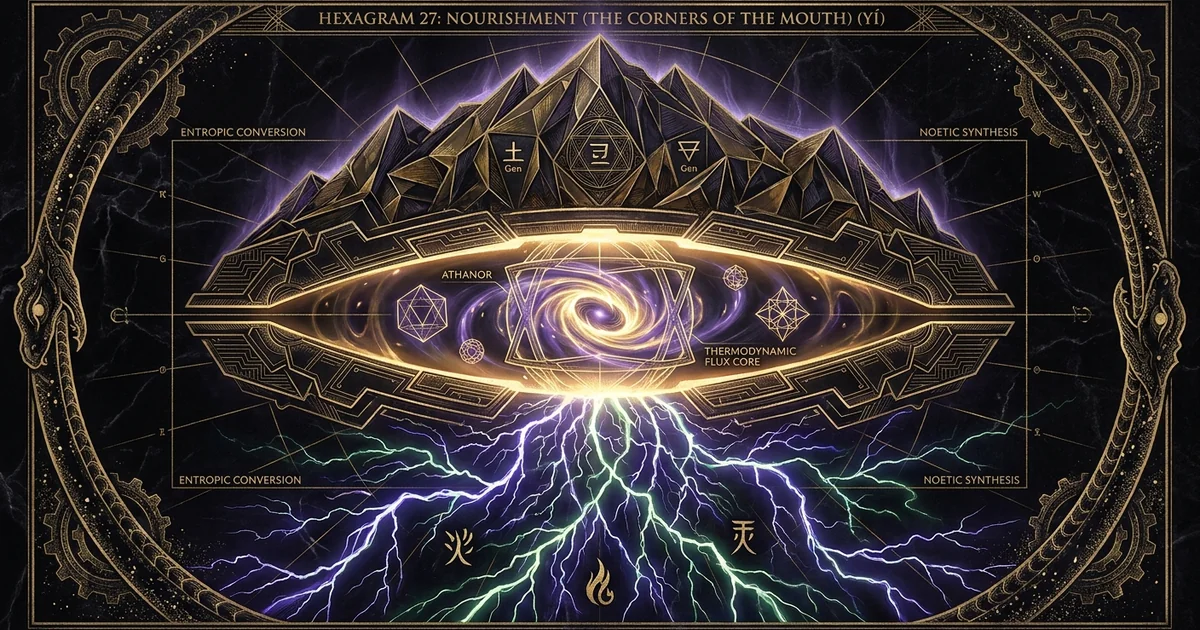
Hexagram 27 Nourishment (The Corners of the Mouth) (Yí): I
Archetypal Thesis & Systemic Paradigm: The Cybernetics of Metabolic Integrity
Metabolism as an Archetypal Invariant of Consciousness
Hexagram 27 (頤, Yí), conventionally rendered as “Nourishment” or “The Corners of the Mouth,” operates within the architecture of the I Ching not merely as a moralistic treatise on moderation, but as an advanced cybernetic model of systemic thermodynamics and boundary maintenance. In the canon of psycho-cosmological coordinate frameworks, Yí formalizes the fundamental law of living systems: continuous structural persistence requires the regulated exchange of matter, energy, and information across a semipermeable boundary. Rather than treating nutrition as an exclusively somatic, biological necessity, the hexagram conceptualizes metabolism as an archetypal invariant operating identically across somatic, cognitive, semantic, and spiritual registers.
Consciousness survives through an intake-processing-output loop. In this schema, physical sustenance, perceptual impression, the introjection of parental and societal values, and the discharge of spoken language and ethical action are isomorphic manifestations of the same underlying metabolic equation. To interrogate the hexagram 27 nourishment (the corners of the mouth) iching meaning is to investigate the threshold mechanics that govern how an individuating consciousness selectively internalizes external reality without succumbing to either starvation or systemic intoxication.
The Somatosensory Morphometry of Yí: The Cavity and the Jaws
The structural morphometry of the yí hexagram constitutes an explicit ideographic and somatosensory schema. Composed of an unbroken line at the base (Line 1), an unbroken line at the apex (Line 6), and four broken lines suspended between them (Lines 2 through 5), the hexagram visually portrays an open oral cavity bordered by the upper and lower jaws. The physical mouth represents the primordial biological threshold—the point of transition where the foreign non-self is masticated, destabilized, and admitted into the interior architecture of the self.
This morphometry simultaneously models the cranium, the stomach, and the womb. The solid boundary lines serve as protective structural containment, while the interior receptive void provides the liminal staging ground wherein chemical, emotional, or ideational digestion occurs. When viewed through the lens of archetypal psychology, this configuration establishes the mouth as the biological root of the ego-boundary. If the upper and lower jaws lose structural cohesion, or if the internal cavity fails to metabolize the raw material admitted through the threshold, the integrity of the total psychosomatic organism fractures.
Thermodynamic Open Systems and Negentropy
Viewed through modern systems theory, Hexagram 27 delineates the operating parameters of thermodynamic open systems. In his foundational work on self-regulating mechanisms, Norbert Wiener (1948) demonstrated that living organisms maintain structural coherence by continuously importing negative entropy (negentropy) from their ambient environments. A closed system inexorably drifts toward maximum entropy—thermodynamic equilibrium, cognitive dissolution, and physical death. Hexagram 27 establishes the exact operational conditions under which an open system imports negentropy without admitting destructive informational noise or biochemical toxicity.
By filtering energetic inputs and modulating expressive outputs, the organism achieves homeostatic equilibrium. Intake must balance internal assimilative capacity; output must match the systemic processing of those raw inputs. When the boundary collapses, the organism either undergoes auto-intoxication by ingesting toxic complexes or suffers energetic depletion by projecting unintegrated psychic material into the interpersonal field.
“Organisms preserve their internal organization against the universal entropic decay documented by the Second Law of Thermodynamics only by continuously processing external negentropy—a dynamic mirrored precisely in the psychological realm, where the conscious ego must continually assimilate, differentiate, and integrate psychic energy from both the somatic infrastructure and the collective unconscious.”
— Derived from Norbert Wiener, Cybernetics: Or Control and Communication in the Animal and the Machine (MIT Press, 1948), and Carl Gustav Jung, Foreword to The I Ching or Book of Changes (Princeton University Press, 1950).
Classical Provenance & Textual Lineage: From King Wen to Wang Bi
The Received Text and the Judgments of King Wen
The classical sequence of the I Ching situates Hexagram 27 immediately following Hexagram 26 (Da Chu, The Taming Power of the Great), a placement of rigorous systemic logic. Hexagram 26 accumulates potential energy, consolidating structural reserves through historical precedent and ethical restraint. Hexagram 27 subsequently addresses the systemic maintenance and metabolic distribution of that accumulated reserve. The Judgment attributed to King Wen anchors this transition in concrete diagnostic terms:
“Nourishment: Perseverance brings good fortune. Pay heed to the providing of nourishment and to what a person seeks to fill his own mouth with.”
In the translation by Richard Wilhelm and Cary F. Baynes (1950), this aphorism shifts divination from speculative augury to forensic examination. King Wen insists that an entity’s character and evolutionary trajectory are discernible through two criteria: what the entity chooses to ingest, and which entities the entity actively sustains. The judgment establishes that nourishment is not a passive reception of fate, but an active, discerning ethical alignment requiring unyielding perseverance (zhen). In the context of ancient Zhou governance, this applied directly to how a ruler nourished worthy ministers, while within inner alchemical traditions, it delineated the macrocosmic cultivation of the spiritual embryo.
The Commentary on the Image (Daxiang Zhuan): Words and Dietary Discernment
The Daxiang Zhuan (Great Image Commentary), historically attributed to the Confucian school, expands King Wen’s physiological observation into an axiomatic template for moral and psychosomatic self-governance. The commentary reads:
“At the foot of the mountain, thunder: The image of Nourishment. Thus the superior person is careful of his words and temperate in eating and drinking.”
The Confucian redactors synthesized the energetic tension of the component trigrams—Mountain (Gen) above, Thunder (Zhen) below—into an explicit regulatory protocol. Speech represents the outward metabolic discharge of the organism; food and drink represent inward energetic intake. The superior person (junzi) operates as an attentive thermodynamic valve. By exercising temperance in consumption, one guards against physical sickness, metabolic imbalance, and psychological greed. By exercising meticulous discipline in linguistic expression, one eliminates the discharge of unconsidered, reactive projections that generate social chaos and karmic entanglement.
Within the broader scope of book of changes divination, the Daxiang Zhuan shifts the querent’s focus from external circumstance to behavioral inputs and outputs, identifying internal self-regulation as the sole determinant of fortune or calamity.
“頤:貞吉。觀頤,自求口實。
《象》曰:山下有雷,頤。君子以慎言語,節飲食。”
Translation: “Nourishment: Constancy brings good fortune. Observe the nourishment, and examine how a person seeks substance for their own mouth.
The Image: Beneath the mountain, thunder stirs: the image of Nourishment. The noble person thereby shows caution in their speech, and temperance in eating and drinking.”
— Textus Receptus, Zhouyi, Hexagram 27.
Wang Bi’s Neo-Daoist Hermeneutics: The Ontological Center of Emptiness
The 3rd-century Neo-Daoist philosopher Wang Bi (trans. Richard John Lynn, 1994) revolutionized the exegesis of Hexagram 27 by shifting the interpretative lens from Confucian moralism to Xuanxue ontological mechanics. Wang Bi observed that the dynamic efficacy of the yí hexagram resides not in the solid enclosing jaws (Lines 1 and 6), but within the four yielded, broken lines that occupy the core (Lines 2, 3, 4, and 5). This receptive core represents the void of the stomach, the throat, and the clear, unattached mind.
Wang Bi argued that an organism cannot metabolize substance if its interior is already congested with fixations, preconceptions, and desires. The receptive yin core must preserve its ontological emptiness (wu) to receive and process the vital essence of reality. If the four inner lines were rigid and solid, the mouth would be occluded, transforming the living somatic cavity into an inert stone block incapable of ingestion or resonance. Wang Bi demonstrated that the structural strength of the solid perimeter exists precisely to protect, insulate, and guarantee the absolute functional emptiness of the interior. In this sophisticated hermeneutic, self-cultivation requires maintaining a spacious interior void beneath a firm, unyielding outer ethical boundary.
Structural Mechanics & Symbolic Geometry: Mountain Over Thunder
Trigrammatic Polarity: Upper Gen (Mountain) Over Lower Zhen (Thunder)
The symbolic geometry of Hexagram 27 is defined by the intimate, polarized interaction between its constituent trigrams: Mountain (trigram-gen, ☶) in the upper position, and Thunder (trigram-zhen, ☳) in the lower position. In five-phase cosmology and elemental mechanics, this arrangement represents Mountain over Thunder. The upper trigram, Gen, embodies stillness, boundary formation, structural stoppage, and the cranial bones of the skull. The lower trigram, Zhen, embodies violent arousal, kinetic initiation, electrical expansion, and the active downward-to-upward vector of physical movement.
This specific polar configuration models the mechanical architecture of mastication. In vertebrate physiology, the cranium and maxilla remain completely stationary during the masticatory cycle; it is the lower jaw (the mandible) that articulates dynamically against the upper structure to grind substance. The dynamic lower trigram Zhen provides the kinetic energy of appetite and physical mastication, forcing matter upward against the immovable ceiling of the upper trigram Gen. Gen arrests the chaotic momentum of Zhen, halting continuous biological consumption before it degenerates into gluttony or systemic destruction. The balance between continuous ignition (Zhen) and sovereign containment (Gen) creates the rhythmic cycle of organic life.
The Six Lines as a Biomechanical Mandible: Kinetic Base to Fixed Cranium
The progression through the six lines of Hexagram 27 outlines a vertical anatomical and psychological vector, ascending from visceral kinetic hunger to the transpersonal distribution of sustenance:
- Initial Nine (Line 1): Occupies the lowest position as the dynamic, solid driver of Zhen. This line is the kinetic mandible, full of personal vitality, but warned against looking outward with longing.
- Six in the Second Place (Line 2): Represents the soft interior tissues of the lower mouth. Yielding and weak, it commits a systemic error by attempting to reverse the direction of nourishment, looking downward to the lower jaw for sustenance rather than resting in its proper station.
- Six in the Third Place (Line 3): Sits at the apex of the lower trigram, the point of maximum instability. It signifies frantic, unanchored craving—turning away from authentic self-cultivation in pursuit of immediate, superficial gratification, which inevitably produces systemic decline.
- Six in the Fourth Place (Line 4): Represents the upper palate and the threshold of the upper trigram Gen. Here, the perspective broadens; the individual seeks nourishment not for narrow self-interest, but with the expansive vision of a tiger stalking its quarry, gathering resources to distribute outward to dependents.
- Six in the Fifth Place (Line 5): The yielding ruler situated within the trigram of stillness. Unable to sustain the collective through its own native strength, it must acknowledge its constitutional limits, avoid attempting to cross great rivers independently, and rely on the guidance of external spiritual wisdom (Line 6).
- Top Nine (Line 6): The immovable cranium and the ultimate origin of systemic sustenance. Solid and sovereign, it carries the full burden of providing nourishment to the entire community, transmuting the physical instinct of Line 1 into an enlightened, transpersonal stewardship.
Line Trajectories: From the Magic Tortoise to Source Nourishment
The textual arc of the lines is anchored by a compelling archetypal polarity between the “magic tortoise” (ling gui) in Line 1 and the “source of nourishment” (you yí) in Line 6. Line 1 admonishes: “You let your magic tortoise go, and look at me with corners of the mouth drooping. Misfortune.” In ancient Chinese metaphysics, the divine tortoise possessed the miraculous capacity to sustain itself purely upon primordial breath (qi) and dew, requiring no coarse earthly matter to maintain its existence.
To abandon one’s inner magic tortoise means to discard internal psychological resilience and spiritual autonomy in favor of desperate, parasitical dependence upon external validation, sensory consumption, or interpersonal approval. The drooping mouth visualizes the bitter craving of the chronic consumer.
Conversely, Line 6 transcends personal dependence altogether. As the cosmic provider, the sage at Line 6 has mastered both inner stillness and structural containment, thereby becoming a clear conduit through which transpersonal nourishment flows to replenish the entire living network.
Psychological Dynamics & Operational Praxis: The Archetypal Digestion of Reality
Introjection and Projection: Jungian Analytical Metabolism
From the vantage point of Jungian depth psychology, Hexagram 27 functions as an epistemological diagnostic of the individual’s assimilative mechanics. The unconscious operates via processes directly analogous to biological digestion. In his clinical formulations, Carl Gustav Jung emphasized that psychic complexes possess an autonomous energetic charge; when an ego encounters unconscious contents, it must process, differentiate, and integrate them through active reflection. If this reflective phase fails, the ego falls victim to the introjection-archetype, swallowing collective ideologies, ancestral traumas, and parental complexes whole without subjecting them to critical differentiation.
Introjection is psychological engulfment. When an individual consumes cultural narratives, emotional scripts, or intellectual dogmas without metabolic breakdown, these foreign bodies remain intact within the psyche as necrotic psychic tissue. Simultaneously, unintegrated psychic material cannot be contained within the vessel of the self; it is violently ejected through projection onto the interpersonal landscape. Hexagram 27 insists that linguistic output is directly tethered to psychological assimilation: what is unintegrated internally is projected externally as reactive, accusatory, and disruptive speech.
Conscious Assimilation (Negentropic)
- Intake Modality: Rigorous curation of ideational, sensory, and somatic inputs.
- Internal Mechanics: Active cognitive differentiation; breaking complexes down into primary components.
- Structural Integrity: Maintenance of firm ego-boundaries; preservation of internal receptive emptiness.
- Linguistic Output: Deliberate, precise semantic articulation; speech governed by the stillness of Mountain (Gen).
- Systemic State: Negative entropy, psychic coherence, energetic autonomy, and emotional maturity.
Neurotic Ingestion (Entropic)
- Intake Modality: Compulsive consumption of cultural noise, unresolved trauma, and immediate gratification.
- Internal Mechanics: Passive introjection; undifferentiated complexes swallowed whole.
- Structural Integrity: Porous, collapsed ego-boundaries; internal void congested with foreign desires.
- Linguistic Output: Reactive projection, linguistic toxicity, gossip, and compulsive ideological defensiveness.
- Systemic State: Systemic auto-intoxication, rapid entropic decay, chronic energetic dependency.
Pathologies of Nourishment: Psychosomatic Fixation and Informational Toxicity
The pathology of Hexagram 27 manifests clinically when the feedback loops governing ingestion become decoupled from systemic necessity. In somatic medicine, this registers as eating disorders, substance addictions, and chronic autoimmune breakdowns where the organism attacks its own tissues, mistaking self for non-self. Psychologically, this corresponds to informational addiction—an insatiable hunger for digital stimulation, sensory distraction, and ideological polarization that numbs the awareness of emotional malnutrition.
When an individual lacks authentic, deep nourishment (metaphysical meaning, genuine community, emotional intimacy), the kinetic engine of the lower jaw (Zhen) accelerates compulsively to compensate for the vacuum. The individual feeds the physical or egoic mouth continuously, yet starves at the soul level. As observed in consultations involving hexagram 27 nourishment (the corners of the mouth) iching meaning, the appearance of this hexagram frequently diagnoses a severe systemic leak: the querent is expending enormous energy assimilating toxic elements that paralyze the spirit, while neglecting the refined sustenance necessary for individuation.
Divinatory Praxis: Tracking Vector Shifts in Consultation
In the operational praxis of the hexagram, receiving Yí demands a relentless audit of the querent’s metabolic field. The diviner must evaluate two diagnostic vectors:
- The Ingestive Vector: What books, media, relationships, foods, and emotional frequencies is the querent permitting to cross the somatic and psychic threshold? Is the querent attempting to solve spiritual existential voids through somatic overindulgence, or spiritualizing somatic neglect through austere dissociation?
- The Expressive Vector: What semantic frequencies, complaints, and unvetted projections is the querent releasing into the world? Is speech being weaponized as a bypass to avoid internal processing?
If Hexagram 27 appears without changing lines, the oracle indicates a state of total systemic stasis requiring absolute containment: the upper jaw must maintain stillness, the lower jaw must cease its compulsive grinding, and the interior cavity must be rigorously purged through fasting, silence, and meditative retreat. When the lines are volatile, the reading tracks the exact evolutionary point at which energy is either being squandered through parasitical dependence or reclaimed through sovereign self-containment.
Philosophical Synthesis & Macrocosmic Correspondence: Biological and Esoteric Mappings
Genetic Codon Mapping: Binary Symmetry and Polypeptide Synthesis
The mathematical architecture of the I Ching reveals profound symmetries with molecular biology. As explored in the pioneering work of Martin Schönberger (1973) in The I Ching and the Genetic Code: The Hidden Key to Life, the 64 hexagrams correspond directly to the 64 triplet codons of messenger RNA that direct the synthesis of the 20 amino acids. The structural composition of Hexagram 27—solid line (yang), four broken lines (yin), solid line (yang)—corresponds to the binary designation 100001.
Within this framework of genetic-codon-mapping, Hexagram 27 operates as an analog for the initiation, framing, and termination dynamics of polypeptide assembly. In biological protein synthesis, the transcription machinery must accurately discern where a coding sequence begins and ends; the cellular apparatus reads structural boundaries to prevent the transcription of catastrophic genetic noise. Hexagram 27, with its rigid outer brackets enclosing a receptive void, symbolizes this fundamental biological boundary: the translation of raw nucleic code into structured, functional physical life. Metabolic nourishment at the macromolecular scale is identical to the archetypal instructions preserved within the hexagram: life persists solely through the immaculate preservation of structural framing.
Systemic Index: Hexagram 27 (頤, Yí)
Binary Sequence: 100001 (Bottom line to top line: Yang, Yin, Yin, Yin, Yin, Yang)
Structural Dynamics: Open Frame Symmetry (Exterior Yang Brackets / Interior Yin Receptivity)
Molecular Mapping: Codon Triplets governing structural synthesis; parallels the structural punctuation of translation initiation and the disciplined regulation of cellular intake.
Cybernetic Circuit: Closed-loop negative feedback architecture; dynamic kinetic base stabilized by structural negative feedback ceiling.
Human Design Synthesis: Gate 27 (The Gate of Caring) and the Sacral Circuit
In the synthesis of Human Design, which incorporates the hexagrams of the I Ching into a body-centered energetic cartography, Hexagram 27 is mapped directly to human-design-gate-27, designated as the “Gate of Caring” or “The Preserver.” Positioned within the sacral-center—the biological engine of generative vital force and reproductive power—Gate 27 operates within the Defense Circuit, the primal tribal architecture dedicated to the survival, protection, and physical sustenance of the species.
Here, the somatic morphometry of the jaws evolves into the archetypal maternal and paternal instinct to care for the vulnerable. Gate 27 asks the fundamental question: Who has the capacity to nourish, and who is worthy of receiving nourishment? When operating from the conditioned, shadow state of the “Not-Self,” this gate drives individuals to deplete their personal Sacral reserves through self-sacrificing, codependent caretaking, feeding others until their own internal magic tortoise perishes from neglect.
Conversely, when operating in alignment with its true mechanics, Gate 27 embodies fierce discernment: it establishes immaculate personal boundaries, nourishing the self first so that the resulting surplus can sustain the tribe without generating resentment or systemic depletion. This directly interfaces with the wisdom of the adjoining channel, ensuring that survival resources are directed exclusively toward that which serves the long-term viability of the collective.
The Hermetic Principle of Rhythm: The Universal Breath of Consumption and Discharge
On the macrocosmic plane, Hexagram 27 exemplifies the Hermetic Principle of Rhythm: “Everything flows, out and in; everything has its tides; all things rise and fall; the pendulum-swing manifests in everything.” Nourishment is the rhythmic oscillation between inhalation and exhalation, consumption and excretion, listening and speaking. To attempt to permanently consume without discharging is to court explosive toxicity; to continually discharge speech and energy without pausing to ingest refined sustenance leads to complete systemic collapse.
By aligning with the macrocosmic breath, an individual stops treating life as an erratic battlefield of survival and begins navigating it as a sacred, metabolic rhythm. Hexagram 27 serves as an ontological reminder that every boundary is an exchange site. The mouth, the skin, the cell membrane, the psychological ego, and the planetary atmosphere are all varying iterations of the same archetypal reality: a liminal interface through which the cosmos continually consumes, digests, and recreates itself in an unending liturgical feast.
Frequently Asked Questions: Advanced Divinatory Inquiries
Resolving Hexagram 27’s Changing Lines
When Hexagram 27 yields multiple changing lines during consultation, the diviner must not read the lines as disconnected, isolated aphorisms, but as a kinetic narrative tracking the movement of energy across the metabolic vessel. A systemic transition occurs when the dynamic shifts between the lower trigram Zhen and the upper trigram Gen:
- Lower Trigram Shifts (Lines 1, 2, 3): When the bottom lines mutate, the systemic crisis is centered on raw, instinctual appetite and immediate consumption. The querent is typically caught in cycles of acute cravings, seeking somatic or emotional rescue from inappropriate sources, or squandering their inner spiritual autonomy. The remediation here is radical self-discipline and the immediate cessation of compulsive consumption.
- Upper Trigram Shifts (Lines 4, 5, 6): When the top lines mutate, the consultation moves beyond personal digestion into the domain of transpersonal leadership, relational stewardship, and social responsibility. The question is no longer merely “How do I feed myself?” but “How do I sustainably shepherd and provide for the collective without sacrificing my foundational integrity?”
- Total Inversion: If all six lines change simultaneously, Hexagram 27 transforms into Hexagram 28 (Da Guo, Preponderance of the Great—two broken lines encasing four solid lines). The metabolic cavity completely collapses into an overloaded, hyper-pressurized ridgepole bending under catastrophic structural weight. This indicates that excessive, uncurated introjection has turned toxic, demanding an immediate structural revolution to avert an outright psychospiritual collapse.
Comparative Analysis: Hexagram 27 (Nourishment) vs. Hexagram 48 (The Well)
While both Hexagram 27 and Hexagram 48: The Well (Jǐng) address the fundamental dynamics of sustenance within the Book of Changes, their systemic operations occupy distinct metaphysical coordinates:
Hexagram 27: Yí (Nourishment)
- Primary Mechanics: Kinetic mastication, boundary defense, active curation, dynamic metabolic intake and discharge.
- Trigrammatic Architecture: Mountain (Gen) over Thunder (Zhen); structural stoppage enclosing kinetic eruption.
- Locus of Operation: The individual somatic and psychological threshold; the mouth, the jaws, the ego-boundary.
- Core Imperative: Ethical, dietary, and linguistic discernment; monitoring what enters and what exits the personal vessel.
Hexagram 48: Jǐng (The Well)
- Primary Mechanics: Passive tapping into inexhaustible, archetypal, transpersonal depths.
- Trigrammatic Architecture: Water (Kan) over Wind/Wood (Sun); the wooden bucket descending into the abyssal spring.
- Locus of Operation: The communal, ancestral, and metaphysical bedrock of the collective unconscious.
- Core Imperative: Structural integrity of the retrieval mechanism; ensuring the rope is long enough and the jug unbroken to access eternal wisdom.
Where Hexagram 48 poses an ontological question regarding the querent’s connection to the primordial source of spiritual life, Hexagram 27 poses an operational cybernetic question regarding the querent’s day-to-day metabolic hygiene: the curation of somatic, emotional, and verbal inputs and outputs. Hexagram 48 is the water table; Hexagram 27 is the biological mouth that drinks it. The querent may also examine Hexagram 5: Waiting (Xū) to understand the temporal, patient anticipation required before nourishment can be received at all.
The Paradox of the Magic Tortoise in Line 1
The enigmatic imagery of the “magic tortoise” (ling gui) in the Initial Nine of Hexagram 27 constitutes one of the most critical warnings in classical divination. Why does the text declare misfortune for an individual possessing such an auspicious spiritual animal? The paradox resolves when one understands the nature of projection and spiritual abdication:
The magic tortoise represents the native, self-sufficient spiritual light resident within the core of every conscious entity—the divine indwelling qi that requires no external, sensory propitiation to experience complete wholeness. The misfortune arises not from possessing the tortoise, but from letting it go. When the subject gazes outward at others “with corners of the mouth drooping,” they abandon their own innate spiritual treasure in a state of envious, ravenous desire for the trivial, external possessions, status, or approvals of the world.
The drooped mouth signifies the somatic collapse into the hungry-ghost archetype (preta), an entity cursed with a massive, yawning belly and a neck the width of a needle, forever starved because it has lost the capacity to recognize that the true source of all nourishment has resided within its own shell from the very beginning. To resolve Line 1, the querent must definitively cease looking outward, reclaim the tortoise, close the mouth, and feast upon the self-sustaining luminescence of their own awakened presence.