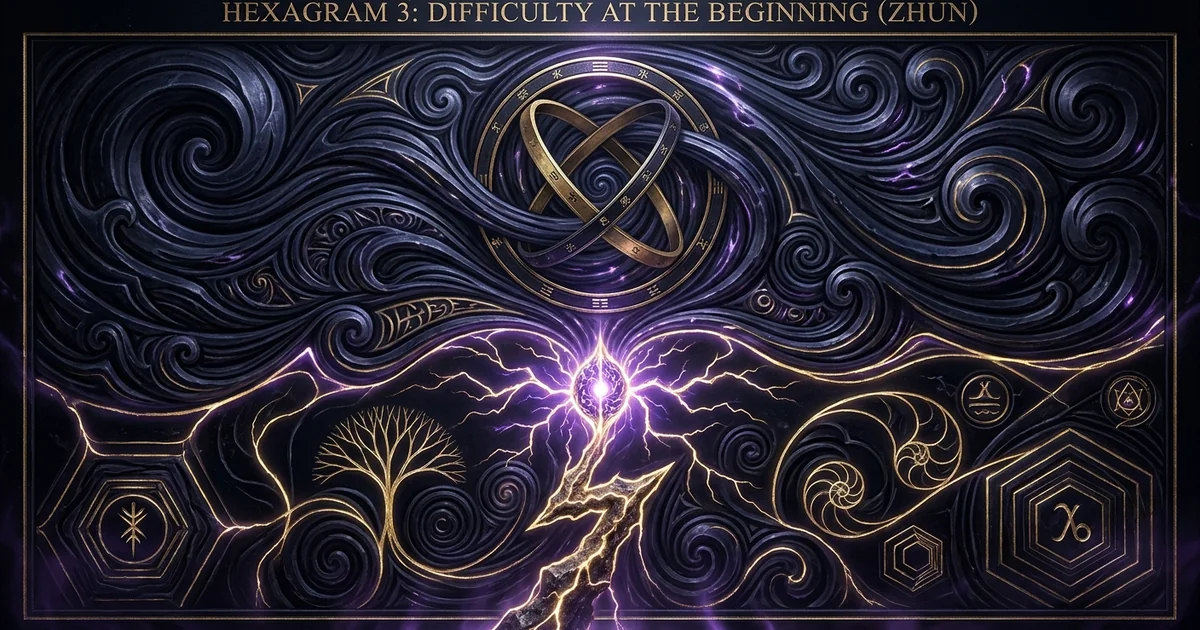
Hexagram 3 Difficulty at the Beginning (Zhūn): I Ching
Archetypal Thesis & Systemic Paradigm: The Thermodynamics of Nascent Form
The Ontological Crisis of Initial Differentiation
Hexagram 3, designated as Zhūn (屯), establishes the initial ontological crisis within the formal architecture of the I Ching. While Hexagram 1: Qián establishes the metaphysical field of pure unconditioned Yang (actuality, teleological drive, undifferentiated creative force) and Hexagram 2: Kūn provides the complementary field of unconditioned Yin (spatial receptivity, materiality, total potentiality), Zhūn represents the catastrophic symmetry break of their initial collision. In this structural juncture, cosmogony ceases to be an abstract contemplation of polarity and descends into the turbulent realm of concrete manifestation. Zhūn is the thermodynamic friction generated when infinite metaphysical potential condenses into the spatial, temporal, and biological limits of form.
This phase transition from metaphysical archetype to physical instantiation is inherently fraught with mechanical resistance. The hexagram 3 difficulty at the beginning iching meaning is therefore fundamentally misunderstood if interpreted merely as an unfortunate obstacle, psychological hesitation, or an inauspicious omen. Within an advanced psycho-cosmological coordinate framework, Zhūn formalizes the thermodynamic cost of establishing an ordered state out of the primal soup of raw possibilities. It is the crisis of the initial boundary condition: the moment an embryonic organism, an emerging political state, or an unintegrated psychic complex attempts to carve an interiority out of an undifferentiated environment. The resulting turbulence is not an indication of operational failure, but the mandatory dissipative state through which complex, non-equilibrium systems must pass to achieve homeostatic self-regulation.
From the vantage point of analytical psychology, Zhūn models the disorientation of the ego during its initial differentiation from the collective unconscious. The nascent I emerges not into a clear, tranquil landscape of deliberate volition, but into a swamp of instinctual drives, archetypal shadows, and structural vulnerabilities. The ego-complex at this phase lacks psychic scaffolding; its operational vectors are constantly overwhelmed by the sheer mass of the unconscious waters from which it seeks to extricate itself. To interpret Zhūn as a command to forge blindly ahead is to mistake kinetic agitation for systemic maturation. The gua insists on recognizing that differentiation requires the establishment of an internal armature capable of bearing the strain of external chaos.
Water over Thunder: Thermodynamic Entropic Resistance
The structural geometry of Zhūn arises from the dynamic tension between its constituent trigrams within the bagua: Trigram Kǎn (☵, Abyssal Water, Danger) situated over Trigram Zhèn (☳, Arousing Thunder, Dynamic Initiative). This specific arrangement of water over thunder establishes an acute vector trap. Zhèn, occupying the lower inner realm, represents an explosive, directional surge of kinetic energy—the vegetative and electrical impulse of life seeking immediate outward release and vertical ascension. It is the sudden trigger of the spark, the primordial pulse that drives systemic evolution.
Hexagram 3 (Zhūn)
☵ Kǎn (Upper Trigram: Water, Abyss, Peril)
☳ Zhèn (Lower Trigram: Thunder, Initiative, Shock)
However, this ascending kinetic impulse does not encounter empty space into which it can effortlessly expand; rather, it collides directly with Kǎn in the upper outer realm. Kǎn embodies the gravitational descent of water, the perilous chasm, and the cold, unyielding ambiguity of the deep. Water flows downward, seeking the path of maximum entropy and lowest gravitational potential, while thunder explodes upward with raw, linear force. The resulting intersection generates an energetic vortex. The directional vector of the lower trigram is arrested by the fluid, opaque, and treacherous mass of the upper trigram.
Vector Mechanics:
Upper: Kǎn (Downward Gravitational Pull / Entropic Dissipation / Danger)
  ▲
  │ Collision / Dynamic Drag
  ▼
Lower: Zhèn (Upward Kinetic Surge / Explosive Differentiation / Movement)
This structural configuration reveals why Zhūn functions as a mechanical model of thermodynamic entropic resistance. When dynamic initiative (Zhèn) is submerged beneath systemic danger and opacity (Kǎn), linear momentum becomes an evolutionary liability. Any attempt by the system to accelerate through the obstacle simply increases the hydro-dynamic drag, dissipating the system’s structural coherence and accelerating its decay into entropy. The structural geometry dictates that the ascending energy of Zhèn must be modulated, slowed, and iteratively organized rather than discharged impulsively. The friction experienced within the zhūn hexagram is the systemic drag of the medium through which the emergent form must navigate.
Zhūn as Cosmological Seed and Vegetative Emergence
The metaphysical mechanics of Zhūn are intimately anchored in vegetative morphology. The hexagram signifies the precise biological threshold at which a seed, buried beneath compacted, mineral-dense earth, splits its outer husk to push an embryonic radicle downward and a plumule upward toward an unseen light. The seed coat represents the absolute boundary between the self and the non-self; its rupture constitutes an existential crisis wherein the organism is exposed to subterranean dampness, parasitic organisms, and the sheer mechanical weight of the soil above it.
The embryonic sprout cannot overcome the mass of the earth through brute physical force. It operates instead via the slow, turgor-driven accumulation of internal pressure, utilizing biochemical feedback loops to navigate around impenetrable stones, adapting its morphology to the grain of the sediment. The seed exists in a liminal zone where it is no longer safely dormant, yet not yet photosynthetically autonomous. It relies entirely on the finite energetic reserves of its endosperm while striving to establish root structures capable of anchoring it in the macrocosm.
This botanical reality provides the hermeneutic key to deciphering Zhūn across macrocosmic and microcosmic domains. Whether analyzing the genesis of a stellar system amidst condensing molecular clouds, the founding of an institution, or the crystallization of a new theoretical paradigm, the system resides in this embryonic vulnerability. The raw materials of the future state are fully present, but they remain unarticulated and unsorted. Zhūn warns that premature exposure to the elements—an overestimation of the embryonic form’s structural integrity—inevitably leads to necrosis. Survival within this phase requires the systemic humility to remain partially hidden, consolidating energy within the subterranean sphere until functional structural differentiation is achieved.
Within the 64-hexagram binary matrix formalized by Shao Yong and later contextualized through Leibnizian binary arithmetic, Hexagram 3 occupies a profound position of functional symmetry breaking. Represented in binary code (reading from bottom to top, where broken Yin lines are 0 and unbroken Yang lines are 1) as 100010 (binary 34 in reverse/standard computational sequences depending on line orientation), Zhūn introduces the initial asymmetrical imbalance into the binary system following the absolute polarities of 111111 (Qián, Hexagram 1) and 000000 (Kūn, Hexagram 2). In molecular genetics, Zhūn mirrors the biochemical mechanics of the start codon (typically AUG, encoding Methionine), which halts the undifferentiated scanning of mRNA to initiate peptide chain synthesis. The start codon does not complete the protein; rather, it introduces the critical operational pause that commands the ribosomal apparatus to bind, assemble structural cofactors, and begin translation amidst the chaotic thermal fluctuations of the cytoplasm.
Classical Provenance & Textual Lineage: The Zhōu Yì and Commentarial Tradition
Etymological Anatomy: The Sprouting Grass Blade (Zhūn)
To rigorously grasp the operational demands of the book of changes divination regarding Zhūn, one must dissect its paleographic origins. In the archaic script of the Western Zhou bronze inscriptions (金文) and the early seal script (篆書), the ideogram for Zhūn (屯) is an explicitly mechanical and botanical pictograph. It depicts a horizontal line representing the surface of the earth, pierced from below by a bent, curling stroke terminating in a swollen base: an emergent blade of grass or sprout struggling against the dense resistance of the soil.
Archaic Pictographic Evolution of Zhūn:
一 (Surface of compacted earth / boundary condition)
 屮 (Bent, embryonic shoot curling against systemic resistance)
 屯 (Zhūn: Dynamic accumulation of structural pressure prior to breakthrough)
The stroke representing the emerging plant is markedly curved, not straight. This deliberate curvature encodes mechanical impedance into the core semantic root. The shoot does not slice through the soil unimpeded; its tip is compressed, bent back upon itself by the physical reality of the crust. The character conveys the concept of accumulation through constraint, a gathering of density (tún, a homograph meaning to station troops, assemble, or stockpile supplies). Thus, the etymology of the character preserves an essential duality: zhūn (difficulty, friction, nascent sprouting) and tún (garrisoning, massing, stockpiling). The pictograph instructs the reader that difficulty is not resolved through aggressive propulsion, but through the defensive gathering of mass and the strategic stockpiling of resources at the boundary.
Classical lexicons, such as the Shuowen Jiezi (說文解字), confirm this physiological interpretation, defining Zhūn as “difficulty in birth” or “the beginning of life struggling to emerge from the grass.” The graphic anatomy of the character insists upon this truth: nascent life encounters structural resistance as an invariant condition of its birth. Without this resistance, the plant would fail to generate the lignin and vascular structure required to support its future height against the atmospheric turbulence of the upper world.
The King Wen Sequence: Moving from Cosmogenesis to Actualization
The placement of Zhūn as the third hexagram within the traditional King Wen Sequence is a profound metaphysical declaration. The architect of the sequence did not place Hexagram 11 (Tài, Peace) or Hexagram 14 (Dà Yǒu, Possession in Great Measure) immediately after the primal parents Qián and Kūn. Such an arrangement would represent a utopian theological fantasy—the assumption that the union of Heaven and Earth instantly yields harmonious abundance.
Instead, the King Wen Sequence inserts Zhūn as the absolute threshold of phenomenal reality, followed immediately by Hexagram 4: Méng, Youthful Folly. The architecture of the sequence articulates an uncompromising cosmogonic narrative:
- Hexagram 1 (Qián): The unmanifest metaphysical impulse; absolute creative volition.
- Hexagram 2 (Kūn): The unmanifest spatial continuum; absolute material receptivity.
- Hexagram 3 (Zhūn): The initial structural collision; physical embodiment, mechanical friction, and the chaotic emergence of form.
- Hexagram 4 (Méng): The subjective perceptual consequence; cognitive entanglement, epistemic opacity, and the necessity of pedagogical structuring.
By positioning Zhūn at this critical threshold, the text asserts that physical actualization is intrinsically traumatic. The pristine perfection of the archetypes is shattered the moment they enter temporal duration. In Qián and Kūn, energy is infinite because it is boundless; in Zhūn, energy becomes finite because it is localized within a specific, nascent structure. This localization triggers immediate vulnerability. King Wen recognizes that the universe does not leap from conception to full functionality in a single stroke. There must first be an epoch of unformed mass, spatial ambiguity, and localized trial-and-error. Zhūn is the codification of this preliminary, non-negotiable stage of cosmic and psychological manifestation.
Wang Bi vs. Neo-Confucian Hermeneutics on Nascent Struggle
The hermeneutic trajectory of Zhūn underwent a seismic shift with the arrival of Wang Bi (226–249 CE) during the Three Kingdoms period. Prior to Wang Bi’s radically streamlined, Xuanxue (Dark Learning / Neo-Daoist) commentary, the Han dynasty commentators (such as Zheng Xuan and Jing Fang) had encrusted the Zhōu Yì with elaborate systems of cosmological correspondences, omen prognostications, and rigid mechanical formulas of the yinyang and wuxing schools. In their view, Zhūn was frequently read as a catastrophic obstruction dictated by celestial disharmony.
Wang Bi demolished this fatalistic framework by prioritizing the inherent dynamic of the lines and the holistic meaning of the hexagram’s structural core:
The Judgment: Difficulty at the Beginning works supreme success, furthering through perseverance. Nothing should be undertaken. It furthers one to appoint helpers.
The Commentary on the Decision (Tuan Zhuan): Difficulty at the Beginning: the firm and the yielding unite for the first time, and the birth is difficult. Out of danger and movement, great success comes through perseverance. The action of thunder and rain fills the air… It furthers one to appoint helpers, but one should not establish order prematurely; instead, one must constantly order and untangle.
The Image: Clouds and thunder: The image of Difficulty at the Beginning. Thus the superior man brings order out of confusion. — The I Ching or Book of Changes, Wilhelm/Baynes translation (1950)
Wang Bi interpreted Zhūn not as an external block to be lamented, but as a problem of internal structural distribution. He observed that while the overall condition of Zhūn is defined by peril (Kǎn) and agitation (Zhèn), the hexagram contains an unbroken, foundational Yang line at the very bottom (the Initial Nine). For Wang Bi, this single Yang line serves as the solitary structural pillar capable of anchoring the unstable, amorphous Yin lines that surround it. Wang Bi argued that the “difficulty” is precisely what calls forth true governance and self-organization: it provides the structural necessity for the strong to support the weak and for the fragmented collective to rally around a unifying center.
Centuries later, the Song Dynasty Neo-Confucian master Cheng Yi (1033–1107 CE) expanded this into an explicit ethical and metaphysical imperative in his Yichuan Yizhuan. Cheng Yi emphasized that Zhūn represents the embryonic state of all human enterprise. Where Wang Bi saw a metaphysical play of substance (ti) and function (yong), Cheng Yi saw an absolute mandate for cognitive endurance (zhen) and ethical vigilance. Cheng Yi warned against the twin failures of the will: the panic that abandons the venture when initial friction arises, and the reckless hubris that attempts to enforce fully formed social or psychological structures upon a situation that has not yet attained basic material stability. Thus, the commentarial lineage transforms Zhūn from a superstitious warning into a sophisticated manual of early-stage systemic governance.
Structural Mechanics & Symbolic Geometry: Trigram Polarity and Vector Mechanics
Kan (Water/Danger) over Zhen (Thunder/Initiative): The Vector Trap
The structural tension of Hexagram 3 is defined by the severe directional contradiction operating between its outer and inner trigram components within the bagua. The inner trigram, Trigram Zhèn (☳), consists of a single solid Yang line beneath two yielding Yin lines. Its mechanical vector is decisively upward: it is the lightning surging up from the earth, the sudden release of tectonic stress, the uncontainable vegetative thrust. It embodies the subjective impulse to act, to transform, to make an indelible mark upon the external world.
Conversely, the outer trigram, Trigram Kǎn (☵), features a single solid Yang line trapped between two Yin lines. Its intrinsic vector is downward, deep, and entangling. Kǎn is the archetype of the pit, the deep river, the fog-laden precipice, and the cognitive dread of the unknown. When Zhèn attempts its upward ascent, it runs directly into the gravitational sinkhole of Kǎn.
Upper: Kǎn (☵) [Danger, Descent, Obscurity, Water]
───────────────────────────────────────────────── [Threshold of Entropic Trap]
Lower: Zhèn (☳) [Kinetic Force, Ascent, Shock, Thunder]
This arrangement creates what systems theory identifies as an impedance mismatch. The lower system generates high-frequency kinetic energy, but the upper medium possesses a totally different impedance, causing the majority of the energetic output to be reflected back upon its source as internal turbulence. If an individual or an organization attempts to force its way forward in this state, the kinetic energy of Zhèn merely churns the treacherous waters of Kǎn, producing blinding mist and treacherous whirlpools. The actor becomes entangled in unintended consequences, systemic blowbacks, and paralytic confusion. The structural geometry proves mathematically that linear momentum cannot resolve an abyssal environment.
The Nuclear Trigrams: Gen (Mountain) and Kun (Receptive)
To fully comprehend the systemic engine driving Hexagram 3, one must look beneath its surface trigrams to its interior core: the nuclear trigrams (互體, hùtǐ). The nuclear trigrams reveal the latent structural forces governing the development of the hexagram, derived from lines 2, 3, and 4 (the lower nuclear trigram) and lines 3, 4, and 5 (the upper nuclear trigram).
Hexagram 3 (Zhūn) Nuclear Trigram Derivation:
Line 6: ──  ── (Yin)
Line 5: ────── (Yang) ┐ Upper Nuclear: Kūn (☷) [Lines 3, 4, 5]
Line 4: ──  ── (Yin)  │ Earth, Absolute Receptivity, Field
Line 3: ──  ── (Yin) ─┴ Lower Nuclear: Gèn (☶) [Lines 2, 3, 4]
Line 2: ──  ── (Yin)   Mountain, Stillness, Boundary
Line 1: ────── (Yang)
The lower nuclear trigram is Gèn (☶, Mountain, Stillness, lines 2-3-4). The upper nuclear trigram is Kūn (☷, Earth, Receptivity, lines 3-4-5). This internal discovery radically reframes the operational dynamics of Hexagram 3:
The presence of Gèn at the structural core proves that the immediate systemic remedy for the friction of Zhūn is not an intensification of Zhèn’s kinetic drive, but an immediate invocation of Gèn’s absolute stillness and boundary-setting. Gèn is the mountain; it commands the halting of movement at the edge of the cliff. It instructs the actor to freeze their advance, delineate their operational perimeter, and secure their structural defenses.
Simultaneously, the upper nuclear trigram Kūn indicates that the environmental medium must be treated with total maternal receptivity, patience, and spatial deference. Together, the nuclear configuration forms the profile of Hexagram 23 (Bō, Splitting Apart) or an internal movement toward structural rooting. It confirms that the resolution of Zhūn is entirely internal: dynamic initiative must be stabilized by internal restraint (Gèn) and grounded in patient spatial assimilation (Kūn) before any safe passage through the abyssal waters of Kǎn can be navigated.
The Dynamic Anatomy of the Six Lines (Yao)
The six individual lines of Zhūn trace the precise, progressive stages of systemic emergence, delineating where action is fatal and where infrastructural anchoring is achieved.
- Initial Nine (Nine at the beginning): Hesitation and hindrance. It furthers one to remain persevering. It furthers one to appoint helpers. As the solitary Yang line in the lower trigram, this line is the structural foundation of the entire hexagram. It carries the raw generative potency of Zhèn, yet it sits at the very bottom of the structure. It cannot charge forward into the chaos; instead, it must act as a gravitational anchor. It establishes the principle of Jian Hou (appointing helpers). Its task is infrastructural: laying foundation stones, organizing logistical support, and refusing the egoic temptation of premature heroic isolation.
- Six in the second place: Difficulties pile up. Horse and wagon part. He is not a robber; he wants to woo when the time comes. The maiden is chaste, she does not pledge herself. Ten years, then she pledges herself. Here, the yielding line in the place of balance is confronted by the gravitational pull of the Initial Nine below and the distant call of the Fifth Nine above. The image of the “horse and wagon parting” depicts mechanical systemic failure—the engine decouples from the chassis. Predatory or premature alliances present themselves in the chaos. The line commands rigorous refusal of premature integration. The system must endure a prolonged period of apparent sterility (“ten years”) rather than compromise its structural integrity through an adulterous, defensive compromise.
- Six in the third place: Whoever hunts deer without the forester only loses his way in the forest. The superior man understands the signs of the time and prefers to desist. To go on brings humiliation. This line sits at the apex of the lower trigram Zhèn, right on the threshold of the upper abyss. It embodies blind, unguided kinetic enthusiasm. Lacking the internal guidance of a “forester” (an internalized cognitive map or an expert external guide), the system chases fleeting energetic opportunities into a dense, dangerous ecosystem. Continuance is disastrous; the only viable evolutionary choice is immediate desistance.
- Six in the fourth place: Horse and wagon part. Strive for union. Going brings good fortune. Everything furthers. The structural polarity shifts. The line has crossed into the upper trigram Kǎn. Although mechanical disorientation recurs (“horse and wagon part”), this line sits in a receptive position directly adjacent to the ruler of the hexagram (the Fifth Nine). The imperative here is radical collaboration. The ego recognizes its radical insufficiency and actively courts the structural alliance it formerly avoided. Humility unlocks forward progress.
- Nine in the fifth place: Difficulties in bestowing blessings. A little perseverance brings good fortune. Great perseverance brings misfortune. This line is the nominal sovereign of the hexagram, the Yang ruler occupying the central, honored place within Kǎn. Yet, because it is entirely surrounded by Yin waters, its capacity to radiate structural authority is severely curtailed. It cannot enact sweeping, systemic reforms (“difficulties in bestowing blessings”). If it attempts grand, overarching imperial transformations (“great perseverance”), it triggers revolt or systemic collapse. It must restrict itself to micro-interventions, incremental ordering, and quiet administrative hygiene (“a little perseverance”).
- Six at the top: Horse and wagon part. Bloody tears flow. The tragic terminus of Hexagram 3. The line resides at the ultimate extreme of the abyssal water, possessing zero dynamic connection to the foundational Yang line at the base. It represents total kinetic exhaustion coupled with hyper-emotional reactivity. The system has pushed beyond the threshold of its functional viability without having established structural roots. The “bloody tears” symbolize the agonizing, systemic consequence of attempting evolutionary differentiation without structural anchoring.
Psychological Dynamics & Operational Praxis: The Archetype of Incubation
The Individuation Shock: Navigating the Chaos of the Prima Materia
In the landscape of Jungian analytical psychology, the reception of Hexagram 3 during a phase of life or clinical analysis marks the immediate confrontation with the chaotic prima materia. When an individual is jolted out of an archaic, unconscious adaptation—whether by trauma, a midlife transition, or the sudden eruption of archetypal contents—they enter the psychic space of Zhūn.
Psychic Phase Transition:
[Undifferentiated Unconscious] (Kūn / Hexagram 2)
              │
              ▼ [Symmetry Break / Psychic Shock]
     [Hexagram 3: Zhūn]
              │
     ┌────────┴────────┐
     ▼                 ▼
[Regressive Trap]   [Iterative Containment]
Impulsive Acting-Out    Appointing Helpers
Vortex of Kǎn       Alchemical Vas Construct
This state is defined by profound disorientation. The ego-complex finds itself stripped of its habitual cartography. The libido, which previously flowed along predictable social and behavioral pathways, drops into the unconscious, re-emerging as terrifying, uncoordinated affects, compulsive somatic discharges, and intense anxiety. The individual experiences the water over thunder dynamic subjectively as a state of acute internal pressure coupled with an absolute inability to see where they are going.
The profound danger at this developmental juncture is what Jung termed psychic inflation or, conversely, abaissement du niveau mental. The panic-stricken ego either charges forward in an attempt to conquer the unconscious through brute rationalistic will (a catastrophic deployment of the Zhèn impulse), or it surrenders unconditionally to the oceanic descent of Kǎn, falling into clinical depression. Zhūn diagnoses this precise condition and provides the clinical protocol: the chaos must not be fought directly, nor should it be fled. It must be recognized as the necessary, raw nutrient-bath of the future self. The raw material cannot be organized until its existence is fully acknowledged and suffered within an alchemically sealed container (the vas Hermeticum).
Operational Divination Protocols: Reading Zhūn in Prognosis
Within the operational praxis of the book of changes divination, casting Zhūn requires a total cessation of aggressive, outward-oriented strategies. When an inquirer receives this hexagram, the oracle delivers an unambiguous diagnostic verdict: the initiative in question is structurally underdeveloped, materially under-resourced, and conceptually unrefined.
The fundamental divinatory directives of Zhūn can be formalized into three non-negotiable operational laws:
- The Law of Interrupted Velocity: The querent must immediately arrest all forward momentum. Any venture launched under the unmediated sign of Zhūn will suffer mechanical failure, bureaucratic impedance, or severe financial hemorrhage. The energy must be shifted from expansion to consolidation.
- The Law of Cartographic Humility: The system currently operates within the upper trigram Kǎn—a state of environmental opacity. The querent does not possess sufficient information to make strategic long-range projections. Any strategic plan constructed during this phase will be based on illusory assumptions and unexamined projections.
- The Law of the Scaffolding: Action must be confined exclusively to the creation of administrative, psychic, and relational infrastructure. The querent must focus on clearing the site, shoring up foundations, defining operational boundaries, and securing logistical supply lines.
Strategic Restraint: The Mandate to ‘Appoint Helpers’ (Jiàn Hóu)
The core strategic formula recurring throughout the Judgment and Line texts of Zhūn is the classical Chinese phrase Jiàn Hóu (建侯), traditionally translated as “it furthers one to appoint helpers” or “establish feudatories.” In the feudal socio-political reality of the early Western Zhou dynasty, when a new territory was conquered or wild frontier land was brought under the nominal aegis of the king, the ruler did not attempt to govern the distant, hostile terrain directly from the capital. To do so would stretch communication and military resources beyond the breaking point.
Instead, the king appointed feudal lords—feudatories (hóu)—who were dispatched to the frontier to build fortified garrisons, establish local alliances, clear the forests, and assimilate the indigenous populations. Applying this operational wisdom to executive strategy and archetypal psychology reveals an indispensable principle: the centralized ego cannot manage systemic chaos through centralized decree.
Feudal Model of Jiàn Hóu (建侯):
[Central King / Ego Core]
        │ (Delegates localized authority)
        ├───────► [Local Feudatory A: Somatic Discipline / Diet / Sleep]
        ├───────► [Local Feudatory B: Professional Scaffolding / Mentorship]
        └───────► [Local Feudatory C: Analytical Boundaries / Clinical Container]
To “appoint helpers” means to establish distributed, localized nodes of stability. In mundane affairs, it signifies hiring specialized expertise, delegating authority to competent operational lieutenants, building coalitions, and refusing to maintain a centralized, heroic posture. Psychologically, it demands the intentional cultivation of specific, localized ego-support structures: establishing rigorous somatic routines, entering psychotherapy, seeking out mentorship, and anchoring the daily life in reliable, predictable domestic habits. These “helpers” act as the internal garrison posts that hold the chaotic environment at bay, allowing the central organism the time and security it requires to slowly coordinate its latent powers.
Hexagram 3: Zhūn (Difficulty at the Beginning)
- Structural Configuration: Water over Thunder (☵ over ☳).
- Cosmological Dimension: The physical, structural crisis of initial embodiment and spatial emergence.
- Primary Environmental State: Environmental chaos, thermodynamic drag, material friction, systemic turbulence.
- Operational Path: Vegetative perseverance, halting kinetic momentum, stockpiling resources, establishing infrastructural garrisons (Jiàn Hóu).
- Psychological Location: The confrontation with the raw prima materia; ontological disorientation of an ego struggling to separate from the collective unconscious.
Hexagram 4: Méng (Youthful Folly)
- Structural Configuration: Mountain over Water (☶ over ☵).
- Cosmological Dimension: The cognitive, perceptual crisis of early awareness and structural ignorance.
- Primary Environmental State: Epistemic opacity, subjective confusion, psychological blindness, unformed consciousness.
- Operational Path: Pedagogical submission, seeking the master/oracle, cultivating intellectual humility, adhering to rigid boundary conditions.
- Psychological Location: The pedagogical phase; the nascent ego entering into a dynamic, structured relationship with an externalizing pedagogical archetype or master.
Philosophical Synthesis & Macrocosmic Correspondence: Cybernetics and Genetic Coding
The Morphogenetic Field: Zhūn as Dissipative Structure
When evaluated through modern complexity science and the non-equilibrium thermodynamics of Ilya Prigogine, Hexagram 3 reveals itself as an extraordinarily precise model of a dissipative structure. Prigogine demonstrated that open physical and biological systems driven far from equilibrium do not inevitably collapse into thermal death; rather, under continuous energetic throughput, they undergo catastrophic symmetry breaks that spontaneously give rise to new, higher-order regimes of self-organization.
Zhūn captures the precise thermodynamic threshold where a system is driven far from equilibrium by the upward surge of internal energy (Zhèn) encountering a high-resistance external boundary (Kǎn). The internal agitation increases the entropy within the system. The systemic chaos, far from being an operational flaw, is the non-negotiable mechanism by which the nascent organism explores its operational state-space.
The system cannot “know” its optimal evolutionary morphology in advance. It must undergo iterative, micro-scale fluctuations—what the Tuan Zhuan calls “constantly ordering and untangling” (經綸, jīng lún, the slow, rhythmic sorting of silk threads from a tangled cocoon). Each micro-fluctuation tests the resilience of the emerging boundary conditions against the ambient environmental noise. If the systemic throughput of energy is maintained without premature discharge, the dissipative structure achieves a dynamic stabilization, locking in a more complex, adaptive morphogenetic architecture.
Human Design and Gate 3: The Gate of Ordering Chaos
In the synthetic framework of the Human Design System, which maps the 64 hexagrams of the I Ching directly into the genetic code and the energetic human biofield, Hexagram 3 manifests as Gate 3: The Gate of Ordering, situated within the Sacral Center. Gate 3 is the foundational component of the Channel of Mutation (3–60, the dynamic connection between the Sacral and the Root Center).
Channel of Mutation (3–60):
[Root Center: Gate 60 (Limitation / Acceptance of Constraint)]
                           ▲
                           │ Pulse of Pressure
                           ▼
[Sacral Center: Gate 3 (Ordering / Synthesizing Mutation from Chaos)]
Gate 3 operates biologically and mechanically as an involuntary, non-linear pulse. It is the genetic and psychic capacity to synthesize order out of ambient chaos. Crucially, the mechanics of Gate 3 dictate that the bearer of this energetic activation cannot artificially force mutation into being. The mutation occurs within an opaque, biological vacuum; it suddenly pulses into manifestation through the sacral life-force, leaving the individual to navigate the intense, chaotic disorientation that immediately precedes the structural leap.
Human Design reinforces the ancient Zhōu Yì revelation: Gate 3 is inherently plagued by deep melancholy and existential frustration if it attempts to rationalize its experience through the mental apparatus. The individual feels an overwhelming energetic pressure to change their life, alter their environment, or launch a radical creative paradigm, yet they find themselves mechanically blocked by circumstance. The design imperative of Gate 3 commands surrender to the pulse. One must wait for the mutation to settle into the cellular matrix, resisting the temptation of the mind to initiate actions while the system remains within the transitional static between orders.
Hermetic Polarity and the Alchemical Nigredo
Within the Hermetic and alchemical traditions of Western esotericism, Zhūn corresponds precisely to the onset of the Nigredo, or the Blackening—the foundational stage of the Magnum Opus. The alchemist cannot begin their work with the brilliant solar clarity of the Rubedo or the pristine psychic reflection of the Albedo. The work must commence in the damp, rotting obscurity of the base matter.
The Nigredo is characterized by the breakdown of all existing structural certainties. In the alchemical alembic, the raw materials are subjected to gentle, sustained heat; they lose their distinctive colors, melt into an indistinguishable, dark sludge, and emit noxious vapors. This is the structural equivalent of Trigram Kǎn holding Trigram Zhèn in dynamic arrest.
The Western esotericist recognizes that this black, chaotic mass is the pregnant womb of the homunculus or the Philosophers’ Stone. To panic and discard the black sludge because it lacks immediate form or beauty is the classic error of the puffers—the failed, superficial experimenters who sought quick material wealth rather than ontological transformation. Zhūn, like the early Nigredo, is an invitation to endure the darkness of the subterranean state, trusting that the internal vegetative intelligence of the gold is quietly organizing itself beneath the chaotic veil of the elements.
“The Chinese mind, as I see it at work in the I Ching, seems to be exclusively preoccupied with the chance aspect of events. What we call coincidence seems to be the chief concern of this peculiar mind, and what we worship as causality passes almost unnoticed… Synchronicity takes the coincidence of events in space and time as meaning something more than mere chance; namely, a peculiar interdependence of objective events among themselves as well as with the subjective (psychic) states of the observer or observers… In the I Ching, the individual hexagram is an image of the situation as it exists at the moment of the casting. Hexagram 3, Zhūn, pictures the moment when the situation is characterized by the presence of a completely new, unorganized reality—an initial chaos that must be allowed to settle into its appropriate channels through careful, persevering, non-presumptuous cultivation.” — Carl Gustav Jung, Foreword to the I Ching (1950)
“Divination systems, and the I Ching chief among them, do not measure quantitative time—the linear ticks of a mechanical clock—but qualitative time: the unique, archetypal fabric of the kairos. When Hexagram 3 is constellated, the chronometer of the soul indicates an unalterable qualitative state: the time of the root, the time of the embryonic shock, where all meaningful progression depends not on speed, but on the capacity to endure the ambiguity of the unformed.” — Marie-Louise von Franz, On Divination and Synchronicity: The Psychology of Meaningful Chance (1980)
Frequently Asked Questions: Analytical Clarifications on Zhūn
Operational Inquiries Regarding Hexagram 3
Why is Hexagram 3 so frequently misinterpreted as a purely negative omen, and how should an analyst correct this bias?
The common misreading of Zhūn as an ominous sign of doom or imminent failure stems from a modern, teleological addiction to linear velocity and immediate operational efficiency. In contemporary culture, any friction, delay, or structural opacity is pathologized as systemic dysfunction. In divinatory analysis, the querent often brings an agenda of unexamined conquest or rapid growth; when Zhūn appears, it acts as an absolute structural brake.
The analyst must correct this bias by contextualizing Zhūn through biological and thermodynamic paradigms. Zhūn is not an index of failure; it is the definitive signature of nascent life. The emergence of real structural novelty—whether a biological child, a breakthrough philosophical treatise, or a corporate reorganization—is inherently disruptive. The presence of friction proves that the system is successfully engaging with the physical medium of reality. If there were no friction, it would indicate that the project is a disembodied fantasy existing only in the frictionless void of the imagination. Zhūn validates the reality of the birth; it commands the querent to switch modes from the fantasy of swift triumph to the rigorous labor of infrastructural midwifery.
What is the structural and strategic difference between the paralysis of Line 1 and the tragic isolation of Line 6 in Hexagram 3?
The structural divergence between the Initial Nine (Line 1) and the Top Six (Line 6) illustrates the decisive difference between constructive incubation and fatal overextension within the mechanics of the Zhōu Yì.
Structural Divergence between Line 1 and Line 6:
Line 6 (Top Six): [Extreme Abyss] / Disconnected from Yang Base / "Bloody tears flow"
        ▲
        │ Systemic Disintegration via Unanchored Ascent
        │
Line 1 (Initial Nine): [Structural Base] / Grounded Yang Core / "Appoint helpers"
The Initial Nine is an unbroken, structural Yang line situated at the very base of the lower trigram Zhèn. While it experiences hesitation and mechanical drag, it possesses immense generative energy and an intimate relationship with the foundational earth. Its paralysis is entirely deliberate and strategic: it chooses to pause, to refrain from premature ascent, and to invest its raw potency into establishing foundations and appointing helpers (Jiàn Hóu). It survives and flourishes because it subordinates its kinetic impulse to infrastructural necessity.
Conversely, the Top Six resides at the absolute apex of the upper trigram Kǎn. It is a yielding Yin line that has climbed to the furthest perimeter of the hexagram, totally detached from the foundational Yang anchor at the base. It possesses neither the structural stamina to sustain itself nor an escape route from the cold, turbulent waters of the abyss. Its movement is an ungrounded, desperate flailing that yields absolute exhaustion. While Line 1 grounds the storm through infrastructural discipline, Line 6 is consumed by the storm, dissolving into the tragic affect of “bloody tears.”
How does Hexagram 3 cybernetically condition its complementary and inverted hexagrams within the binary lattice?
Within the binary architecture of the Book of Changes, Zhūn forms an inseparable cybernetic pair with Hexagram 4 (Méng, Youthful Folly). When Hexagram 3 is inverted (rotated 180 degrees), it transforms directly into Hexagram 4. In Zhūn, the water is on top (Kǎn over Zhèn); in Méng, the water is on the bottom, trapped beneath the mountain (Gèn over Kǎn).
This rotational symmetry reveals an undeniable philosophical and cybernetic feedback loop. Zhūn represents the objective, external crisis of early form—the physical environment that is dense, chaotic, and resistant. When this objective reality is interiorized and experienced subjectively, it manifests as Hexagram 4 (Méng): cognitive fog, perceptual inexperience, and the necessity of pedagogical guidance. The two hexagrams are the exterior and interior faces of the same developmental phase. Hexagram 3 asks: “How does the nascent form survive the thermodynamic resistance of its environment?” Hexagram 4 asks: “How does the nascent mind survive its own structural ignorance?”
Furthermore, Zhūn’s relationship to its opposite—Hexagram 50 (Dǐng, The Cauldron), produced by the total inversion of all its lines (polarity complement)—demonstrates the teleological vector of the entire system. Where Zhūn is the raw, cold, untamed beginning of form in the primeval swamp, Dǐng is the ultimate, highly refined spiritual and cultural vessel, wherein raw nourishment is transformed into divine communion through the controlled, sacred use of internal fire. Zhūn is the raw ore dragged from the earth; Dǐng is the finished bronze vessel gleaming in the ancestral temple. The journey from the primeval mud of Zhūn to the cosmic integration of Dǐng constitutes the entire path of conscious evolution.