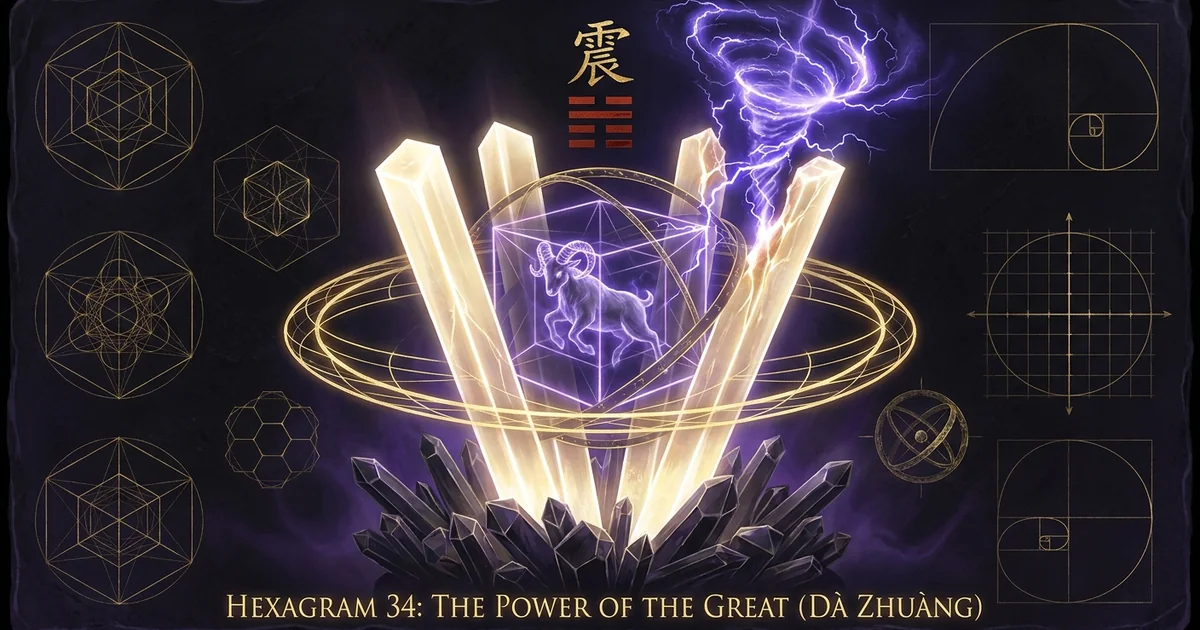
Hexagram 34 The Power of the Great (Dà Zhuàng): I Ching
Archetypal Thesis & Systemic Paradigm: The Vector of Unbridled Force and Conscious Containment
Hexagram 34 of the I Ching, designated as 大壯 (Dà Zhuàng), crystallizes the exact cybernetic threshold where ascending energy risks rupturing its containing systemic matrix. In classical divination and archetypal cosmology, the figure is defined by four solid light-lines (yang) surging from the base upward, pressing relentlessly against two yielding dark-lines (yin) at the summit. In the structural taxonomy of the Book of Changes divination, this architecture does not represent mere abundance or inert density; it models an explosive, highly pressurized kinetic reserve. The fundamental thesis of the dà zhuàng hexagram is that unmediated force is intrinsically self-terminating. When kinetic momentum outpaces structural rectitude (lǐ-propriety), the system inevitably generates catastrophic friction. Therefore, sovereign power (Dà) achieves evolutionary stability (Zhuàng) not through uninhibited external deployment, but through absolute, self-imposed voluntary containment.
The Energetics of Ascending Yang: Dynamic Saturation and Critical Thresholds
The energetic configuration of Hexagram 34 marks a crucial inflection within the binary cycle of the sixty-four figures. As the fourth stage in the ascending half of the twelve sovereign-hexagrams, Dà Zhuàng represents the point where light (yang) attains decisive structural dominance over darkness (yin). Having crossed the midline of the hexagram, the collective momentum of the four unbroken lines exercises an irresistible upward thrust. In thermodynamics or dynamic systems theory, this state mirrors dynamic saturation: a system operating near maximum energetic capacity, where the critical threshold between coherent work and dissipative entropy becomes dangerously narrow.
When analyzing hexagram 34 the power of the great iching meaning, one must recognize that this ascending mass does not encounter external resistance from an equal opponent; rather, it encounters its own structural boundaries. The two upper yielding lines are structurally fragile, unable to halt the upward advance of the lower nuclear mass by direct confrontation. If the lower four lines push forward blindly, assuming that quantitative superiority guarantees frictionless conquest, they precipitate systemic collapse. The dynamic saturation of yang demands a qualitative transmutation from kinetic expansion into potential containment. The power of the great can only remain “great” if it does not degenerate into sheer brute coercion, which inevitably exhausts the reservoir of creative potency that produced it.
The Dialectic of Zhen over Qian: Sovereign Kineticism Confronting Structural Restraint
Cosmologically, Hexagram 34 is composed of the lower trigram Trigram Qián (Heaven, the Creative, pure unyielding strength) and the upper trigram Trigram Zhèn (Thunder, the Arousing, abrupt kinetic shock). The spatial arrangement of thunder over heaven produces a potent archetypal dialectic. Trigram Qián represents the metaphysical bedrock: unbending, indivisible, self-sustaining ontological power. Trigram Zhèn represents phenomenal manifestation: movement, agitation, electrical discharge, and catalytic emergence. When thunder resounds across the vaults of heaven, kinetic energy discharges directly from the core of the absolute.
This structural dyad demonstrates sovereign kineticism acting in immediate concert with ontological authority. However, this pairing exposes an acute operational vulnerability: motion (Zhèn) that springs directly from inner strength (Qián) runs the risk of unchecked hubris. Because the actor feels the inexhaustible reservoir of the Creative beneath their feet, the impulse to act without regard for spatial boundaries or relational context becomes intoxicating. True sovereignty, within the dialectic of Zhèn over Qián, lies in maintaining equilibrium between the capacity to destroy and the discipline to withhold. The sovereign must embody the quietude of Heaven even while wielding the disruptive authority of Thunder.
Cybernetic Feedback Loops: The Failure Modes of Unregulated Hubris
From the standpoint of cybernetics and complex adaptive systems, Hexagram 34 maps a positive feedback loop that urgently requires negative, dampening feedback to avert catastrophe. When systemic output (force) reinforces its own operational logic without incorporating environmental resistance data, the system enters an uncontrolled runaway state. In human statecraft, psychological development, and geopolitical strategy, this dynamic manifests as the fatal illusion that every problem can be solved by an escalating application of leverage.
“The ego is always in danger of identifying with the transpersonal energy it has assimilated… Whenever the conscious mind assimilates unconscious contents, an inflation of the personality occurs, wherein the individual assumes godlike attributes of power, confusing systemic archetype with subjective autonomy. This inflation inevitably summons a catastrophic compensatory reaction from the objective psyche, dashing the inflated conscious attitude against reality.” — Carl Gustav Jung, The Relations between the Ego and the Unconscious (CW 7, par. 227–241)
Within analytical psychology, this dynamic defines psychic-inflation. When the ego taps into the collective archetypal bedrock of the unconscious (represented by the inexhaustible reservoir of Trigram Qián), it routinely falls victim to the delusion that this power belongs to its individual will. The ego identifies with the mana-personality, mistaking the objective energy of the Self for its own proprietary asset. This psychological state inevitably terminates in the failure modes of unregulated hubris: the subjective consciousness charges forward, heedless of external reality, until it collides violently with an immovable compensatory obstacle, resulting in severe psychological fragmentation.
Classical Provenance & Textual Lineage: Dà Zhuàng in the Zhouyi and Neo-Confucian Exegesis
The historical evolution of Hexagram 34 traces a clear trajectory from the harsh agrarian and ritual realities of the Western Zhou dynasty (c. 1046–771 BCE) to the sophisticated ethical and metaphysical treatises of classical and Song-Ming Neo-Confucianism. In the earliest layers of the Zhouyi, the text operates through visceral, zoomorphic imagery rooted in bronze-age pastoral life, where human survival depended on reading the volatile behavior of livestock and seasonal climatic shifts. Across centuries of commentary, the primary texts were deliberately reinterpreted, transmuting concrete warnings about stubborn rams into universal maxims of ethical self-restraint, civil order, and metaphysical alignment.
The King Wen Judgment: Rectitude as the Indispensable Anchor of Greatness
The received Judgment (Tuán) attributed to King Wen delivers a succinct, highly disciplined operational mandate: “The Power of the Great. Perseverance furthers” (Dà Zhuàng: Lì Zhēn). In the context of the Book of Changes divination, the formula Lì Zhēn (利貞) is far more than a casual promise of good luck; it denotes the absolute prerequisite of structural rectitude and moral steadfastness. Strength decoupled from Zhēn (correctness, moral alignment, truth) degenerates into illicit violence, which the moral cosmos of the Zhouyi systematically penalizes.
The Judgment (Richard Wilhelm Translation): “The Power of the Great. Perseverance furthers. The great are strong. Movement accompanied by strength: this produces power. ‘The power of the great furthers through perseverance’: this means that greatness and rectitude must be united. When greatness and rectitude are united, the conditions of heaven and earth are apparent.”
Wang Bi’s Commentary on the Judgment: “Those who are strong and yet act with strength end up exhausting themselves. Therefore, it is said: ‘Perseverance furthers.’ If one uses strength correctly, greatness will be preserved. It is not right to let strength turn into aggressive movement; one must govern strength by means of correct principle.” — Richard Wilhelm & Cary F. Baynes, The I Ching or Book of Changes (1950); Richard John Lynn, The Classic of Changes (1994)
The classical exegesis of the Judgment emphasizes that “greatness” (Dà) refers specifically to the noble, the legitimate, and the transcendent, while “power” or “robustness” (Zhuàng) denotes full physical and energetic maturity. The commentary of the Tuán Zhuàn (Treatise on the Decision) underscores this synthesis: greatness must hold fast to what is right. If strength exceeds the boundaries of correct measure, it ceases to be truly great and becomes grotesque, calling down inevitable systemic collapse.
The Duke of Zhou’s Line Texts: The Parable of the Ram Impaled on the Hedge
The linear narrative of Hexagram 34, traditionally attributed to the Duke of Zhou, is anchored in a vivid metaphor: the belligerent ram (yang, an intentional pun on the cosmic force of yáng) charging against a thorny enclosure. As the six lines progress from bottom to top, the line texts map the consequences of kinetic self-assertion across different degrees of systemic maturity.
At the baseline (Nine at the beginning), power is localized in the periphery—“power in the toes”—where any forward movement leads directly to misfortune. As the energy climbs into the third position, the central catastrophe of the hexagram unfolds: the inferior man relies on brute force, while the noble man refrains. The text warns that “a ram butts against a hedge and gets its horns entangled.” The animal’s headlong rush transforms its very instruments of offense (its horns) into mechanisms of paralyzing entrapment. Only at the fourth and fifth positions, where power is relinquished or directed with sublime technical precision, does the barrier dissolve: “The hedge parts; there is no entanglement.” Through this extended pastoral parable, the Duke of Zhou demonstrates that brute force invariably manufactures its own prison.
Wang Bi and Zhu Xi: Metaphysical Subjugation of Force to Principle (Lǐ)
The third-century CE commentary by Wang Bi represented a decisive break from the rigid, omen-heavy correlative cosmology of the Han dynasty, reframing Dà Zhuàng as an essay on the supremacy of non-action and non-presumption. Wang Bi argued that dynamic power can only endure if it is rooted in non-being (wú) and disciplined by quietude. To Wang Bi, the ram gets its horns entangled because it operates under the illusion that its internal power can override external reality. If one uses strength to conquer strength, both parties are consumed. The only sustainable path is to govern movement via absolute stillness, allowing external conditions to yield naturally without precipitating a catastrophic rebound.
A millennium later, during the Song dynasty, Zhu Xi integrated Hexagram 34 into the grand architecture of Neo-Confucian metaphysics, explicitly subordinating dynamic force (qì) to moral principle (lǐ-propriety). For Zhu Xi, Dà Zhuàng demonstrated that physical vitality and political power are merely volatile energetic raw materials. If qì is not held in complete subjection to lǐ, it devolves into tyrannical despotism. The noble person examines the structural dynamic of Thunder above Heaven and actively refuses to step outside the bounds of propriety. In Neo-Confucian ethics, restraint is not a compromise of strength; it is the ultimate expression of ontological power, demonstrating that the mind of Dao has fully mastered the erratic impulses of human desire.
Structural Mechanics & Symbolic Geometry: Trigram Algebra, Line Dynamics, and Sovereignty
The architectural matrix of Hexagram 34 constitutes a masterpiece of symbolic engineering. Every dynamic relationship within the hexagram—from the fundamental tensions between its constituent trigrams to the sequential vector of its six individual lines—reinforces the core thesis of kinetic containment. By analyzing the trigram algebra, the internal nuclear engines, and its temporal alignment within the ancient calendar, the practitioner uncovers a comprehensive blueprint of dynamic systems under stress.
---  --- Line 6: Yin / Yielding (Upper Trigram: Zhen / Thunder)
---  --- Line 5: Yin / Yielding
-------- Line 4: Yang / Firm
-------- Line 3: Yang / Firm (Lower Trigram: Qian / Heaven)
-------- Line 2: Yang / Firm
-------- Line 1: Yang / Firm
Nuclear Hexagram and Trigram Polarities: Qian (Heaven) Beneath Zhen (Thunder)
The core mechanics of Hexagram 34 rest on the foundational interaction between the lower trigram Trigram Qián (☰) and the upper trigram Trigram Zhèn (☳). Trigram Qián represents pure unbroken vitality, cosmic law, and indestructible inner integrity. Trigram Zhèn represents shock, initiation, lightning, and abrupt motion. When Heaven resides beneath Thunder, the cosmic force of the universe is positioned directly behind phenomenal action. The symbolic geometry indicates an unstoppable propulsion: Heaven does not passively hold back; it drives Thunder upward, while Thunder gives audible, terrifying voice to the power of Heaven.
However, a deeper structural analysis reveals the internal steering mechanism of the hexagram: its nuclear trigrams (hù guà). The nuclear hexagram hidden within Hexagram 34 (derived from lines 2, 3, 4 and lines 3, 4, 5) is Hexagram 43, Kuài (Break-Through / Resolution). The lower nuclear trigram (lines 2-3-4) is Qián (☰, Heaven), and the upper nuclear trigram (lines 3-4-5) is Duì (☱, Lake / Joy / The Mouth). The presence of Hexagram 43 within the core of Dà Zhuàng indicates that beneath the surface shock of thunder lies an impending, definitive rupture: the power of the great is systematically marching toward a decisive breakthrough. The upper nuclear trigram Duì introduces an element of expressive release and potential vulnerability, cautioning that if the sovereign force speaks or acts incautiously, it will prematurely trigger the structural collapse that Hexagram 43 warns against.
The Six Line Trajectories: From the Power in the Toes to the Horns in the Fence
The developmental trajectory of Dà Zhuàng maps a diagnostic continuum, showing the catastrophic degradation of power when driven by personal impulse, contrasted with the effortless efficacy of power anchored in universal timing:
- Nine at the Beginning (Initial Yang): Dynamic force is situated at the lowest conceivable station—“Power in the toes. Setting forward brings misfortune. This is certainly true.” Power at the periphery lacks spatial perspective and structural authority. To act from this initial impulse is to mistake energetic restlessness for sovereign command. Movement here aborts the unfolding cycle.
- Nine in the Second Place (Central Yang): Operating from the center of the lower trigram, this line embodies balanced force: “Perseverance brings good fortune.” Occupying an even position with a firm line, it possesses an intrinsic tension, yet its adherence to the central path (zhōng) ensures that it does not overextend. Its strength is regulated by inner poise.
- Nine in the Third Place (Terminal Yang of Qián): Here lies the catastrophic pivot of the hexagram: “The inferior man uses power; the superior man does not. Setting forward brings danger. A ram butts against a hedge and gets its horns entangled.” Reaching the transition from Heaven to Thunder, the line falls into unchecked aggressiveness. Identifying with its own capacity to push, it charges the boundary, instantly neutralizing its own agency through frictional lockup.
- Nine in the Fourth Place (Initial Yang of Zhèn): The sovereign line that transforms the hexagram: “Perseverance brings good fortune. Remorse disappears. The hedge parts; there is no entanglement. The power depends on the axle of a large cart.” Having crossed into the upper trigram, this line is situated precisely where the barrier dissolves. Because it possesses genuine mechanical authority (the axle of the cart) rather than mere peripheral bravado, resistance collapses naturally. It advances without needing to violently collide with the environment.
- Six in the Fifth Place (Central Yin of Zhèn): Yielding authority in the sovereign position: “Loses the ram with ease. No remorse.” Here, the explosive energy of the ram is surrendered voluntarily. By abandoning belligerent posturing and adopting receptive, flexible governance, the ruler neutralizes all systemic opposition. Force is subsumed into effortless elegance.
- Six at the Top (Terminal Yin): The exhaustion of the vector: “A ram butts against a hedge. It cannot go backward, it cannot go forward. Nothing furthers. If one notes the difficulty, good fortune ensues.” Having reached the spatial limit of the hexagram, rigid persistence results in absolute paralysis. The subject cannot advance due to structural boundaries, nor retreat due to pride. True movement only returns when the subject ceases to struggle and acknowledges its structural impasse.
The Sovereign Hexagram Sequence (Xia Calendar): Second Month of Spring and Seasonal Surges
In the ancient cosmological sequence of the twelve sovereign or tidal hexagrams (bì guà), which trace the inhalation and exhalation of cosmic breath across the twelve lunar months of the Xia calendar, Hexagram 34 corresponds precisely to the Second Month (roughly March, surrounding the Vernal Equinox). The sequence demonstrates the inexorable ascent of the light force:
At Hexagram 11 (Tài, Peace), the dynamic balance between three yang lines below and three yin lines above establishes universal harmony and systemic fruitfulness. With the emergence of Hexagram 34 (Dà Zhuàng), this equilibrium shifts decisively. The fourth yang line invades the upper realm of yin. Seasonally, this corresponds to the explosive biological surge of early spring: the sap rises with immense pressure through trees, frozen soil breaks apart under the germinating power of seeds, and hibernating organisms burst forth into the phenomenal world.
Yet this seasonal surge is intensely perilous. If a plant expends its entire metabolic reserve in a premature burst of vegetative growth during late winter frosts, it freezes and dies. The sovereign hexagram of the Second Month dictates that while the surge of life-force is absolute and inevitable, it must be contained by the frost-resistant boundaries of seasonal patience. The surge of spring must submit to the natural cadence of climatic maturation; otherwise, its creative power precipitates its own extinction.
Psychological Dynamics & Operational Praxis: Archetypal Inflation and Strategic De-escalation
In the crucible of depth psychology and strategic operational praxis, Hexagram 34 functions as a high-voltage diagnostic probe. It surfaces during moments when an individual, organization, or political body has accumulated substantial tactical leverage, yet stands on the precipice of strategic self-destruction due to the unconscious compulsion to assert dominance. The psychological work demanded by Dà Zhuàng is not the acquisition of greater force, but the conscious, calculated mastery of restraint: the deliberate de-escalation of kinetic pressure in order to preserve structural integrity.
Shadow Integration: Confronting the Tyrant and the Impetuous Warrior Archetypes
Within the framework of Jungian archetypal psychology, Hexagram 34 exposes the unintegrated shadow of the Warrior and its degenerate counterpart, the Tyrant. The Impetuous Warrior archetype operates under a binary cognitive framework: it views every boundary as an explicit insult to its autonomy and every obstacle as an enemy to be annihilated. When an analysand is swept up by the energetic current of Dà Zhuàng, they frequently experience an intoxicating sense of self-righteous potency. They mistake systemic friction for a moral mandate to double down on forceful intervention.
Integrating this shadow requires direct confrontation with the terror of vulnerability that drives overcompensation. True shadow integration of power demands that the individual recognize how their compulsion to butt against hedges is born not of genuine strength, but of an unconscious terror of impotence. The Tyrant asserts power preemptively because it cannot tolerate ambiguity, waiting, or the sovereign autonomy of other actors. To master Hexagram 34 is to execute a psychological withdrawal from the archetype of coercive conquest, anchoring the ego in what Daoist psychology defines as wú-wéi (effortless action / non-forcing). Sovereign power becomes operative only when the ego feels zero compulsion to demonstrate its dominance.
The Ram’s Dilemma: Differentiating Kinetic Reactivity from Transpersonal Will
The central psychological motif of Hexagram 34 is the tragic, absurd dilemma of the ram impaled upon the hedge. The ram represents kinetic reactivity: instinctual, blind, animalistic propulsion. It sees an obstacle, lowers its head, blinds itself to the broader landscape, and charges forward. When its horns become snarled in the interlocking branches of the hedge, its instinctual reaction is to thrash with escalating violence, embedding the barbs deeper into its flesh and exhausting its metabolic reserves.
Unconscious Coercion (The Entangled Ram)
- Energetic Vector: Unidirectional, reactive, explosive forward projection.
- Egoic Motivation: Compulsive need to validate strength through overt external conquest.
- Reaction to Friction: Immediate escalation of force; viewing delays as existential threats.
- Systemic Mechanics: Operates entirely from peripheral leverage (“power in the toes”).
- Teleological Outcome: Entrapment in external resistance, energetic depletion, and total paralysis.
Conscious Potency (The Sovereign Master)
- Energetic Vector: Multidimensional, contained, perfectly timed potential reserve.
- Egoic Motivation: Transpersonal alignment with systemic principle (Lǐ); self-containment.
- Reaction to Friction: Deceleration, strategic withdrawal, and internal operational audit.
- Systemic Mechanics: Relies on structural equilibrium and central stability (“the axle of the cart”).
- Teleological Outcome: Dissolution of environmental barriers without collision; effortless advancement.
Differentiating kinetic reactivity from transpersonal will is the paramount developmental task of this hexagram. Transpersonal will does not force outcomes; it assesses the systemic field, recognizes the objective laws governing the situation, and synchronizes its action with the natural flow of events. Kinetic reactivity is personal, emotional, and terrified of stopping; transpersonal will is impersonal, dispassionate, and fully capable of absolute cessation. Whenever an individual feels an overwhelming, desperate urge to force a resolution immediately, they can be certain they are operating as the ram rather than the sovereign master.
Operational Consultation: Diagnostic Protocols for Divinatory Line Shifts
When Hexagram 34 emerges in divinatory consultation, the senior practitioner must immediately evaluate the distribution of kinetic charge within the client’s operational field. The appearance of this hexagram indicates an environment primed for conflict, where the querent possesses substantial leverage, yet faces catastrophic blowback if that leverage is deployed aggressively.
The primary diagnostic protocol for handling Hexagram 34 involves an immediate audit of strategic posture:
- Audit Forward Motion: The consultant must halt all offensive maneuvers, unilateral declarations, and aggressive negotiations. The querent must be instructed that any movement initiated strictly from egoic impatience will activate the curse of Line 1 or Line 3.
- Examine the “Hedge”: What constitutes the external barrier? Is it a legal contract, a relational boundary, an institutional bureaucracy, or an unyielding psychological defense in another person? If it is a true hedge, the querent must not attack it directly. Butting against it will inevitably ensnare their instruments of influence.
- Assess the Transition to Hexagram 33 or Hexagram 43: The relational polarities of Hexagram 34 provide vital strategic intelligence. Its inverse pair is Hexagram 33 (Dùn, Retreat). Where Dùn teaches the sovereign how to withdraw dynamically before encroaching darkness, Dà Zhuàng teaches how to halt dynamic strength before it overruns its own foundations. The querent must learn to blend the wisdom of Dùn (strategic retreat) directly into the heart of Dà Zhuàng (advancing power).
- Identify the Shifting Line Vector:
- If Line 1 moves: The impetus is wholly premature. The querent must physically stop and wait.
- If Line 3 moves: The querent is currently trapped or on the verge of entrapment due to hubris. Immediate strategic de-escalation and non-resistance are required to slip the horns free.
- If Line 4 moves: Obstacles are about to yield naturally. The querent needs only to maintain structural integrity; the path will open of its own accord.
- If Line 5 moves: The querent must sacrifice their aggressive posturing entirely, trading force for diplomatic gentleness.
- If Line 6 moves: The system is deadlocked. The querent must stop struggling, accept the impasse, and allow the passage of time to dissolve the tension.
Philosophical Synthesis & Macrocosmic Correspondence: Hermetic Axioms and Systemic Energetics
The systemic architecture of Hexagram 34 extends far beyond the confines of classical Chinese thought, demonstrating remarkable structural alignment with modern somatic-energetic frameworks, molecular biology, and Western Hermetic traditions. By mapping these cross-disciplinary correspondences, we reveal universal archetypal constants governing the concentration and regulation of kinetic force across multiple scales of reality.
- Universal Codon Assignment: Codon Triplet AAG / AAA (Coding for the basic, positively charged amino acid Lysine, critical for structural protein formation and epigenetic histone regulation).
- Human Design Matrix: Gate 34 (The Gate of Power), situated precisely within the Sacral Center. The primary motor of pure biological and evolutionary kinetic stamina.
- Astrological Decan & Planetary Architecture: The second and third decans of Aries (governed by Mars and the Sun), where cardinal fire reaches maximum combustion and must be tempered by solar equilibrium.
- Hermetic Axiom Correspondence: The Principle of Polarity (“Everything is dual; opposites are identical in nature, but different in degree”) and the Principle of Rhythm (“The measure of the swing to the right is the measure of the swing to the left; rhythm compensates”).
Human Design Correlates: Gate 34 (The Gate of Power) and the Sacral Motor
In the contemporary synthesis of Human Design, which incorporates the I Ching into a body-centered energetic map, Hexagram 34 translates directly into Gate 34: The Gate of Power, located in the Sacral Center. Gate 34 is the most mechanically potent, purely generative gate in the entire bodygraph. It is the only gate in the Sacral Center that connects directly to three distinct centers: the Spleen (via Gate 57, forming the Channel of Power, 34–57), the Throat (via Gate 20, forming the Channel of Charisma, 34–20), and the G Center (via Gate 10, forming the Channel of Exploration, 34–10).
This structural routing offers extraordinary insights into the nature of Hexagram 34:
- Pure Kinetic Availability: Within the Sacral Center, Gate 34 functions as an enormous biological generator. It is the fuel of human survival, sexual propagation, and operational endurance.
- The Imperative of Pure Response: Mechanically, the Sacral motor can never initiate action from the mind without generating debilitating energetic resistance and physical exhaustion. It is designed to act solely in response to environmental stimuli. When an individual with Gate 34 attempts to use their immense force proactively—initiating projects, forcing outcomes, crashing through perceived resistance—they manifest the exact pathology of the entangled ram. Their energy is instantly trapped, resulting in severe physical burnout and metabolic dysfunction.
- The Charisma Trap (Channel 34–20): When Gate 34 hooks directly into Gate 20 in the Throat Center, power is transformed into immediate, unfiltered action in the present moment. This is the archetype of the busy bee, an individual who is constantly doing, moving, and accelerating. Without the stabilizing wisdom of internal restraint, this individual becomes a prisoner of their own kinetic output, acting without awareness and destroying structural alliances through reckless momentum.
Biological and Genomic Parallels: Codon Architectures and Metabolic Surges
At the microscopic scale of molecular biology, the dynamic of Hexagram 34 mirrors the delicate regulatory mechanisms of cellular energetics, particularly the pathways mediated by the amino acid Lysine (encoded by codons AAA and AAG, corresponding to the Dà Zhuàng genetic sector). Lysine is a basic, positively charged amino acid essential for the construction of structural proteins and the post-translational modification of histones.
In epigenetics, histone methylation and acetylation via lysine residues determine whether DNA remains tightly coiled (condensed chromatin / heterochromatin) or uncoils to allow gene transcription (euchromatin). If the uncoiling of genetic material is unregulated—if the cellular system experiences an unconstrained transcriptional surge without negative feedback mechanisms—the result is uncontrolled cellular proliferation, the biological hallmark of oncogenesis.
Similarly, in metabolic cellular respiration, the rapid breakdown of glycogen and production of ATP during anaerobic exertion generates an explosive capacity for physical work. However, if this metabolic surge is maintained beyond physiological limits, the cellular environment rapidly acidifies due to lactate accumulation, triggering enzymatic breakdown and muscular failure. Just as Hexagram 34 dictates that the four ascending yang lines must be bounded by the upper yin lines, cellular biology requires strict, continuous boundary management: power without apoptosis, repair checkpoints, and membrane containment inevitably transitions from life-giving energy into lethal pathology.
The Hermetic Principle of Polarity and the Taoist Cultivation of De (Virtue)
In the Western Hermetic tradition, the operational dynamics of Hexagram 34 align directly with the Principle of Polarity and the Principle of Rhythm, as expounded in the Kybalion. The Hermetic initiate recognizes that force and resistance are not two separate ontological realities, but two poles of the same continuous spectrum. When an actor exerts aggressive force, they automatically polarize the surrounding environment into equal and opposite resistance. The harder the ram strikes the hedge, the more violently the hedge pushes back, entangling the horns.
The Hermetic solution to this dilemma is the art of neutralization, which mirrors the Daoist internal cultivation of Dé (德, Moral Power or Virtue). In Daoist alchemical practice (Nèidān), the practitioner does not suppress the surging vitality of the lower fire (the yang mass of Qián); rather, they sublimate it through the vessel of quietude (Zhèn yielding to the higher principle of the Void). Dé is precisely that form of sovereign power which never asserts itself as power. As the Daodejing states in Chapter 38: “Superior virtue (Dé) does not display itself, and therefore possesses true virtue. Inferior virtue never loses sight of itself, and therefore possesses no virtue.”
When dynamic strength reaches its apex, the Master does not swing the sledgehammer; they embody the quiet structural center of the axle. By aligning the kinetic surge of the four yang vectors with the transpersonal order of the universe, force is transmuted into evolutionary grace. The individual ceases to be a battering ram seeking to conquer external space; they become a transparent conduit for cosmic law, wherein barriers yield naturally without the expenditure of destructive energy.
Frequently Asked Questions Regarding Hexagram 34
Common Interpretive Pitfalls: Is Hexagram 34 a Mandate for Immediate Aggressive Action?
The most widespread and dangerous interpretive error concerning Hexagram 34 is reading its traditional title—“The Power of the Great”—as an unambiguous cosmic endorsement for aggressive outward expansion. Novice consultants, upon seeing four unbroken yang lines surging upward and receiving a name that connotes immense strength, routinely assume that the I Ching is advising them to strike boldly, confront enemies head-on, or force their agenda through institutional resistance.
Classical exegesis and structural mechanics confirm that Hexagram 34 is precisely the opposite: it is an explicit warning against the deployment of unconstrained force. The entire internal narrative of the hexagram details the traps, paralysis, and humiliations that occur when power is asserted naively. The hexagram appears in consultation specifically when the querent possesses dynamic leverage, but stands in immediate danger of abusing it through egoic inflation. The mandate of Dà Zhuàng is not action, but the ethical containment of force through unwavering adherence to propriety (lǐ) and strategic restraint.
Navigating Line 3 versus Line 4: Why Does the Ram Get Caught While the Hedge Collapses for Another?
The structural divergence between Nine in the third place and Nine in the fourth place represents one of the most vital strategic lessons in the Book of Changes divination. Both lines are dynamic yang vectors, yet Line 3 encounters humiliating entanglement, while Line 4 sees the hedge part effortlessly, with remorse vanishing. The operational difference hinges upon structural position, timing, and egoic intent:
- Line 3 (The Entangled Ram): Occupies the summit of the lower trigram Qián. It has reached the limit of internal strength, but has not yet crossed into phenomenal authority. It acts out of pride, believing that sheer willpower can overwrite systemic constraints. It treats the barrier as a personal affront, charges it directly, and its instruments of aggression (its horns) become completely snarled in external resistance. It uses power for subjective, egoic conquest.
- Line 4 (The Parting Hedge): Occupies the entry point of the upper trigram Zhèn. It holds systemic legitimacy and operates at the precise moment of evolutionary readiness. More importantly, Line 4 is anchored in the “axle of a large cart”—meaning its movement is supported by deep structural mechanics, stability, and patience rather than hasty, superficial aggression. Line 4 does not need to assault the hedge; because its timing is harmonious with the cosmic vector, the systemic matrix shifts, and the hedge dissolves before it.
Translational Discrepancies: Understanding ‘Dà Zhuàng’ as ‘Great Strength’ vs. ‘The Power of the Great’
The Chinese ideograms that compose the name of the hexagram—大 (Dà) and 壯 (Zhuàng)—carry precise linguistic nuances that are frequently flattened in Western translations:
- Dà (大): While routinely translated as “Great” or “Big,” in classical cosmological texts it carries an explicit moral and qualitative weight. It denotes that which is noble, expansive, comprehensive, and aligned with Heaven—the attributes of the Jūnzǐ (noble person). It stands in sharp contrast to Xiǎo (小), that which is petty, narrow, reactive, and base.
- Zhuàng (壯): Philologically, the ideogram Zhuàng depicts a strong, fully grown man, combined with the character for a bed or couch, indicating a human being who has attained the full vigor of adult maturity (traditionally around the age of thirty in classical Chinese literature). It signifies robust, fully consolidated, healthy physical strength—vigor that has crystallized, as opposed to raw, erratic juvenile energy.
Translating the pair as “Great Strength” can be misleading, as it encourages the reader to conceptualize the hexagram purely as a quantitative measure of physical or tactical force. The superior translation, popularized by Richard Wilhelm—“The Power of the Great”—preserves the crucial grammatical and philosophical relationship: it is the power that belongs exclusively to the Great Person. It is power made magnificent precisely because it is governed by the adult maturity, moral rectitude, and conscious containment that define the noble human spirit. Strength without greatness is mere violent animalism; greatness with strength is the foundation of cosmic order.