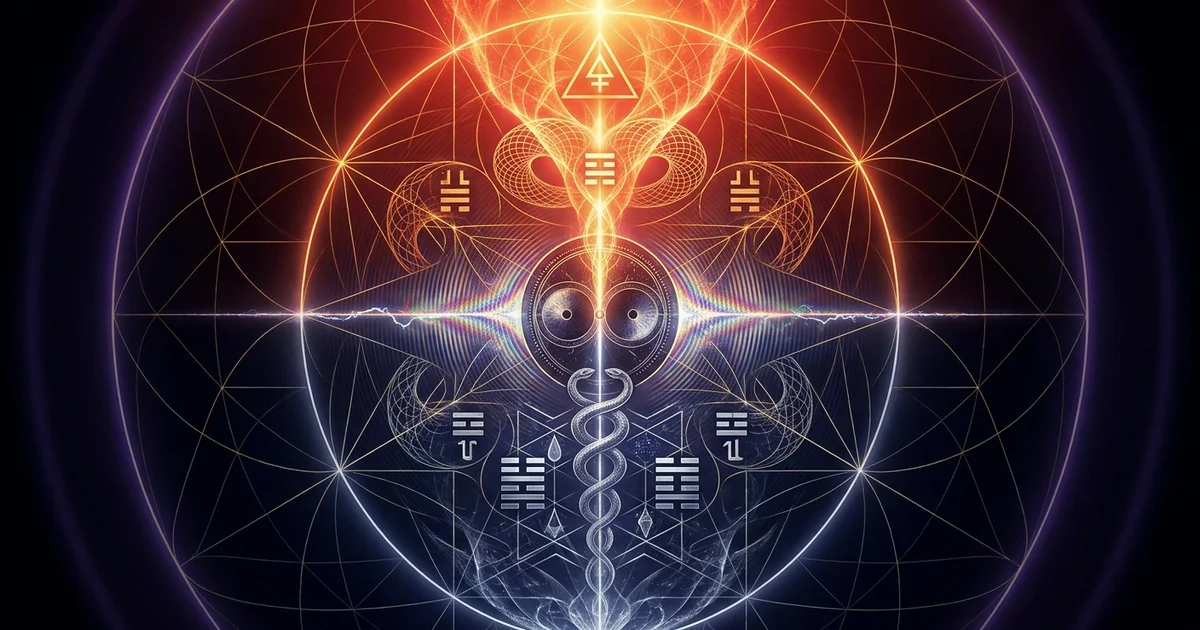
Hexagram 38 Opposition (Kuí): I Ching Divination - Guide
Archetypal Thesis & Systemic Paradigm: The Mechanics of Divergence
Hexagram 38 (睽, Kuí / Opposition) serves within the architecture of the I Ching as a precise topological and cybernetic map of relational entropy, vector divergence, and structural differentiation. In classical Chinese cosmology, the King Wen sequence positions Kuí directly following Hexagram 37 (Jia Ren / The Family), marking an inevitable dialectical transition. Where Jia Ren establishes domestic coherence, concentric bonding, and centripetal social harmony, Kuí operates as an enantiodromic reaction, an explosive centrifugal dispersal that prevents systemic ossification. Rather than conceptualizing opposition as a catastrophic dysfunction or moral failure, the canonical mechanics of Kuí formalize divergence as an indispensable thermodynamic and psycho-spiritual threshold. It is the necessary vector displacement through which structural autonomy and consciousness emerge out of primary, undifferentiated symbiosis.
Thermodynamics of Polarization: Vector Divergence of Fire and Lake
The macrocosmic architecture of Kuí is established by the interaction of its constituent trigrams: the upper trigram is Li (☲, Fire, radiance, combustion), and the lower trigram is Dui (☱, Lake, mist, receptive interiority). In the thermodynamic schema of the Book of Changes, elements possess inherent kinetic vectors. Li naturally combusts, expands, and ascends toward the empyrean, driven by thermal agitation and outward luminosity. Conversely, Dui represents condensed moisture, downward-settling hydrostatic pressure, and gravitational pooling. When positioned with Fire above Lake, the two energetic bodies move in diametrically opposite directions. Unlike Hexagram 63 (/iching/hexagram-63-after-completion, Water over Fire), where the descent of water cools the ascending fire to produce dynamic homeostasis and functional thermodynamic exchange, Hexagram 38 configures a total structural divergence. The heat climbs unchecked into the stratosphere while the water seeps into the chthonic depths, eliminating any zone of immediate energetic intersection.
This physical mechanics illustrates the primary condition of the kuí hexagram: an operational state where two systems, individuals, or intra-psychic complexes share an interface of co-presence but lack directional alignment. The divergence is radical precisely because it is natural. Fire does not ascend out of malice toward the lake, nor does the lake sink to spite the fire. Their polarization is an ontological property of their specific energetic configurations. In contemporary systems theory, this state-space describes an asymmetry of objectives: two nodes operating within a shared network boundary whose utility functions have decoupled. The analytical seeker navigating Hexagram 38 opposition I Ching meaning must first recognize that the prevailing friction is structural rather than accidental. Attempting to force immediate unity violates the intrinsic physics of the constituents, generating systemic shock rather than integration.
Upper Trigram: Li (Fire)
- Directionality: Ascending, radiating outward, expanding.
- Element & Quality: Flame, clarity, clinging consciousness.
- Psychological Vector: Differentiating intellect, autonomous awareness.
Lower Trigram: Dui (Lake)
- Directionality: Descending, settling downward, pooling.
- Element & Quality: Water, joy, receptive interiority.
- Psychological Vector: Affective relationality, social cohesion, instinctual depth.
Kuí as Individuation Threshold: From Co-Dependence to Conscious Separation
From the vantage point of Jungian analytical psychology, Hexagram 38 delineates the crisis of individuation. In early developmental matrices—mirrored by the preceding hexagram of The Family—the ego resides within an unconscious participation mystique, bounded by ancestral archetypes, institutional scripts, and collective dogmas. Systemic cohesion is preserved through conformity, yet this equilibrium inevitably suffocates the emerging Self. Kuí models the structural rupture whereby the conscious ego differentiates itself from the collective matrix. This phase is characterized by an acute subjective experience of alienation, estrangement, and mutual incomprehension. The individual feels an ontological distance from their tribe, their partner, or their inherited ideological framework.
This psychic estrangement operates according to the law of enantiodromia: that which has reached its developmental zenith within the collective must invert into its opposite to preserve psychic vitality. In the diagnostic framework of Marie-Louise von Franz (1980), meaningful divergence signals that an archaic psychological contract has expired. To experience Kuí is to confront the terrifying asymmetry of personal truth against social consensus. The individual who retreats from this opposition back into regressive codependence collapses the tension required for psychic mutation. The fire must be permitted its ascent; the lake must be granted its depth. The archetype demands that the tension of the opposites be sustained within the vessel of conscious awareness without premature, panic-driven compromise, enabling what Jung termed the transcendent function to eventually synthesize a higher-order psychological synthesis.
Cybernetic Feedback and the Dialectical Function of Resistance
Within complex adaptive networks, negative feedback maintains stability by dampening deviation, while positive feedback amplifies deviation toward a phase shift. Hexagram 38 models a cybernetic state wherein the feedback loops between two interacting agents have inverted: signals intended to coordinate are interpreted as interference, and efforts to draw closer amplify mutual repulsion. This dynamic mirrors the geometry of the /sacred-geometry/vesica-piscis-polarity, wherein two intersecting systemic spheres must preserve their distinct focal centers to generate a fertile liminal space, rather than collapsing into a singular, flattened singularity. Resistance in this paradigm is not an error within the machinery; it is an informational metric that demarcates operational boundaries.
Andreas Schöter (2012), in his formal structural analysis of bagua state-space transitions, demonstrates that oppositional hexagrams act as essential regulatory nodes that interrupt runaway entropic conformity within the King Wen sequence. When a sociotechnical or interpersonal system loses internal friction, it enters an entropic drift toward monoculture, rendering it brittle to external shocks. Kuí introduces necessary systemic friction. By encountering structural resistance—the recalcitrance of the other, the impossibility of immediate agreement, the divergence of evolutionary vectors—the system is compelled to map its own limitations. Resistance forces self-definition. The practitioner must abandon coercive attempts to overwrite the other’s reality, recognizing that the dialectical tension itself is performing structural labor, preventing premature closure and preparing the ground for an authentic, post-oppositional convergence.
Classical Provenance & Textual Lineage: Transmission of Kuí
The historical codification of Hexagram 38 during the Western Zhou period and its subsequent hermeneutic evolution across the classical commentators reveal an ongoing effort to civilize and utilize structural divergence. The graph for Kuí (睽) in early bronze and bamboo inscriptions presents an evocative paleographic morphology: it incorporates the radical for “eye” (目, mù) juxtaposed against a phonetic and semantic component depicting divergence, squinting, or physical strabismus (癸, guǐ). Historically, the character denoted eyes that do not focus upon the same point—an ocular divergence wherein each pupil tracks a different visual field. In the sociopolitical landscape of early China, this ocular metaphor captured the condition of ideological estrangement, feudal schism, and diplomatic deadlock, providing the Zhou court with an actionable strategy for managing adversarial factions without resorting to total war.
‘OPPOSITION. In small matters, good fortune. Above, fire; below, the lake: The image of OPPOSITION. Thus the superior man retains his individuality, even when in all kinds of fellowship.’ – Richard Wilhelm / Cary F. Baynes, The I Ching or Book of Changes (1950)
Zhouyuan Origins and the King Wen Judgment Formula
The foundational judgment attributed to King Wen delivers an explicit, paradoxical boundary condition: “Opposition: In small matters, good fortune” (睽:小事吉). This formula encapsulates the operational boundary of the hexagram within book of changes divination. King Wen, navigating the existential tension between the declining Shang hegemony and the rising Zhou consciousness, recognized that periods characterized by the archetype of Kuí cannot support grand, unified enterprises. Totalizing ambitions—such as launching comprehensive institutional transformations, sealing major political alliances, or executing vast military campaigns—require thermodynamic and ideological coherence. Attempting such macro-initiatives during an epoch of Kuí invites immediate disaster because the diverging vectors of the collective will tear the enterprise apart from within.
Instead, the judgment restricts the locus of efficacy to “small matters” (xiǎo shì). In micro-operations, localized adjustments, and incremental, self-contained tasks, the noble actor finds success. When overarching consensus is structurally impossible, the agent preserves agency by contracting their scope of ambition. Success is achieved not by forcing the macroscopic whole into artificial unity, but by tending to molecular responsibilities where divergent pressures exert negligible torque. The judgment affirms that localized progress can be achieved even within a fractured systemic matrix, provided the operator does not demand universal validation or synchronized partnership from their environment.
The Commentary on the Decision (Tuan Zhuan) and the Great Image (Da Xiang)
The Tuan Zhuan (Commentary on the Decision), traditionally attributed to Confucius, broadens the philosophical scope of Kuí from an unfortunate relational friction into a cosmic imperative. The commentary states:
“Fire moves upward, the lake moves downward; two women live together, but their wills do not move together… Heaven and earth are opposed to each other, but their work is identical. Man and woman are opposed to each other, but their seed unites. All things are opposed to each other, but their work is accomplished according to their kinds. Great indeed is the time and the use of Opposition!”
The Tuan Zhuan executes an ontological shift: opposition is revealed as the engine of cosmic generation. Without the distinct polarization of Heaven (Yang) and Earth (Yin), no generative work could occur. Without the biological divergence of male and female, reproduction is nullified. Polarity is shown to be the prerequisite for teleological actualization.
This metaphysical insight is anchored ethically in the Da Xiang (Great Image) commentary: “Above, fire; below, the lake: The image of Opposition. Thus the superior man retains his individuality, even when in all kinds of fellowship” (君子以同而異, literally: the noble person uses sameness to differentiate). The Junzi does not react to alienation by either assimilating into the collective mob or collapsing into nihilistic isolation. Instead, the Junzi masters the art of contextual co-existence: they integrate into social fellowship at the level of external propriety, while maintaining an uncompromised interior sovereignty. They understand that authentic fellowship (tóng) cannot survive without the preservation of individual distinctiveness (yì).
Wang Bi’s Neo-Daoist Exegesis: Non-Coercive Reconciliation
In the third century CE, the brilliant Neo-Daoist philosopher Wang Bi radically demythologized I Ching interpretation by discarding the mechanistic omenology of the Han dynasty commentators in favor of a profound ontological reading anchored in Xuanxue (“Dark Learning”). In his commentary on Hexagram 38, Wang Bi posits that opposition arises from the natural differentiation of the phenomenal world, yet is fundamentally grounded in the unifying silence of the Dao (Non-Being, Wu). Wang Bi warns against applying artificial, legalistic coercion to resolve the tensions of Kuí.
According to Wang Bi, when things fall into opposition, any attempt by an external ruler or ego to violently force them into concord only heightens their mutual antagonism. The true sage does not attempt to extinguish the fire or heat the lake; rather, the sage leaves each element to fulfill its inherent nature (ziran). The transcendent principle (Li, 理) underlying Hexagram 38 is that unity is never achieved through the subjugation of one pole by another, but through the spontaneous realization that both divergent forms emerge from an identical, unnamable root. Reconciliation, when it occurs within Wang Bi’s framework, must be non-actional (wu wei) and organic, arising when the natural cycle of estrangement has exhausted its kinetic momentum.
Structural Mechanics & Symbolic Geometry: Trigram Inversion and Line Progression
The inner dynamic of Hexagram 38 is governed by its strict mathematical structure, its nuclear constitution, and a dramatic, narratively coherent six-line progression that details the psychological trajectory from initial estrangement to total, paranoid projection, culminating in dialectical release.
--- Line 6: Yang (Top)
--- Line 5: Yin
--- Line 4: Yang
--- Line 3: Six (Yin)
--- Line 2: Nine (Yang)
--- Line 1: Nine (Initial)
Upper Trigram: Li (☲) - Fire
Lower Trigram: Dui (☱) - Lake
Trigrammatic Constitution: Flame Above the Abyss of Joy
The primary trigrams configure a profound semiotic tension. Lower Dui is the youngest daughter, associated with metal, joyfulness, persuasion, and the open mouth; upper Li is the middle daughter, associated with fire, clarity, visual acuity, and weapons. Their cohabitation represents a household of sisters whose developmental instincts point in incompatible directions. Dui seeks to draw inward through charm, relational dialogue, and emotional resonance; Li demands intellectual illumination, external projection, and analytical division.
Furthermore, while Dui represents the joyous openness of the marshland, its position beneath combustion means its moisture is systematically evaporated by the overhead heat, while the flame finds nothing substantial to cling to below. There is no reciprocal nourishment. In the language of cybernetic modeling, the feedback channels are misaligned: Dui emits acoustic/affective signals, while Li processes only optical/intellectual data. The two entities misread each other’s primary language, transforming innocent expressions into sources of cognitive friction.
Nuclear Core Dynamics: Kan (Water) and Li (Fire) Hidden Tension
A rigorous structural analysis must examine the nuclear hexagram (hù guà) embedded within the core of Hexagram 38. By extracting lines 2-3-4 (forming the lower nuclear trigram) and lines 3-4-5 (forming the upper nuclear trigram), we uncover the latent topological engine of the hexagram:
- Lower Nuclear Trigram (Lines 2, 3, 4): Kan (☵, Water, Danger, the Abyss).
- Upper Nuclear Trigram (Lines 3, 4, 5): Li (☲, Fire, Clarity, Clinging).
The nuclear configuration constitutes Hexagram 63 (Ji Ji / After Completion, Water over Fire). This structural revelation is of paramount interpretive significance. Embedded within the overt alienation of Hexagram 38 (Fire over Lake) resides the esoteric presence of Hexagram 63—the ultimate emblem of perfect dynamic balance, thermodynamic closure, and interpenetrating completion.
This hidden presence reveals that opposition is not the absence of relationship; it is an inverted form of the most profound relationship possible. Latent harmony is the invisible spine of Kuí. The overt polarization experienced on the surface is simply the tension created by two elements that are destined for an intricate, complementary equilibrium, but whose current outer forms are inverted. The abyss of danger (Kan) sits directly at the belly of the hexagram, warning that clumsy intervention will plunge the situation into genuine trauma, while the inner fire of Li provides the silent discernment necessary to endure the process.
Six-Line Scalar Dynamics: Progression from Lost Horses to False Pigs
The individual lines of Kuí trace the operational journey through the wilderness of estrangement, delineating specific behavioral protocols for every degree of systemic tension.
Initial Nine (Line 1)
“Remorse disappears. If you lose your horse, do not run after it; it will return of itself. When you see bad people, guard yourself against mistakes.” At the threshold of opposition, polarization begins. The horse—symbol of the dynamic, instinctual libido and cooperative social agency—escapes. The structural instruction is strictly non-actional: do not pursue. Chasing a differentiated energy during a phase of Kuí merely drives it further into the badlands; the pursuit validates the estrangement. If left to its own trajectory, the natural field effects of the system will cause it to loop back autonomously. Encountering “bad people” (those hostile to one’s frequency) requires neither crusading warfare nor defensive panic, but rigorous, self-contained integrity to prevent structural contamination.
Nine in the Second Place (Line 2)
“One meets his lord in a narrow alley. No blame.” Because opposition disrupts regular, broad institutional avenues of communication, official meetings are blocked. The line indicates an unexpected, informal convergence in an unconventional corridor (xiang). When formal diplomacy, structured dialogue, or rational debate fail due to overarching systemic polarization, the dialectical link must be re-established through serendipitous, back-channel, or informal encounters where the rigid masks of the opposing parties can be temporarily laid aside.
Six in the Third Place (Line 3)
“One sees the cart dragged back, the oxen halted, a man’s hair and nose cut off. Not a good beginning, but a good end.” This is the point of maximal acute suffering in the hexagram. The traveler’s forward momentum is systematically sabotaged: the vehicle is pulled backward, the driving beasts are paralyzed, and the individual suffers the mutilating punishments of the ancient penal code (loss of hair and nose, signifying total social humiliation and dishonor). The actor is caught between the downward weight of Dui and the upward surge of Li. Every attempt to force forward movement results in profound violation. The instruction is radical patience: accept temporary absolute defeat, for the opposition is so intense that aggressive action guarantees dismemberment. The “good end” is secured only because the line maintains its integrity until the external blockages exhaust their kinetic potential.
Nine in the Fourth Place (Line 4)
“Isolated through opposition, one meets a companion of like mind with whom one can associate in mutual trust. Even despite the danger, no blame.” Here, the noble agent is utterly isolated in the midst of a hostile environment. However, at this juncture of structural exhaustion, an authentic counterpart appears. This is not a massive collective alliance, but an encounter with a singular fellow exile. Through the cultivation of radical interior fidelity (fu), the two isolated nodes form a micro-circuit of trust, creating an island of coherence within the broader sea of systemic divergence.
Six in the Fifth Place (Line 5)
“Remorse disappears. The companion bites his way through the wrapping. If one goes to him, how could this be a mistake?” The fifth line occupies the ruler’s seat, holding the soft, receptive yin virtue within the trigram of Fire. The opposition begins its organic collapse. The true ally, previously separated by layers of administrative obstruction, historical misunderstanding, or protective shielding (“the wrapping”), applies sharp, decisive effort to pierce the veil. The consultant is commanded to abandon defensive suspicion and actively move toward this convergence; the structural estrangement is dissolving from within.
Nine at the Top (Line 6)
“Isolated through opposition, one sees one’s companion as a pig covered with mud, as a wagon full of devils. First one draws a bow against him, then one unbends the bow. He is not a robber; he will woo at the right time. As one goes forward, rain falls; then good fortune comes.” The terminal line represents the psychological climax of Kuí: the acute crisis of paranoid projection. In total isolation, the perceiving consciousness, completely distorted by fear and protracted alienation, hallucinates monstrosity in the other. The approaching partner is perceived through an inverted lens as an obscene beast (a mud-splattered pig) and an existential demonic threat (a cart of devils). The instinct is defensive homicide—the bow is drawn.
Yet, the line achieves ultimate good fortune through an act of epistemic realization: the actor looks again, pierces the veil of the shadow projection, and recognizes that the monster is in fact their legitimate partner arriving for an authentic union. The bow is unstrung. Aggressive paranoia is disarmed by the sudden influx of structural clarity. The resulting release of tension causes the sky to break: “rain falls” (yǔ), symbolizing the dynamic atmospheric discharge of Hexagram 63, where Fire and Water finally interpenetrate, transforming chronic alienation into systemic fertility.
Psychological Dynamics & Operational Praxis: Navigating Interpersonal Schism
When consulted within psycho-spiritual divination, Hexagram 38 acts as a diagnostic mirror revealing severe cognitive and emotional distortion generated by shadow mechanics. The fundamental hazard of the kuí hexagram state is the epistemological fragility of the observer. Protracted alienation deprives the ego of clarifying relational feedback, creating an echo chamber wherein every external gesture is decoded as a hostile act.
‘The confrontation of the two positions generates a tension charged with energy and creates a living, third thing… a living birth that leads to a new level of being, a new situation. The opposition has been overcome not by an intellectual compromise, but through the realization of the archetype.’ – C.G. Jung, ‘The Transcendent Function’ (1958), Collected Works Vol. 8, §189
Shadow Projection and the Epistemology of the Monster
The narrative arc of line 6 reveals the primary psychological mechanism operating under the aegis of Kuí: the total externalization of the personal and archetypal shadow. When an individual or group experiences prolonged divergence from an “Other,” the psyche cannot tolerate the sustained vacuum of incomprehension. In accordance with Jung’s formulation of synchronicity and projection (1952), the unconscious spontaneously populates this informational void with archaic, mythic imagery. The adversary ceases to be a human being with a distinct utility function and is transfigured into a caricature of moral filth or existential malevolence—a cart of devils.
In modern interpersonal dynamics, this manifests as hyper-reactive narratives of persecution, gaslighting paranoia, and ideological demonization. The observer attributes systemic, calculated evil to what is often merely structural divergence or clumsiness. Operational praxis under Hexagram 38 requires what hermetic psychology designates as epistemic containment. The practitioner must implement an absolute veto over their first interpretive impulses. Whenever the impulse arises to view an associate, an institution, or an intimate partner as irredeemably monstrous, the practitioner must recognize that they are peering through the distorted lens of the divergent eye (睽). The bow must be systematically unstrung. The critical spiritual task is to sustain the isolation without discharging its agony through preemptive, defensive strikes.
The Tactical Limit: Small Matters Versus Grand Projects
The pragmatic counsel of the oracle—“In small matters, good fortune”—demands a radical curtailment of strategic ambition. When an individual receives Hexagram 38 in a strategic consultation, it serves as an uncompromising warning against pursuing major integrative maneuvers. The systemic field is polarized; lines of force are moving away from each other.
Therefore, the practitioner must not:
- Attempt comprehensive diplomatic summits or final relationship “clearing” conversations; these will inevitably devolve into acute accusations, mimicking the mutilation of Line 3.
- Launch overarching systemic mergers, grand joint ventures, or totalizing collective missions.
- Demand that the other party adopt their own perceptual framework or emotional vocabulary.
Instead, the practitioner must pivot toward micro-operational discipline. Grand projects are broken down into modest, localized components that require no philosophical agreement. If two individuals cannot agree on the fundamental nature of their relationship, they can still coordinate on the concrete logistics of paying an invoice or feeding the domestic animals. By reducing the surface area of potential friction, the consultant prevents the structural opposition from escalating into institutional war (Hexagram 6, /iching/hexagram-6-conflict). Small matters succeed because they do not trigger the deep, archetypal defenses of the polarized parties.
Consultation Hermeneutics: Discerning When to Withhold Action
In the divination chamber, receiving Hexagram 38 requires the investigator to evaluate the precise geometry of changing lines to determine whether the opposition is currently hardening or preparing for its enantiodromic release. If the lower lines (1 and 2) are active, the divergence is just establishing its boundaries; any intervention here is an absolute violation of operational wisdom. The practitioner must withhold all corrective measures, allowing the lost horse to traverse its arc without energetic pursuit.
If the upper lines (5 and 6) are active, the opposition has matured to the brink of auto-dissolution. Here, the practitioner prepares for the sudden dismantling of the conflict. The operational posture transitions from stoic non-action to graceful reception. The practitioner must be psychologically prepared to welcome the adversary without demanding an apology or gloating over the cessation of hostilities. The arrival of the rain demands that the historical narrative of the conflict be discarded instantaneously, allowing the systemic field to re-seed itself without the toxic residue of preserved grievances.
Philosophical Synthesis & Macrocosmic Correspondence: Hermetic Polarities and Genetic Coding
The archetypal dynamic formalized in Hexagram 38 transcends the human arena of psychological and political tension, reflecting universal principles of cosmic differentiation, systemic information processing, and genetic morphogenesis.
Hermetic Principle of Polarity and the Kybalion Axiom
In the Western esoteric tradition, Kuí corresponds directly to the Fourth Hermetic Principle: The Principle of Polarity. As articulated in the canonical axioms of the Kybalion, “Everything is Dual; everything has poles; everything has its pair of opposites; like and unlike are the same; opposites are identical in nature, but different in degree; extremes meet; all truths are but half-truths; all paradoxes may be reconciled.”
Hexagram 38 demonstrates this Hermetic axiom through its physical and psychic geometry. Fire and Lake appear as absolute, incompatible antitheses: the burning radiance above and the cool moisture below. Yet, Hermetic science recognizes that both are merely thermodynamic gradations along a singular axis of molecular and spiritual vibration. The illusion of irreconcilable conflict exists only so long as the observer remains trapped in a lower-dimensional perspective, viewing the poles as isolated entities rather than extreme limits of the same underlying reality. The work of the alchemist—mirrored in /tarot/major-arcana-temperance-dialectic—is to hold these volatile extremes within the alchemical alembic until their kinetic opposition is transmuted into the coniunctio oppositorum, the sacred marriage of polarities that births the Philosopher’s Stone.
- Binomial Geometry: Upper Trigram Li (☲) / Lower Trigram Dui (☱).
- Human Design Correlate: Gate 38 (The Gate of the Fighter, Root Center, Splenic Pressure via Channel 28-38).
- Genetic Codon: Correlated with the Methionine/Stop signal architecture in systemic codon models.
- Hermetic Axiom: Principle of Polarity (Kybalion IV: ‘Thesis and antithesis are identical in nature, but different in degree’).
- Astrological Coordinate: Mars in opposition to Venus / Sun-Pluto dynamic tension.
Human Design Circuitry: Gate 38 (The Fighter) and the Channel of Awareness
In the contemporary cybernetic-astrological synthesis of Human Design, Hexagram 38 maps directly to Gate 38, designated as The Gate of the Fighter, situated within the adrenalized pressure matrix of the Root Center. Gate 38 forms half of the Channel of Struggle (28-38), a dynamic stream of the Individual Knowing Circuit that drives the consciousness toward discovering whether life has authentic purpose beyond mere biological survival (/human-design/gate-38-the-fighter).
The mechanics of Gate 38 provide striking confirmation of the classical I Ching analysis. As an individual pressure gate, its operational signature is structural obstinacy, resistance to external conditioning, and the capacity to stand in fierce opposition against the collective tribe. Gate 38 must oppose; it is neurologically hardwired to resist any compromise that threatens the individual’s unique integrity. When functioning unconsciously in its low-frequency shadow, Gate 38 fights indiscriminately, manufacturing unnecessary opposition, antagonizing allies, and tilting at windmills like the paranoiac of Line 6. However, when elevated to its mature frequency, Gate 38 becomes the divine warrior that discerns precisely which battles are worth the expenditure of vital energy—preserving the essential spirit of individuation against systemic homogeneity.
Genetic Codon Mapping: Stop Codons and Molecular Asymmetry
At the bio-informational scale, researchers examining the structural isomorphism between the 64 hexagrams and the 64 genetic codons have mapped Hexagram 38 to key regulatory junctions within the ribosome’s translation machinery. In cellular biology, the transcription and translation of life-codes require not merely continuous synthesis, but precise, absolute termination signals—the nonsense or “Stop” codons (UAA, UAG, UGA).
Without the absolute resistance of a stop codon, the polypeptide chain would continue to accumulate amino acids indefinitely, resulting in a non-functional, toxic tangle of protein mass. Hexagram 38 represents this molecular refusal to blend: it is the chemical boundary condition that halts translation, forcing the newly synthesized chain to detach from the ribosomal matrix and fold into its unique, differentiated three-dimensional geometry. Furthermore, cellular morphogenesis relies upon molecular asymmetry—polar gradients of morphogens that divide an embryo into distinct axes (anterior-posterior, dorsal-ventral). The “opposition” of these molecular gradients is precisely what creates anatomical structure. Without the vector divergence of Kuí operating at the nanometer scale, biological life would remain a formless soup of unspecialized, undifferentiated cells.
Frequently Asked Questions: Analytical Clarifications on Hexagram 38
Does Receiving Hexagram 38 Guarantee Inevitable Conflict?
No. Receiving Hexagram 38 does not diagnose an inevitable or bloody conflict; rather, it identifies a structural condition of divergence. Opposition becomes destructive warfare only when the participating entities attempt to violently force the opposing pole into compliance with their own operational trajectory. When an actor misinterprets the natural, directional divergence of Fire and Lake as a deliberate insult or an existential attack, they trigger an escalatory feedback loop that turns estrangement into battle.
If, however, the practitioner recognizes the ontological right of the other element to pursue its natural upward or downward vector, the hexagram simply marks a period of necessary differentiation. It indicates that the parties are currently tracking different horizons. By acknowledging this distance with serene detachment, the consultant avoids conflict entirely, using the period to fortify their own center while allowing the external world to follow its autonomous path.
How Does Hexagram 38 Differ from Hexagram 6 (Conflict / Song)?
The fundamental difference lies in their operational geometry, legalistic status, and systemic stage:
- Hexagram 6 (Song / Conflict) is configured by Upper Heaven (Qian) and Lower Water (Kan). Heaven moves upward, and Water moves downward; they pull apart, but because Heaven is inherently powerful and Water represents internal cunning and danger, the result is active, contentious litigation, institutional warfare, and direct judicial contest. Song is a formal state of dispute where two agents actively contest the same resource, territory, or claim to righteousness.
- Hexagram 38 (Kuí / Opposition) is configured by Upper Fire (Li) and Lower Lake (Dui). Here, there is no direct legal claim or contested prize; the issue is one of epistemic and constitutional divergence. The parties in Kuí do not necessarily desire to sue or destroy each other; they simply do not see the world through the same lens. Their tastes, values, evolutionary trajectories, and perspectives naturally move away from one another. Hexagram 6 is a clash of wills demanding legal adjudication; Hexagram 38 is an existential misalignment demanding psychological differentiation and the restraint of micro-action.
What Is the Strategic Resolution of the Sixth Changing Line?
The strategic resolution of the Sixth Changing Line requires an intentional, conscious act of epistemic disarmament. Line 6 represents the catastrophic zenith of psychological alienation, where prolonged isolation has transfigured the other party into an absolute, monstrous threat—a cart full of devils. The tactical hazard here is a preemptive strike: releasing the arrow of aggression against an entity that is actually arriving to initiate an alliance.
The resolution occurs in the critical space between drawing the bow and releasing the arrow. The consultant must engage in rigorous cognitive reality-testing. They must ask: Is the other party genuinely malicious, or am I interpreting their alterity through the distorted lens of my own unhealed isolation? When the consultant has the courage to lower the weapon and withhold aggressive projection, the illusion collapses. The supposed enemy is recognized as a complementary partner. The psychic tension instantly discharges, symbolized by the falling of rain, transforming a potential tragedy of friendly fire into the supreme good fortune of authentic reconciliation.