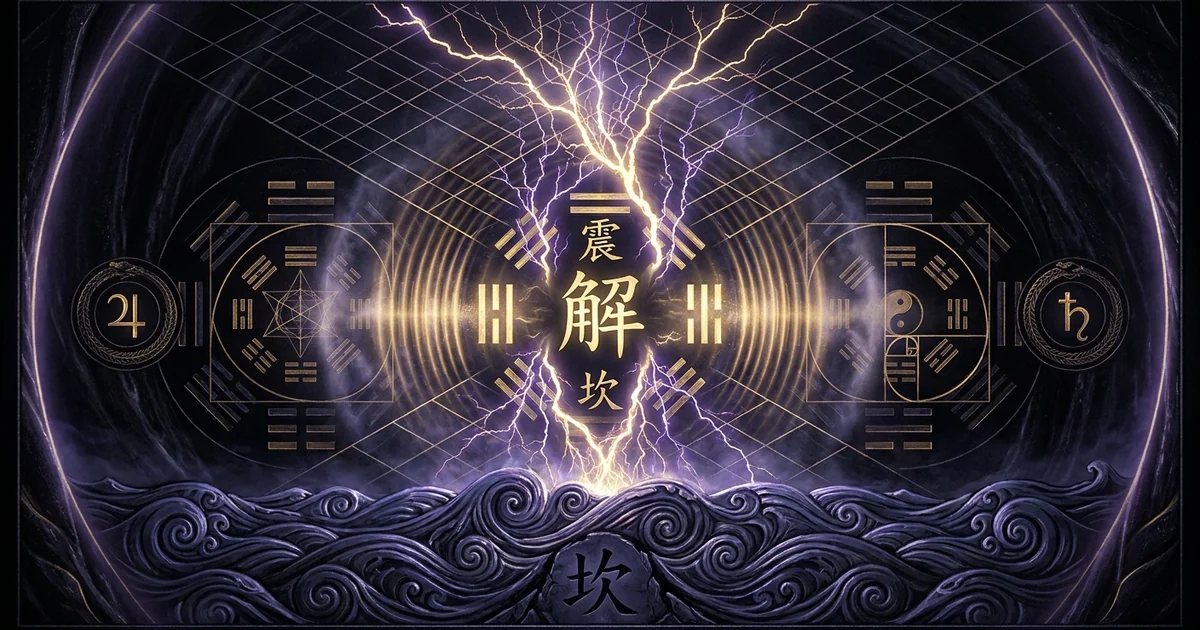
Hexagram 40 Deliverance (Release) (Xiè): I Ching Divination
Archetypal Thesis & Systemic Paradigm: The Mechanics of Cathartic Equilibrium
Hexagram 40 (Xiè, Deliverance/Release) represents the formalization of non-linear phase transitions within complex psycho-cosmological architectures. Within the systemic logic of the I Ching, phenomena do not oscillate indefinitely without encountering threshold limits; rather, systems accumulate structural strain until an energetic critical point is crossed. Where its immediate predecessor, Hexagram 39 (Jiǎn, Obstruction), maps the severe accumulation of potential energy within a bounded, impenetrable perimeter, Hexagram 40 models the sudden conversion of that static latency into kinetic discharge. This dynamic process restores circulation across frozen topologies, marking the definitive boundary where systemic paralysis gives way to homeostatic restoration.
The archetypal foundation of this hexagram rests upon the explosive interaction between two elemental forces: Thunder (Zhèn) mounting over the perilous depths of Water (Kǎn). This atmospheric architecture mirrors the thermodynamic rupturing of an electrical storm. In meteorology, protracted high-pressure differentials create catastrophic atmospheric tension; the lightning strike and torrential downpour do not represent mere chaos, but rather the violent, spontaneous re-equilibration of atmospheric charge. In exact correspondence, the hexagram 40 deliverance (release) iching meaning delineates how dynamic shock, emerging from within existential peril, shatters stagnant barriers and precipitates psychic and physical catharsis.
=== HEXAGRAM 40: XIÈ (DELIVERANCE) ===
Binary: 010100 | Trigrams: Zhèn over Kǎn
Upper: Thunder (Zhèn, ☳) — Kinetic Arousal
Lower: Water (Kǎn, ☵)   — Existential Peril
Phase Transitions from Impediment (Jiǎn) to Release (Xiè)
The transition across the king-wen-sequence from Hexagram 39 to Hexagram 40 mirrors the precise thermodynamics of a phase shift. In Jiǎn, the human agent is confronted by Water above Mountain (Kǎn over Gèn): a vast chasm in front, an unyielding stone cliff behind. The strategic imperative of Jiǎn is stillness, contemplation, and the refusal to expend psychic energy against an immovable impasse. During this phase of containment, potential energy accumulates in direct proportion to the severity of the systemic constraint.
When the structural polarity flips into Hexagram 40, the Mountain (Gèn) dissolves, replaced by the kinetic propulsion of Thunder (Zhèn). The abyss (trigram-kan), formerly an external impediment blocking forward movement, is drawn beneath the rising impulse of movement (trigram-zhen). The system transitions instantaneously from stasis to kinesis. Obstruction is not dissolved through incremental attrition; it is shattered through the sudden mobilization of an inner spring that breaks free of the depths. The psychological and somatic correlates of this shift are profound: muscular armor relaxes, autonomic nervous system tone shifts from chronic sympathetic arousal or dorsal vagal freezing to parasympathetic discharge, and the cognitive horizon expands past the fixation of the trap.
Energetic Signatures: Thunder over Water and Sudden Homeostasis
The phenomenological signature of thunder over water manifests as an immediate decompression event. Water represents the primeval unconscious, peril, the fluid void, and existential dread; Thunder represents vitality, shock, sudden realization, and awakening movement. When Thunder remains submerged beneath Water, it produces internal turmoil and neurosis. When Thunder erupts directly out of Water, it carries the dense, stagnant materials of the deep upward into clear atmospheric visibility. The resultant downpour cleanses the psycho-spiritual atmosphere, washing away accumulated toxic detritus.
Crucially, this sudden homeostasis is not a state of manic expansion, but a return to baseline neutrality. The eruption is momentary; the release is functional. Systemic equilibrium is re-established precisely because the kinetic impulse of Zhèn expends the dangerous volatility that previously characterized Kǎn. The water that was once an impassable flood becomes the life-giving rain that fertilizes the arid soil below. What was toxic when stagnant becomes medicinal through circulation.
The Cybernetic Release of Stored Topological Stress
From an analytical and cybernetic perspective, Hexagram 40 models the discharge of stored topological stress within a self-regulating network. When a complex dynamic network is subjected to continuous external constraints, it stores systemic deformation energy across its nodes. If the feedback loops within that network become hyper-rigidified, the system loses the capacity for internal reorganization. It enters a state of frozen computation, where identical error states are iteratively reproduced.
Hexagram 40 delineates the cybernetic circuit-breaker. The text’s specific operational instruction—“If there is no longer anything where one has to go, return brings good fortune. If there is still something where one has to go, haste brings good fortune”—serves as an algorithmic dampening protocol. In cybernetic systems, after a catastrophic bottleneck has been bypassed, the system must immediately cease high-amplitude corrective actions; failure to do so induces secondary hunting oscillations, re-traumatizing the network. Liberation is preserved not by continuing the battle that broke the barrier, but by executing an immediate reset to baseline resting tone.
Classical Provenance & Textual Lineage: Historical Transmissions of Xiè
The lineage of Xiè reveals a coherent philosophical tradition centered on structural clemency, functional non-action, and the deliberate dissolution of debt. The character Xiè (解) fundamentally denotes loosening, untying, dissecting, or liberating an organism or object from strict binding; it depicts the horn of an animal being separated or carved away, pointing to the surgical alleviation of entanglement. The text warns against the persistent human error of prolonging punitive vigilance long after the precipitating emergency has passed.
The Judgment (Wilhelm/Baynes): “Deliverance. The southwest furthers. If there is no longer anything where one has to go, return brings good fortune. If there is still something where one has to go, haste brings good fortune.”
The Great Image (Daxiang): “Thunder and rain set in: the image of Deliverance. Thus the superior man pardons mistakes and forgives misdeeds.”
Wang Bi (Commentary on Hexagram 40): “Deliverance means the cessation of difficulty. When difficulty ceases, things return to their baseline. The southwest is the realm of Earth (Kūn); it represents peace and simplicity. To employ punitive measures or excessive governance when difficulty has just ended is to invite chaos back into the state. Pardon the unintentional; remit the deliberate.”
The King Wen Judgment and the Southwest Axis of Receptive Clemency
The canonical Judgment established by King Wen situates the vector of auspicious movement toward the “southwest” (xīnán). Within the spatial geometry of the Early and Later Heaven arrangements, the Southwest is the cardinal seat of the Trigram Kūn (Earth), embodying pure receptivity, maternal containment, yield, and absolute non-contention. The symbolic injunction to orient oneself toward the southwest signifies that once the knot of danger has been severed, the sovereign or psychological ego must completely abandon the martial posture of the Northwest (Qián, aggressive penetration and struggle).
To turn toward the southwest means to embrace simplicity, consolidation, and rest. The King Wen Judgment recognizes that following prolonged duress, social organisms and individual psyches inhabit a hypersensitive state prone to retaliatory paranoia. By anchoring the resolution in the southwest, the I Ching constructs an ethical technology: healing is achieved not by organizing the conquered field under strict martial law, but by creating an open, undemanding space where systemic exhaustion can be repaired through non-action.
The Duke of Zhou’s Line Progression: From Pardon to Elimination of the Parasite
The Duke of Zhou’s six line texts for Hexagram 40 trace a calculated path of structural recalibration. Rather than depicting liberation as a singular, frictionless event, the line progression highlights the lingering hazards that stalk an emerging state of freedom. The narrative begins at the initial baseline of release and culminates in the deliberate, lethal surgical strike against the root cause of systemic corruption:
- Initial Six: “Without blame.” The crisis has just broken; the energy is raw. The only duty is absolute stillness to allow the disrupted equilibrium to settle.
- Nine in the Second Place: “One kills three foxes in the field and receives a yellow arrow. Perseverance brings good fortune.” The emergence of internal deceit and sycophancy must be decisively eliminated using moderate, centered (yellow) means.
- Six in the Third Place: “If a man carries a burden on his back and nonetheless rides in a carriage, he thereby encourages robbers to draw near. Perseverance leads to humiliation.” Vulgar pretension and holding onto the markers of a station one has not earned will instantly sabotage the newly won freedom.
- Nine in the Fourth Place: “Deliver yourself from your great toe. Then the companion arrives, and him you can trust.” One must intentionally sever connections with low-frequency, habituated dependencies before legitimate allies can draw near.
- Six in the Fifth Place: “If only the superior man can deliver himself, it brings good fortune. Thus he proves to small men that he is in earnest.” Internal psychological liberation must precede external boundary-setting; small men withdraw only when the ruler demonstrates that inner complicity has ceased.
- Top Six: “The prince shoots at a hawk on a high wall. He hits it. Everything is favorable.” The final, surgical strike against the high-elevation parasitic complex that continues to threaten systemic wholeness.
Wang Bi’s Neo-Daoist Exegesis: Non-Action Following Cataclysm
Wang Bi’s third-century exegesis serves as a major theoretical watershed in the understanding of the xiè hexagram. Translating the text through a Neo-Daoist (Xuanxue) ontological lens, Wang Bi asserts that Deliverance is fundamentally the manifestation of Zìrán (spontaneous self-so-ness). When structural difficulties dissipate, the phenomena of the world do not require an active architect to construct a new reality; left to themselves, they naturally gravitate back toward a baseline of balance.
Wang Bi warns that the ego’s instinct to impose order immediately following cataclysm is a fatal error. By drafting sweeping laws, initiating inquisitions, or obsessively organizing the landscape of survival, the ruler or individual re-introduces the very artificial friction that precipitated the original crisis. True deliverance demands the courage of clemency. The formulation of the Daxiang—pardoning mistakes (shè guò, unintentional slips of dynamic balance) and forgiving misdeeds (yòu zuì, deliberate moral transgressions)—is read by Wang Bi not as sentimental leniency, but as an operational imperative: the cosmic slate must be wiped clean, or the cycle of karmic and historical retribution will immediately regenerate the abyss.
Structural Mechanics & Symbolic Geometry: Trigram Vectors and Nuclear Matrices
The technical mechanics of Hexagram 40 within book of changes divination reveal an intricate geometric distribution of energetic stresses. To comprehend its full cybernetic arc, one must look past the surface symbols and dissect the underlying trigram vectors, the interior nuclear engines, and the precise mechanical shifts occurring at the key transforming lines.
Constituent Trigrams:
- Upper Trigram: Zhèn (☳, Thunder) — Vector: Upward, kinetic, explosive shock.
- Lower Trigram: Kǎn (☵, Water) — Vector: Downward, centripetal, dangerous sink.
Nuclear Matrix:
- Nuclear Lower (Lines 2, 3, 4): Kǎn (☵, Water)
- Nuclear Upper (Lines 3, 4, 5): Lì (☲, Fire)
- Resulting nuclear-hexagram: Hexagram 63 (Jì Jì, After Completion)
Key Transformational Vectors:
- Nine in the Second Place changing $\rightarrow$ Transforms to Hexagram 16 (Yù, Enthusiasm).
- Six in the Fifth Place changing $\rightarrow$ Transforms to Hexagram 47 (Kùn, Oppression/Exhaustion).
HEXAGRAM 40 (XIÈ)          NUCLEAR CORE (HEXAGRAM 63: JÌ JÌ)
Line 6: --  -- (Zhèn)
Line 5: --  -- (Zhèn)      Line 5: ------ (Lì, Upper Nuclear)
Line 4: ------ (Zhèn)      Line 4: --  -- (Lì / Kǎn)
Line 3: --  -- (Kǎn)       Line 3: ------ (Lì / Kǎn)
Line 2: ------ (Kǎn)       Line 2: --  -- (Kǎn, Lower Nuclear)
Line 1: --  -- (Kǎn)
Trigram Vector Dynamics: Dynamic Motion Emerging from the Deep
The macro-cosmic architecture of Hexagram 40 is defined by divergent trigram vectors that paradoxically yield systemic relief. The lower trigram, Kǎn, possesses an intrinsic downward directional pull; it is gravitational, abyssal, seeking the lowest point, and prone to entrapment. Conversely, the upper trigram, Zhèn, contains a single strong yang line bursting upward from beneath two yin lines, generating an explosive, vertical vector of propulsion.
When Kǎn is placed above Zhèn (as in Hexagram 3, Zhūn, Initial Difficulty), the downward vector of water suffocates the upward surge of thunder, creating deep existential strangulation. However, in Hexagram 40, the positioning is inverted: Thunder is above the Water. The kinetic eruption has already escaped the gravity well of the deep. The shock wave reverberates across the atmospheric expanse, pulling the dynamic energy of the abyss upward into the open, where it discharges without crushing the structural matrix of the hexagram. The friction between the downward sinking of the peril and the upward climbing of the shock creates the thermodynamic rupture that breaks the systemic impasse.
The Nuclear Matrix: Internal Tension of Hexagram 63 (Jì Jì)
Beneath the overt interactions of Thunder and Water lies the profound engine of its nuclear-hexagram: Hexagram 63 (Jì Jì, After Completion). The nuclear configuration is derived by isolating lines 2-3-4 (forming nuclear Kǎn) and lines 3-4-5 (forming nuclear Lì). When combined, Fire (Lì) sits directly above Water (Kǎn), establishing the ultimate archetype of absolute structural completion and precarious perfection.
This nuclear presence reveals a profound esoteric truth regarding the nature of Deliverance: the hidden interiority of release is absolute equilibrium. Every act of deliverance is internally governed by the structural mechanics of Jì Jì—the state in which every element is in its technically correct energetic place, yet standing on the precipice of decay. The presence of Hexagram 63 inside Hexagram 40 demonstrates that deliverance is not an unstructured free-for-all; it is the instantaneous realization of perfect energetic calibration. If the release is mishandled, the system does not simply fall backward—it rapidly destabilizes into entropic decline.
Changing Line Trajectories: The Central Nine in the Second Place and Six in the Fifth
The operational spine of Hexagram 40 is maintained by two central lines: the yang line at the second position and the yin line at the fifth position. Their energetic shifts define the mechanics of systemic liberation:
Nine in the Second Place
This line occupies the center of the lower trigram Kǎn. It is a solitary yang force submerged within peril, possessing the rectitude, firmness, and vision necessary to navigate corruption. The “three foxes” it kills represent the tripartite expressions of unconscious fixation: obsession with past wounds, duplicity born of defensive survival strategies, and insidious self-pity. By slaying these parasitic psychic investments, the line receives the “yellow arrow.” Yellow signifies the balanced, golden mean of the center (Earth); the arrow signifies uncompromising, straight intent. When this line activates and changes, the lower trigram becomes Kūn (Earth), transforming Hexagram 40 into Hexagram 16 (Yù, Enthusiasm)—the spontaneous release of creative, harmonious momentum across the social field.
Six in the Fifth Place
Occupying the seat of the ruler in the upper trigram, this yin line represents the sovereign will that must decisively detach from lower-order entanglements. It represents the psychological ego that has historically relied upon destructive defense mechanisms (the “inferior men” or shadow complexes) for survival during times of siege. To achieve authentic release, the ruler cannot simply banish these elements via external decree; rather, the ruler must execute an internal withdrawal of energetic investment. The moment the superior man “delivers himself,” the petty forces naturally fall away, as they no longer possess an energetic host. When Six in the Fifth Place changes, Hexagram 40 transitions into Hexagram 47 (Kùn, Oppression/Exhaustion), warning that if the sovereign fails to maintain inner spiritual boundaries during the process of release, the system will immediately collapse back into structural exhaustion.
Psychological Dynamics & Operational Praxis: Archetypal Release and Enantiodromia
In analytical psychology, Hexagram 40 models the sudden resolution of a severe neurosis or archetypal possession. When the ego-consciousness has been cornered by a constellation of complexes—a state mirrored precisely by the obstruction of Hexagram 39—the psychic economy approaches a critical breaking point. It is at this precise juncture that the law of enantiodromia, first conceptualized by Heraclitus and later formalized by Carl Gustav Jung, manifests within the psychic container.
“In situations of complete impasse, when the conscious mind can no longer find a way out and the unconscious is loaded with unbearable tension, a sudden enantiodromic shift often occurs. In such moments, the archetypal field reorganizes itself instantaneously. The synchronistic event or the sudden psychological breakthrough does not build gradually; it acts like a lightning flash that breaks through the frozen structure, dispersing the complex and restoring the psychic economy to baseline.” — Marie-Louise von Franz, On Divination and Synchronicity: The Psychology of Meaningful Chance (1980)
Deliverance is the psychological archetype of the loosening of the knot. The accumulated pressure within the unconscious breaks through the threshold of repression, sweeping away the structural defenses of the neurosis. However, this breakthrough carries acute psychological danger: if the ego attempts to harness this sudden liberation to pursue manic inflation or launch an inquisition against former internal oppressors, the catharsis degenerates into psychosis or fresh neurosis.
PSYCHOANALYTIC DISCHARGE SCHEMA: HEXAGRAM 40
[ Constellated Trauma Complex ]
           │
           ▼
[ Neurotic Impasse / Frozen Libido (Hexagram 39: Jiǎn) ]
           │
           ▼ (Threshold Tension Crossed)
[ Archetypal Enantiodromia (Lightning / Zhèn Activation) ]
           │
           ▼
[ Dissolution of Defense Mechanisms (Xiè) ]
    ┌──────┴────────────────────────────────┐
    ▼                                       ▼
[ Pathological Retaliation ]        [ Integrative Clemency ]
(Vengeance, Manic Inflation,        (Pardon of Mistakes,
 Re-traumatization)                 Southwest Baseline Receptivity)
Enantiodromia and the Dissolution of the Neurotic Complex
The psychological mechanics of Xiè correspond to the cathartic discharge of the constellated complex. A complex is an emotionally charged group of psychological ideas and images clustered around an archetypal core; when active, it acts like an autonomous splinter psyche, draining libido from the ego and freezing development. Under the reign of Hexagram 39, the ego attempts to fight the complex head-on, resulting in total cognitive and emotional paralysis.
Hexagram 40 formalizes the moment of enantiodromia, wherein the energy trapped within the complex suddenly reverses its flow. The water (Kǎn) of the unconscious yields to the awakening shock (Zhèn) of genuine conscious insight. This insight is not an intellectual rationalization; it is an embodied somatic realization that dissolves the energetic charge binding the complex together. The neurosis simply runs out of fuel. The operational mandate following this event is immediate psychological pardon: the individual must actively forgive themselves and others for the compromises, regressions, and destructive actions committed while trapped within the emergency state. To obsessively analyze the origins of the dissipated crisis is to re-knot the severed cord.
The Falcon on the High Wall: Line 6 and the Precision of Shadow Decoupling
The ultimate psychological challenge of Deliverance is articulated in the enigmatic imagery of the Top Six: “The prince shoots at a hawk on a high wall. He hits it. Everything is favorable.” In classical Chinese iconography, the hawk (sun) is an avian predator that perches upon high, commanding elevations—representing an entrenched, elevated psychic defense mechanism or a toxic, predatory shadow element that has fortified itself in the highest strata of the personality.
THE ARCHETYPAL ARCHERY MECHANIC (LINE 6)
[ High Wall: Elevated Ego/Superego Defense Structure ]
      │
      └─► [ The Hawk: Entrenched Predatory Shadow Complex ]
                ▲
                │ (The Prince: High Conscious Intent)
                │ (Single Arrow: Highly Targeted Surgical Libido)
                │
          [ Absolute Decoupling: Freedom Restored ]
This predatory complex cannot be dispersed through generalized clement pardon. It is an active psychic parasite that exploits the architecture of the personality (the “high wall”) to dominate the internal landscape. The “prince” is the unified conscious intent, the integrated Self. The shooting of the arrow represents an act of absolute, concentrated psychic precision. There is no chaotic, wide-scale battle; there is only a single, ruthlessly accurate intervention that decouples the predatory fixation from the structural heights of the ego. The eradication of this apex parasite is what finally permits the landscape of the psyche to rest without fear of re-enslavement.
Consultation Praxis: Discerning the Ceasefire from Retaliation
Within professional or clinical divination praxis, the appearance of the hexagram 40 deliverance (release) iching meaning serves as an urgent injunction regarding time and boundary management. When a querent receives Hexagram 40, they are rarely in the absolute middle of a crisis; rather, they are typically standing in the immediate smoking aftermath of one, yet continuing to operate under the frantic psychological programming of the emergency.
The divinatory mandate requires the practitioner to enforce the boundary between the necessary emergency operation and lingering pathological retaliation. The querent must be systematically interrogated: Are you manufacturing an artificial crisis because you are addicted to the adrenaline of the struggle? Are you pursuing a defeated adversary out of lingering resentment? Hexagram 40 instructs that the war is over. Continuing to fire into the wilderness simply alerts fresh adversaries to one’s exhausted position. The divinatory instruction is uncompromising: secure the immediate necessities, pardon the debts, lay down the energetic weaponry, and retreat immediately to the quiet pastures of the southwest.
Philosophical Synthesis & Macrocosmic Correspondence: Hermetics, Codons, and Systemic Maps
Hexagram 40 operates not merely as an isolated psychological manual, but as a macrocosmic blueprint for cyclical release across multi-dimensional planes of existence. By reading Xiè through the Hermetic lens, the energetic mapping of Human Design, and the biomolecular architecture of genetic transcription, we perceive the universal scale of its structural mechanics.
Hexagram 39: Jiǎn (Obstruction)
- Trigram Composition: Water over Mountain (Kǎn over Gèn)
- Vector Direction: Inward, downward, frozen, compressive
- Systemic Stance: Absolute halting; refusal to advance; containment
- Energetic Signature: Accumulation of unexpressed potential energy
- Psychological State: Traumatic freeze response; neurosis under siege
- Operational Mandate: Face the abyss; retreat to the Southwest; seek the great man
Hexagram 40: Xiè (Deliverance)
- Trigram Composition: Thunder over Water (Zhèn over Kǎn)
- Vector Direction: Outward, upward, kinetic, explosive
- Systemic Stance: Dynamic breakthrough followed by absolute return to baseline
- Energetic Signature: Rapid conversion of potential into kinetic discharge
- Psychological State: Enantiodromic release; catharsis; trauma dissolution
- Operational Mandate: Execute surgical acts; pardon errors; cease struggle; rest
Structural Duality: Hexagram 39 (Jiǎn) versus Hexagram 40 (Xiè)
The structural pairing of Hexagrams 39 and 40 represents one of the most explicit operational dualities in the entire King Wen sequence. They are inverted mirror images of systemic capacity. In Jiǎn, the dynamic trigram is Mountain (Gèn): still, unyielding, interior, blocking the path while peril (Kǎn) looms overhead. The system is choked; energy is pressurized within a closed loop.
In Xiè, the Mountain has unlocked its rigidity, transmuted into the raw, dynamic upward spark of Thunder (Zhèn). Peril is no longer looming over the head of the system; it has been cast down into the foundation, where it serves as the fuel source that the thunder consumes to break free. In Jiǎn, the southwest is sought as a refuge of quiet contemplation away from the mountain; in Xiè, the southwest is sought as an expansive meadow of systemic convalescence after the storm has shattered the chains. This pairing demonstrates the Hermetic Principle of Rhythm: every compression must inevitably swing into an equivalent expansion, provided the conscious agent does not artificially freeze the wave through panic or vengeful fixation.
The Human Design Gate 40 (The Deliverer) and the Willpower Circuit
In the structural synthesis of Human Design, which maps the 64 hexagrams onto the human bio-energetic body graph, Hexagram 40 manifests as Gate 40 (The Deliverer / The Gate of Aloneness). Located within the Heart (Ego) Center, Gate 40 forms half of the Channel of Community (37-40), the arterial bridge connecting the tribal emotional motor of the Solar Plexus to the willpower reservoir of the Ego.
THE CIRCUITRY OF DELIVERANCE: CHANNEL 37-40
[ Gate 37: The Family / Tribal Bargain ] (Solar Plexus)
                   ▲
                   │  Channel of Community
                   ▼
[ Gate 40: The Deliverer / Aloneness ] (Heart / Ego Center)
                   │
                   └─► Operational Dynamic: Willpower expends energy
                       for the tribe, then demands absolute solitude
                       and rest to prevent physiological collapse.
Gate 40 represents the physiological and psychological boundary between exhausting communal labor and the radical necessity of aloneness. As the Deliverer, Gate 40 possesses the willpower to break the collective out of structural scarcity and crisis; it bears the crushing weight of the tribal burden. However, its evolutionary mechanics mandate that the moment the deliverer has provided for the tribe, it must immediately withdraw into isolation to regenerate. If Gate 40 remains trapped in the communal collective without retreating to its “southwest” of pure solitude, its willpower bankrupts the physical heart, inducing somatic collapse. The Human Design mechanics thus mirror the King Wen Judgment with staggering biological fidelity: deliver the blow, resolve the crisis, and then instantly return to your own sacred aloneness.
Genetic Codon Mapping: Stop Codons and Biomolecular Termination
In the groundbreaking theoretical synthesis initiated by Martin Schönberger in The I Ching and the Genetic Code (1973), the 64 hexagrams correspond directly to the 64 triplet codons of messenger RNA that dictate the synthesis of all terrestrial life. Within this biomolecular coordinate framework, Hexagram 40 aligns with the systemic mechanisms of Translational Termination—the universal Stop Codons (UAA, UAG, UGA).
BIOMOLECULAR TERMINATION CORRESPONDENCE
[ mRNA Polypeptide Elongation ] ──► Systemic Construction
               │
               ▼
   [ Recognition of Stop Codon ] ──► Systemic Boundary (Xiè / Hexagram 40)
               │
               ▼
[ Release Factor (RF) Binding ] ──► Hydrolysis of Peptidyl-tRNA Bond
               │
               ▼
[ Ribosomal Subunit Dissociation ] ──► Polypeptide Released / Free Baseline Rest
During protein synthesis, the ribosome moves along the mRNA transcript, incrementally building a linear polypeptide chain. This process represents structural tension, resource consumption, and programmatic elongation. When the ribosome encounters a Stop Codon, it does not insert another amino acid; instead, it binds a specialized Release Factor. This Release Factor triggers a water molecule to hydrolyze the bond holding the emerging protein to the transfer RNA, instantly liberating the fully formed protein and causing the ribosomal machinery to dissociate and disperse. Hexagram 40 is the macrocosmic symbol of this precise molecular event: the cessation of structural assembly, the binding of the release factor, the immediate liberation of the finished organism, and the return of the energetic machinery to an unburdened baseline.
Frequently Asked Questions: Operational Hermeneutics of Deliverance
Action vs. Non-Action in the Awakening of Deliverance
One of the most persistent interpretive ambiguities encountered during the divinatory reading of Hexagram 40 centers on the dynamic tension between decisive action and radical non-action. The classical text appears to offer contradictory guidance: on the one hand, it champions returning to the clement stillness of the southwest; on the other, it mandates that “haste brings good fortune” if there is somewhere left to go.
The resolution to this dialectic lies entirely in the temporal phase of the querent’s system:
- The Regime of Non-Action (Return): If the structural knot has already been broken, if the primary threat has passed, or if the obstacle has retreated, any continued expenditure of martial willpower is fundamentally toxic. In this phase, non-action (wuwei) is not passivity; it is an active, disciplined refusal to regenerate the crisis through lingering paranoia. The system must immediately fold its banners, lower its defenses, and return to baseline rest.
- The Regime of Decisive Action (Haste): If, however, there remains an explicit, well-defined operational dependency that still tethers the system to the peril (such as an unsevered toxic legal tie, an unfinished surgical intervention, or an unclosed energetic gateway), action must be executed with lightning-like velocity. There must be no negotiation, no lingering debate, and no structural dithering. Strike the mark, cut the knot, and then immediately transition into the Regime of Non-Action.
The Hazard of Post-Liberation Retribution and Lingering Resentment
A foundational warning encoded within Hexagram 40 concerns the grave danger of indulging in post-liberation retribution. When an individual, an organization, or a nation escapes from a protracted period of oppression or terror, the immediate instinct of the wounded ego is to turn upon the vanquished oppressor or systemic saboteur with vengeful fury.
The Daxiang explicitly forbids this dynamic through its ethical command to “pardon mistakes and forgive misdeeds.” From a psycho-spiritual perspective, retribution is an energetic trap. To hunt down every lingering shadow element that participated in your historical imprisonment requires you to remain continuously tethered to the vibrational frequency of the original prison. Resentment is a structural tether that holds the abyss in place. By pardoning the debt, the superior man does not engage in sentimental moralism; rather, they perform a ruthless act of energetic self-preservation. Pardon is the only operational method that permanently decouples the consciousness of the liberated from the causal matrix of the oppressor.
Navigating Multiple Changing Lines in Hexagram 40
When a consultation yields multiple changing lines within Hexagram 40, the interpretation must be read as a dynamic choreography of progressive disengagement, with specific attention paid to structural contradictions between early and late lines.
THE DIALECTICAL TENSION OF TRANSITION LINES
Line 3 (Pretension/Immaturity)          Line 5 (Sovereign Detachment)
[ Riding in carriage with burden ]  <──► [ Inwardly cutting off petty men ]
  Invites systemic robbery and            Demonstrates genuine internal sovereignty;
  maintains the trauma identity.          unconscious parasites naturally detach.
The most common internal collision occurs when Six in the Third Place and Six in the Fifth Place change simultaneously:
- The Trap of Line 3: Line 3 warns that while the door to liberation has opened, the individual is still clutching the historical baggage of their suffering like a status symbol. They are “carrying a burden on their back while riding in a carriage.” They are using their past wounds to demand unearned privileges, thereby practically begging the psychic robbers of the unconscious to come and rob them of their newly won peace.
- The Mastery of Line 5: Simultaneously, Line 5 demands that the inner sovereign deliver themselves by breaking inner complicity with these very same self-victimizing, petty attitudes.
When these lines appear together, the oracle is demonstrating that the outer door is unlocked, but the querent is self-sabotaging the liberation. The querent is clinging to the identity of the victim or the beleaguered warrior because they do not know who they are without their struggle. The changing lines indicate that full Deliverance cannot physically manifest in the outer world until this inner psychological theatre is dismantled through the uncompromising, golden rectitude of centered self-awareness. Clear the field, loose the cord, shoot the predatory complex, and step definitively into the broad, forgiving meadows of the southwest.