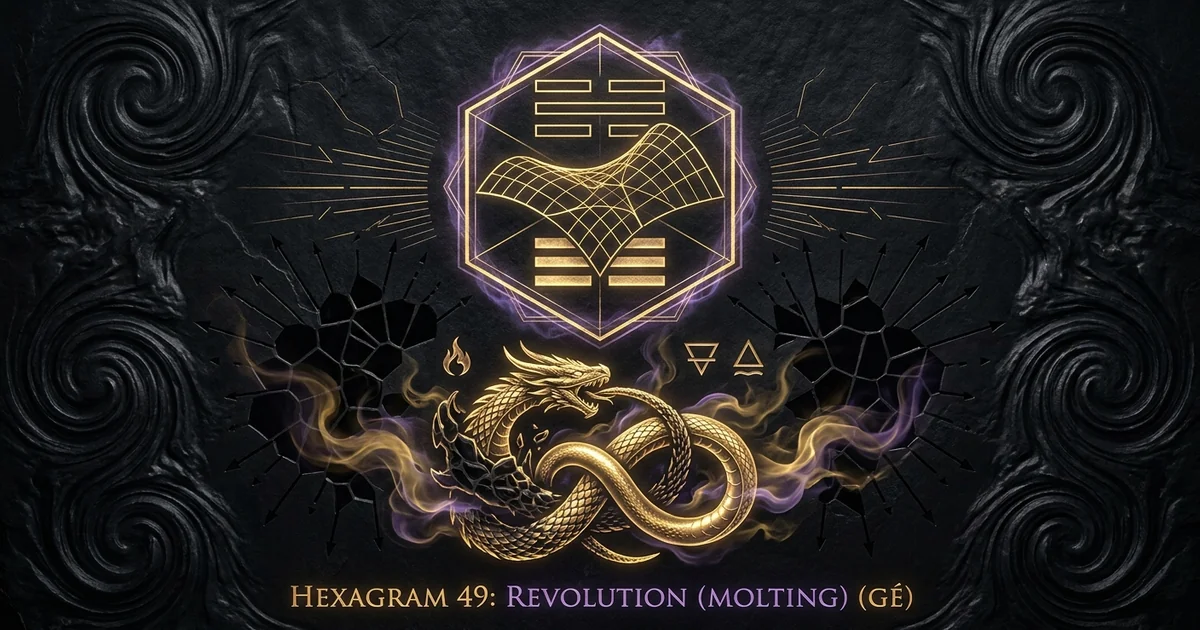
Hexagram 49 Revolution (Molting) (Gé): I Ching Divination
Archetypal Thesis & Systemic Paradigm: The Thermodynamics of Radical Metamorphosis
The Phase Transition Archetype in Divinatory Systems
In the taxonomy of the I Ching, Hexagram 49 (Gé, 革) represents a critical bifurcation point within systemic state-spaces. Far from depicting linear evolutionary development or gradual cyclical variation, Gé codifies the mechanics of the non-linear catastrophe: a moment wherein accumulated, unresolved systemic entropy forces an abrupt, qualitative transformation. Within classical Chinese cosmography and divination systems, the hexagram does not function as an omen of arbitrary political disruption, but as an energetic diagnostic of structural exhaustion. When an existing operational framework reaches maximum internal variance, the governing boundary conditions collapse, precipitating an enantiodromia—the Carl Jung-identified phenomenon whereby an extreme psychological or energetic charge inevitably transmutes into its diametric opposite.
The primary ideogram Gé (革) carries a dual lineage that underpins its metaphysical significance. In its most concrete, archaic etymology, it depicts the pelt of an animal stripped from the carcass and suspended on a frame to undergo tanning, scraping, and chemical conversion into leather. Concurrently, it signifies “to molt,” “to cast off,” and “to radically overturn an administrative lineage.” The physical act of tanning unworked animal skin requires an aggressive, irreversible chemical and physical stripping: the hair, epidermis, and putrefying flesh must be eradicated so that the core structural collagen can be preserved and stabilized. Applied to psychic and institutional architectures, the gé hexagram denotes that authentic renewal demands a literal de-structuring. The obsolete formal identity cannot be negotiated with, reformed, or merely renovated; it must be systematically skinned.
                  ┌──────────────────────┐
                  │ Systemic Equilibrium │
                  └──────────┬───────────┘
                             │
                             ▼
                  ┌──────────────────────┐
                  │ Entropy Accumulation │
                  └──────────┬───────────┘
                             │
                             ▼
                  ┌──────────────────────┐
                  │ Vector Incongruence  │
                  │ (Fire ☲ rises,       │
                  │  Lake ☱ presses down)│
                  └──────────┬───────────┘
                             │
                             ▼
                  ┌──────────────────────┐
                  │ Catastrophic Rupture │
                  │     (Gé / Molt)      │
                  └──────────┬───────────┘
                             │
                             ▼
                  ┌──────────────────────┐
                  │ Re-stabilized Order  │
                  │    (Ding Vessel)     │
                  └──────────────────────┘
Divinatory inquiry into Hexagram 49 reveals that the querent or the macrocosmic system under analysis has arrived at a structural impasse. Divination acts here not as fatalistic decree, but as a diagnostic radar mapping the psychic or systemic libido at the absolute threshold of saturation. The conscious persona, calcified through long habituation, resists the dissolution of its governing forms, generating acute friction within the unconscious field. This diagnostic maps precisely when the homeostatic mechanisms of a personality or an organization are no longer capable of absorbing negative feedback, leaving catastrophe—in the strict mathematical sense of catastrophe theory—as the only pathway toward systemic survival.
Thermodynamic Incompatibility: The Vector Dynamics of Lake over Fire
The structural architecture of Hexagram 49 presents an immediate thermodynamic crisis defined by the elemental and spatial vectors of its constituent trigrams. The lower trigram is Trigram Li (Fire) (☲), representing combustion, upward directional ascent, psychic illumination, and the energetic dynamic of clinging awareness. The upper trigram is Trigram Dui (Lake) (☱), denoting the marsh, the downward weight of standing water, the autumnal metal element in late phase, and the capacity for expressive or joyous outward discharge.
In classical natural philosophy, this configuration generates a state of radical, mutually assured destruction:
- The Downward Pressure: Water contained within a lake naturally presses downward under gravitational pull.
- The Upward Ignition: Fire naturally combusts, generating heat, light, and convective currents that rise vertically.
Unlike Hexagram 63 (Ji Ji, After Completion), where Water rests harmoniously above Fire to form a stabilized thermodynamic engine capable of sustained boiling and controlled energy transfer, Hexagram 49 manifests an unmediated clash. The downward descent of the Lake extinguishes the Fire beneath it, while the upward fury of the Fire boils and vaporizes the Lake above. They cannot occupy the same coordinate plane without provoking a catastrophic change of state. One of the elements must consume or completely alter the phase of the other. The structural integrity of the lake over fire configuration is therefore intrinsically transient; it captures a transient condition that cannot persist as a static matrix. It forces an ultimatum upon reality: total annihilation, or the qualitative phase shift denoted by hexagram 49 revolution (molting) iching meaning.
Catastrophe Theory and the Inevitability of Structural Shedding
To rigorously understand Hexagram 49 within modern complexity models, one must observe it through the lens of dynamic systems and René Thom’s catastrophe theory. A system governed by gradual continuous changes along its control parameters will, upon reaching a fold or cusp point, suddenly exhibit an abrupt, discontinuous jump to an entirely new equilibrium state. The gé hexagram embodies this cusp catastrophe. The control parameters—whether socio-political corruption, psychological repressions, or energetic contradictions—have drifted past the threshold where ordinary adaptation remains viable. The system experiences a radical loss of stability.
At this juncture, structural shedding is not an ethical option, but an existential imperative. Biological organisms that fail to shed an outgrown exoskeleton die of internal compression; societies that fail to re-articulate their primary legal and moral structures collapse under the inertia of institutional decay. In psychological registers, this process models persona-dissolution. The ego constructs defensive skins to survive specific developmental phases. However, as the unconscious individuation drive presses forward, these historical structures become choking armatures. Hexagram 49 emerges when the psychic organism must split its protective carapace down the median seam and crawl out, raw and vulnerable, into an unmapped developmental clearing.
Classical Provenance & Textual Lineage: Historical Mandates and Exegetical Traditions
The Mandate of Heaven (Tianming) and the Zhou-Shang Transition
The operational lineage of Hexagram 49 is anchored in one of the most consequential geopolitical upheavals of ancient East Asia: the overthrow of the Shang Dynasty by King Wu of Zhou at the Battle of Muye (c. 1046 BCE). The Shang possessed an ancestral and sacerdotal monopoly on divination, claiming an inherent, indissoluble right to rule granted by Shangdi (the supreme high god). In executing their rebellion, the early Zhou philosophers were compelled to construct a profound metaphysical and ethical justification that departed from hereditary absolutism. They formulated the doctrine of tianming (天命), the “Mandate of Heaven.”
According to the doctrine codified within the Zhouyi, Heaven does not grant immutable hegemony to any single lineage. Sovereignty is conditional upon the ruler’s moral attunement, structural justice, and ability to harmonize human action with cosmic seasons. When a regime degenerates into cruelty, hubris, and energetic decay—as embodied by the last Shang monarch, Zhou Xin—the Mandate revokes its energetic support and actively transfers itself to an external agent capable of realigning the earthly realm with cosmic order. Hexagram 49 is the specific technical locus where this transfer occurs. Revolution is thus redeemed from the suspicion of mere treason or illegitimate power-seizure; it is consecrated as a cosmological necessity, a sacred recalibration executing the will of Heaven when an administrative apparatus has separated itself from truth.
Revolution. On your own day you are believed. Supreme success, furthering through perseverance. Remorse disappears. Fire in the lake: the image of Revolution. Thus the superior man sets the calendar in order and makes the seasons clear.
The Epistemology of ‘On Your Own Day’ (Ji Ri) in the Judgment
The core judgment text contains a critically cryptic condition for effective systemic overhaul: Ji Ri (己日), traditionally translated by Richard Wilhelm as “On your own day you are believed.” The historical and linguistic mechanics of this phrase demand exacting exegetical unpacking. Within the Shang and Zhou sexagenary cycle (Ganzhi), Ji is the sixth of the ten Heavenly Stems. Occurring past the midpoint of the decimal cycle, it marks the exact inflection point where the initial outward expansion of the cycle exhausts its momentum and begins its descent into necessary transformation and internal consolidation.
HEAVENLY STEM CYCLE (TIAN GAN)
       [Jia 甲] -> [Yi 乙] -> [Bing 丙] -> [Ding 丁] -> [Wu 戊]
                                                         │
                                                         ▼
       [Gui 癸] <- [Ren 壬] <- [Xin 辛] <- [Geng 庚] <- [Ji 己]
                                                    (The Axis of Molt)
Epistemologically, “On your own day” signifies the achievement of radical temporal, psychological, and social resonance. A transformative act carried out arbitrarily—before the systemic conditions have ripened—is perceived by the collective as violent disruption, provoking counter-revolutionary resistance. If initiated prematurely, the change agent lacks credibility and falls into the snare of the renegade. Conversely, if action is delayed beyond the optimal window, the moment passes into entropy and decay. To act on Ji Ri means to initiate the rupture precisely when the objective exhaustion of the old paradigm has become universally self-evident. At this precise chronological and psychic juncture, the molt requires no defense; consensus emerges spontaneously, remorse dissolves, and the transformational mandate commands implicit, universal belief (xin, 信).
Wang Bi versus Cheng Yi: Ontological Stillness versus Timely Action
The exegetical traditions of Hexagram 49 diverge sharply across the Neo-Daoist and Neo-Confucian commentaries, most notably between Wang Bi (226–249 CE) and Cheng Yi (1033–1107 CE). Richard John Lynn’s translation of Wang Bi reveals a profound focus on the underlying ontological dynamics of the gé hexagram. For Wang Bi, revolution is not primarily about aggressive kinetic confrontation, but about the profound alignment of the mind with the natural law of structural change (li, 理). Wang Bi asserts that when things cannot remain as they are, change occurs inevitably; the sage does not invent revolution, but passively accords with the objective dissolution of forms. He cautions that if one pursues revolution out of a desire for innovation rather than as a reluctant acquiescence to cosmic inevitability, the endeavor will collapse into chaotic disharmony.
Cheng Yi, writing in the Song Dynasty, shifts the analytical axis from ontological non-action to the rigorous ethical duties of governance and timely intervention. Cheng Yi emphasizes the image of the calendar: “The superior man sets the calendar in order and makes the seasons clear.” He argues that revolution is synonymous with the progression of the four seasons: just as the crisp clarity of autumn must inevitably strip the lush, exhausted growth of summer to prepare for winter’s stillness, so too must the moral statesman periodically clear the administrative calendar, redefine weights and measures, and purge corrupted statutes.
Furthermore, philological recoveries from the Mawangdui silk manuscripts, translated by Edward L. Shaughnessy, illuminate that early readings of Gé were bound tightly to both seasonal astronomy and metallurgy. In the Mawangdui recension, the hexagram operates as an instruction in recalibrating the astrolabe. When heaven’s astronomical indicators diverge from the earthly calendar, agricultural famine and social disintegration follow. To “molt” is to synchronize the civil clock with the celestial mechanics, a technological and spiritual correction that resets the coordinates of the entire civilization.
Structural Mechanics & Symbolic Geometry: Trigram Vectoring and Vector Analysis
The Trigrammatic Dialectic: Dui (Lake) Supine Over Li (Clarity/Fire)
A structural inspection of Hexagram 49 requires a granular analysis of its trigrammatic dialectic. The lower trigram, Trigram Li (Fire), is formed by two solid yang lines enclosing a central yielding yin line (☲). This inner space represents the empty locus of receptivity around which combustion thrives; Li is luminous, sharp, diagnostic, and discerning. It illuminates the rot within the existing order. It provides the clarity to diagnose which forms have outlived their evolutionary utility.
Directly above Li sits Trigram Dui (Lake), composed of two strong yang lines beneath an open yin line (☱). Dui is the marsh, the lake, the dynamic of joy, metal, autumn, and outward verbal declaration. When Dui rests atop Li, the joyful, expressive, and malleable nature of the upper structure is continually heated by the intense, clarifying fire below.
Unlike the balance found in Hexagram 11 (Tai, Peace) where Earth descends and Heaven ascends to meet in harmonious communion, the lake over fire relationship is explosive. Fire naturally attacks metal; water naturally quenches fire. The boundary between the two trigrams represents an unstable interface. The subterranean heat cannot be contained indefinitely by the lake’s cool basin. As the heat builds, the water begins to churn and boil. In divinatory mechanics, this reveals that surface harmony (the apparent calmness of the lake’s open upper surface) is an illusion; beneath the thin veil of institutional protocol or conscious composure, a structural ignition is underway that will inevitably rupture the boundary.
- Upper Trigram: Dui (Lake, ☱, Metal/Yin, Joyous/Marsh, downward pressure)
- Lower Trigram: Li (Fire, ☲, Fire/Yang, Clinging/Clarity, upward combustion)
- Nuclear Core: Trigram Qian (☰) over Trigram Xun (☴) -> Hexagram 44 (Gou / Coming to Meet)
- Inversion Pair: Hexagram 50 (Ding / The Cauldron, 鼎) representing constructive vessel alchemy.
Nuclear Geometries: The Latent Presence of Heaven and Wind
Beneath the primary trigrams of Hexagram 49 lies an intricate internal engine revealed by its nuclear-hexagram structure. By extracting lines 2, 3, 4 to form the lower nuclear trigram, and lines 3, 4, 5 to form the upper nuclear trigram, we expose the energetic substructure that drives the outer metamorphosis.
- Lower Nuclear Trigram (Lines 2-3-4): Trigram Xun (☴), Wind/Wood. Xun represents penetrating insight, pervasive influence, flexibility, and the slow, inexorable dispersal of stagnant energy.
- Upper Nuclear Trigram (Lines 3-4-5): Trigram Qian (☰), Pure Heaven/Creative Yang. Qian provides unrelenting sovereign force, pure cosmic law, and unyielding will.
Synthesized, these nuclear trigrams form Hexagram 44, Gou (姤, Coming to Meet), an archetype detailing the sudden, explosive encounter with a potent, potentially disruptive feminine or unconscious force that rises from below. The presence of Qian within the core of Hexagram 49 indicates that the drive toward revolution is not born of petty, disgruntled ambition; it is informed by the uncompromising authority of Heaven. The wind of Xun ensures that this sovereign impulse penetrates deeply into every sinew of the existing situation. The nuclear dynamic reveals that the external conflict of the lake over fire is not a chaotic skirmish, but the visible friction of a profound cosmic encounter (Gou) forcing its way through the calcified surface of reality.
The Six Line Trajectories: From Yellow Ox Hide to Leopard Spotting
The evolutionary trajectory of Hexagram 49 unfolds through a rigorous progression of six changing lines, mapping the transformation from its initial, highly volatile inception to its final systemic integration.
       LINE ARCHITECTURE OF HEXAGRAM 49
       Line 6: ──  ── [Yin]   The Leopard Transforms (Pragmatic Stabilization)
       Line 5: ────── [Yang]  The Great Man Transforms Like a Tiger (Sovereign Authority)
       Line 4: ────── [Yang]  Changing the Mandate Brings Good Fortune (Structural Shift)
       Line 3: ────── [Yang]  Action Brings Misfortune; Revolution Spoken Thrice (Consensus)
       Line 2: ────── [Yang]  On One's Own Day, Strike Forth (The Ripened Moment)
       Line 1: ────── [Yang]  Bound with the Yellow Hide of an Ox (Absolute Restraint)
Line 1: The Yellow Hide of an Ox
The initial line, an unbroken yang line at the base of the fire trigram, possesses intense kinetic energy but lacks strategic maturity. It is positioned at the very onset of the impulse toward change. The text warns: “Bound with the yellow hide of an ox.” Yellow is the central, stabilizing color of Earth; the ox is an animal of patient, enduring labor and quiet strength. The instruction is unambiguous: the impulse to overturn must be restrained. The would-be revolutionary is currently powerless, untested, and situated in the subterranean depths. To act prematurely is to guarantee self-destruction. The raw libido must be bound with the unyielding discipline of the yellow hide; internal consolidation must precede external action.
Line 2: The Ripened Moment of Rupture
The second line, a centered and correct yang line within the lower trigram of clarity, marks the true beginning of the operational shift. “On your own day, one may overturn. Starting brings good fortune. No blame.” Here, the temporal axis has rotated into alignment (Ji Ri). The internal clarity of Li has matured. Because the agent occupies the balanced center of the lower trigram, their motives are purged of neurotic haste. The mandate is recognized not through theoretical speculation, but through historical readiness. Action initiated at this moment encounters minimal resistance because the structural balance has already broken internally.
Line 3: The Crucible of Consensus
The third line, situated at the precarious apex of the lower trigram, embodies the dangerous threshold of transition. It is yang in a yang place, excessively forceful and dangerously poised at the point of combustion. The text offers a double-edged warning: “Starting brings misfortune. Perseverance brings danger. When talk of revolution has gone its round three times, one may commit oneself, and one will be believed.”
Direct assault at this juncture invites catastrophe because the social or psychic field has not yet fully digested the implications of the molt. The revolution must be “spoken thrice”—it must be debated, analyzed, tested, and subjected to rigorous dialectical cross-examination. Only when the proposed paradigm shift has been thoroughly parsed by the collective consciousness can the final, decisive action proceed without triggering violent reactionary backlash.
Line 4: The Legal and Structural Shift
Crossing the boundary into the upper trigram of Dui, the fourth line acts as the executive hinge of the entire hexagram. An unbroken yang line operating in an even, yin position, it blends firm decisive power with systemic yielding. “Remorse disappears. Men believe him. Changing the form of government brings good fortune.” Here, the revolution transitions from an underground ideological insurgency into an overt, institutional reality.
The mandate has officially transformed (gai ming, 改命). Remorse dissolves because the transformation is no longer a destabilizing shock, but the restoration of true cosmic order. The old laws are formally rescinded, and the foundational statutes of the new era are struck into bronze.
Line 5: The Tiger Metamorphosis
Line five is the sovereign yang ruler of the hexagram, occupying the place of supreme balance and authority within the trigram of joyous compliance. “The great man transforms like a tiger. Even before he consults the oracle, he is believed.” The imagery of the tiger (hu, 虎) conveys radiant, unmistakable, and terrifying beauty. When a tiger molts in autumn, its old, dull, matted fur falls away, revealing brilliant, gleaming orange and black stripes of breathtaking clarity.
This line represents the highest realization of archetypal authority. The leader does not require validation through divinatory mechanisms, external consensus, or polemical defense. The transformation is so self-evident, majestic, and structurally coherent that doubt evaporates upon sight. The internal spirit of the new paradigm has manifested as an undeniable physical and structural presence.
Line 6: The Leopard’s Nuanced Adaptation
The terminating yin line of the hexagram represents the secondary, pragmatic stabilization of the revolution within the wider collective. “The superior man transforms like a leopard. The inferior man molts in the face. Starting brings misfortune. To remain persevering brings good fortune.” The leopard (bao, 豹), smaller and more agile than the tiger, possesses finer, more intricate rosettes. The superior individual, acting within the secondary echelons of the new order, refines their habits, aligns their conduct with the new mandate, and adapts with elegant precision.
Conversely, the common or “inferior” individuals (xiao ren) cannot undergo profound metaphysical rebirth; they simply “molt in the face”—adjusting their surface demeanor, adhering to the new laws, and shifting their outward compliance to survive under the new regime. The hexagram closes with a strict injunction: the time of violent destruction is over. The revolutionary fervor must cease. To push the transformative impulse beyond this terminal line is to decline into ideological fanaticism and reign-of-terror dynamics. The molting has concluded; the task now is conservative stabilization.
Psychological Dynamics & Operational Praxis: The Shadow of Stagnation and Archetypal Shedding
Enantiodromia and the Dissolution of the Calcified Persona
From the perspective of Jungian archetypal psychology, Hexagram 49 provides a structural diagram of the violent dissolution of the persona. The persona—the psychological mask and defensive armature constructed by the ego to navigate social demands—inevitably suffers from ossification. Over the course of life, behavior patterns that were originally adaptive crystallize into rigid structures that suffocate the wider life of the psyche. The conscious ego mistakenly identifies itself with this static mask, repressing any material that challenges its coherence.
In divination frameworks, a crisis hexagram does not predict inevitable external catastrophe, but maps an archetypal constellation where psychic energy (libido) reaches a saturation point, triggering an enantiodromic shift across the conscious-unconscious threshold.
When this psychic stagnation persists, the unconscious libido accumulates behind the persona’s barrier until it reaches dynamic pressure. The psychological state becomes identical to the lake over fire configuration: the cool, complacent surface of the ego-consciousness rests precariously over an incandescent reservoir of dynamic energy. If the ego refuses to initiate a conscious molt, the unconscious forces an involuntary enantiodromia.
This internal revolution frequently registers as severe neurosis, sudden affective breakthroughs, or the total collapse of one’s external life structures. In book of changes divination, casting Hexagram 49 signals that the querent must willingly surrender the identification with the old persona. One must endure the profound anxiety of the liminal interval—the terrifying condition of the freshly molted crustacean, whose soft, unarmored flesh is directly exposed to the friction of the world before the new shell can harden.
Diagnostic Decoding: Moving Lines as Psycho-Spiritual Phase Shifts
The clinical utility of Hexagram 49 within archetypal consultation depends upon interpreting its changing lines not as external predictions, but as internal developmental mandates:
- Line 1 Moving (Premature Acting-Out): The querent feels the unbearable heat of psychic dissatisfaction and seeks to immediately overturn their external circumstances—quitting a vocation, destroying a partnership, or adopting a radical identity. The mandate is containment: the raw affect must be bound and digested internally. The ego must hold the tension of the opposites rather than discharging it prematurely.
- Line 2 Moving (The Ripened Ego-Breakthrough): The unconscious readiness has aligned with conscious awareness. The individual can now take decisive action to sever outworn relational, professional, or psychological attachments without falling into regression. The action is pure and guilt-free.
- Line 3 Moving (Dialectical Integration): The individual must not assume that an initial insight constitutes complete individuation. The proposed changes must be subjected to rational critique, therapeutic reality-testing, and rigorous scrutiny. The psyche must process the transformation “three times” before the new mode of being is safely integrated.
- Line 4 Moving (Structural Re-patterning): The internal breakthrough codifies into a permanent restructuring of the querent’s character armor. Archaic superego demands are dismantled; the psychic constitution is formally rewritten.
- Line 5 Moving (Radiant Individuation): The Self breaks through the fragmented ego complex with sovereign clarity. The individual operates from an integrated center of gravity where action, values, and instinctual drives exist in total harmony—the raw, undeniable vitality of the tiger.
- Line 6 Moving (Integration of the Persona): The individual must acknowledge the limits of transformation. The core transformation has completed; what remains is the pragmatic, external adaptation of daily habits (the leopard’s rosettes) and the acceptance that certain peripheral aspects of the personality will merely conform externally (molting in the face). Ideological perfectionism must be abandoned.
Distinguishing Genuine Paradigm Molting from Neurotic Reactionism
A primary hazard in divinatory praxis is confusing the archetypal demand of Hexagram 49 with neurotic reactionism or manic flight. The neurotic ego perpetually mistakes its own internal restlessness, boredom, or intolerance of discipline for a “divine call to revolution.” It uses the rhetoric of transformation to justify continuous, disruptive cycles of abandonment—discarding vocations, relationships, and commitments the moment they demand patience and the sacrifice of personal indulgence.
Authentic paradigm molting, as defined by the gé hexagram, exhibits distinct markers that separate it from juvenile revolt:
Pathological Reactionism (Neurotic Ego)
- Originates from avoidance of boredom, frustration, or necessary psychic friction
- Characterized by manic urgency, impulsive severance, and acute anxiety
- Disregards the temporal rhythm of Ji Ri; acts reactively on any day
- Leaves behind a trail of energetic waste, unresolved debts, and psychological fragmentation
- Destroys existing structures without possessing any programmatic blueprint for renewal
Authentic Molting (Hexagram 49)
- Emerges from the exhaustive, total exploration of the existing form’s evolutionary limits
- Characterized by sober clarity, patient containment (Line 1), and emotional weight
- Strictly honors the ripened temporal alignment (Ji Ri); acts with strategic inevitability
- Dissolves remorse (hui wang, 悔亡) because the obsolete form is recognized as exhausted
- Naturally seeds the ground for the immediate emergence of the sacred vessel (Hexagram 50)
Philosophical Synthesis & Macrocosmic Correspondence: Transmutation Across Cybernetics and Hermeticism
Second-Order Cybernetics: Morphogenesis vs. Morphostasis
Hexagram 49 serves as an ancient, highly sophisticated model of what modern cybernetician Magoroh Maruyama classified as “morphogenesis”—the second cybernetics. While first-order cybernetic mechanisms rely upon negative feedback loops to maintain morphostasis (homeostasis, balance, preservation of existing norms), positive feedback loops act as deviation-amplifying mechanisms. In healthy systems, negative feedback preserves integrity; however, in dying or overly rigid systems, negative feedback acts as an instrument of pathological ossification, actively suppressing the necessary mutations required for evolutionary adaptation.
When the deviation-amplifying dynamics of Hexagram 49 are triggered, the positive feedback loop overrides the system’s homeostatic governors. The heat generated by the lower trigram Li continues to compound, driving the internal temperature of the systemic lake past its critical threshold. Morphogenesis occurs: the system’s existing operating software is scrambled, forcing the emergence of a higher-order dissipative structure.
In this cybernetic context, the phrase “sets the calendar in order” designates the implementation of new systemic protocols, feedback channels, and governing algorithms. The old homeostatic baseline is discarded, and an entirely fresh baseline of systemic organization is stabilized.
The Hermetic Principle of Polarity and the Rhythm of Radical Cleansing
Within the Western Hermetic tradition, the structural dynamics of Hexagram 49 correspond directly to the Principle of Polarity and the alchemical operation of Calcinatio and Separatio. The Kybalion states: “Everything is Dual; everything has poles; everything has its pair of opposites; like and unlike are the same; opposites are identical in nature, but different in degree.” In Hexagram 49, the apparent elemental war between Fire and Water is revealed as an alchemical necessity for purification.
The animal pelt (Gé) cannot be transmuted into sacred leather through water alone (which rots it) or fire alone (which chars it). It requires the precise, violent interaction of both: heat to boil the liquid, and acidic tannin solutions to strip away the dead flesh.
Hermetically, the lake over fire arrangement corresponds to the stage of the Great Work known as the Nigredo (the blackening), progressing into the Mortificatio. The calcified ego-structure, contaminated by the dead residue of obsolete psychological adaptations, must be subjected to intense alchemical heat until it breaks down into its constituent prima materia. The stripping of the skin is the removal of the external illusion—the veil of Maya—so that the inner, immortal essence can be retrieved, refined, and cast into an enduring, elevated form.
The Dyad of Hexagrams 49 and 50: The Skinning and the Sacred Vessel
The architecture of the I Ching is fundamentally structured upon complementary pairs; every odd-numbered hexagram finds its immediate evolutionary fulfillment in the even-numbered hexagram that follows it. Hexagram 49 cannot be understood in isolation; it forms an indivisible structural and spiritual dyad with Hexagram 50 (Ding / The Cauldron).
The relationship between Gé and Ding is the relationship between the skinning of the raw material and its sacred culinary preparation. Hexagram 49 strips away the obsolete form; it slaughters the ancestral ox, skins its hide, and dissolves the structural corruption of the outmoded political or psychological dynasty.
However, if transformation ends with Hexagram 49, the result is merely destruction, an open wound, an anarchic void. It demands the immediate, sequential arrival of Hexagram 50, where the elemental coordinates invert: Fire is now placed harmoniously beneath Wood (☲ over ☴), forming the sacred sacrificial bronze vessel (the Ding). The raw materials liberated by the violent molting of Hexagram 49 are placed inside the Cauldron of Hexagram 50, where they are cooked, spiritualized, and offered up as divine sustenance to Heaven and the ancestors.
               THE DYADIC TRANSFIGURATION
               ┌────────────────────────┐
               │      HEXAGRAM 49       │
               │        (GÉ)            │
               │  Lake ☱ over Fire ☲    │
               │   The Skinning / Molt  │
               └───────────┬────────────┘
                           │
                           │ Systemic Inversion
                           ▼
               ┌────────────────────────┐
               │      HEXAGRAM 50       │
               │        (DING)          │
               │   Fire ☲ over Wood ☴   │
               │  The Vessel / Alchemy  │
               └────────────────────────┘
Hexagram 49: Gé (Revolution / Molting)
- Elemental Configuration: Lake over Fire (Destructive/Dynamic tension)
- Structural Function: Dismantling calcified forms, stripping obsolete skins
- Catalytic Agent: Discontent, systemic friction, temporal mandate (Tianming)
- Psycho-Spiritual Phase: Nigredo / Mortificatio (Ego-death, shedding of persona)
Hexagram 50: Ding (The Cauldron / Transformation)
- Elemental Configuration: Fire over Wood (Constructive/Nourishing harmony)
- Structural Function: Casting the sacred vessel, institutionalizing the new law
- Catalytic Agent: Spiritual alignment, alchemical distillation, ancestral communion
- Psycho-Spiritual Phase: Albedo / Rubedo (Integration, vessel of the Self)
Frequently Asked Questions: Operational Clarifications for Hexagram 49
How Does Hexagram 49 Differ from Hexagram 28 (Preponderance of the Great)?
While both hexagrams address structural crisis, their causal mechanisms, internal vectors, and practical resolutions are fundamentally divergent. Hexagram 28 (Da Guo, Preponderance of the Great) consists of Lake over Wind (☱ over ☴), characterized by four heavy yang lines trapped between two fragile, yielding yin lines at the base and the summit. It represents a weight-bearing beam bending to the snapping point under immense, unmanageable pressure. Da Guo is an objective physical emergency: the external load is too heavy for the foundational supports. The mandate in Hexagram 28 is one of emergency bracing, tactical retreat, or radical passage through an unsustainable situation before it collapses under external force.
Hexagram 49, conversely, is not an emergency caused by external physical overload; it is an internal thermodynamic ignition. In Gé, the crisis is generated by ideological, energetic, and structural contradiction between its lower and upper trigrams (Fire directly boiling Lake). While Hexagram 28 warns of imminent collapse where one must quickly move through or endure catastrophic failure, Hexagram 49 demands active, deliberate, and sovereign intervention. It is the conscious seizure of the Mandate to dismantle the structure before it collapses on its own terms. Da Guo is catastrophic mechanical strain; Gé is purposeful systemic revolution.
What Is the Exact Meaning of ‘On Your Own Day’ (Ji Ri) in Modern Divinatory Praxis?
In contemporary psychological and situational application, Ji Ri (“On your own day”) serves as the primary diagnostic criterion for action. When this phrase appears in the Judgment of Hexagram 49, it warns the querent against arbitrary, reactive, or ideologically driven disruption. It indicates that transformation cannot be willed into existence merely because the ego feels dissatisfied, angry, or bored with its present constraints.
“On your own day” signifies the exact arrival of temporal, systemic, and environmental synchronicity. It means that the outworn paradigm has fully demonstrated its decay to all participants within the systemic field, not just to the querent’s subjective perception. To act on Ji Ri means to initiate the rupture when the energetic support for the old system has dissolved completely.
If one acts before Ji Ri, one is perceived as an aggressive, destabilizing renegade, generating massive social resistance and psychological guilt. If one acts on Ji Ri, action encounters no moral or systemic friction: consensus aligns naturally, guilt and remorse evaporate, and the dismantling of the old pattern is greeted not as destruction, but as a long-overdue, liberating realization of truth.
How Should Moving Line 6 (The Leopard Changes Its Spots) Be Practiced in Daily Life?
Moving Line 6 marks the terminal edge of the revolutionary process and delivers a crucial warning against ideological extremism. When this line is cast, the fundamental systemic transformation has already concluded. The “tiger” (the core structural overhaul, the overthrow of the old paradigm) has already completed its dramatic molt in Line 5.
For the querent, Line 6 demands an immediate pivot from revolutionary disruption to quiet, pragmatic behavioral consolidation:
- Abandon Structural Confrontation: One must cease attacking the system, the partner, or the self. The time for broad-scale ideological combat has expired.
- Refine Secondary Details: Like the leopard whose rosettes are intricate, detailed, and subtle, the individual must focus on refining small-scale habits, optimizing daily protocols, and adjusting minor interpersonal dynamics to harmonize with the newly established baseline.
- Accept Surface Compliance in Others: One must not demand that everyone in the environment undergo a total spiritual or psychological rebirth. Inferior elements or peripheral associates may only “molt in the face”—meaning they will adjust their surface language, etiquette, and compliance to match the new atmosphere. The practitioner must accept this pragmatic outward conformity without demanding fanatical, deep-seated conversion from everyone. Pushing the revolutionary impulse further invites catastrophic social reactionism. The molt is finished; live gracefully within the new skin.