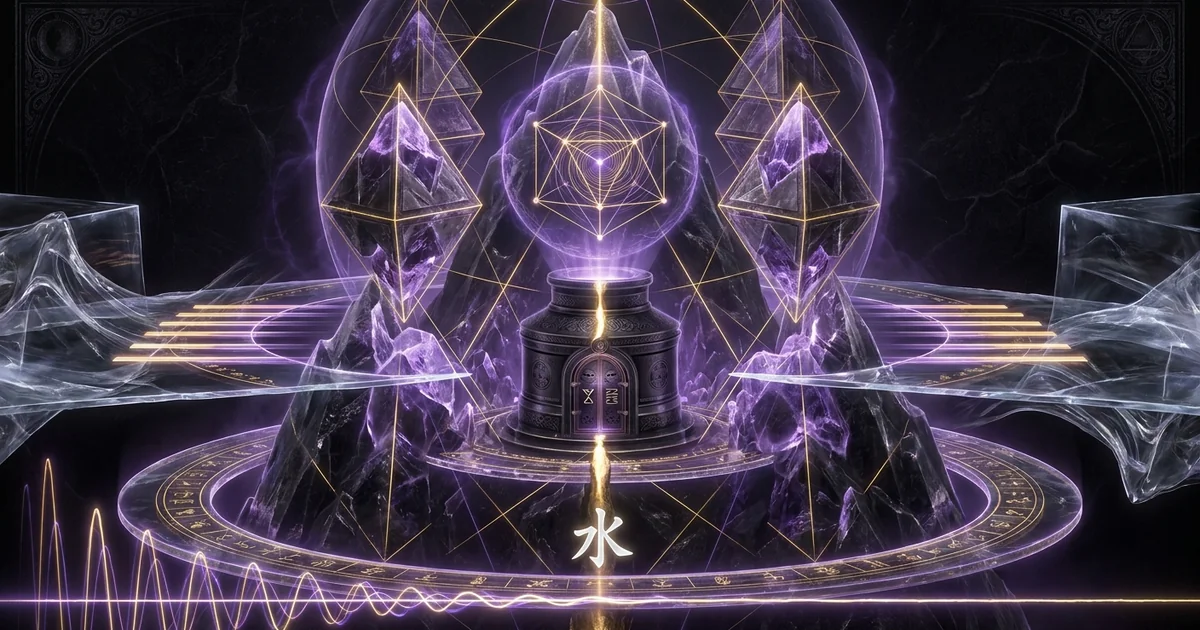
Hexagram 52 Keeping Still (Mountain) (Gèn): I Ching
Archetypal Thesis & Systemic Paradigm: Gèn as the Cybernetic Null-State
Hexagram 52 (Gèn / Keeping Still) formalizes a cybernetic attractor state of dynamic equilibrium within the structural cosmology of the I Ching. Rather than designating a condition of inert vegetative paralysis, passive catatonia, or entropic decay, Gèn maps an intentional, highly energized negative-feedback threshold. In the lexicon of complex adaptive systems, the hexagram represents the deliberate deceleration of volitional motor-output until it converges upon a baseline of zero phase-shift relative to the environmental ground. This functional state operates through the systematic decoupling of sensory afference from involuntary reactive momentum. The somatic and metaphysical architecture of the hexagram is constituted by the doubled Mountain trigram (☶ over ☶), an arrangement that models an impenetrable topological boundary. Within this configuration, the dissipative, kinetic expenditure of attentional resources is arrested, redirecting psychic energy—what Carl Gustav Jung classified as libido—away from peripheral projections and back into the axial core of the psychosomatic organism.
The systemic problem addressed by the gèn hexagram is the unconstrained acceleration of instinctual reaction. When human consciousness is ensnared by continuous environmental perturbation, the ego functions merely as an unbuffered relay mechanism, executing stereotyped behavioral routines without reflective mediation. Hexagram 52 introduces an operational circuit breaker. By halting the forward propulsion of intentionality, the subject transitions from a purely temporal, vector-driven mode of survival into a spatialized, interoceptive stabilization. The hexagram signifies the precise juncture where consciousness ceases to project desires onto prospective time horizons and instead anchors itself within the coordinate space of the absolute present. This topological containment is the foundational prerequisite for higher-order metabolic and psychological consolidation.
The Dorsal Axis of Consciousness and Sensory Decoupling
The primary somatic metaphor underpinning the hexagram 52 keeping still (mountain) iching meaning is the human back (gèn qí bèi). Classical Chinese anatomy and esoteric cartography identify the spine as the vessel of the Du Mai (Governor Vessel), the primary river of ascending yang energy that governs structural integrity, postural tonus, and alertness. However, while the ventral surface of the human body is soft, receptive, and loaded with sensory organs geared toward consumption, social engagement, and predatory navigation, the dorsal plane constitutes an opaque shield. It is biomechanically oriented toward structural support rather than external perception.
To keep the back still means to withdraw conscious awareness from the forward-facing sensory apparatus—the eyes, mouth, and hands—which are perpetually drawn toward objects of desire and conflict. In neurological terms, this corresponds to an intentional inhibition of the efferent motor pathways that normally execute egoic commands in response to external stimuli. By stabilizing the dorsal axis, the subject silences the motor programs that generate continuous engagement with the external world. The sensory receptors continue to receive raw data, yet the internal cognitive mechanism stops translating this sensory afference into reflexive behavioral compulsion.
Through this dorsal inhibition, consciousness achieves a state of radical phenomenological reduction (epoché). The somatic field ceases to register as a fragmented collection of aches, appetites, and reactions; rather, the somatic boundary becomes transparent. When the classical text records that the subject “no longer feels his body,” it describes the complete cessation of somatic friction that occurs when postural alignment precisely cancels the pull of gravity through vector equilibrium, extinguishing the proprioceptive “noise” generated by muscular struggle and psychomotor agitation.
Vector Equilibrium in the Doubled Mountain Trigram
The architecture of mountain over mountain presents an absolute structural boundary condition. In the system of the bagua, the Mountain trigram (trigram-gen) consists of two receptive Yin lines capped and terminated by a single solid Yang line at the summit. This topological form depicts an upward surge of earth energy that has met its definitive structural limit. The Yang line acts as a dynamic lintel, containing the expansive Yin pressure beneath it and preventing further vertical displacement.
When this trigram is doubled upon itself, the resultant hexagram manifests a closed thermodynamic system. In systemic terms, each mountain acts as an absolute resistance to the other. There is no open channel through which kinetic discharge can occur, nor is there an inner vacuum that induces collapse. The two trigrams establish an unchanging relational field: stillness confronting stillness. This configuration generates a vector equilibrium wherein all active internal forces are paired with equal and opposite resistive counter-forces.
Consequently, Hexagram 52 does not represent an absence of power, but the total containment of immense structural tension. The mountain does not move not because it lacks mass or energy, but because its internal mass-energy distribution is completely integrated with the gravitational field of the Earth. The psychic libido, having been systematically withdrawn from its enmeshment in outer forms, collects within this mountainous enclosure, achieving a density that is impervious to external ideological or emotional weather systems.
Classical Provenance & Textual Lineage: The Sequence of King Wen and the Ten Wings
Within the structural taxonomy of the king-wen-sequence, Hexagram 52 is paired with and directly follows Hexagram 51 (Zhèn / The Arousing / Shock). This contextual placement is foundational to deciphering its hermeneutic function within book of changes divination. Hexagram 51 initiates the dialectical movement through the violent eruption of kinetic energy: thunder bursting from the earth, shattering psychological complexes, dissolving habitual patterns, and inducing autonomic panic. If the psyche were to remain indefinitely within the seismic shockwave of /iching/hexagram-51-zhen-the-arousing, total systemic dissolution would inevitably follow.
Hexagram 52 acts as the structural compensatory balance. It absorbs, metabolizes, and integrates the catastrophic release of electrical tension generated by Zhèn, transmuting kinetic disruption into geological stability. This dialectic mirrors the physical world, where tectonic upheaval and volcanic eruptions are immediately followed by orogenic cooling, crystallization, and the emergence of stable mountain ranges. Without the grounding capacity of Gèn, the sudden awakening sparked by Zhèn deteriorates into manic dispersion; conversely, without the prior awakening of Zhèn, the stillness of Gèn risks degenerating into rigid petrification. Following Gèn, the sequence moves naturally toward /iching/hexagram-53-jian-development, demonstrating that authentic, organic progress (Jiàn) can only emerge from an unshakable, non-reactive foundation.
Judgment: ‘KEEPING STILL. Keeping his back still / So that he no longer feels his body. / He goes into his courtyard / And does not see his people. / No blame.’ Image: ‘Mountains standing close together: / The image of KEEPING STILL. / Thus the superior man / Does not permit his thoughts / To go beyond his situation.’
Exegesis of the Tuanzhuan and Xiangzhuan Commentaries
The Tuanzhuan (Commentary on the Judgment) explicitly clarifies that the stillness of Gèn is profoundly dynamic and contingent upon situational timing. The text asserts: “When it is time to stop, then stop; when it is time to advance, then advance. When movement and rest alternate according to the proper season, the path becomes luminous and clear.” This commentary dismantles any quietistic misinterpretations of the hexagram. Gèn is not a permanent ascetic retreat from worldly affairs, nor is it a wholesale rejection of temporal action. It represents the mastery of systemic timing: the capacity to achieve absolute rest at the precise moment action ceases to be efficacious.
The Xiangzhuan (Commentary on the Great Image) expands this insight into the psychological and cognitive domain: “Mountains standing close together: The image of Keeping Still. Thus the superior man does not permit his thoughts to go beyond his situation.” Here, the spatial boundary of the doubled mountain is translated into an epistemological protocol. The mind is forbidden from projecting hypothetical futures, ruminating over unalterable pasts, or entertaining teleological fantasies that exceed the empirical requirements of the immediate spatiotemporal coordinates. Mental activity is constrained strictly to the “situation” (wèi), meaning its exact ontological position within the cosmic web. To allow thought to wander beyond one’s immediate locus is to induce psychic fragmentation, bleeding the organism’s energy into phantom configurations that have no reality in the present moment.
Wang Bi’s Metaphysics of Negation and Non-Action (Wu)
In his seminal third-century commentary on the Yijing, the Neo-Daoist philosopher Wang Bi (226–249 CE) approached Hexagram 52 through the metaphysics of wu (non-being or absolute absence). Wang Bi recognized that human suffering and social chaos emerge primarily from excessive purposiveness—the ego’s relentless drive to assert its personal intentions over the natural, self-so-ing order of the cosmos (ziran).
Wang Bi’s exegesis of the Judgment’s enigmatic phrase—“He goes into his courtyard and does not see his people”—identifies this scenario as an allegory for the radical suspension of relational projection. The courtyard is the intimate inner sanctum of the home, the liminal space between public civic life and private subjectivity. Entering the courtyard and failing to “see” one’s people does not denote physical blindness, misanthropy, or the callous neglect of familial responsibilities. Rather, it signifies the total cessation of egoic object-cathexis.
According to Wang Bi, when the dorsal axis is stilled and the internal awareness is unified, the individual ceases to process other humans through the distorting lenses of utility, craving, competition, or defensive posturing. The subject no longer sees people as mirrors for personal vanity or instruments for ambitious designs. In this state of supreme non-action (wu-wei), relational entanglements drop away, leaving behind a tranquil clarity. Social friction dissolves because the dynamic ego, which usually provokes and reacts to interpersonal turbulence, has been thoroughly suspended within the null-field of the mountain.
Structural Mechanics & Symbolic Geometry: Binary Architecture of Doubled Mountain
The mathematical and symbolic topography of Hexagram 52 provides an exact blueprint of structural containment. In the binary mapping developed by modern analysts like Andreas Schöter (2012), the hexagram corresponds to the binary sequence 100100 when read from upper to lower lines (or 001001 when read conventionally from bottom to top, where Yin = 0 and Yang = 1). This mathematical pattern exhibits an absolute symmetry of rhythmic interruption: two passive intervals of absorption followed by a definitive terminal assertion of order, duplicated across both the inner (lower) and outer (upper) realms of manifestation.
Line 6: ————— (Yang)  [Noble Stillness / Crest of Upper Mountain]
Line 5: —   — (Yin)   [Jaw / Articulation of Speech]
Line 4: —   — (Yin)   [Heart / Trunk / Postural Anchorage]
Line 3: ————— (Yang)  [Loins / Lumbar Split / Structural Lintel]
Line 2: —   — (Yin)   [Calves / Kinetic Impulsion]
Line 1: —   — (Yin)   [Toes / Nascent Propensity]
Within this configuration, the two Yang lines occupy the structural apexes of their respective trigrams: Line 3 (the third place, summit of the lower trigram) and Line 6 (the sixth place, summit of the upper trigram). These Yang lines act as boundary caps over the two Yin lines resting beneath them. In Chinese cosmological physics, as documented by Robin R. Wang (2012), the natural tendency of Yin is to settle, descend, and condense, whereas the tendency of Yang is to rise, disperse, and illuminate.
In Gèn, the Yin lines are denied their downward dissipation by the geological mass beneath them, while their latent capacity to shift into volatile upward motion is definitively arrested by the solid Yang ceiling above. The Yang lines do not advance; they serve as structural anchors, sealing the energetic charge of the receptive lines within an unyielding geometric vault.
- Binary Code: 100100 (reading line 6 to 1: Yang-Yin-Yin-Yang-Yin-Yin)
- Genetic Codon Mapping: Human Design Gate 52 (Keeping Still / The Gate of Inaction) corresponds to the Root Center, regulating the adrenaline pressure to sit still and concentrate.
- Trigram Kinship: Youngest Son (Gèn) representing culmination of the yang trajectory beneath the mother (Kun).
Trigram Polarity and the Structural Cap of the Yang Lines
To fully grasp the architecture of Gèn, one must analyze its position within the broader structural taxonomy of the bagua. Gèn is designated as the Youngest Son. It represents the final, most refined iteration of the masculine creative principle (Qian) embedded within the dark, receptive field of the feminine ground (Kun). Whereas the Eldest Son (Zhèn) possesses Yang at the very base—signifying an explosive, upward-surging volcanic thrust from underground—the Youngest Son possesses Yang at the summit. This signifies that the masculine drive has completed its journey, reached its zenith, and exhausted its kinetic volatility.
Consequently, the Yang line in Gèn does not push outward; it seals. It functions like the cooling crust atop a batholith of magma. In the mechanics of mountain over mountain, this capping dynamic occurs simultaneously within the interior psychology of the individual (the lower trigram) and the exterior engagement with social reality (the upper trigram). The inner mountain prevents subconscious urges and complexes from erupting into conscious turbulence; the outer mountain prevents environmental chaos from breaching the threshold of the subjective sanctuary. The result is an insulated psychic redoubt, invulnerable to environmental entropy.
Somatic Anatomical Ascent: From Toes to the Mandible
The structural poetry of the six lines of Hexagram 52 provides an explicit, sequential map of psychosomatic immobilization, charting an anatomical ascent that parallels the most sophisticated biofeedback protocols:
-
Initial Six (Line 1): “Keeping his toes still. No blame. Continued perseverance furthers.” The sequence begins at the absolute foundation of human kinetic movement: the hallux and digits of the foot. In locomotion, the toes represent the nascent inception of intentional momentum. Before a stride can be executed, the weight shifts and the toes grip the earth to propel the organism forward. To arrest movement at the toes is to interdict kinetic impulse at its absolute sub-threshold origin, before intent crystallizes into physical consequence.
-
Six in the Second Place (Line 2): “Keeping his calves still. He cannot rescue him whom he follows. His heart is not glad.” The calves are the muscular engines of locomotion and climbing. In this position, the lower limbs yearn to follow the upward pull of the Yang ruler at the third line. However, because the line is receptive, soft, and lacks central authority, its forced immobility induces a profound psychological lament. The calves are immobilized while the rest of the body maintains an unintegrated tension, producing frustration. It models an incomplete stillness: the body is held captive, but the will remains tethered to an external object.
-
Nine in the Third Place (Line 3): “Keeping his loins still. Making his sacrum stiff. Dangerous. The heart suffocates.” This line marks the critical morphological boundary of the hexagram: the transition from the lower to the upper trigram. Occupied by a rigid, unyielding Yang line in a Yang position, it embodies structural disaster. The loins and the lumbar spine represent the kinetic axis that joins the upper and lower halves of the human body. To enforce an artificial, hypertonic rigidity across this pivotal juncture shatters the functional integrity of the spine. The circulatory, nervous, and energetic flows between the instinctual base and the cognitive summit are violently severed. The classical image of the “heart suffocating” (xūn xīn) describes the unbearable autonomic and psychological anguish that occurs when libido is aggressively suppressed through neurotic willpower rather than dissolved through relaxed integration.
-
Six in the Fourth Place (Line 4): “Keeping his trunk still. No blame.” Ascending beyond the volatile lumbar break, Line 4 governs the thorax and somatic core. The trunk houses the vital cardiopulmonary systems. Stillness here does not indicate cardiac arrest, but rather the quietude of autonomic equilibrium: deep, unhurried diaphragmatic respiration and the attenuation of the sympathetic stress response. In this quiet state, conscious intentionality rests comfortably within its somatic housing, generating “no blame” because the ego has ceased to project friction outward into the world.
-
Six in the Fifth Place (Line 5): “Keeping his jaws still. The words have order. Remorse disappears.” The fifth line reaches the articulation centers of the facial mask and mandible: the anatomical seat of language, self-justification, and verbal aggression. Speech is the most subtle and dangerous form of kinetic discharge. By keeping the jaws still, the subject ceases the compulsive linguistic over-determination of reality. Silence replaces chatter; when words are finally permitted to pass this somatic checkpoint, they are measured, precise, and structurally ordered. The risk of error vanishes because speech is no longer an uncontrolled emotional leakage, but an intentional act of cosmic alignment.
-
Nine at the Top (Line 6): “Noblehearted keeping still. Good fortune.” At the absolute summit of the hexagram, the Yang cap of the upper mountain attains consummate integration. This is not the strained, repressive rigidity seen at the third line, but a transcendent, magnanimous quietude (dūn gèn). Stillness has ceased to be an operational technique or a somatic discipline; it has become the fundamental ground of being. The boundary between the stillness of the mountain and the stillness of the cosmos has vanished, fulfilling the highest promise of the archetypal mountain.
Psychological Dynamics & Operational Praxis: Jungian Active Stillness and Somatosensory Transduction
Within the operational framework of analytical psychology, Hexagram 52 delineates the precise psychic conditions required to activate the transcendent-function. Carl Gustav Jung recognized that the conscious ego is perpetually engaged in a defensive campaign against the contents of the unconscious, maintaining control through obsessive rationalization, strategic planning, and constant action. In his 1950 Foreword to the I Ching, Jung observed that the Western mind suffers from a profound prejudice toward kinetic extroversion, viewing any suspension of visible productivity as pathological indolence or moral failure.
Yet, as Jung’s foundational practice of active imagination demonstrates, unconscious archetypal contents can only cross the liminal threshold into consciousness when the volitional apparatus of the ego is temporarily decommissioned. Hexagram 52 models this exact psychological posture. The ego suspends its judgment, silences its internal dialogue, and anchors itself along the non-reactive dorsal axis. By adopting this stance of active receptivity, the subject ceases to project personal shadow-material or animus/anima dynamics onto the surrounding social environment. The courtyard is cleared; the projections that populate the perceptual field with monstrous adversaries or alluring sirens naturally collapse.
Pathological Rigidity (Perverted Line 3 Dynamics)
- Forced conscious suppression of impulse
- Somatic splinting, spinal hypertonicity, and affective freezing
- Severing of upper and lower instinctive faculties (peril to heart/spirit)
- Alienation resulting in neurotic dissociation
Dynamic Equilibrium (Harmonized Line 6 Mastery)
- Spontaneous cessation of non-essential intentionality
- Dorsal alignment fostering parasympathetic autonomic tone
- Seamless integration of consciousness within boundary coordinates
- Transcendent quietude that responds effortlessly to crisis
The Transcendent Function as Attentional Suspension
The achievement of the transcendent function relies on holding psychic tension without premature cognitive closure. When an individual confronts an agonizing life crisis, the immediate instinct is to discharge the resulting anxiety through compulsive action—a desperate move to assert control, make preemptive strikes, or manufacture superficial reconciliations. This impulse corresponds to the pathology of moving when it is time to be still.
Hexagram 52 instructs the practitioner to construct a psychic vessel capable of containing high energetic voltages without leaking. By adopting the posture of the mountain, the psyche contains the thesis and the antithesis simultaneously. The individual refuses to identify with either pole of an archetypal conflict. Instead, consciousness remains rooted, quiet, and watchful, allowing the unconscious to gestate a novel, third psychological position that could never have been deduced through rational deliberation. This dynamic equilibrium is the operational essence of the gèn hexagram: the kinetic pressure of conflicting polarities is transmuted into the structural stability of a unified psychic core.
Pathology of Rigidification: The Peril of the Locked Lumbar (Line 3)
The catastrophic failure mode of Hexagram 52 is systematically mapped in the third line, providing one of the most brilliant somatic-psychological warnings in archaic literature. When an individual attempts to master psychological turbulence through tyrannical willpower alone, the result is not authentic spiritual stillness, but somatic and psychological splinting.
In body-oriented psychotherapy and Reichian somatic character analysis, this condition is known as “armoring.” The subject uses the voluntary musculature—specifically the deep paraspinal muscles of the lumbar region and the diaphragm—to lock down somatic movements, emotional surges, and instinctual impulses. This strategy fractures the holistic self. The lower instincts, symbolized by the lower trigram, are repressed, quarantined, and alienated beneath an arbitrary wall of conscious control.
This functional split inevitably induces severe somatic and psychic pathologies. The energetic flow within the Du Mai is choked off; the spine stiffens like a tombstone; the respiration becomes shallow; and the heart, starving for authentic emotional and metabolic circulation, undergoes symbolic suffocation. The individual becomes an unyielding fanatic of discipline, utterly detached from the ground of life. The lesson of the third line is that an unyielding stillness is lethal: whenever stillness ceases to breathe, it transforms into an executioner.
Philosophical Synthesis & Macrocosmic Correspondence: Hermetic Polarity and Taoist Non-Action
In the overarching architecture of esoteric metaphysics, Hexagram 52 serves as the primary meeting ground between classical Taoist internal alchemy (Neidan) and the Western Hermetic tradition. The Hermetic Kybalion articulates the Axiom of Rhythm: “Everything flows, out and in; everything has its tides; all things rise and fall; the pendulum-swing manifests in everything; the measure of the swing to the right is the measure of the swing to the left; rhythm compensates.”
Under ordinary conditions, human consciousness is tossed about by this systemic pendulum swing, oscillating between joy and despair, conquest and collapse, manic excitation and depressive withdrawal. Hexagram 52 delineates the operational method for transcending this rhythmic slavery: the subject must retreat to the pendulum’s zero-point of suspension at its absolute rotational axis.
‘The condition of absolute standstill in Hexagram 52 designates an archetype of psychological consolidation. Only when the kinetic momentum of the ego complex is radically interrupted can the autonomous synchronistic field manifest without distortion from personal projections.’
By locating the exact fulcrum where kinetic swings cancel one another out, the Hermetic adept achieves invulnerability to the external oscillations of fortune. The doubled mountain is the architectural monument erected at this still point. It does not deny the rhythm of the universe; rather, it occupies the timeless axis around which the cosmic wheel spins.
The Hermetic Axiom of Rhythm and the Point of Zero Oscillation
This point of zero oscillation is closely linked to the macrocosmic symbol of the sacred mountain, or the /archetypes/axis-mundi-and-sacred-mountain. The mountain is the physical anchor where Heaven and Earth intersect. Its bedrock is sunk deep into the subterranean depths of the underworld, while its snow-capped peak penetrates the rarefied vaults of the celestial sphere. By anchoring the identity in the archetype of the mountain, the practitioner ceases to be a fragmented leaf driven by the winds of seasonal change; they become the landscape itself, the stable stage upon which the drama of existence unfolds.
In the language of the human design matrix, this dynamic is mirrored in /human-design/gate-52-stillness-mountain, known as the Gate of Keeping Still, situated in the Root Center. In that system, Gate 52 processes the raw, pressurized adrenaline energy of the body, transmuting kinetic stress into the concentrated, razor-sharp focus necessary to sit motionless and assess a situation before acting. If this pressure is mismanaged through hasty, premature discharge, it generates systemic chaos; if it is correctly held in stillness, it yields the focused power of supreme strategic composure.
Geological Orography: The Alchemical Coagulation of Spirit
Within the operational stages of Western alchemy, Hexagram 52 corresponds precisely to the operation of Coagulatio. The alchemical aphorism Solve et Coagula demands that what is dense must first be dissolved (the work of water and fire, mirrored in Hexagram 51’s lightning and thunder), but subsequently, that which is volatile and dissolved must be coagulated, fixed, and crystallized into an imperishable body.
In Taoist Neidan, the process is described as the gathering and stabilizing of the Golden Elixir (Jindan). During the early phases of meditative cultivation, psychic awareness is highly volatile: the “monkey mind” runs frantically after external forms, while the inner fire (Li) and water (Kan) leak through the sensory orifices into the external world. Hexagram 52 provides the protocol for the ultimate crystallization. By sealing the senses, arresting the spine, and fixing the gaze within the empty courtyard of the soul, the volatile psychic vapors are brought to a sudden, cool halt against the stone walls of the internal mountain. The mercurial spirit condenses, precipitates, and solidifies into the immortal embryo—an indestructible, diamond-hard center of awareness that can never again be dissolved by physical death or psychic turmoil.
Frequently Asked Questions: Structural Clarifications on Hexagram 52
Resolving the Paradox of Motionless Action
A common hermeneutic stumbling block in the study of Hexagram 52 is the seeming contradiction between the mandate for absolute immobility and the practical necessity of navigating an ever-shifting material reality. How can an individual operate within human society while maintaining the condition of an unmoving mountain?
The resolution lies in the ontological distinction between volitional egoic propulsion and the spontaneous, unforced responsiveness of wu-wei. Hexagram 52 does not mandate the cessation of physical movement; it mandates the cessation of subjective, egoic friction. When a true master of Gèn walks, their back remains phenomenologically still because their actions carry no personal ambition, anxious grasping, or psychological resistance. Movement occurs without a moving ego at the center. The individual acts purely as an unobstructed channel for cosmic timing, stepping forward only when reality itself pulls the step forward, and stopping the millisecond the path meets a natural barrier. The mountain moves when the tectonic plate moves, yet it never ceases its profound, internal quietude.
Hermeneutic Diagnosis in Divinatory Consultation
When Hexagram 52 emerges within an authentic consultation utilizing the book of changes divination, its diagnostic implications must be interpreted with structural precision, particularly when moving lines alter its baseline topology. If the hexagram appears stationary (unchanging), it serves as an uncompromising, authoritative command for the immediate cessation of all outer initiatives. It is a diagnostic declaration that the querent’s current trajectory is running dangerously ahead of cosmic timing, and that any attempt to force a resolution, execute an ambitious plan, or retaliate against an adversary will result in absolute structural collapse. The consultation demands immediate dorsal withdrawal, strategic silence, and profound interoceptive inventory.
The emergence of specific changing lines provides granular diagnostic discrimination:
- Line 1 Moving: Indicates that the querent has caught an impulsive, erroneous initiative at its very inception. Halting now carries no structural penalty and prevents systemic entanglement.
- Line 3 Moving: Serves as a stark clinical warning against neurotic suppression, tyrannical self-control, and the dangerous repression of instinctual truths. The querent is advised that their rigid, unyielding moralizing or somatic tension is suffocating the life-force of their enterprise, courting acute spiritual and physical disaster.
- Line 5 Moving: Pinpoints the querent’s primary vulnerability at the locus of communication. The instruction is to radically truncate verbal justifications, cease unnecessary declarations, and allow silence to realign the relational matrix.
Through these precise distinctions, Hexagram 52 operates not as an ambiguous oracle, but as a rigorous, cybernetic diagnostic system for maintaining homeostatic alignment with the cosmic order.