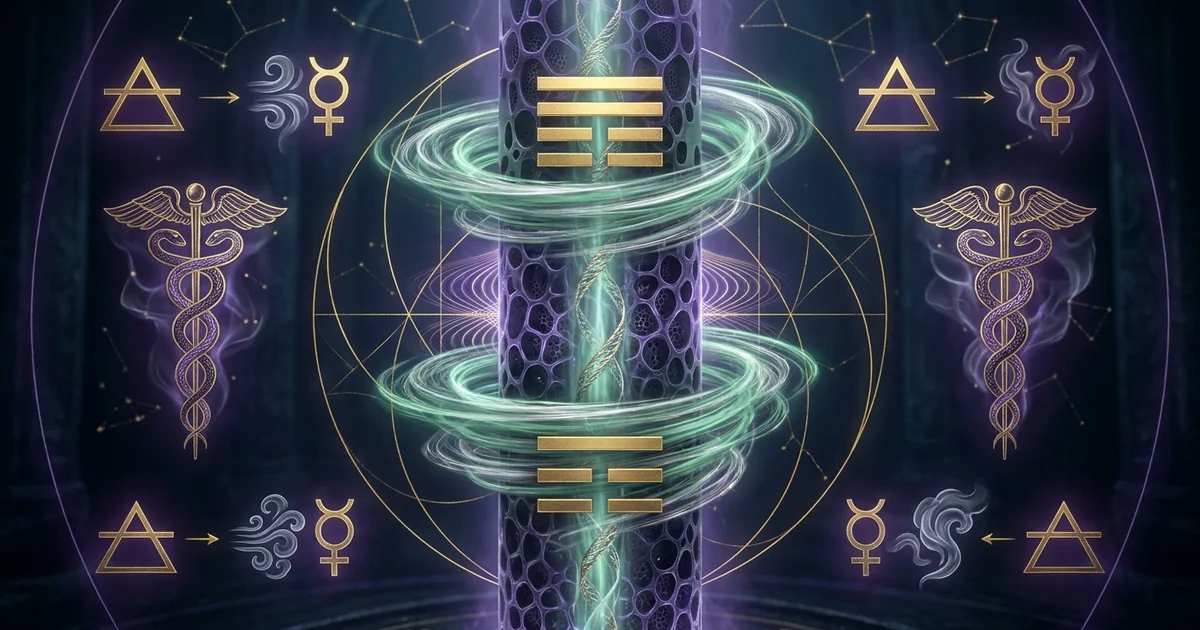
Hexagram 57 The Gentle (Penetrating Wind) (Xùn): I Ching
Archetypal Thesis & Systemic Paradigm: The Cybernetics of Constant Penetration
Hexagram 57 (Xùn, 巽), translated canonically as “The Gentle” or “The Penetrating,” defines an epistemological paradigm in the I Ching where systemic transformation is accomplished not through kinetic rupture, but via uninterrupted informational permeation. Within classical Chinese cosmogony and psycho-structural systems, Xùn is symbolized by the double repetition of the wind and wood trigram: wind over wind.
This topological reduplication describes a medium of low-amplitude, continuous pressure capable of dissolving structural recalcitrance by bypassing the defensive homeostatic thresholds of complex systems. Where its structural dynamic opposite, /iching/hexagram-51-zhen-the-arousing (Zhen, Thunder), deploys high-energy catalytic disruption to fracture consolidated balance, Hexagram 57 operates through asymptotic infiltration. It modifies the boundary conditions of an organism, psyche, or polity without triggering the immediate, reactive counter-forces characteristic of coercive vector dynamics.
Hexagram 57 (Xùn) Architecture:
Line 6: ——— (Yang)
Line 5: ——— (Yang)
Line 4: — — (Yin)
Line 3: ——— (Yang)
Line 2: ——— (Yang)
Line 1: — — (Yin)
The Pervasive Medium: Wind as Sub-Threshold Information
In cybernetic theory, communication within an adaptive network depends on the signal-to-noise ratio and the systemic threshold of sensory resistance. Hexagram 57 the gentle (penetrating wind) iching meaning models an informational dynamic that operates precisely beneath this perceptual threshold. In meteorological physics, wind is the thermodynamic redistribution of kinetic energy across atmospheric pressure gradients; it possesses neither discrete edges nor static form, yet it reconfigures geographic landscapes, desiccates moisture, and circulates organic chemical agents.
Within the human somatic and cognitive architecture, this corresponds to sub-threshold sensory registration—the ambient informational hum that bypasses ego-directed cortical defenses to act directly upon autonomic and limbic receptors.
Xùn does not strike; it infiltrates. Because the medium has no localized mass that can be seized, resisted, or deflected, the recipient system fails to mobilize its classical defensive complexes. The wind enters through the interstices of rigid behavioral patterns, introducing microscopic perturbations that gradually shift the entire dynamic attractor landscape of the host system.
Non-Coercive Vector Dynamics: The Power of Gradual Insinuation
The mechanical efficiency of the xùn hexagram relies on its non-coercive vector geometry. In both Newtonian mechanics and interpersonal dynamics, direct force generates an equal and opposite counter-force; psychological resistance mounts in proportion to the transparency of an external attempt to impose change. Hexagram 57 circumvents this dialectic entirely through strategic non-assertion. Its structural signature—a single, soft Yin line lying prone beneath two dominant, unyielding Yang lines—models an energetic strategy of yielding at the point of contact while relentlessly advancing along the baseline.
The lower Yin line acts as an exploratory probe that accommodates the contours of whatever obstacle it encounters. By bending to external terrain, it creates an open vector path along which the superior Yang lines can subsequently project their structured coherence.
The insinuation is therefore imperceptible in real-time execution; it can only be retroactively deduced by its cumulative evolutionary consequences. What appeared solid is discovered to have been hollowed from within, not by assault, but by the patient spatial occupation of the invisible medium.
Thermodynamic Dissipation and Adaptive State-Space Evolution
From the perspective of non-equilibrium thermodynamics, the duplicated trigram wind over wind describes an open system subject to continuous ambient flux. When a homeostatic system becomes calcified—locked into suboptimal equilibria or entropic stagnation—brute intervention often leads to catastrophic collapse rather than organized renewal. Hexagram 57 initiates an iterative, dampening frequency that systematically dissipates this internal resistance.
In terms of state-space evolution, the hexagram modifies the topology of the system’s phase space, lowering the potential energy barriers between existing states and allowing the system to transition smoothly toward a more viable energetic configuration. This continuous drift constitutes the essence of organic adaptation: plants do not shatter rock through blunt acceleration, but through the microscopic expansion of soft root tips that insinuate into preexisting fissures. By maintaining an uninterrupted continuity of purpose (yi) while varying its external manifestation according to environmental constraints, Xùn exemplifies systemic evolution governed by low-energy, high-efficiency informational flow.
Classical Provenance & Textual Lineage: Historical Transmission of Xùn
The historical transmission of Hexagram 57 within the canon of the Yijing reveals a deep evolution from Bronze Age sacrificial praxis to sophisticated administrative philosophy and metaphysics. The Chinese character Xùn (巽) contains ancient graphic components depicting two individuals kneeling before a pedestal or offering vessel, a posture signifying voluntary submission, deference, and ritual obedience.
In the archaic milieu of the early Western Zhou dynasty, this deferential posture was not a badge of modern servility, but the liturgical technique through which human agency aligned itself with the mandates of ancestral and heavenly powers (Tianming). To kneel beneath the unseen atmospheric currents was to become an unobstructed conductor for cosmic directives, allowing the individual to survive catastrophic sociopolitical shifts by bending in synchrony with overarching historical cycles.
The Judgment: 巽:小亨,利有攸往,利見大人。 The Gentle: Success through what is small. It furthers one to have somewhere to go. It furthers one to see the great man.
The Great Image (Daxiang): 隨風,巽;君子以申命行事。 Winds following one upon another: the image of the Gently Penetrating. Thus the noble person clarifies and spreads his directives, carrying out his affairs. — The I Ching or Book of Changes, Richard Wilhelm and Cary F. Baynes translation (1950)
The Western Zhou Layer: King Wen’s Judgment and Sacrificial Submissiveness
King Wen’s foundational Judgment for Hexagram 57 establishes a specific operational framework: “The Gentle: Success through what is small. It furthers one to have somewhere to go. It furthers one to see the great man.” This formulation addresses situations where direct macroscopic intervention is doomed to failure, requiring instead the continuous execution of micro-adjustments (“what is small”).
The declaration that “it furthers one to have somewhere to go” (li you you wang) demands an unwavering teleological vector; gentle adaptation without a clear destination degrades into chaotic dispersion.
Conversely, “to see the great man” indicates that low-amplitude informational tactics must remain anchored to an objective hierarchy of values, preventing the yielding technique from decaying into opportunistic relativism. In the context of Zhou statecraft, this represented the diplomatic strategy of the ascendant yet militarily vulnerable Zhou clan toward the crumbling Shang hegemony—infiltrating peripheral loyalties, subverting corrupt institutions through moral prestige, and yielding tactically to avoid premature, devastating confrontation.
The Ten Wings: Xiangzhuan (Great Image) and the Spreading of Directives
With the codification of the Ten Wings (Shi Yi) during the Warring States period, the atmospheric nature of Hexagram 57 was explicitly mapped onto the mechanics of political infrastructure. The Daxiang (Great Image) commentary identifies the primary dynamic as “winds following one upon another” (sui feng), generating an image of atmospheric continuity where one gust of wind reinforces, stabilizes, and carries forward the momentum of the preceding wave.
From this environmental phenomenon, the commentary derives the ethical mandate for governance: “Thus the noble person clarifies and spreads his directives, carrying out his affairs” (junzi yi shen ming xing shi).
The verb shen (申) specifically implies iteration—reiterating, explaining, and unfolding directives so that they permeate the consciousness of the population like an ambient mist rather than falling upon them as a violent edict. Confucian hermeneutics recognized that laws imposed purely through punitive, external enforcement foster evasion and rebellion, whereas policies diffused through continuous administrative education alter societal norms organically, securing compliance through uncoerced cultural internalization.
Metaphysical Reinterpretation: Wang Bi and Cheng Yi on Pervasive Order
During the Three Kingdoms period, the Neo-Daoist (Xuanxue) philosopher Wang Bi reinterpreted Hexagram 57 through the lens of non-action (wuwei) and absolute metaphysical yielding. Wang Bi posited that the wind’s capacity to penetrate all things without resistance stems from its fundamental lack of solid self-nature: because it has no fixed spatial boundaries, there is no surface upon which external force can act. By aligning with intrinsic nothingness (benwu), the sage yields internally to worldly variations, penetrating human consciousness not through intellectual or rhetorical coercion, but by becoming transparent to the universal Tao.
Centuries later, Song Dynasty Neo-Confucian master Cheng Yi shifted the focus back toward moral ontology in his Yichuan Yizhuan. Cheng Yi argued that Xùn represents the natural moral order (li) slowly permeating material existence (qi). For Cheng Yi, the wind does not signify empty passivity, but the relentless, life-giving distribution of seasonal warmth and celestial intention. Yielding is thus transformed into an active virtue: the systematic subordination of personal ego-will to universal ethical imperatives, allowing the individual’s moral influence to penetrate society as quietly and undeniably as the spring breeze waking dormant roots from winter frost.
Structural Mechanics & Symbolic Geometry: Trigram Anatomy and Line Vector Dynamics
The geometric integrity of Hexagram 57 is defined by its status as one of the eight doubled hexagrams (Ba Chun Gua) within the King Wen sequence, directly pairing structural stability with the dynamic qualities of /iching/trigrams-bagua-mechanics. It is composed of the lower trigram Xùn (Wind/Wood, ☴) positioned beneath the identical upper trigram Xùn (☴). In the symbolic taxonomy of the bagua, Xùn represents the eldest daughter, an archetype characterized by thoughtful deliberation, developmental intelligence, and deep systemic adaptability.
Visual Architecture of Hexagram 57:
Line 6: ——— (Yang, Ruler of the Upper)
Line 5: ——— (Yang, Sovereign Center)
Line 4: — — (Yin, Base of Upper Trigram)
Line 3: ——— (Yang, Apex of Lower Trigram)
Line 2: ——— (Yang, Central Balancer)
Line 1: — — (Yin, Base of Lower Trigram)
- Trigram Composition: Upper: Xùn (Wind/Wood, ☴); Lower: Xùn (Wind/Wood, ☴).
- Nuclear Hexagram (Hu Gua): Hexagram 38 (Kui, Opposition, ䷥), composed of Lower Nuclear Tui (Lake, ☱) and Upper Nuclear Li (Fire, ☲).
- Constituent Line Polarities: Yin at Line 1 and Line 4; Yang at Line 2, Line 3, Line 5, and Line 6.
- Dynamic Polarity: Soft, accommodating Yin roots serving as structural conduits for concentrated Yang directional thrusts.
The Doubled Trigram: Yin at the Base Supporting Two Yang Vectors
The anatomy of a single Xùn trigram consists of a broken Yin line at the bottom supporting two solid Yang lines above. In classical structural mechanics, this configuration produces a dynamic base-state: the ground is pliable, flexible, and receptive, while the superstructure remains coherent, directed, and potent.
When this geometry is doubled to form Hexagram 57, the structural pattern repeats at both the personal, foundational level (lines 1 to 3) and the macrocosmic, relational level (lines 4 to 6).
The Yin lines at positions 1 and 4 are the entry conduits through which the hexagram functions. If these lines were Yang, the structure would be unyielding, confronting obstacles head-on and generating kinetic shock waves. Instead, the subterranean Yin lines function like aerodynamic rudders or the soft edge of a wedge. They slip effortlessly beneath systemic defenses. Once this foundational entry is secured, the two overlying Yang lines—solid, focused, and persistent—drive their directional vectors through the newly opened corridor, ensuring that penetration deepens into lasting, structural alignment.
Nuclear Core Topology: The Hidden Tension of Hexagram 38 (Kui)
Beneath the calm, ambient surface of Hexagram 57 lies a complex dynamic core revealed by its nuclear hexagram (Hu Gua). By extracting lines 2-3-4 as the lower nuclear trigram and lines 3-4-5 as the upper nuclear trigram, we uncover Hexagram 38 (Kui, Opposition / Estrangement, ䷥), composed of Lake (Tui, ☱) below Fire (Li, ☲).
This nuclear revelation exposes the subterranean catalyst driving Xùn’s gentle tactics: the deep, underlying reality of structural opposition, systemic estrangement, and divergent interests.
Fire naturally moves upward, while Lake settles downward; their vectors are fundamentally polarized. Hexagram 57 does not deny or forcefully suppress this latent opposition. Instead, it operates as an evolutionary technology engineered precisely to navigate systems plagued by internal polarization. Penetrating wind is required precisely because the landscape is fractured by Kui.
Direct intervention within an environment ruled by Hexagram 38 would accelerate conflict and deepen ideological divides. The double wind of Xùn uses low-amplitude insinuation to navigate this opposition, slipping between opposing factions and harmonizing conflicting worldviews without provoking the explosive volatility latent in its nuclear core.
Sequential Line Vector Analysis: From Wavering Hesitation to Destructive Penetration
The progressive sequence of the six lines in book of changes divination charts the path of subtle penetration from initial, hesitant grounding to the fatal excess of structural over-investigation.
Line 1: Yin at the Base
Initial Wavering and Hesitation.
“In advancing and retreating, the perseverance of a warrior furthers.”
Positioned at the very base of the system, this initial Yin line is naturally soft, yielding, and prone to endless strategic vacillation. Because it feels the weight of the two Yang lines above it, it hesitates, advancing and retreating like wind shifting direction against a cliff face. The classical text counsels “the perseverance of a warrior” (wu ren zhi zhen) to inject internal mental discipline into an external posture of yielding. Without this focused inner resolve, gentle diplomacy degenerates into aimless, paralyzing ambivalence.
Line 2: Yang in the Second Position
Shamanic Discernment and Subterranean Excavation.
“Penetration under the bed. Priests and magicians are used in great numbers. Good fortune. No blame.”
Occupying the central, balanced position of the lower trigram, the second Yang line penetrates directly into the unconscious substructure of the situation (“beneath the bed,” chuang xia). The bed symbolizes repose, the domestic sphere, and the hidden repositories of instinctual complexes and suppressed anxieties. The deployment of “priests and magicians” (wu shi) signifies an analytical and ritual excavation of unseen psychological roots. By using objective, archetypal tools to illuminate the repressed dynamics operating beneath the visible arena, this line eliminates unconscious sabotage and secures good fortune.
Line 3: Yang in the Third Position
Compulsive Insinuation and Exhausting Over-Penetration.
“Repeated penetration. Humiliation.”
Standing at the transitional apex of the lower trigram, this Yang line is excessively rigid and overly deliberate. It loses the spontaneous, natural rhythm of wind, transforming gentle persistence into an obsessive, micromanaging assault. This is the strategist who cannot cease calculating, or the individual who over-analyzes an emotional dynamic until trust is suffocated. The insinuation is repeated (pin xun) ad nauseam, provoking irritation and systemic fatigue in those around it. Humiliation inevitably follows because the technique has become completely transparent.
Line 4: Yin in the Fourth Position
Subtle Alignment and Systemic Consolidation.
“Remorse vanishes. In the field three kinds of game are caught.”
Crossing the threshold into the upper trigram, this Yin line combines receptivity with high sociopolitical responsibility. It yields appropriately to the sovereign power of Line 5 while providing an intuitive, flexible conduit for systemic directives. Through this position of pure service, all previous remorse and vulnerability vanish. The catching of “three kinds of game” (tian huo san pin) symbolizes the integration of systemic energies across three holistic levels: the spiritual (sacrificial offerings), the relational (hospitality to guests), and the somatic (daily physical sustenance).
Line 5: Yang in the Fifth Position
Sovereign Transformation and the Geng Cycle.
“Perseverance brings good fortune. Remorse vanishes. Nothing that does not further. No beginning, but an end. Before the change, three days. After the change, three days. Good fortune.”
The central, noble ruler of the entire hexagram. Here, the penetrating quality of wind is wielded with consummate geopolitical and moral mastery. The line acknowledges that past trajectories may have lacked proper form (“no beginning”), yet through corrective infiltration, a harmonious outcome is secured (“an end”).
The command “before the change, three days; after the change, three days” invokes the ancient geng-days-temporal-cycle (庚), an esoteric planning protocol requiring deliberate structural assessment, patient preparation, and post-implementation auditing. Sovereign change is executed not by decree, but by carefully preparing the psychological environment beforehand and continually adjusting it afterward.
Line 6: Yang at the Apex
Hubristic Over-Extension and Destructive Loss.
“Penetration under the bed. He loses his property and his axe. Perseverance brings misfortune.”
At the absolute summit of Hexagram 57, the penetrating impulse overshoots its evolutionary mandate, degenerating into pathological hyper-vigilance. Like Line 2, it probes “beneath the bed,” but no longer with the objective clarity of priests and scribes. Instead, this is the obsessive paranoia of the tyrant or the neurotic ego endlessly hunting for hidden treachery in every corner.
In this obsessive process, the agent loses both baseline material support (“property”) and the capacity for clear, decisive action (“his axe,” fu). The instrument of critical judgment is dissolved in a sea of endless, corrosive suspicion; persisting in this state leads directly to catastrophic systemic collapse.
Psychological Dynamics & Operational Praxis: The Splenic Intuition of Deep Consciousness
In the landscape of archetypal psychology and psychoanalysis, Hexagram 57 provides an elegant coordinate map of subliminal perception and unconscious integration. Carl Jung, in formulating his thesis on /psychology/jungian-synchronicity-iching, recognized that the oracular efficacy of the I Ching rests on the psyche’s capacity to read meaningful patterns in the environment that lie outside the linear, causal chains of rational cognition.
Xùn models the specific structural mechanism through which unconscious content gradually infiltrates ego-consciousness, slipping past the psychic immune systems of repression, rationalization, and neurotic defense.
“The unconscious seems to possess information that transcends the threshold of our conscious sensory awareness… Synchronistic phenomena, along with the operational dynamics of divinatory systems like the I Ching, rely precisely upon these micro-perceptions—subliminal impressions carried on the psychic wind that register within somatic awareness before the rational intellect can structure or dismiss them.” — Marie-Louise von Franz, On Divination and Synchronicity: The Psychology of Meaningful Chance (1980)
Subliminal Perception: The Analytical Psychology of the Subconscious Complex
The human cognitive apparatus is constantly flooded with millions of environmental and biological cues every second, the vast majority of which are systematically discarded by sensory gating mechanisms to preserve sanity and focus. Hexagram 57 corresponds to the functional layer of consciousness that processes these sub-threshold signals.
Rather than confronting an autonomous psychological complex head-on—an aggressive tactic that reliably triggers intense ego defenses, projection, and resistance—the clinical praxis implied by Xùn operates through gradual therapeutic insinuation.
The analytical dialogue drops subtle interpretive seeds into the associative stream, allowing the latent insights to circulate freely within the patient’s unconscious. Much like wind rustling the branches of a tree, these quiet seeds gently reveal the inner architecture of the complex through its spontaneous behavioral, somatic, and dream responses, rather than demanding an immediate, traumatic confrontation with the shadow.
Human Design Gate 57: The Acoustic Splenic Circuitry of Survival Clarity
In the synthesis of Human Design, which maps the 64 hexagrams directly onto somatic architecture, /human-design/splenic-center-intuition houses Hexagram 57 as Gate 57: the Gate of Intuitive Clarity (The Gentle). Located within the splenic-center, this gate operates as the primary sensory organ of direct acoustic and vibrational intuition.
Unlike the intellectual computations of the Ajna Center or the emotional waves of the Solar Plexus, the splenic awareness of gate-57-intuitive-clarity operates purely in the immediate, microsecond reality of the present moment.
Its sensory medium is sound: it reads the subtle shifts, tonal frequencies, and acoustic hesitations of the environment to evaluate physical safety and systemic integrity.
Splenic Acoustic Awareness Circuit:
[Vibrational/Acoustic Resonance]
       │
       ▼
[Gate 57: Intuitive Clarity] ──(Channel 57-20 / 57-10 / 57-34)──> [Immediate Somatic Action]
       │
       ▼
[Shadow: Paralyzing Fear of the Future]
The biological imperative of Gate 57 is survival, maintained through hyper-attuned micro-perception. However, its shadow frequency emerges precisely when the mind tries to project this momentary intuitive whisper into distant temporal horizons, generating a paralyzing fear of the future.
Because the spleen communicates only once, through a quiet acoustic pulse, rational consciousness often overrides it as unsubstantiated superstition. Yet, ignoring this gentle, penetrating signal typically results in systemic failure, as the organism blunders into physical, relational, or environmental crises that the splenic wind had already detected and warned against.
Operational Praxis: Navigating Line 1 Ambivalence and Line 2 Shamanic Probing
The practical mastery of Hexagram 57 requires an individual to navigate the operational dialectic between the hesitation of Line 1 and the deep excavation of Line 2.
Line 1 represents the initial sensory overload of the intuitive state: the agent registers an impending systemic change or hidden danger, but because the evidence is entirely subliminal, the conscious mind is seized by doubt. One advances, then retreats, caught in an agonizing loop of analytical paralysis.
The operational remedy is the psychological stance of the “resolute warrior”—anchoring the awareness in bodily presence and unwavering internal discipline, refusing to let the imagination run wild with speculative narratives.
Diagnostic Matrix for Resolving Unconscious Hesitation:
1. Identify the Ambient Drift: Detect the subliminal resistance or subtle pull.
2. Descend Beneath the Bed: Apply objective archetypal inquiry to reveal the root complex.
3. Silence the Future Narrative: Sever the connection to speculative anxiety.
4. Align with Present Resonance: Reclaim the single acoustic pulse of the immediate moment.
Once this baseline discipline is established, the operational focus shifts to the redemptive methodology of Line 2: diving beneath the bed. In practical analytical work, this corresponds to dragging the unarticulated anxieties, paranoid fantasies, and hidden projections that haunt the psychic baseline out into the light of conscious awareness.
By employing the modern equivalents of priests and scribes—such as systematic dream work, active imagination, and objective psychometric or somatic tracking—the practitioner illuminates the hidden roots of their disquiet. The subterranean complex is exposed, its unrefined psychic charge is consciously integrated, and the intuitive faculty is liberated from neurosis, transforming into an instrument of razor-sharp situational clarity.
Philosophical Synthesis & Macrocosmic Correspondence: Hermetic, Genetic, and Biological Vectors
The foundational mechanics of Hexagram 57 transcend cultural boundaries, corresponding directly with primary laws found in Western esotericism, systems biology, and molecular genetics. In the Hermetic tradition, Xùn reflects a profound synthesis of the Principle of Polarity and the Principle of Rhythm:
“Rhythm compensates… Measure for measure, motion to the right is motion to the left; the pendulum swing manifests in everything.” — The Kybalion
Hexagram 57 achieves its aims by surrendering to this rhythmic oscillation. It does not battle the pendulum, but moves with it, applying gentle, persistent micro-vectors that gradually recalibrate the axis of the entire system.
The Hermetic Principle of Polarity and Rhythm: Microcosmic Insinuation
In Hermetic mechanics, directly attacking an entrenched polarity often deepens its pathological expression by feeding energy directly into the opposing charge. The adept instead uses the art of mental and energetic insinuation—a process mirroring Xùn. By matching the vibrational frequency of an existing condition, the practitioner penetrates its interior architecture without causing polarization shock.
Once inside, subtle rhythmic adjustments are introduced at the structural base, slowly transmuting the quality of the energy from within.
This mirrors the behavior of fluids: water does not wage war against granite; it adapts entirely to the stone’s geometry, finding the microscopic fault line, flowing within, and freezing, ultimately transforming the boulder not through blunt kinetic impact, but through intimate, patient geometric adaptation.
Biochemical Isomorphism: Hexagram 57 and the Genetic Codon Framework
In the structural mapping of the genetic code to the 64 hexagrams pioneered by Martin Schönberger in The I Ching and the Genetic Code (1973), and expanded in dynamic biophysics, Hexagram 57 occupies a crucial position within the transcription and amino acid synthesis architecture. The 6-bit binary logic of the I Ching (broken Yin lines representing 0, solid Yang lines representing 1) maps cleanly onto the 64 triplet codons of messenger RNA built from the four nucleotide bases: Uracil, Cytosine, Adenine, and Guanine.
Binary Structural Coding of Hexagram 57:
Line 6: 1 (Yang)
Line 5: 1 (Yang)
Line 4: 0 (Yin)
Line 3: 1 (Yang)
Line 2: 1 (Yang)
Line 1: 0 (Yin)
Binary Value: 110110 (Base-2) -> Corresponding to Specific Transfer RNA Triplet Combinations
Hexagram 57 sits structurally within the codon-ring-of-matter, aligning with amino acids like Alanine and Valine, which are fundamental building blocks for stable, flexible protein matrices.
In molecular biology, transcription factors do not rip open the DNA double helix through violent chemical reactions; they locate specific, accessible structural motifs, slipping between the base pairs with molecular gentleness. Once bound, these microscopic factors initiate cascades of enzymatic communication that alter the entire metabolic state of the cell.
Hexagram 57 is an archetypal map of this very process: the gentle, non-destructive insertion of an informational key that unlocks vast reservoirs of structural and biological potential.
Hexagram 57 (Xùn) - Gentle Penetration
- Energetic Signature: Fluid, ambient, dispersed, sub-threshold.
- Elemental Archetype: Wind / Wood (☴ over ☴).
- Temporal Cadence: Continuous, gradual, iterative, evolutionary.
- Neurological Correlate: Splenic/acoustic micro-awareness, autonomic processing.
- Operational Method: Insinuation beneath defenses; reshaping from the interior.
- Strategic Failure Mode: Chronic hesitation, paranoid over-analysis, loss of instruments.
Hexagram 51 (Zhen) - The Arousing / Shock
- Energetic Signature: Sudden, explosive, kinetic, supra-threshold.
- Elemental Archetype: Thunder / Fire-Energy (☳ over ☳).
- Temporal Cadence: Immediate, disruptive, catastrophic, revolutionary.
- Neurological Correlate: Sympathetic nervous system, amygdala shock, startle reflex.
- Operational Method: Frontal sensory assault; shattering frozen equilibria.
- Strategic Failure Mode: Systemic panic, traumatic paralysis, indiscriminate destruction.
Dynamic Comparative Analysis: Direct Kinetic Force vs. Insinuative Permeation
The structural relationship between Hexagram 57 and its evolutionary complementary opposites—Hexagram 51 (Zhen, The Arousing) and /iching/hexagram-58-dui-the-joyous (Dui, The Joyous)—highlights the unique power of non-coercive dynamics. Zhen attempts to awaken the world through sudden, catastrophic shocks that force immediate reorganizations of consciousness. However, these abrupt awakenings carry high operational risks: they frequently shatter fragile systems, leaving lasting psychic or organizational trauma in their wake.
Hexagram 57 accomplishes identical developmental aims without this attendant systemic collapse. Rather than terrifying the defenses into submission, it integrates with the host system so thoroughly that its restructuring work is experienced as a natural, self-directed evolutionary unfolding.
Where Zhen is lightning searing the night sky, Xùn is the unseen atmospheric shift that quietly heralds the coming season, warming the soil and calling the seed forth into daylight on its own terms.
Frequently Asked Questions: Analytical Inquiries into Hexagram 57
Distinguishing Yielding Flexibility from Pathological Subservience
A frequent misinterpretation of Hexagram 57 the gentle (penetrating wind) iching meaning reduces its core dynamic of yielding (xùn) to passive resignation, weakness, or codependent subservience. This reading completely misses the structural geometry of the hexagram.
In Hexagram 57, yielding is strictly a surface-level, aerodynamic posture: the lower Yin line bends exclusively to let the structural momentum of the two Yang lines behind it advance unobstructed. The yielding of Xùn is purposeful, disciplined, and strategic. It is the calculated flexibility of the martial artist slipping a direct strike to occupy an opponent’s blind spot, or the diplomat conceding minor procedural points to secure a transformative treaty.
Subservience abandons its directional vector and dissolves its core purpose (yi). Xùn, by contrast, retains absolute clarity of intention, altering only the outer trajectory of its approach to slip effortlessly around environmental obstacles.
Operational Mechanics: Strategic Yielding vs. Subservience:
Strategic Yielding (Xùn)  = Pliant Boundary + Inflexible Vector of Intent
Pathological Subservience  = Dissolved Boundary + Abandoned Vector of Intent
Decoding the Cryptic Line 2 and Line 6 Imagery: ‘Penetration Under the Bed’
The recurring image of “penetration under the bed” (chuang xia) in both Line 2 and Line 6 represents an archetypal descent into the hidden, suppressed regions of reality. In ancient China, the bed was not merely furniture, but the private, enclosed setting for rest, intimacy, and protection from the public gaze. What lies beneath the bed is that which has been tucked away: dust, forgotten relics, hidden wealth, or lurking dangers.
In Line 2, this descent is redemptive, disciplined, and analytical. By employing “priests and magicians”—symbolizing structured, objective frameworks for interrogating the unconscious—the individual investigates hidden anxieties and ideological biases before they can erupt as real-world problems. It is an act of proactive shadow work.
In Line 6, however, this very same action becomes toxic and compulsive. Here, at the apex of the hexagram, the agent has fallen into a state of hyper-vigilance, peering endlessly beneath the bed out of chronic paranoia. The search no longer seeks to heal, but to confirm its own worst terrors. In doing so, the individual squanders their inner peace, their material security (“property”), and their capacity for decisive action (“his axe”), ending in complete psychological paralysis.
The Strategic Computation of ‘Three Days Before and Three Days After’ (Line 5)
The enigmatic formula found in Line 5—“Before the change, three days. After the change, three days” (xian geng san ri, hou geng san ri)—encodes an ancient system of temporal planning and systemic governance.
Within the traditional Chinese calendar of the Ten Heavenly Stems (Tian Gan), Geng (庚) occupies the seventh position, an astronomical coordinate associated with the transformative energy of Autumn, the direction West, and the decisive, severing quality of Metal. Geng represents an evolutionary juncture where systemic decay must be cut away to make room for new growth.
The Classical Geng Decan Matrix:
Stem 4: Ding (丁) ──> Stem 5: Wu (戊) ──> Stem 6: Ji (己)
  └────────────────── 3 Days Before Geng: Structural Assessment, Modeling, Environmental Preparation ──────────────────┘
                                   │
                           [ STEM 7: GENG (庚) ]  <-- The Moment of Systemic Realignment
                                   │
  ┌────────────────── 3 Days After Geng: Calibration, Auditing, Stabilizing Feedback Loops ────────────────────────────┘
Stem 8: Xin (辛) ──> Stem 9: Ren (壬) ──> Stem 10: Gui (癸)
The three days preceding Geng (the stems Ding, Wu, and Ji) represent the preparatory phase: assessing the situation, analyzing the hidden roots of decay, and educating the population so that the coming change is understood in advance.
The three days following Geng (the stems Xin, Ren, and Gui) constitute the implementation phase: tracking systemic feedback, correcting unexpected side-effects, and stabilizing the new dynamic balance.
This temporal formula reveals that Hexagram 57 never approaches systemic change as an impulsive, instantaneous leap. Transformation is approached as an extended, carefully calibrated process that integrates thorough preparation with rigorous follow-through, ensuring that reforms settle into the social fabric as naturally and permanently as the turning of the seasons.