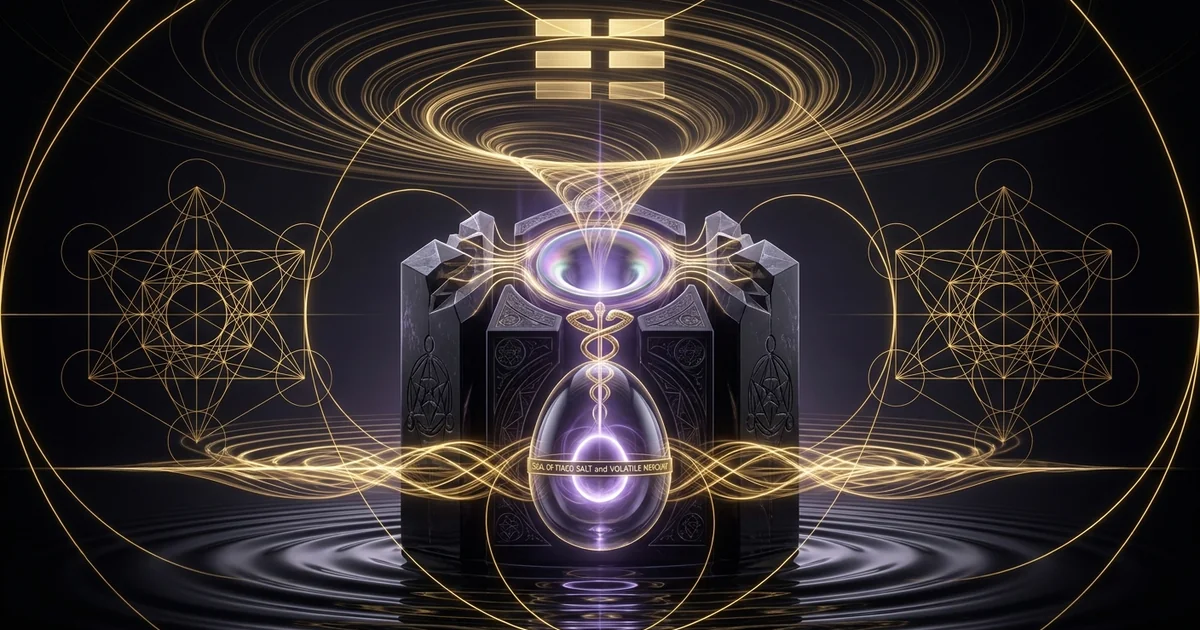
Hexagram 61 Inner Truth (Zhōng Fú): I Ching Divination
Archetypal Thesis & Systemic Paradigm: The Cybernetics of Inner Truth
Hexagram 61 (Zhōng Fú, 中孚) codifies a psycho-cosmological cybernetics of resonance wherein consciousness achieves objective attunement with reality not through aggressive cognitive capture, but through an emptied, non-egoic center bounded by structural rigor. Rather than representing an assertive intellectual dogma or a set of moralistic creeds, the hexagram models sympathetic resonance—phenomenologically symbolized as wind agitating the surface of an unfathomable lake. Within the systemic architecture of the Book of Changes, epistemic fidelity operates as an attractor state capable of resolving systemic entropy across individual psychological, sociological, and biophysical domains.
The hexagram asserts that truth is fundamentally acoustic and topological rather than propositional. When the internal architecture of the subject mirrors the harmonic invariants of the cosmos, communication ceases to require coercive force. Divination with Zhōng Fú reveals that influence occurs along lines of morphological correspondence and acoustic fidelity, demonstrating how an authentic interior disposition modifies the trajectory of phenomenal events without physical perturbation.
       HEXAGRAM 61: ZHŌNG FÚ (INNER TRUTH)

       Line 6: ———  Yang  (Upper Trigram: Xùn / Wind)
       Line 5: ———  Yang
       Line 4: — —  Yin
       ------------------
       Line 3: — —  Yin   (Lower Trigram: Duì / Lake)
       Line 2: ———  Yang
       Line 1: ———  Yang
The Empty Heart (Xū Xīn) as an Acoustic Cavity
The core premise of the hexagram 61 inner truth iching meaning rests upon the radical Daoist and early Confucian concept of xū xīn (虛心)—the “empty heart-mind.” The graphic morphology of the hexagram reveals two central yin lines (lines 3 and 4) flanked symmetrically above and below by pairs of solid yang lines (lines 1, 2 and 5, 6). This configuration creates an open interiority, a literal hollow chamber ensconced within a solid structural shell. In the language of cybernetics and wave mechanics, this topology constitutes a resonant acoustic cavity.
If the center were occupied by an assertive, unyielding yang line, the cavity would choke on its own density, producing cognitive static and ideological noise. The empty yin core ensures that the internal state remains an unbiased receiver, minimizing input distortion. Signal transmission within this system depends upon the complete elimination of self-referential ego-interference. Epistemic fidelity is achieved only when the observer ceases to project subjective intentionality onto the incoming signal, allowing the intrinsic geometry of reality to register cleanly upon the psychic substrate.
     YANG (Lines 5 & 6)  ==== Solid Upper Boundary (Rigor)
     YIN  (Lines 3 & 4)  -  - Hollow Central Cavity (Xū Xīn / Receptivity)
     YANG (Lines 1 & 2)  ==== Solid Lower Boundary (Grounding)
In psychological terms, this empty center represents the suspension of confirmation bias, defensiveness, and ideological fixation. The subject becomes an open transducer. This condition is not passive vacuity, but dynamic, poised receptivity. The structural boundaries of the outer yang lines prevent the collapse of identity into amorphous diffusion, while the hollow interior preserves the freedom necessary for sympathetic oscillation.
Truth, within the framework of zhōng fú hexagram, is an ontological state rather than an epistemological possession: one does not “have” the truth; one makes oneself empty enough to be inhabited by it. When this internal evacuation is accomplished, the individual ceases to operate as an isolated solipsistic node and instead becomes an unobstructed channel for systemic coherence, radiating an unforced authority that recalibrates distorted psychic environments.
Morphic Attunement and the Wind-Lake Interface
The macrocosmic phenomenology of Hexagram 61 is established through the interaction of its component trigrams in the classical bagua matrix: Trigram Sun (Wind/Wood) occupying the superior position, and Trigram Dui (Lake/Marsh) situated inferiorly. This atmospheric juxtaposition—wind over lake—demonstrates how invisible, macrocosmic vector dynamics exert tangible morphic pressure on fluid, receptive substrates without structural coercion. Wind is imperceptible to the eye; its reality can be inferred solely through its thermodynamic effects and the kinetic displacement it induces upon the visible world. When the wind moves over the expanse of the lake, the water does not resist, nor does it erect defensive ramparts. It yields completely, yet in that yielding, it manifests rhythmic, geometrically precise undulations that mirror the velocity, vector, and density of the invisible atmosphere above.
This interface serves as an ecological paradigm for non-coercive influence. Trigram Sun represents gentle, pervasive penetration; it enters into crevices and porous surfaces with gradual, persistent inevitability. Trigram Dui represents joyous receptivity, depth, and the communicative interface between liquid interiority and the external atmosphere. Their dynamic intersection illustrates that true systemic authority does not impose itself through violent rupture, but through continuous, penetrating attunement that awakens a reciprocal movement within the receptive medium.
The lake responds to the wind because its very molecular structure possesses an innate capacity for wave-formation. In the same manner, when genuine zhōng fú is enacted within an interpersonal or political field, it bypasses the defensive mechanisms of the cognitive ego and speaks directly to the shared, archetypal foundations of the collective unconscious, producing unforced compliance and spontaneous alignment.
Epistemic Fidelity Beyond Subject-Object Duality
The deeper metaphysical implications of Zhōng Fú dismantle the Cartesian divide that separates the knowing subject from the known object. Conventional Western epistemology treats truth as an assertive correspondence between an internal linguistic proposition and an external state of affairs—a dualistic tension that inherently breeds doubt, alienation, and manipulation. In contrast, the systemic paradigm articulated within the Book of Changes divination tradition treats truth (Fú) as an unbroken circuit of mutual induction. The knowing apparatus and the phenomenal field are recognized as co-emergent features of an undivided psychoid reality.
Within this acausal framework, epistemic fidelity is not verified through detached, adversarial experimentation, but through the instantaneous registration of harmonic resonance across qualitative thresholds. The observer does not stand outside the phenomenal display to measure it; rather, the observer participates in the systemic unfolding by maintaining an uncorrupted somatic and psychic center.
“The second line of Hexagram 61 provides an unequivocal classical prototype for the acausal connecting principle: ‘A crane calling in the shade, her young answer her; I have a good goblet, I will share it with you.’ Here, communication is emancipated from visual tracking and spatial proximity. The call and response operate through an underlying psychoid continuum where separation is revealed as an artifact of sensory limitation, establishing the operational mechanics of meaningful synchronistic coincidence.” — C.G. Jung, Synchronicity: An Acausal Connecting Principle (1952)
As Jung identified in his analytical investigations into mantic systems, the phenomenon of meaningful coincidence—synchronicity—demands a theoretical framework that transcends simple mechanical causality. Hexagram 61 provides this exact architecture. The crane cries from deep within the obscured vegetation, invisible to its offspring, yet the chicks respond instantly without cognitive hesitation.
The connection is not mediated by light waves or explicit sign systems, but by an instinctual, non-local attunement that operates across the obscured vegetative matrix. When the internal state of the diviner or contemplative achieves absolute transparency (xū), the artificial barrier between the psychological interior and the material exterior dissolves. Events in the physical world begin to align with the core psychic trajectory, not because the mind causes the external event through psychokinesis, but because both mind and matter are configured as simultaneous reflections of an underlying archetypal attractor.
Classical Provenance & Textual Lineage: Historical Exegesis of Zhōng Fú
To decipher the full philosophical architecture of Zhōng Fú, one must track its etymological, historical, and hermeneutic development from Bronze Age divinatory liturgies to its modern synthesis in archetypal psychology. The understanding of this hexagram underwent a profound transmutation over three millennia, shifting from archaic sacrifice and the physical incubation of life to a sophisticated technology of self-cultivation and non-local metaphysics.
                   ARCHAIC BRONZE AGE:
                   Fú (孚): Claw (爫) hovering over Child (子)
                   [Physical Incubation / Maternal Brooding / Captive Fidelity]
                                  │
                                  ▼
                   WAR-RING STATES / CONFUCIAN ERA:
                   Zhōng Fú (中孚): Center + Sincerity
                   [Moral Interiority / Influence over Instinctual Substrates]
                                  │
                                  ▼
                   NEO-CONFUCIAN METAPHYSICS (Song Dynasty):
                   Xū Xīn (虛心): The Empty Heart-Mind
                   [Acoustic Cavity / Epistemic Non-Coercion / Cosmic Attunement]
                                  │
                                  ▼
                   TWENTIETH-CENTURY HERMENEUTIC:
                   Wilhelm-Jung Collaboration
                   [Acausal Connecting Principle / Psychoid Archetypal Reality]
Etymological Evolution: Fú as Brooding, Incubation, and Structural Faith
The etymological anatomy of the character Fú (孚) preserves the somatic, biological origins of the concept before it was abstracted into the philosophical register of “truth” or “sincerity.” In its earliest oracle bone and bronze script forms, the ideogram is composed of two distinct pictographic elements: the upper component depicts a downward-reaching hand or raptor’s claw (zhǎo, 爫), while the lower component clearly illustrates a child or fledgling (zǐ, 子). Historically, this glyph indicated the protective grasping of a child, the capturing of prisoners who were bound by an oath of fidelity, or, most profoundly, the biological posture of a mother bird brooding over her clutch of eggs.
  ORACLE BONE GLYPH MORPHOLOGY:

  [ 爫 ]  <-- Upper component: Avian claw / protective hand
    │
  [ 子 ]  <-- Lower component: Fledgling / fragile biological life
    =  FÚ (孚): Incubation, metabolic faith, unhatched somatic truth
The avian metaphor of maternal incubation provides the crucial conceptual key to the hexagram. A brooding bird sits upon an unhatched egg in an attitude of complete, unbroken metabolic commitment. The egg appears inert, calcified, and silent from the exterior; it offers no immediate mechanical feedback to the mother. Yet, through the continuous application of somatic warmth, moisture, and weight, an invisible transubstantiation occurs beneath the shell. The embryonic tissues organize, the heart begins its rhythmic contraction, and eventually, the shell fractures from within.
Fú is therefore not an intellectual belief system that demands outward affirmation; it is biological, somatic incubation. It is the structural faith that maintains thermodynamic pressure upon an invisible potential until that potential crosses the threshold into physical manifestation. When paired with Zhōng (中)—meaning “center,” “interior,” or “balance”—the compound Zhōng Fú signifies an incubation that originates from the absolute core of the being, a metabolic trust so deeply anchored that it nurtures latent life through structural fidelity alone.
The Commentary on the Decision (Tuan Zhuan) and Neo-Confucian Interiority
The Tuan Zhuan (Commentary on the Decision), historically attributed to Confucius, fundamentally elevated the systemic scope of the hexagram by declaring: “Inner Truth: Pigs and fishes are touched, and good fortune arrives. Advantage in crossing the great water. Advantage in firm correctness.” The inclusion of “pigs and fishes” (shǐ yú, 豕魚) represents a striking philosophical departure. In the taxonomy of the ancient Chinese world, pigs were regarded as the most recalcitrant, obstinate, and intellectually inaccessible of domesticated beasts, while fishes occupied the lowest, most opaque strata of the wild, aquatic realm—creatures fundamentally indifferent to human rhetoric, ethical suasion, or moral posturing.
By asserting that Zhōng Fú influences even pigs and fishes, the classical commentary establishes that genuine inner truth operates beneath the linguistic apparatus. Rhetorical elegance, persuasive logic, and authoritarian coercion slide uselessly off the consciousness of a pig or a fish; they can be moved only through profound, visceral attunement. The Neo-Confucian commentaries of the Song Dynasty, notably those of Cheng Yi and Zhu Xi, integrated this insight into their programs of interior cultivation.
Cheng Yi argued that the heart-mind, when emptied of selfish human desire (rén yù), inherently mirrors the cosmic pattern (tīan lǐ). Because pigs and fishes belong to the identical material-force (qì) matrix as humanity, an internal recalibration within the noble person causes an involuntary, thermodynamic readjustment within the surrounding environment. Influence ceased to be understood as external governance and was re-articulated as harmonic induction: transform the self through absolute interior fidelity, and the phenomenal field aligns spontaneously.
“Wind over lake: the image of Inner Truth. Thus the noble man discusses criminal cases in order to delay executions. The wind penetrates the lake, moving it from within; so too must the sovereign penetrate the psychic circumstances of the accused with absolute, selfless empathy. Justice cannot be executed through cold mechanical jurisprudence; it demands an emptied heart that uncovers the latent humanity within the most degraded offender, seeking life where the rigid law perceives only terminal culpability.” — Richard Wilhelm & Cary F. Baynes, The I Ching or Book of Changes (1950)
The socio-judicial application outlined in the Daxiang commentary demonstrates how this interiority operates within legal praxis. The noble person does not wield the law as a punitive bludgeon. Confronted with capital litigation, the sage suspends judgment, emptying the mind of bias in order to step into the exact subjective framework of the transgressor. This deliberate delay of execution represents an institutional application of the empty center: creating a temporal and psychological void wherein the structural truth of the situation can reveal itself, preserving systemic life even within the cold mechanics of statecraft.
The Wilhelm-Jung Hermeneutic Pipeline and Western Synchronicity
The transmission of the Book of Changes to the West underwent an unprecedented acceleration through the collaborative alchemy between sinologist Richard Wilhelm and depth psychologist Carl Gustav Jung. During his decades in China amidst the collapse of the Qing Dynasty, Wilhelm received intensive oral instruction from the venerable Neo-Confucian scholar Lao Naixuan. Lao initiated Wilhelm into the cosmological architecture of the text, emphasizing that the hexagrams were not dead fortune-telling fragments, but dynamic maps of psychological and natural morphogenesis. When Wilhelm’s German rendering was translated into English by Cary F. Baynes and issued as Bollingen Series XIX, it carried Jung’s famous forward—a document that legitimized the I Ching within Western depth psychology.
Jung’s encounter with Zhōng Fú was pivotal in crystalizing his theory of the acausal connecting principle. Jung realized that the mantic efficacy of the oracle did not rely upon mechanical, linear causality (where action A causes effect B via energetic transfer). Instead, it operated within a psychophysical matrix where interior psychological states and external objective arrangements share qualitative congruence.
Zhōng Fú emerged as the self-referential archetype for this dynamic: the hexagram describes the very attunement required to engage with the oracle itself. The diviner must embody the hollow center (lines 3 and 4) while maintaining analytical and ethical boundaries (the outer yang lines), allowing the unconscious to mirror the macrocosmic situation without distortion. This Wilhelm-Jung pipeline elevated Hexagram 61 from an esoteric Chinese curio to a primary diagnostic text for post-Newtonian models of mind-matter complementarity.
Structural Mechanics & Symbolic Geometry: Trigram Dynamics and Nuclear Topography
The architectural power of Hexagram 61 resides in its symmetrical geometry, its energetic vectors, and its latent nuclear hexagrams structural dynamics. Divination systems operate through structural morphology; every line, trigram, and nuclear shift provides a precise spatial-temporal coordinate describing how energy circulates through the situation under analysis.
       HEXAGRAM 61: VECTOR & ENERGY FLOW

       Line 6: ———  Yang  ▲ Sun (Wind): Ascending, Dispersing, Penetrating
       Line 5: ———  Yang  │ Vectors move upward and outward
       Line 4: — —  Yin   ─
       ------------------   CENTRAL ACOUSTIC VOID (Xū Xīn)
       Line 3: — —  Yin   ─
       Line 2: ———  Yang  │ Duì (Lake): Descending, Collecting, Receptive
       Line 1: ———  Yang  ▼ Vectors settle into somatic depth
Trigram Geometries: Penetration (Sun) Agitating Joyous Depth (Dui)
The external interaction between the two constitutive trigrams—Sun over Dui—sets up a continuous oscillation between kinetic dispersion and hydrostatic gathering. Trigram Sun (☴), placed above, consists of two solid lines resting upon a broken base. Its elemental attribution is Wood and Wind; its kinetic tendency is upward, pervasive, and insinuating. It moves without fixed physical form, slipping through the smallest apertures, embodying the principle of continuous breath (qì). Trigram Dui (☱), placed below, consists of a broken line resting upon two solid foundations. Its element is Metal and Lake; its psychological characteristic is joyful communication, interior containment, and the deep, silent reserves of water accumulated in low places.
When Wind moves over Lake, an energy transfer occurs across an elastic boundary. The wind does not conquer the lake; the lake does not extinguish the wind. Instead, the wind imprints its dynamic movement onto the water’s surface, translating atmospheric turbulence into fluid rhythm. The lake, by yielding to the pressure of the wind, reveals the wind’s invisible patterns to the visible universe.
This reciprocal dynamic reveals that in any system governed by Hexagram 61, influence is completely non-linear. The lower trigram is joyous because it does not feel violated or dominated; the upper trigram is penetrative because it possesses no rigid, blunt surfaces that could incite resistance. The two trigrams maintain a continuous thermodynamic dialogue, providing an archetype for optimal communication between human consciousness (the wind) and the instinctual, somatic unconscious (the lake).
The Nuclear Core: Hexagram 27 (Yí, The Corners of the Mouth / Nourishment)
A profound structural dimension of any hexagram is its nuclear hexagram (Hù Guà, 互卦), extracted by taking lines 2, 3, and 4 as the lower nuclear trigram, and lines 3, 4, and 5 as the upper nuclear trigram. In the case of Hexagram 61, this extraction yields an extraordinary revelation:
  HEXAGRAM 61 LINES:               NUCLEAR EXTRACTION:

  Line 6: ——— (Yang)
  Line 5: ——— (Yang) ──┐
  Line 4: — — (Yin)  ──┼── Upper Nuclear: Trigram Gen (Mountain, ☶) [Lines 3, 4, 5]
  Line 3: — — (Yin)  ──┼── Lower Nuclear: Trigram Zhen (Thunder, ☳)  [Lines 2, 3, 4]
  Line 2: ——— (Yang) ──┘
  Line 1: ——— (Yang)

  RESULTING NUCLEAR HEXAGRAM: HEXAGRAM 27 (YÍ - NOURISHMENT)
  Upper: Mountain (☶)
  Lower: Thunder (☳)
  Topology: Solid lines on the extremes, hollow lines in the center.
The nuclear core of Hexagram 61 is Hexagram 27: Yí (頤, Nourishment / The Corners of the Mouth). Hexagram 27 visually resembles an open mouth: a solid line at line 1, four broken lines in the middle (lines 2, 3, 4, 5), and a solid line at line 6. Its systemic imperative revolves around the regulation of energetic intake and output: what enters through the mouth as food, and what exits through the mouth as speech.
The presence of Hexagram 27 within the interior matrix of Hexagram 61 establishes an unavoidable operational axiom: The maintenance of Inner Truth depends entirely upon energetic and metabolic self-regulation. Truth cannot inhabit a psychic vessel that consumes toxic informational, emotional, or biological inputs. If an individual ingests deceit, frantic stimulation, and unvetted projections, the central acoustic chamber (the hollow yin core) becomes clogged with debris, destroying its capacity for sympathetic resonance.
Simultaneously, Hexagram 27 demands absolute surveillance over what speech consciousness emits into the world. Careless, hyperbolic, or performative utterances immediately collapse the delicate structural equilibrium of Zhōng Fú. Thus, the nuclear core reveals that inner truth is not a static intellectual realization, but a continuous metabolic practice of dietary, cognitive, and verbal discernment.
Line Vector Anatomy: The Symmetrical Carapace and the Central Chamber
The structural morphology of Hexagram 61 possesses a rare mathematical symmetry that commands close analytical scrutiny. It belongs to a select class of hexagrams that are internally balanced: two solid yang lines at the base (lines 1 and 2), two yielding yin lines at the center (lines 3 and 4), and two solid yang lines at the summit (lines 5 and 6). This configuration can be read as an enlarged or doubled version of the basic trigram Li (Fire, ☲), which has solid lines on the outside and an open line on the inside, or as an enlarged variant of Hexagram 27 itself.
       LINE TOPOGRAPHY OF HEXAGRAM 61:

       Line 6: ——— Yang  \__ Upper Symmetrical Carapace: Structural Closure,
       Line 5: ——— Yang  /   Intellectual Boundary, Macrocosmic Order

       Line 4: — — Yin   \__ The Central Empty Chamber (Xū Xīn):
       Line 3: — — Yin   /   Non-egoic Interiority, Receptive Aperture

       Line 2: ——— Yang  \__ Lower Symmetrical Carapace: Somatic Grounding,
       Line 1: ——— Yang  /   Instinctual Integrity, Microcosmic Base
This structural architecture resembles a biological carapace or a seed: a tough, protective exterior enclosing a tender, fertile, and empty interior. The outer yang lines provide the structural firmness necessary to resist entropy, societal distortion, and external predation. Without these firm outer walls, the inner emptiness would simply dissolve into the chaotic currents of the collective environment, falling into the psychological collapse of borderline ego-diffusion.
Conversely, without the central hollow core, the hexagram would convert into Hexagram 1 (The Creative, pure yang density)—a state of unrelieved, rigid assertiveness entirely incapable of listening, feeling, or establishing acoustic resonance. The balanced geometry of Zhōng Fú solves the fundamental paradox of individuation: it maintains an uncompromising, rigorously delineated ego-boundary on the outside, precisely so that it can sustain an unconditioned, ego-less void on the inside.
Psychological Dynamics & Operational Praxis: The Six-Line Diagnostic Arc
When consulted within the practice of Book of Changes divination, Hexagram 61 offers a granular, step-by-step phenomenological diagnostic through its six lines. The sequence maps the journey of consciousness as it attempts to anchor, stabilize, and radiate truth without falling into the pervasive traps of codependency, emotional oscillation, and discursive hubris.
                  THE SIX-LINE DIAGNOSTIC SPECTRUM:

  Line 6 (Top)    ——— Yang: The Ascending Cockcrow (Pathological Inflation)
  Line 5          ——— Yang: Sovereign Integration (Truth as a Binding Cord)
  Line 4          — — Yin : Shedding Partisan Ties (The Solitary Moon)
  Line 3          — — Yin : Affective Instability (Weeping, Singing, Reliance)
  Line 2          ——— Yang: The Hidden Crane (Deep Acausal Resonance)
  Line 1 (Base)   ——— Yang: Grounded Preparedness (Preventing Hidden Motives)
Linear Evolution: From Grounded Preparedness to the Void of Hubris
Initial Line (Yang): Initial Preparedness Brings Good Fortune
The baseline of the hexagram establishes that before resonance can occur, consciousness must be purged of ulterior motives. Wilhelm translates: “Being prepared brings good fortune. If there are secret designs, it is disquieting.” At this foundational stage, the individual must establish absolute somatic and ethical alignment. If one enters a situation with hidden agendas, secondary gains, or concealed mental reservations, the acoustic cavity is contaminated before the process begins. The “secret designs” (tā) introduce an aberrant frequency into the system, distorting the signal and precipitating deep psychological unease. Purity of intent is an operational requirement for clear reception.
Line 2 (Yang): The Crane Calling in the Shade
This line represents the systemic zenith of autonomous, non-local resonance. The text states: “A crane calling in the shade. Its young answers it. I have a good goblet; I will share it with you.” The crane is a creature of high altitude and profound spiritual significance in the Daoist canon, symbolizing longevity and connection with transcendent realms. It calls from the “shade” (yīn)—an obscured, hidden, or subterranean location.
It does not announce its presence on an illuminated stage; it does not engage in public performance. Yet, despite its invisibility, its young respond instantly. This is the pristine manifestation of sympathetic resonance: interior authenticity commands an immediate response across distance because it vibrates at the natural frequency of the relational bond. The shared goblet symbolizes the communion that naturally follows this non-coercive alignment.
Line 3 (Yin): The Dilemma of External Dependency
Moving upward into the unstable, receptive core, Line 3 reveals the pathology of emotional volatility. Wilhelm renders the text: “He finds a comrade. Now he beats the drum, now he stops. Now he sobs, now he sings.” Here, the receptive yin nature, situated at the peak of the lower trigram, lacks internal self-sufficiency. Instead of discovering the truth within its own emptied center, it ties its identity to an external “comrade” or external validation.
Consequently, the individual is tossed between frantic manic expression (beating the drum, singing) and depressive despondency (stopping, sobbing). The energetic state fluctuates violently based on whether external affirmation is present or absent. This line functions as an urgent clinical diagnostic: the subject has outsourced their internal locus of evaluation, destroying the quietude required for genuine zhōng fú.
Line 4 (Yin): The Moon Nearly Full and the Solitary Horse
Line 4 marks the critical transition out of interpersonal codependency toward transpersonal alignment. The judgment observes: “The moon nearly full. The horse goes away solitary. No blame.” The moon nearly full represents psychic illumination that has reached peak receptivity without succumbing to the dark hubris of assuming it is the originating light source; it recognizes that it merely reflects the solar ray.
To maintain this refined state, the individual must emulate the solitary horse that snaps its traces and leaves its herd behind. This demands the severing of tribal loyalties, sectarian alliances, and groupthink. Epistemic fidelity requires radical solitude: one must be willing to walk away from peer validation to remain true to the direct perception of the central axis.
Line 5 (Yang): Possessing Truth as a Binding Cord
Occupying the sovereign seat of the upper trigram, Line 5 embodies the fully realized integration of inner truth within the social and administrative field. The line reads: “He possesses truth, which binds together. No blame.” This is the ruler who governs not through surveillance, bureaucratic micromanagement, or punitive edicts, but through the irresistible gravity of their personal integration.
The inner truth here is described as a cord or net (luán) that naturally holds society together without visible ropes. Because the sovereign’s internal state is completely unified, without hypocrisy or division, the people naturally rally around this center of moral mass. Systemic entropy is arrested through the quiet presence of an integrated character.
Line 6 (Yang): Cockcrow Penetrating to Heaven
The apex of the hexagram presents a severe archetypal warning concerning discursive inflation and spiritual exhibitionism. The judgment cautions: “Cockcrow penetrating to heaven. Perseverance brings misfortune.” The rooster is an animal bound to the earth; its physiological role is to herald the dawn from the barnyard fence. Here, the rooster attempts to project its harsh, screeching voice into the transcendent heavens (tīan). This represents the fatal error of substituting loud, external vocalization for genuine inner substance.
It is the archetype of the false prophet, the performative intellectual, or the spiritual narcissist who compensates for an inner spiritual void by increasing the volume, rhetoric, and reach of their pronouncements. The sound may ascend, but it has no authentic metaphysical root; it merely creates acute acoustic dissonance that inevitably collapses into exhaustion, shame, and misfortune.
The Axis of Attunement: Mutual Induction Between Line 2 and Line 5
The functional spine of Hexagram 61 is formed by the dynamic relationship between the two central yang lines: Line 2 (the central line of the lower trigram) and Line 5 (the central line of the upper trigram). In classical I Ching line theory, these two positions are usually considered in mutual tension or complementary resonance depending on their polarities. In Zhōng Fú, both lines are yang—a configuration that might theoretically indicate conflict or rivalry.
However, within the unique architecture of this hexagram, they function as two synchronized oscillators that stabilize the hollow yin core between them. Line 2 represents the inner, subterranean foundation of truth anchored in somatic, instinctual reality; Line 5 represents the outer, manifested apex of truth realized as ethical and social governance.
                   THE AXIS OF MUTUAL INDUCTION:

  Line 5 (Yang) [Upper Center]: Macrocosmic Resonance / Sovereign Integration
        ▲
        │  Mutual Induction across the empty central cavity (Lines 3 & 4)
        ▼
  Line 2 (Yang) [Lower Center]: Microcosmic Resonance / Somatic Grounding
The induction between these two positions operates across the empty space of lines 3 and 4 without physical contact. Line 2 calls from the hidden depth; Line 5 responds from the heights of authority. This axis demonstrates how authentic spiritual and structural reform occurs within human systems: it is never initiated by top-down bureaucratic mandates alone, nor is it sustained by bottom-up chaotic rebellion. Rather, it occurs when an enlightened, receptive leadership (Line 5) establishes an acausal alignment with the authentic, instinctual movements of the base (Line 2). The two poles act as the plates of a massive psychic capacitor, generating an intense moral field that transforms everything caught within its parameters.
The Pathology of Affective Mimicry: Line 3 Hesitation vs. Line 6 Vocal Inflation
A diagnostic comparison between Line 3 and Line 6 illuminates the primary ways the human psyche corrupts the frequency of Zhōng Fú. Both lines represent distortions of authentic expression, but they err in diametrically opposed directions: Line 3 fails through collapse into emotional codependency, while Line 6 fails through manic inflationary projection.
Line 2: The Hidden Crane (Somatic Integrity)
Operates from the subterranean shade (yīn), completely removed from vanity, image management, or the impulse toward self-advertisement. Relies entirely upon acoustic resonance and morphic field attunement; the young respond immediately despite the lack of visual contact. Maintains a quiet, stable reservoir of internal substance symbolized by the “good goblet” shared in intimate, transpersonal communion. Signifies deep, grounded attunement with reality that resolves systemic entropy without deploying coercive phonetic or rhetorical force.
Line 6: The Cockcrow (Discursive Inflation)
Climbs to the precarious summit of the situation, frantic to announce its presence, moral authority, and insights to the widest possible audience. Relies on blunt acoustic volume, performative posturing, and intellectual inflation; attempts to penetrate the highest heavens with Earth-bound screeching. Possesses an entirely hollow, depleted center, compensating for the lack of somatic substance by producing continuous ideological noise. Signifies an acute clinical warning: the ego has co-opted the archetype of truth, leading directly to systemic exhaustion, alienation, and collapse.
Line 3 demonstrates the disaster of affective mimicry: the individual attempts to feel truth by bonding hysterically with another, oscillating between drums and sobbing, completely unable to find an equilibrium within their own vessel. Line 6 demonstrates the disaster of cognitive mimicry: the individual attempts to proclaim truth through rhetoric, lecturing, and ideological pontification.
Line 3 collapses inward into emotional mush; Line 6 explodes outward into prophetic grandiosity. Both conditions are violently allergic to the true medicine of Hexagram 61: the silent, rigorous maintenance of the empty center (xū xīn). The diviner who receives either of these lines must immediately implement an ascetic protocol of psychological containment.
Philosophical Synthesis & Macrocosmic Correspondence: Hermetic Axioms and Genetic Symmetry
The systemic principles encoded within Hexagram 61 transcend cultural boundaries, reappearing across disparate intellectual frameworks, including the Western Hermetic tradition, molecular biology, and contemporary synthesis frameworks such as Human Design. This cross-disciplinary isomorphism demonstrates that Zhōng Fú articulates an invariant law of cosmological organization.
       MACROCOSMIC CORRESPONDENCE TAXONOMY:

       Cosmological Domain     Manifestation of Hexagram 61 Dynamics
       ──────────────────────────────────────────────────────────────────
       Hermetic Axiom          Principle of Vibration & Matched Impedance
       Molecular Biology       Stop Codons / High-Fidelity Transcription Limits
       Human Design Matrix     Gate 61 (Head Center): Pressure to Know Mystery
       Jungian Psychology      Psychoid Reality / Synchronistic Attunement
       Kabbalistic Tree        Da'at (The Abyss of Void / Unitive Knowing)
The Hermetic Axiom of Correspondence: Harmonic Induction Across Scales
The second and third Hermetic principles articulated in the Kybalion—the Principle of Correspondence (“As above, so below; as below, so above”) and the Principle of Vibration (“Nothing rests; everything moves; everything vibrates”)—find their exact algorithmic realization in Zhōng Fú. Hermetic philosophy posits that the universe does not communicate through physical contact, but through harmonic induction. A vibrating tuning fork tuned to 440 Hz will induce sympathetic oscillation in an adjacent, dormant tuning fork of the exact same calibration, leaving all forks tuned to other frequencies entirely undisturbed.
Hexagram 61 establishes that this physical law applies with equal rigor to the human psyche. The noble person does not seek to alter the phenomenal world through forceful intervention; instead, they alter their own vibrational frequency by purifying their intent and emptying their central chamber. Once this internal impedance matches the invariant frequency of the Dao (the macrocosmic blueprint), the surrounding environment aligns through the Hermetic law of correspondence. The microcosm (human consciousness) and the macrocosm (world events) become phase-locked, resolving psychic conflict and external resistance without the expenditure of mechanical energy.
Bio-Cosmological Isomorphism: Hexagram 61 and Genetic Codon Architecture
In the pioneering work of medical researchers and systems theorists such as Dr. Martin Schönberger (The I Ching & The Genetic Code, 1973), the 64 hexagrams of the Book of Changes were mapped onto the 64 triplet codons of messenger RNA. Within this genetic topology, the four bigrams correspond to the four nitrogenous bases (Adenine, Cytosine, Guanine, and Uracil), while the six-line hexagram represents the exact structural codon specifying an amino acid or a punctuation signal within the ribosome’s translation machinery.
  MOLECULAR BIOLOGY ISOMORPHISM:

  Upper Trigram (Sun / Wind)    ──> Triplet Base Configuration
  Central Hollow Void           ──> Ribosomal Catalytic Site / Reading Frame
  Lower Trigram (Dui / Lake)    ──> Triplet Base Configuration

  Functional Mapping: Termination / Stop Codons (UAA, UAG, UGA)
  Structural Role   : Halts mechanical elongation to preserve genetic fidelity
Within this biophysical matrix, Hexagram 61 has been structurally correlated with the critical “Stop” or termination codons (such as UAA, UAG, or UGA)—the punctuation boundaries that instruct the ribosome to cease polypeptide elongation. This correlation holds immense archetypal significance:
- The stop codon does not assemble another physical block of matter; it introduces an intentional void, a definitive pause.
- By refusing to add further mass, the termination codon allows the completed protein to fold into its precise, biologically active three-dimensional shape.
- If the stop codon fails to fire—if it mimics Line 6 and continues to synthesize noise—the resulting protein becomes a useless, toxic elongation, fatal to the cell.
Thus, at the deepest biological level of our cellular reality, Zhōng Fú governs the structural fidelity of transcription: it is the sacred pause, the empty boundary that preserves the life and functional integrity of the entire organism.
Operational Integration in Human Design: Gate 61 as the Head Center Initiator
In the synthesis framework of the Human Design System, Hexagram 61 maps directly to Gate 61: The Gate of Mystery (Inner Truth), located precisely at the apex of the bodily mandala in the Head Center. As an initiator of the Individual Knowing Circuit, Gate 61 exerts relentless mental pressure to penetrate the unknown, contemplate life’s underlying mechanics, and grasp the transpersonal mysteries of the cosmos.
       HUMAN DESIGN TOPOGRAPHY:

       [ HEAD CENTER ] ─────── Gate 61 (Inner Truth / The Mystery)
              │                 Pressure to resolve mental entropy
              │ Channel 61-24:  Acoustic awareness through silence
              ▼ (Awareness)
       [ AJNA CENTER ] ─────── Gate 24 (The Return / Rationalization)
Within this mechanics, Gate 61 does not represent the linear, logical mind that computes data or organizes schedules. That functional processing belongs to the Ajna Center below. Gate 61 operates purely as an acoustic and mental receptor at the crown, exerting structural pressure to decipher the mystery of being.
When functioning healthily through its defined channel (the 61-24 Channel of Awareness, connecting to Gate 24, The Return), the individual recognizes that the ultimate mysteries of existence cannot be solved by obsessive mental rationalization. True knowing arrives as an acoustic epiphany in the spaces between thoughts.
If the individual attempts to force Gate 61 into continuous intellectual production—mimicking the disastrous cockcrow of Line 6—the mental pressure mutates into severe anxiety, obsessive rumination, and cognitive burnout. The gate fulfills its true archetypal function only when the Head Center surrenders its frantic search for answers and becomes comfortable dwelling within the mystery itself, exemplifying the classical xū xīn of the ancient masters.
- I Ching Coordinate: Hexagram 61 (Zhōng Fú, Inner Truth)
- Trigram Composition: Upper: Xùn (Wind, Wood) | Lower: Duì (Lake, Metal)
- Nuclear Hexagram: Hexagram 27 (Yí, Nourishment / The Corners of the Mouth)
- Human Design Integration: Gate 61 (Head Center, Individual Knowing Circuit)
- Biological Isomorphism: Termination / Stop Codon Architecture (Transcription Integrity)
- Tarot Correspondence: Queen of Cups (Receptive Intuition) / Temperance (XIV, Alchemical Blending)
- Dynamic Polarity: Follows Hexagram 60: Limitation (Structural Borders); Precedes Hexagram 62: Preponderance of the Small (Meticulous Adaptation)
Frequently Asked Questions: Decoding Hexagram 61 in Divinatory Consultation
Decoding the Cryptic Judgment: Why Are ‘Pigs and Fishes’ Singled Out?
A modern querent encountering Hexagram 61 during a Book of Changes divination is often unsettled by the archaic judgment: “Pigs and fishes are touched. Good fortune.” Within modern urban consciousness, this phrase reads as bizarre, rural nonsense. However, within archetypal psychology and systemic evolutionary theory, the pig and the fish represent the deep, non-cognitive layers of the vertebrate brain—the reptilian brainstem, the enteric nervous system, and the primitive limbic drives that operate entirely beneath linguistic processing.
           THE ARCHETYPAL NEUROLOGICAL SPECTRUM:

  Cortical Ego Consciousness   ──> Addressed by Hexagram 60 (Rules, Limitations)
              │
              ▼
  Limbic / Instinctual Substrate──> PIGS (Sensory fixation, autonomic recalcitrance)
              │
              ▼
  Deep Somatic / Unconscious   ──> FISHES (Silent, aquatic, completely unreachable)
              │
              ▼
  VIBRATIONAL ATTUNEMENT (ZHŌNG FÚ): Bypasses the cortex, penetrates to the base.
The fish lives submerged in the dark, cold depths of the water; it possesses no external ears, cannot speak, and flees from the slightest clumsy shadow. The pig is notoriously obstinate, driven by immediate primal appetites, and violently resists physical steering. Therefore, when the oracle states that Zhōng Fú reaches pigs and fishes, it is delivering a precise operational diagnostic: The situation you are inquiring about cannot be resolved through debate, contracts, logical proof, or intellectual arguments.
The parties involved—or the instinctual components of the querent’s own fractured psyche—are currently deaf to cognitive appeals. They are operating from their “pig and fish” centers. The only force that can penetrate their obstinate, fearful defenses is the pure frequency of absolute personal integrity, patience, and non-coercive somatic presence. If your inner truth is clean, these primal strata will register the resonance and respond automatically, without a single word being exchanged.
Navigating the Boundary Between Inner Truth (61) and Limitation (60)
In the structural sequence of the 64 hexagrams (the King Wen sequence), Hexagram 61 is positioned directly between Hexagram 60: Limitation (Jié) and Hexagram 62: Preponderance of the Small (Xiǎo Guò). This dynamic placement is critical for the consulting practitioner to understand.
  THE TRANSITIONAL SEQUENCE:

  [ HEXAGRAM 60: JIÉ (LIMITATION) ]
  Borders, structural constraints, containment, defining the vessel.
                 │
                 ▼
  [ HEXAGRAM 61: ZHŌNG FÚ (INNER TRUTH) ]
  The empty, resonant cavity within the vessel; acoustic fidelity.
                 │
                 ▼
  [ HEXAGRAM 62: XIǍO GUÒ (SMALL PREPONDERANCE) ]
  Meticulous behavioral adaptation; tiny steps; somatic caution.
Hexagram 60 represents the construction of the vessel: the dams, boundaries, measurements, and structural limits that prevent energy from dissipating into formless entropy. The text of Hexagram 60 explicitly warns that without boundaries, life collapses. However, if limitation remains the ultimate stage of development, the system suffocates in its own rigidity, becoming a totalitarian prison. Hexagram 61 is the direct systemic consequence of Hexagram 60: once the structural limitations have established a secure container, an interior void is created. That interior void is Zhōng Fú.
Without the structural boundaries of 60, the inner truth of 61 has no acoustic cavity in which to reverberate. Conversely, if one attempts to practice the radical openness of 61 without first establishing the rigorous ethical and personal limitations of 60, the result is naive, ungrounded psychic collapse. Hexagram 61 is the living spirit that breathes inside the architectural constraints constructed by the preceding hexagram.
Remediating Line 6: How to Pivot Away from Spiritual Exhibitionism
When a querent receives changing Line 6 (“Cockcrow penetrating to heaven. Perseverance brings misfortune”), the oracle has delivered a severe clinical diagnostic. The querent has allowed their spiritual, creative, or intellectual ego to separate from its somatic root, becoming intoxicated by its own rhetoric, reputation, or imagined authority. The immediate question is: how does one remediate this dangerous trajectory?
                       REMEDIATION PATHWAY FOR LINE 6:

  PATHOLOGY (Line 6 Active) ──> Screeching Cockcrow / Discursive Vanity
             │
             │ [INTERVENTION: Cease verbal output; enforce contemplative silence]
             ▼
  TRANSFORMATION TO HEXAGRAM 60 (Line 6 Yang -> Yin)
  Enters Hexagram 60: Applying severe, conscious limitation to speech and ego.
             │
             │ [RESTORATION: Drop awareness back into somatic depth (Line 2)]
             ▼
  SOMATIC ALIGNMENT         ──> The Crane in the Shade (Silent, invisible potency)
The remediation protocol demands an immediate, radical cessation of all performative output:
- Impose Complete Linguistic Fasting: The individual must cease proselytizing, publishing, advising, teaching, or arguing. Any words uttered under the energetic regime of Line 6 will only increase the acoustic static and accelerate personal humiliation.
- Somatic Down-Regulation: The querent must deliberately direct their awareness out of the head center and into the lower abdomen (dāntián) and feet. The rooster screeches because all its energy has congested in its throat and crown; the remedy is grounding through physical labor, fasting, and connection with the earth.
- Return to the Solitude of Line 2: The querent must consciously step off the elevated public stage and deliberately enter the “shade.” One must cultivate the capacity to be profoundly right without needing anyone else to know it. When the soul is once again content to let its truth remain invisible, the harsh, discordance of the cockcrow falls silent, the acoustic cavity is cleared of egoic debris, and the sovereign power of genuine Zhōng Fú quietly reclaims its natural, unforced dominion over the phenomenal field. :::