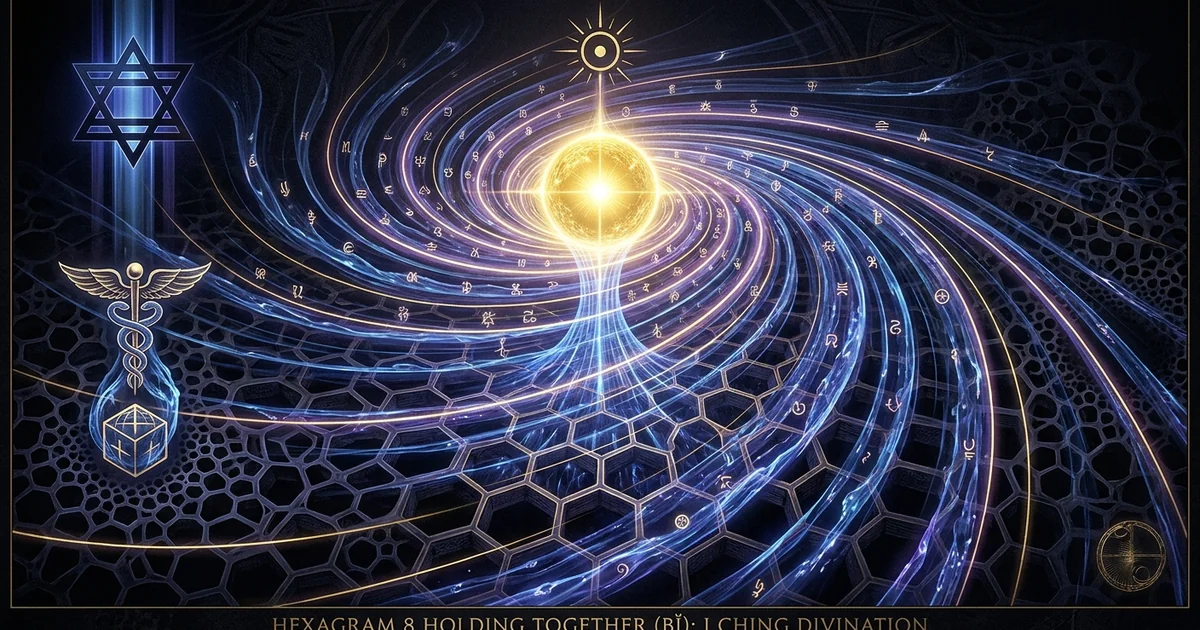
Hexagram 8 Holding Together (Bǐ): I Ching Divination
Archetypal Thesis & Systemic Paradigm: The Mechanics of Cohesion
Centripetal Dynamics and the Attractor State
Hexagram 8 (Bǐ, 比) constitutes the primary psycho-cosmological model for spontaneous self-organization within the I Ching state-space. Operating mathematically and phenomenologically as a non-linear basin of attraction, Bǐ details the conditions under which decentralized, discrete energetic units surrender isolated autonomy to participate in a coherent macro-system. Within systemic thermodynamics, an attractor represents a set of states toward which a dynamical system evolves over time; in the symbolic cartography of the Book of Changes, Hexagram 8 formalizes this exact principle through the structural placement of a solitary, radiant yang line at the fifth rank, anchoring and organizing five peripheral yin lines.
The hexagram does not portray an artificial or imposed consolidation. Rather, it models the natural aggregation of matter, energy, and psychic contents around a gravitational center of gravity. Viewed through the lens of analytical psychology, Bǐ exemplifies the consolidation of the ego-self-axis. When psychic contents remain splintered in dissociative identification with autonomous complexes, consciousness experiences fragmentation. The manifestation of Hexagram 8 marks the energetic threshold where these split elements undergo centripetal capture, drawn toward the archetypal Self not through repressive psychic defenses, but via an irresistible, non-coercive internal affinity.
Hexagram 8 (Holding Together / Bǐ)
--- --  Line 6 (Yin): The Latecomer / Severance
------  Line 5 (Yang): The Sovereign Ruler / Attractor
--- --  Line 4 (Yin): Outer Affiliation
--- --  Line 3 (Yin): Misguided Alliance
--- --  Line 2 (Yin): Inner Resonance
--- --  Line 1 (Yin): The Earthen Vessel / Sincerity
The Dialectic of Hexagram 7 (The Army) and Hexagram 8 (Holding Together)
In the canonical architecture of the King Wen sequence, Hexagram 8 directly follows and dialectically resolves Hexagram 7 (The Army, Shī). These two hexagrams form an inseparable operational pair sharing an identical binary polarity count (five yin lines and one yang line) while executing inverse systemic functions. In Shī, the solitary yang line is submerged at the second rank within the lower trigram, depicting water sequestered beneath the earth: latent, pressurized force subjected to rigid martial discipline, organizational hierarchy, and coercive mobilization. The army consolidates human multiplicity through external protocol, severe boundary conditions, and the imminent threat of state violence.
Hexagram 8 completely inverts this topological distribution. Here, the yang dynamic ascends to the fifth rank, moving from the subterranean operational sphere to the zenith of sovereign governance, while the water trigram emerges above the earth. The coercion of the military campaign gives way to organic social adherence. If Hexagram 7 represents the kinetic consolidation of disparate forces under the duress of conflict, Hexagram 8 signifies the enduring peace of voluntary union. The dialectic between them demonstrates that while an empire or psychic structure may be secured through martial concentration (Shī), it can only be sustained through the authentic, gravitational cohesion of Bǐ.
Hexagram 7: Shī (The Army)
- Trigram Topology: Water (Kǎn) beneath Earth (Kūn). Subterranean storage of force.
- Governing Mechanism: Centralized military discipline, legalistic constraint, and external command.
- Vector Dynamic: Centrifugal deployment of collective energy directed toward external pacification.
- Psychic Correlation: Egoic mobilization of will; defensive containment of unconscious drives.
- Structural Line: Nine in the second place serves as the subaltern general executing orders.
Hexagram 8: Bǐ (Holding Together)
- Trigram Topology: Water (Kǎn) above Earth (Kūn). Hydraulic permeation and surface irrigation.
- Governing Mechanism: Gravitational affinity, internal resonance, and spontaneous allegiance.
- Vector Dynamic: Centripetal convergence of peripheral elements toward a central, radiant attractor.
- Psychic Correlation: Individuation around the Self; spontaneous reconciliation of split complexes.
- Structural Line: Nine in the fifth place serves as the sovereign ruler embodying effortless centerhood.
Gravitational Consensus versus Coercive Force
The systemic transition embodied by the bǐ hexagram hinges upon the difference between coercive vector application and gravitational topological curvature. In sociopolitical, institutional, and psychic registers, coercive consolidation requires a continuous expenditure of thermodynamic energy to overcome entropic dispersion. Once the coercive pressure ceases, the system inevitably collapses back into factionalism or neurosis. Hexagram 8 introduces a stable equilibrium: the central sovereign node does not chase, hunt, or manipulate the components of the field. Instead, by fully actualizing its intrinsic nature, it alters the curvature of the relational landscape, compelling external elements to move toward it as a matter of path-of-least-resistance geodesic motion.
This operational equilibrium forms the core of the hexagram 8 holding together iching meaning. Cohesion here is non-violent. Water naturally flows across the surface of the earth, permeating every fissure, while the soil drinks in the moisture, forming a fertile, cohesive loam. Neither element violates the essential nature of the other; their union is dictated by physical law and topological compatibility. If an individual or an organizing node must resort to emotional manipulation, dogma, or administrative micro-management to maintain an alliance, the condition is not Bǐ, but a degenerative corruption of Shī. Gravitational consensus demands that the core maintain radical interior stability, allowing the peripheral components to align according to their own authentic affinities.
Classical Provenance & Textual Lineage: From King Wen to the Ten Wings
The Judgment (Tuan Zhuan) and the Oracle of Divinatory Fitness
The classical Judgment for Hexagram 8 establishes an immediate, paradoxical divinatory protocol that separates the casual user of the oracle from the initiated practitioner. The text explicitly demands a recursive act of self-interrogation before unity can be validated.
The Judgment (Wilhelm/Baynes): “Holding Together brings good fortune. Inquire again of the oracle whether you possess sublimity, constancy, and perseverance; then there is no blame. Those who are uncertain gradually join. Whoever comes too late meets with misfortune.”
Wang Bi (Zhouyi zhu, trans. Lynn, 1994): “Bǐ means mutual adherence… The five yin lines adhere to the one yang line, and the yang line adheres to the yin lines; they possess mutual trust. But adherence must have a center; if it lacks a center, divergence occurs. Therefore, the ruler must be sublime, constant, and steadfast. ‘Inquire again of the oracle’ means examining whether one’s virtue matches the position of the ruler before accepting allegiance. If one has such virtue, those without peace will gradually attach themselves.”
The admonition to “inquire again of the oracle” (yuán shì, yuán yǒng zhēn, wú jiù, 原筮元永貞无咎) has frequently baffled modern commentators who view divination as an externalized predictive mechanism. In classical book of changes divination, however, this phrase signifies an internal auditing of ethical and structural fitness. The oracle does not merely provide a passive forecast; it demands that the querent ascertain whether they hold the interior gravity—characterized by yuán (sublime originative power), yǒng (temporal perseverance), and zhēn (unwavering moral rectitude)—required to anchor a field of cohesion. If these properties are lacking, the attempt to form an alliance degenerates into complicity, yielding systemic decay (jiù).
Wang Bi’s Metaphysical Reading of the Isolated Yang Line
The third-century philosopher Wang Bi radically transformed the interpretation of the Zhouyi by sweeping away the cumbersome, mechanical omen-systems of the Han dynasty (such as xiangshu or image-and-number methodology) in favor of a clean, Xuanxue (Neo-Daoist) structural ontology. In his analysis of Hexagram 8, Wang Bi highlights the profound structural leverage of the lone yang line occupying the sovereign fifth rank. In a matrix dominated by Yin—which represents multiplicity, receptivity, and passive mass—the solitary Yang represents Unity, ontological primacy, and active intent.
Wang Bi demonstrates that line nine in the fifth place functions as the zhu (主), the structural ruler and metaphysical master of the hexagram. Because it is both central (zhong) and correct (zheng)—being an odd, firm line residing in an odd, elevated position—it does not need to move to influence the others. The five yin lines are drawn to it by virtue of their structural deficiency; lacking internal light, they naturally seek the central luminary. Wang Bi’s insight is fundamentally anti-totalitarian: the supreme ruler does not actively rule; rather, the ruler acts as an ontological axis around which the world orders itself through spontaneous alignment (ziran).
The Warning of the Latecomer (Hou Lai Fu)
The closing formula of the Judgment introduces a severe, non-negotiable temporal parameter: “Whoever comes too late meets with misfortune” (hòu lái xiōng, 後夫凶). In the temporal mechanics of the bǐ hexagram, timing is an ontological boundary condition rather than a mere logistical convenience. Cohesion depends upon phase synchronization. When an attractor initializes within a chaotic system, an open window of integration occurs during which decentralized nodes can join the emerging order and actively shape the collective basin.
Once the phase transition completes, the boundaries of the system undergo structural crystallization. The thermodynamic window closes. The entity that hesitates—whether driven by narcissistic inflation, ambivalence, or neurotic skepticism—finds that the gravitational center has consolidated its perimeter. At this juncture, the latecomer (hou fu) is no longer an invited partner, but an ontological anomaly, an unintegrated fragment exposed to the harsh exterior environment without systemic support. The late arrival does not merely miss an opportunity; it experiences active systemic expulsion, a catastrophe dictated by the immutable physics of temporal exclusion.
Structural Mechanics & Symbolic Geometry: Trigram Architecture and Vector Polarities
Water over Earth: Hydraulic Permeation and Substrate Stability
The macro-architecture of Hexagram 8 is defined by the intimate physical and symbolic interaction of its component trigrams: the upper trigram Kǎn (The Abysmal / Water) resting upon the lower trigram Kūn (Pure Receptivity / Earth). This configuration, water over earth, represents one of the most harmonious elemental relationships in the entire canon of the Changes. Water is by nature amorphous, downward-seeking, penetrating, and inherently hazardous; when left unchanneled, it dissolves into formless swamp or destructive torrent. Earth, conversely, is stable, dense, passive, and receptive, yet liable to barren sterility if unmoistened by fluids.
========  Trigram Kan (Water): Upper, Dynamic, Permeating
---  ---
========
---  ---  Trigram Kun (Earth): Lower, Receptive, Grounded
---  ---
---  ---
When water rests upon the surface of the earth, an immediate synergy occurs. The earth provides boundaries, channels, and a foundational substrate that contain the water’s dangerous fluidity, preventing it from dissipating into chaos. Simultaneously, the water permeates the granular interstices of the earth, binding dust into fertile soil capable of bearing life. The vector dynamics are perfectly complementary: water exerts a downward hydraulic pressure, while earth exerts an upward supporting force. In human affairs, this represents the integration of dangerous, fluid emotional and psychic currents within a grounded, practical framework of institutional and bodily reality.
The Sovereign Line: Nine in the Fifth Place as Central Vortex
The metaphysical core of Bǐ resides exclusively in the fifth line: Nine in the Fifth Place. In the syntax of the I Ching, the fifth rank is the station of the Prince, the Emperor, or the Self-actualized individual who has attained mastery over their domain. Nine in the fifth is the sole yang line in the entire hexagram. It is strong, luminous, and creative, balanced precisely in the center of the upper trigram Kǎn.
Because it occupies an odd rank with a firm line, it possesses structural correctness (zheng). Because it occupies the median point of the trigram, it possesses structural centrality (zhong). It thus unites both axial imperatives of classical Chinese metaphysics: it is neither deficient nor excessive. The nine in the fifth does not grasp at the five yin lines; its royal power is demonstrated through the famous metaphor of the royal hunt recorded in the line text:
“Holding together manifested. In the royal hunt, beaters are used on three sides only, and the game that runs off ahead is lost. The citizens need no warning. Good fortune.”
This passage outlines an archetypal doctrine of leadership and relational mechanics. The sovereign drives game from three directions, intentionally leaving the forward gate wide open. Those who wish to flee may flee; those who wish to enter the enclosure enter freely. The nine in the fifth rejects coercive containment, operating purely through the majesty of its presence. It represents a leadership model wherein personal sovereignty attracts free agents while refusing to trap those who are not in resonance with its teleology.
Line Trajectories: From Foundation to the Headless Conclusion
The six lines of Hexagram 8 delineate an evolutionary continuum of relational cohesion, illustrating every permutation of alliance from foundational sincerity to catastrophic isolation.
Six at the Top:       -- -- (Headless, tardy, systemic expulsion)
Nine in the Fifth:    ----- (Sovereign attractor, royal hunt on three sides)
Six in the Fourth:    -- -- (External allegiance, loyalty to the center)
Six in the Third:     -- -- (Misguided affiliation, shadow entanglement)
Six in the Second:    -- -- (Internal resonance, ego-Self alignment)
Six at the Beginning: -- -- (Earthen vessel, pure foundational sincerity)
-
Six at the Beginning: The base of the hexagram represents the initial impulse toward union. The imagery is that of a simple earthen vessel (fǒu, 缶) filled with plain water or wine. In antiquity, the fǒu was an unadorned clay pot used by the common people, contrasted with the ornate bronze ritual vessels of the aristocracy. The text insists that true alliance does not begin with sophisticated contracts or intellectualized alliances, but with radical, unvarnished interior truth (fú, 孚). Without this raw, foundational sincerity, any subsequent structural cohesion is illusory.
-
Six in the Second Place: This line occupies the central rank of the lower trigram Kun. It holds an authentic, internal connection with the sovereign fifth line above. The line text states: “Holding together comes from within. Perseverance brings good fortune.” Here, alignment is not mediated by external social pressures or political expediency; it emerges from the subterranean depth of character. In psychological terms, this is the interior intuition of the Self experienced by the quiet, receptive ego.
-
Six in the Third Place: Marking the transition point between the lower and upper trigrams, the third line occupies an unstable, over-excited position. The line text is stark and chilling: “You hold together with the wrong people” (bǐ zhī fěi rén, 比之匪人). The third line is surrounded by other pliable yin lines and severed from direct access to the sovereign ninth line. It represents the catastrophe of indiscriminate affiliation: enmeshment in toxic peer groups, trauma bonds, ideological echo chambers, and collective neuroses. The warning is categorical; maintaining this alliance ensures psychic or organizational contamination.
-
Six in the Fourth Place: Positioned in the outer trigram, the fourth line acts as the executive minister directly subordinate to the sovereign fifth line. “Holding together with him outside. Perseverance brings good fortune.” This line represents open, formalized, and public loyalty to a worthy principle or leader. The internal affinity of line two is here externalized into operational allegiance, providing a clean conduit between the ruler and the realm.
-
Nine in the Fifth Place: As detailed previously, this is the golden axis of the hexagram. The sovereign line practices non-possessive inclusion through the metaphor of the three-sided hunt. Cohesion is maintained through radical generosity and the absolute refusal to coerce.
-
Six at the Top: The final rank represents the tragic exhaustion of the hexagram’s structural potential: “Holding together without a head. Misfortune” (bǐ zhī wú shǒu, xiōng, 比之无首凶). Having delayed adherence past the critical phase transition, the top line finds itself positioned above the sovereign ruler, completely alienated from the central attractor. It has neither the humility to follow nor the generative potency to lead; it is entirely headless (wú shǒu). This line marks the fate of the latecomer who refuses systemic integration out of pride or procrastination, resulting in irreversible isolation.
Psychological Dynamics & Operational Praxis: Synchronicity and Consultative Decoding
Analytical Psychology: Constellating the Ego-Self Axis
Within the framework of analytical psychology formulated by Carl Gustav Jung and developed by Marie-Louise von Franz, the divinatory mechanism of the I Ching operates via the principle of synchronicity—an acausal connecting principle linking subjective psychic states with objective physical events. Hexagram 8 represents a profound archetypal event: the constellating of the ego-self axis.
“In the consultation of the I Ching, we are confronted with what Jung defined as a synchronistic event, wherein an inner, psychological condition meets an outer, physical constellation of yarrow stalks or coins. Hexagram 8 (Bǐ) specifically mirrors that moment in psychic development where the scattered, contradictory archetypal projections of the unconscious are recalled. The ego ceases its erratic, centrifugal flight and surrenders to the centripetal pull of the Self. The hexagram warns, however, that this alignment cannot be faked; it requires absolute authenticity, an ‘earthen bowl’ of interior emptiness and sincerity, without which the psychic fragments remain neurotic and disconnected.” — Marie-Louise von Franz, On Divination and Synchronicity: The Psychology of Meaningful Chance, pp. 68–72.
When an individual receives Hexagram 8 in a moment of existential crisis, the oracle diagnoses an urgent need for central psychic reorganization. In the unindividuated personality, the ego constantly attempts to govern the psyche through will, repression, and intellectual contrivance—a state analogous to the martial discipline of Hexagram 7. The emergence of Hexagram 8 demands that the ego abdicate this tyrannical role. The ego must recognize that it is not the sovereign Nine in the Fifth; it is merely one of the receptive Yin lines tasked with yielding to the true sovereign center: the Self. By aligning with this interior center, the split-off, autonomous complexes of the shadow and the personal unconscious are organically pacified and integrated into a unified whole.
Discerning True Affinities vs. Neurotic Codependency
A central diagnostic hazard addressed by Hexagram 8 is the confusion between authentic affinity and neurotic codependency. The text provides a vital corrective to the romanticized assumption that all forms of “holding together” are inherently benevolent. The presence of the third line, “You hold together with the wrong people,” serves as an uncompromising diagnostic marker for false unions, ideological possession, and collective shadow-bonding.
Neurotic cohesion is characterized by enmeshment, anxiety, boundary violations, and mutual projection. In such dynamics, individuals hold together not out of sovereign self-possession, but out of fear of isolation, systemic inertia, or shared pathology. Authentic Bǐ, conversely, requires that each participant maintain their structural integrity—symbolized by the distinct, uncompromised nature of Water and Earth. Water does not become Earth; Earth does not become Water. They form a functional alliance while preserving their essential chemical and elemental identities. Operative divinatory analysis must aggressively interrogate whether a client’s prospective partnership, business consolidation, or ideological allegiance is anchored in the foundational sincerity of Line 1 and the structural sovereignty of Line 5, or if it represents a degenerative descent into the codependent mire of Line 3.
Operational Directives for Consultative Praxis
When interpreting Hexagram 8 in consultative praxis, the esoteric cartographer must lead the querent through a rigorous, tripartite systemic diagnostic protocol:
-
Topological Position Assessment: The practitioner must first determine whether the querent is operating as the central attractor or as an orbiting node. If the querent is in the position of Nine in the Fifth (a founder, a leader, a spiritual teacher, an organizing node), the operational mandate is total non-coercion. They must establish clear ethical boundaries, maintain their internal virtue, and practice the “royal hunt on three sides,” permitting dissenters and non-resonators to depart without punitive retaliation. If the querent occupies the position of a Yin line, they must abandon subversive independence, check their egoic inflation, and commit whole-heartedly to an attractor worthy of their loyalty.
-
Temporal Window Evaluation: The practitioner must assess the system’s phase transition threshold. Is the collective still forming, or has the moment of crystallization passed? If the divination includes changing lines indicating a transition toward the upper register, the querent must be warned against the procrastination of the latecomer (hou fu). Ambivalence in the face of an authentic attractor inevitably leads to the headless catastrophe of the top line.
-
Substrate Integrity Verification: In alignment with the Judgment’s recursive command (“Inquire again of the oracle”), the querent must be instructed to audit their motives. Are they joining an enterprise out of genuine resonance, or out of commercial opportunism, fear of loneliness, or social vanity? If the “earthen vessel” of internal simplicity is absent, the consultation dictates immediate withdrawal until motive-purity is restored.
Philosophical Synthesis & Macrocosmic Correspondence: Hermetic Axioms and Systemic Dynamics
Phase Locking and Kuramoto Oscillations in Symbolic Cosmology
The energetic behavior formalized in Hexagram 8 finds an astonishing modern analog in non-linear dynamics, particularly the study of coupled nonlinear oscillators modeled by the Kuramoto equation:
$$\frac{d\theta_i}{dt} = \omega_i + \frac{K}{N} \sum_{j=1}^{N} \sin(\theta_j - \theta_i)$$
In a population of $N$ oscillators with natural frequencies $\omega_i$, weak coupling $K$ initially produces disorganized, incoherent behavior. As the coupling strength reaches a critical threshold ($K_c$), the system abruptly undergoes a spontaneous phase transition: the oscillators phase-lock, firing in collective, synchronized harmony without any external conductor directing their rhythm.
Hexagram 8 models this exact cosmological phenomenon within a symbolic framework. The five yin lines represent oscillators with diverse individual trajectories, while the nine in the fifth represents the sovereign coupling field ($K$). The transition from dispersion to cohesion is non-linear; once the central field reaches critical structural mass, the peripheral components snap into resonance. This dynamic directly mirrors the foundational Hermetic Principle of Correspondence: “As above, so below; as within, so without.” The same mathematical and symbolic dynamics governing the synchronization of cardiac pacemaker cells, planetary orbital resonances, and firefly flash-patterns govern the psycho-spiritual convergence of individuals within a civilization or archetypal contents within an individuating consciousness.
Genetic Codon Mapping and Molecular Self-Assembly
At the level of the biological substrate, the sixty-four hexagrams of the I Ching correspond structurally to the sixty-four codons of the universal genetic code—a mapping extensively explored by contemporary researchers in biophysics and esoteric cartography. Within this matrix, Hexagram 8 occupies an essential station related to molecular self-assembly and biological cohesion.
In macromolecular biology, the synthesis of a functional protein cannot proceed through random spatial collisions; it depends upon highly specific chemical affinities, hydrogen bonding, and hydrophobic interactions that allow long polypeptide chains to fold spontaneously into precise tertiary and quaternary architectures. Hexagram 8 corresponds to the regulatory transcription factors and molecular chaperones that facilitate this non-covalent, affinity-based cohesion. Just as water permeates and binds the granular earth without destroying its mineral composition, the aqueous cellular environment drives the folding of amino acids into biologically active complexes. The bǐ hexagram thus represents the archetype of biological morphogenesis: life organizing itself through the precise, delicate balance of liquid attraction and stable structural scaffolding.
Esoteric Parallels: The Sephira Tiphereth and Human Design Gate 8
The psycho-cosmological coordinates of Hexagram 8 interface seamlessly with adjacent western and modern esoteric frameworks, verifying the cross-cultural universality of its core archetype.
- Trigram Composition: Water (Kǎn, 坎) over Earth (Kūn, 坤).
- Western Astrological Affinity: Sun in Taurus / Moon in Cancer (Grounding emotional fluidity into form).
- Qabalistic Attribution: The Sephira Tiphereth (Beauty/Harmony/The Solar King) balancing and irrigating Malkuth (The Physical Kingdom/Earth).
- Human Design Integration: Gate 8: The Gate of Contribution (Located in the Throat Center; Circuit: Individual Knowing).
- Biological Mapping: Genetic Codons governing structural molecular cohesion and start-complex assembly.
- Alchemical Stage: Coagulatio (The fixation of the volatile within an earthen vessel).
In the Hermetic Qabalah, the nine in the fifth place corresponds directly to the solar center of Tiphereth, the sixth Sephira situated at the center of the Tree of Life. Tiphereth represents the harmonizing mediator that integrates the severe judgments of Geburah and the expansive mercies of Chesed, projecting its cohesive, solar light down into the dense material vessel of Malkuth (Earth). This is precisely the image of Water over Earth, where the heavenly sovereign waters the terrestrial domain, establishing an empire of peace through the sheer radiance of its central position.
Within the architecture of Human Design, Hexagram 8 maps directly to Gate 8 (The Gate of Contribution), located within the Throat Center. Belonging to the Individual Knowing Circuit, Gate 8 is the voice of authentic individual expression that leads by example: “I know I can contribute or not.” Crucially, Gate 8 does not lead through dogma or authoritarian control; it leads through the public manifestation of its unique creative integrity. It attracts the collective by being uncompromisingly itself, providing a visible model of individuation that others may voluntarily emulate. This modern configuration perfectly re-articulates the ancient Zhouyi teaching of the nine in the fifth: the sovereign hunter who leaves three sides of the field open, holding together the collective not through coercion, but through the irresistible excellence of its own authentic contribution.
Frequently Asked Questions
Resolving Ambiguities in Hexagram 8 Consultations
The appearance of Hexagram 8 in a divination consultation often induces confusion regarding the phrase: “Inquire again of the oracle whether you possess sublimity, constancy, and perseverance.” Practitioners frequently ask: Does this instruction require an immediate, literal re-casting of the coins or stalks?
The classical consensus across major lineages, from Wang Bi to Richard Wilhelm, affirms that this directive is primarily an operative interior mandate rather than an instruction to mechanically repeat the divinatory act. The text demands a reflexive pause. Divination is an act of synchronistic communion; when the system returns Hexagram 8, it issues a meta-cognitive warning that one cannot enter into a binding alliance, project, or institutional commitment while harboring internal ambiguity.
The querent must mentally step back and subject their soul to an internal audit: Do I possess the moral stamina (zhēn), the longevity of commitment (yǒng), and the pure generative nobility (yuán) required to sustain this bond? If the answer is uncertain, the querent must not proceed. If the querent chooses to cast a second time as a ritualized inquiry, they must do so only to interrogate the purity of their own motives regarding the alliance in question.
The Problem of the Latecomer and Systemic Boundaries
Another frequent interpretive dilemma centers on the severe warning that concludes the Judgment: “Whoever comes too late meets with misfortune.” Inquirers often struggle to reconcile this unforgiving boundary condition with the generally benevolent, unifying tone of the hexagram. Why does tardiness invite outright catastrophe?
The answer lies in the physics of phase transitions and boundary formation. Cohesion is not an infinitely elastic, perpetual state; it is a discrete evolutionary event. When an organizing node establishes a field, an open energetic corridor exists during which the system is plastic and receptive to newcomers. During this window, any joining entity contributes to the foundational parameters of the emerging culture, group mind, or structural architecture.
Once dynamic equilibrium is attained, the open corridor undergoes structural crystallization. The field shifts from an open basin of attraction to a closed, self-sustaining homeostatic organism. An entity that attempts to join after this crystallization has occurred cannot be natively integrated into the system’s structural matrix. The latecomer arrives either expecting special accommodations or lacking the humility to submit to the already established laws of the field. Consequently, the latecomer is experienced by the host system as a foreign pathogen or an energetic drain, resulting in inevitable friction, boundary rejection, and psychological or financial disaster (xiōng).
Differential Diagnosis of Changing Lines
The interpretation of Hexagram 8 shifts dramatically depending upon which changing lines are activated, particularly when the hexagram mutates toward related archetypal terrains:
-
Hexagram 8 mutating to Hexagram 2 (Pure Earth, Kūn): This transition occurs when the singular sovereign line, Nine in the Fifth, destabilizes and transforms into a yin line. This represents the total collapse of the central attractor. Without the organizing solar axis of the ninth line, the system dissolves into pure, undifferentiated mass. In consultative work, this diagnoses a situation where leadership has abdicated, the unifying vision has expired, and the individual or organization must surrender all attempts at centralization, adopting instead a stance of absolute yielding, passive waiting, and substrate receptivity.
-
Hexagram 8 mutating to Hexagram 20 (Contemplation / Viewing, Guān): This occurs when dynamic movement shifts the upper water trigram into wind (Xùn). The immediate, fluid emotional coherence of Bǐ elevates into a cool, objective, panoramic contemplation of macrocosmic patterns. The mandate ceases to be immediate relational consolidation and becomes instead the spiritual observation of universal law from a high tower.
-
Changing Six at the Top alone (mutating to Hexagram 23, Splitting Apart, Bō): This represents the most dangerous permutation of the hexagram. The “headless” condition at the summit catalyzes an immediate phase transition into systematic disintegration (Bō). It confirms that the querent has waited too long, has prioritized egoic pride over timely alignment, and must now prepare for the total, irreversible dissolution of the relational or institutional structure they sought to preserve.