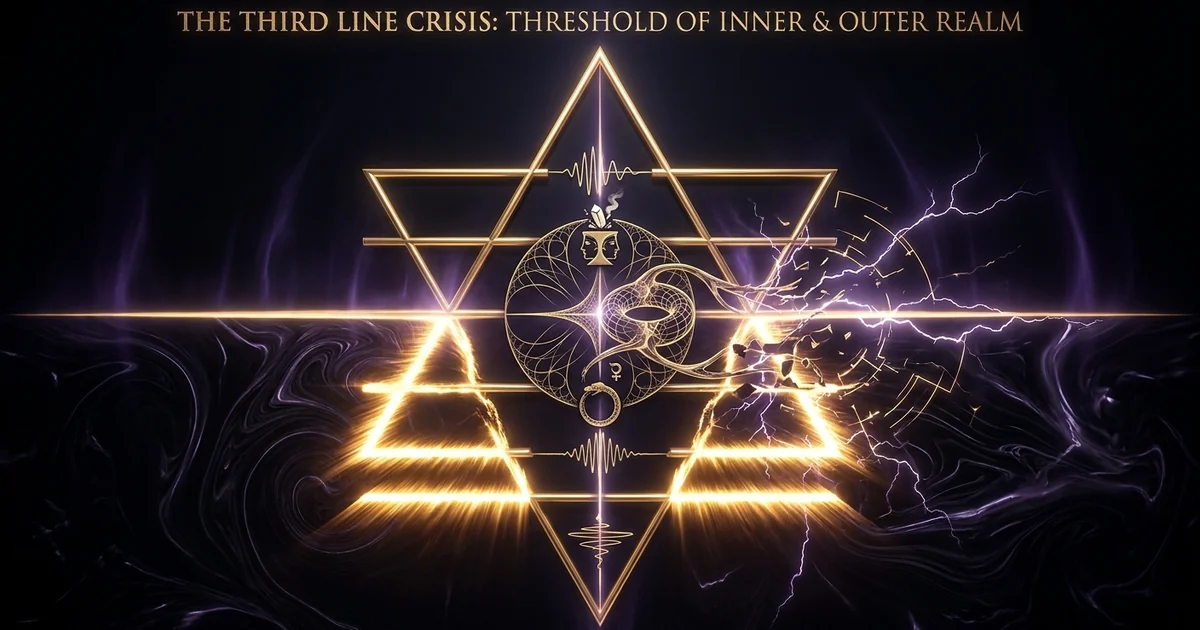
The Third Line Crisis: Threshold of Inner & Outer Realm
Archetypal Thesis & Systemic Paradigm: The Threshold of Rupture
Liminal Topology: The Terminal Apex of the Lower Trigram
In the formal architecture of the I Ching, the hexagram operates not merely as an arbitrary collection of six binary markers, but as a stratified state-space modeling the trajectory of consciousness through systemic transformation. Within this six-tiered hierarchy, the third line occupies an inherently destabilized coordinate: the absolute summit and structural cul-de-sac of the inner trigram (nei-gua). As the terminal boundary of interiority, line three constitutes an ontological threshold where self-referential containment reaches maximum density, collapses under its own internal pressure, and is forced to confront the unmediated friction of an objective outer reality (wai-gua).
This boundary position transforms the third line into an archetypal testing ground. In the progression documented across the classical sixty-four hexagram sequence, the first line signifies the subtle, unmanifest germination of an impulse, while the second line achieves internal equilibrium, residing in the harmonious center of the lower structure. By the time the dynamic vector reaches the third line, this equilibrium is violently disrupted. The third line cannot remain insulated within the subjective theater; it has exhausted the possibilities of private development. Consequently, the third line crisis represents the existential and structural impasse wherein an internally validated model of reality experiences violent dissonance upon colliding with systemic resistance.
The Dialectic of Containment and Exposure
The psychological and cosmological tension native to this position stems from the dialectic between structural containment and forced exposure. While lines one and two are shielded by the matrix of the lower trigram, line three borders the structural chasm dividing the subjective self from the collective cosmos. The third line is structurally over-leveraged. It has attained the highest status possible within its local domain, breeding an inflation of subjective competence, yet it occupies the lowest possible vantage relative to the macrocosmic demands of the upper trigram.
This generates a severe systemic disequilibrium. In human behavioral terms, this manifests as an overestimation of personal agency prior to actual contact with institutional, collective, or environmental constraints. The subjective matrix can no longer sustain the evolving dynamic, yet the external landscape remains foreign, indifferent, and hostile to unrefined projections. Thus, the danger of transition inherent to this coordinate is characterized by awkward overreach, structural fragility, and the recurring humiliation of an ego-complex that mistakes its localized mastery for universal authority.
Catastrophe Theory and the Epistemological Shock of Line Three
Interpreted through the lens of cybernetic feedback mechanisms and René Thom’s catastrophe theory, the line-three crisis is formalized not as a moral aberration or operational failure, but as a mandatory structural bifurcation. In catastrophe theory, continuous variations in internal parameters can induce sudden, discontinuous shifts in the behavioral state of a dynamic system. Line three represents precisely such a cusp catastrophe: the parameters of the inner trigram have been driven to their mathematical limits, producing a systemic instability that cannot be resolved through gradual adaptation.
Marie-Louise von Franz, in On Divination and Synchronicity: The Psychology of Meaningful Chance (1980), explicates structural threshold mechanics within archetypal divination arrays: “Whenever a dynamic system approaches the extreme boundary of its primary structural matrix, the continuity of cause-and-effect yields to synchronistic shock. The boundary state functions as an energetic cliff; the archetypal matrix enforces an abrupt structural death—an ontological humiliation—in order to purge the localized complex of its subjective autonomy before transpersonal reorganization can occur.”
The epistemological shock of line three functions as an evolutionary circuit breaker. If a psychic complex or organizational strategy could cross seamlessly from internal ideation into external execution without undergoing the crucible of line three, it would unleash unchecked pathologies into the macrocosm. The third line crisis iching transition threshold functions as a rigorous, dissipative filter: only those structures capable of absorbing systemic shock, discarding subjective hubris, and recalibrating their operational assumptions through empirical collision are permitted to cross the liminal seam into the higher structural tiers of the outer trigram.
Classical Provenance & Textual Lineage: The Dangers of the Border Zone
The Dazhuan (The Great Treatise) on the Uneasy Seat of Line Three
The canonical literature of the Yijing leaves no ambiguity regarding the precarious nature of this coordinate. In the Dazhuan (The Great Treatise, or Xici Zhuan), the cosmological architects of the text systematically categorized the lines according to their inherent moral and energetic risks. While the second line is consistently characterized as praiseworthy and balanced, and the fifth line as exalted and sovereign, the third line is marked by perennial catastrophe, anxiety, and operational friction.
“The third and fifth lines have the same function but different positions. The third line is often beset with misfortune; the fifth line is often marked by merit. This is because their ranks are high and low respectively. The soft is dangerous for the third line; the hard is precarious for the third line. If the third line is not endangered, it is humiliated. The third line is an uneasy seat, for it sits at the extreme of the inner and has not yet entered the honorable center of the outer.” — Dazhuan, Section II, Chapter 9 (trans. based on Wilhelm & Baynes, 1950)
The Dazhuan emphasizes that the third position is structurally unstable regardless of whether a Yin or a Yang line resides there. If a Yin line (the soft) occupies this seat, it is considered too frail to bear the intense structural shear forces generated at the trigram apex; it collapses under the weight of incoming macrocosmic forces. Conversely, if a Yang line (the hard) occupies the position, its assertiveness drives it into premature aggression, causing it to violently collide with the base of the upper trigram. Thus, the classical literature canonizes the testing ground hexagram as an archetype defined by anxiety (duo you) and disaster (duo xiong).
Wang Bi’s Neo-Daoist Exegesis: Multiplicity, Excess, and Friction
In his seminal third-century commentary, the Neo-Daoist philosopher Wang Bi radically reframed these divinatory judgments by establishing an ontological grammar based on the concepts of Zhong (centrality) and Wei (positional propriety). For Wang Bi, the tragedy of the third line is its absolute departure from centrality. While the second line governs the lower trigram because it holds the mean (Zhong), preserving an inward poise that does not lean toward extremes, the third line has fully abandoned the center to reside at the dangerous periphery of non-being and externalization.
Wang Bi argues that line three represents the tipping point where pure, unified intention degenerates into multiplicity and friction. In his commentary on the Classic of Changes, he demonstrates that the third line’s drive to act exceeds its structural foundation. It sits atop the lower realm looking upward, yet it lacks the transcendent vantage of the upper trigram’s center (line five). Consequently, its movements are inherently fraught with over-extension. Wang Bi notes that whenever a line occupies the third position, its primary virtue cannot be conquest or expansion; its sole path toward preservation lies in vigilant apprehension, profound modesty, and the systematic restraint of its own kinetic momentum.
Wilhelm’s Archetype of the Over-Ambitious Transition
Richard Wilhelm, synthesizing centuries of Neo-Confucian commentary with a nascent Western psychological sensibility, consistently translates the third line across the sixty-four hexagrams through the motif of the over-ambitious transition. In Hexagram 1 (Qian, The Creative), the third line famously dictates: “All day long the superior man is creatively active. At nightfall his mind is still beset with cares. Danger. No blame.” Wilhelm explicates this as the critical juncture where the individual steps out from private contemplation into public visibility. The individual is not yet recognized by the sovereign authority (the fifth line), nor firmly entrenched in the administrative apparatus (the fourth line); they are entirely alone on an exposed precipice.
Similarly, in Hexagram 3 (Chun, Difficulty at the Beginning), the third line cautions: “Whoever hunts deer without the forester only loses his way in the forest. The superior man understands the signs of the time and prefers to desist.” Here, the Wilhelm-Baynes translation exposes the line three archetype as an unguided impulse attempting to force progress without external mapping. In Hexagram 29 (Kan, The Abysmal/Water), the third line encounters “abyss upon abyss,” marking an absolute structural entrapment where any aggressive motion triggers catastrophic failure. Across the entire classical corpus, the third line is systematically codified not as an arena of victory, but as an operational furnace designed to incinerate presumption through immediate, unsparing feedback.
Structural Mechanics & Symbolic Geometry: Lower to Upper Trigram Dynamics
The Architectural Seam: The Void Between Earth-Human-Heaven Triads
To decipher the mechanics of the third line crisis, one must map its coordinates onto the foundational cosmological framework of the San Cai (The Three Talents: Earth, Human, Heaven). In this classical schema, the six lines of the hexagram are divided into three cosmic dyads:
- Lines 1 and 2 represent the foundational realm of Earth (Di).
- Lines 3 and 4 represent the mediating realm of Humanity (Ren).
- Lines 5 and 6 represent the macrocosmic realm of Heaven (Tian).
Heaven:  Line 6 (Yin/Transcendence)  | Upper Trigram (Wai Gua)
         Line 5 (Yang/Sovereignty)   | Macrocosmic Application
-----------------------------------------------------------------
Human:   Line 4 (Yin/Ministerial)    | Outer Boundary of Threshold
=================================================================
             *** THE LIMINAL SEAM / RUPTURE ZONE ***
=================================================================
Human:   Line 3 (Yang/Crisis/Trial)  | Inner Boundary of Threshold
-----------------------------------------------------------------
Earth:   Line 2 (Yin/Equilibrium)    | Lower Trigram (Nei Gua)
         Line 1 (Yang/Inception)     | Microcosmic Generation
A profound structural paradox occurs at this boundary. Lines 3 and 4 jointly constitute the Human realm, yet they are structurally bifurcated by the fundamental cleavage dividing the lower trigram from the upper trigram. This structural division means the Human realm is born in rupture. Line three functions as the lower, Yang, chthonic floor of humanity—representing raw existential striving, biological adaptation, and the unrefined ego. Line four represents the upper, Yin, socialized ceiling of humanity—representing cultural integration, ministerial duty, and institutional adaptation.
Consequently, the leap from line three to line four is the most structurally severe transition in the hexagram. Moving from line one to line two is an intra-trigram development; moving from line two to line three is the escalation toward an internal boundary. But the movement from line three to line four requires leaping across the void dividing the nei-gua from the wai-gua. Line three stands at this structural seam, looking across an ontological abyss toward an upper realm it cannot yet conceptualize.
Vector Analysis of Line Position: Polarities of Odd/Even and Inner/Outer
The intrinsic instability of the third position is further exacerbated by its mathematical attributes within the Yin-Yang coordinate matrix. In traditional structural analysis:
- Lines 1, 3, and 5 are intrinsically Yang positions (odd, active, initiating, forward-thrusting).
- Lines 2, 4, and 6 are intrinsically Yin positions (even, receptive, consolidating, yielding).
Because the third line occupies an inherently Yang position, it possesses an irrepressible dynamic imperative to thrust forward. It is structurally conditioned to advance, explore, disrupt, and assert. However, this Yang positionality is situated at the terminal boundary of an inward-facing system (nei-gua). The line’s kinetic energy is trapped within an architecture that has reached maximum capacity.
This creates an intense vector conflict. The odd-line imperative commands movement, but the structural geometry offers nowhere to move except into immediate collision with the ceiling of the lower trigram. If the occupant of this position is a Yang line (e.g., nine at the third place), this structural conflict becomes hyper-acute: Yang force sits in a Yang position at the end of an inner domain, generating extreme structural shear stress that frequently manifests as arrogance, premature externalization, or disastrous kinetic over-reach. Conversely, if a Yin line sits here (six at the third place), the passive substance is forced into an aggressive posture it cannot organically sustain, leading to exhaustion, systemic collapse, and profound self-doubt.
Systemic Vector Shift: From Nei Gua (Substance) to Wai Gua (Function)
The crossing of this boundary forces a transformation in systemic orientation, transitioning the entire operational calculus from Ti (Substance/Essence) to Yong (Function/Application). As documented in the foundational treatises on /iching/trigram-anatomy-inner-outer, the lower trigram models the internal state of the querent or system—its psychological makeup, latent resources, subjective intent, and foundational physics. The upper trigram models the external environment—the socius, macroeconomic conditions, transpersonal networks, and fate.
Line three operates as the crucible where Ti is violently converted into Yong. Prior to line three, a strategy or psychological development exists purely in the theoretical safety of the laboratory. It is self-consistent because it has not yet engaged an unyielding counter-will. Line three forces the initial, awkward interface with the external medium. It is an experimental heuristic; its task is to execute trial-and-error strikes against the threshold to discover what holds structural integrity and what collapses under external resistance. The line does not complete the crossing—that is the ministerial task of line four—but it unmasks every flaw in the lower trigram’s internal logic, functioning as a merciless operational filter.
Psychological Dynamics & Operational Praxis: The Trial-and-Error Individuation
Jungian Shadow and the Humiliation of the Ego-Complex
In his seminal Foreword to the Wilhelm-Baynes translation of the I Ching (1950), Carl Gustav Jung emphasized that the oracle’s mechanics depend upon the synchronistic intersection of subjective psychic states with archetypal, objective coordinate space. Viewed through analytical psychology, the third line crisis represents the painful confrontation between the inflated ego-complex and the broader demands of /esoteric-psychology/individuation-and-divination.
During the initial stages of psychological development (lines one and two), the ego builds interior competence. Line two represents that idyllic psychological plateau where the individual feels harmonized with their immediate environment; the unconscious and conscious intentions appear aligned. However, the movement into line three shatters this localized narcissism. The third line forces an encounter with the Jungian Shadow—specifically, with those unintegrated, repressed, or over-idealized elements that cannot survive exposure to the social and cosmic macrocosm.
Line 2: Interior Equilibrium
- Structural Location: Central node of the lower trigram (Zhong).
- Operational Stance: Receptive, self-contained, homeostatic balance.
- Relational Focus: Inward coherence; organic alignment between ego and local matrix.
- Systemic Failure Mode: Stagnant complacency; fear of externalizing capability.
- Primary Virtue: Modesty, equilibrium, preservation of internal resources.
Line 3: Threshold Crisis
- Structural Location: Terminal apex of the lower trigram (Liminal boundary).
- Operational Stance: Kinetic, disruptive, trial-and-error collision.
- Relational Focus: Boundary friction; aggressive confrontation with external alterity.
- Systemic Failure Mode: Inflation, premature overreach, structural rupture.
- Primary Virtue: Resilience, empirical adaptation, radical deconstruction of hubris.
The humiliation endemic to the third line in classical divinatory texts corresponds precisely to the deflation of the ego. As the individual attempts to step onto the transpersonal stage, their internal fantasy of omnipotence is unceremoniously dismantled by the friction of external reality. The ego discovers that its localized mastery counts for nothing in the broader socio-cultural hierarchy (represented by lines four and five). This psychological crisis is indispensable: without this deflation, the individual cannot achieve true maturity, remaining trapped in a state of arrested, infantile development.
Trial, Error, and Resilience: The Mechanic of Bonds Made and Broken
This mechanical dynamic finds modern systemic formulation within the structural mapping of Human Design, derived through Ra Uru Hu’s synthesis of the I Ching hexagram matrix with contemporary genetic and astronomical systems. Within this framework, as explored in /human-design/profile-lines-archetypes, the third line is designated as the archetype of the “Martyr/Experimenter.”
The third line operates through an immutable biological and psychological imperative: it learns exclusively through trial and error, discovering what does not work by colliding with it. The third line is designed to stumble into systemic faults, discover structural weaknesses, and experience the rupture of bonds. It is characterized by a cycle of making and breaking bonds:
- An initial investment in an ideology, relationship, or operational trajectory is pursued with absolute conviction.
- The trajectory inevitably collides with an unanticipated structural flaw at the boundary between internal expectation and external fact.
- The bond breaks, precipitating a localized crisis and emotional or operational humiliation.
- The system extracts empirical data from the collision, achieving a higher order of resilience and operational sobriety.
This trial-and-error mechanic is not a character flaw or a karmic curse; it is an epistemological methodology. In complex systems, the only way to map the true boundaries of an operational terrain is to cross them until a rupture occurs. The third line is the evolutionary probe sent to find the fault lines in reality. It exposes the latent fragility in systems so that the fourth line can establish stable, collective foundations upon resilient ground.
Divinatory Remediation: Navigating Line Three Mutations in Consultation
When an active (changing) line occurs at the third position during an I Ching consultation, it requires a distinct tactical and psychological recalibration. Novice practitioners frequently misinterpret line three mutations as harbingers of unmitigated tragedy, falling victim to superstitious anxiety. The practitioner must understand that the line simply marks a required structural audit.
In divinatory praxis, the appearance of an active third line mandates the following strategic maneuvers:
- Immediate Kinetic Cessation: The querent must instantly suspend forward-thrusting initiatives aimed at macrocosmic expansion. Any attempt to conquer the outer environment (line four or five territory) while anchored in an active line three will trigger structural rupture.
- Internal Boundary Audit: The querent must shift focus from external expansion to the containment of systemic leaks. Line three indicates that the internal model has broken down; the operating parameters must be audited and reconstructed.
- Embracing Operational Humiliation: Instead of defending an obsolete position out of egoic pride, the querent must yield to empirical feedback. The setback must be re-contextualized not as a permanent defeat, but as invaluable empirical data revealing what does not work.
- Preparation for the Chasm: The querent must recognize that they stand before the seam separating the inner from the outer realm. The crossing cannot be forced through direct exertion; it requires waiting for the structural resonance of line four to manifest organically.
Philosophical Synthesis & Macrocosmic Correspondence: Cybernetics, Mutation, and Genetic Codons
Information Theory and the Third Nucleotide Degeneracy
The mathematical homology between the sixty-four hexagrams of the I Ching and the sixty-four codons of the universal genetic code provides compelling evidence that the third-position crisis reflects a fundamental principle of informational and material architecture. In the genetic code, a codon consists of a three-nucleotide sequence that instructs the cellular machinery to produce a specific amino acid. When the hexagram is mapped as a double-codon (a lower triplet of nucleotides and an upper triplet), the third position corresponds to the terminal base of the first codon.
In molecular biology, Francis Crick’s wobble hypothesis demonstrates that the base-pairing rules are remarkably strict at the first and second positions of the codon triplet, but demonstrate profound thermodynamic relaxation—or “wobble”—at the third position. This third nucleotide degeneracy allows for non-standard base pairings, functioning as an evolutionary shock absorber: mutations at this third coordinate frequently do not alter the resulting amino acid, granting the organism mutational flexibility without lethal structural consequence. Simultaneously, this position is the primary engine of evolutionary drift and informational mutation within the genome.
The structural parallel to the I Ching is mathematically and conceptually exact. Just as the third nucleotide in the genetic codon represents the point of maximum systemic variance, flexibility, and mutational hazard, the third line of the hexagram is the structural node where the binary pattern destabilizes to permit systemic mutation. The lower trigram cannot cross into the upper trigram without the operational “wobble” of line three. The testing ground hexagram is nature’s mechanism for introducing controlled error into an otherwise rigid system, ensuring that genetic and conscious life remains capable of adaptive evolution rather than crystallizing into systemic rigor mortis.
The Alchemical Nigredo of the Lower Realm
In the Hermetic and Western alchemical traditions, the transformation of base matter into the incorruptible vehicle of the Philosopher’s Stone mirrors the tripartite progression of the lower trigram. The first line corresponds to the initial gathering of the prima materia; the second line reflects the harmonious distillation of the internal elements within the sealed vessel (vas hermeticum). Line three, however, represents the catastrophic onset of the Nigredo (the Blackening)—the mandatory putrefaction and structural death of the matter.
In alchemy, the lower vessel must undergo absolute mortification before the subtle essences can vaporize and rise into the upper realm of the alembic. If the alchemist attempts to bypass the Nigredo, the work is aborted; the base elements remain unpurified, merely coated in a superficial, volatile sheen.
The third line crisis is the exact equivalent of this alchemical putrefaction. The subjective ego, built up through the initial lines, must undergo a process of systematic mortification. Its calcified assumptions must be reduced to ash through painful contact with reality. Only when this dissolution is complete can the dynamic force cross the liminal threshold into the upper realm, reforming as the purified, transpersonal consciousness of the upper trigram.
Macrocosmic Cyclical Evolution: Phase Shifts in Complex Systems
Across all self-organizing systems—whether macroeconomic cycles, the rise and fall of historical civilizations, or the phase shifts of complex thermodynamic systems—progress is never linear. Systems evolve according to the principles of punctuated equilibrium. A system maintains homeostatic stability across a prolonged period until internal pressures and environmental changes drive it to the far-from-equilibrium state known in cybernetics as a critical bifurcation threshold.
Macrocosm  | Wai Gua (Upper)  : Lines 4-5-6 [Collective Praxis & Sovereignty]
=============================================================================
THRESHOLD  | BIFURCATION SEAM : Phase Transition / Catastrophe Node
=============================================================================
Microcosm  | Nei Gua (Lower)  : Lines 1-2-3 [Localized Assembly & Rupture]
Line three marks this precise bifurcation threshold within the systemic topology of the I Ching. It is the coordinate where a complex system can no longer sustain itself on its initial operating parameters. The crisis that unfolds here is the macroscopic phase shift in miniature: the localized order breaks down, creating chaos, friction, and entropy. Yet, this localized entropy is the strict mathematical precondition for negentropy (the creation of higher-order complexity) to emerge in the upper trigram. Without the third line crisis, the system remains a closed thermodynamic circuit, destined for entropic heat-death. By breaking the vessel of the lower trigram, line three forces the system to open itself to the macrocosm, initiating the vast, evolutionary ascent into the outer world.
Frequently Asked Questions
Why is the third line so consistently described as dangerous or humiliated across the 64 Hexagrams?
The third line is branded as dangerous and humiliated (xiu) across the classical canon not due to moral failing, but because of its topological location at the absolute limit of the inner trigram (nei-gua). At this coordinate, the system has exhausted its internal structural possibilities. It has reached the highest rank possible within the subjective, private sphere, which naturally breeds cognitive inflation and over-confidence.
However, line three possesses no formal rank or authority within the macrocosmic outer realm (wai-gua). When it inevitably attempts to assert its localized mastery across the boundary, it collides directly with external reality, social hierarchies, and cosmic laws that remain wholly indifferent to its internal assumptions. The resulting systemic friction strips away the line’s subjective pretenses through an abrupt operational check. In the architectural taxonomy of the hexagram, line three is designated as an experimental sacrificial probe: it takes the brunt of the impact so the overarching system can extract empirical data regarding where the external boundaries truly lie.
How does the dynamic between Line 3 and Line 4 differ from other adjacent line transitions?
The transitions between adjacent lines within the same trigram—such as Line 1 to Line 2, or Line 4 to Line 5—represent continuous, localized developments within a single operational theater. Moving from Line 1 to Line 2 is an organic consolidation of interior substance (Ti); moving from Line 4 to Line 5 is a smooth upward transition from administrative implementation to sovereign authority within the external sphere (Yong).
The transition between Line 3 and Line 4 is fundamentally discontinuous, representing a quantum leap across the great architectural seam dividing the hexagram. Line 3 is the terminal apex of the internal, self-referential world; Line 4 is the vulnerable foundation of the external, collective world. Crossing this seam requires a complete inversion of operational polarity. Line 3 must accept the total exhaustion and death of its subjective omnipotence, while Line 4 must step out onto the uncertain stage of the social matrix as an apprentice to higher forces. It is the only transition in the hexagram where the underlying structural domain itself radically shifts from the micro-subjective to the macro-objective.
What is the tactical remedy when receiving an active third line in an I Ching divination?
Receiving an active (changing) third line requires immediate operational and psychological recalibration. The primary strategic imperative is the immediate cessation of outward kinetic expansion. Any attempt to force an external outcome, launch an enterprise, or impose one’s will on the social hierarchy will trigger the archetypal humiliation native to the position.
The querent must adopt an operational stance of vigilant, non-defensive observation. Specifically, one should:
- Anticipate Localized Breakdowns: Recognize that current plans contain structural vulnerabilities that must fail so that deeper flaws can be identified.
- Re-frame Failure as Heuristic Data: Interpret operational friction, interpersonal rejection, or mechanical breakdown not as a personal indictment, but as objective feedback signaling the absolute limits of the current approach.
- Execute Internal Repairs: Shift resources away from external engagement and redirect them toward auditing internal boundaries, refining systems, and purging unrealistic assumptions.
- Resist Premature Crossing: Yield to the reality that the time for sovereign command (Line 5) has not arrived; one must patiently endure the crucible of trial and error until the threshold between the inner and outer realms naturally dissolves.