Early Heaven vs Later Heaven Bagua: Cosmic Transits
Archetypal Thesis & Systemic Paradigm: The Noumenal and Phenomenal Coordinate Spaces
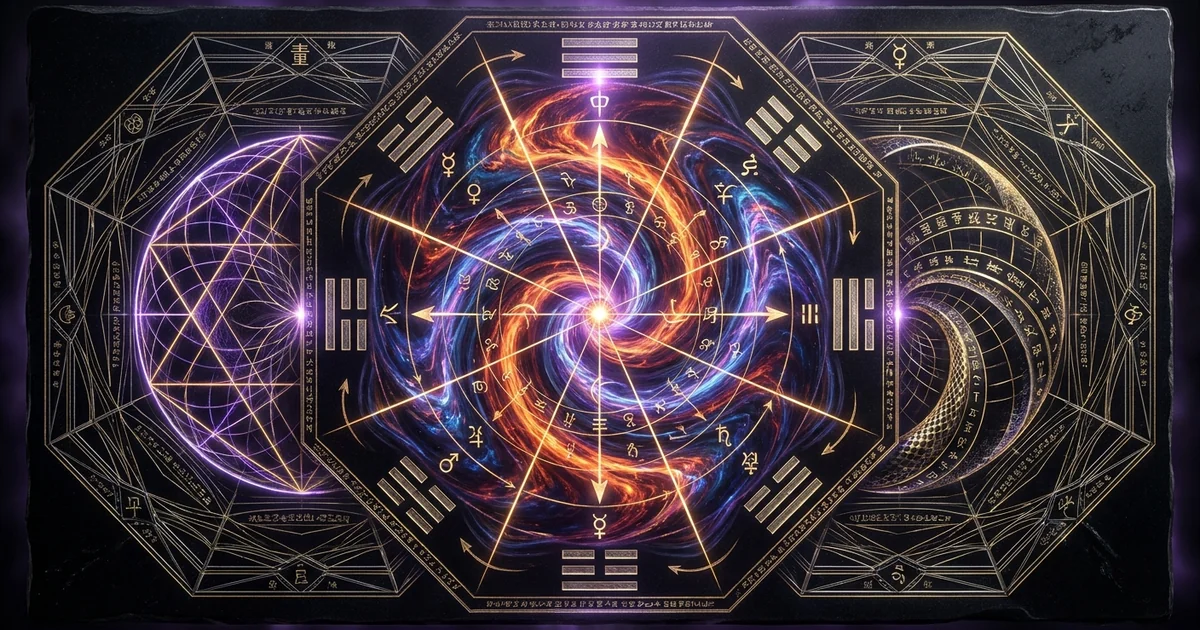
The structural architecture of the I Ching rests upon a foundational topological bifurcation: the dual configurations of the eight trigrams (bagua), known historically and conceptually as the Early Heaven (Xiantian, or Fu Xi) and the Later Heaven (Houtian, or King Wen) arrangements. Far from representing arbitrary historical revisions or competing mythological traditions, these two cosmograms constitute a coherent, coupled coordinate system. Together, they model the ontological transition from unmanifest, symmetrical noumenon to dynamic, dissipative phenomenal manifestation. In this psycho-cosmological framework, the Early Heaven array operates as an unmanifest coordinate space of pure potentiality, where diametrically opposed trigrams establish complementary polar balances that mathematically sum to absolute cancellation—a zero-point energy of archetypal equilibrium. Conversely, the Later Heaven arrangement maps this potentiality into actualized, thermodynamic reality, transposing the polar pairs into a broken-symmetry, sequential vector field governed by the temporal cycles of solar irradiation, biological metabolisms, and seasonal decay.
                  [ EARLY HEAVEN (Fu Xi) ]
                     Noumenal Invariant
               Static Zero-Sum Cancellation
                Symmetric Archetypal Ground
                            │
                            │  Spontaneous Symmetry-Breaking
                            │  (Temporalization / Genesis)
                            ▼
                  [ LATER HEAVEN (King Wen) ]
                    Phenomenal Kinematics
                 Dynamic Thermodynamic Work
                 Asymmetric Temporal Vector
The Primordial Symmetry of Xiantian (Fu Xi) as Ontological Invariant
The Xiantian cosmogram, traditionally attributed to the mythic cultural hero Fu Xi, articulates reality in potentia. Within this arrangement, the cosmos is modeled prior to the descent into temporal succession, presenting an eternal, self-contained architecture of reciprocal forces. Each trigram is situated directly across the circle from its exact binary and qualitative opposite: Qian (☰, Pure Yang, Heaven) occupies the South, directly opposing Kun (☷, Pure Yin, Earth) at the North; Li (☲, Clinging Fire) in the East confronts Kan (☵, Abyssal Water) in the West; Dui (☱, Joyous Lake) in the Southeast faces Gen (☶, Still Mountain) in the Northwest; and Zhen (☳, Arousing Thunder) in the Northeast mirrors Xun (☴, Gentle Wind) in the Southwest.
This geometric distribution produces an absolute standing wave. When evaluated through binary notation—where a broken yin line signifies 0 and an unbroken yang line signifies 1—every diametrical pair constitutes an exact bitwise NOT operation: Qian (111) reflects Kun (000), Li (101) cancels Kan (010), Dui (110) balances Gen (001), and Zhen (100) resolves Xun (011). The vector sum of these opposing archetypal forces across every geometric axis is zero. The Early Heaven array therefore models an ontological invariant: an unconditioned state of balance devoid of directional torque, kinetic entropy, or internal evolutionary pressure. It is the geometric signature of the Void (Wuji) polarizing into primordial polar differentiation (Taiji) without yet precipitating the asymmetric friction required for temporal duration. As explored in the study of /sacred-geometry/platonic-solids-and-symmetry-breaking, primordial geometric forms maintain complete spatial invariance until structural perturbations introduce directional development; the Fu Xi Bagua is precisely this invariant, pristine baseline.
The Asymmetric Dynamic of Houtian (King Wen) as Manifest Phenomenal Flux
The Houtian arrangement, formulated under the historical suffering and systemic turbulence associated with King Wen of Zhou, structurally ruptures this primordial equilibrium to construct an empirical, temporal cartography. In this phenomenal configuration, the pristine diametric cancellations of Fu Xi are dismantled. The pure metaphysical axes of Qian and Kun are displaced from the primary vertical orientation. Li (Fire, ☲) is elevated to the South, occupying the apex of maximum solar culmination, while Kan (Water, ☵) descends to the North, anchoring the nadir of midnight and the winter solstice. Qian (☰) is relocated to the Northwest, and Kun (☷) to the Southwest, transforming their roles from primary structural pivots into supporting generative margins.
This geometric reorganization breaks the pristine spatial symmetry of the Xiantian field, introducing a persistent rotational torque. The trigrams no longer rest in mutual, self-canceling contemplation; instead, they generate a directional, thermodynamic circuit. Zhen (Thunder, ☳) is placed in the East, initiating the vernal impulse of biological germination; Xun (Wind/Wood, ☴) occupies the Southeast, fostering growth and proliferation; Li drives the metabolic heat of the South; Kun provides the receptive physical matrix in the Southwest; Dui harvests and condenses in the West; Qian bestows crystalline ordering principles in the Northwest; Kan preserves latent vital essence amidst the entropic cold of the North; and Gen halts movement in the Northeast, establishing the winter threshold where the cycle rests before re-emerging. The King Wen Bagua is thus an operational map of thermodynamic expenditure, tracking irreversible temporal progression, biological emergence, cellular decay, and the cyclical reality of the lived world.
Early Heaven (Xiantian / Fu Xi)
- Structural Axis: Pure Diametric Inversion (Heaven-Earth Axis: Qian ☰ / Kun ☷).
- Directional Orientation: Metaphysical/Ideal (South = Maximum Yang/Qian; North = Maximum Yin/Kun).
- Thermodynamic Property: Zero-sum equilibrium; standing wave; zero entropy production; static potential.
- Metaphysical Domain: Noumenal ground; the archetypal matrix of the Unconscious; unmanifest order (Wuji to Taiji).
- Mathematical Vector: Static polar symmetry; exact binary complementation (Bitwise NOT across all 4 axes).
Later Heaven (Houtian / King Wen)
- Structural Axis: Kinetic Thermodynamic Axis (Fire-Water Axis: Li ☲ / Kan ☵).
- Directional Orientation: Terrestrial/Phenomenological (South = Noon/Summer/Li; North = Midnight/Winter/Kan).
- Thermodynamic Property: Far-from-equilibrium dissipation; cyclical vector flow; positive entropy conversion.
- Metaphysical Domain: Phenomenal manifestation; temporal embodiment; biological and historical cyclicity.
- Mathematical Vector: Broken symmetry; circular rotational sequence driven by Five-Phase (Wuxing) generation.
Classical Provenance & Textual Lineage: From Mythic Codices to Song Dynasty Neo-Confucian Cartography
The structural differentiation between the Early and Later Heaven arrangements is rooted in the Han-era hermeneutic canon, yet its formal geometric visualization did not achieve standardized cartographic expression until the intellectual renaissance of the Northern Song Dynasty. Understanding this lineage requires disentangling ancient cosmological fragments from their later systematic visual expressions.
The Shuogua Zhuan (Tenth Wing) and the Classical Cryptography of Directional Arrays
The foundational textual locus for both arrangements resides within the Shuogua Zhuan (說卦傳, “Explanation of the Trigrams”), historically cataloged as the Eighth of the “Ten Wings” (Shiyi) appended to the core divinatory manual of the Zhouyi. Rather than displaying visual geometric diagrams—which were largely esoteric, transmissible only via lineage, or suppressed prior to the Song epoch—the Shuogua Zhuan preserves these two spatial orientations in cryptic, contrasting nature aphorisms.
In Chapter 3 of the Shuogua Zhuan, the text outlines the structural balance of the primordial order:
“Heaven and Earth determine the direction. The forces of mountain and lake are united. Thunder and wind arouse each other. Water and fire do not combat each other. Thus are the eight trigrams intermingled. Counting that which is going past is accordance; knowing that which is to come is anticipation. Therefore the Changes consists of anticipatory knowledge.”
This passage models the Xiantian geometry: it lists the trigrams strictly in reciprocal pairs (Heaven/Qian vs. Earth/Kun; Mountain/Gen vs. Lake/Dui; Thunder/Zhen vs. Wind/Xun; Water/Kan vs. Fire/Li), outlining a space of simultaneous co-presence and mutual counterweight. The final mathematical aphorism—linking the mechanics of the I Ching to “anticipatory knowledge” through backwards calculation—points to the non-linear, reversible nature of time within this primordial state.
In stark contrast, Chapter 5 of the same treatise abruptly shifts from spatial balance to a chronological, cyclical narrative:
“The Lord emerges in the sign of the Arousing; he brings all things to completion in the sign of the Gentle; he causes them to meet one another in the sign of the Clinging; he causes them to be served in the sign of the Receptive; he rejoices them in the sign of the Joyous; he battles in the sign of the Creative; he rests in the sign of the Abyssal; he brings them to perfection in the sign of the Keeping Still.”
Here, the text articulates the Houtian progression. It traces a unidirectional, clockwise sequence through the seasons and compass quadrants, commencing in the East with Zhen (the Arousing, Spring) and culminating at the threshold between Kan (Winter) and Gen (the pivot between death and rebirth). The textual juxtaposition within the Shuogua Zhuan preserved the cosmological seed of these two topologies for over a millennium, awaiting an intellectual paradigm capable of decoding their underlying geometric matrices. The technical mechanics of how these trigrams compound into composite structures can be further explored in the study of /iching/structural-anatomy-64-hexagrams.
Source Translation Reference: Richard Wilhelm & Cary F. Baynes (1950), The I Ching or Book of Changes, Bollingen Series XIX, Princeton University Press.
Chapter 3 (The Primordial Symmetrical Array / Fu Xi): 天地定位,山澤通氣,雷風相薄,水火不相射,八卦相錯。數往者順,知來者逆,是故《易》逆數也。 “Heaven and Earth determine the positions; Mountain and Lake intercommunicate their vital breaths; Thunder and Wind arouse each other; Water and Fire do not combat each other; the eight trigrams intermingle. Counting the past follows the natural flow; knowing the future requires moving counter to the flow. Hence, the Book of Changes is calculated backwards.”
Chapter 5 (The Sequential Phenomenal Array / King Wen): 帝出乎震,齊乎巽,相見乎離,致役乎坤,說言乎兌,戰乎乾,勞乎坎,成言乎艮。 “The Divine Ruler comes forth in Zhen (East/Spring); He brings all things to uniformity in Xun (Southeast); He reveals them to one another in Li (South/Summer); He causes them to be nourished in Kun (Southwest); He brings them joy in Dui (West/Autumn); He contends in Qian (Northwest); He rests in Kan (North/Winter); He completes them in Gen (Northeast).”
Shao Yong’s Neo-Confucian Epistemology and the Resurfacing of the Dual Bagua Cosmograms
The implicit geometry of these two textual fragments was formally realized through the work of the Northern Song philosopher and cosmologist Shao Yong (邵雍, 1011–1077 CE). Operating within the burgeoning Neo-Confucian movement, Shao Yong sought to re-establish the metaphysical underpinnings of Sinitic philosophy by constructing a comprehensive structural cartography of reality, synthesized within his monumental work, the Huangji Jingshi Shu (皇極經世書, Book of Supreme World Ordering Principles).
Drawing upon mystical diagrams transmitted through Daoist lineages—most notably through the master Chen Tuan (陳摶, c. 871–989 CE)—Shao Yong demonstrated that the two arrangements in the Shuogua Zhuan were mathematical maps of reality. He formally coined the terms Xiantian (“Early Heaven” or “Pre-celestial”) and Houtian (“Later Heaven” or “Post-celestial”), assigning the former to the pristine primal awareness of Fu Xi and the latter to the empirical socio-political ordering of King Wen.
[ Mythic River Codices: He Tu & Luo Shu ]
                   │
                   ▼ (Esoteric Daoist Lineages: Chen Tuan)
[ Song Dynasty Formalization: Shao Yong (1011–1077 CE) ]
                   │
       ┌───────────┴───────────┐
       ▼                       ▼
[ Xiantian Cosmogram ]   [ Houtian Cosmogram ]
(Binary / Structural)     (Cyclic / Dynamic)
       │                       │
       └───────────┬───────────┘
                   ▼
[ Unified Neo-Confucian Metaphysical Coordinate System ]
Shao Yong’s critical epistemological breakthrough was the realization that the Xiantian Bagua represents a pure binary sequence. By arranging the trigrams according to their yin and yang compositions, he illustrated that Fu Xi’s circle was an unconditioned, self-generating binary continuum. He aligned the Xiantian array with the mythic river chart known as the He Tu (Yellow River Map), which stresses an additive, balanced numeric order of primal elements. Simultaneously, he correlated the Houtian Bagua with the Luo Shu (Writing from the Luo River), whose 3x3 magic square captures asymmetric dynamism and directional change. For an exhaustive analysis of these primordial codices, see the research monograph on /iching/he-tu-luo-shu-origins. Through Shao Yong’s synthetic cartography, the Zhouyi transitioned from an ancient oracle into an all-encompassing psycho-cosmological coordinate framework capable of navigating both eternal being and temporal becoming.
Structural Mechanics & Symbolic Geometry: Topological Inversion and Phase Shifts
The mechanical and mathematical distinctions between the Early Heaven and Later Heaven matrices become apparent when analyzed through spatial geometry, binary topology, and thermodynamic phase dynamics.
       EARLY HEAVEN (Fu Xi)                   LATER HEAVEN (King Wen)
       Noumenal Equilibrium                    Phenomenal Circulation

               Qian (☰)                                 Li (☲)
             S (Pure Yang)                           S (Fire / Midsummer)
                  ▲                                       ▲
                  │                                       │
      Dui (☱)     │     Xun (☴)               Xun (☴)     │     Kun (☷)
         SE       │       SW                     SE       │       SW
                  │                                       │
Li (☲) ──────────┼────────── Kan (☵)     Zhen (☳) ───────┼─────── Dui (☱)
E (Fire)          │          W (Water)    E (Spring)      │       W (Autumn)
                  │                                       │
      Zhen (☳)    │     Gen (☶)               Gen (☶)     │     Qian (☰)
         NE       │       NW                     NE       │       NW
                  ▼                                       ▼
               Kun (☷)                                 Kan (☵)
             N (Pure Yin)                           N (Water / Midwinter)
Axis Polarity and Binary Inversion in the Fu Xi Matrix
The Fu Xi matrix is governed by absolute geometric polarization. The central vertical axis represents the primordial ontological polarity: Qian (☰, binary 111) at the South directly confronts Kun (☷, binary 000) at the North. This axis marks the cosmological extremes of light and shadow, consciousness and material latency. The horizontal axis establishes the thermodynamic balance of fluids and excitation: Li (☲, binary 101) in the East faces Kan (☵, binary 010) in the West, balancing radiance with cohesion. The diagonal axes preserve this exact polarity: Zhen (☳, binary 100, Thunder) at the Northeast opposes Xun (☴, binary 011, Wind) at the Southwest; Dui (☱, binary 110, Lake) at the Southeast opposes Gen (☶, binary 001, Mountain) at the Northwest.
Every single axis through the center of the Fu Xi cosmogram sums to an identical scalar value when evaluating yin and yang line metrics: every axis consists of exactly three yang lines and three yin lines. This configuration maintains a complete standing wave. Because every structural vector is immediately neutralized by an equal and opposite counter-vector, the system has zero net kinetic angular momentum. The Xiantian Bagua does not rotate; it oscillates in place as a perpetual resonance of archetypal possibilities.
Thermodynamic Phase Transitions and Five-Phase (Wuxing) Alignment in the King Wen Matrix
The King Wen arrangement fractures this standing wave by realigning the trigrams according to the qualitative kinetics of the Five Phases (Wuxing, 五行) and the astronomical realities of the Northern Hemisphere:
- South (Zenith / Apex): Seated by Li (☲, Fire). This corresponds to maximum solar elevation (noon), midsummer, the color red, and the dispersion of thermal energy.
- North (Nadir / Base): Seated by Kan (☵, Water). This corresponds to maximum solar absence (midnight), midwinter, deep cold, and the consolidation of quiescent potential.
- East: Seated by Zhen (☳, Wood/Thunder). This marks the sunrise, the vernal equinox, the emergence of dynamic kinetic motion, and the sudden arousal of vegetative life.
- West: Seated by Dui (☱, Metal/Lake). This governs the sunset, the autumnal equinox, the gathering of the harvest, and condensational deceleration.
- Southwest: Seated by Kun (☷, Earth). Kun represents the late summer harvest and the dense, receptive physical substrate required to support the zenith of solar expenditure.
- Northwest: Seated by Qian (☰, Metal/Father). Displaced from the zenith, Heaven is repositioned as the structural architect at the edge of darkness, supplying the crystalline law and moral ordering principles that preserve coherence through winter.
- Northeast: Seated by Gen (☶, Earth/Mountain). Gen stands as the gatehouse between night and dawn, the stillness where temporal inertia ceases before the new cycle germinates in Zhen.
- Southeast: Seated by Xun (☴, Wood/Wind). Xun represents late spring, the fluid dispersal of life-giving breath, and the vegetative branching of form.
By positioning Li (Fire) at the top and Kan (Water) at the bottom, the King Wen Bagua replicates the physical architecture of a heat engine. Unlike Qian and Kun, which are abstract metaphysical polarities, Li and Kan represent embodied thermodynamic principles. Fire naturally ascends; water naturally descends. Placed in their phenomenal positions, Fire moves upward into empty space while Water flows downward away from it, driving a continuous cycle of evaporation, condensation, and systemic convection.
Topological Vector Shifts: From Diametric Balance to Vector Circulation
The phase shift between the two cosmograms can be mapped as a topological vector reorganization. In the transition from Early Heaven to Later Heaven, the system undergoes spontaneous symmetry breaking:
This shift forces an operational pivot:
- The Heaven-Earth Axis to Fire-Water Axis Transformation: Metaphysical containment (Qian-Kun) folds inward, yielding its outer directional dominance to experiential thermodynamic agency (Li-Kan).
- Polar Cancellation to Rotational Vector: The static diametric opposition gives way to a clockwise, closed-loop circulation driven by the generative (Sheng, 生) and restrictive (Ke, 剋) cycles of the Five Phases.
- Reversibility to Irreversibility: In Fu Xi’s array, time is mathematically reversible because the axes are symmetric mirrors. In King Wen’s wheel, time acquires its phenomenological arrow. One cannot transit from the autumnal harvest of Dui directly into the vernal germination of Zhen without passing through the entropic consolidation of Qian, Kan, and Gen. The King Wen arrangement models the macroscopic thermodynamic arrow of time.
Psychological Dynamics & Operational Praxis: Archetypal Decentering and State-Space Navigation
Beyond its cosmological and mathematical dimensions, the dual Bagua paradigm functions as a sophisticated model of human consciousness, somatic embodiment, and psychic transformation.
       EARLY HEAVEN MATRIX                     LATER HEAVEN MATRIX
        (Psychic Archetype)                    (Psychic Manifestation)

    ┌─────────────────────────┐             ┌─────────────────────────┐
    │     Unconscious Self    │             │      Ego-Complex        │
    │  Pre-Individuated Whole │             │ Temporal Adaptation     │
    │     Zero-Entropy Core   │             │ Dissipative Neurosis    │
    └────────────┬────────────┘             └────────────▲────────────┘
                 │                                       │
                 │    Decentration / Incarnation         │
                 └───────────────────────────────────────┘
                                     │
                                     ▼
                    [ INNER ALCHEMY (Neidan Praxis) ]
                        Inversion of Kan and Li
                      Dissolution of the Ego-Axis
                   Return to Primordial Symmetry
The Trigrams as Cognitive and Archetypal Attractors
In analytical psychology, the eight trigrams represent primitive cognitive and archetypal attractors within the collective unconscious. Each trigram delineates a specific vector of psychic energy (libido): Qian signifies the structuring Logos; Kun embodies the oceanic Receptive; Kan maps the perilous depths of the unconscious; Li characterizes directed conscious awareness; Zhen represents spontaneous psychic eruption; Xun models subliminal infiltration; Dui channels social cohesion; and Gen anchors introverted psychic stillness.
Within this framework, the Xiantian Bagua models the pristine architecture of the archetypal Self prior to the ego’s separation from the unconscious. It reflects an unperturbed, pre-individuated wholeness where every psychic drive is held in counterweight by its complementary shadow. Conversely, the Houtian Bagua represents the ego-complex immersed in phenomenal reality. Here, the ego is subjected to the directional demands of environmental adaptation, somatic drives, and socio-historical conditioning. The displacement of Qian and Kun from the central axis mirrors the fundamental alienation of human development: the primordial parents are no longer the immediate ground of existence, but have receded to the periphery, leaving the conscious ego suspended between the searing demands of conscious clarity (Li) and the terrifying pull of the primal depths (Kan).
Divinatory Navigation: Resolving Existential Conflicts via the Noumenal-Phenomenal Axis
In divinatory praxis, the operational interplay between these two matrices allows the practitioner to navigate between the timeless root condition of an inquiry and its temporal unfolding:
When an oracle caster receives an omen or evaluates the dynamic lines of a hexagram, the Xiantian geometry is applied to diagnose the structural root condition—the invisible, archetypal balance of forces undergirding the moment. It reveals what the situation is in its noumenal essence. Simultaneously, the Houtian geometry provides the operational roadmap for physical action, spatial deployment (such as in Classical Feng Shui), and chronological timing.
If an individual experiences acute emotional turmoil, a divinatory assessment reads the phenomenal friction through the King Wen framework—noting where the seasonal and elemental flow has experienced stagnation (for example, Fire [Li] blazing uncontrolled without the grounding restraint of Water [Kan]). The practitioner then maps this distortion back onto the Fu Xi matrix to identify the primordial axis of balance that has been obscured, applying symbolic and behavioral compensations to restore archetypal coherence.
The following matrix delineates the structural, binary, and archetypal mappings operating across the Early Heaven (Xiantian) and Later Heaven (Houtian) coordinate systems:
- Qian (☰): Binary
111. Direction: Early Heaven = South; Later Heaven = Northwest. Phase: Metal. Archetype: Pure Creative Conscious Will, The Transcendent Father, Structural Coherence. - Kun (☷): Binary
000. Direction: Early Heaven = North; Later Heaven = Southwest. Phase: Earth. Archetype: Radical Receptivity, The Dark Primordial Mother, Somatic Matrix. - Kan (☵): Binary
010. Direction: Early Heaven = West; Later Heaven = North. Phase: Water. Archetype: The Perilous Deep, The Shadow Abyss, Latent Libidinal Drive, Primordial Fear. - Li (☲): Binary
101. Direction: Early Heaven = East; Later Heaven = South. Phase: Fire. Archetype: Illuminating Consciousness, Discriminating Intellect, Entropic Combustion. - Zhen (☳): Binary
100. Direction: Early Heaven = Northeast; Later Heaven = East. Phase: Wood. Archetype: The Initial Impulse, Awakening Instinct, Catharsis, Kinetic Outbreak. - Xun (☴): Binary
011. Direction: Early Heaven = Southwest; Later Heaven = Southeast. Phase: Wood. Archetype: Flexible Insinuation, Intuitive Permeation, Biological Proliferation. - Gen (☶): Binary
001. Direction: Early Heaven = Northwest; Later Heaven = Northeast. Phase: Earth. Archetype: The Threshold Guardian, Containment, Ego-Quiescence, Boundary Formation. - Dui (☱): Binary
110. Direction: Early Heaven = Southeast; Later Heaven = West. Phase: Metal. Archetype: The Ecstatic Opening, Communal Exchange, Consumptive Harvest, The Persona’s Radiance.
Inner Alchemy (Neidan) and Reversing the Houtian Wheel back into Xiantian Alignment
In the esoteric practice of Daoist Internal Alchemy (Neidan, 內丹), the dynamic tension between the Early and Later Heaven configurations serves as the core operational protocol for transmuting the human psycho-somatic vehicle. The practitioner recognizes that normal biological life is trapped in the entropic loop of the Later Heaven world: Fire (Li) rises toward mental distraction and sensory exhaustion, while Water (Kan) leaks downward through reproductive dissipation, visceral panic, and aging.
                  [ HOUTIAN CONDITION (Entropic Dispersion) ]
                         Li (Fire / Intellect) Ascends
                                    ▲
                                    │ (Separation / Mortality)
                                    ▼
                         Kan (Water / Jing) Descends
                                    │
                                    │  NEIDAN OPERATIONAL REVERSAL
                                    │  (Inverting the Cauldron)
                                    ▼
                  [ XIANTIAN RESTORATION (Golden Elixir) ]
                      Kan Sublimated / Li Drawn Inward
                     Restoration of Primordial Polarity
                      Integration of Qian and Kun
The alchemical process reverses this dynamic through the protocol known as Lian Dan (煉丹, “Refining the Elixir”). Through precise contemplative breathing, somatic containment, and attentional focus, the practitioner reverses the directional vectors of the Later Heaven axis: Water (Kan, somatic vitality/Jing) is drawn upward along the spinal governing vessel through heat, while Fire (Li, mental attention/Shen) is forced downward into the lower abdominal cauldron (Dantian). When Water is boiled by Fire, it converts into spiritual steam (Qi), transmuting the split phenomenal wheel of King Wen back into the pristine, unified polar balance of Fu Xi. By achieving the “Inversion of Kan and Li” (水火既濟), the alchemist closes the thermodynamic leak of temporal existence, re-establishing the unbroken axis of Qian (Pure Spirit) and Kun (Pure Body)—the unmanifest Golden Elixir of Xiantian consciousness.
Philosophical Synthesis & Macrocosmic Correspondence: Chronobiology, Genetic Codons, and Hermetic Axioms
The structural relationship between the Early and Later Heaven Bagua offers profound analogies to modern scientific epistemologies, notably complexity theory, chronobiology, and the genetic code, bridging ancient Sinitic metaphysics with contemporary models of self-organizing systems.
Macrocosmic Chronobiology: The Earthly Branches, Diurnal Rhythm, and Biological Cycles
The Houtian Bagua maps directly onto terrestrial chronobiology, functioning as a qualitative clock calibrated to the planet’s diurnal and orbital cycles. In classical Sinitic medicine (TCM), the eight trigrams of the King Wen wheel interface with the twelve Earthly Branches (Dizhi), establishing the theoretical foundation for the circumbulbar circulation of Qi through the human meridian system throughout the twenty-four-hour day.
- The vernal quadrant (Zhen and Xun, Wood) corresponds to the biological awakening of the liver and gallbladder networks, orchestrating the surge of hormonal catalysts and muscular readiness associated with the morning hours (03:00 to 09:00).
- The southern peak (Li, Fire) dictates the acme of cardiovascular activity and central nervous system illumination, coinciding with the solar meridian at midday (11:00 to 13:00).
- The autumnal sector (Kun and Dui, Earth and Metal) governs digestive assimilation and pulmonary gas exchange, transitioning the organism toward homeostatic catabolism (13:00 to 19:00).
- The northern quadrant (Qian, Kan, and Gen, Metal and Water) regulates renal filtration, bone marrow regeneration, and deep cellular repair under the shelter of darkness (21:00 to 03:00).
This structural alignment confirms that the King Wen Bagua is an operational map of biological rhythmicity. As demonstrated in contemporary chronobiology and explored in /astrology/circadian-clocks-and-astrological-chronobiology, living systems are not continuous, steady-state engines; they are non-linear oscillators whose survival depends on maintaining precise phase alignments with cosmic vectors. The Later Heaven cosmogram maps this dynamic interface where temporal geometry becomes biological flesh.
The Hermetic Law of Polarity and Prigogine’s Dissipative Structures in Sinitic Thought
The functional relationship between Fu Xi’s and King Wen’s arrangements provides an ancient resolution to a central problem of modern physics: how complex, living forms emerge and maintain themselves in an entropic universe. In the language of non-equilibrium thermodynamics developed by Ilya Prigogine, an isolated physical system situated in absolute thermodynamic equilibrium possesses zero capacity to perform work. Complete symmetry is synonymous with thermal death. To produce organization, novelty, and life, a system must undergo symmetry breaking, transiting into an open, “far-from-equilibrium” state.
The Xiantian Bagua represents this absolute, isolated equilibrium: an idealized, eternal symmetry of zero work capacity—the noumenal blueprint of reality. The transition to the Houtian Bagua is the primordial symmetry-breaking event that inaugurates the phenomenal cosmos. By displacing the polar axes and establishing Li (Fire) and Kan (Water) as an open thermodynamic engine, the universe becomes a “dissipative structure.” It metabolizes energy, radiates heat, generates entropy, and, through that very dissipative process, self-organizes into higher orders of systemic complexity.
Carl G. Jung, in his celebrated Foreword to the Wilhelm/Baynes translation of the I Ching (1950), grasped that the Chinese mind did not build its science upon the Western axiom of linear causality, but upon what he designated as the “synchronistic principle”—an acausal connective matrix based on the meaningful configuration of temporal moments. Jung identified that the I Ching’s dynamic structures are fundamentally psychoid: they bridge the gap between material events and psychic states.
Expanding on this thesis in Time: Rhythm and Repose (1978), Jungian scholar Marie-Louise von Franz demonstrated that the dual arrangements of the Bagua represent two distinct orientations of the archetypal unconscious toward the time dimension:
“The Fu Xi arrangement of the trigrams reflects the static, timeless aspect of the collective unconscious, an a priori pattern of psychological and physical energy existing in potentiality. The King Wen arrangement, by contrast, maps the cyclic entry of this unconditioned energy into the temporal realm of human experience. The transition between them represents the psychoid threshold where timeless meaning becomes temporal event, transforming an acausal archetypal field into the phenomenological reality of fate, seasonal rhythm, and conscious crisis.”
This principle mirrors the Hermetic axiom As above, so below; as within, so without, reimagined through cybernetic dynamics. The pristine symmetry of the macrocosmic noumenon (Fu Xi / Early Heaven) operates as the invariant formal cause, while the fractured, kinetic circulation of the phenomenal engine (King Wen / Later Heaven) serves as the dynamic material and efficient cause. Manifest existence requires both geometries: without the unconditioned balance of the Early Heaven source, the temporal world would dissipate into entropic chaos; without the broken symmetry of the Later Heaven wheel, reality would remain frozen in an unmanifest, timeless void.
Frequently Asked Questions: Resolving Classical Bagua Paradoxes
Why is South positioned at the top in Chinese cartographic Bagua arrangements?
The placement of South at the apex of Sinitic cosmological and cartographic diagrams is anchored in biological, solar, and astronomical alignment. In the Northern Hemisphere, an observer orienting themselves toward the path of the sun stands facing South to witness its daily culmination at midday. South is the orientation of maximum illumination, warmth, and yang energy.
Historically and ritualistically, the Chinese Emperor, occupying the position of the Son of Heaven (Tianzi), sat upon his throne in the northern quadrant of the imperial palace facing southward toward his ministers and subjects. In this posture, the ruler replicated the polar star: resting in the unmoving axis of the North while directing his attention toward the manifest, radiant activity of the South. Consequently, Sinitic cartographers constructed maps from the perspective of the imperial observer looking outward: South was placed at the top (front/zenith), North at the bottom (rear/nadir), East to the observer’s left (sunrise), and West to the right (sunset). This convention preserves human somatic alignment with the celestial architecture.
How do the He Tu and Luo Shu diagrams relate mathematically to the Early and Later Heaven Bagua?
The He Tu (Yellow River Map) and the Luo Shu (Luo River Writing) are the mythic numerical matrices from which the geometric Bagua configurations were derived. Their mathematical operations reveal the exact mechanics of the two Bagua systems:
The He Tu is an additive, balanced numeric matrix based on the numbers 1 through 10. It pairs odd (Heaven/Yang) and even (Earth/Yin) numbers within the four directions: 1 and 6 at the North (Water), 2 and 7 at the South (Fire), 3 and 8 at the East (Wood), and 4 and 9 at the West (Metal), with 5 and 10 anchored at the Center (Earth). The difference between each paired inner and outer number is an invariant 5 ($6 - 1 = 5$; $7 - 2 = 5$; $8 - 3 = 5$; $9 - 4 = 5$). This mathematical invariance reflects the Xiantian Bagua: an architecture of balanced polar complements held in mutual cancellation.
                  HE TU (Yellow River Map)
               Additive Equilibrium Matrix
                         2 - 7 (S)
                             │
       3 - 8 (E) ──── [ 5 - 10 (C) ] ──── 4 - 9 (W)
                             │
                         1 - 6 (N)
           [ Paired Invariance: (N + 5) = Outer ]
                             │
                             ▼
                  LUO SHU (Luo River Writing)
                    3x3 Dynamic Magic Square
                          4   9   2
                          3   5   7
                          8   1   6
           [ Any Straight Line Sums to Exactly 15 ]
The Luo Shu, conversely, is a dynamic $3 \times 3$ magic square utilizing the numbers 1 through 9. In this grid, every horizontal, vertical, and diagonal axis sums to 15 ($4+9+2=15$; $3+5+7=15$; $8+1+6=15$; $4+5+6=15$; etc.). To maintain this dynamic harmony across odd and even numbers, the numbers must follow a sequential, rotational movement around the central 5. The Luo Shu eliminates the static dualities of the He Tu in favor of a distributed, cyclical kinetic balance. This transition directly generated the Houtian Bagua, mapping the rotational vector of the Five Phases and the directional path of temporal manifestation.
Can a practitioner utilize both Bagua configurations concurrently during an I Ching divination?
Divinatory praxis does not treat the two Bagua arrangements as mutually exclusive, but as orthogonal lenses within a unified field. Utilizing both configurations concurrently is necessary to achieve structural diagnosis.
When interpreting a hexagram, the practitioner employs the Xiantian Bagua to discern the archetypal essence, underlying tension, and karmic ground of the inquiry. By reading the binary and polar positions of the constituent trigrams within the Fu Xi array, the diviner identifies where the querent’s unmanifest baseline has drifted from equilibrium.
Simultaneously, the practitioner deploys the Houtian Bagua to formulate strategic action within the temporal realm. The King Wen array provides the chronological timing (seasons, months, hours), directional orientation (physical location, spatial design, trajectory of travel), and elemental interactions (Wuxing generative and destructive vectors) required to manifest that archetypal transformation within the physical world. Divining with only the Xiantian Bagua traps the inquiry in abstract, ungrounded metaphysics; relying solely upon the Houtian Bagua strands the querent within pragmatic, reactive materialism. Mastering the transition between the two cosmograms empowers the practitioner to navigate between the eternal blueprint of being and the unfolding wheel of human becoming.