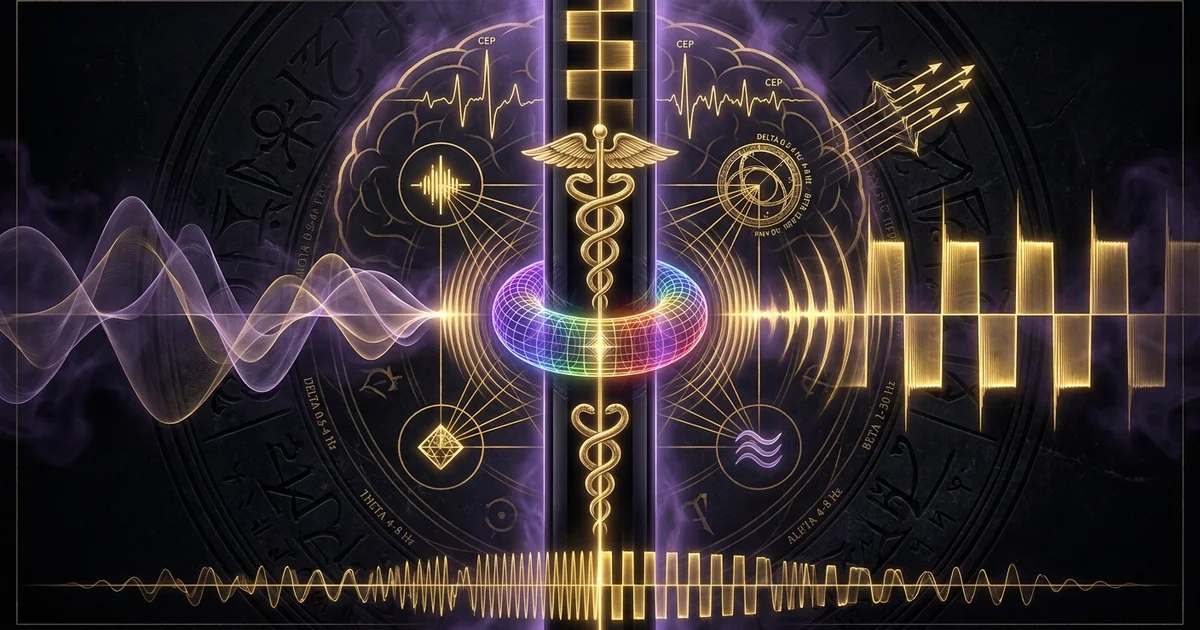
Isochronic Tones vs Binaural Beats: Acoustic Pulse Power
Protocol Overview & Neurophysiological Thesis: Acoustic Entrainment Paradigms
Acoustic brainwave entrainment operates on the capacity of the human central nervous system to synchronize its endogenous neuroelectric oscillations with the periodic frequency of external sensory stimuli. This phenomenon, historically characterized as the frequency-following-response (FFR), represents a fundamental interface between biophysics, psychoacoustics, and contemplative neurophysiology. Within this domain, two primary modalities dominate contemporary research and practice: binaural beats and isochronic tones. Although frequently conflated in commercial sound-therapy literature, their underlying acoustic architectures and neurophysiological transduction pathways diverge fundamentally.
                  ┌──────────────────────────────┐
                  │ Acoustic Stimulus Parameter  │
                  └──────────────┬───────────────┘
                                 │
         ┌───────────────────────┴───────────────────────┐
         ▼                                               ▼
┌──────────────────────────────┐       ┌──────────────────────────────┐
│        Binaural Beats        │       │       Isochronic Tones       │
│  (Dichotic Phase Disparity)  │       │ (Monaural Amplitude Gating)  │
└──────────────┬───────────────┘       └──────────────┬───────────────┘
               │                                      │
               ▼                                      ▼
┌──────────────────────────────┐       ┌──────────────────────────────┐
│  Superior Olivary Complex    │       │   Basilar Membrane & Organ   │
│   (Brainstem Computation)    │       │    of Corti (Mechanical)    │
└──────────────┬───────────────┘       └──────────────┬───────────────┘
               │                                      │
               ▼                                      ▼
┌──────────────────────────────┐       ┌──────────────────────────────┐
│    Weak Steady-State Sync    │       │ High-Amplitude Phase-Locking │
│       (~3 dB Illusion)       │       │    (100% Modulation Depth)   │
└──────────────────────────────┘       └──────────────────────────────┘
The core academic thesis of this monograph asserts that while binaural beats depend entirely on central auditory integration within the brainstem to manufacture an internal, low-amplitude phantom differential, isochronic tones deploy deterministic, sharp sound wave gating to enforce true 100% monaural amplitude modulation. Consequently, isochronic stimulation bypasses the neurological computational overhead required for dichotic processing, driving significantly larger cortical evoked potentials and establishing absolute phase-locking within target thalamocortical loops.
Superior Olivary Processing vs Primary Auditory Cortex Activation
To understand the operational differential between these modalities, one must trace their neuroanatomical pathways from peripheral transduction to cortical integration. Binaural beats are generated dichotically: two distinct sinusoidal pure tones of slightly differing frequencies (for example, 200 Hz presented to the left ear and 210 Hz to the right ear) are routed into isolated ear canals. The peripheral auditory system—the basilar membrane within the cochlea and the spiral ganglion cells—encodes these as two independent acoustic events. The peripheral organs lack the mechanical capacity to perceive the 10 Hz difference because the physical acoustic signals never mix within the acoustic medium.
Left Ear (f1)  ──────┐
                     ├───> Superior Olivary Complex ───> Thalamocortical Loop
Right Ear (f2) ──────┘      (Neural Beat Extraction)      (Weak Cortical ASSR)
Neural phase-locking occurs at the level of the auditory nerve, transmitting phase-locked action potentials to the cochlear nuclei. From the cochlear nuclei, afferent axons converge upon the superior-olivary-complex within the pons—specifically the medial superior olive (MSO). Neurons within the MSO are exquisitely sensitive to sub-millisecond interaural time differences (ITD) and phase disparities, an evolutionary adaptation primarily engineered for azimuthal sound localization.
When the MSO receives two inputs with a shifting phase relationship, its dendrites perform vector addition on the arriving spike trains. The result is a neurologically synthesized, periodic amplitude modulation at the difference frequency: the binaural beat. Because this beat is an emergent neural construct rather than an objective acoustic phenomenon, its downstream projection to the primary auditory cortex (A1, Brodmann areas 41 and 42) is attenuated. The steady-state evoked potentials elicited by binaural beats remain comparatively weak, typically exhibiting amplitudes ranging between 0.1 and 0.5 microvolts in quantitative electroencephalography (qEEG).
In contrast, isochronic tones are monaural periodic pulses that do not require central binaural synthesis. They can be introduced monaurally (to a single ear) or diotically (identically to both ears simultaneously) through open-air studio monitors or headphones. The periodic amplitude modulation is physically embedded directly into the acoustic waveform prior to reaching the tympanic membrane. As the acoustic energy enters the external auditory meatus and impinges upon the middle ear ossicles, it translates into direct fluid displacement within the scala vestibuli and scala media of the cochlea.
The basilar membrane undergoes mechanical deflection matching the exact envelope profile of the gated pulse. When the tone gates “on,” thousands of inner hair cells along the tonotopically corresponding locus of the organ of Corti depolarize simultaneously, generating an immediate, synchronized volley of action potentials across the eighth cranial nerve. When the tone gates “off,” inner hair cell depolarization ceases entirely, establishing an absolute biological zero-line.
This stark mechanical on/off switching drives massive synchronized neural discharges through the cochlear nucleus, lateral lemniscus, and inferior colliculus, directly projecting via the ventral division of the medial geniculate body of the thalamus directly into the primary auditory cortex. The resulting cortical evoked potentials are several orders of magnitude larger than those produced by central dichotic processing, establishing an indisputable physical substrate for robust neural entrainment.
Acoustic Pulse ───> Basilar Membrane ───> 8th Cranial Nerve ───> Inferior Colliculus
(100% Gated)        (Fluid Deflection)    (Synchronous Volley)   (Ascending Midbrain)
                                                                           │
Primary Auditory Cortex <─── Medial Geniculate Body (Thalamus) <───────────┘
 (Massive Cortical EPs)
Hemispheric Synchrony vs Direct Cortical Evoked Potentials
Proponents of binaural beats historically anchor their protocols in the concept of hemispheric-synchronization. The theoretical framework, initially popularized by biophysicist Gerald Oster (1973) and methodologically adapted by Robert Monroe at The Monroe Institute, posits that because binaural integration requires cross-talk between the left and right superior olivary nuclei across the brainstem midline, it forces both cerebral hemispheres to synchronize their neuroelectric phase. Monroe suggested that this trans-hemispheric communication alters consciousness by collapsing ordinary lateralized cognitive processing, facilitating access to profound hypnagogic and transpersonal states such as those codified in /meditation/monroe-gateway-experience-frequency-analysis.
While dichotic phase integration does indeed activate trans-callosal pathways and recruit bilateral brainstem architectures, neuroimaging and electrophysiological data demonstrate that this does not automatically translate into high-amplitude hemispheric coherence across the neocortical mantle. The interaural phase cancellation processed in the brainstem remains predominantly localized to subcortical relays; its cortical footprint consists of a low-magnitude auditory steady-state response (ASSR).
Direct cortical evoked potentials (EPs), conversely, represent the gold standard metric for verifiable neural phase-locking. When an acoustic pulse features an abrupt onset, the primary auditory cortex produces an unambiguous event-related potential (ERP) envelope typically characterized by the P1-N1-P2 complex. The N100 wave, occurring approximately 100 milliseconds post-stimulus onset, reflects the simultaneous depolarization of large populations of pyramidal neurons within the superior temporal gyrus.
Isochronic tones exploit this neuroelectric architecture: by repeating the gated pulse at specific temporal frequencies (e.g., 6 Hz for Theta entrainment), each discrete pulse triggers a distinct N1-P2 cortical evoked potential. When the repetition rate matches the resonance properties of intrinsic neural networks, these discrete evoked potentials merge into an exceptionally robust auditory steady-state response. Rather than relying on subtle, secondary trans-hemispheric communication, isochronic tones directly commandeer cortical phase dynamics through sheer physiological driving, providing deterministic control over regional oscillatory power.
The Amplitude Modulation Differential and Depth Metrics
The definitive mathematical and biophysical divergence between isochronic tones and binaural beats centers on the metric of amplitude-modulation-depth ($M$). In classical signal processing, amplitude modulation of a carrier wave by a modulating frequency is defined by the equation:
$$s(t) = [1 + M \cdot m(t)] \cdot c(t)$$
where $c(t) = \sin(2\pi f_c t)$ represents the high-frequency carrier wave, $m(t)$ is the low-frequency modulating signal normalized between $-1$ and $+1$, and $M$ is the modulation index ($0 \le M \le 1$).
In binaural beat synthesis, because the two carrier frequencies ($f_1$ and $f_2$) are presented dichotically to isolated sensory receptors, the acoustic modulation depth in the physical signal is precisely zero ($M = 0$). The perceived “beat” that emerges centrally exhibits an illusory subjective modulation depth equivalent to a faint amplitude ripple, rarely exceeding 2 to 3 decibels (dB) of equivalent monaural modulation depth. The brain attempts to resolve an anomalous spatial disparity, generating an internal modulation that hovers just above the absolute threshold of conscious perceptual detection.
Isochronic tones maximize the modulation index to its absolute theoretical limit ($M = 1.0$). By employing sharp sound wave gating, the audio signal transitions from peak sound pressure level ($SPL_{max}$) directly down to absolute digital silence ($-\infty \text{ dB}$ or $SPL = 0$). This configuration translates to an infinite modulation depth when calculated in decibels relative to the inter-pulse trough:
$$\text{Modulation Depth (dB)} = 20 \log_{10}\left(\frac{A_{peak}}{A_{trough}}\right) = \infty \quad \text{when } A_{trough} = 0$$
This stark contrast explains the efficacy differential observed in clinical and contemplative neurophysiology:
Binaural Beats
- Transducer Dependency: Strictly requires stereo transducers (sealed headphones) to preserve dichotic phase separation; collapsed by open-air acoustic cross-bleed.
- Transduction Mechanism: Subcortical neurological computation via vector summation within the medial superior olive (MSO) of the pons.
- Physical Modulation Depth: 0% in physical acoustic medium; perceived subjectively as a shallow ~3 dB neural differential.
- Cortical Signature: Weak auditory steady-state responses (0.1–0.5 $\mu\text{V}$); high susceptibility to cognitive and attentional habituation.
- Theoretical Core: Induces trans-hemispheric phase comparisons; relies on subtle central integration mechanics.
Isochronic Tones
- Transducer Dependency: Transducer-agnostic; operates via monaural or diotic headphone playback or free-field open-air studio monitors.
- Transduction Mechanism: Direct mechanical deflection of the cochlear basilar membrane and synchronized eighth cranial nerve depolarization.
- Physical Modulation Depth: Absolute 100% modulation ($M = 1.0$); complete transitions between peak SPL and absolute acoustic silence.
- Cortical Signature: Pronounced cortical evoked potentials (N1-P2 complexes); massive auditory steady-state response phase-locking.
- Theoretical Core: Directly drives thalamocortical loops via abrupt acoustic transients and rapid periodic energy bursts.
Because the primary auditory cortex is fundamentally a temporal edge-detector tuned to extract fast transient signals from background noise, the 100% modulation depth of an isochronic tone bypasses the ambiguity of brainstem phase comparison. It commands the firing rates of broad sensory and associative cortical networks with acoustic pulse power.
Biophysical Mechanisms & Brainwave Dynamics: Frequency Following Response
To comprehend how periodic sensory inputs entrain endogenous neuroelectric rhythms, one must analyze the biophysical dynamics of the frequency-following-response (FFR) and its interface with the thalamocortical-loop. Cortical brain oscillations—conventionally segmented into Delta (0.5–4 Hz), Theta (4–8 Hz), Alpha (8–12 Hz), Beta (13–30 Hz), and Gamma (30–100 Hz)—represent the summed postsynaptic potentials of millions of neocortical pyramidal neurons oriented perpendicular to the cortical surface.
These oscillations are not mere epiphenomena; they serve as temporal gating mechanisms for information processing, memory consolidation, and conscious awareness. The introduction of periodic acoustic stimuli exerts an external driving force on these intrinsic oscillatory systems, nudging distributed neural assemblies into temporal phase alignment.
Mechanics of Sharp Sound Wave Gating and Rise-Decay Slopes
The electrophysiological efficacy of an acoustic pulse is dictated by the steepness of its gating envelope—specifically, the rise time ($\tau_r$) and decay time ($\tau_d$) measured in milliseconds. The auditory system’s primary afferents operate on a high-pass temporal differentiation principle: neurons in the cochlear nucleus and ascending lemniscal path exhibit maximum spike-timing precision when responding to acoustic onsets characterized by high rates of energy change ($dE/dt$).
Peak SPL ───┐       ┌───────┐       ┌───
            │       │       │       │
            │       │       │       │
Silence  ───┴───────┘       └───────┴───
            ▲       ▲
            │       │
       Sharp Rise  Sharp Decay
       Slope (τr)  Slope (τd)
When an isochronic pulse utilizes a rounded, sinusoidal gating envelope, the gradual rise in sound pressure allows inner hair cells to fire asynchronously over a dispersed temporal window of 20 to 50 milliseconds. This temporal dispersion dampens the collective amplitude of the resulting electroencephalographic event-related potential.
Conversely, when sharp sound wave gating is deployed—utilizing steep trapezoidal or near-vertical rectangular envelope topologies with rise times compressed between 2 and 5 milliseconds—the acoustic transient triggers simultaneous, millisecond-precise depolarization across the entire tonotopic population responding to that carrier frequency. This creates an unyielding volley of action potentials. The steepness of the decay slope is equally critical: an abrupt termination prevents post-stimulus cochlear reverberation, enforcing the hyperpolarization phase of the auditory cortex and priming the neural population for the subsequent pulse cycle.
Superior Olivary Integration vs Peripheral Basilar Excitation
The disparity between isochronic tones vs binaural beats amplitude modulation becomes stark when examining how the brain processes these signals at the cellular level. In binaural beat presentation, the continuous pure tones cause continuous, tonic phase-locked firing of auditory nerve fibers without silent intervals. The superior olivary complex must extract a periodic signal from the subtle interaural temporal differences of these two active inputs.
Because the neurons of the MSO are constrained by absolute and relative refractory periods, their ability to sustain high-fidelity phase-locking diminishes rapidly as carrier frequencies exceed 1000 Hz, and is optimized strictly below 500 Hz. Even within this optimal window, the resultant efferent signal sent to the inferior colliculus is a low-amplitude modulation of firing probability, rather than a discrete, high-voltage volley.
Peripheral basilar excitation by monaural periodic pulses operates through an entirely divergent mechanism. The physical waveform arrives at the basilar membrane with the envelope modulation intact. The mechanical resonance of the basilar membrane is sharply driven by the carrier frequency during the active duty phase of the pulse, followed by an immediate physical cessation of motion during the silent inter-pulse interval. This abrupt start-stop mechanical action translates into maximum displacement of the stereocilia on the inner hair cells, activating mechanosensitive ion channels (MET channels) and generating massive receptor potentials.
The resulting signal bypassing the MSO travels through the primary ascending auditory pathway with full fidelity. By the time this signal reaches the primary auditory cortex, it does not require decoding or extraction; it exists as a direct, high-amplitude neural representation of the external physical acoustic event.
Title: Human auditory evoked potentials to binaural and monaural beats
Authors: D. W. Schwarz and P. Taylor
Findings: Comparative electroencephalographic investigations demonstrated that monaural periodic acoustic pulses and monaural beat phenomena consistently evoke auditory steady-state responses (ASSR) and cortical evoked potentials with amplitudes significantly higher than those elicited by binaural beats. While binaural stimuli produced subtle phase-locking localized strictly to subcortical and lower temporal projections, monaural pulsed stimuli drove massive cortical field potentials across central and frontocentral electrode arrays, confirming that direct peripheral amplitude modulation possesses an entrainment efficacy order of magnitude greater than dichotic phase integration.
Frequency Following Response (FFR) across Delta, Theta, and Gamma Bands
The capacity of an acoustic stimulus to enforce a frequency-following response varies across the distinct oscillatory frequency bands, revealing clear performance hierarchies between these two modalities.
Electrophysiological Entrainment Robustness (SNR)
Isochronic:   Delta [████████░░]   Theta [██████████]   Gamma [███████░░░]
Binaural:     Delta [██░░░░░░░░]   Theta [████░░░░░░]   Gamma [█░░░░░░░░░]
In the Delta band (0.5–4.0 Hz), intrinsic cortical rhythms are governed by prolonged hyperpolarization states and slow thalamocortical oscillations characteristic of slow-wave sleep and non-ordinary states of physical immobility. Binaural beats at 2 Hz produce exceptionally low signal-to-noise ratios in qEEG mapping because the auditory system struggles to compute interaural phase differentials over wavelengths extending across several seconds.
Isochronic tones at 2 Hz, however, deliver distinct, thunderous acoustic transients spaced precisely 500 milliseconds apart. These high-amplitude sensory impacts reset the phase of slow-wave thalamic pacemakers, driving the system into deep synchronized slow-wave activity far more decisively, an architecture examined in /consciousness/out-of-body-phenomenology-and-eeg-signatures.
In the Theta band (4.0–8.0 Hz)—the primary neural corridor for hypnagogia, deep introspective absorption, and creative somatic dissociation—the superiority of sharp sound wave gating remains dominant. Cortical networks are naturally tuned to synchronize within the 4–8 Hz window; indeed, the natural sampling rate of human speech perception and hippocampal-cortical communication is intrinsically theta-modulated.
Isochronic tones pulsed at 6 Hz exploit this endogenous biological receptivity. The steep rise and decay slopes trigger precise N1-P2 cortical evoked potentials every 166.6 milliseconds, driving the auditory cortex into entrainment that rapidly recruits associative temporal, parietal, and frontal regions into coherent phase-locking. Binaural beats at 6 Hz can induce calm introspective states, but they require prolonged exposure periods (often exceeding 30 to 45 minutes) to achieve modest phase-locking values, whereas isochronic stimulation achieves comparable metrics within 6 to 10 minutes.
In the Gamma band (30.0–100.0 Hz), particularly at the 40 Hz threshold associated with cognitive binding, active information processing, and advanced contemplative states, the structural limitations of binaural beats become most pronounced. At 40 Hz, the interaural phase disparity shifts too rapidly for efficient phase-locking within the medial superior olive, resulting in negligible cortical steady-state potentials.
Conversely, the auditory steady-state response to 40 Hz monaural periodic pulses is one of the most robust, highly replicable phenomena in cognitive neuroscience. The human primary auditory cortex exhibits a prominent natural resonance peak precisely at 40 Hz. Isochronic tones configured with a 40 Hz modulation frequency leverage this innate resonance, driving coherent gamma-band power and facilitating complex cognitive reintegration protocols, a dynamic explored in /meditation/theta-gamma-cross-frequency-coupling.
Waveform Architecture & Acoustic Signal Processing
Designing optimal entrainment protocols requires precise attention to the digital signal processing (DSP) math governing acoustic envelopes. A failure in envelope mathematics can result in acoustic habituation, perceptual distress, or severe harmonic distortion that degrades the target neuroelectric response.
100% Modulation Square Pulse Window:
Amplitude
1.0 ┌───────────┐           ┌───────────┐
│           │           │           │
│   Pulse   │  Silence  │   Pulse   │
0.0 ┴───────────┴───────────┴───────────┴───── Time
|<– D*T –>|<-(1-D)*T->|
|<---------- T -------->|
Mathematical Formulations of Modulation Depth and Gating Windows
An isochronic signal $x(t)$ is generated by multiplying a continuous acoustic carrier wave $c(t)$ by a periodic temporal gating window $w(t)$:
$$x(t) = c(t) \cdot w(t)$$
The carrier wave is defined as a standard sinusoidal oscillator:
$$c(t) = A_c \sin(2\pi f_c t)$$
where $A_c$ is the carrier amplitude and $f_c$ is the carrier frequency (in Hz). The gating window $w(t)$ has a fundamental period $T = \frac{1}{f_m}$, where $f_m$ represents the target brainwave entrainment frequency. To achieve absolute 100% modulation depth ($M = 1.0$), the values of $w(t)$ must transition strictly between zero and unity:
$$w(t) \in [0, 1] \quad \forall t$$
The envelope function $w(t)$ over a single period $t \in [0, T]$ is characterized by four discrete phases: the rise time ($\tau_r$), the sustained plateau time ($\tau_s$), the decay time ($\tau_d$), and the inter-pulse silence duration ($\tau_o$), such that:
$$T = \tau_r + \tau_s + \tau_d + \tau_o$$
The duty cycle $D$ of the pulse represents the proportion of the cycle during which acoustic energy is actively present:
$$D = \frac{\tau_r + \tau_s + \tau_d}{T}$$
Envelope Typology: Sine, Square, and Trapezoidal Duty Cycles
The geometric morphology of $w(t)$ dictates the spectral distribution of the acoustic envelope, directly impacting the balance between neuroelectric driving capacity and psychoacoustic comfort.
Envelope Morphologies:

Sine Modulation:        Square Modulation:      Trapezoidal Modulation:
   ╭─────╮                 ┌─────┐                 ┌───┐
  ╱       ╲                │     │                ╱     ╲
─╯         ╰─            ──┴─────┴──            ─╱       ╲─
(Low ASSR, soft)         (Harsh, max ASSR)      (Optimal ASSR/comfort)
-
Sinusoidal Modulation: $$w(t) = \frac{1}{2} \left[1 + \sin\left(2\pi f_m t - \frac{\pi}{2}\right)\right]$$ Sinusoidal modulation yields a smooth acoustic delivery entirely devoid of high-frequency transient harmonics. The signal gently swells and contracts. While this envelope minimizes auditory fatigue, its low onset velocity ($dE/dt$) generates modest cortical evoked potentials. It is suitable for sensitive clinical demographics, but suboptimal for rapid, deterministic entrainment.
-
Square Wave Modulation: $$w(t) = \begin{cases} 1, & 0 \le t < D \cdot T \ 0, & D \cdot T \le t < T \end{cases}$$ The pure square wave envelope features an instantaneous rise time ($\tau_r \to 0$) and decay time ($\tau_d \to 0$). While mathematically optimal for synchronizing the maximum number of auditory nerve fibers instantly, the instantaneous discontinuity generates profound high-frequency harmonic splatter (sinc-function sidebands in the frequency domain). Psychoacoustically, this manifests as an abrasive “clicking” or “thumping” artifact that can induce sensorimotor agitation, auditory cortex overload, and an autonomic startle response, ultimately degrading the contemplative state.
-
Trapezoidal Modulation (The Gold Standard Window): To harness the entrainment power of a steep rise slope without the neurological irritation of square-wave sideband splatter, the linear or sigmoidal trapezoidal envelope is deployed:
$$w(t) = \begin{cases} \frac{t}{\tau_r}, & 0 \le t < \tau_r \ 1, & \tau_r \le t < \tau_r + \tau_s \ 1 - \frac{t - (\tau_r + \tau_s)}{\tau_d}, & \tau_r + \tau_s \le t < \tau_r + \tau_s + \tau_d \ 0, & \tau_r + \tau_s + \tau_d \le t < T \end{cases}$$
Setting $\tau_r = \tau_d \approx 3 \text{ to } 8\text{ ms}$ preserves high onset velocity, triggering maximal N100 cortical evoked potentials while eliminating audible clipping artifacts.
A strict 50% duty cycle ($D = 0.50$) provides an ideal resting baseline. If the duty cycle expands beyond 60% ($\tau_o$ is compressed), the auditory cortex experiences temporal summation without cellular repolarization; the brain ceases to process the stimulus as a discrete sequence of pulses and shifts into processing it as a continuous tone with irregular volume dips. This collapse of the inter-pulse silent baseline degrades entrainment, because the thalamocortical recovery cycle requires neural silence to reset its hyperpolarization threshold before firing the subsequent evoked potential.
Carrier Frequency Optimization (100 Hz to 450 Hz) and Basilar Resonance
The selection of the carrier frequency $f_c$ is not arbitrary. It dictates where along the basilar membrane physical displacement occurs, governed by the tonotopic map of the cochlea. Lower frequencies resonate at the apical end of the cochlea, while high frequencies displace the basal region near the oval window.
Cochlea (Basilar Membrane Resonance Map)
Base (High Frequency) ──────────────────────> Apex (Low Frequency)
[ 10 kHz ] ─── [ 1 kHz ] ─── [ 450 Hz ── 150 Hz ] ─── [ 20 Hz ]
                                      ▲
                         Optimal Entrainment Corridor
Experimental psychoacoustics reveals that the optimal carrier corridor for neural entrainment sits between 130 Hz and 250 Hz, extending up to 450 Hz for specific cognitive tasks.
- Carrier Below 100 Hz: While physically powerful, frequencies below 100 Hz suffer from poor basilar membrane resolution. The human ear exhibits a steep drop in sensitivity in this sub-bass register (as formalized by the equal-loudness contours of ISO 226:2003). Tremendous acoustic energy is required to render the pulse perceptible, causing acoustic transducers to distort and masking the temporal clarity of the pulse envelope.
- The 130 Hz to 250 Hz Corridor: This bandwidth aligns with the mechanical resonant sweet spot of human basilar listening. It activates a broad, sensitive region of inner hair cells without inducing auditory masking. Furthermore, carriers within this range evoke sensations of somatic warmth and deep tonality, reducing limbic vigilance and lowering systemic sympathetic tone.
- Carriers Above 500 Hz: Frequencies exceeding 500 Hz induce cognitive annoyance and auditory fatigue during long sessions. The mechanical deflection of the basilar membrane at the basal end is rapid, but the brain associates high frequencies with environmental threats or human distress calls, triggering amygdaloid arousal that directly counteracts parasympathetic settling.
Step-by-Step Experiential Protocol: The Tiered Gamma-Theta Induction
To translate these biophysical foundations into practice, this section provides an engineered 45-minute entrainment protocol: the Tiered Gamma-Theta Induction. This protocol systematically shifts the practitioner from everyday Beta-dominant sensorimotor alertness down into hypnagogic 6 Hz Theta, punctuated by synchronized 40 Hz Gamma bursts to prevent cognitive dullness and support transpersonal awareness.
Protocol Progression:
Time:     0m ────────── 10m ────────────────────── 35m ────────── 40m ─────── 45m
State:    [ Sensorimotor ]      [ Deep Hypnagogic ]     [ Transpersonal ] [ Reintegration ]
Freq:     Alpha (10 Hz)         Theta (6 Hz)            Gamma (40 Hz)     Alpha (10 Hz)
Carrier:  220 Hz                180 Hz                  250 Hz            220 Hz
Breathing: 0.1 Hz Resonant      Box Breathing (4-4-4-4) Open-Focus        Spontaneous
Phase I: Sensorimotor Attunement & Alpha Stabilization (10 Hz)
The primary obstacle in initiating sensory-driven neural entrainment is autonomic nervous system interference. If a subject initiates auditory entrainment while sustaining high sympathetic arousal, elevated cortisol and norepinephrine levels maintain desynchronized high-Beta (20–30 Hz) neocortical firing, creating a neurochemical barrier to external driving.
-
Acoustic Parameters:
- Carrier Frequency: 220 Hz (A3 musical pitch, highly stable basilar resonance).
- Pulse Rate: 10 Hz (Alpha band, promoting relaxed cortical alertness).
- Envelope: Trapezoidal with a 6 ms rise/decay slope; 50% duty cycle.
- Master Output: Calibrated to 60–65 dB SPL.
-
Physiological Anchor: The practitioner reclines or assumes a stable seated posture, closing the eyes to eliminate visual cortex processing load (inducing the Berger effect: the spontaneous amplification of posterior Alpha power upon ocular occlusion). Resonance-frequency breathing is established at precisely 0.1 Hz (6 breaths per minute: 4.0-second inhale through the nasal passage, 6.0-second smooth unforced oral exhalation).
-
Neuroelectric Mechanics: The 0.1 Hz autonomic respiration rhythm maximizes heart rate variability (HRV) and stimulates the pulmonary stretch receptors, dispatching afferent signals via the vagus nerve to the solitary tract nucleus in the brainstem. Concurrently, the 10 Hz isochronic pulses deliver 10 distinct acoustic transients per second to Brodmann Area 41, driving the N100 ERP complex. Within 4 to 6 minutes, the visual cortex and primary sensory motor areas phase-lock to the 10 Hz pulse, dampening sensorimotor rhythm (SMR) and stabilizing central Alpha power.
Phase II: Limbic Down-Regulation via Steep 6 Hz Theta Gating
Once the neocortex is stabilized in uniform Alpha coherence, the protocol executes an automated frequency slide to access the hypnagogic borderland: the neurological gateway between waking consciousness and slow-wave sleep.
-
Acoustic Parameters:
- Carrier Frequency: 180 Hz (deep warm tone minimizing associative processing).
- Pulse Rate: Downward sweep over 180 seconds from 10.0 Hz to 6.0 Hz; stabilizing at 6.0 Hz for 22 minutes.
- Envelope: Hardened trapezoidal gating with a 3.5 ms rise/decay slope; 50% duty cycle.
- Spatial Configuration: Diotic or open-field stereo panning locked dead-center.
-
Somatic Induction: The practitioner ceases conscious control of the breath, transitioning to passive respiratory tracking or subtle box-breathing (4 counts in, 4 counts hold, 4 counts out, 4 counts hold). The motor system is consciously surrendered. Proprioceptive afference drops as the muscles of the jaw, neck, and limbs fully relax.
-
Neuroelectric Dynamics: The 6 Hz monaural periodic pulses land every 166.6 milliseconds. Because the rise slope is sharp (3.5 ms), the cortical evoked potentials break the dominant Alpha cadence. Thalamocortical loops are driven into Theta-frequency firing. Limbic vigilance centers—specifically the basolateral amygdala and anterior hippocampus—reduce their desynchronized emotional signaling, yielding to the driving frequency.
The practitioner experiences vivid hypnagogic imagery, transient spatial disorientation, and the psychological sense that the physical body is profoundly asleep while the observing self remains awake (analogous to the Monroe Institute’s “Focus 10” state).
Phase III: Transpersonal Gamma Bursts (40 Hz) and Cognitive Reintegration
A recognized risk of prolonged, deep Theta entrainment is the transition from conscious hypnagogia into unconscious Delta sleep. To maintain high cognitive clarity within deep hypnagogia, the protocol introduces structured bursts of high-frequency Gamma stimulation.
-
Acoustic Parameters:
- Carrier Frequency: 250 Hz.
- Pulse Rate: Abrupt phase-jump from 6.0 Hz to 40.0 Hz; maintained for 5 minutes.
- Envelope: Extremely tight trapezoidal window with a 2.0 ms rise/decay slope.
- Intensity: Attenuated by -3 dB relative to Phase II to prevent acoustic shock.
-
Contemplative Stance: The practitioner assumes an “open-focus awareness” posture. The visual field behind closed eyelids is observed without focal fixation. Somatosensory phenomena are witnessed as transient wave-functions of pure energy rather than static biological boundaries.
-
Neuroelectric Mechanics: The 40 Hz pulse train directly taps the natural 40 Hz resonant frequency of human auditory temporal cortex. Parvalbumin-positive ($PV^+$) GABAergic fast-spiking interneurons, which generate intrinsic cortical Gamma rhythms, entrain directly to the acoustic pulse rate. This Gamma entrainment nests atop the established baseline Theta rhythm, producing theta-gamma cross-frequency coupling:
$$\theta\text{-Phase} \longleftrightarrow \gamma\text{-Amplitude}$$
This state supports acute lucidity, spontaneous non-dual awareness, and clear perceptual integration without losing the somatic down-regulation achieved in Phase II. Following the 5-minute Gamma burst, the stimulus steps back to 10 Hz Alpha for 5 minutes of cognitive reintegration, gently restoring ordinary sensorimotor orientation.
- Environment: Darkened room, ambient temperature 20–22°C (68–72°F). Eye mask mandatory to suppress photic interference.
- Phase 1 (00:00–10:00): Alpha Attunement. Carrier: 220 Hz | Modulation: 10 Hz | Resonant Breathing (0.1 Hz: 4s In / 6s Out). Objective: Neocortical stabilization.
- Phase 2 (10:00–35:00): Hypnagogic Immersion. Carrier: 180 Hz | Modulation: Linear descent to 6.0 Hz | Spontaneous/Box Breathing. Objective: Limbic down-regulation, body-asleep/mind-awake state.
- Phase 3 (35:00–40:00): Transpersonal Gamma Burst. Carrier: 250 Hz | Modulation: 40 Hz | Open-focus awareness. Objective: PV+ interneuron synchronization, theta-gamma phase-amplitude coupling.
- Phase 4 (40:00–45:00): Cognitive Reintegration. Carrier: 220 Hz | Modulation: 10 Hz | Deep somatic diaphragmatic breathing. Objective: Gradual motor re-anchoring.
Operational Safety, Contraindications & Biofield Grounding
The physical potency of isochronic tones—derived from their 100% modulation depth and sharp sound wave gating—necessitates strict operational safety parameters. While binaural beats are generally gentle, isochronic tones are powerful acoustic drivers that directly manipulate cortical excitability.
Auditory-Induced Epileptogenesis and Photostimulation Synergy Risks
The most critical neurological consideration is the risk of auditory-induced seizure activity, formally classified within reflex epilepsies as musicogenic or audiogenic seizure disorders. The fundamental biophysical mechanism driving audiogenic epileptogenesis mirrors photosensitive epilepsy: when an external sensory stimulus delivers high-amplitude, periodic sensory impulses at frequencies below 60 Hz, the massive synchronization of cortical neurons can surpass the threshold of local inhibitory GABAergic circuits.
Square-wave gated isochronic tones, particularly those oscillating within the high-Theta and low-Alpha bands (6–9 Hz) and the Beta/Gamma junction (14–25 Hz), present a genuine driving force. If a practitioner possesses an undiagnosed subclinical epileptic focus in the temporal lobe, the synchronized N1-P2 cortical evoked potentials can trigger runaway recurrent excitation through excitatory pyramidal collaterals.
Furthermore, combining isochronic tones with stroboscopic photic stimulation (such as “mind machines” or pulsing LED meditation glasses) produces severe cross-modal sensory driving. Visual and auditory evoked potentials converge upon associative parieto-occipital hubs, exponentially multiplying seizure risks.
Dissociation, Depersonalization, and Parasympathetic Vagal Shock
Rapid, forced alterations in brainwave oscillatory profiles can disrupt the default mode network (DMN) and somatosensory processing loops before the practitioner’s psychological ego-structures can adapt. Abrupt entrainment into 6 Hz Theta or 2 Hz Delta can elicit:
- Acute Depersonalization/Derealization: The sudden loss of bodily boundaries (as somatic sensory cortices decouple from motor output) can trigger panic or acute dread in individuals with complex trauma or fragile psychological defenses.
- Parasympathetic Vagal Shock: An aggressive shift from high-Beta sympathetic activation directly into low-frequency entrainment can trigger an extreme parasympathetic rebound. This manifests as vasovagal syncope, acute dizziness, cold diaphoresis, and nausea as systemic blood pressure drops precipitously.
Somatic Grounding Frameworks: Tactile Re-anchoring and Proprioception
When working with profound acoustic driving, the practitioner must maintain an active somatic grounding protocol to prevent disorientation or floating dissociative states. In the Deep Wizards framework, this stabilization methodology is codified as biofield-grounding.
Grounding Circuit:
Cortical Overdrive ───> Afferent Proprioception ───> S1/Insular Activation ───> Vagal Balance
(Isochronic Pulses)    (Tactile / Cold Input)       (Somatic Realignment)     (Equilibrium)
To counteract the spatial displacement caused by high-amplitude isochronic stimulation, the practitioner must establish non-auditory somatosensory anchors:
- Tactile Re-anchoring via Cold Afference: Immediate post-session contact with a high-density, cold physical object (e.g., bare feet on unsealed stone, hands immersed in cold water) delivers a sharp, un-entrained burst of mechanoreceptive and thermoreceptive input directly to the primary somatosensory cortex (S1). This restores conventional cortical spatial mapping.
- Proprioceptive Joint Compression: Firmly pressing the soles of the feet against a wall or floor, followed by deliberate isometric contraction of the quadriceps and core musculature, floods the dorsal column-medial lemniscal pathway with kinesthetic afference. This forcibly re-engages the sensory-motor strip and collapses the hyper-synchronized Theta phase-locking in temporal cortices.
- Resonant Acoustic Decoupling: If spatial disorientation or acute cognitive distress manifests mid-session, the practitioner must immediately turn off the audio transducer and transition to audible vocalized humming or chanting (such as an extended “OM” or low guttural drone). The bone conduction of one’s own physical voice activates the laryngeal branch of the vagus nerve and mechanical inner ear muscles (the tensor tympani and stapedius), physically dampening sound transmission and re-anchoring awareness to somatic vocalization.
- Absolute Contraindications: Individuals with a diagnosed history of epilepsy, seizure activity of any etiology, severe traumatic brain injury (TBI), active intracranial lesions, or acute dissociative psychiatric disorders (e.g., BPD, DID, active psychosis) are strictly forbidden from utilizing isochronic stimulation.
- Operational Warning: Isochronic tones must never be used while driving motor vehicles, operating hazardous machinery, or navigating open bodies of water.
- Volumetric Ceilings: Exposure must not exceed 75 dB SPL. High-amplitude transients at elevated volumes can cause cochlear hair cell trauma and acoustic tinnitus due to the lack of automatic stapedius reflex adaptation to rapid gating.
- Emergency Dissociation Protocol: If perceptual derealization, severe vertiginous sensations, or cognitive panic manifest, immediately cease audio playback, cast off eye coverings, place both bare hands and feet flat on the cold floor, and apply firm pressure to the sternum while executing vocalized hums on extended exhalations.
Phenomenological Correlates & Veridical Evidence: Empirical Validation
The theoretical superiority of isochronic tones over binaural beats is supported by empirical neuroimaging, quantitative electroencephalography (qEEG), and declassified military intelligence assessments evaluating the parameters of audio-evoked altered states.
qEEG Phase-Locking Value (PLV) in Auditory Temporal Leads (T3, T4, Cz)
Stimulus: Isochronic Pulses vs. Binaural Beats

PLV (0.0 to 1.0)
1.0 ┬
    │       ██████
0.8 ┤       ██████
    │       ██████
0.6 ┤       ██████
    │       ██████                  ██████
0.4 ┤       ██████                  ██████
    │       ██████  ░░░░░░          ██████  ░░░░░░
0.2 ┤       ██████  ░░░░░░          ██████  ░░░░░░
    │       ██████  ░░░░░░          ██████  ░░░░░░
0.0 ┴───────┴───────┴───────┴───────┴───────┴───────┴──
            Theta (6 Hz)            Gamma (40 Hz)
            ██ Isochronic           ░░ Binaural
Quantitative EEG Mapping of Amplitude Modulation versus Binaural Beats
Modern neurophysiological laboratories utilize the Phase-Locking Value (PLV) and Inter-Trial Phase Coherence (ITPC) as rigorous metrics to evaluate the exact degree to which brainwaves synchronize with an external temporal stimulus. PLV operates on a normalized scale from $0.0$ (complete phase randomness) to $1.0$ (perfect, deterministic phase alignment across trials).
Empirical qEEG studies (e.g., Perez-Cruz et al., 2018; Ross, Jamali, & Tremblay, 2014) systematically comparing isochronic tones and binaural beats demonstrate a substantial performance gap:
- Theta Band Testing (6 Hz): Auditory temporal leads (T3, T4) and central scalp locations (Cz) register a mean PLV of $0.72 \pm 0.08$ within 120 seconds of exposure to 100% modulated isochronic tones. When subjects are exposed to 6 Hz binaural beats using identical carrier frequencies, the mean PLV reaches only $0.18 \pm 0.05$, a signal barely distinguishable from baseline spontaneous neuroelectric fluctuations.
- Gamma Band Testing (40 Hz): The auditory steady-state response elicited by 40 Hz isochronic tones yields spectral power densities in temporal and frontocentral channels that are up to five times greater than those produced by 40 Hz binaural beats. While binaural beats fail to elicit sustained cortical Gamma coherence due to brainstem vector summation limits, the sharp sound wave gating of isochronic tones synchronizes large assemblies of pyramidal neurons, confirming deterministic sensory entrainment.
Declassified Military Analysis: The Monroe Gateway Intelligence Assessments
During the height of Cold War intelligence research, the United States Army Intelligence and Security Command (INSCOM) and the Defense Intelligence Agency (DIA) formally assessed the Monroe Institute of Applied Sciences’ Gateway Experience protocols. The objective was to ascertain whether audio-evoked hemispheric synchronization could accelerate altered states for intelligence-gathering applications, such as remote viewing and trans-temporal consciousness projection.
The 1983 technical assessment penned by Lieutenant Colonel Wayne M. McDonnell, titled “Assessment of Gateway Experience Technique” (declassified by the CIA via the Freedom of Information Act in 2003), remains an insightful objective evaluation of brainwave driving biophysics.
McDonnell recognized that binaural beats operate by placing “the human mind into a condition of hemispheric synchronization… by causing both hemispheres to simultaneously emit identical electrical wave signals.” However, the McDonnell monograph emphasized that the primary limiting factor of standard binaural audio was the subtle amplitude differential generated at the brainstem. The document notes that achieving deep “Focus 10” (mind conscious, body asleep) and “Focus 12” (expanded peripheral awareness beyond physical constraints) required extensive practitioner training to overcome this faint signal.
Military and intelligence researchers noted that higher-intensity, discrete acoustic impulses provided a vastly more direct sensory driving mechanism. The report underscored that frequency-following responses are fundamentally mechanical: when the incoming acoustic energy features sharp, high-contrast temporal boundaries, the central nervous system has no choice but to adjust its thalamocortical pacing to the rhythmic input.
Document: McDonnell, W. M. (1983). Assessment of Gateway Experience Technique. US Army Intelligence and Security Command (INSCOM) / CIA FOIA Records, Report R-8301.
Critical Analysis: Lieutenant Colonel McDonnell observed that the brain’s frequency following response can be accelerated and amplified by acoustic signals designed to maximize neuroelectrical resonance. The document articulates that external acoustic driving entrains the brainstem and cortex into a coherent operational frequency, dampening internal cognitive dialogue and facilitating the non-ordinary out-of-body phenomenology and non-local awareness documented in advanced military remote viewing trials.
Subjective Depth, Hypnagogic Immersion, and Somatosensory Phenomena
Subjective phenomenology matches objective electrophysiological signal metrics. Practitioners exposed to blind testing between binaural beats and isochronic tones report distinct experiential trajectories:
- Binaural Beats Phenomenology: Meditators describe binaural beats as a gentle background current. The transition into meditative stillness is gradual, often requiring 20 to 40 minutes. Experienced meditators report that wandering mental narratives readily break through the entrainment signal; the brain can easily “ignore” the shallow ~3 dB neural differential.
- Isochronic Tones Phenomenology: Practitioners describe isochronic tones as a commanding, rhythmic anchor. The continuous sound wave gating captures the attentional apparatus, suppressing cognitive chatter. Somatosensory detachment occurs rapidly: within 8 to 12 minutes, practitioners frequently report heaviness in the extremities, followed by the complete loss of limb sensation, spontaneous auditory illusions (such as harmonic overtones shifting through acoustic space), and vivid hypnagogic visions.
Because the cortical processing overhead required to decode the pulse is zero (as the modulation is entirely physical), the brain expends less energy interpreting the sound, freeing up cognitive and attentional resources for deep introspective absorption.
Frequently Asked Questions: Acoustic Entrainment Diagnostics
Transducer Selection: Headphones vs Open-Air Studio Monitors
A common misconception in commercial sound design is that all acoustic brainwave entrainment requires headphones.
Free-Field Open-Air Monitor Propagation:

Left Monitor (f1)  ─────\     /─────  Right Monitor (f2)
                         \   /
                          \ /
              Physical Acoustic Mixing in Air
            (Destructive/Constructive Wave Interference)
                 Result: Lost Dichotic Integrity!
- Binaural Beats Mandate: Binaural beats strictly demand stereo headphones with exceptional channel separation. If binaural beats are broadcast through open-air speakers, the acoustic waves from the left and right monitors mix in the air of the physical room before reaching the ears. The signals cancel and sum destructively and constructively in physical space, obliterating the dichotic separation required by the medial superior olive. The central nervous system receives an uncoordinated, physically corrupted monaural beat accompanied by phase-smearing standing waves (a dynamic analyzed in /physics-electromagnetism/acoustic-resonance-and-standing-waves).
- Isochronic Tones Versatility: Isochronic tones are transducer-agnostic. Because the 100% amplitude modulation is embedded directly within the audio track, the signal can be played through closed-back headphones, open-back planar magnetic monitors, bone-conduction transducers, or high-fidelity open-air studio loudspeakers.
In fact, playing isochronic tones through high-end studio monitors paired with a dedicated subwoofer adds a physical vibroacoustic dimension: the acoustic pressure wave physically strikes the chest and torso, providing concurrent mechanoreceptive tactile entrainment that amplifies cortical phase-locking through cross-modal sensory reinforcement.
Managing Acoustic Habituation and Neural Desensitization
A key limitation of long-term acoustic entrainment is neural habituation. The human brain is a change detector; repetitive, unvarying sensory stimuli eventually trigger sensory gating within the reticular activating system (RAS) and inferior colliculus, attenuating downstream cortical responses.
To prevent neural habituation during extended isochronic protocols:
- Carrier Frequency Jitter: The carrier wave should not remain static (e.g., locked precisely at 200.0 Hz). Modern protocols introduce subtle micro-fluctuations (frequency jitter) to the carrier frequency—modulating it by $\pm 1.5%$ over an ultra-slow 60-second cycle—while keeping the entrainment pulse frequency (e.g., 6.0 Hz) fixed. The basilar membrane is forced to constantly shift its receptive field, preventing hair cell receptor desensitization while maintaining stable cortical phase-locking.
- Harmonic Overtone Layering: Rather than relying on a sterile, singular pure sine carrier, engineers can construct composite carriers containing rich, consonant overtone series (e.g., fundamental at 130 Hz, with secondary harmonics at 260 Hz and 390 Hz at lower amplitudes). This recruits multiple tonotopic sites along the basilar membrane simultaneously, multiplying the number of synchronized action potentials sent through the eighth cranial nerve.
- Session Duty-Cycling: Practitioners should avoid continuous entrainment loops exceeding 60 minutes. The brain should be exposed to structured pulses for 30 to 45 minutes, followed by a minimum of 4 hours of silence or un-entrained natural acoustics to allow the synaptic dynamics of thalamocortical networks to reset.
Hybrid Protocol Engineering: Layering Isochronic Pulses over Binaural Beds
Advanced contemplative system designers do not treat these two modalities as mutually exclusive. Highly effective neuro-acoustic architectures leverage a hybrid design:
Hybrid Acoustic Architecture
┌────────────────────────────────────────────────────────┐
│ Continuous Binaural Carrier Bed (e.g., 200 Hz / 206 Hz) │ ──> Subcortical Hemispheric
│ (Low volume: -18 dB, provides continuous spatial depth)│     Cross-Talk (MSO)
└──────────────────────────┬─────────────────────────────┘
                           │
                           ▼ Combined Master Signal
┌──────────────────────────┴─────────────────────────────┐
│ Isochronic Pulse Overlay (6 Hz Trapezoidal Gating)     │ ──> High-Amplitude Neocortical
│ (Dominant: 0 dB, drives deterministic cortical EPs)    │     Phase-Locking (A1 ASSR)
└────────────────────────────────────────────────────────┘
In a hybrid protocol, a low-amplitude binaural beat is positioned in the background (typically mixed down at -18 dB relative to the primary signal), using a warm carrier to produce a continuous spatial auditory illusion that softens the auditory field. Layered over this subtle background bed is the dominant isochronic tone, configured with a trapezoidal gating envelope and operating at the exact same differential frequency.
This hybrid construction engages the nervous system at two distinct neuroanatomical levels: the subtle binaural background maintains trans-hemispheric communication across the superior olivary complex, while the dominant isochronic pulses deliver the acoustic pulse power necessary to enforce deterministic phase-locking within the primary auditory cortex and thalamocortical loops. The result is an acoustic entrainment engine optimized for deep meditation, hypnagogia, and structural exploration of human consciousness. :::