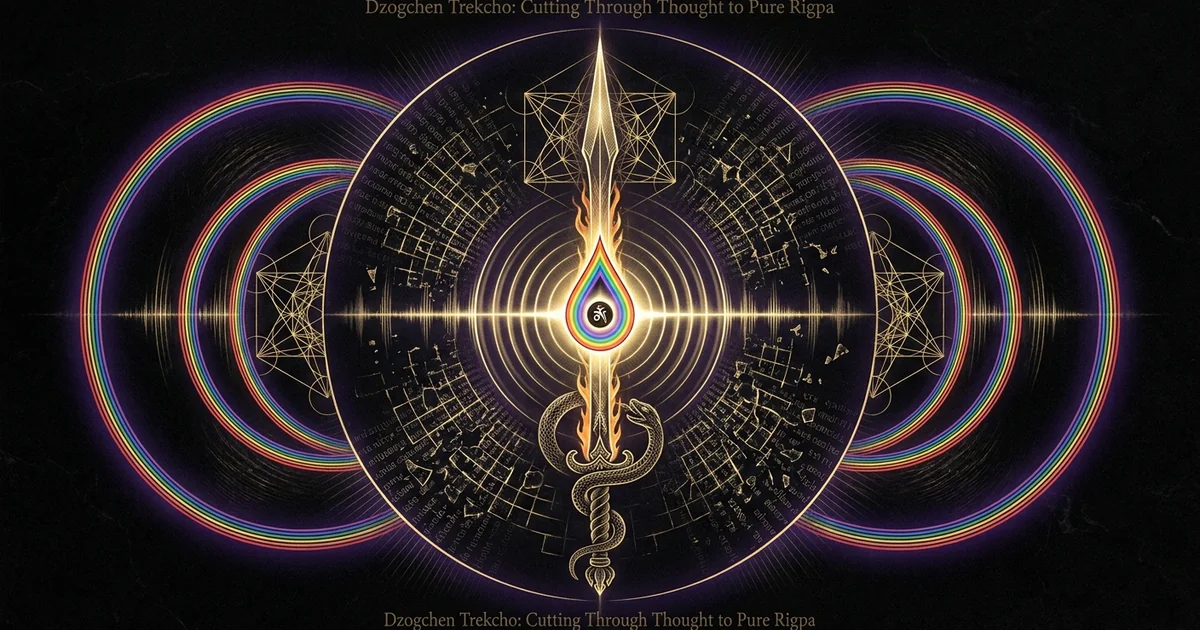
Dzogchen Trekcho: Cutting Through Thought to Pure Rigpa
Protocol Overview & Neurophysiological Thesis: The Architecture of Cutting Through
Non-Dual Ontology: Differentiating Discursive Mind (Sem) from Primordial Awareness (Rigpa)
Within the epistemological taxonomy of the Great Perfection (Dzogchen Atiyoga), the human cognitive apparatus is divided into two operational modalities: the conditioned, discursive intellect (sem) and primordial, non-referential awareness (rigpa). Discursive mind operates via continuous conceptual fabrication (spros-pa). It synthesizes sensory afference, mnemonic traces, and affective valences into a coherent, time-bound narrative self. This dualistic construct perpetually bifurcates reality into an apprehending subject (gzung-ba) and an apprehended object ('dzin-pa). As systematized by Longchen Rabjam in The Treasury of the Supreme Vehicle (Theg mchog mdzod), this conceptual momentum constitutes the root mechanism of cyclic confusion, reifying transient phenomenological events into solid, self-existing entities.
Conversely, rigpa denotes the unconditioned, timeless baseline of consciousness. It is not an altered state of consciousness engineered through sustained concentration, nor is it an affective absorption (samadhi) cultivated by mental suppression. Rather, rigpa is the intrinsic luminosity (gsal-ba) and uncompounded emptiness (stong-pa) of consciousness recognizing its own nature.
Trekchö (khregs-chod), translated literally as “cutting through tension” or “severing hardness,” acts as an immediate deconstructive operation. It dissolves the karmic momentum of discursive processing without generating an antithetical cognitive counter-structure. By withdrawing the dynamic imputation of identity from arising thoughts, the practitioner leaves mental arisings naked, self-liberated at the precise instant of their emergence.
Longchen Rabjam, Finding Comfort and Ease in the Nature of Mind (Sems nyid ngal gso), Chapter 4: “When the solid ice of conceptual grasping melts into the unfabricated water of pure being, the natural state dawns without seeking. Do not modify, do not fabricate; rest precisely as it is in naked awareness.”
Kadag (Primordial Purity) and the Collapse of Subject-Object Dualism
The ontological ground of Trekchö is anchored in kadag—primordial purity. Kadag posits that all arisings, regardless of their moral or qualitative valence, are intrinsically devoid of self-nature from their very origin. They are unarisen (skye-med) and empty (stong-pa). In ordinary perception, the mind superimposes ontological permanence onto perceptual streams, initiating an interpretive loop that solidifies the dualism of observer and observed.
In Trekchö, this interpretive overlay collapses. The practice requires no manipulation of the perceptual visual field, somatic inputs, or affective states. The practitioner rests in the unfabricated natural state (gnas-lugs), allowing sensory patterns to present themselves with raw vividness.
When phenomena are seen through the lens of kadag, the reflexive impulse to grasp at appearances (snang-ba) or reject them is immediately neutralized. The subject-object dichotomy is revealed as a retrospective cognitive fabrication. Without this dualistic divide, perception transforms into an unmediated expanse of naked cognizance (zang-thal). Consciousness recognizes that the observer is not a localized entity residing within the cranium looking outward at an objective world; rather, appearance and emptiness are indivisible (snang-stong dbyer-med), co-arising within the single sphere of awareness (thig-le nyag-gcig).
Neurobiological Target: Cortical Hub Suppression and Attenuation of the Default Mode Network
From a cognitive neuroscience perspective, the structural reification of sem depends on the metabolic activity of the Default Mode Network (DMN). This network is anchored in midline cortical nodes, specifically the posterior cingulate cortex (PCC), the precuneus, and the ventromedial and dorsomedial prefrontal cortices (vmPFC/dmPFC). The PCC and precuneus form the central hubs for narrative self-referential processing, autobiographical memory retrieval, and temporal projection into the past and future. During typical wakefulness, the DMN maintains the baseline continuity of the narrative ego, continuously referencing sensory data against an ongoing personal history.
                    [ vmPFC / dmPFC ]
              (Autobiographical Judgment)
                          ▲
                          │
                          ▼
                  [ PCC / Precuneus ]  ◄────►  [ Inferior Parietal Lobule ]
              (Self-Referential Narrative)       (Ego-Spatial Boundary)
                          │
                          ▼
           =====================================
           TREKCHÖ INTERVENTION (GHAD-DRAL / PHAT)
           =====================================
                          │  Downregulation & Decoupling
                          ▼
                 [ Global Hypometabolism ]
            Phase-Locked Gamma Synchrony (40–100 Hz)
            Unfabricated Non-Dual Rigpa Expose
During Dzogchen Trekchö, the sudden cessation of conceptual reification precipitates rapid downregulation and functional decoupling of these cortical midline structures. Garrison et al. (2015) demonstrated that during non-referential contemplative states, regional cerebral blood flow and blood-oxygen-level-dependent (BOLD) signals within the PCC and precuneus decrease significantly.
Unlike focused attention meditation (which elevates activity within the dorsolateral prefrontal cortex [dlPFC] and dorsal attention network [DAN] to sustain fixation upon an object), Trekchö involves zero attentional effort. Consequently, it destabilizes both the dorsal and ventral attentional systems while simultaneously quieting the DMN. This induces a state of transient hypofrontality paired with high sensory throughput, characterized by minimal metabolic consumption in narrative processing regions. The reduction in BOLD signal within the PCC correlates directly with the practitioner’s experiential report of the collapse of the internal observer. This biological shift marks the transition from sem to rigpa.
Biophysical Mechanisms & Brainwave Dynamics in Non-Referential Awareness
Phase-Locked High-Amplitude Gamma (40–100 Hz) Oscillatory Synchrony
The electrophysiological hallmark of resting in the unfabricated natural state of rigpa is the appearance of sustained, high-amplitude gamma-band oscillatory synchrony spanning the 40 to 100 Hz spectrum. In conventional cognitive tasks, gamma oscillations appear as localized, transient bursts lasting tens to hundreds of milliseconds. These bursts reflect the binding of distinct sensory modalities—such as color, shape, and motion—into unified perceptual representations.
In advanced practitioners of Trekchö, gamma oscillations cease to be transient, localized events. Instead, they transform into a global, continuous baseline of high-amplitude synchrony that covers bilateral frontal, parietal, and temporal cortical networks.
Lutz, A., et al. (2004). “Long-term meditators self-induce high-amplitude gamma synchrony during mental practice.” PNAS, 101(46), 16369–16373. Long-term non-referential open-presence practitioners displayed resting-state ratio of gamma (25–42 Hz) to slow-wave activity (4–13 Hz) up to thirty times higher than control subjects, indicating sustained non-dual neuroplastic reorganization.
This widespread gamma coherence is driven by the synchronized firing of fast-spiking, parvalbumin-positive (PV+) GABAergic interneurons. These interneurons regulate the temporal windows of pyramidal cell firing within cortical microcircuits. In Trekchö, PV+ interneuron networks fire with rhythmic precision, dampening baseline cortical noise without restricting sensory throughput.
The resulting global synchrony reveals that consciousness does not depend on dynamic, localized top-down attention to achieve coherence. Rather, pure awareness is an intrinsic property of the synchronized neural substrate. This non-referential clarity operates entirely outside the computational limits of subject-object processing. For deeper exploration of this mechanism, see the technical analysis on /neuroscience/gamma-synchrony-nondual-awareness.
Parieto-Occipital Alpha (8–12 Hz) Desynchronization and Theta-Gamma Phase Coupling
Alongside frontoparietal gamma coherence, Trekchö induces pronounced parieto-occipital alpha-band (8–12 Hz) desynchronization paired with cross-frequency theta-gamma phase coupling. In standard contemplative practices such as shamatha, alpha rhythms typically increase over occipital and parietal sensors. This reflects active sensory gating and the inhibition of incoming visual and somatosensory streams to protect internal concentration.
Trekchö rejects sensory gating. Because appearances (snang-ba) are recognized as the direct display of awareness, sensory suppression is viewed as an artificial fabrication that sustains the subtle duality of an interior self hiding from an exterior environment.
Theta Phase (4–8 Hz)    : ───/───\───/───\───/───\───/───\─── (Excitability Cycle)
                             │       │       │       │
Gamma Bursts (40–100 Hz):  |||||   |||||   |||||   |||||     (High-Density Clarity)
                             ▲
                             └── PV+ Interneuron Gating (Zero Sensory Attenuation)
Consequently, parieto-occipital alpha synchrony drops, indicating that sensory cortices remain open to broadband external stimuli. Visual, auditory, and tactile afference passes uninhibited into the thalamocortical matrix without triggering top-down filtering.
Concurrently, the phase of slow theta oscillations (4–8 Hz) dynamically modulates the amplitude of fast gamma oscillations (40–100 Hz). This theta-gamma phase-amplitude coupling coordinates long-range communication between deep subcortical structures—specifically the anterior thalamic nuclei and hippocampus—and superficial neocortical layers. Sensory signals are received with uninhibited clarity, but they fail to trigger the secondary associative cascades that typically form episodic memory and autobiographical narratives. The practitioner perceives stimuli cleanly, without cognitive fixation.
Neurochemical Homeostasis: Monoaminergic Attenuation and Endogenous Cannabinoid Signaling
The sustained stabilization of Trekchö drives distinct neurochemical changes, dampening hyper-arousal while maintaining vivid wakefulness. The effort-free subtraction inherent in kadag reduces firing in the locus coeruleus noradrenergic system. This reduction strips incoming sensory signals of acute sympathetic reactivity, preventing the fight-or-flight cascades driven by habitual emotional reactions.
Simultaneously, the practice downregulates the mesolimbic and mesocortical dopaminergic pathways that drive goal-oriented motivation, conceptual search patterns, and the craving to modify present-moment phenomena. This attenuation of dopaminergic wanting eliminates the cognitive restlessness that usually disrupts open presence.
Concurrently, this state engages the endocannabinoid system, elevating levels of circulating anandamide (N-arachidonoylethanolamine) alongside targeted upregulation of serotonin 5-HT1A receptor occupancy. Anandamide binds to central CB1 receptors distributed throughout the basolateral amygdala, hippocampus, and prefrontal cortex. This binding suppresses the release of presynaptic glutamate, preventing neurotoxic excitation during states of high gamma power.
Elevated central anandamide acts as an experiential shock absorber, cultivating deep somatic ease while heightening sensory lucidity. The practitioner’s nervous system settles into homeostatic balance: sympathetic hyper-vigilance and parasympathetic lethargy fall away, leaving the organism grounded in clear, unconditioned baseline awareness.
The Non-Dual Trajectory: Delineating Trekchö and Tögyal
Kadag (Primordial Purity) as the Ground of Trekchö vs. Lhungrub (Spontaneous Presence) in Tögyal
The path of the Great Perfection is classically structured into two interlocked phases: Trekchö (cutting through) and Tögyal (direct crossing). Trekchö focuses on the realization of kadag (primordial purity). It strips away conceptual grasping to reveal the unconditioned ground (gzhi) of awareness, functioning as an empty, formless, and contentless release. The practitioner cuts through mental constructs to realize the non-existence of an egoic core.
Tögyal (thod-rgal), by contrast, cultivates the complementary dimension of the ground: lhungrub (spontaneous presence). Once the emptiness of awareness is recognized through Trekchö, Tögyal introduces specific visual and postural practices that manifest this emptiness as spontaneous luminous vision. For an exhaustive analysis of these visionary modalities, consult /meditation/dzogchen-togyal-visionary-practices.
Trekchö (Cutting Through)
- Principle: Primordial Purity (Kadag)
- Modality: Formless, open resting, radical non-fabrication
- Neural Profile: DMN suppression, global gamma-band synchrony, hypofrontality
- Visual Component: Naked eye posture, non-focused space-gazing, zero photic fixation
- Target: Immediate collapse of conceptual mind (sem) into awareness (rigpa)
Tögyal (Direct Crossing)
- Principle: Spontaneous Presence (Lhungrub)
- Modality: Form-based light-gazing (sunlight, sky, dark retreat)
- Neural Profile: Visual cortex (V1-V4) excitation, optic chiasm photic modulation, bio-photonic capture
- Visual Component: Specific postures (Lion, Elephant, Sage) with fixed gazes into optical vectors
- Target: Exhaustion of phenomena into the four visions (snang-ba bzhi)
Contentless Openness versus Direct Optical Crossing into Luminous Vision
Trekchö remains radically non-visual and contentless. It requires no specific optical target, light source, or imaginative framing; awareness rests wide open within the ordinary perceptual field. The gaze is soft, cast outward into empty space without locking onto focal points.
Tögyal, conversely, leverages the visual system directly. By adopting specific physiological postures—the Lion, the Elephant, and the Sage—the practitioner applies targeted mechanical pressure to cervical autonomic pathways and the carotid sinus. Gazing directly into ambient light sources, such as clear skies or peripheral sunlight, the practitioner directs photic input through the optic chiasm and lateral geniculate nucleus (LGN) into visual cortices V1 through V4.
This process stimulates the perception of pure biophotonic discharge, manifesting as light-chains (lu-gu-rgyud) and bindus (thig-le). While Tögyal uses these optical pathways to exhaust phenomena into visionary experience, Trekchö remains the unchanging space in which those visions arise, unfold, and dissolve.
The Critical Epistemological Prerequisite: Stabilizing Trekchö to Prevent Tögyal Hallucination
A foundational warning within the Dzogchen lineage insists that Tögyal cannot be practiced without first stabilizing Trekchö. If a meditator attempts the optical postures and visionary practices of Tögyal without genuine realization of primordial purity (kadag), the emerging photic forms will inevitably be reified by the conceptual mind (sem).
The visual cortex easily mistakes entoptic phenomena and ocular biophoton emissions for external realities, generating neurotic spiritual delusions, manic inflation, or waking visual hallucinations.
Stabilizing Trekchö breaks the associative loop that assigns conceptual meaning to internal sensory forms. When Trekchö is firmly established, visionary arisings are recognized instantly as the natural radiance (rtsal) of one’s own awareness, carrying no intrinsic selfhood or external reality. The practitioner watches visionary phenomena form, transform, and self-liberate without clinging. Trekchö secures the epistemological foundation: it ensures that spontaneous presence (lhungrub) is never mistaken for an external object, protecting the practitioner from delusion.
Step-by-Step Experiential Protocol: The Four Chogshag and Ghad-Dral
Preparatory Settling: Vairochana Posture and the Unmoving Gaze into Empty Space
The physical execution of Trekchö utilizes the Seven-Point Posture of Vairochana to establish postural and autonomic stability. The practitioner sits upon a firm cushion with legs crossed in the vajra posture, anchoring the pelvic floor to stabilize lower spinal tone. The hands rest in the equanimity mudra below the navel or flat upon the knees. The spine is held vertical, aligning the central physiological axis. The shoulders are drawn slightly back and up to open the thoracic cavity, while the chin is tucked gently inward toward the throat, flattening the cervical lordosis and lightly stimulating the carotid sinus to facilitate vagal dominance. The tongue rests against the upper palate behind the incisors, reducing salivation and stabilizing autonomic balance.
       [ Eye Gaze: Fixed at 45° Angle into Unfocused Space ]
       [ Chin Tucked: Slight Vagal/Carotid Compression ]
       [ Spine Aligned: 90° Axis / Thoracic Cavity Opened ]
       [ Syllable PHAT: Pelvic/Solar Plexus Diaphragmatic Snap ]
Crucially, the eyes are not closed, nor are they focused on any object. The gaze is directed slightly upward or straight ahead at a forty-five-degree angle into the open space of the sky or room. The eyes remain wide, unblinking, and unfocused.
By eliminating the focal convergence reflex, the practitioner reduces ocular micro-saccades—the minute, involuntary eye movements that correlate with conceptual scanning, object recognition, and inner speech. This non-convergent, motionless gaze immediately quiets the frontal eye fields (FEF) and the superior colliculus, sending an inhibitory signal to the discursive associative machinery of the prefrontal cortex. This somatic gateway closely parallels the pointing-out methodologies detailed in the /meditation/mahamudra-pointing-out-instructions.
- Postural Alignment: Seven-Point Vairochana posture. Spine vertical at 90 degrees; chin tucked slightly inward to compress carotid sinus; tongue at palate; eyes open, unblinking, cast into open space at 45 degrees.
- The Sudden Severance (Ghad-Dral): Inhale deeply into lower dhyana center (3 finger-widths below navel). Eject the wrathful syllable “PHAT!” (acoustic frequency profile peaked at 180–250 Hz vocal fundamental) from the solar plexus with sharp diaphragmatic contraction. Instantly freeze body and mind in the subsequent void.
- Abiding via the Four Placements (Chogshag):
- Mountain (ri-bo): Body unmoving, immune to somatic perturbations.
- Ocean (rgya-mtsho): Senses wide open, impressions washing through without mental ripple.
- Appearance (snang-ba): Thoughts arise and self-dissolve like writing upon water.
- Awareness (rig-pa): Self-knowing, luminous, untouched by past, present, or future.
- Session Duration & Frequency: 15–20 minute burst sessions executed 4–6 times daily, preventing cognitive dullness (bying-ba) and agitation (rgod-pa).
The Explosive Severance: Executing the Syllable ‘Phat’ to Shatter Discursive Mind (Ghad-Dral)
When conceptual momentum, affective fixation, or daydreaming clouds the open expanse of awareness, the practitioner executes the sudden method of severance: ghad-dral. Drawing a full breath into the lower abdomen, the practitioner uses the diaphragm to forcefully eject the wrathful acoustic syllable:
$$\text{PHAT!}$$
This syllable must be explosive, abrupt, and voiced directly from the solar plexus, with a fundamental frequency landing between 180 and 250 Hz.
The physical shock of this forceful vocalization, combined with the sudden burst of intrathoracic and intracranial pressure, triggers a rapid acoustic startle response. This sharp stimulus depolarizes ascending reticular activating system (ARAS) projections and floods the thalamic reticular nucleus. Discursive inner monologue is shattered instantly.
In the precise moment following the ejaculation of Phat!, the practitioner freezes completely—suspending breath, ocular motion, and mental searching. In this gap (bar-mtshams), the discursive mind (sem) stops dead, yet consciousness does not black out. The practitioner encounters the ground state of unconditioned awareness (rigpa), laid completely bare.
Abiding in the Four Placements (Chogshag): Mountain, Ocean, Appearance, and Awareness
Following the cut of ghad-dral, the practitioner stabilizes the natural state by applying the Four Great Placements (chog-bzhag bzhi), which integrate all bodily, sensory, and cognitive arisings:
- The Mountain Placement (ri-bo chog-bzhag): The physical posture rests like a great mountain. The body remains stable, grounded, and unmoving, unaffected by aches, muscular tension, or external disturbances. Somatic sensations are left exactly as they are without adjustment.
- The Ocean Placement (rgya-mtsho chog-bzhag): The sensory gaze rests like a vast, calm ocean. The eyes remain open and clear, receiving sensory inputs without actively scanning or interpreting them. Visual, auditory, and tactile perceptions ripple across the surface of the senses without disturbing the ocean’s depths.
- The Appearance Placement (snang-ba chog-bzhag): Thoughts, memories, and emotions are left entirely alone. The practitioner neither suppresses a rising thought nor chases it down associative rabbit holes. Thoughts self-arise and self-dissolve without leaving a trace, resembling patterns drawn upon running water.
- The Awareness Placement (rig-pa chog-bzhag): Consciousness rests in its own nature. Unmodified by conceptual effort, untainted by past memories, and free from future anticipation, rigpa recognizes its own empty, luminous presence. It abides effortlessly as the self-knowing ground of all experience.
Operational Safety, Contraindications & Biofield Grounding
Etiology and Diagnosis of Snying-rlung (Life-Force Wind Agitation)
The radical open-presence orientation of Trekchö carries specific physiological and energetic vulnerabilities if practiced incorrectly. In Tibetan medical neurophysiology and subtle prana dynamics, the heart center houses the subtle life-bearing wind (srog-'dzin rlung), which regulates affective stability, autonomic balance, and systemic coherence across the subtle biofield. When a practitioner uses excessive cognitive force to suppress thought, or attempts to gaze into space with subconscious tension, the subtle winds (prana-vayus) reverse their downward course and surge violently into the cardiac region.
This functional pathology is diagnosed as snying-rlung (life-force heart wind agitation). Its clinical manifestation features persistent precordial chest tightness, resting tachycardia, unexplained panic, extreme irritability, vestibular vertigo, severe insomnia, and a distressing feeling of ungrounded detachment.
Biophysically, this condition mirrors severe sympathetic autonomic dysregulation, characterized by attenuated vagal tone, suppressed heart rate variability (HRV), and disrupted hypothalamic-pituitary-adrenal (HPA) axis balance. For deeper analysis of how these biological currents interface with subtle energetic systems, refer to /physics-electromagnetism/biofield-electrodynamics.
- Psychiatric Contraindications: Do not execute Trekchö or acute gaze-fixation protocols if diagnosed with dissociative identity disorder, schizotypal personality, clinical mania, or active PTSD. The radical non-referential deconstruction of the self-matrix requires an intact, robust psychological ego-structure to dismantle.
- Wind-Disorder (Snying-rlung) Symptomology: If experiencing chronic chest tightening, tachycardia, vestibular vertigo, ungrounded anxiety, or persistent cognitive depersonalization, halt open-space contemplation immediately.
- Grounding Protocol: Cease all mental observation. Consume warm, nutrient-dense foods (ghee, bone broths). Perform physical biofield grounding by lying supine on bare earth, applying warm sesame oil to the vertex of the cranium (tshangs-bug) and soles of the feet (rkang-mthil), and engaging slow, diaphragmatic resonant breathing at 0.1 Hz (6 breaths per minute) to re-engage parasympathetic vagal tone.
Psychiatric Contraindications: Dissociative Disorders, Borderline Structural Integrity, and Psychosis
Trekchö is strictly contraindicated for individuals presenting with active psychotic disorders, borderline personality organization, or complex dissociative conditions. The practice deconstructs ego boundaries and reveals the emptiness of the narrative self.
To safely and effectively dismantle this structure, the practitioner must first possess an intact, mature ego capable of healthy self-regulation.
When applied to a fragile or traumatized ego-structure, Trekchö can trigger pathological dissociation rather than liberating non-dual insight. Instead of realizing the primordial purity of awareness (kadag), an unstable psyche may fall into depersonalization-derealization episodes, profound existential terror, or catatonic apathy.
Without stable executive integration, dissolving the boundary between self and world can unlock latent psychotic decompensation, manifesting as ideas of reference, megalomania, or paranoid breakdown. Practitioners must display robust psychological stability before undertaking non-referential deconstruction.
Somatic Reclamation and Prana-Grounding Protocols
If symptoms of snying-rlung or psychological disorientation emerge, all space-gazing and formless meditation must halt immediately. The practitioner must initiate somatic grounding protocols to redirect ascending subtle winds downward into the lower energy centers.
The practitioner lies supine directly on the earth, maximizing physical contact with the ground to stabilize biofield potentials and discharge accumulated static voltage.
[ Prana Rising: Snying-rlung ] ──► Tachycardia / Precordial Agitation / Derealization
                                    │
    ┌───────────────────────────────┴───────────────────────────────┐
    ▼                                                               ▼
[ Physical Interventions ]                                  [ Somatic Regulators ]
• Warm Sesame Oil (Vertex/Soles)                            • Resonant Breathing (0.1 Hz)
• Nutrient-Dense Diet (Bone Broths/Ghee)                    • Abdominal Bandha Compression
• Total Cessation of Open-Space Gazing                      • Downward Prana Redirection
Somatic reclamation requires working directly with the physical body and breath. The practitioner applies warm, unrefined sesame oil to the cranial vertex (tshangs-bug), the palms, and the centers of both soles (rkang-mthil), massaging deeply to draw heat and subtle wind downward away from the heart and head.
Breathing shifts exclusively to slow, deep abdominal respiration at a resonant frequency of 0.1 Hz (approximately 6 breaths per minute, maintaining an equal 5-second inhalation and 5-second exhalation). This breathing pattern stimulates afferent vagal pathways, elevating systemic acetylcholine release and restoring healthy heart rate variability.
The diet must transition to warm, unctuous, nutrient-dense foods—such as slow-cooked animal broths, grass-fed ghee, and rooted vegetables—providing the dense physical nourishment required to stabilize the nervous system.
Phenomenological Correlates & Veridical Evidence
Qualitative Taxonomy: Naked Cognizance (Zang-thal) and Non-Grasping Transparency
The phenomenological terrain of stabilized Trekchö is defined by zang-thal, commonly translated as “unobstructed penetrability” or “naked cognizance.” In zang-thal, perception is transparent and clear. Reality is no longer perceived through the conceptual lens of names, categories, or narrative associations. The three-dimensional world remains fully visible, yet appearances lose their dense, unyielding quality. Sights, sounds, and physical sensations register as luminous, shimmering arisings devoid of substantial mass.
Dualistic Perception (Sem)  : [ Self-Center ] ─── (Grasping / Filter) ───► [ External Object ]
                                                       │
                                            Conceptual Solidification
                                                       ▼
Non-Dual Rigpa (Zang-thal)  : [          Luminous Expanse of Awareness (Rigpa)          ]
                                (Sensory Arisings Appear and Self-Liberate Concurrently)
The practitioner’s inner landscape undergoes a parallel shift toward non-grasping transparency (shes-pa zang-thal). Sensations and emotions pass cleanly through the field of awareness without sticking to an egoic core.
If anger, fear, or attachment arises, it is not resisted, analyzed, or cultivated. The practitioner neither identifies with the affective wave nor attempts to suppress it. Left untouched within naked awareness, the emotional charge dissolves the very moment it appears, leaving no trace on the mind.
Neuroimaging Correlates: Frontoparietal Phase Locking and Global Hypometabolism
Neuroimaging and dense-array electroencephalography (EEG) have helped clarify the objective neural correlates of Trekchö. Functional magnetic resonance imaging (fMRI) studies conducted by Josipovic (2014) reveal that deep non-dual awareness alters the typical reciprocal antagonism between the brain’s task-positive network (TPN) and task-negative network (DMN). Under ordinary conditions, when the task-positive network engages to complete external tasks, the DMN is suppressed; conversely, when the mind drifts into internal narrative processing, the TPN drops away.
During Trekchö, this competitive antagonism disappears. Both the task-positive network and the default mode network show coordinated, balanced reduction in metabolic activity, yielding an integrated, intermediate cortical state.
Dense-array quantitative EEG demonstrates high frontoparietal Phase Locking Values (PLV) across the gamma band (specifically 40 to 80 Hz). This cross-cortical coherence confirms that distant brain regions can achieve synchrony without relying on focused attention or task execution. Positron emission tomography (PET) imaging reveals global cerebral hypometabolism, marked by significant drops in glucose uptake throughout associative frontoparietal networks. Consciousness rests in bright, wakeful clarity while operating at absolute metabolic efficiency.
Empirical Evidence of Spontaneous Phenomenological Self-Liberation
The definitive qualitative test of authentic Trekchö is spontaneous self-liberation (rang-grol). In lesser contemplative stages, thoughts are neutralized through cognitive antidotes—for example, cultivating loving-kindness to counter anger, or tracking the breath to anchor a restless mind. In Trekchö, antidotes are unnecessary. The practice relies on the innate self-liberating capacity of the mind’s ground state.
As detailed by Padmasambhava in Self-Liberation through Seeing with Naked Awareness, thoughts self-liberate in three distinct developmental phases:
- Liberation through Direct Recognition (cher-grol): The practitioner looks directly at an arising thought the instant it appears. By catching the thought with naked attention, it vanishes immediately, like a thief caught in the act.
- Spontaneous Self-Liberation (rang-grol): As the practice deepens, the effort of “looking” drops away. The thought dissolves on its own the exact moment it forms, resembling a snake naturally uncoiling its own knots.
- Liberation Without Harm or Benefit (phan-gnod-med-par grol): At advanced stabilization, thoughts dissolve simultaneously with their emergence, like writing upon water. The arising does not obscure awareness, nor does its passing improve it. Dualistic cognitive momentum collapses, leaving pristine, unfabricated clarity intact.
Frequently Asked Questions
Resolving Discursive Thought vs. Suppressing Cognition in Practice
A primary point of confusion for modern meditators is distinguishing the effortless resolution of discursive thought from deliberate mental suppression. In classic concentration practices, the practitioner actively silences internal dialogue by forcing attention back to a single anchor (such as the breath or a visual symbol).
This active suppression requires continuous effort from the dorsolateral prefrontal cortex. It builds cognitive tension, and when vigilance inevitably slips, suppressed thoughts rebound with added force.
Dzogchen Trekchö rejects mental suppression entirely. Attempting to freeze or block thoughts is simply the discursive mind (sem) trying to police itself, which only reinforces the illusion of an internal controller. In Trekchö, thoughts are permitted to arise freely. The practitioner does not manipulate, judge, encourage, or suppress any mental content.
By resting as the open, unconditioned space (rigpa) in which thoughts occur, the practitioner strips away the conceptual grasping that sustains their lifespan. Unfed by attention, mental arisings dissolve naturally back into the ground of awareness, leaving no karmic trace behind.
Distinguishing Primordial Rigpa from the Subconscious Substrate (Alaya-Vijnana)
A common obstacle in advanced practice is mistaking the subconscious substrate (kun-gzhi or alaya-vijnana) for genuine primordial awareness (rigpa). The alaya-vijnana is a neutral, non-conceptual resting state characterized by blankness, stillness, and an absence of active discursive thoughts.
When a practitioner sits quietly and successfully quiets the internal narrative, they often land in this blank, quiet space. Mistaking this void for enlightenment is an ancient contemplative trap.
Subconscious Substrate (Alaya / Kun-gzhi) : [ Static Blankness ]  ──► Dullness / Non-Cognizant Stupor
                                              (Subtle karmic traces remain latent)
                                                       VS
Primordial Awareness (Rigpa)             : [ Dynamic Luminosity ] ──► Vivid, Unobstructed Lucidity
                                              (Kadag & Lhungrub indivisibly unified)
The difference between the two states is absolute:
- The Alaya-Vijnana is fundamentally passive, opaque, and non-cognizant (lung-ma-bstan). It functions as a dormant reservoir where subtle karmic imprints continue to slumber under a veil of quiet dullness (bying-ba).
- Rigpa, by contrast, is vivid, intensely alert, and intrinsically luminous (gsal-rig). It does not depend on the absence of thoughts to remain clear; it is equally aware whether the mind is full of activity or completely silent.
Resting in the alaya-vijnana leads only to deep mental sluggishness or passive trance states. Awakening to rigpa cuts clean through this dormant blankness, exposing the vibrant, non-dual clarity of primordial reality.
Biometric and EEG Indicators of Authentic Non-Fabrication
Authentic resting in the unfabricated natural state of Trekchö produces consistent, objective physiological markers:
- Ocular Stabilization: The practitioner’s eyes remain open, relaxed, and non-convergent. High-speed eye-tracking reveals a near-total cessation of micro-saccades, showing that the cognitive systems driving visual search and narrative labeling have powered down.
- Respiratory Deceleration: Respiration slows spontaneously to four to six breaths per minute without conscious breath control. Tidal volume expands gently, and respiration synchronizes cleanly with heart rate variability at the resonant 0.1 Hz frequency.
- Autonomic Balance: Galvanic skin conductance drops steadily, indicating the release of sympathetic nervous system tension and low emotional arousal.
- Electrophysiological Profile: Quantitative EEG analysis registers high-amplitude, phase-locked gamma oscillations (spanning 40 to 100 Hz) distributed globally across the neocortex. This fast-wave coherence is accompanied by decreased parieto-occipital alpha power and cross-frequency theta-gamma phase-amplitude coupling.
Crucially, these biometrics emerge alongside a sharp reduction in prefrontal metabolic demand. The practitioner remains fully conscious, sensory pathways stay completely open, and the narrative self-referential machinery of the Default Mode Network falls silent. Awareness rests in its own primordial ground: pristine, unconditioned, and free.