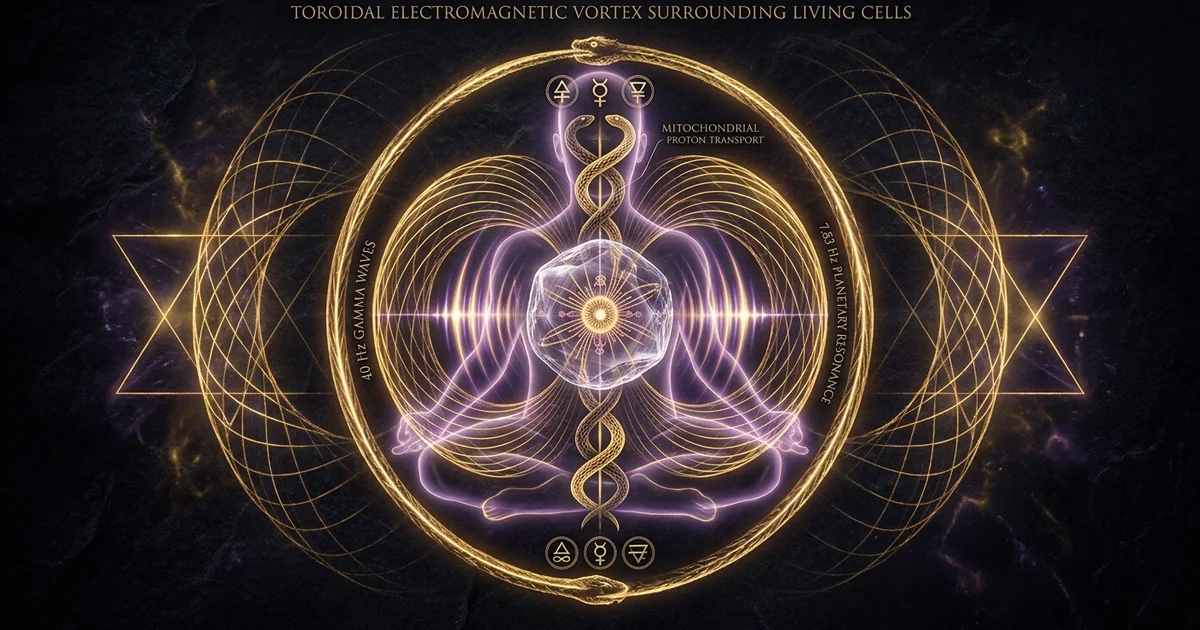
Toroidal Electromagnetic Vortex Surrounding Living Cells
Protocol Overview & Neurophysiological Thesis: Micro-Toroidal Resonance and Cellular Coherence
Endogenous Cellular Bioelectromagnetism vs. Macroscopic Biofield Dynamics
Classical reductionist cell biology has long treated the interior of eukaryotic systems as an isotropic, aqueous solution wherein biochemical reactions occur purely through stochastic thermal collisions and Brownian diffusion. This view, dominated by the fluid mosaic model and standard reaction-diffusion kinetics, overlooks the profound electrodynamic environments maintained by living matter. Intracellular space is not an amorphous medium; it is a densely packed, anisotropic, highly organized dielectric matrix characterized by sustained electric fields reaching magnitudes on the order of $10^7\text{ V/m}$ across cellular and organellar membranes.
At the center of cellular energetics, the electron transport chain continuously pumps protons across the inner mitochondrial membrane, generating an electrochemical membrane potential ($\Delta\Psi_m$) between $-140\text{ mV}$ and $-180\text{ mV}$ across a lipid bilayer merely 4 to 5 nanometers thick. This spatial polarization produces enormous local field gradients that, when coupled with the mechanical, piezoelectric, and dielectric vibrations of the cytoskeletal network, generate sustained ultra-weak electromagnetic fields (UWEFs). Rather than dissipating randomly into thermal dissipation, the flux vectors of these fields are geometrically guided by polar lipid membranes and structural polymers. The resulting field topologies close upon themselves, forming microscopic, dynamic toroidal vortices—a self-contained torus energy field cellular bioelectromagnetism merkaba micro architecture operating continuously at the single-cell level.
The biophysical reality of coherent cellular electrodynamics was mathematically formulated by Herbert Fröhlich, who proved that metabolic energy supply causes polar macromolecules to condense into a single, lowest-frequency macroscopic vibrational mode spanning $10^{11}$ to $10^{12}\text{ Hz}$ (Fröhlich, 1968). This quantum-like coherence operates far from thermal equilibrium. Decades later, Cifra, Fields, and Farhadi (2011) confirmed that the structural integration of microtubules and mitochondria sustains endogenous, localized electromagnetic field oscillations that mediate non-chemical cellular communication. Concurrently, Albrecht-Buehler (1992) demonstrated through meticulous optical assays that living cells possess directional electromagnetic sensitivity—a rudimentary form of cellular “vision” mediated by infrared-absorbing centriolar shafts that orient and navigate toward external light fields independent of biochemical signaling pathways.
These micro-toroidal geometries aggregate into the macroscopic biofield that envelops the human organism. However, the transition from micro-scale cellular vortices to a coherent, unified macro-field is fundamentally non-linear. In chaotic, non-regulated states, the phase relationships between individual cellular toroidal fields remain largely incoherent; their relative electromagnetic vectors cancel each other out via destructive interference, resulting in an externally measured biofield that resembles thermal noise. When the organism enters specific states of profound neurovisceral resonance—characterized by synchronized autonomic outflow and phase-locked cortical oscillations—the billions of micro-toroidal fields across somatic tissues achieve macroscopic phase alignment. This synchronization translates microscopic dielectric oscillations into an integrated bodily toroidal field, creating a cross-scale resonance conduit that links cellular metabolism directly to transpersonal conscious states.
The Centrosome-Microtubule Complex as a Micro-Merkaba Resonator
The geometric core of cellular bioelectromagnetism resides within the centrosome, the primary microtubule-organizing center (MTOC) of eukaryotic cells. Structurally, the centrosome consists of two mutually perpendicular (orthogonal) cylinders known as centrioles, immersed in a structured pericentriolar material. Each centriole is composed of nine microtubule triplets arranged in a chiral, barrel-like pinwheel configuration with $C_9$ rotational symmetry. This orthogonal arrangement is unique within cellular biology. It is not an arbitrary spatial artifact; rather, cellular centrosome geometry satisfies the rigorous topological criteria required for an electrodynamic transceiver array capable of processing, emitting, and resolving three-dimensional vector fields.
[Mother Centriole (Vertical Dipole)]
                      ||
                      ||  Z-Axis
                      ||
  ====================++====================  X/Y-Axis
       [Daughter Centriole (Horizontal Dipole)]
Because microtubules are composed of polymerized $\alpha$- and $\beta$-tubulin heterodimers—each carrying a substantial intrinsic dipole moment of roughly 100 to 1000 Debyes—the entire microtubular scaffold behaves as an anisotropic, ferroelectric lattice. As alternating electrical currents flow along the centrosomal axis driven by metabolic phosphorylation, the two orthogonal centrioles establish two perpendicular, alternating dipole axes.
In electrodynamic systems, mutually perpendicular oscillating dipoles naturally induce rotational curl in the adjacent electromagnetic flux lines, generating a swirling Poynting vector field. This dual-vortex morphology closely mirrors the geometry of the historical merkaba—interlocking, counter-rotating pyramidal and toroidal energy fields documented across sacred geometry and esoteric lineages. Within the context of biophysical mechanics, the mother and daughter centrioles act as counter-oscillating electromagnetic emitters. Their orthogonal vector summation converts linear metabolic current into a self-reinforcing, rotational vortex: a micro-merkaba operating within the cytocenter of every nucleated human cell.
Through non-linear electrodynamic resonance, these centriolar vortices couple directly to the surrounding mitochondrial network. Mitochondria are structurally bound to microtubules via dynactin and kinesin motor complexes, positioning their localized, high-amplitude electric fields in immediate proximity to the centrosomal waveguide. The centriolar barrel acts as an electromagnetic cavity resonator, absorbing sub-cellular infrared emissions and high-frequency vibrations from adjacent mitochondrial cristae, organizing them into a stabilized, toroidal standing wave that projects outward across the cytoplasm to the plasma membrane.
Target Neurobiological Signatures of Fractal Scale-Coupling
To achieve macroscopic access to these cellular micro-toroids, the central nervous system must act as an impedance-matching transformer. The brain’s macroscopic dipole must match the geometry and phase signatures of somatic tissue. This cross-scale bridge relies upon the physiological principle of fractal toroidal self-similarity: the operational physics governing the micro-torus of the single cell are topologically identical to the electrodynamic field generated by the human heart and brain.
+-------------------------------------------------------------------------+
|                  FRACTAL TOROIDAL SELF-SIMILARITY                       |
|                                                                         |
|   [ Cellular Scale ]   <--->   [ Organ Scale ]   <--->  [ Macro Scale ] |
|   Centrosomal Vortex           Myocardial Torus         Human Biofield  |
|   10^11 - 10^12 Hz             0.1 Hz Envelope          Cortical Waves  |
|   Subcellular EMF              Hemodynamic Vector       Phase Sync      |
+-------------------------------------------------------------------------+
The target neurobiological state requires simultaneous stabilization across three nested frequency bands:
- The Sub-Harmonic Carrier: A sustained autonomic cardiac and respiratory coherence at precisely $0.1\text{ Hz}$ (equivalent to a 10-second breath cycle or 6 breaths per minute). This autonomic rhythm aligns baroreceptor reflexes with heart rate variability (HRV), converting the pulsatile blood flow of the aorta into a stabilized, rhythmic mechanical and electromagnetic pumping action that modulates perineural fluid dynamics.
- The Intermediate Entrainment Window: Cortical synchronization locked into the low-frequency boundary between Theta and Alpha, specifically the fundamental Schumann Resonance harmonic of $7.83\text{ Hz}$. At this frequency, cortical impedance drops substantially, allowing bilateral synchronization across the cerebral hemispheres.
- The High-Frequency Resonator: Cross-frequency nested $40\text{ Hz}$ Gamma band oscillations. These Gamma rhythms are not permitted to operate randomly; rather, their phase amplitudes must be locked directly to the peaks of the underlying $7.83\text{ Hz}$ carrier waves.
When an operator sustains this cross-frequency nested hierarchy, macroscopic cortical dipoles become phase-coherent with the low-frequency envelope of mitochondrial metabolic fluctuations. This establishes a bidirectional resonant conduit: macro-cortical volition modulates microscopic dielectric dynamics, and the unified energy signatures of billions of somatic micro-toroids reflect upward into conscious transpersonal awareness.
Biophysical Mechanisms & Brainwave Dynamics: From Centrioles to Cortical Hemispheric Synchronization
Frequency Following Response (FFR) and Binaural Hemispheric Sync
The auditory brainstem possesses an innate capacity to synchronize its ongoing electrical activity with the envelope frequencies of external periodic acoustic signals, a phenomenon known as the frequency-following-response. When distinct, phase-locked acoustic sine waves are presented dichotically to each ear—for example, $136.1\text{ Hz}$ to the left ear and $143.93\text{ Hz}$ to the right ear—the auditory cortex cannot process them as distinct environmental sounds. Instead, the signals pass through the cochlear nuclei into the superior olivary complexes of the brainstem, which are the earliest neuroanatomical sites of binaural sound integration.
Within the superior olivary complex, neurons detect the subtle phase difference between the inputs from the left and right ears. In attempting to resolve this phase disparity, the olivary neurons discharge at an amplitude-modulated rate identical to the arithmetic difference between the two carriers:
$$f_{\text{beat}} = |f_1 - f_2| = |136.1\text{ Hz} - 143.93\text{ Hz}| = 7.83\text{ Hz}$$
This neural pacing signal travels via the lateral lemniscus to the inferior colliculi and onward to the thalamus, the primary pacemaker for electrocortical activity. The thalamocortical projections then distribute this $7.83\text{ Hz}$ pacing signal across the neocortex.
As a direct consequence, regions of the brain that typically operate in functional isolation begin to align their oscillatory cycles. The corpus callosum mediates a cross-hemispheric phase alignment, driving the left and right cerebral hemispheres out of their typical asymmetric processing states and into a unified, phase-locked operating mode termed hemispheric-synchronization. In this state, the standard phase lag between cortical regions is replaced by a global standing wave pattern, turning the entire cerebrum into a unified, macroscopic dipole oscillator.
Mitochondrial Proton Gradients as High-Frequency Dipole Arrays
While the central nervous system achieves macroscopic hemispheric synchronization, the thermodynamic engine of the somatic biofield operates within the mitochondrial matrix. The internal architecture of a mitochondrion contains numerous invaginations of the inner membrane, termed cristae. These cristae are tightly packed with electron transport chain complexes (Complexes I through IV) and ATP synthase units.
Linear Hodgkin-Huxley Reductionism
- Mechanism: Relies solely on passive ion diffusion and membrane gating.
- Thermodynamics: Treats energy dissipation as isotropic thermal waste.
- Field Dynamics: Localizes electrical fields strictly to transverse transmembrane potentials; fields beyond the Debye length (~1 nm) are treated as completely shielded and biologically inert.
- Information Transfer: Constrained to chemical kinetics and classical nerve impulse conduction velocities (1–100 m/s).
Non-Linear Toroidal Bioelectromagnetics
- Mechanism: Integrates Fröhlich condensates, coherent biophotonics, and piezoelectric cytomatrices.
- Thermodynamics: Energy is stored in non-thermal, long-range vibrational and dipole modes far from equilibrium.
- Field Dynamics: Sustains anisotropic, longitudinal, and toroidal electromagnetic fields that extend across cells and surrounding tissues via dielectric waveguides.
- Information Transfer: Mediated by phase-coherent electromagnetic resonance and biophoton exchange at the speed of light within cellular dielectric conduits.
During normal oxidative phosphorylation, protons ($H^+$) are pumped across the inner membrane from the matrix into the intermembrane space, creating a massive electrochemical proton motive force:
$$\Delta p = \Delta\Psi_m - \left(\frac{2.303 RT}{F}\right)\Delta\text{pH}$$
This high concentration of positive ions on one side of a dielectric lipid bilayer transforms each crista into a microscopic capacitor. Because mitochondrial metabolic flux fluctuates rapidly, the cristae act as high-frequency oscillating dipole arrays.
These mitochondrial electromagnetic fields emit coherent radiation within the high infrared and low terahertz spectra. Microtubules, which interface with mitochondria throughout the cytosol, function as dielectric waveguides with high refractive indices relative to the surrounding cytoplasm. The terahertz and infrared dipole oscillations of the mitochondria are funneled directly into these cytoskeletal conduits.
The acoustic resonance within the microtubule lattice acts to filter and organize these mitochondrial signals. As metabolic energy pumps the tubulin dipoles, the entire cytoskeletal framework undergoes coherent longitudinal vibrations, establishing a macroscopic quantum state known as frohlich-coherence. This process converts disorganized metabolic heat into an organized, high-frequency electromagnetic standing wave that naturally curls along the centrosome’s orthogonal axis, forming the dynamic foundation of the cellular micro-torus.
Cross-Frequency Coupling: Nesting 40 Hz Gamma within 7.83 Hz Theta-Alpha Carriers
The functional link between macro-cortical entrainment and sub-cellular dielectric oscillations relies on cross-frequency coupling, specifically phase-amplitude coupling (PAC). In this biophysical hierarchy, the phase of an underlying, low-frequency macroscopic oscillation modulates the amplitude envelope of a higher-frequency oscillatory burst.
Theta-Alpha Phase (7.83 Hz):
+               *               +               *
|              * *              |              * *
|             *   *             |             *   *
+------------*-----*------------+------------*-----*------------
            *       *                       *       *
           *         *                     *         *
Gamma Bursts (40 Hz):
          |||||||||||                             |||||||||||
When an operator enters deep states of meditative absorption through acoustic pacing, the neocortex generates high-amplitude $7.83\text{ Hz}$ waves spanning frontal and occipital lobes. Simultaneously, localized populations of parvalbumin-positive ($PV^+$) GABAergic interneurons in the hippocampus and cortex fire in synchronized micro-bursts at approximately $40\text{ Hz}$ (Gamma). Through cross-frequency coupling, these $40\text{ Hz}$ bursts are gated so that they fire almost exclusively during the depolarizing peaks of the $7.83\text{ Hz}$ carrier waves, as detailed in our research on gamma wave synchronization protocols.
This nested architecture has a direct somatic downstream effect. The human nervous system is structurally unified with the somatic connective tissue via the perineurium—a continuous sheath of dielectric, laminar connective tissue that encloses peripheral nerves down to their terminal endings. The perineural matrix is composed of collagen fibers exhibiting non-linear bio-piezoelectric and semi-conductive properties.
When the central nervous system produces high-coherence, cross-frequency coupled electrical patterns, the resulting oscillatory voltages travel down the perineural system as low-frequency, piezoelectric pressure waves. These waves bypass traditional synaptic pathways, providing a structural waveguide directly into the extracellular matrix.
Upon reaching somatic tissues, these macro-scale piezoelectric potentials interface with cellular integrins—transmembrane proteins that physically connect the extracellular matrix to the internal actin and microtubule cytoskeleton. Through this mechanotransductive and electrodynamic coupling, the nested $40\text{ Hz}$ and $7.83\text{ Hz}$ brainwave rhythms modulate the dielectric vibrations of the intracellular cytoskeletal lattice, matching macroscopic conscious intent with the endogenous micro-toroidal resonance of the cell.
Step-by-Step Experiential Protocol: Inducing the Micro-Toroidal Field
- Auditory Delivery: Open-back circumaural planar magnetic headphones capable of flat frequency response down to $5\text{ Hz}$ ($\pm 1.5\text{ dB}$). Sound pressure levels must be calibrated strictly between $55\text{ dB}$ and $62\text{ dB}$ SPL to avoid auditory fatigue.
- Acoustic Carrier Architecture: $136.1\text{ Hz}$ fundamental carrier delivered binaurally with a right-ear frequency offset of $+7.83\text{ Hz}$ (producing a $7.83\text{ Hz}$ binaural beat), modulated with an isochronic amplitude envelope pulsing at $40.0\text{ Hz}$ (duty cycle $50%$).
- Posture: Savasana (supine, neutral spine at $180^\circ$, legs uncrossed, hands pronated at a $30^\circ$ angle from hips) or full Dandasana with supported pelvic tilt. The spine must remain straight to prevent physical compression of the perineural axis.
- Respiration Rhythm: Fixed $0.0909\text{ Hz}$ autonomic cycle ($5.5\text{ seconds}$ continuous diaphragmatic inhalation, $5.5\text{ seconds}$ continuous smooth exhalation, zero breath retention), yielding precisely $5.45\text{ breaths per minute}$.
Phase I: Sub-Harmonic Grounding & 0.1 Hz Autonomic Stabilization (Minutes 0-10)
- Somatic Positioning and Gating: Assume the supine or seated posture with the spine straightened. Close the eyes and settle visual focus behind the closed eyelids at a $15^\circ$ upward angle toward the optic chiasm. This subtle upward gaze facilitates the initial shift toward parieto-occipital alpha rhythm generation.
- Pneumatic Stabilization: Initiate the calibrated breathing pattern: breathe in smoothly through the nasal passages for $5.5\text{ seconds}$, expanding the lower abdominal cavity first, followed by the intercostal ribs, without raising the shoulders. Transition smoothly into a $5.5\text{ second}$ nasal exhalation without pausing. Maintain this continuous cycle at $5.45\text{ breaths per minute}$ for the duration of Phase I.
- Electrostatic Perineal Charge Accumulation: At the base of each exhalation, gently engage the pelvic floor muscles via a subtle, non-forced activation of the pubococcygeus (Mula Bandha). This mechanical engagement produces a faint, localized electrostatic compression across the sacral plexus and perineural sheath, creating a bioelectric reference point at the base of the spine.
- Visceral De-clamping: As autonomic resonance settles at $0.1\text{ Hz}$, consciously release chronic micro-contractions in the facial musculature, specifically the masseter, temporalis, and ocular orbits. This disengages trigeminal motor-sensory input, dampening sympathetic afferents and shifting autonomic tone toward parasympathetic vagal dominance.
[ Phase I: Minutes 0-10 ]
   0.1 Hz Respiratory Cycle (5.5s In / 5.5s Out) + Pelvic Floor Gating
   ==> Autonomic stabilization, vagal activation, and baseline biofield alignment
Phase II: Centrosomal Activation via 136.1 Hz Carrier & 7.83 Hz Entrainment (Minutes 10-25)
- Acoustic Engagement: Introduce the primary auditory signal: the $136.1\text{ Hz}$ carrier tone carrying the $7.83\text{ Hz}$ binaural beat into both ears. Allow the acoustic frequency-following response to capture the auditory pathways without actively analyzing the sound.
- Internal Cytocentric Somatization: Direct interoceptive awareness away from macro-proprioception (the boundary of the skin) and sink inward into the interior volumes of the somatic tissues. Focus on the core of the lower abdomen (the inferior pelvic hypogastric center), visualizing the tissue resolving into a matrix of billions of microscopic, glowing coordinate axes.
- Centriolar Axis Alignment: Inwardly visualize within each cellular coordinate center two bright, orthogonal cylinders positioned at $90^\circ$ angles—the mother and daughter centrioles. As the $7.83\text{ Hz}$ acoustic pulse pulses through the cranium, mentally correlate the pulse with these microscopic hubs. With every cycle of the $7.83\text{ Hz}$ beat, visualize these orthogonal cylinders beginning to shed electromagnetic flux lines that loop outward and curl back into themselves.
- Dynamic Phase-Coupling: Observe the sensation of localized warmth and subtle vibrating pressure emerging in the deep core of the tissues. This proprioceptive correlate reflects the alignment of somatic mitochondrial dipoles with the macroscopic entrainment frequency, as explored in mitochondrial quantum dipoles and cellular fields.
[ Phase II: Minutes 10-25 ]
   Binaural Carrier (136.1 Hz + 7.83 Hz Beat) + Centrosome Spatial Imagery
   ==> Hemispheric coherence, cellular dipole activation, and micro-torus spin induction
Phase III: Transpersonal Expansion & Nested 40 Hz Gamma Merkaba Phase-Locking (Minutes 25-45)
- Gamma Pulse Gating: The secondary acoustic signal—the nested $40.0\text{ Hz}$ Gamma amplitude modulation—now enters the audio mix. The acoustic texture shifts from a smooth hum to a rapid, shimmering acoustic buzz.
- Counter-Rotating Field Induction (Merkaba Generation): Within the somatic visualization, initiate the counter-rotational movement of the cellular vector fields:
- Direct the vertical centriolar vector (mother centriole) to rotate clockwise along the primary vertical axis of the cell.
- Direct the horizontal centriolar vector (daughter centriole) to counter-rotate counter-clockwise along the equatorial axis.
- Fractal Scale Expansion: Expand this dual-rotational vector map outward from individual cells into the entire somatic field. The physical body becomes the cytocenter of an expanding macroscopic field. Visualize the counter-rotating currents drawing energy upward from the perineum through the central spinal axis (the cerebrospinal fluid core) and projecting it out through the cranial vertex. The field then loops outward in an expansive arc that descends around the physical body and re-enters the perineum from below.
- Merkaba Phase-Locking: Hold this dynamic, counter-rotating toroidal field stable in conscious awareness. The feeling-tone shifts from localized somatic vibration to an expansive, non-local weightlessness. The micro-toroidal vortices of individual cells have achieved macroscopic phase coherence with the human biofield, sustaining an integrated, functional merkaba field.
[ Phase III: Minutes 25-45 ]
   Nested 40 Hz Gamma Pulse + Counter-Rotating Merkaba Geometry
   ==> Full fractal scale expansion, perineural conduction, and biofield emergence
Operational Safety, Contraindications & Biofield Grounding Protocols
- Epileptogenic Vulnerability: The combination of $40\text{ Hz}$ Gamma audio modulation with nested Theta-Alpha frequencies directly affects the primary thalamocortical pacing networks. This protocol is strictly contraindicated for individuals with a history of idiopathic epilepsy, photosensitive seizure disorders, severe migraine with aura, or unexplained cortical paroxysms.
- Psychiatric Classifications: Absolute contraindications apply to individuals diagnosed with Bipolar Disorder (Type I/II), Schizophrenia Spectrum Disorders, or acute dissociative conditions. Rapid shifts in cross-scale bioelectric resonance can precipitate severe derealization, depersonalization episodes, or mania.
- Auditory Safety: Acoustic decibel levels must never exceed $65\text{ dB}$ SPL. Neurological entrainment operates via frequency and phase-locking mechanisms, not raw acoustic amplitude. High volumes create sensory distortion that degrades olivary phase-locking and risks permanent acoustic injury.
Neuroacoustic Epileptogenic Vulnerabilities and Photic Precautions
The induction of coherent brainwave states across the $40\text{ Hz}$ Gamma spectrum introduces specific neurological risks. While natural Gamma bursts occur in the brain during states of conscious insight, attention, and memory consolidation, driving high-amplitude, sustained Gamma activity via external acoustic entrainment lowers seizure thresholds in predisposed individuals.
The mechanism behind this vulnerability centers on parvalbumin-positive interneurons within cortical networks. If these inhibitory interneurons become metabolically stressed or possess latent channelopathy mutations (e.g., sodium channel gene alterations such as $SCN1A$), high-frequency acoustic entrainment can overwhelm their inhibitory capacity. Instead of producing stable phase-locking, the cortical network can lapse into uncontrolled hypersynchronous discharges that propagate across the corpus callosum, triggering an entrained generalized paroxysmal seizure.
Practitioners must always test their response to lower-frequency entrainment (Alpha/Theta) for several sessions before introducing Phase III’s nested $40\text{ Hz}$ modulation. The protocol must never be combined with flickering lights, stroboscopic mind-machines, or deep hyperventilation practices, as rapid hypocapnia causes cerebral vasoconstriction that compounds epileptogenic sensitivity.
Autonomic Shock, Parasympathetic Overshoot, and Dissociative States
When an operator abruptly activates cellular micro-toroids without adequate physiological stabilization, the autonomic nervous system can enter a state of disequilibrium. One common dysfunction is parasympathetic overshoot, often manifesting as a vasovagal reaction. As the body attempts to adapt to intense bioenergetic focus and rapid shifts in neurovisceral tone, the vagus nerve can overcompensate, causing a precipitous drop in systemic blood pressure and cerebral perfusion:
[ Unstabilized Centrosomal Focus ]
               |
               v
[ Autonomic Disequilibrium ]
       /               \
      v                 v
(Sympathetic Shock)   (Parasympathetic Overshoot)
   Tachycardia           Vasovagal Drop
   Tremors / Spasms      Depersonalization
This sudden reduction in perfusion presents subjectively as peripheral coldness, clammy extremities, visual tunneling, nausea, and acute disequilibrium.
Conversely, operators with unintegrated psychological material or chronic autonomic stress may experience sympathetic shock. In these cases, the localized sensations of energetic vibration and thermogenesis are misidentified by the amygdala as an autonomic crisis. This misinterpretation triggers an immediate fight-or-flight catecholamine cascade characterized by tachycardia, severe shivering, and intense somatic tremors.
Furthermore, if the consciousness expands into the transpersonal field while somatic proprioception remains dissociated, the practitioner risks prolonged depersonalization, feeling as though their consciousness has detached from the physical body and cannot properly integrate back into ordinary somatic coordinates.
Somatic Discharge and Cytoskeletal Stabilization Grounding Techniques
To avoid these adverse states, every operator must execute a standardized biofield grounding protocol immediately upon completing Phase III, or earlier if neurological fatigue or autonomic distress manifests during the session. The process of grounding is not merely a psychological transition; it is a physiological discharge of excess electrostatic energy accumulated along the perineural and fascial sheaths.
+--------------------------------------------------------------------------+
|                  SOMATIC RECALIBRATION GROUNDING SEQUENCE                |
|                                                                          |
|  [ Step 1: Proprioceptive Loading ]  Firm plantar flex & dorsal contact  |
|                 |                                                        |
|  [ Step 2: Mechanical Transduction ] Compression of long bones & joints  |
|                 |                                                        |
|  [ Step 3: Thermal Reset ]           Cold water application to face/arms |
|                 |                                                        |
|  [ Step 4: Metabolic Anchoring ]     Complex carbohydrates + hydration   |
+--------------------------------------------------------------------------+- Proprioceptive Mechanical Loading: Slowly slide both feet flat onto the floor, planting the soles firmly against the ground. Strongly flex the toes and push the metatarsals into the floor. This contact activates the primary somatosensory mechanoreceptors of the foot (Merkel discs and Ruffini endings), sending dense afferent proprioceptive volleys up the spinal cord into the primary somatosensory cortex ($S1$), breaking the diffuse non-local attentional field and re-establishing spatial boundaries.
- Compressive Self-Palpation: Using the hands, apply firm, compressive touch down both arms, the chest, the thighs, and the shins. This targeted mechanical pressure compresses the connective tissue lattices, discharging localized dielectric charges through piezoelectric transformation and re-anchoring the operator’s awareness within physical anatomy.
- Thermal Shock Recalibration: Immediately splash cold water ($10^\circ\text{C}$ to $15^\circ\text{C}$) over the face, neck, and forearms. This triggers a mild, controlled dive reflex that stabilizes the trigeminal-vagal complex, resets systemic vascular tone, and brings the cortical biofield back into balance with the body’s physical limits.
- Metabolic Anchoring: Consume $200\text{ to }300\text{ ml}$ of electrolyte-rich spring water and a small portion of complex carbohydrates. This shifts the body’s internal resources from high-frequency electromagnetic field maintenance back to basic metabolic digestion, anchoring the subtle-body dynamics firmly in standard cellular operations.
Phenomenological Correlates & Empirical Evidences of Cellular Field Modulation
Biophoton Emission Transients During Focused Contemplative Volition
Living cells emit a continuous stream of ultra-weak photons known as biophotons, operating across an optical range of $380\text{ to }750\text{ nm}$ (from ultraviolet through the visible spectrum into near-infrared). This emission is distinct from common black-body thermal radiation; it displays a remarkably high degree of spatial and temporal coherence, characteristic of a stable single-mode laser system operating at the biological quantum threshold.
Empirical investigations by Fritz-Albert Popp and his team established that cellular biophoton emission originates primarily from the non-equilibrium excimer states of condensed DNA lattices within the cell nucleus, modulated directly by cytoskeletal vibration (Popp et al., 1992). During sustained, focused meditation, the intensity of this biophotonic glow changes significantly: human hands and forehead regions display marked, measurable shifts from incoherent, stochastic emission into highly organized Poisson-distributed coherent radiation.
Parallel military investigations carried out by US Army Intelligence and Security Command—analyzing the Monroe Institute Gateway Process—similarly concluded that focused nervous system entrainment creates high-amplitude bodily electrostatic field accumulation (McDonnell, 1983). The declassified report documented that when an individual achieves hemispheric synchronization via acoustic entrainment, the human body acts as an integrated vibrational circuit, generating an externalized toroidal electromagnetic resonance that alters conventional spatiotemporal perceptual constraints.
When contemplative operators successfully induce the micro-toroidal field, laboratory photometers equipped with Superconducting Single-Photon Detectors (SSPD) register sharp, transient shifts in cellular photon emission. Instead of an uncontrolled release of photons, the cellular matrix displays a marked decrease in baseline biophotonic dissipation followed by structured, high-intensity periodic bursts.
These emission dynamics indicate that metabolic energy, rather than leaking out as thermal and optical waste, is being stored directly within the coherent electromagnetic standing wave of the cellular cytoskeleton—confirming Herbert Fröhlich’s early theoretical models. The cells temporarily pool their quantum electrodynamic fields, using the centrosome-microtubule complex to direct these biophotons along cellular axes.
The Monroe Gateway Mechanics: Electrostatic Toroidal Charging and Spatiotemporal Egress
The technical analysis of the Monroe Institute’s Gateway Process, conducted by Lieutenant Colonel Wayne M. McDonnell in 1983 for the U.S. Army Intelligence and Security Command (INSCOM), provides a detailed model of macro-toroidal biofield evolution. The report details the mechanics of how the brain, entrained into hemispheric coherence via binaural acoustic pacing, drives the cardiovascular and respiratory systems into a unified mechanical and electrical standing wave.
+--------------------------------------------------------------------------+
|                  THE MONROE GATEWAY BIOFIELD CIRCUIT                     |
|                                                                          |
|       [ Hemisync Acoustic Input ]                                        |
|                   |                                                      |
|                   v                                                      |
|       [ 7.83 Hz Thalamocortical Phase Locking ]                          |
|                   |                                                      |
|                   v                                                      |
|       [ Aorta-Heart Rhythmic Hydrodynamic Pulse (0.1 Hz) ]               |
|                   |                                                      |
|                   v                                                      |
|       [ Electrostatic Bodily Toroid Formation (~10^-7 to 10^-5 V/m) ]    |
|                   |                                                      |
|                   v                                                      |
|       [ External Holographic Phase Shift / Non-Local Perception ]        |
+--------------------------------------------------------------------------+
According to the INSCOM findings, as the human organism rests in sustained hemispheric synchronization (termed “Focus 10” and “Focus 12” within the Gateway nomenclature), the rhythmic pumping of the heart pushes blood into the descending aorta, where it encounters resistance at the iliac bifurcation. This creates a mechanical reflection wave that travels back up the arterial tree, colliding with the next descending pulse. When the breathing cycle settles to the $0.1\text{ Hz}$ autonomic frequency, this hydrodynamic pressure wave synchronizes with the acoustic resonance of the skull and ventricular cavities, causing the entire body to oscillate in a micro-motion displacement cycle of roughly 0.005 to 0.010 millimeters.
This continuous, phase-locked mechanical oscillation turns the body into an integrated electrostatic emitter. The movement of the heart and brain against their fascial and skull interfaces creates an electric dipole that sweeps up and down the organism, generating a toroidal electromagnetic field that extends several feet beyond the body into surrounding space.
The military report noted that this bodily toroidal field mirrors the surrounding terrestrial and universal spatial geometries. McDonnell concluded that when the frequency of this bodily torus field is tuned to the fundamental frequency of the environment ($7.0\text{ to }7.83\text{ Hz}$), the phase boundaries between internal conscious identity and external spatial realities dissolve, allowing practitioners to project their focus into non-local, out-of-body states. A more thorough review of these findings can be found in our analysis of the Monroe Gateway Hemi-Sync neurobiology.
Subjective Correlates of Micro-Merkaba Spinning: Auditory Humming and Proprioceptive Weightlessness
When an operator sustains the nested micro-toroidal resonance protocol across the somatic matrix, internal perceptual signals follow a predictable, reproducible sequence:
- The Primary Acoustic Carrier Shift (Nada Sound): The initial perceptual marker is the emergence of a continuous, high-frequency internal hum, often identified within the yogic lineage as the nada or the sound of the subtle biofield. This phenomenon is distinct from clinical tinnitus; it possesses a soft, flute-like tone operating near $10\text{ to }14\text{ kHz}$. It lacks the intrusive dissonance of audiogenic hearing damage and shifts in pitch when attention moves up or down the spinal axis. Biophysically, this sound corresponds to the auditory perception of high-frequency dielectric vibrations propagating through the inner ear’s basilar membrane and perineural tissue sheaths.
- Proprioceptive Dissolution and Weightlessness: As the orthogonal centriolar vortices synchronize across somatic tissues, the brain’s internal proprioceptive body schema (mapped within the parietal lobes) begins to dissolve. The subjective sense of having a heavy, physical body is replaced by a light, expansive sensation of floating. The boundaries of the limbs soften, and the operator perceives their physical form as a permeable cloud of tingling, highly organized energy points.
- Rotational Somatosensory Torque: A clear phenomenological indicator of the merkaba field is the perception of gentle rotational torque. The operator experiences a rotational movement: a core column of upward-surging energy spinning along the spinal axis, complemented by a broader, counter-rotating sensation moving around the perimeter of the torso and limbs. This rotational sensation mirrors the underlying biophysical mechanics: the Poynting vector fields generated by the orthogonal centriolar dipoles of the cells are combining into a macroscopic, counter-rotating toroidal vortex.
- Localized Thermogenesis: Without any physical movement or skeletal muscle engagement, distinct regions of the body—specifically the palms of the hands, the soles of the feet, the heart center, and the cranial vertex—experience marked increases in perceived and measurable temperature ($0.5^\circ\text{C}$ to $1.5^\circ\text{C}$). This phenomenon is driven by peripheral vasodilation via vagal activation and non-shivering thermogenesis across mitochondrial beds, triggered by coherent proton transit along inner mitochondrial membranes.
Frequently Asked Questions Regarding Cellular Bioelectromagnetism & Contemplative Entrainment
Differentiating Genuine Bioelectromagnetic Sensation from Somatosensory Paresthesia
One of the most persistent challenges in contemplative biofield research is distinguishing between authentic bioelectromagnetic field induction and standard, non-specific somatosensory paresthesia (tingling, numbness, and cutaneous vibration).
Subjective tingling is frequently caused by simple hyperventilation. When an inexperienced practitioner engages in irregular breathing, rapid respiration blows off carbon dioxide ($CO_2$), inducing acute hypocapnia. This raises systemic blood pH (respiratory alkalosis), which drives extracellular calcium ions to bind to serum albumin.
The resulting drop in ionized serum calcium destabilizes peripheral nerve membranes, causing peripheral motor and sensory nerves to fire spontaneously. This yields intense tingling across the hands, feet, and lips (tetany), which practitioners frequently mistake for an energetic awakening.
Hypocapnic Paresthesia (False Indicator)
- Respiratory Cycle: High variability, tachypneic ($>12\text{ BPM}$), or erratic chest breathing.
- Hemodynamic Signature: Vasoconstriction, drop in peripheral surface temperature, cold clammy extremities.
- Skin Conductance: Sudden, chaotic sympathetic galvanic skin response spikes.
- Neurological Marker: Beta desynchronization without distinct PAC patterns; systemic feelings of anxiety or panic.
Bioelectromagnetic Alignment (Genuine Indicator)
- Respiratory Cycle: Strict autonomic resonance locked at $5.45\text{ BPM}$ ($0.1\text{ Hz}$).
- Hemodynamic Signature: Vasodilation, stable or elevated peripheral surface temperature ($+0.5\text{ to }1.5^\circ\text{C}$).
- Skin Conductance: Smooth, continuous decrease in baseline skin resistance accompanied by steady tone.
- Neurological Marker: Frontal-occipital $7.83\text{ Hz}$ Alpha/Theta standing waves with nested $40\text{ Hz}$ Gamma bursts.
A genuine micro-toroidal induction never causes muscular tetany, involuntary jaw clenching, or respiratory distress. True bioelectromagnetic resonance produces a calm, centered, and physically relaxed state where somatic tingling is accompanied by warm vasodilation, elevated heart rate variability (HRV) power in the low-frequency band ($0.04\text{ to }0.15\text{ Hz}$), and a noticeable drop in perceived physical tension.
Laboratory Validation Protocols Using Quantitative EEG and SQUID Magnetometry
To confirm and quantify these cellular-cortical resonant states in a clinical or laboratory setting, researchers deploy dual-modality non-invasive measurement protocols that record central neural dynamics and peripheral electromagnetic fields simultaneously:
-
64-Channel Quantitative Electroencephalography (QEEG): Cortical electrical patterns are mapped using a high-density, 64-channel geodesic sensor net. Analysis focuses on two primary neurobiological metrics:
- Phase-Lag Index (PLI) and Coherence: Measuring the phase synchronization between distant cortical leads (e.g., frontal electrodes $F_3/F_4$ and occipital electrodes $O_1/O_2$). Coherent micro-toroidal entrainment displays a sharp, statistically significant rise in cross-hemispheric coherence at $7.83\text{ Hz}$ and $40.0\text{ Hz}$.
- Phase-Amplitude Coupling (PAC) Modulation Index: Quantifying how the phase of the $7.83\text{ Hz}$ wave modulates the amplitude envelope of the $40\text{ Hz}$ Gamma bursts. A successful state produces high Modulation Index (MI) values across the prefrontal and temporoparietal cortices.
-
Superconducting Quantum Interference Device (SQUID) Magnetometry: Because the magnetic fields produced by cellular micro-toroids are extraordinarily faint (on the order of femtoteslas, $10^{-15}\text{ T}$, to picoteslas, $10^{-12}\text{ T}$), traditional magnetometers cannot isolate them from environmental noise.
Testing must be conducted within a magnetically shielded room (MSR) using multi-channel SQUID magnetometers positioned adjacent to the cranium, heart, and hands. Under this setup, successful induction of the micro-toroidal state yields a clear peak in low-frequency biomagnetic emissions matching the $7.83\text{ Hz}$ autonomic-cortical envelope, with harmonic sidebands extending into the kilohertz range.
Troubleshooting Acoustic Desynchronization, Neural Fatigue, and Asymmetric Torus Sensation
Practitioners attempting to induce the micro-toroidal field often encounter specific operational road blocks. Below are targeted corrective actions:
-
Neural Fatigue and Frontal Tension: If the operator experiences heavy, aching pressure behind the frontal bone or eyes during Phase II or III, the cerebral cortex is becoming fatigued by active listening. The practitioner is actively analyzing the auditory stimulus rather than allowing the brainstem’s frequency-following response to operate passively.
Correction: Shift the conscious focus away from the auditory input and re-anchor attention on the gentle mechanical movement of the breath in the lower abdomen. Let the binaural carrier tones fade into the auditory background.
-
Asymmetric Torus Sensation (“Field Tilting”): Operators frequently report that the rotating energetic vortex feels unbalanced—for example, spinning vividly on the right side of the body while feeling absent, heavy, or blocked on the left. This asymmetry indicates uneven hemispheric entrainment, often stemming from lateralized auditory processing or persistent muscular tension along one side of the spine.
Correction: First, reverse the physical orientation of the headphones (switching the left and right earcups) to determine if the asymmetry is rooted in auditory hardware balance. If the bias persists in the same somatic area, engage in gentle, alternating bilateral eye movements (saccades) with eyes closed for sixty seconds. This helps balance inter-hemispheric activation across the motor and parietal cortices before resuming Phase II.
-
Acoustic Desynchronization and Distraction: If the mind cannot hold the visualization of the micro-toroidal matrix and instead drifts into cognitive chatter, the acoustic carrier frequency is failing to capture the thalamocortical pacing loops.
Correction: Temporarily raise the volume of the audio delivery by $3\text{ to }5\text{ dB}$ SPL (keeping it strictly within the safe window below $65\text{ dB}$), and double the length of the exhalation to $7\text{ seconds}$ while keeping the inhalation at $3\text{ seconds}$ for three minutes. This increases vagal parasympathetic output, lowering baseline cognitive noise and enabling the binaural carrier to re-entrain thalamic pacemaker circuits. Further protocols for clearing this resistance can be explored in our guide to acoustic resonance within the microtubule lattice.