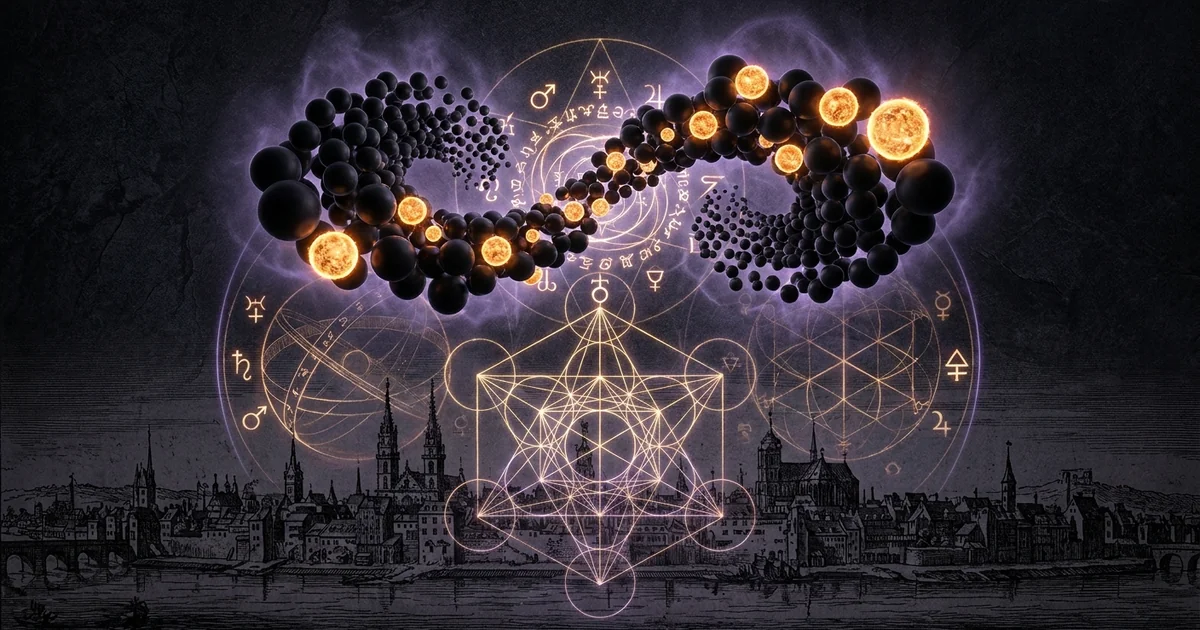
The 1566 Basel Aerial Battle: Spheres in Renaissance Art
Metaphysical Thesis & Epistemological Opening: The Trans-Physical Horizon of Aerial Prodigies
Beyond Naive Materialism: The Limits of Renaissance Meteorological Determinism
The aerial engagement documented in the 1566 Basel broadsheet by Samuel Coccius cannot be accommodated within the frameworks of classical meteorological determinism or contemporary parhelia-reductionism. When the citizens of Basel looked skyward during the dawn hours of July 27–28 and August 7, 1566, their perceptions registered far more than anomalous refraction, mock suns, or vaporous exhalations. The documented manifestation of discrete, spherical forms executing rapid trajectory alterations, non-ballistic passes, and chromatic shifts from ink-black to incandescent carmine challenges both sixteenth-century natural philosophy and twenty-first-century mechanical materialism. Rather than signaling an erratic atmospheric anomaly, the incident constitutes a coordinated semiotic intrusion that directly assaulted the observational paradigms of its era.
Standard historical attempts to explain early modern anomalous aerial phenomena habitually default to uniformitarian reductionism. Historians of science routinely invoke halo phenomena, ice crystal refraction in the upper troposphere, or uncalibrated mass hysteria to neutralize reports that disturb standard historiographical models. Such dismissals collapse under close phenomenological analysis. Optical halos generated by hexagonal ice prisms produce predictable, mathematically static symmetries: parhelia appear at approximately 22 or 46 degrees from the sun, tied to horizontal solar parhelic circles. They do not maneuver independently, track against prevailing winds, nor alter their albedo from high-absorptive black to high-luminance scarlet while performing coordinated aerial evolutions over urban centers.
To understand the 1566 Basel broadsheet samuel coccius black spheres aerial battle, the analytical posture must shift from retrospective dismissal toward ontological openness. The observers—anchored in an epistemic milieu characterized by intense empirical scrutiny of the heavens—possessed sophisticated descriptive vocabularies for standard celestial occurrences, such as comets, bolides, and ordinary parhelia. Coccius’s text records specific behaviors that defy atmospheric optics: selective velocity vectors, physical collisions between distinct aerial bodies, and localized spectral absorption that partially eclipsed the morning sun. The event operates outside the mechanistic limits of classical natural philosophy, demanding an interpretive framework capable of addressing non-human agency and interdimensional boundary-crossings.
The Basel Encounter as a Dimensional Rupture in the Aristotelian Cosmos
Within the intellectual landscape of late-Renaissance Switzerland, the cosmos was predominantly comprehended through a Christianized Aristotelian-Ptolemaic synthesis, despite the burgeoning influence of Copernican mathematics. In this cosmological architecture, the sublunary sphere was the domain of change, decay, and chaotic elemental mixture, while the supralunary realms remained immutable, crystalline, and orderly. The Basel encounter functioned as an abrupt dimensional rupture across these bifurcated strata. The presence of dynamic, geometric spheres maneuvering within the sublunary atmosphere—yet displaying properties alien to elemental earth, water, air, or fire—destabilized the ontological security of this inherited world-picture.
This rupture occurred along geographic and cultural fault lines. Basel was not merely an ordinary municipality; it was an epicenter of humanism, intellectual disputation, and early printing culture, situated along the Rhine axis where Paracelsian chemical philosophy, Reformed Protestant theology, and the occult sciences converged. The manifestation of flying globes above this specific theater suggests a targeted semiotic deployment. The anomalous spheres did not emerge within an unpopulated wilderness, but directly above an urban cathedral city whose inhabitants were intellectually primed to record, codify, and disseminate the event through print media.
Viewed through modern metaphysics, this event suggests an intersection where higher-dimensional physical manifolds intrude upon a three-dimensional continuum. The spheres acted as three-dimensional cross-sections of geometries transcending the local spatiotemporal manifold. When an n-dimensional object intersects an (n-1)-dimensional space, its appearance to native observers is necessarily characterized by sudden genesis, volumetric morphing, kinetic impossibility, and uncaused dematerialization. The Basel battle exposed the perceptual fragility of the Aristotelian cosmos, introducing an ontological-shock that neither scholastic disputation nor late-Renaissance naturalism could cleanly assimilate.
Epistemic Thresholds: Prodigy Literature as Pre-Technological Disclosure
Early modern prodigy broadsheets (Flugblätter) functioned as an epistemic transmission medium situated between theology and proto-scientific observation. As demonstrated by Lorraine Daston and Katharine Park in Wonders and the Order of Nature, 1150–1750, the late sixteenth century experienced an intense proliferation of prodigy tracts that served to document nature’s apparent deviations from its accustomed course. Far from operating simply as sensationalist yellow journalism, these publications represented a cultural effort to categorize anomalies at the threshold of scientific modernity. They constituted a pre-technological disclosure framework through which humanity attempted to process non-human intelligence (NHI) interventions.
The prodigy literature reveals that anomalous aerial phenomena are not modern artifacts born of the Cold War, the atomic age, or the jet propulsion era. The persistent archetype of the aerial conflict—conducted by self-luminous or light-absorbing geometries—points to an invariant informational control mechanism operating across centuries. These early modern broadsheets captured the precise phenomenological contours of what contemporary researchers categorize as Unidentified Anomalous Phenomena (UAP).
By externalizing these encounters into the linguistic framework of military conflict and divine omens, sixteenth-century witnesses preserved granular, low-noise observational data regarding vehicle-like kinetic parameters. The Coccius broadsheet documents an encounter with high-strangeness that deliberately mirrored the conceptual capacity of its human observers. The phenomenon used early modern expectations of military conflict as an intelligible semiotic interface, initiating an informational shift within the collective unconscious of Central Europe.
The Latin term prodigium denotes an unnatural event functioning as a prophetic sign, traditionally interpreted within Greco-Roman and early modern Christian frameworks as an unmediated divine portent (ostentum, monstrum). The Greek equivalent, teras (τέρας), carries the dual connotation of a wonder and a signifier of divine displeasure or historical rupture.
Within the /nhi-phenomena/jacques-vallee-control-system-hypothesis, the phenomenon is reframed from theological omen to an interdimensional intrusion: a localized, high-strangeness manipulation of physical space-time by an autonomous informational control system. While the early modern mind decoded the Basel event through an eschatological vocabulary, the underlying physical signature exhibits the hallmarks of a controlled hyperdimensional projection designed to induce ontological-shock within a target culture.
Primary Codices & Historical Transmission: Deconstructing the Samuel Coccius Broadsheet
The Textual Hermeneutics of Samuel Coccius’s 1566 Broadsheet
The principal historical source documenting the Basel phenomena is the broadsheet penned by Samuel Coccius, designated in archival records as a student of the “free arts and medicine” at the University of Basel. Published by Samuel Apiarius, this document (Flugblatt von Basel: Wahrhafftige Beschreibung der erschröcklichen Zeichen so am Himmel gesehen worden) possesses an empirical restraint that sets it apart from typical sensationalist apocalyptic broadsheets of the mid-sixteenth century. Coccius approached the celestial events of July and August 1566 through the dual lens of medical observation and proto-scientific reporting, noting temporal variations, environmental conditions, and the specific physiological responses of the watching citizenry.
[ 1566 Basel Phenomenological Progression ]
July 27-28: Solar Chromatic Inversion & Blood-Red Phantasm
|
v
August 7 (Dawn): Emergence of Dense, Light-Absorbing Black Spheres
|
v
High-Velocity Vector Alteration & Non-Ballistic Aerial Conflict
|
v
Thermal Shift to Incandescent Carmine / Photon Emission Phase
|
v
Instantaneous Dimensional De-coherence (Residue Deficit)
The broadsheet is divided into distinct observational sequences across three separate dates: July 27, July 28, and August 7. The initial events of late July involved violent atmospheric color shifts, with the rising and setting sun appearing dark, blood-red, and accompanied by mournful, ominous optical conditions that provoked widespread panic throughout Basel.
The primary anomalous event, however, unfolded at dawn on August 7. Coccius explicitly describes the appearance of numerous large, spherical black bodies that populated the sky in the direction of the rising sun. These objects moved at elevated velocities, violently striking one another as if engaged in tactical combat. Many of these spheres subsequently turned incandescent red and fiery before spontaneously dissolving, leaving behind zero material residue or impact craters on the urban landscape below.
Middle High / Early New High German: “Im 1566. Jar auff den 7. Augusti / mit der auffgehenden Sonn / seind vil grosser schwartzer kugele am lufft gesehen worden / welche vor der Sonnen mit grosser schnelle vnd geschwinde hin vnd wider gefaren / vnd an einander geschlagen / gleichsam ob sie ein treffen fletzten / deren etliche schwartzroht worden / vnd hernach verloschen seind.”
English Translation: “In the year 1566, on the 7th of August, as the sun arose, many large black balls were seen in the air, which moved before the sun with great speed and swiftness back and forth, and struck against one another as if they were conducting a battle; some of them became black-red and fiery, and afterwards extinguished.” — Samuel Coccius, Wahrhafftige Beschreibung der erschröcklichen Zeichen, printed in Basel by Samuel Apiarius, 1566. Archival preservation: Zentralbibliothek Zürich.
Coccius’s text avoids attributing the aerial phenomena to demonic illusion, instead recording the trajectories as discrete physical behaviors. His report emphasizes the collective nature of the witness pool: the spectacle was observed not by an isolated visionary, but by the general public of Basel, including civic and clerical authorities assembled for morning services. The narrative voice maintains a descriptive cadence that records the dynamic movement of the spheres across the sky, their interactions with ambient morning light, and their ultimate disappearance.
Comparative Stratigraphy: The 1561 Nuremberg Broadsheet vs. Basel 1566
The Basel incident cannot be analyzed in isolation; it belongs to a morphological and chronological cluster of early modern anomalous aerial phenomena documented across the Germanic cultural sphere during the mid-sixteenth century. Foremost among these parallel occurrences is the aerial phenomenon over Nuremberg on April 14, 1561, preserved in the woodcut broadsheet by Hans Glaser (detailed extensively in the analysis of the /nhi-phenomena/1561-nuremberg-aerial-battle-hans-glaser). A comparative reading of both historical documents reveals unmistakable topological, kinetic, and chromatic correspondences that refute the idea of isolated local hallucinations.
Nuremberg Event (April 14, 1561)
- Primary Chronicler: Hans Glaser, woodcut artist and printer.
- Morphology: Blood-red, blue-black, and pearlescent globes; triangular shapes, crosses, and tubular cylindrical carriers (Schiffsmaterial).
- Kinetic Behaviors: Protracted combat maneuvering, mutual engagement, non-ballistic trajectory intersections; objects descending toward earth and combusting with heavy smoke.
- Solar Context: Eruption directly out of and around the rising morning sun, producing localized optical obscuration.
- Semiotic Tone: Heavily millenarian, steeped in Lutheran eschatological crisis and divine retribution warnings.
Basel Event (August 7, 1566)
- Primary Chronicler: Samuel Coccius, academic student of medicine and liberal arts.
- Morphology: Predominantly spherical bodies, appearing uniformly dark/black before transitioning to fiery crimson.
- Kinetic Behaviors: High-velocity vector inversion, direct collisions resembling tactical aerial dogfights, absence of terrestrial wreckage.
- Solar Context: Direct intersection with the solar disk at dawn, exhibiting high-absorptive properties that occluded morning light.
- Semiotic Tone: More clinical and observational, registering deep ontological shock while emphasizing empirical witness consensus.
The comparative stratigraphy demonstrates that the Basel event represents a more streamlined, geometrically purified iteration of the Nuremberg engagement. While Nuremberg presented an elaborate semiotic array of cylindrical “motherships,” crosses, and diverse geometric solids, the Basel display focused on the dynamic interaction of uniform spherical forms. In both instances, the solar disk served as the backdrop and spatial focus for the manifestations. The anomalous agents utilized the morning sun as an optical anchor, ensuring maximum perceptual contrast and high-visibility illumination for witnesses below.
The Munster Prodigies of 1533 and Pre-Reformation Combat Epiphanies
The lineage of sixteenth-century aerial combat phenomena extends further back to the anomalous aerial manifestations observed over Münster in 1533 and 1534, amid the rise of the radical Anabaptist millenarian movement. During this period of acute sociopolitical instability, the skies above Westphalia yielded recurring reports of incandescent globes, sword-like linear vectors, and simulated army formations engaged in tactical skirmishing. The flying spheres over munster served as cognitive antecedents to the later Basel and Nuremberg events, illustrating a sustained campaign of aerial spectacles interacting with historical inflection points across Central Europe.
These combat epiphanies coincided with profound religious and sociological changes. The Protestant Reformation had fractured the theological consensus of Western Christendom, destabilizing the symbolic grammar that mediated human encounters with the numinous. In this climate of theological instability, the boundary between the natural and supernatural spheres grew increasingly porous. Anomalous aerial incursions took advantage of this epistemic vulnerability, utilizing a semiotic theater of war that resonated directly with contemporary fears of religious violence, apocalyptic reckoning, and imperial breakdown.
The woodcuts produced to accompany these broadsheets—such as the woodcut accompanying Coccius’s text, attributed to Samuel Apiarius—operated as visual information storage systems. While contemporary art historians occasionally dismiss these woodcuts as derivative allegories, historical analysis reveals that printmakers were working within strict guild standards to visually represent witness testimony. The recurring visual motifs—black orbs arrayed against a cityscape, kinetic motion lines indicating non-Newtonian vectors, and high-contrast solar positioning—represent systematic visual documentation of non-human intrusions into early modern space.
Ontological Architecture & Cosmological Models: Interdimensional Control Systems and Paracelsian Elementals
The Vallée-Hynek Informational Paradigm Applied to Early Modernity
To move beyond both naive theological interpretations and simplistic technological readings, the 1566 Basel event must be evaluated through the informational control system hypothesis pioneered by Jacques Vallée. In his foundational text, Passport to Magonia: From Folklore to Flying Saucers (1969), and later elaborated in Dimensions (1988), Vallée argued that anomalous phenomena do not represent the physical visitation of biological extraterrestrials traveling across interstellar space in nuts-and-bolts spacecraft. Instead, they operate as an endogenous or interdimensional control system: an autonomous mechanism that conditions human cultural evolution across historical time.
[ Valleean Informational Control Loop ]
Human Societal Stagnation / Epistemic Crisis
|
v
Interdimensional Intrusion (High-Strangeness Theater)
|
v
Ontological Shock & Semiotic Imprinting (Prodigy / Omen)
|
v
Gradual Cultural Metanoia & Paradigm Expansion</code></pre>
The Basel black spheres functioned as symbolic inputs into the human informational matrix. The phenomenon manifests with characteristics designed to elicit specific sociological responses, generating an acute ontological shock that breaks prevailing perceptual paradigms.
In 1566, an overt demonstration of modern technology would have been unintelligible, whereas an unadorned, non-technological display of physical geometry (the sphere) engaged in an intelligible human social activity (combat) established a direct semiotic link with the observers. The informational control system utilized the perceptual baseline of early modern humanity to inject an unsettling, anomalous signifier into the collective cultural record, preventing intellectual stagnation by exposing the limits of contemporary reality models.
This hypothesis explains the total absence of physical debris or enduring wreckage following the Basel engagement. If the event had been a clash of material extraterrestrial craft operating within classical Newtonian mechanics, kinetic collisions would have produced physical debris across the urban topography of Basel.
Instead, the spheres transformed into incandescent carmine states and dissolved directly into the atmospheric ground-state. This complete residue deficit strongly points to an interdimensional projection—a temporary materialization of non-physical forms executing a programmed symbolic interaction before returning across the dimensional threshold.
Paracelsian Archei, Chaos, and Subtle Atmospheric Entities
The philosophical proximity of the Basel event to the Paracelsian revolution in natural philosophy warrants close examination. Paracelsus (Theophrastus von Hohenheim), who had taught at the University of Basel several decades prior to 1566, developed a sophisticated cosmology that posited the existence of intermediate, non-human intelligences inhabiting the subtle realms of nature. In his treatise Liber de Nymphis, Sylphis, Pygmaeis et Salamandris, Paracelsus detailed classes of beings that occupied an ontological middle ground: entities possessing organized subtle bodies, capable of appearing in solid form, yet lacking the immortal soul (anima) unique to humanity.
According to Paracelsian metaphysics, the atmospheric realm was populated by aerial beings (Sylphs) governed by the subtle elemental forces of Chaos (the unformed primal matter) and directed by internal organizational principles known as the Archei. These entities operated within the subtle vaporous matrix of the atmosphere, capable of condensing their subtle energetic bodies into visible, geometric structures when intersecting the lower terrestrial senses.
Paracelsus argued that these beings were not demonic, but natural manifestations of the Astrum—the astral influence acting upon and through physical matter.
From this perspective, the black spheres of 1566 can be interpreted as organized, non-human living intelligences native to an adjacent, subtle physical plane. Their geometric purity (the sphere being the most elemental and stable configuration of subtle matter) and their kinetic dynamics reflect the behavior of elemental consciousness manipulating atmospheric density and light absorption.
The Paracelsian framework anticipated modern interdimensional perspectives by recognizing that physical reality is interpenetrated by parallel ecologies of subtle matter, capable of intersecting human perception during periods of localized energetic resonance.
Gnostic Archontic Vectors: Dimensional Interference in Lower Terrestrial Spheres
A deeper esoteric hermeneutic connects the Basel aerial engagement with the Archontic cosmologies preserved in Gnostic and Hermetic codices. Within classical Gnosticism—as articulated in texts such as the Hypostasis of the Archons and the Apocryphon of John—the terrestrial sphere is enmeshed within seven lower celestial domains governed by the Archons: lower dimensional administrators and gatekeepers who maintain the material matrix. These entities are characterized by geometric coldness, an obsession with surveillance and control, and an operating grammar rooted in conflict and hierarchy.
In this cosmological model, the Basel encounter represents a visible skirmish between conflicting Archontic vectors operating within the planetary atmosphere. The manifestation of dense, light-absorbing black globes battling for supremacy reflects the internal friction of these demiurgic forces. The black spheres—devoid of light emissions during their initial phase, actively absorbing the rays of the morning sun—manifested as energetic sinks: entities that consume and redirect the ambient spiritual and psychic energies of the terrestrial population.
[ Archontic Dimensional Stratification ]
Pleroma / Hyperdimensional Source
|
v
Archontic Governors (Demiurgic Matrix Controllers)
|
v
Spatial Rupture: 1566 Basel Atmospheric Intersection
|
v
Terrestrial Mind (Passive Receiver of Semiotic Shock)
The theurgic traditions of late antiquity, closely tied to the /ancient-prehistory/merkabah-mysticism-and-trans-dimensional-craft, warn against mistaking these intermediate atmospheric battles for divine encounters. The theurgist sought to ascend past these turbulent lower heavens, recognizing that the aerial spirits of the lower firmament routinely engage in deceptive, martial demonstrations designed to capture human consciousness in cycles of terror and apocalyptic surrender.
The 1566 Basel spectacle, with its striking combat choreography, exhibited this Archontic signature: an engineered theatrical display that commanded the attention of an entire city, realigning its psychic energy toward fear, eschatological panic, and ontological paralysis.
Phenomenological Mechanics & Interdimensional Interaction: Kinetic Anomalies and Solar Occlusion
Non-Newtonian Ballistics: High-Velocity Vector Inversion and Swarming Dynamics
The kinetic profile recorded by Samuel Coccius presents behaviors that violate classical fluid dynamics, Newtonian mechanics, and the ballistic realities of Renaissance military engineering. The broadsheet explicitly notes that the spheres traveled “with great speed and swiftness back and forth” (hin vnd wider gefaren), a formulation describing high-velocity vector inversion without observable deceleration curves. In aerodynamic flight, an object possessing physical mass is subject to inertia; it must decelerate before reversing its trajectory, particularly within the dense fluid medium of the lower troposphere.
The Basel spheres displayed no such inertial lag. The witnesses observed objects executing abrupt 180-degree vector inversions, lateral darts, and coordinated orbital maneuvers that point to advanced gravitational manipulation or the projection of mass-less geometries into three-dimensional space. The objects moved against the prevailing atmospheric currents, demonstrating that their locomotion was completely decoupled from local air currents.
Furthermore, the broadsheet documents swarming dynamics and localized swarming intelligence. The black spheres did not move as an unorganized cloud of inert debris, but exhibited tactical formation flight, breaking off into specialized subgroups and converging in deliberate collision courses (an einander geschlagen). This behavior requires either autonomous collective intelligence or centralized control over the spatial distribution of the forms.
The kinetic signature corresponds directly to the observable behaviors documented in modern military encounters with UAP clusters, where spherical objects demonstrate instantaneous acceleration, lack of control surfaces, and an apparent indifference to aerodynamic drag.
Sun Eclipsing Combat Anomalies: Trans-Spectral Light Absorption
One of the most physically significant details in the Coccius broadsheet is the positioning of the spheres relative to the morning sun and their interaction with the visible spectrum. The text indicates that these dark spheres operated directly “before the sun” (vor der Sonnen), generating localized occultations of sunlight. Rather than reflecting the intense rays of the dawn sun as high-albedo metallic or aqueous bodies would, the spheres presented as dense, optical-absorption voids—suggesting a state of continuous, active photon absorption across the entire visible spectrum.
[ Trans-Spectral Light-Bending Model ]
 Dawn Solar Radiation (Photons) ------>
                                      |
                                      v
  [ Spatial Distortion Field / Gravitic Well ]
     |                              |
     v                              v

Absorbed Photons              Bended Light Rays
(Void/Black Presentation)      (Micro-Lensing Artifacts)
This phenomenon suggests the presence of an engineered spatial distortion field or a localized micro-gravitational boundary surrounding each craft. An object capable of bending local spacetime to generate metric propulsion would naturally display severe optical lensing effects, often appearing as a dark, light-sinking sphere to external observers. When placed directly between an observer and a luminous source such as the rising sun, a field of this nature absorbs or deflects incoming photons away from the observer’s line of sight, creating an apparent silhouette of absolute blackness regardless of the material’s underlying surface composition.
These sun eclipsing combat anomalies point to physical processes that exceed standard atmospheric phenomena. For an airborne object to maintain a matte-black presentation while bathed in direct, low-angle morning sunlight requires either an engineered metamaterial surface with an ultra-high absorption coefficient (analogous to modern carbon-nanotube arrays such as Vantablack) or an active, field-driven warping of local electrodynamics.
This optical behavior systematically undermines the hypothesis of ice crystal parhelia, which rely fundamentally on the refraction and dispersion of light to produce luminous, chromatic halos—not dense, light-consuming physical voids.
The Phenomenon of Combustive Extinction and Residue Deficits
The final phase of the August 7 engagement, as chronicled by Coccius, introduces a thermodynamic and ontological shift: many of the black spheres underwent an abrupt chromatic transformation, turning “black-red and fiery” (schwartzroht worden) before vanishing entirely (vnd hernach verloschen seind). This progression—from light-absorbing black, to high-energy radiant carmine, followed by complete visual extinction without physical debris—reveals the mechanics of their presence in three-dimensional space.
The shift from black to incandescent red signifies an extreme, localized increase in blackbody radiation or the activation of an energetic ionization envelope surrounding the craft. In high-energy plasma physics, the transition from a non-luminous to a luminous state can indicate the breakdown of ambient atmospheric gases into an energized plasma sheath.
Alternatively, if the spheres represented hyperdimensional projections, this thermal and chromatic shift corresponds to a dimensional phase-transition. The object sheds its coherent three-dimensional manifestation by dumping vast quantities of electromagnetic energy into the local environment before its topological retreat back into the astral or higher-dimensional substrate.
The defining anomaly remains the complete absence of physical fall-down or structural impact. Despite dozens of violent, high-velocity collisions described as resembling an aerial battle, not a single fragment of twisted metal, slag, or extraterrestrial debris was recovered from the streets, rooftops, or surrounding fields of Basel.
The combustion was not a chemical explosion yielding physical shrapnel, but an energetic extinction: a de-coherence of physical structure back into ambient space. This structural evaporation remains the hallmark of true interdimensional incursions, differentiating them from classical technological crashes and cementing their identity as transient physical manifestations generated by an informational control system.
Initiatic Synthesis & Philosophical Implications: Archetypal Intrusion and Collective Metanoia
The Mandala and the Spherical Archetype: Jungian Self-Regulation of the Unconscious
In his 1958 work, Ein moderner Mythus: Von Dingen, die am Himmel gesehen werden (Flying Saucers: A Modern Myth of Things Seen in the Skies), Carl Gustav Jung subjected both the 1566 Basel broadsheet and the 1561 Nuremberg engraving to psychoanalytic and archetypal scrutiny. Jung identified the primary visual element of these historical encounters—the sphere or disk—as the quintessential primordial mandala: the psychological archetype representing psychic wholeness, the integrated Self, and the totality of the cosmic order.
Jung observed that throughout human history, manifestations of celestial mandalas erupt during eras of profound collective psychic fragmentation and spiritual crisis. The year 1566 marked an apex of religious trauma in Europe: the Council of Trent had concluded its counter-reformation mandates in 1563, religious wars were tearing France apart, and the threat of Ottoman expansion loomed over Central Europe.
According to Jungian theory, when the conscious intellectual framework of a culture is fractured, the collective unconscious undergoes an autonomous compensatory reaction, projecting symbols of order and integration into the perceptual field:
Collective Psychic Fragmentation (Reformation Trauma)
                           |
                           v
  Compensatory Surge of the Collective Unconscious
                           |
                           v
   Archetypal Projection / Physicalized Mandala Intrusion
                           |
                           v
  The Basel Black Spheres (The Self in Combat / Integration)
Yet the Basel phenomena complicate Jung’s strictly psychological model. The broadsheet records an external, objective intrusion that was observed simultaneously by a diverse populace, complete with physical dynamics that cannot be reduced to simple visionary projections.
A more complete synthesis—bridging the Jungian and Valleean paradigms—emerges when we recognize the sphere as both an objective hyperdimensional form and an archetypal visual symbol. The autonomous intelligence responsible for the phenomenon deliberately selects the spherical mandala as its physical interface because it operates directly upon the human psychic structure, bypassing conscious defenses to trigger rapid transformation in the observer.
Ontological Shock as an Evolutionary Catalyst for Human Perception
The primary operational output of the Basel aerial battle was the generation of widespread ontological-shock. This shock occurs when an observed reality directly violates the fundamental parameters of an observer’s operational worldview. For the citizens of Renaissance Basel, the presence of black, maneuvering spheres in the morning sky created an irreconcilable fissure in their explanatory models. It could not be fully integrated into Aristotelian physics, nor could it be cleanly assimilated into conventional theological demonology, despite the printer’s attempts to frame it as a call to repentance.
Ontological shock functions as an evolutionary catalyst. When a conscious system encounters an anomaly that resists assimilation into its current cognitive architecture, it is forced to choose between two paths: dogmatic retreat into perceptual denial, or an expansion of its epistemic bandwidth.
The recurring intrusion of anomalous aerial geometries across human history operates as a destabilizing force designed to loosen the grip of rigid materialist and theological orthodoxies. By confronting human civilizations with phenomena that exhibit both physical reality and logical impossibility, the control system accelerates the evolution of human consciousness, driving human culture toward higher levels of cognitive complexity.
This evolutionary process is historically visible in the trajectory of science and metaphysics following the Renaissance. The persistent accumulation of celestial prodigies—scrupulously recorded by proto-scientists—gradually dismantled the medieval concept of an immutable supralunary vault, clearing the conceptual space necessary for the development of modern astronomy and field physics.
The spheres of Basel were part of a broader sequence of boundary-violating intrusions that forced Western consciousness to abandon its anthropocentric view of a closed, predictable cosmos, preparing the human mind for an open, multi-dimensional universe.
Reclaiming Sovereignty Against Hyper-Dimensional Mimetic Deceptions
While the informational control system acts as a driver of cognitive evolution, it poses severe risks to human spiritual autonomy. Throughout esoteric literature, from the warnings of the Corpus Hermeticum to modern critiques of the UFO mythos, scholars have highlighted the deceptive, mimetic nature of anomalous atmospheric manifestations.
These phenomena operate as a hall of mirrors, actively mirroring the cultural forms, religious hopes, and darkest fears of the societies they visit, while masking the true identity and long-term motivations of the non-human intelligence behind the screen.
Engagement with anomalous aerial phenomena presents acute epistemological hazards. Observers and investigators face the danger of psychic inflation—a psychological breakdown wherein the witness interprets a trans-dimensional intrusion through a framework of personal messianic selection or apocalyptic doom.
The mimetic nature of the control system deliberately baits human observers into dogmatic traps: either hyper-materialist techno-fetishism (the literal belief in benevolent extraterrestrial saviors) or religious hysteria (the conflation of interdimensional intelligences with classical demons or divine omens).
Genuine spiritual and intellectual sovereignty demands an unwavering, detached hermeneutic. One must perceive the semiotic structure of the phenomenon without surrendering critical autonomy to its seductive theatrical illusions.
To navigate these interdimensional incursions, human consciousness must maintain analytical independence. When the citizens of Basel viewed the sky in 1566, their immediate interpretive surrender was theological: they fell to their knees, begged for divine mercy, and interpreted the spheres as heralds of an imminent Apocalypse. In doing so, they reacted precisely as the theatrical mechanics of the phenomenon intended—their emotional and psychic energy was gathered, directed, and shaped by the spectacle.
True metaphysical maturity requires decoding the symbolic syntax of the phenomenon without succumbing to the terror of its display. We must recognize the spheres not as harbingers of religious doom, nor as physical spacecraft of biological extraterrestrials, but as the dynamic, holographic projections of an adjacent reality system testing the perceptual boundaries of the human species.
Frequently Asked Questions: Epistemic & Ontological Inquiries into the Basel Event
Could the Basel 1566 phenomena be explained purely by sun dogs (parhelia) or atmospheric optics?
A rigorous analysis of atmospheric optics reveals that the Basel phenomena cannot be reconciled with parhelia, halo complexes, or mirages.
Solar parhelia are static or slow-drifting optical artifacts generated when sunlight refracts through horizontally oriented hexagonal plate crystals suspended in cirrus clouds. They are structurally constrained by the physics of refraction: they appear along the 22-degree halo line, align horizontally with the sun, and retain fixed, symmetrical relationships to the solar disk. They do not execute independent vector paths, alter their spatial orientation relative to one another, or display black bodies that move dynamically across the celestial dome.
In contrast, the Samuel Coccius broadsheet documents independent, high-velocity maneuvering: the spheres moved “back and forth” (hin vnd wider), changed their velocity at will, and converged in physical collisions. Furthermore, the objects exhibited an optical signature diametrically opposed to refraction: they were dense, light-absorbing black bodies that subsequently shifted to incandescent fiery red.
Parhelia cannot transition from black to red, nor can they vanish abruptly following an apparent kinetic conflict. To claim an optical explanation requires discarding the descriptive content of the primary historical source in favor of a comfortable, anachronistic reductionism.
Why did early modern aerial phenomena frequently manifest as battles or military skirmishes?
The recurring motif of celestial combat (Gefecht, Treffen) in early modern anomalous phenomena reflects both the semiotic mimicry of the informational control system and the perceptual grammar of Renaissance witnesses.
As developed within the /consciousness/jungian-archetypes-and-the-uap-phenomenon and the Valleean model, the phenomenon adapts its presentation to match the cognitive framework of its human audience. In an era marked by intense religious and military conflict, combat was the ultimate cultural signifier of historical importance, existential threat, and divine intervention.
The control system engaged this cultural expectation by staging spectacles structured as military engagements, ensuring that the occurrences would be exhaustively recorded, preserved, and analyzed by the society’s cultural gatekeepers.
Simultaneously, the physical mechanism of the intrusion—which involves intense electromagnetic, gravitational, and topological fluctuations—may naturally produce phenomena that resemble dynamic conflict: multiple bodies interacting within an active spatial distortion field, exchanging energy charges (perceived as weapon discharges), and neutralizing one another through localized phase transitions.
“We are dealing with a phenomenon that appears throughout history, adapting itself to the cultural matrix of the human observers. In the Middle Ages and Renaissance, it took the form of angelic hosts, celestial armies, and heraldic broadsheets. In modern times, it assumes the guise of interplanetary craft. The constant is not the physical skin of the machine, but the informational manipulation of human reality models.” — Jacques Vallée, Dimensions: A Casebook of Alien Contact (New York: Contemporary Books, 1988), pp. 42–47.
“The woodcuts of Nuremberg and Basel are remarkable human documents. They present a visual confrontation with the archetypal reality of the Self, externalized into the heavens at a moment of historical agony. The spherical mandalas do battle in the sky not because the stars are at war, but because the human psyche is torn asunder and projects its unconscious longing for integration upon the canvas of the firmament.” — Carl Gustav Jung, Flying Saucers: A Modern Myth of Things Seen in the Skies (Zürich: Rascher Verlag, 1958; trans. R.F.C. Hull, Princeton University Press, 1978), pp. 95–102.
What connects the Basel 1566 black spheres to modern Unidentified Anomalous Phenomena (UAP)?
The morphological and kinetic correspondences connecting the Basel 1566 black spheres to contemporary UAP are striking and systematically coherent. Modern sensor systems and military flight crews continue to encounter dark, spherical objects that display identical phenomenological characteristics.
A notable contemporary example is the military-filmed “Mosul Orb” (recorded over Iraq in 2016 and declassified in 2023), which documents a metallic, dark sphere moving at elevated velocity with no visible propulsion systems, control surfaces, or exhaust trails.
Both early modern and contemporary accounts document key shared observables:
- Morphological Invariance: The simple sphere remains the most frequently encountered geometric shape across the historical record.
- Non-Newtonian Kinematics: Both sixteenth-century broadsheets and modern military radar track instant vector changes, hyper-velocity acceleration from a dead hover, and the complete absence of inertial deceleration curves.
- Absence of Thermal Exhaust: Neither the Renaissance spheres nor modern anomalous orbs produce typical chemical combustion signatures; their propulsion operates via metric space-time manipulation rather than mass displacement.
- Physical Residue Deficits: When contemporary spherical UAPs depart or dematerialize, they consistently leave zero physical fragments behind, behaving precisely like the Basel globes that “extinguished” into the atmospheric substrate.
These sustained phenomenological correspondences show that we are not analyzing isolated, historically contingent fictions, but an enduring, non-human technological or interdimensional presence.
This intelligence has interacted with human civilizations across centuries, altering its surface presentation to match human cultural capacity while preserving an invariant geometric core. The black spheres that challenged the humanist scholars of Renaissance Basel remain active within the skies of twenty-first-century planet Earth, continuing to present their unresolved challenge to human models of reality.