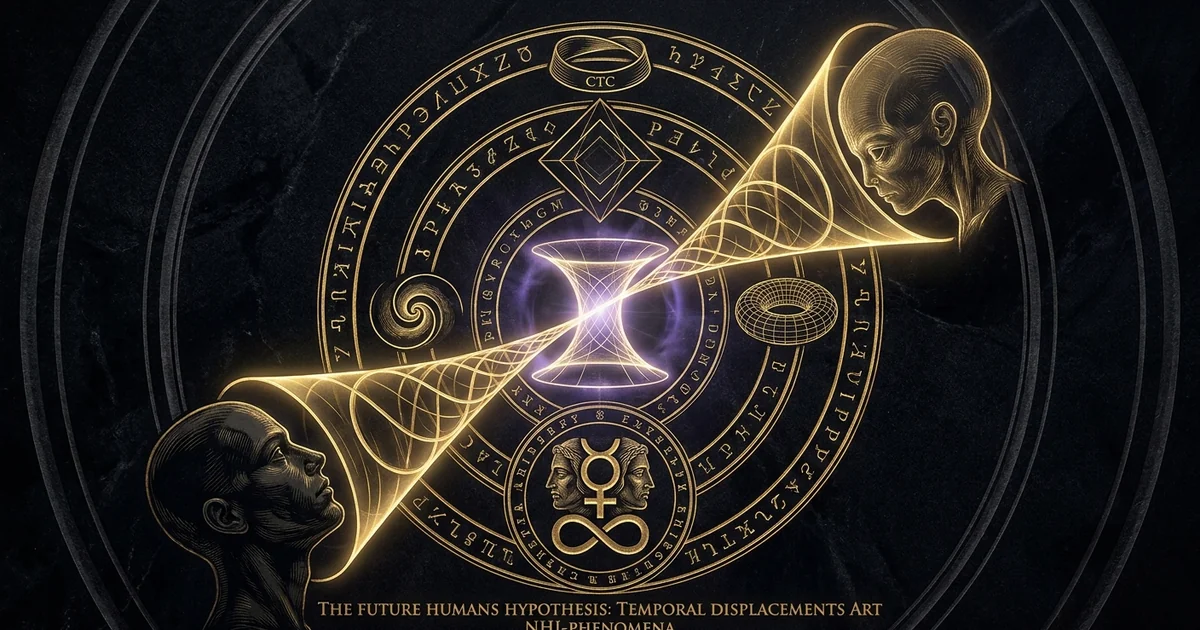
The Future Humans Hypothesis: Temporal Displacements Art
Metaphysical Thesis & Epistemological Opening: Beyond the Interstellar Fallacy
The Collapse of the Standard Extraterrestrial Hypothesis (ETH)
The prevailing paradigm within twentieth-century anomalistics has operated under an unexamined cosmological presupposition: that anomalous non-human intelligences (NHI) navigating terrestrial airspace originate across deep Euclidean space. The classical Extraterrestrial Hypothesis (ETH) posits physical biological entities traversing interstellar voids via relativistic or superluminal velocities from distant star systems. However, decades of rigorous phenomenology and physical trace analysis reveal profound theoretical and biological vulnerabilities in this model. The ETH fails to resolve the Fermi Paradox precisely because it remains trapped in spatial displacement models, ignoring the profound morphogenetic and psychotropic congruence between the observed entities and modern human observers.
Foremost among these failures is the biological improbability of convergent evolution generating a bilateral, bipedal, forward-facing, encephalized hominin phenotype on a biospherically disconnected exoplanet. The canonical morphology reported across the historical ledger exhibits four limbs, five-digit extremities, stereoscopic vision, and a cranial architecture that precisely mirrors terrestrial phylogenetic trajectories. For an alien biosphere—unfolded through billions of years of distinct planetary contingencies, atmospheric compositions, and biochemical selections—to replicate the precise skeletal and anatomical ratios of late-stage hominins defies evolutionary mechanics. Concurrently, the psychological and linguistic fabric of contact events, documented in Jacques Vallée’s analysis of the informational control system, operates through direct semiotic, mythical, and psychic manipulation that presupposes a shared neurological substrate.
“If we look at the phenomenon with an evolutionary lens, the hominin body plan is extraordinarily specific to Earth’s evolutionary history… The likelihood that an organism evolving on a completely different planet with different gravity, atmospheric pressure, and chemical history would independently arrive at the exact same upright, bipedal, encephalized form is virtually zero. Conversely, if these entities are our own biological descendants returning from the future, this anatomical congruence is not merely explained—it is expected.” — Dr. Michael P. Masters, Identified Flying Objects: A Multidisciplinary Scientific Approach to the UFO Phenomenon (2019), cross-referenced with Jacques Vallée, The Invisible College (1975).
The spatial distance model also collapses beneath thermodynamic and energetic mandates. Traversing interstellar space demands energy expenditures on scales that render physical reconnaissance voyages irrational for purely exploratory purposes. Furthermore, the persistent, localized, and multi-millennial nature of these incursions does not conform to the logistics of an interstellar expeditionary force, which would logically culminate in formal planetary interface or total exploitation. Instead, the phenomena demonstrate an obsessive, multi-generational curation of human genetic stock, historical milestones, and socio-technical inflection points.
Anthropological Time Travel Craft and Relativistic Trajectories
The future humans hypothesis time travel ufo michael masters formulation radically reconstructs these observations by repositioning the origin coordinates of NHI from an exogenous celestial vector to an endogenous temporal vector. Under this framework, unidentified aerial phenomena (UAP) do not constitute interstellar transports; rather, they are anthropological time travel craft engineered to navigate the retrograde geometries of Earth’s localized light cone. This conceptual pivot dissolves the thermodynamic absurdities of interstellar transit by substituting spatial displacement across light-years with temporal displacement across chronons.
General Relativity has long established that space and time form a unified, continuous pseudo-Riemannian manifold. Within this fabric, the trajectory of any mass-bearing object traces a worldline governed by the metric tensor:
$$ds^2 = g_{\mu\nu} dx^\mu dx^\nu$$
When local stress-energy tensors ($T_{\mu\nu}$) are engineered to generate extreme spacetime curvatures, the geodesics traced by a vessel do not merely bridge Euclidean separations ($dx^i$), but actively rotate the temporal axis ($dx^0$), forming closed trajectories. Rather than crossing tens of trillions of kilometers of hostile cosmic vacuum, these anthropological time travel craft navigate back along the historical worldtube of the Earth itself.
This repositioning provides an immediate, logically robust rationale for the observed behaviors of the craft and their occupants. Anthropologists, evolutionary biologists, and historical ecologists routinely deploy minimally invasive, covert observational strategies when studying ancestral populations or delicate ecosystems. The classic signatures of UAP encounters—silent surveillance, rapid acceleration without sonic signatures, selective visibility, obfuscation through technological screening, and targeted biological sampling—are precisely the operational methodologies of our own academic field researchers, amplified by millennia of post-singularity technological maturation.
The Extratempestrial Horizon: Deconstructing the Cosmic Distance Myth
The deconstruction of the cosmic distance myth shifts our ontological category from the extraterrestrial (originating from another spatial location) to the extratempestrial (originating from another temporal coordinate within the same topological space). This transition demands an epistemological reorientation regarding the nature of the cosmos itself. Classical Newtonian paradigms conditioned humanity to view time as an absolute, forward-surging river, rendering the past fixed and inaccessible. Conversely, modern theoretical physics, from Gödelian cosmology to relativistic block universe models, treats all points in spacetime as possessing equal ontological reality.
The extratempestrial horizon suggests that modern humanity does not occupy the apex of terrestrial evolution, nor are we an isolated anomaly in a silent cosmos. We are, instead, living in dynamic proximity to our own biological, cultural, and technological progeny. The historical veil that conceals these visitors is not the unfathomable depth of the interstellar void, but the temporal refractive index of our own localized present. When contact occurs, the psychological disorientation experienced by the observer—the radical sense of the uncanny, termed by anomalists as high-strangeness—stems not from encountering the absolute alien, but from confronting the radically altered self.
This insight fundamentally alters the hermeneutics of anomalistics. The phenomenon ceases to be an invasive rupture originating from the stars; it becomes a familial, recursive interaction. Human history is revealed as an interactive tapestry wherein the future actively observes, samples, and discreetly curates its own morphological and cultural foundations, creating an informational loop that links our current sociopolitical crisis directly to the survival strategies of our post-human descendants.
Primary Codices & Historical Transmission: The Archival Continuum of Temporal Visitation
Enochian Interventions and the Retrocausal Watchers
The historical continuum of anomalistic encounters demonstrates that extratempestrial incursions are not phenomena unique to the post-Second World War technological epoch. Rather, they form the bedrock of esoteric and religious historiography. A rigorous hermeneutic reading of the pseudepigraphal First Book of Enoch unveils an encounter pattern deeply congruent with the operations of future anthropological researchers executing covert cultural and biological interventions. The entities designated as the Watchers (Grigori) descend upon Mount Hermon, explicitly defying standard cosmic administrative protocol to interface with hominin populations.
The primary codices describe these entities as executing systematic educational initiatives, transmitting metallurgical, astrological, pharmacological, and engineering knowledge to early human societies. Concurrently, they engage in genetic hybridization with human females, producing morphological outliers that destabilize the local ecosystem. Read through the extratempestrial lens, the Watchers are not divine apostates falling from an empyrean realm; they represent retrospective temporal agents intervening at a sensitive anthropological nexus. Their mission reflects the dual imperatives of temporal fieldwork: technological catalysis to ensure specific historical developments, paired with the retrospective acquisition of uncorrupted genomic material from antediluvian civilizations before catastrophic population bottlenecks or irreversible genomic decay.
The severe condemnation of the Watchers in the Enochian literature—culminating in their binding within temporal subterranean prisons until the “end of days”—encodes the cultural trauma of a population whose linear timeline was disrupted by retrocausal intervention. The historical memory recorded in 1 Enoch reflects an archaic conceptualization of field researchers who exceeded their observational mandate, violating their non-interference protocols and triggering cascading historical instabilities that required localized systemic resets.
Hermetic Memory and the Proleptic Nous
In the intellectual crucible of Hellenistic Alexandria, the Corpus Hermeticum formalized an esoteric epistemology that dissolved the absolute distinction between linear temporal vectors. In Tractate XI (Nous unto Hermes), the supreme intellect reveals that divine awareness, or the nous, operates via total temporal omnipresence, perceiving the unfolded cosmos simultaneously across past, present, and future horizons. The human intellect, insofar as it is a fractal instantiation of this cosmic Mind, possesses the latent capacity to traverse these chronological coordinates.
“If then you do not make yourself equal to God, you cannot understand God; for the like is not intelligible, save to the like. Make yourself grow to a greatness beyond measure, by a bound free yourself from the body; raise yourself above all time, become Eternity; then you will understand God. Believe that nothing is impossible for you; think yourself immortal and that you are able to understand all things, all arts, all sciences, the manner and nature of every living creature… Become higher than all height, and lower than all depth. Comprehend in yourself the sensations of all creations, of fire and water, even of the dry and moist. Think that you are at once in every place, on earth, in the sea, at the sky; that you are not yet born, that you are now in the womb, that you are young, that you are old, that you have died, that you are in the world beyond the grave.” — Corpus Hermeticum, Tractate XI: Mind unto Hermes (trans. Brian P. Copenhaver, Cambridge University Press, 1992).
This Hermetic formulation directly anticipates the retrocausal block universe of modern relativistic physics. In this framework, memory is not merely a neurological recording of a receding past; it is bidirectional. The proleptic Nous represents an intellectual interface capable of receiving information propagating backward along the light cone. Ancient initiates who entered altered states of consciousness were not projecting subjective fantasy into the ether; they were aligning their neural architecture to decode the retrocausal signals emanating from more technologically and cognitively evolved human nodes located higher along the temporal axis.
The historical lineages of Hermeticism, Kabbalah, and Western Esotericism—documented by Wouter J. Hanegraaff in Esotericism and the Academy—consistently preserve this rejected epistemological premise: that time is a construct of localized perception, and that higher orders of intelligence communicate across the temporal continuum rather than across geographic or celestial voids. The entities invoked within the theurgic rituals of Late Antiquity and the Renaissance were functionally identical to the extratempestrial visitors of the contemporary era: our own post-biological descendants utilizing the psychotronic and consciousness-mediated channels of the temporal architecture to interface with their historical ancestors.
Folkloric Temporal Lapses and Fairy Dwellings as Local Metric Distortions
The folkloric record provides additional compelling empirical documentation of extratempestrial mechanics. In his seminal 1969 work Passport to Magonia, Jacques Vallée systematically established the morphological, operational, and psychological isomorphism between modern UAP occupants and the “good neighbors,” fairies, and devas of classical European and Asian folklore. When examined through general relativistic physics, the most striking commonality across centuries of folkloric transmission is not merely the appearance of diminutive, large-eyed humanoids, but the ubiquitous signature of extreme gravitational time dilation.
Accounts of mortal subjects entering the subterranean or dimensional realms of the sidhe consistently feature an acute temporal displacement metric. An individual who spends what appears to be three hours within an illuminated hollow hill or an aerial glass palace returns to find that thirty, fifty, or three hundred years have elapsed within Earth’s standard linear frame. The subject frequently crumbles into dust upon consuming food in the present, their biological clock reasserting the accumulated temporal divergence.
This phenomenon is the definitive mathematical signature of an engineered localized metric well. To manipulate time travel along closed curves, an anthropological time travel craft must generate intense localized gravitational fields or frame-dragging vorticities. An observer situated within the boundary of this engineered metric will experience an enormous gravitational time dilation relative to an outside observer positioned in the ambient terrestrial spacetime. Folklore did not invent these temporal mechanics as poetic metaphor; ancestral populations were faithfully recording empirical encounters with localized metric engineering, documenting the physiological and temporal side-effects of stepping across the Cauchy horizon of an extratempestrial research vessel.
Ontological Architecture & Cosmological Models: Neoteny, Metric Engineering, and Metric Tensors
Evolutionary Neoteny: Morphological Mapping of the ‘Grey’ Phenotype
The primary biological argument anchoring the extratempestrial hypothesis is the phenomenon of evolutionary neoteny grey aliens. In physical anthropology, neoteny (or pedomorphism) denotes the retention of juvenile physical characteristics into adult forms, alongside the extension of developmental periods. Over the past four million years, hominin evolution from Australopithecus through Homo habilis and Homo erectus to anatomically modern Homo sapiens has followed an unmistakable, accelerating trajectory characterized by progressive neotenization and hyper-encephalization.
When paleoanthropological trendlines are projected into deep time, the morphological destination of Homo sapiens aligns precisely with the canonical “Grey” phenotype documented in modern contact events. Consider the structural transformations:
- Encephalization and Cranial Vault Expansion: Human cranial capacity has expanded exponentially, transitioning from ~450 cm³ in australopithecines to ~1400 cm³ in modern humans. The canonical Grey presents a massive, ballooning cranium, reflecting an extreme continuation of this encephalization vector to accommodate advanced neural, computational, or synthetic integration.
- Reduction of Facial Prognathism and Orthognathic Flattening: The human facial skeleton has dramatically contracted beneath the frontal lobes, reducing the heavy jaws, zygomatic arches, and teeth of our ancestral lineage. The Grey phenotype represents the terminal iteration of this process: a virtually vestigial jawline, absence of functional dentition, and a microscopic mouth slit consistent with nutritional delivery systems that bypass mechanical mastication.
- Hypertrophic Ocular Expansion: The human orbit has progressively altered its angle to favor stereoscopic, high-definition visual processing. The iconic, oversized, wrap-around black eyes of the Grey phenotype reflect an evolutionary adaptation to synthetic environments, low-light interstellar or temporal transit conditions, or optical bio-implants designed to process electromagnetic spectra far beyond the narrow 400–700 nm range accessible to modern humans.
- Post-Cranial Gracilization and Digit Reduction: Human skeletal morphology has shifted consistently from robust, hyper-dense bone matrices toward gracility, accompanied by reduced musculature as technological tool use supersedes physical labor. The Grey’s slender, elongated neck, fragile torso, and reduced digit count (frequently reported as three to four elongated fingers lacking the robust muscularity of our current manual anatomy) represent the evolutionary consequence of millennia lived in low-gravity, mechanized, or cybernetically mediated habitats.
The Grey is not an alien; it is a future human reflection. The morphology is deeply, unmistakably terrestrial—a living phylogenetic projection of our own evolutionary trajectory under conditions of sustained technological acceleration.
PAST (Homo erectus)       PRESENT (Homo sapiens)        FUTURE (Extratempestrial / "Grey")
[Robust Skull/Jaw]   -->  [Gracile Cranium/Teeth]  -->  [Hyper-Encephalized Cranium]
[Heavy Prognathism]  -->  [Orthognathic Face]      -->  [Vestigial Jaw/No Dentition]
[Standard Orbits]    -->  [Stereoscopic Vision]    -->  [Hypertrophic Ocular Surface]
[High Bone Density]  -->  [Moderate Gracility]     -->  [Extreme Gracility/Digit Reduction]
General Relativistic Mechanics: Closed Timelike Curves and Tipler-Morris-Thorne Geometries
The physical plausibility of the extratempestrial model rests upon solutions to Einstein’s Field Equations:
$$G_{\mu\nu} = \frac{8\pi G}{c^4} T_{\mu\nu}$$
where the geometry of spacetime (represented by the Einstein tensor $G_{\mu\nu}$) is directly coupled to the distribution of matter and energy ($T_{\mu\nu}$). In 1949, Kurt Gödel demonstrated that in a rotating cosmological solution, the field equations permit the existence of trajectories in spacetime where a worldline curves back upon itself, forming a closed timelike curve (CTC). Within a spacetime region possessing CTCs, an object moving continuously into its own local future inevitably intersects its own past light cone.
Subsequent work by Frank Tipler (the Tipler Cylinder) and Michael Morris and Kip Thorne (traversable wormholes supported by exotic matter) confirmed that macroscopic CTCs can be engineered without violating the local laws of Special Relativity. If an engineering culture masters the manipulation of negative energy densities via the Casimir effect or dynamic scalar fields, it becomes possible to warp the metric tensor such that light cones tilt progressively until the time coordinate flips orientation.
To an external observer, an anthropological time travel craft utilizing these metrics appears to manipulate spacetime locally: it demonstrates instantaneous acceleration, right-angle turns at Mach-20 without inertial effects, and total cloaking. These anomalous kinematics are precisely the expected signatures of a vessel enclosed within a localized metric bubble (an engineered Alcubierre-type geometry or localized traversable Cauchy horizon). The craft does not move through space against atmospheric friction; it translates space-time around itself, operating within a localized free-fall geodesic that shields both the hull and the occupants from gravitational shear and inertial mass. By extending this metric distortion, the craft shifts its chronological coordinate along an engineered CTC, accessing historical terrestrial strata while remaining tethered to the gravitational well of the planet.
Comparative Ontologies: Extraterrestrial vs. Extratempestrial Frameworks
To clearly discern the epistemological distinctions governing these competing hypotheses, we must systematically contrast their core ontological, energetic, and phenomenological parameters.
Extraterrestrial Hypothesis (ETH)
- Geographic Origin: Exoplanetary systems situated across interstellar space (e.g., Zeta Reticuli, Pleiades, Alpha Centauri).
- Propulsion Mechanics: Traversal of Euclidean physical space ($dx^i$) via superluminal (FTL) engines, generation ships, or brute relativistic acceleration over interstellar voids.
- Biological Morphology: Coincidental hominin bilateralism; biological convergence assumed across wildly disparate planetary biospheres.
- Interaction Motives: Planetary reconnaissance, theoretical resource exploitation, conquest, or primitive diplomatic contact.
- Temporal Mechanics: Strictly linear forward time ($t \rightarrow \infty$); encounters are vulnerable to light-speed communication delays and severe relativistic time lag between home worlds and Earth.
- Anomalistic Fit: Fails to account for centuries of localized folklore, fairy lore, high-strangeness psychotronic effects, and intimate genetic compatibilities.
Extratempestrial Hypothesis (FHH)
- Geographic Origin: Earth; localized temporal coordinate displaced deep along the future temporal axis ($t+n$).
- Propulsion Mechanics: Metric engineering of local stress-energy tensors to produce Closed Timelike Curves (CTCs); temporal navigation through Earth’s historical light cone.
- Biological Morphology: Direct phylogenetic continuity; extreme expression of evolutionary neoteny, cranial encephalization, and orthognathic facial reduction.
- Interaction Motives: Anthropological fieldwork, non-disruptive historical observation, and systematic genetic salvage to rescue degraded future homozygous bloodlines.
- Temporal Mechanics: Nonlinear, retrocausal, and self-consistent; navigation operates via Novikov-constrained loops and Wheelerian participatory timelines.
- Anomalistic Fit: Perfectly explains the anthropomorphic body plan, localized high-strangeness, time dilation signatures, cloaking behaviors, and covert bio-monitoring.
Phenomenological Mechanics & Interdimensional Interaction: Paradox Resolution and Contact Topology
The Novikov Self-Consistency Principle in Biological Anomalistics
The foundational objection directed against any temporal displacement thesis is the Grandfather Paradox: the assertion that backward time travel enables an agent to eliminate their historical progenitor, thereby unspooling their own existence. In theoretical physics, this paradox is resolved by the Novikov Self-Consistency Principle, formulated by astrophysicist Igor D. Novikov in 1992. Novikov proved that within the context of General Relativity on a global manifold containing CTCs, the only physical events that can occur locally are those that are globally self-consistent.
Mathematically, the probability of an event occurring that creates a logical paradox is precisely zero:
$$P(\text{paradox}) = 0$$
If a retrograde temporal agent intervenes in the historical stream, that intervention was already accounted for in the historical timeline that produced the agent. There is no historical bifurcation or timeline erasure; there is only a single, unbroken, self-consistent causal loop.
       [ Modern Humanity: T(0) ]  <=========\
                   |                         \
      (Generations of Evolution)              \  Closed Timelike
                   |                           \  Geodesic
                   v                            \  Navigation
       [ Future Humans: T(+n) ]  ================/
This mathematical imperative fundamentally recontextualizes the covert nature of NHI interactions. The intense evasiveness of UAP—their refusal to land on the White House lawn, enter formal geopolitical treaties, or permanently present themselves to the global sensor grid—is not the outcome of extraterrestrial indifference or strategic malice. It is an operational necessity imposed by the Novikov Self-Consistency Principle. Any overt, uncalibrated rupture of the historical baseline would risk triggering non-self-consistent feedback loops.
The extratempestrial agents must execute temporal paradox resolution contact: calibrated, high-strangeness, liminal interactions designed to gather required data, sample biological germplasm, and introduce necessary semiotic adjustments into the cultural mythos without triggering a systemic collapse of the historical preconditions that lead to their own future genesis.
Temporal Paradox Resolution Contact: The Logic of Non-Disruptive Operations
The subtle, theater-like absurdity of contact encounters—termed the “absurdity factor” by Jacques Vallée—now reveals its true operational function. When an extratempestrial craft interacts with a witness, the interaction is cloaked in surreal, dreamlike imagery that mirrors the cultural expectations of the witness’s epoch: an angelic visitation in the Bronze Age, an airship captain in 1897, a fairy queen in medieval Ireland, or a metallic disk containing Grey entities in the post-atomic era.
By staging the contact as an epistemological paradox that defies contemporary scientific consensus, the temporal agents prevent the encounter from being canonized into disruptive empirical reality. The event is sequestered into the cultural categories of myth, mental illness, religious visionary experience, or pop-cultural aberration. The dominant historical trajectory remains unperturbed. The seed of biological or informational exchange is successfully planted, yet the consensus reality of the timeline marches forward uninterrupted, ensuring the Novikov loop remains sealed.
This informational loop demonstrates that ancestral humanity is not merely living alongside its future descendants; ancestral humanity is being subtly steered by them. The future human presence functions as a feedback stabilizer, ensuring that our historical actions steadily assemble the exact physical, cognitive, and technological frameworks necessary for their own manifestation.
High Strangeness as Horizon Shear: Gravitational and Informational Side-Effects
For decades, investigators of close encounters have noted bizarre physical and psychological effects: the sudden cessation of ambient environmental sound (the “Oz Factor”), electromagnetic vehicle failure, persistent temporal lapses (missing time), acute dehydration, radiation burns, and subsequent outbreaks of localized poltergeist phenomena around the witnesses’ homes. Within the ETH framework, these effects are dismissed as random biological reactions or unrelated anomalies. Under the extratempestrial metric engineering model, they are understood as the physical consequences of crossing a localized metric shear boundary.
When an anthropological time travel craft establishes a closed timelike curve or a localized Morris-Thorne warp bubble, it constructs a severe gravitational and chronometric gradient between the interior of the bubble and the ambient spacetime:
$$\nabla_\mu t = \partial_\mu t - \Gamma^\nu_{\mu\lambda} t_\nu$$
An observer standing within meters of this metric interface does not merely encounter electromagnetic radiation; their biological organism is exposed to intense chronometric shear.
The Oz Factor represents the acoustic redshift and phase cancellation that occurs when atmospheric sound waves attempt to propagate across a sharp gravitational metric horizon. “Missing time” is not merely psychological dissociation or hypnotic amnesia induced by the entity; it is the physiological reality of the witness being momentarily enclosed within the temporal dilation field of the craft, where biological processes proceed at a different chronometer reading relative to the external clock of the planet.
Furthermore, the psychotronic interference, hallucinations, and telepathic links reported by contactees are direct side-effects of intense gravitational and electromagnetic frame-dragging interacting with the human brain’s electromagnetic rhythms. By perturbing the observer’s endogenous neural arrays, the vessel’s localized metric induces profound altered states of consciousness, dissolving the Cartesian boundary between external stimulus and internal cognitive projection.
Initiatic Synthesis & Philosophical Implications: The Self-Begetting Species and the Recursive Ouroboros
The Participatory Universe and Wheelerian Retrocausality
To comprehend the full metaphysical horizon of the future humans hypothesis, one must discard classical determinism and integrate the quantum cosmological models pioneered by John Archibald Wheeler. Wheeler’s concept of the “Participatory Universe” posits that observer-participancy is the fundamental mechanism that brings reality into being. Through his classic delayed-choice thought experiments, Wheeler demonstrated that choices made by an observer in the present moment dictate whether a photon traversed one path or two paths billions of years in the past. Time, at the quantum informational level, operates bidirectionally via retrocausal quantum observer mechanics.
When Wheeler’s retrocausality is scaled to macro-historical systems, the extratempestrial hypothesis emerges as the definitive biological instantiation of this law. Modern humanity is not passive clay waiting to see what the future holds; our present choices are continuously being observed, anchored, and subtly steered by an observer-system situated at the terminal end of our evolutionary worldtube. The post-human observer looks backward, interacts with the historical node, and by that very act of observation, collapses the quantum wave functions of planetary history into a stable, realized timeline.
Reality is not an open-ended linear trajectory running from an uncaused Big Bang to an entropic heat death; it is a self-referential cybernetic loop. The past and the future are coupled in a perpetual act of reciprocal genesis. We are manufacturing the physical, infrastructural, and genomic substrate that allows future humans to exist, while they are reaching backward through metric spacetime to observe, preserve, and inspire the consciousness evolution that gave them birth.
The Ouroboric Species: Transcending Linear Historicism
The realization of the extratempestrial presence collapses the dominant historical myth of the Western mind: linear historicism. For millennia, human civilizations have viewed history through either a linear eschatology (a straight line running from Eden to the Apocalypse) or an entropic descent (a fall from a Golden Age into degeneration). The future humans hypothesis explodes these models by inaugurating the metaphysics of the Ouroboros—the serpent devouring its own tail.
Humanity is revealed as a self-begetting species. We are the authors of our own creators, and the descendants of our own children. This recursive topology dissolves the foundational categories of traditional ontology: subject and object, origin and terminus, ancestor and descendant.
The integration of the extratempestrial thesis induces a profound psychological and philosophical rupture known as chronological vertigo. When the researcher fully realizes that the enigmatic, terrifying, or god-like intelligences documented throughout human myth and modern anomalistics are merely our own progeny returning along the loops of spacetime, the traditional ontological foundations of human selfhood evaporate. Linear personal identity, temporal autonomy, and ancestral security are fundamentally destabilized.
The practitioner of anomalous research must maintain absolute cognitive sovereignty to prevent severe psychological inflation, apocalyptic fixation, or nihilistic paralysis upon encountering the recursive mirror of our own post-human destiny.
In this ouroboric framework, the modern UAP contact phenomenon is not the herald of an imminent cosmic invasion or a galactic federation welcoming humanity into the stars. It is the evolutionary labor pain of a species discovering that it is locked in an eternal temporal knot. The craft moving silently across our skies are the physical manifestation of our own ultimate survival—evidence that humanity does not perish in its planetary cradle, but perseveres, masters the fundamental geometry of the cosmos, and reaches backward through the metric of time to claim its historical heritage.
Epistemological Shock and Cognitive Sovereignty in Ancestral Encounters
Confronting this temporal recursivity demands a radical restructuring of human cognitive sovereignty. Throughout history, whenever hominin populations encountered temporal displacements, they immediately fell into religious surrender, venerating these extratempestrial observers as archangels, gods, or demons. In the modern era, that same unexamined impulse projects savior status onto the phenomenon, leading to UFO cults, technological millenarianism, and the desperate yearning for extraterrestrial salvation.
All these postures represent failures of ontological maturity. If the entities stepping out of these metric bubbles are indeed future humans, they are not our gods, nor are they our masters. They are our flesh and blood, transformed by deep time, ecological catastrophe, cybernetic integration, and morphological neoteny. Their motivations—as evidenced by their covert genetic acquisition and clinical detachment—are pragmatic, scientific, and likely desperate. They may be returning not to grant us enlightenment, but to salvage lost genetic diversity, document an extinct biosphere, or repair catastrophic chronological errors engineered in their own deep past.
True cognitive sovereignty requires modern humanity to gaze into the oversized, ancient eyes of the Grey entity and recognize neither an alien invader nor a heavenly redeemer, but an estranged descendant. We must meet this encounter not with ecstatic worship or xenophobic terror, but with ancestral dignity. We are the architects of their reality; they are the consequence of our choices. Navigating the extratempestrial paradigm means embracing our position in the temporal loop, accepting the burdens of our evolutionary trajectory, and engaging the anomaly not as bewildered primitives, but as the sovereign ancestors of the future human race.
Frequently Asked Questions: Deep Ontological Enquiries into the Extratempestrial Paradigm
Coexistence with the Interdimensional Hypothesis
Does the extratempestrial hypothesis contradict or invalidate the interdimensional hypothesis proposed by Jacques Vallée and J. Allen Hynek?
The two paradigms do not contradict each other; rather, they form mathematically contiguous dimensions of a singular unified gauge model. In theoretical physics—particularly within Kaluza-Klein architectures, Superstring theory, and M-theory—spatial and temporal dimensions are fundamentally integrated. An “extratempestrial” craft traversing Closed Timelike Curves requires the manipulation of higher-dimensional bulk spacetime to twist the localized four-dimensional metric tensor ($x, y, z, t$).
What an observer perceives as an “interdimensional” transition—a craft vanishing into thin air, phasing through solid physical structures, or expanding into impossible non-Euclidean geometries—is precisely the visual and physical signature of an object rotating through higher-dimensional spatial rotations to execute a temporal coordinate transformation. The interdimensional hypothesis provides the geometric pathway; the extratempestrial hypothesis provides the biological identity and physical coordinate of the intelligence utilizing that pathway. They are two vantage points surveying the exact same hyper-dimensional mechanics.
The academic nomenclature governing anomalistic taxonomy must be rigorously bifurcated into three distinct vectors:
- Extraterrestrial: An entity evolving independently on an exoplanetary biome across Euclidean spatial distances ($\Delta x^i$).
- Interdimensional: An entity residing natively within parallel braneworlds or higher compactified spatial dimensions ($d > 4$).
- Extratempestrial: An indigenous terrestrial hominin navigating retrograde geodesics across the chronon axis ($\Delta t$), utilizing localized metric engineering to interface with its own evolutionary ancestry.
Genetic Harvesting and the Degeneration Problem
Why would advanced, post-singularity future humans engage in the systematic, covert harvesting of human reproductive material, oocytes, and corneal/organ tissue documented in modern abduction phenomenology?
This persistent aspect of the contact phenomenon—historically distorted into mythological incubi/succubi encounters or modern medical extraction reports—is the strongest biological confirmation of the extratempestrial thesis. A society that has engaged in millennia of hyper-technological adaptation, cybernetic integration, and planetary isolation (such as living in subterranean or artificial habitats following ecological collapse) inevitably encounters severe evolutionary bottlenecks.
Over-reliance on synthetic cloning, combined with the reduction of reproductive mating arrays, causes extreme homozygous degeneration, telomeric degradation, and the accumulation of lethal genetic mutations. Furthermore, the extreme evolutionary neoteny grey aliens exhibit comes at a profound price: the loss of critical immune diversity, structural skeletal integrity, and emotional/instinctual neuro-circuits.
Our future descendants are not crossing time to study our philosophy; they are returning to access the primeval, uncorrupted, heterozygous ancestral genome of modern humanity. They are conducting evolutionary salvage operations. They harvest our reproductive tissue because it represents the raw, biodiverse, uncorrupted genetic baseline of their own lineage before their historical bottleneck occurred. They are literally mining their own biological past to rescue their failing present.
Resolving Many-Worlds Branching versus Metric Singularities
Does the future humans hypothesis operate within an Everettian Many-Worlds quantum multiverse, where each temporal journey splinters off a new alternate reality, or within a single, deterministic block universe?
This resolution hinges upon the topological structure of the spacetime metric. If time travel occurred via simple branching worldlines (the classical Everettian interpretation), the entities would alter our present without affecting their own origin point, spinning off disconnected parallel timelines. However, the physical and historical evidence of contact argues against pure Many-Worlds branching.
The obsessive, meticulous adherence to minimal interference, the masking of their technology behind archetypal cultural mythology, and their persistent genetic intervention suggest that the visitors are operating under the strict parameters of Novikov self-consistency within a singular, macroscopically coherent block universe. If they were free to branch into infinite parallel universes, there would be no operational mandate to conceal their presence or curate our timeline so carefully.
The extratempestrial visitors act precisely like agents who are bound to our specific timeline. They must walk a razor’s edge: gathering the critical biological and historical data required for their survival, while exercising surgical restraint to avoid introducing catastrophic historical paradoxes that could collapse the delicate temporal bridge carrying their own existence. They are prisoners of the very loop they have engineered—an enduring biological monument to the self-creating, recursive architecture of human destiny.