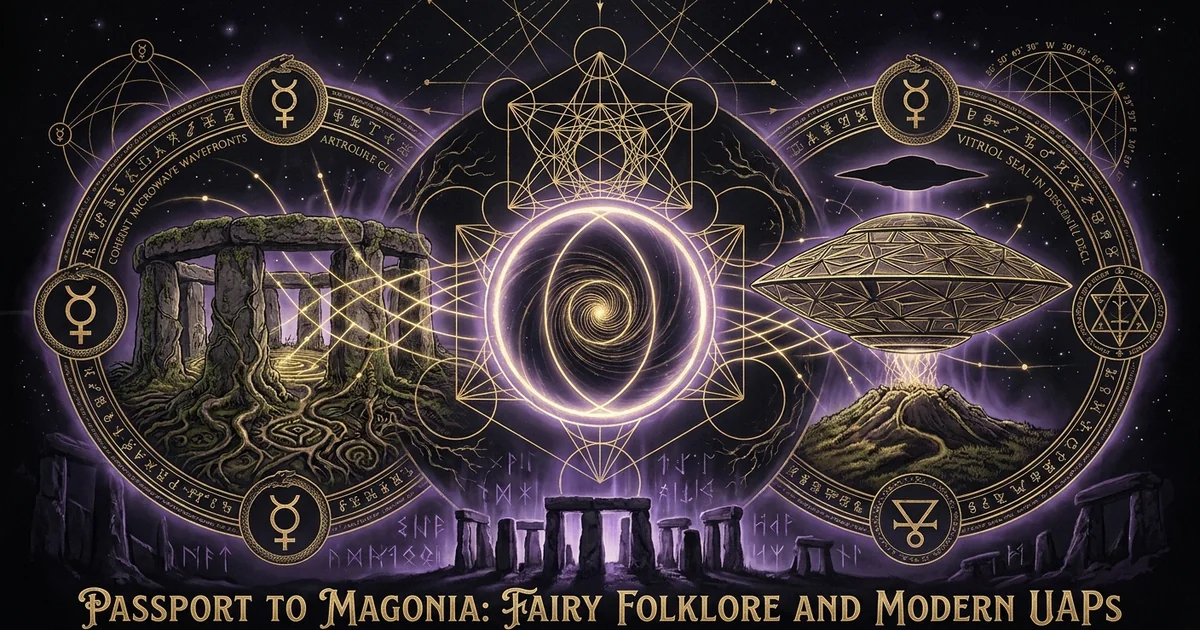
Passport to Magonia: Fairy Folklore and Modern UAPs
Metaphysical Thesis & Epistemological Opening: The Magonia Paradigm and Ontological Rupture
Beyond the Extraterrestrial Hypothesis: The Morphic Continuity of Non-Human Intelligence
When Jacques Vallée published Passport to Magonia: From Folklore to Flying Saucers in 1969, he enacted an epistemological rupture across anomalistics. For over two decades, post-war scientific ufology had trapped itself within the narrow confines of the Extraterrestrial Hypothesis (ETH)—the naive materialist assumption that unidentified aerial objects necessarily represent technological spacecraft piloted by flesh-and-blood biological organisms traversing interstellar distances from star systems like Zeta Reticuli. Vallée demonstrated that this hypothesis fails to account for the actual phenomenological data: the sheer volume of global encounters, the absurd and surreal morphology of the entities, the overt manipulation of human space-time, and the pervasive elements of psychic and physiological transmutation.
By conducting a comparative historical analysis spanning classical antiquity, medieval Latin Christendom, and early-modern folklore, Vallée revealed an underlying invariance. Modern close encounters with flying saucers and their occupants are structural-functional analogs to the historic folkloric encounters with elves, fairies, sylphs, and daemonic entities documented across centuries. The phenomena observed in modern skies and isolated country roads do not represent an unprecedented intrusion of mechanical starships; rather, they mark the ongoing, morphic continuity of a singular, pervasive non-human intelligence that has shared terrestrial reality with humanity since the inception of recorded consciousness.
This morphic continuity demands a radical shift from linear astrophysical models to the Jacques Vallée interdimensional control system framework. When we trace the cross-cultural contact mythos from the archaic sidhe mounds of Ireland to twentieth-century landings in rural North America and Europe, the operational behaviors remain identical. The entities paralyze observers with directed beams of light, abduct them across spatial liminalities, execute invasive physiological and biological samplings, subject them to profound temporal anomalies, and impart enigmatic, socio-philosophical riddles. The technological exterior of the phenomenon—metallic saucers, luminescent dials, and silver flight suits—is merely the contemporary cultural dial through which an non-physical presence negotiates perceptual entry into consensus reality.
The Deceptive Screen: Camouflage Mechanics and Cultural Reflexivity
The non-human intelligence behind these events does not present its absolute ontological essence directly to the witness. Instead, it deploys a sophisticated, psycho-physical camouflage system. This mechanism relies on what ufologists identify as the screen-memory—a cognitive distortion in which the human brain superimposes a familiar or culturally coherent image over an encounter of overwhelming high-strangeness. In sixteenth-century folklore, a witness paralyzed in a forest might perceive a court of miniature, iridescent nobles dressed in medieval finery; in 1897, witnesses across the United States reported Victorian airships complete with propellers, searchlights, and steam-engine hissing; in 1961, the entity interface codified into the cold, clinical aesthetic of the macrocephalic Gray alien wielding surgical instruments.
This cultural reflexivity reveals an intelligence that behaves like a mirror, reflecting humanity’s technological and metaphysical preoccupations back upon itself while remaining fundamentally hidden behind an informational veil. The camouflage is not incidental; it is an active ontological cloaking mechanism. The entity projects an interactive theatrical interface calibrated to the symbolic language of the observer’s specific historical era. Epistemological materialism falters when confronted with these events because it treats the projected symbol—the metallic hull, the fairy ring, or the celestial carriage—as a literal, standalone technological artifact rather than an induced semiotic interface.
In his subsequent treatises, refining the core argument initiated in Passport to Magonia (1969), Jacques Vallée formulated five decisive arguments that undermine the simplistic materialist interplanetary hypothesis:
- Unwarranted Event Frequency: The thousands of documented close encounters worldwide far exceed the logistical requirements of an exploratory scientific survey by physical astronauts.
- Physiological and Morphological Invariance: The humanoid body plan and respiratory compatibility of the entities defy the probabilistic expectations of independent exobiological evolution on distant planets.
- Cross-Cultural Mythic Parallels: The behavioral patterns of entity encounters precisely mirror historic lore concerning incubi, succubi, fairies, demons, and elementals across millennia.
- Psychic and Non-Local Transmutation: Encounters are characterized by telepathy, psychokinesis, precognition, out-of-body states, and localized space-time warps incompatible with purely mechanical rocketry.
- Absurdist Informational Theater: The messages and behaviors delivered by the entities are deliberately deceptive, nonsensical, and subversive, functioning not as scientific exchange, but as a symbolic conditioning mechanism designed to alter human cultural paradigms.
Hermeneutic Transmutation: From Sylphs to Grays
To comprehend the deep history of passport to magonia fairy folklore ufonauts parallels vallee established, scholarship must execute a hermeneutic transmutation of historical texts. The elemental beings systematized by Renaissance physician Theophrastus von Hohenheim, known as Paracelsus, in his 1566 treatise Liber de Nymphis, Sylphis, Pygmaeis et Salamandris et de caeteris Spiritibus, provide an indispensable bridge. Paracelsus classified these beings not as disembodied spirits nor as immortal angels, but as creatures holding an intermediate metaphysical status: possessing non-adamite, subtle flesh, capable of materializing and dematerializing at will, inhabiting environments inaccessible to physical humankind, and possessing an intelligence that surpasses mortal craft yet remains bound to the elemental architecture of creation.
The Gray alien of modern lore is the direct philosophical and morphological successor to the Paracelsian elemental. Both are described as diminutive, pale, largely devoid of emotional expressiveness, possessing enlarged cranial vaults and penetrating, lidless eyes, operating through trans-dimensional manipulation rather than brute mechanical force. By mapping Paracelsian pneumatology alongside modern encounter reports, we observe that the vocabulary has shifted while the ontological category remains invariant. Modern secular materialism transformed the “subtle bodies” of the elementals into the “cloned biologics” of the extraterrestrial, yet the underlying phenomenological signature—an elusive, liminal race executing covert biological transactions with humanity—persists unchanged across five hundred years of European and Atlantic history.
Primary Codices & Historical Transmission: From Agobard of Lyon to Celtic Fairy-Faith
Agobard’s Magonia: Sky-Ships, Cloud-Reapers, and Carolingian Anomalistics
The foundational titular reference of Vallée’s work derives from a ninth-century manuscript composed by Agobard, the Archbishop of Lyon, titled Contra insulsam vulgi opinionem de grandine et tonitruis (c. 815 AD). Agobard was writing to combat the widespread peasant superstition concerning weather-witches known as tempestarii, who claimed the ability to conjure storms and manipulate crops. In this polemic, Agobard documents a profound narrative embedded within the Carolingian collective consciousness: the belief in an atmospheric realm or aerial kingdom named Magonia, from whence sailed celestial ships upon the clouds.
“Plerosque autem vidimus et audivimus tanta dementia obrutos, tanta stultitia alienatos, ut credant et dicant quandam esse regionem, quae dicatur Magonia, ex qua naves veniant in nubibus, in quibus relatae naves fruges, quae grandinibus decidunt, et tempestatibus pereunt, vehantur in eandem regionem, ipsis videlicet nautis aereis dantibus pretia tempestariis, et accipientibus frumenta vel ceteras fruges.”
Translation: “We have seen and heard many men plunged into such madness, alienated by such folly, that they believe and say that there is a certain region, which is called Magonia, from which ships come in the clouds, in which the fallen crops, destroyed by hail and tempests, are carried back to that same realm, after the aerial sailors have paid a price to the storm-makers and received in return wheat and other produce.”
Agobard recounts an incident in which an angry mob paraded four captives—three men and a woman—through the streets of Lyon, having captured them after they allegedly fell from one of these aerial ships. The populace intended to stone them to death as accomplices to the sky-sailors. Agobard, acting as a rationalist churchman, intervened to save their lives, arguing that such aerial navigation was theological nonsense.
Yet for modern anomalistics, this archival fragments establishes that ninth-century Europeans witnessed aerial crafts interacting with terrestrial agriculture, bartering for biological matter, and occasionally dropping humanoid occupants to the ground. The parallels to twentieth-century crop circles, soil samplings, cattle mutilations, and anomalous crash-retrievals are striking. The phenomenon of aerial ships extracting terrestrial biomass did not originate in the twentieth century; it possessed an identical structural grammar during the reign of Charlemagne.
+---------------------------------------------------------------------------------------+
| HISTORICAL TRANSMISSION OF LIMINAL PHENOMENOLOGY                                      |
+---------------------------------------------------------------------------------------+
| 815 AD: Agobard of Lyon      -> Cloud-ships of Magonia extracting agricultural biomass|
| 1566:   Paracelsus            -> Intermediary, subtle-bodied elementals (Sylphs)       |
| 1691:   Rev. Robert Kirk      -> The Secret Commonwealth: subterranean etheric beings  |
| 1911:   W.Y. Evans-Wentz      -> The Fairy-Faith: living trans-physical entities       |
| 1969:   Jacques Vallée        -> Passport to Magonia: UAP as cybernetic control system |
+---------------------------------------------------------------------------------------+
Robert Kirk’s ‘Secret Commonwealth’: Subterranean Hierarchies and Double-Sight
In 1691, the Reverend Robert Kirk, an Episcopalian minister and Gaelic scholar at Aberfoyle in the Scottish Highlands, committed to writing a remarkable ethnographic and metaphysical catalog: The Secret Commonwealth of Elves, Fauns, and Fairies. Kirk approached the subject not as a fabulist, but as a proto-scientific phenomenologist determined to document the actual nature of the “Subterranean People” or “Good People” (Sithchean). He recorded that these entities possess bodies of congealed air or fluid ether, pliable and porous, which allow them to vanish and recondense at will. They operate within hollowed hills, traverse the countryside invisible to ordinary sight, and are seen exclusively through the faculty of “second sight”—an innate or acquired mode of altered, non-local perception.
Kirk observed that these subterranean beings possessed a technology and physical culture that mirrored humanity yet diverged in fundamental respects. Their crafts were described as luminous, capable of silent flight, and resistant to decay. Furthermore, Kirk detailed the systematic abduction of human nursing mothers to nurture fairy offspring, as well as the replacement of vigorous human infants with sickly, withered effigies known as changelings. His documentation of the Sithchean reflects every diagnostic signature of the modern abduction narrative: paralytic “fairy darts” (analogous to the immobilizing light beams of UAP encounters), medical and reproductive exploitation, localized missing time, and the pervasive hazard of entering their subterranean chambers, where hours equate to earthly years. Kirk’s own mysterious death in 1692 on Doon Hill—his body discovered without marks, with legend claiming his physical form was taken directly into the Fairy Commonwealth—cements his role as the preeminent early-modern martyrologist of non-human contact.
Evans-Wentz and the Living Gaelic Tradition: Evidence of Trans-Physical Intelligences
Two centuries after Kirk, Walter Evans-Wentz, an Oxford-trained anthropologist who would later translate The Tibetan Book of the Dead, published his monumental survey The Fairy-Faith in Celtic Countries (1911). Evans-Wentz surveyed the rural populations of Ireland, Scotland, the Isle of Man, Wales, Cornwall, and Brittany to ascertain whether the fairy-faith was merely decaying nature-mythology or the lingering empirical record of genuine, non-human encounters. Evans-Wentz came to a provocative conclusion: the testimonies gathered from literate farmers, priests, and scholars described an authentic, invisible order of beings coexisting alongside humanity.
His informants repeatedly described anomalous lights—balls of incandescent plasma darting across moorlands, expanding into luminous globes, and hovering over ancient barrows—from which humanoid beings emerged. These descriptions are functionally indistinguishable from modern UAP landing reports. The Celtic informants insisted that these entities were not the ghosts of the human dead, but an independent, highly organized species of invisible, trans-physical intelligences inhabiting an orthogonal plane of reality. Evans-Wentz argued that the ancient druidic cosmology, which recognized interpenetrating realms accessible through altered states of consciousness, provided a far more sophisticated epistemological framework for understanding these phenomena than the crude physical materialism of the twentieth century. His work demonstrated that the modern “contactee” is recounting experiences structurally identical to those recorded by the Gaelic seers who sat beside the fairy mounds centuries earlier.
Ontological Architecture & Cosmological Models: The Informational Control System
The Cybernetic Feedback Loop: Reality Conditioning via Absurdist Theater
To move beyond both naive materialist ufology and reductive psychological skepticism, Vallée advanced the concept of the phenomenon as an informational control system. Drawing upon cybernetic principles established by Norbert Wiener, Vallée hypothesized that UAP encounters function as a planetary-scale governor or thermostat operating upon human consciousness. In cybernetic systems, a governor introduces targeted perturbations into a dynamic process to correct deviations, stabilize a system, or guide it toward a predetermined evolutionary state.
The non-human intelligence interface does not seek to establish formal, peer-to-peer diplomatic contact with terrestrial nation-states, nor does it conduct an open invasion. Instead, it generates controlled bursts of absurdist theater—events characterized by high-strangeness that actively disrupt human epistemological categories. By engineering events that oscillate wildly between hyper-technological manifestations and surreal mythological play, the control system shatters established paradigms.
In the medieval epoch, it catalyzed religious and demonological mythologies; in the nineteenth century, it seeded the nascent mythos of industrial aviation; in the post-atomic era, it accelerated the mythos of space exploration, computational logic, and trans-dimensional physics. This dynamic operates across global populations through the ultraterrestrial hypothesis, systematically conditioning humanity’s long-term sociocultural evolution without revealing the true nature of the operating entity.
Dimensional Foldings: The Fairy Raths and Topological Non-Locality
A crucial structural parallel between the Celtic fairy lore and modern UAP encounters lies in the topological non-locality of the encounter space. In Gaelic folklore, the rath, barrow, or fairy mound is an architectural paradox: an earthen hillock measuring twenty feet in diameter on the exterior, yet opening into an expansive, luminescent cavern of infinite proportions on the interior. The witness enters this liminal chamber through a fissure that appears and disappears instantaneously, finding themselves inside an environment governed by entirely distinct spatial and temporal metrics.
This exact non-Euclidean spatial distortion dominates modern close encounters of the third and fourth kinds. Abductees describe being pulled inside craft that appear no larger than an automobile or small house from the exterior, only to discover sprawling corridors, massive clinical amphitheaters, and cathedral-scale chambers within. This architectural impossibility points directly to the interdimensional hypothesis:
$$\mathcal{M}{4} \hookrightarrow \mathcal{M}{4+n}$$
The phenomenon does not construct mechanical interiors within terrestrial three-space ($\mathcal{M}{4}$); rather, it folds a higher-dimensional metric ($\mathcal{M}{4+n}$) into three-dimensional coordinates. The fairy mound and the hovering craft are not containers; they are topological gateways—intersections where higher-dimensional manifolds intersect consensus reality. The entrance is an event horizon across which localized geometry is suspended, allowing an orthogonal space to interpenetrate our own.
Physical-Virtual Duality: Dense Coherence versus Illusory Projection
One of the most vexing problems in UAP research is the coexistence of hard physical traces with blatant psychic and hallucinatory phenomena. A typical landing event may leave physical soil compressions measuring thousands of pounds per square inch, trace isotopic anomalies, and vegetation scorching, while simultaneously inducing telepathic projections, impossible morphological transformations, and waking dreams in the witness. Materialists seize upon the trace evidence to argue for a purely physical spacecraft, while psychologists seize upon the surreal visions to dismiss the entire event as a mental aberration.
The Magonia paradigm resolves this tension by proposing a physical-virtual duality. The non-human intelligence possesses the capability to manipulate matter and consciousness simultaneously via direct informational coding. It modulates its physical density across a broad spectrum: from pure, immaterial psychic archetypes operating in the imaginal realm, to semi-dense, luminous plasmas, and finally into hard, coherent physical matter capable of deflecting radar waves and compressing the earth.
Once its communicative or conditioning objective is achieved, this dense physical coherence destabilizes. The craft dissolves into light or vanishes entirely, leaving behind physical traces that mock human scientific analysis. This explains why retrieved fragments often contain impossible isotopic ratios or amorphous structures that resist reverse-engineering; they are physical manifestations precipitated out of an orthogonal substrate, designed to perplex the materialist investigator rather than surrender technological blueprints.
Phenomenological Mechanics & Interdimensional Interaction: The Abduction Complex
Changelings and Hybridization: The Biological Imperative of the Liminal Folk
The most disturbing thematic convergence between the Celtic fairy-faith and modern ufological literature is the systematic biological predation centered on human reproduction. In historic folklore across Europe, the primary dread associated with the fairy folk was their persistent theft of human infants, women of childbearing age, and lactating mothers. The fairies, described as an ancient race suffering from genetic degeneration, waning vitality, or an inability to sustain their population, required infusions of fresh human genetic and biological material.
To conceal the theft, they left behind a changeling entity abduction relic—a sickly, stunted fairy, a wooden block animated by a temporary glamour, or a vacant, dying infant that withered and perished shortly after the exchange.
In modern UAP abduction research, documented extensively by researchers such as Budd Hopkins, David Jacobs, and John Mack, the narrative structural components are identical. Abductees report being subjected to invasive gynecological and urological procedures during which ova and sperm are extracted. Women report missing pregnancies—clinically verified gestations that vanish without a medical trace following a close encounter.
In later encounters, these individuals are brought into clinical nurseries aboard the craft, where they are presented with fragile, translucent, large-eyed hybrid infants and instructed to hold and nurture them. The ancient fear of the sidhe stealing the vital essence of the clan to replenish their dying stock has been updated into the extraterrestrial hybridization program. Both traditions describe an identical biological imperative: an ancient, trans-physical, non-human lineage using human biology to bridge its existence with the terrestrial sphere.
Celtic & Medieval Folkloric Motifs
- The Changeling Exchange: Sickly, hybrid fairy infants substituted for human babies; extraction of infant vitality.
- The Fairy Blast & Paralysis: Instantaneous immobility induced by magical gaze, fairy darts, or invisible strikes.
- Temporal Dilation in the Sidhe: An evening of dancing within the hollow hill equates to decades or centuries in human consensus time.
- The Taboo of Fairy Food: Consumption of otherworldly nourishment permanently binds the mortal soul to the subterranean realm.
- Nuptial Abductions: Young women and nursing mothers taken to provide milk, biological vitality, and domestic labor for the hidden race.
Modern UAP Abduction Mechanics
- Genetic Hybridization: Extraction of human gametes; presentation of frail alien-human hybrid offspring to the abductee for bonding.
- Directed Energy Paralysis: Witnesses frozen in place by focused beams of blue/white light; suppression of motor control.
- Missing Time & Relativistic Gaps: Unaccounted-for hours or days during which the witness is removed from the linear temporal stream.
- Synthetic Nutrient Offerings: Bizarre presentation of wafer-like, saltless substances (e.g., the Simonton buckwheat pancakes) by entities.
- Medical Exploitation: Abduction of reproductive-age individuals for biological harvesting, fetal extraction, and cross-species engineering.
Temporal Dilation and Missing Time: The Fairy Ring as Gravitational/Consciousness Lens
The temporal anomaly known in modern anomalistics as missing time—wherein an abductee perceives an encounter as lasting twenty minutes, only to discover that four hours of earthly time have elapsed—is a structural pillar of Celtic fairy lore. The classic motif involves a traveler lured into a fairy ring (chorea faunorum) by enchanting music and dancing lights. After what appears to be a single night of revelry inside the subterranean hall, the traveler steps back out onto the road to discover that decades have passed. Their family is long dead, their home is reduced to moss-covered ruins, and their name is remembered only in ancestral parish records. In extreme cases, upon touching the earthly soil, the traveler crumbles instantly into ash, as the physical decay held in suspension by the fairy realm asserts itself instantaneously.
Relativistic / Consciousness Lens Mechanics:
-----------------------------------------------------------------------------------------
[ Linear Earth Time (T_E): Delta t = 4 Hours / Decades ]
             |
             v   (Boundary: Fairy Ring / Craft Hull / Portal Interface)
[ Relativistic Compression / Altered Metric: Delta t' = 20 Minutes ]
             |
             v
[ Localized Interdimensional Sensorium (Non-Ordinary State of Consciousness) ]
-----------------------------------------------------------------------------------------
This phenomenon indicates that the encounter occurs within a localized relativistic lens or within altered states of consciousness where the brain’s internal temporal pacemaker is fundamentally decoupled from consensus physics. Whether generated by intense, localized gravitational fields that warp space-time according to general relativity, or by an induced neurological state that overrides linear temporal perception, the result is identical. The boundary of the fairy ring, like the threshold of the UAP craft, acts as an interface between two radically asynchronous temporal metrics.
The Taboo of Fairy Food and The Spacecraft ‘Pancake’: Symbolic Biopolitical Exchange
In every traditional folklore codex, the most emphatic warning issued to those entering the fairy realm is the absolute prohibition against consuming fairy food or drink. To eat their bread, drink their wine, or taste their fruits is to seal one’s fate, completing an esoteric contract that anchors the human soul to the Otherworld and renders escape back to the mortal plane impossible. The food functions not merely as physical sustenance, but as a symbolic biopolitical token of communion and territorial subjugation.
This bizarre motif resurfaced with striking clarity in twentieth-century ufology. The most notorious manifestation occurred on April 18, 1961, in Eagle River, Wisconsin, where chicken-farmer Joe Simonton reported that a metallic saucer landed in his yard. Diminutive, dark-skinned occupants dressed in black two-piece suits gestured for water. When Simonton complied, filling their jug, they offered him three warm, perforated, wafer-like cakes resembling buckwheat pancakes in exchange.
The subsequent laboratory analysis conducted by the United States Air Force and Project Blue Book revealed that these “pancakes” consisted of simple terrestrial buckwheat, rye, and bran, but were conspicuously devoid of salt. In ancient folklore, salt is the universal apotropaic agent—the supreme symbol of terrestrial incorruptibility that repels spirits, demons, and fairies. Simonton was offered saltless bread by aerial travelers, replicating the exact culinary and magical grammar of the Celtic Otherworld. The absurd nature of this transaction is intentional; it is a signature of the control system, operating through symbolic biopolitical exchange to mock simplistic scientific analysis while reinforcing archaic mythic archetypes.
Epistemological Hazards & Psycho-Spiritual Pathology: The Seduction of the Trickster
The Oz Factor: Sensory Dampening, Acoustic Stasis, and Psychic Paralysis
Before the overt manifestation of an entity or craft, close encounters universally initiate a profound sensory state designated by British anomalist Jenny Randles as the Oz Factor. This state is marked by an abrupt, oppressive silence. The ambient sounds of the natural world—the rustling of leaves, the hum of insects, traffic noise, and birdsong—fall instantly silent. The surrounding environment appears to freeze, taking on an unreal, hyper-vivid, two-dimensional quality, as if the witness has stepped out of reality and into a painted theatrical set.
This sensory dampening is accompanied by an acute sense of isolation and profound dread, followed by psychic paralysis. The witness finds themselves completely immobilized, capable of moving only their eyes as an anomalous light approaches. This identical acoustic and perceptual stasis is described in seventeenth-century accounts of encounters with the Good People. The Highland Scots spoke of a heavy, suffocating “glamour” that descended over the senses, rendering the traveler deaf to the world and frozen to the earth.
The Oz Factor marks the transition phase where the human nervous system is decoupled from consensus reality and coupled to the local interdimensional sensorium generated by the non-human intelligence. It is the signature of the veil being drawn aside.
The investigator of interdimensional phenomena must maintain rigorous hermeneutic detachment. The non-human intelligence operating behind the UAP and fairy interface is fundamentally archetypal, polymorphous, and deceptive, conforming precisely to the cross-cultural Trickster archetype.
Entities routinely project elaborate, apocalyptic prophecies (e.g., impending nuclear destruction, magnetic pole shifts, or ecological cataclysms) with specific dates that fail to materialize. They deliver pseudo-scientific formulas, declare themselves celestial emissaries from imaginary federations, or masquerade as benevolent spiritual masters. To accept entity disclosures at face value is to succumb to ontological capture. The history of contact, from Robert Kirk to modern channelers, demonstrates that total credulity leads to psychological disintegration, spiritual inflation, and epistemological ruin.
Egregoric Entanglement and Ontological Shock: Avoiding Deceptive Revelations
The psychological fallout of direct contact is often catastrophic to the ungrounded mind. When an individual undergoes an experience that invalidates their entire secular, materialist ontology, the resulting cognitive dissonance—ontological shock—frequently leaves them vulnerable to egregoric entanglement. The witness, desperate to find an explanatory framework for an encounter with the impossible, grasps at the pseudo-religious or messianic narratives provided by the entities themselves.
Historically, this gave rise to isolated cults, demonic pacts, and religious heresies; in the twentieth and twenty-first centuries, it fuels contactee cults, millenarian UAP sects, and channelers claiming transmissions from the “Ashtar Command” or “Galactic Federations.” These movements are modern expressions of an ancient phenomenon. The entities manipulate humanity’s deep-seated religious impulses, dressing their deceptions in the language of the contemporary zeitgeist.
By delivering paradoxical messages that are half-profound and half-nonsensical, the intelligence creates an intellectual labyrinth that traps the rational mind, neutralizing the witness’s critical faculties and binding their consciousness to an elusive, parasitic dynamic. This psycho-spiritual pathology mirrors the behavior of the predatory entities identified in Gnostic cosmology and Archontic lore.
The Dangerous Communion: Historical Precautions from Kirk to Modern Anomalists
The historical record is unambiguous: communion with these liminal beings is fraught with severe physiological and psychological peril. In Celtic folklore, those who sought out the fairies or stumbled into their strongholds returned marked by premature aging, chronic sickness, profound melancholy, or madness. The Gaelic term poc-sídhe—the “fairy stroke”—denoted an instantaneous stroke, paralysis, or wasting illness induced by their touch or weapons. Modern UAP close encounter databases, such as those compiled by John Schuessler and Jacques Vallée, record identical physiological consequences: localized burns, dehydration, radiation-induced cell damage, immune system collapse, temporary blindness, long-term sleep paralysis, and terminal neoplastic conditions.
Reverend Robert Kirk understood these hazards intimately. In The Secret Commonwealth, he warned that direct association with the subterranean people requires rigorous spiritual fortitude, purity of intention, and strict psychological boundaries. Kirk’s own fate serves as an enduring warning. In May 1692, while walking upon the fairy rath at Aberfoyle, he collapsed and died suddenly under circumstances that the local Highlanders interpreted as an abduction of his subtle body into the fairy mound, leaving only an apparent corpse behind. Whether interpreted literally or symbolically, Kirk’s death underscores the hazard: to pierce the boundary of Magonia without an adequate ontological anchor is to invite destruction by an intelligence that does not share human moral, biological, or spiritual values.
Initiatic Synthesis & Philosophical Implications: Humanity’s Place in the Multiverse
The Ecology of the Invisible: Non-Human Intelligence as Terrestrial Co-Inhabitants
The ultimate realization emerging from the Magonia paradigm is that humanity does not dwell within an empty, mechanical cosmos punctuated only by occasional visits from distant spacefaring species. Rather, we inhabit an intricate ecology of the invisible. Earth is not a closed terrarium, but an open, multidimensional matrix in which multiple forms of consciousness interpenetrate, overlap, and interact across adjacent vibrational strata. The beings we have categorized as fairies, elves, daimons, djinn, sylphs, and Gray aliens are co-inhabitants of this terrestrial space-time complex.
This ecological understanding demystifies the phenomenon without reducing it to materialist triviality. Just as deep-sea organisms dwell in the ocean depths oblivious to terrestrial air-breathers until a submersible descends into their realm, human beings exist within a narrow band of electromagnetic and conscious perception, oblivious to the trans-physical intelligences that occupy the adjacent rooms of the planetary mansion.
These entities are not interplanetary visitors who must burn fossil fuels or harness fusion reactors to traverse light-years of dead vacuum; they are our permanent, shadow neighbors, separated from us not by spatial distance, but by a thin partition of consciousness and dimensional frequency.
The Western esoteric tradition has maintained precise categories for this liminal ecology:
- Daimon (Greek, δαίμων): In pre-Platonic and Neoplatonic philosophy, an intermediary spiritual entity occupying the middle realm between mortals and gods, serving as an ontological messenger, guardian, or catalyst of fate.
- Genius (Latin): The generative, trans-temporal spirit associated with an individual, place, or lineage, possessing subtle agency and capable of shaping circumstance.
- Elementals (Paracelsian): Beings composed of subtle matter (caro non-adamica) linked to the four elemental principles (sylphs, nymphs, undines, salamanders). Paracelsus explicitly distinguished them from angels and demons, defining them as mortal creatures lacking an immortal soul, yet possessing vast esoteric intelligence and longevity.
- Archons (Gnostic, ἄρχοντες): Predatory, psycho-informational rulers of the lower heavens who maintain the material matrix and feed upon human spiritual amnesia—a category distinct from the natural, amoral elementals.
The Shifting Boundary of Mind and Matter: Trans-Physical Reality Architecture
The phenomenon forces a re-examination of the Cartesian bifurcation between res cogitans (mind) and res extensa (matter). In the crucible of the high-strangeness encounter, this division dissolves. The craft and its occupants are neither purely subjective hallucinations nor purely objective physical hardware; they are trans-physical reality architectures that operate at the unified root where consciousness and physical reality originate.
This architecture operates on informational principles. In modern physics, Wheeler’s “it from bit” doctrine suggests that physical reality is derived from informational interactions. The intelligence behind UAP demonstrates the mastery of this information substrate: it can project a thought directly into a witness’s mind that precipitates into a physical craft, lands on the grass, leaves burned soil and metallic residue, and then evaporates back into the collective unconscious.
To ask whether the craft is “real” or “imaginary” is to ask a fundamentally flawed question rooted in nineteenth-century materialism. It is real, but it is real within a physics that recognizes mind and matter as dual aspects of an underlying informational continuum.
Preserving Human Sovereignty: Epistemic Clarity in an Age of Disclosure
As global nation-states move cautiously toward official UAP disclosure, releasing sensor data, infrared tracking tapes, and acknowledging encounters with unknown aerial systems, the imperative for philosophical literacy becomes paramount. If humanity approaches disclosure through the lens of secular materialism, it will fall into one of two traps: either weaponizing the phenomenon through an adversarial military framework, or kneeling before the occupants in religious devotion, treating the “ufonauts” as benevolent extraterrestrial saviors who will solve our ecological and geopolitical crises.
Both outcomes represent a victory for the deceptive control system. The lessons of Magonia, preserved across centuries of folklore, provide the necessary antidote to these delusions. Humanity must cultivate an active epistemic clarity, recognizing that these entities are not benevolent space brothers, nor are they new gods. They are the same elusive, archetypal, and trickster-like intelligences that misled travelers upon the medieval moors, stole the milk of Irish farmers, and substituted withered changelings in Celtic cradles. Preserving human sovereignty within an interdimensional multiverse requires standing firm upon our own ontological ground—refusing both blind technological fear and naive spiritual surrender, and approaching the inhabitants of Magonia with the vigilant, clear-eyed discernment of the ancient sages.
Frequently Asked Questions: Resolving the Magonia Paradox
Ontological Status of Physical Trace Evidence versus Illusory Phantasmagoria
A common objection to the folkloric parallel is the existence of hard physical traces left by modern UAPs—such as ground radar-visual locks, meta-material fragments with unearthly isotopic ratios, and radiation-induced cellular necrosis—which seem out of place in a discussion of folklore.
However, historically documented fairy encounters also produced physical residue: circular scorched patches in grass (fairy rings), damaged crops, physical wounds (the “fairy stroke”), and retrieved material objects (the “fairy cup” of Malew or the Luck of Edenhall).
The Magonia paradigm asserts that the phenomenon is capable of localized psycho-physical condensation. It operates at the boundary of quantum potentiality, using high-energy physics and field manipulation to temporarily solidify its subtle structures into our consensus space-time. Once the interaction terminates, the dense coherence dissipates, leaving behind anomalous physical traces—unusual radiation signatures, disturbed soil chemistry, and micro-metallic residues—that testify to the reality of the event while refusing to yield standard mechanical functionality.
The Evolutionary Function of the Interdimensional Control System
If the phenomenon acts as an informational control system, what is its ultimate teleological objective? Jacques Vallée suggested that the system serves as a long-term cultural thermostat designed to manage human cognitive evolution. By challenging human dogmatism—whether the dogmatism of medieval religion or the dogmatism of modern scientific materialism—the phenomenon prevents intellectual stagnation. Whenever consensus reality crystallizes into rigid orthodoxy, the phenomena intrudes with an impossible, absurdist event that forces an ontological crisis.
This crisis destabilizes the existing paradigm, triggering artistic, philosophical, and scientific revolutions. The control system does not seek to conquer or instruct humanity directly; it guides, perturbs, and prods human consciousness from the shadows, ensuring that our species continues its dialectical ascent toward multidimensional awareness without destroying itself through premature technological hubris.
Methodological Demarcation Between Folkloric Belief and Objective Interaction
How does the Magonia model distinguish between subjective human mythmaking and an objective interaction with an external non-human intelligence? The critical distinction lies in phenomenological invariance across disconnected eras. Human myths are heavily shaped by local cultural, economic, and linguistic factors; they evolve, drift, and morph according to standard anthropological models of transmission.
In contrast, the core phenomenological signatures of the contact event—the sudden acoustic paralysis (Oz Factor), the physiological immobilization, the extraction of biological materials, the temporal dilation, and the absurd communicative transaction—remain invariant across civilizations that shared no contact.
A medieval Scottish farmer and an twentieth-century Brazilian farmer, separated by centuries, geography, language, and culture, report identical physiological mechanics, sensory distortions, and entity behaviors. Folkloric belief is the narrative dress woven by the human mind around the encounter; the primary contact event itself is an objective, external intrusion by a trans-physical intelligence operating upon the human instrument.