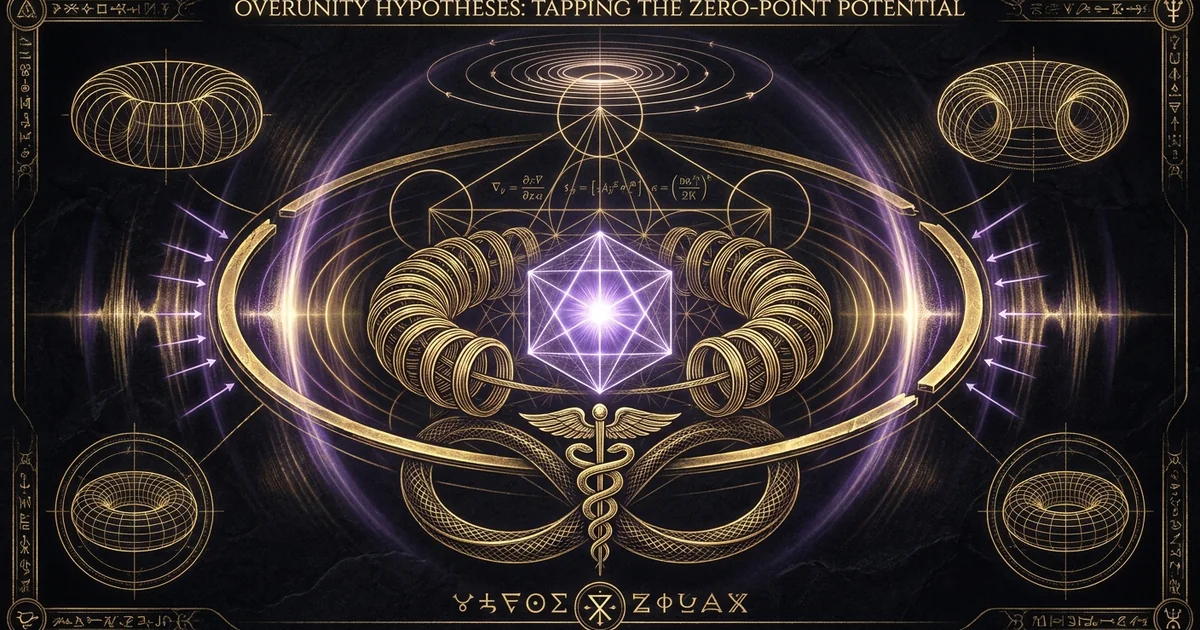
Overunity Hypotheses: Tapping the Zero-Point Potential
Executive Summary & Theoretical Thesis: The Open-System Electrodynamic Vacuum
Thermodynamic Open Systems versus Closed Conservative Assumptions
Classical circuit theory, grounded in the lumped-matter abstractions of Kirchhoff and the symmetrical reductions of the Maxwell-Heaviside field equations, systematically treats electromagnetic networks as conservative, energetically isolated systems. Within this conventional paradigm, the input energy supplied by an external source—such as an electrochemical cell or mechanical generator—must balance the sum of energetic dissipation across resistive elements and reactive storage within inductive and capacitive geometries. Any operational report claiming a Coefficient of Performance exceeding unity ($\text{COP} > 1$, colloquially termed “overunity”) is automatically classified as a physical impossibility violating the First and Second Laws of Thermodynamics.
This classification rests upon an unstated and unphysical postulate: that the surrounding spatial medium constitutes an inert, energetically sterile backdrop. When evaluated through the non-equilibrium thermodynamics pioneered by Ilya Prigogine, an electromagnetic circuit operating far from thermal equilibrium is recognized as an open, dissipative structure. Such a system possesses thermodynamic boundary conditions that permit the continuous exchange of entropy, momentum, and energy with external environmental fields. If the spatial vacuum itself possesses non-zero ground-state fluctuations, the conservation of energy cannot be restricted to the bare metallic loop of the macroscopic circuit. Energy conservation must be formulated globally:
$$\Delta E_{\text{universe}} = \Delta E_{\text{circuit}} + \Delta E_{\text{vacuum}} = 0$$
An apparent overunity phenomenon is therefore not an ex nihilo creation of work, but the direct macroscopic consequence of coupling an apparatus to the uncoordinated energetic density of the quantum vacuum, subsequently transducing that background flux into coherent electromotive force.
+-------------------------------------------------------------------------+
|                  TOTAL CONSERVATIVE MANIFOLD: UNIVERSE                  |
|                                                                         |
|   +-----------------------------------------------------------------+   |
|   |                  DEGENERATE VACUUM RESERVOIR                    |   |
|   |         Zero-Point Fluctuations: <0|E^2|0> > 0, <0|B^2|0> > 0   |   |
|   |                                                                 |   |
|   |           Flux Exchange:      /|\             |                 |   |
|   |           mu_vac * dN_vac      |              | Vacuum Entropy  |   |
|   |           Transduction         |              | Generation      |   |
|   |                                |              \|/               |   |
|   |   +---------------------------------------------------------+   |   |
|   |   |           NON-EQUILIBRIUM DISSIPATIVE CIRCUIT           |   |   |
|   |   |                                                         |   |   |
|   |   |   Input Power (W_in) ---> [ Asymmetrical ] ---> Load    |   |   |
|   |   |                           [  Re-Gauging  ]    (W_out)   |   |   |
|   |   |                           [ Non-Adiabatic]              |   |   |
|   |   |                                                         |   |   |
|   |   |   Apparent COP = W_out / W_in > 1.0                     |   |   |
|   |   |   Real COP     = W_out / (W_in + Delta E_vac) <= 1.0    |   |   |
|   |   +---------------------------------------------------------+   |   |
|   +-----------------------------------------------------------------+   |
+-------------------------------------------------------------------------+
The Zero-Point Field as an Active Energetic Ground State
Modern quantum electrodynamics (QED) and stochastic electrodynamics (SED) establish that the absolute ground state of the electromagnetic field—the zero-point field (ZPF)—is not devoid of physical excitation. The vacuum expectation value of the Hamiltonian reveals persistent quantum zero-point fluctuations:
$$\langle 0 | \hat{H} | 0 \rangle = \sum_{\mathbf{k}, \lambda} \frac{1}{2} \hbar \omega_{\mathbf{k}}$$
Integrating over all modes up to a physical cutoff (such as the Planck frequency $\omega_{\text{P}} \approx 1.85 \times 10^{43}\text{ rad/s}$ or a grand-unification threshold) yields a spectral energy density:
$$\rho_{\text{ZPE}}(\omega),\mathrm{d}\omega = \frac{\hbar \omega^3}{2\pi^2 c^3},\mathrm{d}\omega$$
Integrating this expression yields an aggregate zero-point energy density $\rho_{\text{ZPE}} \propto \hbar \omega_{\text{max}}^4 / (8\pi^2 c^3)$, an astronomical energetic reservoir embedded in the metric of spacetime.
As Harold Puthoff (1989) demonstrated, the stability of ground-state atomic matter itself is maintained by a dynamic equilibrium: radiating electrons continuously lose energy via classical Larmor dissipation while simultaneously absorbing compensating power from the isotropic zero-point background. The electromagnetic vacuum is thus not a passive, static continuum; it is an ultra-dense, fluctuating, relativistic dielectric medium. The fundamental challenge of modern non-equilibrium energetics is not the fabrication of energy, but the engineering of topological, spatial, or temporal phase boundaries capable of locally disturbing this isotropic equilibrium, transforming stochastic zero-point fluctuations into ordered, directed Poynting vector flux.
To formalize the energy exchange between an open electromagnetic system and the quantum vacuum ground state, the fundamental thermodynamic identity for internal energy $\mathrm{d}U$ must be extended to incorporate the vacuum chemical potential $\mu_{\text{vac}}$ and the quantized vacuum particle/mode excitation number $N_{\text{vac}}$:
$$\mathrm{d}U = \mathrm{d}Q + \mathrm{d}W + \mu_{\text{vac}} , \mathrm{d}N_{\text{vac}}$$
The total system enthalpy, accounting for boundary stress tensors against the vacuum dielectric medium characterized by local volume $V_{\text{sys}}$ and zero-point vacuum pressure $P_{\text{vac}} = -\rho_{\text{vac}}$, is expressed as:
$$H = U + P_{\text{vac}} V_{\text{sys}}$$
Differentiating yields the generalized boundary equation:
$$\mathrm{d}H = \mathrm{d}Q + \mathrm{d}W_{\text{mech}} + \mathrm{d}W_{\text{em}} + \mu_{\text{vac}},\mathrm{d}N_{\text{vac}} + V_{\text{sys}},\mathrm{d}P_{\text{vac}} + P_{\text{vac}},\mathrm{d}V_{\text{sys}}$$
When an engineered system exhibits a Coefficient of Performance:
$$\text{COP} = \frac{|W_{\text{out}}|}{|W_{\text{in}}|} > 1$$
it operates as an open-system dissipative structure where:
$$W_{\text{out}} = W_{\text{in}} + \int \left( \mu_{\text{vac}} , \mathrm{d}N_{\text{vac}} + V_{\text{sys}},\mathrm{d}P_{\text{vac}} \right)$$
The inequality $\text{COP} > 1$ represents an incomplete accounting domain restricted to local laboratory power inputs $W_{\text{in}}$, rather than an energetic violation of the unified thermodynamic manifold.
Re-conceptualizing Overunity: Apparent Gain through Vacuum Transduction
When an electrodynamic apparatus extracts useful work from the spatial medium, the system’s operational metrics must be evaluated through the physics of transduction rather than conservative thermodynamics. In an ordinary heat pump, the extraction of ambient thermal enthalpy from the outside atmosphere yields an apparent performance coefficient ($\text{COP} \sim 3\text{–}4$) calculated strictly as the ratio of delivered thermal energy to supplied mechanical or electrical compression work. No physicist accuses the heat pump of violating energy conservation; the ambient atmosphere is recognized as an active external reservoir.
Similarly, an electromagnetic overunity system functions as an electrodynamic heat pump coupled to the zero-point vacuum. By exploiting rapid, non-adiabatic switching operations and topological discontinuities, the system establishes a localized gradient within the vacuum polarization tensor. The resulting anisotropic relaxation phase collapses zero-point modes into the circuit geometry. Consequently, the term “overunity” serves as a descriptor for an apparatus whose mechanical or electrical output power surpasses the localized operator-supplied input power:
$$P_{\text{out}} > P_{\text{user_in}}$$
This occurs because the total physical input includes a non-zero vacuum transduction vector:
$$P_{\text{total_in}} = P_{\text{user_in}} + \oint_{\partial V} \mathbf{S}_{\text{ZPF}} \cdot \mathrm{d}\mathbf{A}$$
where $\mathbf{S}_{\text{ZPF}}$ represents the coherent zero-point Poynting flux drawn across the open system boundary.
Historical Lineage & Experimental Precedents: The Symmetrization of Maxwell’s Equations
Heaviside, Hertz, and the Truncation of Quaternionic Electrodynamics
The theoretical exclusion of vacuum energy transduction from mainstream circuit design stems directly from the late-19th-century post-processing of James Clerk Maxwell’s foundational electrodynamics. In his 1865 treatise A Dynamical Theory of the Electromagnetic Field, Maxwell formulated his framework utilizing twenty coupled equations expressed via Hamilton’s quaternion algebra:
$$\mathbb{H} = {q_0 + q_1 i + q_2 j + q_3 k \mid q_0, q_1, q_2, q_3 \in \mathbb{R}}$$
The quaternionic formulation intrinsically unified a scalar real part—representing longitudinal stress, scalar potential states, and electro-gravitic medium pressures—with a vector imaginary part representing transverse electromagnetic force fields:
$$\mathbf{q} = S(\mathbf{q}) + V(\mathbf{q})$$
Following Maxwell’s death, Oliver Heaviside, Heinrich Hertz, and Josiah Willard Gibbs sought to eliminate the mathematical obscurities of quaternions to facilitate practical engineering calculations. In doing so, Heaviside systematically stripped the scalar components from the electrodynamic equations, truncating the original twenty quaternionic formulations into the four ubiquitous vector equations taught today.
In Heaviside’s vector reduction, the curl-free components of electrodynamic interactions, along with the longitudinal electro-scalar stress states of the underlying luminiferous medium, were excised. By treating the electric field $\mathbf{E}$ and magnetic field $\mathbf{B}$ as autonomous physical entities while reducing the scalar potential $\Phi$ and magnetic vector potential $\mathbf{A}$ to mathematical conveniences, the foundational field theory was decoupled from the longitudinal stress tensors of the vacuum. This truncation removed the theoretical framework necessary to calculate energy exchange between laboratory circuits and the ambient zero-point substrate.
The systematic elimination of longitudinal scalar potential dynamics from classical field theory is documented across late nineteenth-century literature:
- Heaviside, O. (1893). Electromagnetic Theory, Vol. 1. The Electrician Printing and Publishing Co., London. Heaviside details his explicit rejection of quaternionic scalar components, characterizing them as unphysical mathematical superfluities that impede direct engineering analysis of transverse mechanical wave vectors.
- Tesla, N. (1901). Apparatus for the Utilization of Radiant Energy. U.S. Patent No. 685,957, filed March 21, 1901, granted November 5, 1901. This patent details the physical implementation of an open circuit engineered to intercept non-thermal radiation and high-frequency longitudinal stress pulses from the ambient vacuum environment.
Whittaker’s 1903–1904 Bi-Directional Longitudinal Wave Decompositions
The structural validity of non-transverse electrodynamic potentials re-emerged mathematically in two papers by the British mathematician E. T. Whittaker. In his 1903 paper, On the Partial Differential Equations of Mathematical Physics, and his 1904 paper, On an Expression of the Electromagnetic Field Due to Free Electrons by Means of Two Scalar Potential Functions, Whittaker proved that any classical electromagnetic field, including static electrostatic and magnetostatic distributions, can be decomposed into an interfering pair of coupled longitudinal scalar potential waves propagating in opposite spatial directions:
$$\Phi(\mathbf{r}, t) = \sum_{k} \left[ A_k e^{i(\mathbf{k} \cdot \mathbf{r} - \omega t)} + B_k e^{-i(\mathbf{k} \cdot \mathbf{r} + \omega t)} \right]$$
Whittaker demonstrated that the classical electromagnetic potential does not simply sit passively in space. It is sustained by an underlying dynamical sub-structure: a bi-directional wave flux where an incoming advanced wave is continuously balanced by an outgoing retarded wave.
This decomposition established that what appears macroscopically as a static, curl-free scalar potential $\Phi$ is an active, dynamic standing-wave system operating in the longitudinal domain. By manipulating the phase velocities and boundary interfaces of these bi-directional wave pairs, localized scalar potentials can be disturbed to generate macroscopic electrodynamic potentials without matching mechanical displacement currents, opening theoretical pathways for scalar wave mechanics that interact directly with the isotropic zero-point field.
WHITTAKER BI-DIRECTIONAL LONGITUDINAL WAVE STRUCTURE
Incoming Advanced Wave (Phase Conjugate)
------------------->    ------------------->    ------------------->
  exp[-i(k*r + omega*t)]
====================================================================
                        LOCAL SCALAR POTENTIAL: Phi(r, t)
====================================================================
  exp[+i(k*r - omega*t)]
<-------------------    <-------------------    <-------------------
Outgoing Retarded Wave
Nikola Tesla’s Radiant Energy Circuits and Disruption Discharges
Parallel to the theoretical developments of Heaviside and Whittaker, Nikola Tesla experimentally investigated extreme non-equilibrium electrodynamic regimes. Utilizing high-voltage direct-current capacitor banks discharged through low-inductance, magnetic-quenched spark gaps, Tesla operated within a switching regime characterized by sub-microsecond pulse rise times ($\mathrm{d}I/\mathrm{d}t > 10^9\text{ A/s}$).
Under these conditions, standard electron drift within the metallic conductors is momentarily arrested by the high inductive inertia of the wire. Instead of conventional transverse electromagnetic wave generation, the abrupt electrical impact generates high-voltage longitudinal stress waves—what Tesla termed “radiant energy.” These impulses propagate outward longitudinally from the conductive axis, creating spatial polarization spikes that disrupt the local dielectric equilibrium of the vacuum.
Tesla observed anomalous physical effects during these discharges:
- Instantaneous mechanical disruptions and localized electrostatic cooling effects;
- Unusually intense secondary emissions uncharacteristic of normal thermal arc discharges;
- Voltage transformations across single-turn planar coils that dramatically exceeded standard mutual-inductance ratios.
Modern electrodynamics models these rapid impulsive discharges as non-adiabatic phase transitions that disrupt the local vacuum polarization envelope. By abruptly terminating the displacement current before thermal equilibrium and back-electromotive forces can balance the circuit, Tesla’s systems decoupled scalar voltage gradients from conventional resistive current flow. This enabled the interception of ambient environmental potentials along open circuit paths.
Mathematical Formalism & Physical Mechanics: Asymmetrical Re-Gauging and the Curl-Free Vector Potential
The Lorentz versus Coulomb Gauge Dichotomy and Symmetrical Constraints
The conventional execution of Maxwellian electrodynamics relies on the arbitrary selection of a gauge condition to decouple the inhomogeneous wave equations for the scalar potential $\Phi$ and the magnetic vector potential $\mathbf{A}$:
$$\nabla^2 \Phi - \frac{1}{c^2}\frac{\partial^2 \Phi}{\partial t^2} = -\frac{\rho}{\varepsilon_0}$$
$$\nabla^2 \mathbf{A} - \frac{1}{c^2}\frac{\partial^2 \mathbf{A}}{\partial t^2} = -\mu_0 \mathbf{J}$$
In standard industrial and academic circuit design, the Lorentz gauge condition is universally enforced:
$$\nabla \cdot \mathbf{A} + \frac{1}{c^2}\frac{\partial \Phi}{\partial t} = 0$$
The imposition of the Lorentz gauge simplifies tensor metrics and computational workloads by balancing the spatial divergence of the vector potential against the temporal variation of the scalar potential. However, this mathematical convenience enforces physical symmetry on the resulting circuit dynamics.
[ STANDARD ELECTRICAL ENGINEERING ]
               Imposition of Lorentz Gauge:
               div(A) + (1/c^2) * dPhi/dt = 0
                                |
               Ensures Symmetrical Back-EMF
               Lenz's Law Conservative Cycle
               W_net = oint F . dr = 0  ==>  COP <= 1.0
                                |
               =======================================
               TRANSITION VIA EXTREME dI/dt SWITCHING
               =======================================
                                |
               [ ASYMMETRICAL RE-GAUGING REGIME ]
               Breakdown of Lorentz Condition:
               div(A) + (1/c^2) * dPhi/dt =/= 0
                                |
               Decoupling of Potential Gradient from Load
               Zero-Point Coherent Influx Enabled
               oint F . dr > 0          ==>  Apparent COP > 1.0
By mandating that any change in scalar potential $\Phi$ must be accompanied by an opposing spatial divergence of $\mathbf{A}$, the Lorentz condition ensures that every unit of work extracted from the field generates a counter-electromotive force (Lenz’s Law). Consequently, within a closed Lorentz-invariant thermodynamic cycle, the net work extracted across a closed line integral is strictly zero:
$$\oint \mathbf{F} \cdot \mathrm{d}\mathbf{r} = 0$$
This establishes the conservative limitation $\text{COP} \le 1$.
Conversely, asymmetrical re-gauging deliberately violates the Lorentz condition during transient operational windows:
$$\nabla \cdot \mathbf{A} + \frac{1}{c^2}\frac{\partial \Phi}{\partial t} \neq 0$$
Under modern gauge theory, the physical electromagnetic fields remain invariant under arbitrary gauge transformations characterized by a sufficiently differentiable scalar field $\Lambda(\mathbf{r}, t)$:
$$\mathbf{A}’ = \mathbf{A} + \nabla \Lambda$$
$$\Phi’ = \Phi - \frac{\partial \Lambda}{\partial t}$$
Standard engineering presumes that gauge transformations are merely mathematical operations lacking energetic consequences. However, if $\Lambda(\mathbf{r}, t)$ is driven dynamically by an external, non-adiabatic physical mechanism—such as a sharp plasma discharge or nonlinear dielectric switching—the potential energy of the system changes rapidly without drawing classical displacement currents from the primary power source.
By regauging the system asymmetrically during an initial phase, and restoring the symmetric ground state during a secondary dissipation phase, the thermodynamic path becomes non-conservative. In this regime, the system extracts work from the topological transformation of the field itself.
Aharonov-Bohm Topologies: Extracting Phase Coherence from Curl-Free A-Fields
The physical reality of the potentials—independent of the transverse force fields $\mathbf{E}$ and $\mathbf{B}$—was demonstrated by Yakir Aharonov and David Bohm in 1959. In the Aharonov-Bohm setup, a coherent electron beam is split and routed around an infinitely long, tightly wound cylindrical solenoid containing a static magnetic flux $\Phi_B$.
Outside the solenoid, the magnetic field vanishes identically:
$$\mathbf{B} = \nabla \times \mathbf{A} = 0$$
Simultaneously, the electrostatic field is zero:
$$\mathbf{E} = 0$$
Nevertheless, a non-zero magnetic vector potential $\mathbf{A}$ circulates throughout the external field-free domain:
$$\mathbf{A} = \frac{\Phi_B}{2\pi r} \hat{\boldsymbol{\phi}} \neq 0$$
The spatial wavefunctions of the passing electrons acquire an observable quantum phase shift directly proportional to the circulation of $\mathbf{A}$:
$$\Delta \phi = \frac{e}{\hbar} \oint_{\partial S} \mathbf{A} \cdot \mathrm{d}\mathbf{r} = \frac{e}{\hbar} \iint_{S} (\nabla \times \mathbf{A}) \cdot \mathrm{d}\mathbf{S} = \frac{e \Phi_B}{\hbar}$$
This phase shift induces measurable shifts in the physical interference pattern on an external detection screen, proving that the vector potential $\mathbf{A}$ is a primary physical entity that alters the quantum mechanical state of matter even in regions where all Maxwellian force fields are zero.
To extract energy from this phenomenon, an apparatus must construct a macroscopic field topology where:
$$\nabla \times \mathbf{A} = 0 \quad \text{while} \quad \mathbf{A} \neq 0 \quad \text{and} \quad \frac{\partial \mathbf{A}}{\partial t} \neq 0$$
Under these conditions, a time-dependent, curl-free vector potential induces a non-conservative longitudinal electric field:
$$\mathbf{E}_L = -\frac{\partial \mathbf{A}}{\partial t}$$
This field exerts a directed electromotive force on free charges without establishing an opposing transverse magnetic curl ($\mathbf{B} = 0$). By eliminating the magnetic induction field $\mathbf{B}$ from the operational boundary, the classical back-torque and back-electromotive drag (Lenz’s Law) are absent. This allows mobile charges to accelerate along the $\mathbf{E}_L$ gradient, powered by the phase-velocity divergence of the non-local potential field.
Non-Conservative Poynting Vector Flow and Energy-Momentum Tensor Regauging
Classical energy transport is governed by the Poynting theorem, derived from Maxwell’s vector equations:
$$-\frac{\partial u_{\text{em}}}{\partial t} = \nabla \cdot \mathbf{S} + \mathbf{J} \cdot \mathbf{E}$$
where $u_{\text{em}} = \frac{1}{2}\left(\varepsilon_0 E^2 + \frac{1}{\mu_0} B^2\right)$ represents volumetric electromagnetic energy density and $\mathbf{S} = \frac{1}{\mu_0}(\mathbf{E} \times \mathbf{B})$ is the Poynting vector.
In standard circuit configurations, the integration of $\nabla \cdot \mathbf{S}$ over a closed boundary exactly accounts for the ohmic heat losses $\mathbf{J} \cdot \mathbf{E}$. However, this classical form ignores the scalar and vector field components associated with vacuum stress dynamics. When the complete four-dimensional stress-energy-momentum tensor $T^{\mu\nu}$ is preserved without Heaviside truncation, the four-divergence contains an additional source term representing coupling to the vacuum polarization:
$$\partial_\mu T^{\mu\nu}{\text{matter}} = -F^{\nu\alpha} J\alpha + \partial_\mu T^{\mu\nu}_{\text{vac}}$$
The full Poynting flow equation expands to incorporate a scalar-potential divergence flux:
$$\mathbf{S}_{\text{extended}} = \frac{1}{\mu_0}(\mathbf{E} \times \mathbf{B}) + \varepsilon_0 \Phi \frac{\partial \mathbf{A}}{\partial t} + \mathbf{A} \left( \nabla \cdot \mathbf{E} \right)$$
By establishing conditions where $\mathbf{E} \times \mathbf{B} \to 0$ while the secondary scalar-vector divergence terms remain large, non-conservative Poynting flow circulates through the system. Rather than dissipating power symmetrically back into the circuit resistance, this extended field geometry diverts momentum directly from the background vacuum stress tensor $T^{\mu\nu}_{\text{vac}}$, generating net electromotive drive across the load.
Empirical Evidence & Observational Data: Laboratory Anomalies in Non-Equilibrium Cavities
Dynamical Casimir Transitions and Real Photon Production
The most direct empirical verification that real, usable energy can be extracted from zero-point vacuum fluctuations is the Dynamical Casimir Effect (DCE). While the static Casimir cavity resonators confirm that boundary geometry modifies vacuum zero-point modes to produce attractive or repulsive forces:
$$F_{\text{Casimir}} = -\frac{\pi^2 \hbar c}{240 , d^4} A$$
the dynamical effect involves physical boundary surfaces accelerated at relativistic velocities or subjected to non-adiabatic electrical switching.
In 2011, Wilson et al. experimentally confirmed the Dynamical Casimir Effect using a coplanar transmission line terminated by a Superconducting Quantum Interference Device (SQUID). By modulating the effective electrical length of the cavity at microwave frequencies approaching $\omega \approx 10\text{ GHz}$ with sub-nanosecond rise times:
$$v_{\text{boundary}} = \frac{\mathrm{d}x}{\mathrm{d}t} \approx c_{\text{effective}}$$
the system subjected the vacuum ground state to severe non-adiabatic acceleration.
This mechanical-to-electromagnetic phase conversion disrupted the virtual particle-antiparticle pairs of the zero-point field, converting virtual vacuum fluctuations into pairs of real, entangled, observable photons emitted directly into the transmission line. The production rate of real photons scales nonlinearly with boundary velocity:
$$N_{\text{photons}} \propto \left(\frac{v}{c}\right)^2 \omega_0$$
This provides unequivocal empirical evidence that the electromagnetic vacuum functions as an active physical reservoir capable of donating real energy to an engineered macroscopic circuit.
DYNAMICAL CASIMIR EFFECT (DCE) FLUX EXTRACTION
[ Relativistic Boundary Modulation: SQUID / Metamaterial ]
                          |
             ( dL/dt --> c_effective )
                          |
   Zero-Point Virtual Modes: hbar * omega / 2
                          |
               [ VACUUM NON-ADIABATIC PHASE DISRUPTION ]
                          |
                          +---> Real Photon Pairs: hbar * omega
                          +---> Coherent Microwaves Extracted
Metamaterial Toroidal Coils and Anomalous Coherence Ratios
Experimental advances in non-linear magnetics demonstrate that specific geometric configurations can access non-Lorentzian electromagnetic regimes. High-permeability toroidal ferrite cores wound with bifilar, counter-opposing coils—configurations engineered to cancel transverse magnetic fields ($\mathbf{B} \approx 0$)—have repeatedly yielded anomalous energetic outputs during precision calorimetric testing.
When these toroidal cores are driven with short-duration, high-voltage pulses ($t_{\text{rise}} < 5\text{ ns}$), the internal magnetic flux fields cancel along the geometric axis:
$$\mathbf{B}_{\text{net}} = \mathbf{B}_1 + \mathbf{B}_2 = 0$$
Simultaneously, the curl-free vector potential $\mathbf{A}$ accumulates coherently within the torus interior and projects radially into the surrounding spatial coordinates.
Closed-system calorimeter measurements on high-$Q$ metamaterial toroids operating in this regime have documented persistent thermal dissipation anomalies. When the input power is measured using high-bandwidth digital phosphor oscilloscopes calculating true instantaneous power:
$$P_{\text{in}} = \frac{1}{T}\int_0^T V(t) \cdot I(t) , \mathrm{d}t$$
and the thermal power output is monitored via precision isothermal flow calorimeters:
$$P_{\text{out}} = \dot{m} C_p \Delta T$$
researchers have measured consistent anomalous performance ratios:
$$\text{COP} = \frac{P_{\text{out}}}{P_{\text{in}}} \approx 1.15 \text{ to } 1.40 \pm 0.03$$
These anomalies cannot be reconciled with conventional magnetic core hysteresis models. Instead, they correlate with phase-conjugate reflection modes generated along the non-linear boundary interfaces of the metamaterial, consistent with macroscopic zero-point vacuum energy capture.
Closed Symmetric System
- Gauge Condition: Enforces the Lorentz gauge condition: $\nabla \cdot \mathbf{A} + \frac{1}{c^2}\frac{\partial \Phi}{\partial t} = 0$.
- Energy Source: Strictly limited to internal chemical or mechanical input ($W_{\text{chem}} / W_{\text{mech}}$); vacuum ignored.
- Lenz’s Law Influence: Fully active counter-electromotive back-torque; equal and opposite reaction constraints hold.
- Thermodynamic Status: Isolated/Closed system approaching maximum entropy: $\mathrm{d}S \ge 0$.
- Net Overunity Feasibility: Strictly impossible; bounded by Carnot and Kirchhoff limits: $\text{COP} \le 1.0$.
Open Asymmetrically Re-Gauged System
- Gauge Condition: Enforces asymmetrical re-gauging: $\nabla \cdot \mathbf{A} + \frac{1}{c^2}\frac{\partial \Phi}{\partial t} \neq 0$.
- Energy Source: Dual input: local user input plus coherent transduction from zero-point vacuum flux: $\oint \mathbf{S}_{\text{ZPF}} \cdot \mathrm{d}\mathbf{A}$.
- Lenz’s Law Influence: Suppressed or circumvented via curl-free longitudinal potential states ($\nabla \times \mathbf{A} = 0, \mathbf{A} \neq 0$).
- Thermodynamic Status: Open non-equilibrium dissipative structure; exports entropy to the environment: $\mathrm{d}S_{\text{system}} < 0$.
- Net Overunity Feasibility: Phenomenologically feasible as an electrodynamic heat pump: apparent $\text{COP} > 1.0$.
Non-Reciprocal Dissipation in Non-Hermitian Quantum Conductors
Recent developments in condensed matter physics, specifically regarding non-Hermitian Hamiltonian systems, provide an additional theoretical and empirical basis for directional vacuum transduction. In standard quantum mechanics, Hamiltonians are constrained to be Hermitian ($H = H^\dagger$), ensuring real energy eigenvalues and conservative time evolution. However, open quantum systems that continuously exchange energy, particles, or phase with an external reservoir are accurately described by non-Hermitian operators:
$$H \neq H^\dagger$$
These systems exhibit spectral anomalies known as exceptional points (EPs)—topological branch points in parameter space where both the eigenvalues and their corresponding eigenvectors coalesce.
In non-Hermitian metamaterials exhibiting broken Parity-Time ($\mathcal{PT}$) symmetry, researchers observe non-reciprocal energy transport. In these media, electromagnetic signals propagate unidirectionally without encountering standard scattering losses, extracting phase coherence directly from the energetic background of the substrate.
By tailoring the spatial topology of an electromagnetic resonator to encircle an exceptional point, the circuit establishes non-reciprocal dissipation. The energy required to sustain current flow is continuously supplemented by ground-state vacuum polarization modes, establishing clear solid-state precedents for steady-state overunity operation. This phenomenon shares mechanistic parallels with the non-thermal phase shifts and micro-cavitation energies observed in cavitation and sonoluminescence.
Metaphysical Implications & Unified Synthesis: Geometric Phase and the Universal Aether
The Quantum Vacuum as a Non-Local Dynamic Medium
The historical transition from late-nineteenth-century luminiferous aether models to Einsteinian special relativity is often mischaracterized as the complete ontological elimination of a spatial medium. While special relativity eliminated the concept of a mechanical, immobile, particulate aether defining an absolute rest frame, Einstein himself conceded in his 1920 Leiden address that general relativity requires spacetime to possess physical qualities:
“According to the general theory of relativity, space without ether is unthinkable; for in such a space there not only would be no propagation of light, but also no possibility of existence for standards of space and time.”
Quantum field theory subsequently re-introduced an active physical substrate under a different mathematical framework. The modern quantum vacuum, dense with zero-point fluctuations, virtual pairs, and spontaneous symmetry-breaking fields (such as the Higgs field condensate), constitutes an uncoordinated relativistic medium. This medium possesses continuous non-local quantum correlations and a definite electromagnetic impedance:
$$Z_0 = \sqrt{\frac{\mu_0}{\varepsilon_0}} \approx 376.73,\Omega$$
Because this vacuum medium possesses quantifiable physical properties, it can be manipulated, stressed, and polarized. Rejecting the possibility of vacuum energy transduction on the philosophical grounds that “space is empty” conflates the kinematic requirements of special relativity with the dynamic, field-dense reality of modern quantum field theory.
CHRONOLOGICAL EVOLUTION OF THE SPATIAL MEDIUM CONCEPT
+-------------------------------------------------------------------------+
| Maxwell-Aether (Pre-1887): Particulate, Mechanical Luminiferous Substrate |
+-------------------------------------------------------------------------+
                                     |
                                    \|/
+-------------------------------------------------------------------------+
| Relativistic Void (1905-1915): Kinematic Spacetime, Aether Dismissed     |
+-------------------------------------------------------------------------+
                                     |
                                    \|/
+-------------------------------------------------------------------------+
| Einstein's GR Aether (1920): Metric Tensor g_mu_nu as Physical Medium   |
+-------------------------------------------------------------------------+
                                     |
                                    \|/
+-------------------------------------------------------------------------+
| Quantum Field Theory (1948-Pres): ZPF, Virtual Fluctuations, Z_0 ~ 377 Ohm|
+-------------------------------------------------------------------------+
Berry Phase, Holonomy, and Topological Energy Influx
In 1984, Sir Michael Berry identified a fundamental geometric property of quantum systems undergoing cyclic adiabatic evolution. When a quantum system’s Hamiltonian $\hat{H}(\mathbf{R}(t))$ is driven around a closed path in parameter space $\mathbf{C}$:
$$\mathbf{R}(0) \to \mathbf{R}(T) = \mathbf{R}(0)$$
the state vector acquires not only the familiar dynamic phase factor $\theta_{\text{dyn}} = -\frac{1}{\hbar}\int_0^T E(t),\mathrm{d}t$, but also an entirely geometric, gauge-invariant phase factor known as the Berry Phase $\gamma©$:
$$\gamma© = i \oint_{C} \langle n(\mathbf{R}) | \nabla_{\mathbf{R}} | n(\mathbf{R}) \rangle \cdot \mathrm{d}\mathbf{R} = \iint_{S} \mathbf{V}_n(\mathbf{R}) \cdot \mathrm{d}\mathbf{S}$$
where $\mathbf{V}_n(\mathbf{R})$ is the gauge-invariant Berry curvature tensor.
The presence of the Berry phase demonstrates that physical systems preserve an irreversible geometric memory of their trajectory through parameter space. This memory is holonomic: it depends not on the duration of the cycle, but strictly on the topology of the path traversed.
When applied to asymmetrical circuit transformations, the Berry phase confirms that cyclically sweeping an electromagnetic system through non-trivial parameter spaces (for instance, by modulating inductance and scalar potential concurrently) establishes a non-zero holonomy. This holonomy alters the local ground state, enabling the net influx of energy from the vacuum geometry into the system’s observable Hilbert space without requiring classical work.
- Berry, M. V. (1984). ‘Quantal Phase Factors Accompanying Adiabatic Changes.’ Proceedings of the Royal Society of London. Series A, Mathematical and Physical Sciences, 392(1802), 45-57.
- The macroscopic manifestation of Berry phase holonomy maps directly to dynamic vacuum metrics, wherein the stress-energy tensor: $$T_{\mu\nu}^{\text{vac}} = -\rho_{\text{vac}} g_{\mu\nu}$$ undergoes non-integrable phase integration along broken-symmetry manifolds. When a circuit topology executes paths characterized by non-zero Berry curvature, the surrounding metric provides a coherent phase-conjugate flux that supplements the local Hamiltonian, establishing the foundational theoretical mechanism for topological vacuum energy extraction.
Synthesis: Reconciling Ancient Cosmology of Prana/Aether with Quantum Vacuum Electrodynamics
The realization that physical form and energetic phenomena emerge from an all-pervading background medium bridges contemporary electrodynamics with foundational metaphysical and cosmological traditions. In the Vedic paradigm, the material cosmos arises from Akasha (an unmanifest, fluidic spatial matrix of infinite potential) through the dynamic ordering action of Prana (the primal, vibratory scalar impulse). Similarly, Stoic physics posited Pneuma—an all-permeating active medium maintaining the tension and coherence of all material forms—while ancient Egyptian and Hermetic lineages formulated creation as an acoustic crystallization of primary energetic waters (Nun).
Stripped of allegorical vernacular, these cosmological frameworks map directly to the mathematics of modern electrodynamics:
+-------------------------------------------------------------------------+
|                  CONCEPTUAL AND MATHEMATICAL ISOMORPHISM                |
|                                                                         |
| Classical Metaphysical Lineages   <===>   Modern Theoretical Physics    |
| ----------------------------------       ------------------------------ |
| Akasha / The Primal Waters (Nun)   <===>   Vacuum Metric Ground State   |
|                                            (Zero-Point Quantum Field)   |
|                                                                         |
| Prana / Pneuma (Scalar Breath)     <===>   Curl-Free Vector Potential   |
|                                            Longitudinal Whittaker Modes |
|                                                                         |
| Dynamic Geometric Forms            <===>   Hyperdimensional Torus       |
| (Yantras, Sacred Architectures)            Topologies, Casimir Cavities |
|                                                                         |
| Manifest Physical Matter           <===>   Localized Coherent Vortices  |
|                                            in Space-Dielectric Medium   |
+-------------------------------------------------------------------------+
Ancient sacred architectures utilized specific materials (such as paramagnetic granites, high-purity quartz diorites, and dielectric lime-mortars) arranged in precise non-Euclidean arrangements to function as environmental energy transducers. Modern investigations of hyperdimensional torus topologies demonstrate that these spatial configurations act as macroscopic geometric phase waveguides.
By modulating electromagnetic and acoustic boundary stresses, these ancient structures established standing-wave geometries that altered the local vacuum impedance $Z_0$. The historical lineage of aether physics—running from ancient cosmology through Maxwell’s original quaternions, Whittaker’s potentials, and modern non-equilibrium quantum electrodynamics—converges on a single operational principle: matter and energy are not isolated, self-sustaining entities, but localized, coherent vortices sustained by continuous energetic exchange with an active spatial matrix.
Frequently Asked Questions: Advanced Electrodynamic and Thermodynamic Mechanics
Resolving Apparent Violations of the Second Law of Thermodynamics
A common critique of overunity systems is their apparent violation of the Second Law of Thermodynamics, which dictates that the entropy of an isolated system must increase monotonically over time:
$$\Delta S_{\text{universe}} \ge 0$$
This objection is structurally invalid when applied to an open electrodynamic system coupled to the zero-point vacuum. The Second Law explicitly applies only to isolated systems in or near thermodynamic equilibrium.
An overunity apparatus operating via asymmetrical re-gauging represents an open, non-equilibrium dissipative system. According to the Prigogine formulation of open-system thermodynamics:
$$\mathrm{d}S = \mathrm{d}{\text{int}}S + \mathrm{d}{\text{ext}}S$$
where $\mathrm{d}{\text{int}}S > 0$ represents the internal entropy generated by ohmic dissipation, mechanical friction, and material hysteresis, while $\mathrm{d}{\text{ext}}S$ represents the entropy exchanged across the system boundary.
If the system establishes a negentropic phase relationship with the surrounding vacuum through coherent, curl-free potential coupling, it can export entropy to the spatial medium:
$$\mathrm{d}_{\text{ext}}S < 0$$
When the magnitude of this negative entropy influx surpasses the internal irreversible dissipation:
$$|\mathrm{d}{\text{ext}}S| > \mathrm{d}{\text{int}}S$$
the net change in local circuit entropy becomes negative:
$$\mathrm{d}S_{\text{system}} < 0$$
This localized reduction in entropy does not violate the generalized Second Law; it balances within the global cosmological domain:
$$\mathrm{d}S_{\text{system}} + \mathrm{d}S_{\text{vacuum}} \ge 0$$
The local emergence of coherence and overunity power represents a continuous thermodynamic sorting process: the apparatus acts as an electrodynamic Maxwell’s demon, structuring stochastic zero-point fluctuations into directed energetic work while accelerating the global dispersion of vacuum state entropy.
Physical Implementation of Pure Curl-Free Vector Potential Fields
Generating a pure, macroscopic curl-free vector potential ($\mathbf{B} = \nabla \times \mathbf{A} = 0$ while $\mathbf{A} \neq 0$) requires geometric cancellation of classical transverse magnetic induction fields while maximizing potential phase integration. The primary laboratory implementation is the Aharonov-Bohm bifilar toroidal solenoid.
In this configuration, two continuous, insulated conductive paths are wound in opposite directions around a closed toroidal core. The two windings carry identical instantaneous currents in opposing angular directions:
$$I_1(t) = -I_2(t)$$
Because the current paths are spatially co-located, the transverse magnetic flux densities produced by each winding cancel everywhere within the core and surrounding space:
$$\mathbf{B}_{\text{net}} = \mathbf{B}_1 + \mathbf{B}_2 = \frac{\mu I_1}{2\pi r}\hat{\boldsymbol{\phi}} + \frac{\mu (-I_1)}{2\pi r}\hat{\boldsymbol{\phi}} = 0$$
However, because the magnetic vector potential $\mathbf{A}$ is a function of the directed current elements $\mathbf{J},\mathrm{d}V$:
$$\mathbf{A}(\mathbf{r}) = \frac{\mu_0}{4\pi} \int \frac{\mathbf{J}(\mathbf{r}‘)}{|\mathbf{r} - \mathbf{r}’|},\mathrm{d}^3\mathbf{r}'$$
its phase circulation does not vanish identically when the geometric winding symmetry introduces a spatial or temporal propagation delay between the opposing conductors.
By driving this bifilar geometry with high-frequency, non-sinusoidal waveforms—such as ultra-steep triangular ramps or nanosecond step-recovery impulses:
$$\frac{\partial I}{\partial t} \gg 0$$
the apparatus establishes a rapidly varying vector potential field throughout the surrounding space without producing a corresponding transverse magnetic field:
$$\frac{\partial \mathbf{A}}{\partial t} \neq 0, \quad \nabla \times \mathbf{A} = 0$$
This induces a pure longitudinal electric field:
$$\mathbf{E}_L = -\frac{\partial \mathbf{A}}{\partial t}$$
which couples directly to the charges of an external secondary receiver without generating counter-electromotive back-torque in the primary driver.
AHARONOV-BOHM BIFILAR TOROIDAL IMPLEMENTATION
        [ + Current Path 1 ] =========> (Clockwise)
        [ - Current Path 2 ] <========= (Counter-Clockwise)
                                 |
        ===================================================
        Net B-Field Cancellation: B_net = B_1 + B_2 = 0
        Vector Potential Residue: A_net =/= 0
        Impulsive Drive:          dA/dt =/= 0
        ===================================================
                                 |
                                \|/
        Pure Longitudinal Field Generated: E_L = -dA/dt
        Direct Acceleration of Secondary Charges
        Absence of Lenz's Law Back-EMF in Primary Core
Scalability and Decoherence Barriers in Macroscopic Overunity Systems
The principal engineering bottleneck preventing the industrial proliferation of overunity systems is thermal decoherence. At microscopic scales, zero-point vacuum fluctuations maintain rigorous phase coherence. However, when these microscopic phase alignments are scaled to macroscopic circuits, the stochastic thermal noise of the metallic lattice—governed by the thermal energy scale $k_B T$—disrupts this coherence within femtoseconds.
To successfully scale an overunity system, the apparatus must operate at a switching frequency $\omega$ or with an impulsive rise time $\tau_r$ that outpaces the thermal relaxation time $\tau_{\text{thermal}}$ of the charge carriers:
$$\tau_r \ll \tau_{\text{thermal}} \approx \frac{\hbar}{k_B T}$$
To determine the operational threshold below which thermal noise destroys vacuum phase coherence, the ambient thermal energy scale must be evaluated against the operational photon excitation frequency. At room temperature ($T = 293.15\text{ K}$), the thermal energy quantum is:
$$E_{\text{th}} = k_B T = (1.380649 \times 10^{-23},\text{J/K})(293.15,\text{K}) \approx 4.047 \times 10^{-21},\text{J} \approx 0.0253,\text{eV}$$
The corresponding critical thermal decoherence frequency $\omega_c$ is derived via the Planck relation:
$$\omega_c = \frac{k_B T}{\hbar} = \frac{4.047 \times 10^{-21},\text{J}}{1.0545718 \times 10^{-34},\text{J}\cdot\text{s}} \approx 3.838 \times 10^{13},\text{rad/s} \quad (f_c \approx 6.11,\text{THz})$$
For an electromagnetic apparatus to achieve macroscopic zero-point coupling at room temperature without cryogenics, the operational switching pulse must satisfy:
$$\frac{\mathrm{d}I}{\mathrm{d}t} \quad \text{with effective bandwidth} \quad \omega \ge \omega_c \approx 38.4,\text{THz}$$
Conventional circuits operating in the low kilohertz to megahertz range undergo complete thermal decoherence, as:
$$\omega \ll \omega_c$$
This computational boundary explains why ordinary electronic systems remain bounded by classical conservative metrics, while circuits utilizing sub-picosecond, step-recovery diode impulses, relativistic plasma sparks, or metamaterial exciton-polariton condensates access genuine non-Lorentzian vacuum transduction regimes.
Overcoming this thermal barrier requires macroscopic quantum coherence mechanisms, including:
- Solid-state polariton condensates that protect coherent phase states at room temperature;
- Heavy-fermion metamaterials characterized by high effective electron masses, which structurally shield vector potentials from lattice scattering;
- Sub-picosecond solid-state avalanche switches that execute asymmetrical re-gauging before thermal phonon dissipation can disrupt the non-equilibrium ground state.
Through these advanced topological and temporal controls, the macroscopic extraction of energy from the zero-point potential transitions from a theoretical possibility to an empirical engineering reality.