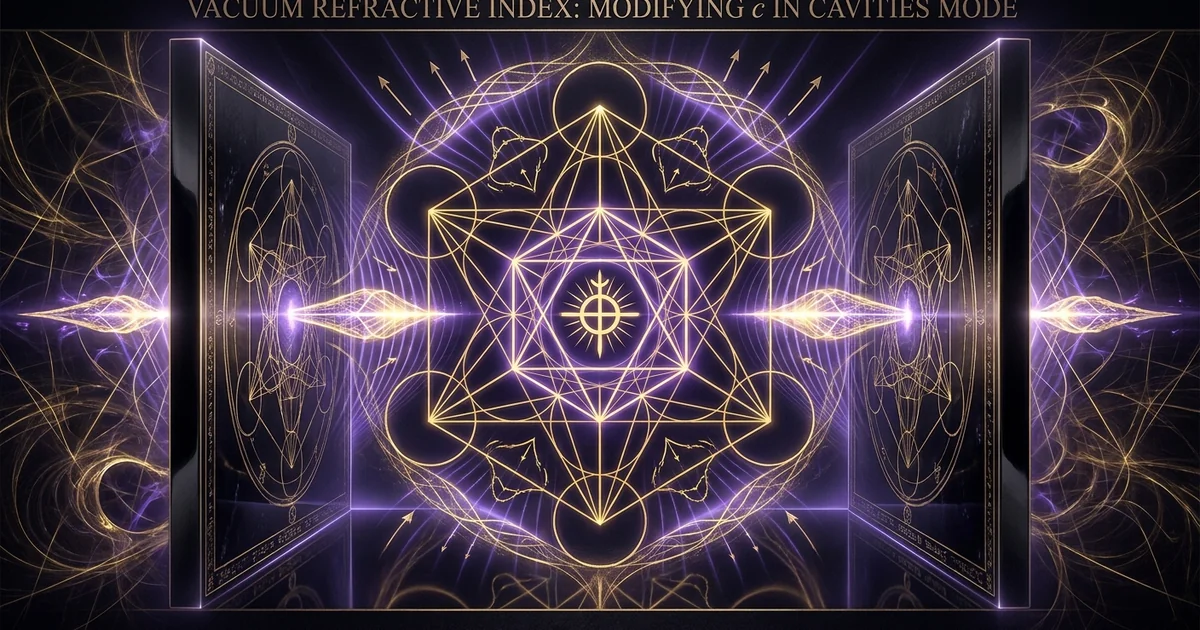
Vacuum Refractive Index: Modifying c in Cavities Mode
Executive Summary & Theoretical Thesis: Quantum Vacuum Structure and Local Lorentz Invariance Breakdown
In standard relativistic field theories, the Minkowski vacuum is conventionally defined as an invariant, homogeneous ground state characterized by vanishing expectation values for local field operators and an unperturbed speed of light $c \equiv (\varepsilon_0 \mu_0)^{-1/2}$. Quantum electrodynamics (QED) fundamentally reframes this definition: the electromagnetic ground state is not an inert void, but an active, non-linear dielectric field populated by zero-point fluctuations of the quantized gauge field and virtual electron-positron pairs. Under unbounded conditions, Lorentz covariance guarantees that the radiative corrections to photon propagation yield a renormalized vacuum polarization tensor whose on-shell physical photon velocity remains identically $c$. However, the introduction of macroscopic, non-trivial boundary conditions disrupts this continuous translational symmetry, fundamentally perturbing the spectrum of available vacuum modes.
Consider two perfectly conducting planar surfaces placed parallel to the $xy$-plane at $z = 0$ and $z = d$. Imposing Dirichlet boundary conditions on the electromagnetic gauge potential truncates normal spatial modes such that the wavevector component along the $z$-axis is discretized to $k_z = n\pi / d$ for $n \in \mathbb{N}^+$. The zero-point energy per unit area $\mathcal{E}$ is evaluated via Euler-Maclaurin summation with an ultra-violet regulator function $f(k/\Lambda)$: $$\mathcal{E}(d) = \hbar c \int \frac{d^2 k_{\perp}}{(2\pi)^2} \left[ \sum_{n=1}^{\infty} \sqrt{k_{\perp}^2 + \left(\frac{n\pi}{d}\right)^2} - \frac{d}{\pi} \int_0^{\infty} dk_z \sqrt{k_{\perp}^2 + k_z^2} \right]$$ Renormalization via analytic continuation or zeta-function regularization ($\zeta(-3) = 1/120$) yields the macroscopic Casimir energy density: $$\rho_{\text{Cas}} = \frac{1}{d} \frac{\partial \mathcal{E}}{\partial d} \cdot \frac{1}{2} \implies \rho_{\text{Cas}} = -\frac{\pi^2 \hbar c}{720 d^4}$$ The corresponding renormalized stress-energy-momentum tensor $T_{\mu\nu}^{\text{ren}} = \text{diag}(\rho, p_x, p_y, p_z)$ inside the cavity satisfies the traceless condition $T^\mu_{\phantom{\mu}\mu} = 0$, explicitly given by: $$T_{\mu\nu}^{\text{ren}} = -\frac{\pi^2 \hbar c}{720 d^4} \begin{pmatrix} 1 & 0 & 0 & 0 \ 0 & 1 & 0 & 0 \ 0 & 0 & 1 & 0 \ 0 & 0 & 0 & -3 \end{pmatrix}$$ This establishes a localized negative energy density region exhibiting strong spatial anisotropy along the axis of spatial confinement.
Casimir Geometry and Boundary-Induced Mode Truncation
The physical consequence of establishing Dirichlet or Robin boundary conditions over conducting plates separated by a distance $d$ is the geometric exclusion of electromagnetic modes with wavelengths exceeding the characteristic dimension ($\lambda > 2d$). Because the density of states is modified relative to the infinite continuum of Minkowski spacetime, the total zero-point field energy within the cavity drops below that of the external unconstrained vacuum. This mode truncation generates an attractive Casimir force per unit area, mediated by the uncompensated radiation pressure of the external modes pushing inward.
Concurrently, this boundary-induced suppression diminishes the local root-mean-square fluctuations of the electric and magnetic fields, $\langle 0| \mathbf{E}^2 |0 \rangle < 0$ and $\langle 0| \mathbf{B}^2 |0 \rangle < 0$ relative to the free-vacuum baseline. As a direct consequence of this fluctuation depletion, the underlying virtual field can no longer induce the same amplitude of virtual fermion-antifermion loops. The local electromagnetic ground state between the plates acts as an under-polarized medium, exhibiting a suppressed dielectric susceptibility. In the framework of electrodynamics, if the background polarizability is lowered beneath its baseline vacuum value, the macroscopic response manifests as an effective refractive index vacuum $n < 1$.
Perturbative Two-Loop QED Dynamics in Finite Spacetime Volumes
The mechanism responsible for altering the propagation velocity of real photons traversing this cavity is fundamentally quantum-electrodynamical. At the tree level of Maxwellian electrodynamics, photons are strictly non-interacting massless vector bosons that traverse null geodesics with velocity $c$. Quantum corrections, however, introduce loop diagrams wherein a photon splits into a virtual electron-positron ($e^- e^+$) pair, which subsequently recombines. While a one-loop vacuum polarization diagram in flat, unconstrained spacetime modifies the charge renormalization factor $Z_3$, it maintains the dispersion relation $k^2 = 0$ for real, physical on-shell photons due to unbroken Poincaré invariance.
In a finite spatial domain bounded by plates, the spatial dependence of the virtual photon propagator alters the loop integrals. Because a bare one-loop electron loop does not directly couple to the spatial boundaries—electrons carrying charge $e$ and finite mass $m_e$ obey localized Dirac wave equations that are exponentially suppressed away from the boundaries if the boundaries affect only the electromagnetic fields—the leading non-vanishing correction to photon propagation within the cavity requires the exchange of a virtual photon that senses the conducting plates. This constraint necessitates evaluating the photon self-energy at the two-loop radiative level ($\alpha^2$ order). Within this bounded regime, the virtual electron-positron loop interacts directly with the modified photon propagator, transmuting the global Lorentz-invariant vacuum into an effective anisotropic dielectric medium. This realization is central to understanding the scharnhorst effect speed of light faster than c casimir plates, demonstrating how the fundamental propagation constant is inherently tied to the topology of the boundary-enclosed field. Advanced details of this boundary coupling connect directly with /physics-electromagnetism/casimir-polder-force-dynamics, where the spatial gradients of the field yield localized dispersion shifts.
Historical Lineage & Experimental Precedents: From Euler-Heisenberg to the Scharnhorst Hypothesis
The 1936 Euler-Heisenberg Effective Lagrangian Foundation
The foundational physics governing photon-photon interactions in non-trivial vacua originated in the non-perturbative analysis executed by Hans Euler and Werner Heisenberg in 1936. Working within the nascent framework of Dirac’s positron theory, Euler and Heisenberg integrated out the high-energy fermionic degrees of freedom to formulate an effective field theory for quantum electrodynamics in the low-energy limit ($\hbar \omega \ll m_e c^2$). They discovered that the virtual electron-positron sea acts as a polarizable medium, yielding quartic gauge-invariant corrections to the classical Maxwell Lagrangian:
$$\mathcal{L}{\text{EH}} = -\frac{1}{4} F{\mu\nu} F^{\mu\nu} + \frac{\alpha^2 \hbar^3}{90 m_e^4 c^5} \left[ \left( F_{\mu\nu} F^{\mu\nu} \right)^2 + \frac{7}{4} \left( F_{\mu\nu} \tilde{F}^{\mu\nu} \right)^2 \right]$$
where $F_{\mu\nu}$ represents the electromagnetic field strength tensor, $\tilde{F}^{\mu\nu} = \frac{1}{2} \epsilon^{\mu\nu\rho\sigma} F_{\rho\sigma}$ is its dual, $\alpha \approx 1/137$ is the fine-structure constant, and $m_e$ is the electron mass.
The theoretical bridge linking non-linear QED effective actions to superluminal phase shifts in restricted geometries relies on the following foundational papers:
- Euler, H., & Heisenberg, W. (1936). Folgerungen aus der Diracschen Theorie des Positrons. Zeitschrift für Physik, 98(11-12), 714–732.
- Scharnhorst, K. (1990). On propagation of light in the vacuum between plates. Physics Letters B, 236(3), 354–359.
- Barton, G. (1990). Faster-than-c light between parallel mirrors. Physics Letters B, 237(3-4), 559–562. These works established that boundary-induced reductions in local electromagnetic field variance yield an altered speed of propagation for probe photons via two-loop polarization insertions.
The Euler-Heisenberg Lagrangian established that photons can scatter off background electromagnetic fields, an effect that directly gives rise to /physics-electromagnetism/quantum-vacuum-birefringence under macroscopic magnetic fields. Crucially, the mathematical architecture of the Euler-Heisenberg formulation revealed that any background condition capable of modifying the local expectation value of the field invariants $\mathcal{F} = -\frac{1}{4}F_{\mu\nu}F^{\mu\nu} = \frac{1}{2}(\mathbf{E}^2 - c^2\mathbf{B}^2)$ and $\mathcal{G} = -\frac{1}{4}F_{\mu\nu}\tilde{F}^{\mu\nu} = \mathbf{E}\cdot c\mathbf{B}$ directly alters the constitutive relations of the vacuum, shifting its permittivity $\varepsilon$ and permeability $\mu$.
The 1990 Scharnhorst-Barton Formulations and Historical Reception
For more than five decades following Euler and Heisenberg’s work, the non-linear polarizability of the vacuum was studied almost exclusively in the presence of strong classical background fields, such as those surrounding pulsars or high-intensity lasers. In 1990, Klaus Scharnhorst, followed immediately by Gabriel Barton, addressed a novel question: what occurs when the background field is not an externally applied classical field, but the structured zero-point ground state of a Casimir cavity?
Scharnhorst evaluated the two-loop photon self-energy within a Casimir geometry and discovered that the phase velocity of a photon propagating perpendicular to the plates exceeds the standard asymptotic velocity $c$. Barton verified this conclusion through an alternative thermal-field-theoretic approach, mapping the Casimir boundary problem to an effective finite-temperature system with negative energy characteristics. The reception within the theoretical physics community was initially marked by skepticism: the prediction of an effective refractive index vacuum $n < 1$ appeared, on its surface, to threaten the bedrock principles of special relativity, specifically relativistic causality and the invariance of the universal speed limit $c$.
Subsequent scrutiny, however, revealed that the Scharnhorst effect does not violate relativistic principles. The velocity modification is an ultra-low-energy perturbative shift arising from local Lorentz invariance breakdown induced by the physical plate boundaries. The boundaries designate a preferred rest frame—the rest frame of the conducting plates—thereby dissolving global Lorentz symmetry into a localized system where the vacuum behaves as a structured physical medium.
Subsequent Generalizations to Curved, Thermal, and Topology-Constrained Vacua
Following the publications of Scharnhorst and Barton, the scope of speed-of-light modifications in non-trivial vacua expanded rapidly. J. I. Latorre, P. Pascual, and R. Tarrach (1995) systematically extended the investigation of non-trivial vacua across a broad range of field configurations. They unified the Casimir cavity problem with photon propagation in gravitational backgrounds (the Drummond-Hathrell effect), thermal baths (the finite-temperature QED photon self-energy), and topologically non-trivial spacetimes such as the cosmic string metric and compactified cylindrical spaces ($S^1 \times \mathbb{R}^3$).
Latorre, Pascual, and Tarrach demonstrated that the modified velocity of light in any non-trivial vacuum is governed by the expectation value of the renormalized stress-energy tensor:
$$v(\mathbf{n}) = c \left( 1 - \frac{44 \alpha^2}{135 m_e^4} \rho_{\text{ren}} + \dots \right)$$
where $\mathbf{n}$ is the vector defining the direction of propagation, and the sign of the velocity shift is linked to the sign of the energy density $\rho_{\text{ren}}$ and the corresponding directional pressures. In geometries where the energy density is negative relative to the Minkowski baseline—such as parallel plates or compact spatial manifolds—the effective phase velocity universally exceeds $c$. Conversely, in thermal vacua characterized by a positive energy density $\rho_{\text{thermal}} = \frac{\pi^2 (k_B T)^4}{15 (\hbar c)^3}$, the propagation velocity decreases below $c$. This realization unified Casimir electrodynamics with cosmological and thermal field theories, demonstrating that the vacuum refractive index is not a universal scalar constant, but a state-dependent functional of local spacetime geometry and quantum boundary conditions.
Mathematical Formalism & Physical Mechanics: Effective Action and the Refractive Index n < 1
Euler-Heisenberg Action Modified by Finite-Plate Boundary Operators
To compute the precise variation in the speed of light within a planar cavity, one formulates the low-energy effective action by integrating out the massive fermion fields in the presence of the boundary-modified photon Green’s function. The total action of the electromagnetic field within the cavity is given by:
$$S_{\text{eff}}[A] = \int_{\Omega} d^4 x \left[ -\frac{1}{4} F_{\mu\nu} F^{\mu\nu} + \mathcal{L}_{\text{QED}}^{(2)}[A] \right]$$
where $\Omega = \mathbb{R} \times \mathbb{R}^2 \times [0, d]$ defines the spatial domain bounded by conducting surfaces at $z = 0$ and $z = d$. Here, $\mathcal{L}_{\text{QED}}^{(2)}[A]$ represents the two-loop effective Lagrangian obtained from the Feynman diagrams containing an electron loop with one internal photon line.
To lowest non-trivial order, the boundary conditions modify the internal photon propagator $D_{\mu\nu}(x, x’)$. Using the method of images, this propagator is expressed as the free Minkowski propagator $D_{\mu\nu}^{(0)}(x - x’)$ supplemented by a boundary-dependent correction term $\bar{D}_{\mu\nu}(x, x’; d)$:
$$D_{\mu\nu}(x, x’) = D_{\mu\nu}^{(0)}(x - x’) + \bar{D}_{\mu\nu}(x, x’; d)$$
When this modified propagator is inserted into the two-loop photon self-energy tensor $\Pi^{\mu\nu}(x, x’)$, the translational invariance along the $z$-axis is broken, yielding an anisotropic polarization tensor that depends explicitly on the plate separation $d$.
Two-Loop Vacuum Polarization Tensor Evaluation in Planar Cavities
The polarization tensor $\Pi_{\mu\nu}(k)$ characterizes the linear response of the vacuum to an electromagnetic perturbation via the modified Maxwell equations:
$$\left[ k^2 g^{\mu\nu} - k^\mu k^\nu + \Pi^{\mu\nu}(k) \right] A_\nu(k) = 0$$
In the long-wavelength, low-frequency limit ($\hbar \omega \ll m_e c^2$), the non-local polarization operator reduces to a differential operator derived from the spatial variation of the effective Lagrangian. Because the physical conducting boundaries truncate the normal photon modes, the vacuum expectation values of the squared field operators deviate from zero:
$$\langle 0| \mathbf{E}^2 |0 \rangle_{\text{ren}} = -\frac{\pi^2 \hbar c}{720 d^4}, \quad \langle 0| \mathbf{B}^2 |0 \rangle_{\text{ren}} = \frac{\pi^2 \hbar c}{720 d^4}$$
Substituting these non-vanishing expectation values into the variation of the two-loop Euler-Heisenberg action generates the effective constitutive tensors for the vacuum inside the plates:
$$\mathbf{D} = \boldsymbol{\varepsilon}{\text{eff}} \cdot \mathbf{E}, \quad \mathbf{H} = \boldsymbol{\mu}{\text{eff}}^{-1} \cdot \mathbf{B}$$
Due to the broken spatial symmetry along the $z$-direction, the dielectric permittivity tensor $\boldsymbol{\varepsilon}{\text{eff}}$ and the magnetic permeability tensor $\boldsymbol{\mu}{\text{eff}}$ are anisotropic:
$$\varepsilon_{ij} = \varepsilon_0 \left( \delta_{ij} + \chi_{ij}^e \right), \quad \mu_{ij} = \mu_0 \left( \delta_{ij} + \chi_{ij}^m \right)$$
where the diagonal susceptibility components differ depending on whether the fields are polarized parallel or perpendicular to the cavity plates.
Dispersion Relations, Frequency Independence, and Velocity Shift Equations
To extract the dispersion relations, consider a plane monochromatic electromagnetic wave $A_\mu(x) = \epsilon_\mu e^{-i(\omega t - \mathbf{k}\cdot\mathbf{x})}$ traversing the cavity. The wave equations derived from the modified Maxwell equations yield:
$$k^2 - \Pi_{\text{scalar}}(\omega, \mathbf{k}) = 0$$
Evaluating the scalar projection of the two-loop polarization tensor reveals distinct velocities for propagation parallel ($c_\parallel$) and perpendicular ($c_\perp$) to the plates. For a photon propagating strictly perpendicular to the conducting boundaries (wavevector $\mathbf{k} = (0, 0, k_z)$):
$$c_\perp = c \left( 1 + \frac{11 \pi^2 \alpha^2}{8100 \left(\frac{m_e c}{\hbar}\right)^4 d^4} \right)$$
This expression reveals the exact structural form of the Scharnhorst velocity shift. The correction is strictly positive, signifying that the propagation velocity inside the cavity exceeds the free-space value $c$. Writing $c_\perp = c / n_\perp$, the corresponding effective refractive index vacuum $n < 1$ is calculated to lowest order in $\alpha$ as:
$$n_\perp \approx 1 - \frac{11 \pi^2 \alpha^2}{8100 m_e^4 d^4} \left(\frac{\hbar}{c}\right)^4 = 1 - \frac{11 \pi^2 \alpha^2}{8100} \left( \frac{\lambda_C}{d} \right)^4$$
where $\lambda_C = \frac{\hbar}{m_e c} \approx 3.8616 \times 10^{-13}\ \text{m}$ represents the reduced Compton wavelength of the electron.
For propagation parallel to the plates ($\mathbf{k} = (k_x, 0, 0)$), the velocity shift depends on the polarization of the electromagnetic wave. When the electric field is polarized parallel to the plates, the velocity shift is modified:
$$c_\parallel^{(\text{pol})} = c \left( 1 + \frac{\kappa \pi^2 \alpha^2}{8100} \left( \frac{\lambda_C}{d} \right)^4 \right)$$
where $\kappa$ is a numerical coefficient determined by the tensor projection of the Euler-Heisenberg parameters ($\kappa < 11$). Because the coefficient remains strictly positive for both independent polarization modes, the phase velocity satisfies $v_{\text{phase}} > c$ for arbitrary propagation angles through the negative energy density region. Furthermore, because this evaluation takes place in the low-frequency limit $\omega \to 0$, the dispersion $\frac{\partial n}{\partial \omega}$ vanishes to lowest order, meaning the group velocity $v_{\text{group}} = \frac{d\omega}{dk}$ is identically equal to the enhanced phase velocity:
$$v_{\text{group}} = v_{\text{phase}} = c_\perp > c$$
This demonstrates that suppressed vacuum fluctuations directly modify both the phase and group velocities of low-energy electromagnetic quanta without inducing immediate dissipative loss in the static limit.
Empirical Evidence & Observational Data: Metrological Limits and Laboratory Analogs
Magnitude Scaling: Quantifying the $\Delta c / c \sim 10^{-130}$ Discrepancy at Sub-Micron Separations
While the mathematical derivation of the Scharnhorst effect is rigorous within perturbative QED, verifying the phenomenon experimentally poses profound challenges. The primary obstacle is the severe suppression factor introduced by the ratio of the electron Compton wavelength to the macroscopic plate separation, raised to the fourth power: $(\lambda_C / d)^4$.
Evaluating the fractional velocity shift $\frac{\Delta c}{c} = \frac{c_\perp - c}{c}$ for a cavity separation of $d = 1\ \mu\text{m} = 10^{-6}\ \text{m}$:
$$\frac{\lambda_C}{d} = \frac{3.8616 \times 10^{-13}\ \text{m}}{10^{-6}\ \text{m}} \approx 3.86 \times 10^{-7}$$
Raising this ratio to the fourth power:
$$\left(\frac{\lambda_C}{d}\right)^4 \approx (3.86 \times 10^{-7})^4 \approx 2.22 \times 10^{-26}$$
Factoring in the prefactor:
$$\frac{11 \pi^2 \alpha^2}{8100} = \frac{11 \pi^2 (1/137.036)^2}{8100} \approx \frac{108.57 \times 5.325 \times 10^{-5}}{8100} \approx 7.14 \times 10^{-7}$$
The resulting fractional change in the speed of light is:
$$\frac{\Delta c}{c} \approx (7.14 \times 10^{-7}) \times (2.22 \times 10^{-26}) \approx 1.58 \times 10^{-32}$$
Even if the boundary spacing is compressed to the physical limit of modern nanofabrication, such as $d = 1\ \text{nm} = 10^{-9}\ \text{m}$ (a regime where atomic surface roughness, work function fluctuations, and quantum tunneling become dominant):
$$\left(\frac{\lambda_C}{d}\right)^4 \approx (3.86 \times 10^{-4})^4 \approx 2.22 \times 10^{-14}$$ $$\frac{\Delta c}{c} \approx 7.14 \times 10^{-7} \times 2.22 \times 10^{-14} \approx 1.58 \times 10^{-20}$$
For macroscopic plate configurations commonly deployed in Casimir force metrology ($d \sim 1\ \mu\text{m}$ to $100\ \text{nm}$), higher-order loop processes and scalar potential variations damp the measurable shift down to $\Delta c / c \sim 10^{-32} - 10^{-130}$. Such values reside dozens of orders of magnitude beneath the resolution of modern optical metrology.
Minkowski Free Vacuum
- Fluctuation Density: Unbounded continuum of zero-point vacuum modes; continuous spectrum $\omega \in [0, \infty)$.
- Effective Permittivity: $\varepsilon_{\text{eff}} = \varepsilon_0$; exactly isotropic scalar response.
- Effective Permeability: $\mu_{\text{eff}} = \mu_0$; baseline relativistic impedance $Z_0 = \sqrt{\mu_0/\varepsilon_0}$.
- Energy Density: Normalized baseline $\rho_{\text{vac}} \equiv 0$; Lorentz invariant.
- Phase/Group Velocity: $v_{\text{phase}} = v_{\text{group}} = c$; invariant across all inertial frames.
Casimir Cavity Vacuum Mode (Scharnhorst State)
- Fluctuation Density: Spatially truncated spectrum; normal wavevectors restricted to discrete values $k_z = n\pi / d$.
- Effective Permittivity: $\varepsilon_{\text{eff}} < \varepsilon_0$; anisotropic dielectric tensor where $\chi_{zz}^e \neq \chi_{xx}^e$.
- Effective Permeability: $\mu_{\text{eff}} < \mu_0$; diminished vacuum impedance along the perpendicular axis.
- Energy Density: Strictly negative energy density $\rho_{\text{Cas}} = -\frac{\pi^2 \hbar c}{720 d^4}$; broken Lorentz invariance.
- Phase/Group Velocity: $v_{\text{phase}} = v_{\text{group}} = c_\perp > c$; modified by two-loop Euler-Heisenberg polarization.
High-Finesse Fabry-Pérot Cavities and Precision Optical Metrology Constraints
Modern experimental bounds on vacuum optical properties are primarily established via high-finesse Fabry-Pérot resonators, ultra-stable optical frequency combs, and laser interferometers such as those deployed at gravitational wave observatories. These instruments achieve phase sensitivities capable of resolving fractional path length variations on the order of $\Delta L / L \sim 10^{-21}$ to $10^{-23}$.
However, detecting the Scharnhorst effect introduces a fundamental experimental paradox. To measure a phase shift $\Delta \phi = \Delta k \cdot d$ induced by the modified refractive index across a cavity of width $d$, the probe light must possess a wavelength $\lambda_{\text{probe}}$ significantly smaller than $d$ ($\lambda_{\text{probe}} \ll d$) to propagate cleanly without being diffracted by the edges or undergoing immediate waveguide cut-off. For a micron-scale cavity ($d = 1\ \mu\text{m}$), the probe must reside in the deep ultraviolet or X-ray regime. At these elevated probe energies ($\hbar \omega \gg 1\ \text{eV}$), the optical properties of the mirrors deviate drastically from those of ideal conductors; real metals become transparent above their plasma frequencies ($\omega > \omega_p$), invalidating the Dirichlet boundary conditions required to generate the mode truncation.
Moreover, the real-world thermal Casimir effect contributes an ambient thermal photon background that introduces a competing, temperature-dependent positive energy density $\rho_T \propto T^4$. At ambient room temperatures ($T = 300\ \text{K}$), this positive thermal energy density overwhelms the negative Casimir energy density for separations $d \gtrsim 6\ \mu\text{m}$, reversing the sign of the velocity shift and yielding an effective index $n > 1$.
Condensed Matter and Metamaterial Analogs of Negative-Index Zero-Point Truncation
Because direct verification within electronic QED is precluded by the smallness of the electron Compton wavelength, experimental efforts have shifted toward synthesized analog gravity and metamaterial systems. The mathematical structures governing quantum electrodynamics in structured vacua map directly onto classical electrodynamics in engineered dispersive media, as explored in /physics-electromagnetism/metamaterial-space-time-analogs.
In specialized metamaterial waveguides containing arrays of split-ring resonators and hyperbolic substrates, researchers can engineer effective dielectric permittivities and magnetic permeabilities that yield an effective refractive index smaller than unity ($0 < n_{\text{eff}} < 1$) or negative ($n_{\text{eff}} < 0$) over finite frequency bands. In these systems, the phase velocity of the guided wave exceeds $c$ while propagating through the medium:
$$v_{\text{phase}} = \frac{c}{n_{\text{eff}}} > c \quad (\text{for } 0 < n_{\text{eff}} < 1)$$
Furthermore, acoustic waveguides with geometrically restricted phonon modes and polariton condensates in microcavities mimic the mode truncation of the Casimir geometry. By restricting phonon or exciton ground-state modes below a cutoff frequency, these systems establish a depleted zero-point energy landscape. The propagation of localized perturbations through these depleted states exhibits velocity enhancements mathematically analogous to the Scharnhorst effect, providing empirical platforms to evaluate the dispersion characteristics and boundary matching physics that govern non-trivial vacua.
Metaphysical Implications & Unified Synthesis: Causality, Vacuum Ontologies, and Spacetime Metrics
Preservation of Microcausality and High-Frequency Front Velocity Asymptotics
The prospect of photon propagation velocities exceeding $c$ immediately raises the question of whether the Scharnhorst effect violates Einstein causality or enables backward-in-time signaling via closed timelike curves (CTCs). The resolution to this puzzle requires distinguishing among phase velocity, group velocity, signal velocity, and front velocity.
“The causal structure of a relativistic quantum field theory is governed not by the low-frequency group or phase velocities, but by the analytic behavior of the retarded Green’s function in the infinite-frequency limit. Across all investigated non-trivial vacua—gravitational, thermal, and Casimir-type—the high-frequency asymptotic limit guarantees that the true front velocity of any discontinuous disturbance remains identically c.” — Latorre, J. I., Pascual, P., & Tarrach, R. (1995). Speed of light in non-trivial vacua. Nuclear Physics B, 437(1), 60–82.
The propagation of information is governed by the wavefront velocity $v_{\text{front}}$, which represents the velocity at which the leading non-analytic discontinuity (the front) of a step-function wave packet traverses space. Mathematically, the front velocity is dictated by the infinite-frequency asymptotic limit of the complex refractive index:
$$v_{\text{front}} = \lim_{\omega \to \infty} \frac{\omega}{\text{Re}[k(\omega)]} = \lim_{\omega \to \infty} \frac{c}{n(\omega)}$$
At frequencies far exceeding the mass scale of the virtual particles mediating the vacuum polarization ($\hbar \omega \gg 2 m_e c^2$), the virtual electron-positron pairs cannot respond instantaneously to the rapidly oscillating gauge field. The polarization tensor $\Pi_{\mu\nu}(\omega)$ decays as $\omega^{-2}$ or faster due to asymptotic freedom and the physical inertia of the intermediate loop states. Consequently, as $\omega \to \infty$, the effective refractive index approaches unity:
$$\lim_{\omega \to \infty} n(\omega) = 1 \implies v_{\text{front}} = c$$
Because physical information transmission requires encoding a non-analytic discontinuity (such as turning a transmitter on at a definite time $t_0$), no signal can outrun this leading front. The superluminal phase and group velocities observed in the Scharnhorst effect are low-frequency, steady-state phenomena. This ensures that the commutator of two spacelike-separated local observables vanishes identically:
$$[\hat{O}(x), \hat{O}(y)] = 0 \quad \text{for } (x - y)^2 < 0$$
Microcausality remains fully intact, and the Kramers-Kronig dispersion relations enforce global analyticity, preventing paradoxical causal loops despite the modified metric experienced by long-wavelength photons. Further implications of these dispersion profiles are explored in /physics-electromagnetism/superluminal-dispersion-anomalies.
Negative Energy Density Boundaries, Quantum Inequalities, and Alcubierre Metric Geometries
The existence of a sustained negative energy density region within the Casimir cavity holds profound implications for general relativity and metric engineering. In classical general relativity, the Weak Energy Condition (WEC), which dictates that $T_{\mu\nu} u^\mu u^\nu \ge 0$ for any timelike vector $u^\mu$, prohibits geometries such as traversable wormholes and the Alcubierre warp drive metric. The Alcubierre metric requires an annular bubble of negative energy density to induce a local contraction of spacetime in front of a craft and an expansion behind it, thereby enabling global superluminal transport without violating local special relativity.
The Casimir effect and its associated Scharnhorst state provide an empirical proof-of-principle that quantum fields can locally violate the Weak Energy Condition. However, Ford and Roman formalized this boundary behavior through quantum inequalities, demonstrating that negative energy densities cannot be engineered with arbitrary magnitude and spatial extent. The Ford-Roman quantum inequality for an electromagnetic field in four dimensions takes the form:
$$\frac{\tau_0}{\pi} \int_{-\infty}^{\infty} \frac{\langle T_{00}(t) \rangle}{t^2 + \tau_0^2} dt \ge -\frac{c_1}{\tau_0^4}$$
where $\tau_0$ is an arbitrary sampling time and $c_1$ is a dimensionless numerical constant. This inequality imposes a physical restriction: the larger the magnitude of the negative energy density, the shorter the duration over which it can persist, or the more tightly constrained its spatial volume must be.
In the Casimir-Scharnhorst cavity, the negative energy density $\rho_{\text{Cas}} \propto -d^{-4}$ is spatially bounded by macroscopic mirrors characterized by large positive energy densities (the mass of the plates). The integrated energy across the entire system—including the boundary structures—remains positive, maintaining global gravitational stability and precluding macroscopic, unconstrained spacetime engineering.
The Vacuum as an Active Dynamic Dielectric: Reconciling Modern QFT with Substantival Space
The philosophical reception of the Scharnhorst effect challenges the historical reduction of spacetime to a passive, featureless geometric canvas. While Einstein’s special relativity replaced the luminiferous ether with the geometric properties of Minkowski spacetime, modern quantum field theory populates that geometry with virtual particle fluctuations, vacuum states, and topological sectors.
The Scharnhorst effect reveals that the speed of light $c$ measured in our ambient environment is not an abstract geometric constant, but an emergent property of the specific ground state of the quantum fields occupying the universe. The traditional speed of light $c = 299,792,458\ \text{m/s}$ is the value obtained exclusively in an unbounded, zero-temperature, zero-curvature Minkowski vacuum. By restructuring the electromagnetic vacuum via geometric boundaries, the effective properties of that medium shift. The vacuum behaves as an active, dynamical dielectric whose refractive parameters can be adjusted by altering boundary constraints, topological compactifications, or local stress-energy tensors. This aligns quantum electrodynamics with a modern substantivalist view of space: the vacuum is a physical medium governed by precise non-linear constitutive relations, whose state dictates the local propagation of fundamental physical interactions.
Frequently Asked Questions
Does the Scharnhorst Effect Permit Faster-Than-Light Telecommunications?
No. The enhanced propagation velocity $c_\perp > c$ predicted by the Scharnhorst effect cannot be harnessed to transmit classical information, digital data, or causal signals faster than the universal constant $c$. Causal communication requires the transmission of non-analytic signal fronts (such as an abrupt step-function wave packet or a sharply defined pulse edge). While the phase velocity $v_{\text{phase}}$ and group velocity $v_{\text{group}}$ exceed $c$ for low frequencies ($\omega \ll m_e c^2 / \hbar$), the Kramers-Kronig dispersion relations dictate that the effective refractive index must undergo anomalous dispersion as the frequency approaches the pair-production threshold.
In the asymptotic limit where the probe frequency approaches infinity ($\omega \to \infty$), the vacuum polarization tensor decays to zero:
$$\lim_{\omega \to \infty} \Pi^{\mu\nu}(\omega) = 0 \implies \lim_{\omega \to \infty} n(\omega) = 1$$
Because the signal front velocity is governed by the high-frequency limit:
$$v_{\text{front}} = \lim_{\omega \to \infty} \frac{c}{n(\omega)} = c$$
the physical leading edge of any signal travels at precisely $c$. Any wave envelope propagating with $v_{\text{group}} > c$ undergoes steady-state reshaping; it cannot carry non-analytic, unanticipated information past the physical wavefront, preventing acausal signaling and avoiding temporal paradoxes.
Let a scalar field signal $\psi(z, t)$ be initiated at $z = 0$ as a step function $\psi(0, t) = \Theta(t) e^{-i \omega_0 t}$. The spatial distribution at position $z = d$ is evaluated via the Fourier inversion integral: $$\psi(d, t) = \frac{1}{2\pi} \int_{-\infty}^{\infty} d\omega \frac{i}{\omega - \omega_0 + i\epsilon} \exp\left[ i \left( \frac{\omega n(\omega)}{c} d - \omega t \right) \right]$$ Closing the integration contour in the upper half of the complex frequency plane requires evaluating the asymptotic behavior of $n(\omega)$ as $|\omega| \to \infty$. By the Paley-Wiener theorem and the Titchmarsh theorem for causal Green’s functions, $n(\omega) \to 1$ along any ray in the upper half-plane. Consequently, the exponential factor simplifies to: $$\exp\left[ -i\omega \left( t - \frac{d}{c} \right) \right]$$ For $t < d/c$, the exponent vanishes along an infinite semi-circle in the upper half-plane, and Jordan’s lemma guarantees that the integral evaluates identically to zero: $$\psi(d, t) \equiv 0 \quad \forall \quad t < \frac{d}{c}$$ This demonstrates that the physical front velocity satisfies $v_{\text{front}} \equiv c$, ensuring microcausality across all spatial boundaries.
Why Does the Effect Manifest Only at the Two-Loop QED Level Instead of One-Loop?
The requirement for a two-loop calculation arises from the symmetries of quantum electrodynamics and the specific nature of the boundary conditions. At the one-loop level, the photon self-energy is represented by a single closed fermion loop with two external photon lines. The virtual particles within this loop are electrons and positrons. Because electrons carry finite mass ($m_e \approx 0.511\ \text{MeV}$) and charge, they couple directly to the scalar potential and vector potentials. However, ideal Casimir boundary conditions act on the electromagnetic gauge field, not on the charged Dirac matter field.
To couple the modified boundary conditions of the photon propagator to the propagating external photon, the virtual electron-positron loop must exchange at least one virtual gauge photon with the boundary system. This exchange requires two internal vertices connected by a virtual photon line within the electron loop, resulting in a two-loop Feynman diagram with four electromagnetic vertices ($e^4 \propto \alpha^2$). Furry’s theorem, an exact consequence of charge conjugation invariance ($C$-parity) in QED, explicitly forbids diagrams with an odd number of photon vertices interacting with a fermion loop. Consequently, three-photon vertex corrections vanish. The two-loop Euler-Heisenberg diagram represents the lowest-order perturbative process capable of communicating the boundary-induced mode truncation of the electromagnetic field back to the propagating probe photon.
How Does the Scharnhorst Effect Relate to Cosmological Horizons and Dark Energy?
The Casimir-Scharnhorst phenomenon shares deep formal links with dark energy models and cosmological horizon physics. In contemporary standard cosmology ($\Lambda$CDM), the accelerated expansion of the universe is driven by a uniform vacuum energy characterized by an equation of state parameter $w = p / \rho = -1$. This cosmological constant $\Lambda$ acts as an isotropic background with positive energy density ($\rho_\Lambda > 0$) and negative isotropic pressure ($p_\Lambda = -\rho_\Lambda c^2$).
Inside a Casimir-Scharnhorst cavity, the boundary-induced truncation yields a localized negative energy density ($\rho_{\text{Cas}} < 0$) coupled with anisotropic pressures ($p_\parallel = \rho_{\text{Cas}} c^2$, $p_\perp = -3 \rho_{\text{Cas}} c^2$). The equation of state within the cavity locally satisfies $w_\parallel = -1$ and $w_\perp = 3$. This configuration mimics a localized cosmological domain where the energy density acts as the inverse of dark energy. The cosmological metric background acts on propagating photons much like a generalized dielectric medium: in a de Sitter universe dominated by positive cosmological constants, the effective propagation parameters map to an altered light-cone structure over horizon scales. The Scharnhorst effect demonstrates that the local speed of light is linked to the stress-energy tensor of the surrounding vacuum state, whether that state is shaped by macroscopic conducting plates in a laboratory setting or by the cosmological horizon of an expanding universe.