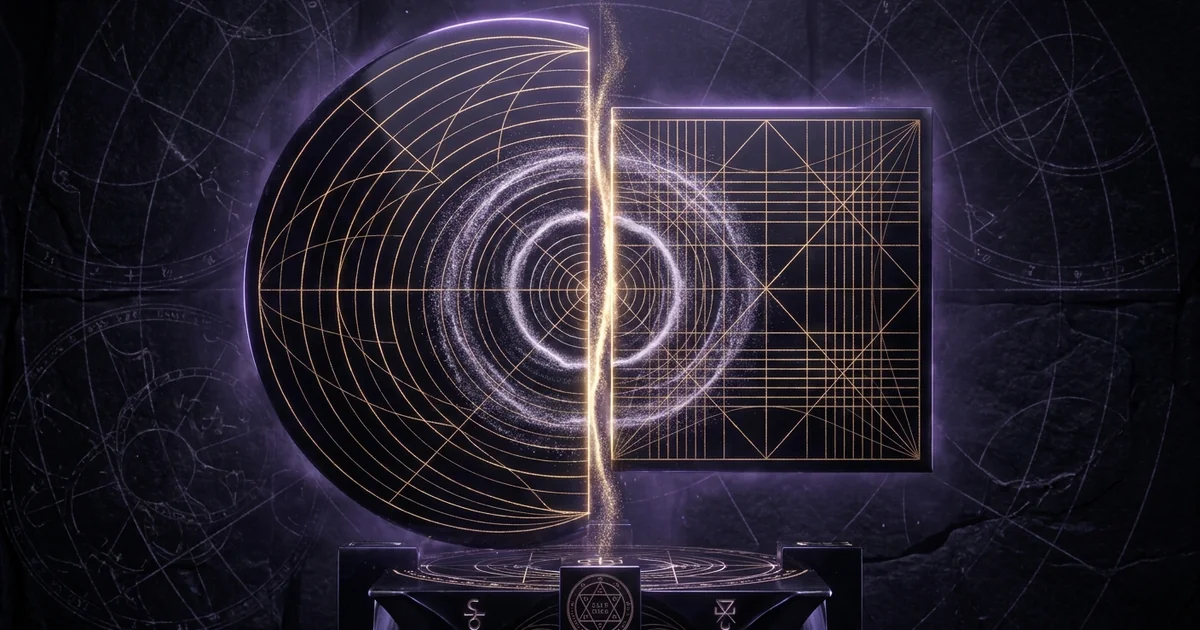
Circular vs Square Plates: Symmetries in Nodal Geometry
Executive Summary & Theoretical Thesis: Elastodynamic Symmetry and Modal Morphology
The acoustic nodal geometry of vibrating thin plates represents a direct physical realization of boundary-enforced eigensystem symmetries. When an elastic continuum is driven to resonance, the geometric contour of its perimeter restricts the domain of permissible displacement vectors, governing how acoustic energy crystallizes across space.
Under the classical Kirchhoff-Love elastodynamic framework, the transverse displacement field of a thin, isotropic plate satisfies a fourth-order partial differential equation whose spatial operators are parameterized by the boundary conditions. In this monograph, we establish that the visible morphology of Chladni figures is an exact topological projection of the underlying group invariants of the spatial domain. The divergence between circular square plates geometric symmetry chladni figures traces back to a fundamental symmetry bifurcation: circular boundaries enforce continuous orthogonal rotational symmetry $O(2)$, while square boundaries compress the system’s modal degrees of freedom into the finite dihedral group $D_4$.
CONTINUOUS VS DISCRETE MODAL TOPOLOGY
Circular Domain: O(2) Square Domain: D4
Continuous Rotation Discrete Dihedral
.---'''''-. Radial .---------. Interfering
.' | '. Lines | \ / | Hyperbolic
/ .-''*''-. \ \ | \ / | Chambers
: / | \ : \ |----*----| |
| |-----+-----| | * Polar | / \ | * Cartesian
: \ | / : / Origin | / \ | / Center
\ '-..*..-' / / '---------' /
'. | .' Concentric Corner Singularity
'---.....-' Circles Concentration Zone</code></pre>
The transverse elastodynamic displacement $w(\mathbf{x}, t)$ of a homogeneous, isotropic thin plate in the absence of external in-plane stresses is governed by the fourth-order biharmonic wave equation: $$\nabla^4 w + \frac{\rho h}{D}\frac{\partial^2 w}{\partial t^2} = 0$$ where $\nabla^4 = \nabla^2 \nabla^2$ is the biharmonic operator, $\rho$ denotes the volumetric mass density, $h$ is the uniform plate thickness, and $D$ represents the flexural rigidity of the continuum: $$D = \frac{E h^3}{12(1-\nu^2)}$$ Here, $E$ is Young’s modulus and $\nu$ is Poisson’s ratio. Under time-harmonic excitation of frequency $\omega$ ($w(\mathbf{x}, t) = W(\mathbf{x})e^{i\omega t}$), the equation reduces to the Helmholtz-factored spatial eigensystem: $$(\nabla^2 - k^2)(\nabla^2 + k^2)W(\mathbf{x}) = 0, \quad \text{with} \quad k^4 = \frac{\rho h \omega^2}{D}$$
Bifurcation of Continuous O(2) and Discrete D4 Group Invariants
The spatial solutions $W(\mathbf{x})$ of the factored biharmonic equation depend strictly on the boundary conditions applied to the edge manifold $\partial\Omega$. In an unconstrained, ideal circular plate of radius $R$, the domain exhibits continuous rotational invariance. The underlying Hamiltonian commutes with all elements of the orthogonal group $O(2)$, which comprises continuous planar rotations $SO(2)$ and axial reflections. Because the differential operators invariant under $O(2)$ map naturally into polar coordinates $(r, \theta)$, the Laplacian decouples cleanly.
The resulting spatial modes split into purely radial components dependent on distance from the origin and azimuthal periodicities characterized by integer angular wave numbers $m$. The nodal configurations of this continuous regime manifest as concentric circles and rectilinear diametric lines passing through the origin. These structures are physically bound to coordinate invariants of the circle.
Conversely, truncating the spatial continuum into an equilateral quadrate geometry with side length $L$ breaks this continuous group into the finite dihedral group $D_4$, which contains eight symmetry operations: four rotations (multiples of $\pi/2$) and four reflections across Cartesian and diagonal axes. This geometric compression breaks the rotational symmetry of the modal field.
The spatial operators no longer commute with an arbitrary infinitesimal rotation generator $\partial/\partial\theta$. Instead, modal solutions are forced into Cartesian configurations governed by products of beam eigenfunctions along orthogonal $x$- and $y$-axes. The shift from $O(2)$ to $D_4$ reconfigures the nodal topologies: concentric circular geometries deform into curvilinear coordinate loops, and radial rays transform into orthogonal crosses, corner-oriented hyperbolic branches, and interconnected lattice matrices.
Degenerate Eigenspaces of the Kirchhoff-Love Biharmonic Operator
The geometry of the boundary condition dictates not only the spatial coordinates of the eigenfunctions, but also the algebraic degeneracy of the spectrum of eigenvalues $\lambda_i = k_i^4$. For free circular boundaries, degeneracy occurs naturally between orthogonal azimuthal states. The solutions take the form:
$$W_{m,n}(r, \theta) = R_{m,n}®\cos(m\theta - \alpha)$$
where the phase angle $\alpha$ is arbitrary on an ideal isotropic plate. Any spatial rotation of the mode yields a mathematically equivalent state with the same resonant frequency.
Square plates exhibit an additional class of degeneracies. Because the domain is symmetric under coordinate transposition $(x \leftrightarrow y)$, any non-symmetric vibrational mode characterized by integer index pairs $(m, n)$ with $m \neq n$ shares an identical eigenvalue with its transposed counterpart $(n, m)$. The associated eigenspace is therefore at least two-fold degenerate. The general physical displacement is an arbitrary linear combination of these states:
$$W(x, y) = c_1 W_{m,n}(x, y) + c_2 W_{n,m}(x, y)$$
The phase-space topology of the resulting Chladni figure depends directly on the ratio $c_1/c_2$. Minor shifts in this coefficient balance transform intersecting coordinate axes into hyperbolic geometries that avoid the origin, revealing that Chladni patterns map the internal structure of multi-dimensional eigenspaces.
Topological Conservation Across Morphological Phase Boundaries
Nodal lines represent the zero-amplitude manifolds of the scalar field $W(\mathbf{x}) = 0$. On these lines, local kinetic and strain energies vanish identically throughout the harmonic cycle. These nodal topologies are constrained by underlying topological conservation laws. In both circular and square geometries, the sign of the displacement field must alternate across any regular nodal line segment, dividing the plate into an array of anti-phase acoustic domains.
The intersections of nodal lines form singular points where the gradient of the displacement field drops to zero ($\nabla W = \mathbf{0}$). The local geometry around these points behaves like a saddle: adjacent quadrants alternate phase between $+\pi$ and $-\pi$.
When a geometric perturbation breaks a system’s underlying symmetry, the total topological index of the nodal intersections is preserved. Nodal lines may distort, separate, or reconnect into hyperbolic branches, but the sign alternation across adjacent domains enforces strict continuity on the global field. Geometric symmetry breaking induces avoided crossings—or level repulsions—in the frequency spectrum, driving modal transitions between concentric/radial polar modes and Cartesian standing-wave matrices.
Historical Lineage & Experimental Precedents: From Chladni’s Sand to Cryogenic Transduction
- Chladni, E. F. F. (1787). Entdeckungen über die Theorie des Klanges. Leipzig: Weidmanns Erben und Reich. First systematic experimental mapping of nodal topologies across glass and brass plates using particulate tracking.
- Kirchhoff, G. (1850). ‘Über die Schwingungen einer elastischen Kreisscheibe.’ Journal für die reine und angewandte Mathematik, 1850(40), 51–88. Variational derivation of correct free boundary conditions and analytical Bessel-order solutions for circular plates.
- Rayleigh, J. W. S. (1894). The Theory of Sound (2nd ed., Vols. 1–2). London: Macmillan. Classical consolidation of energy principles, variational mechanics, and degenerate modal superposition.
- Waller, M. D. (1961). Chladni Figures: A Study in Symmetry. London: G. Bell & Sons. Comprehensive experimental atlas of modal symmetries using cryogenic sublimation excitation techniques.
                     HISTORICAL ADVANCEMENT VECTOR

  Chladni (1787)        Kirchhoff (1850)        Rayleigh (1894)        Waller (1930s-60s)
  Tactile Bowing   -->  Variational Calculus --> Energy Formulations --> Cryogenic Sublimation
  Empirical Sand        Free-Edge Boundary       Ritz Method            Standardized
  Classification        Formulations             Degeneracy Models      Point Transduction
Ernst Chladni’s 1787 Acoustic Methodology and Bowing Techniques
The empirical study of modal geometry began with Ernst Florens Friedrich Chladni’s 1787 publication Entdeckungen über die Theorie des Klanges. Chladni transformed acoustic analysis by introducing an optical-particulate method for visualizing standing transverse waves in solid continua. Rather than relying on transient auditory observation, he excited circular, square, and elliptical plates of glass and brass using an oiled horsehair violin bow applied perpendicularly to their edges. By simultaneously damping selected peripheral points with his fingertips, he constrained the kinematic boundary conditions, enforcing nodal points at designated coordinates.
Chladni distributed fine silica sand across the plate surfaces. Upon acoustic excitation, the grains were thrown ballistically away from high-acceleration antinodal regions and settled along zero-acceleration nodal paths. His systematic classification revealed that nodal lines form reproducible, geometrically organized curves.
In circular plates, he observed combinations of concentric nodal circles and radial nodal diameters. In square plates, he documented complex patterns of parallel lines, diagonal crosses, and hyperbolic loops. Chladni recognized that increasing the bowing pitch produced higher-order, denser nodal patterns, though he lacked the mathematical apparatus needed to derive these geometries from continuum mechanics.
The Kirchhoff-Poisson Analytical Formulation of Free Circular Boundaries
The mathematical characterization of thin vibrating plates proved difficult for early nineteenth-century elasticians. In 1829, Siméon Denis Poisson applied molecular elasticity theory to plates, but his model yielded three independent boundary conditions at a free edge: the vanishing of the bending moment, the twisting moment, and the vertical shear force. In 1850, Gustav Kirchhoff demonstrated that Poisson’s formulation was overdetermined. Kirchhoff applied the principle of virtual work to the full strain-energy functional, showing that the physical boundary conditions at a free edge reduce to two. The twisting moment and shear force combine into a single, effective transverse edge condition:
$$V_n = Q_n + \frac{\partial M_{nt}}{\partial s} = 0$$
Applying these boundary conditions to a circular plate, Kirchhoff solved the spatial biharmonic equation analytically in polar coordinates. He demonstrated that transverse displacement is characterized by an ordinary Bessel function of the first kind $J_m(kr)$ combined with a modified Bessel function of the first kind $I_m(kr)$. This mathematical triumph allowed Kirchhoff to calculate theoretical natural frequencies and nodal circle radii that matched Chladni’s empirical measurements with sub-millimeter precision, providing an analytical foundation for cartesian vs polar vibrational modes.
Mary D. Waller’s Systematic Cryogenic Solid-CO2 Excitation Methods
During the mid-twentieth century, Mary D. Waller transformed the experimental investigation of Chladni figures by replacing manual violin bowing with point-contact cryogenic excitation. Manual bowing introduces subjective, non-uniform stresses and dampens the plate through manual touch, skewing higher-order modal degeneracies.
Waller observed that pressing a piece of solid carbon dioxide against a warm metal plate produces intense, sustained, pure-tone oscillations. As the solid sublimates, expanding gas escapes rapidly through the contact interface, forming an alternating high-pressure gas bearing that excites the plate at its natural resonant frequencies without requiring mechanical damping.
CRYOGENIC SOLID-CO2 TRANSDUCTION MECHANISM
             [ Compressed Solid CO2 Block ]
             [ Temperature: ~195 K        ]
                          |
                 Thermal Gradient Heat Flux
                          |
                          v
         ~~~~~~~~~~~~~~~~~~~~~~~~~~~~~~~~~~~  (Sublimating Vapor Layer)
         ===================================  (High-Velocity Escape Jets)
         -----------------------------------
         [ Target Resonator Plate: ~295 K  ]  --> Self-Sustained High-Q
         -----------------------------------      Acoustic Oscillation
                          |
                   No Edge Clamping
                 Unperturbed Eigenspace</code></pre>
Waller used this standardized, non-damping excitation method to map hundreds of vibrational modes in free circular and square plates, compiling her observations in Chladni Figures: A Study in Symmetry (1961). Her work demonstrated that:
- All observable nodal patterns in square plates can be formed by superposing degenerate or near-degenerate orthogonal eigenfunctions, and
- The mechanical response of the plate is governed by the symmetry properties of the point of excitation relative to the plate’s nodal axes.
Her empirical catalogs provided the benchmark data modern researchers use to validate computational models of free-edge plate elastodynamics and acoustic levitation standing waves.
Mathematical Formalism & Physical Mechanics: Polar vs. Cartesian Eigensystem Solutions
Polar System (Circular Domain)
- Boundary Contour: $\Omega = {(r, \theta) \mid 0 \le r \le R, 0 \le \theta < 2\pi}$
- Governing Symmetry: Continuous orthogonal group $O(2)$
- Eigenfunction Basis: Combined Bessel and modified Bessel radial functions: $$W_{m,n}(r, \theta) = [A_m J_m(k r) + B_m I_m(k r)] \cos(m\theta - \alpha)$$
- Nodal Topologies: Strictly decoupled concentric circular manifolds ($r = \text{const}$) and radial linear diametric manifolds ($\theta = \text{const}$)
- Degeneracy Profile: Spectral degeneracy limited to the orthogonal angular phase pair $\cos(m\theta)$ and $\sin(m\theta)$; radial modes remain non-degenerate
Cartesian System (Square Domain)
- Boundary Contour: $\Omega = {(x, y) \mid -L/2 \le x \le L/2, -L/2 \le y \le L/2}$
- Governing Symmetry: Finite dihedral group $D_4$
- Eigenfunction Basis: Non-separable sum of products of hyperbolic and trigonometric beam functions: $$W_{m,n}(x, y) = \sum [a_{mn} X_m(x)Y_n(y) \pm a_{nm} X_n(x)Y_m(y)]$$
- Nodal Topologies: Coupled curvilinear loops, Cartesian grids, and diagonal hyperbolic branches avoiding origin singularities
- Degeneracy Profile: Twofold geometric degeneracy for all pairs $m \neq n$ under the permutation $(x \leftrightarrow y)$; higher order accidental degeneracies
Polar Formulation: Ordinary and Modified Bessel Functions in Circular Domains
In a circular plate of radius $R$ and uniform thickness $h$, the transformed biharmonic equation factors into two second-order Helmholtz-type operators:
$$\nabla^2 W_1 + k^2 W_1 = 0 \quad \text{and} \quad \nabla^2 W_2 - k^2 W_2 = 0$$
where the general spatial displacement is the superposition $W(r, \theta) = W_1(r, \theta) + W_2(r, \theta)$. Separating variables via $W(r, \theta) = R®\Theta(\theta)$ requires the azimuthal solution to satisfy $\Theta’'(\theta) + m^2 \Theta(\theta) = 0$, enforcing $2\pi$-periodicity with integer $m \in \mathbb{N}_0$. The radial components satisfy the ordinary and modified Bessel equations of order $m$:
$$r^2 \frac{d^2 R_1}{dr^2} + r \frac{d R_1}{dr} + (k^2 r^2 - m^2)R_1 = 0$$
$$r^2 \frac{d^2 R_2}{dr^2} + r \frac{d R_2}{dr} - (k^2 r^2 + m^2)R_2 = 0$$
Because the displacement field must remain finite at the coordinate origin ($r=0$), the singular Neumann functions $Y_m(kr)$ and modified Bessel functions of the second kind $K_m(kr)$ are excluded. The radial displacement profile simplifies to:
$$R_m® = A_m J_m(kr) + B_m I_m(kr)$$
RADIAL DISPLACEMENT COMPONENTS
Displacement W®
^
|     J_m(kr) [Propagating / Oscillatory Core]
+1 +        \          .—.
|         \        /

0 ±------------------------------------> Radial Distance r
|           \    /         \    /
-1 +            '–'           '–'   I_m(kr) [Evanescent Edge Layer]
|                                  /
-2 +                                 /
|                                /  (Rapid divergence cancels
±------------------------------'    free-edge shear/moment)
The integration constants $A_m$ and $B_m$, along with the wavenumber $k$, are determined by applying Kirchhoff’s free-edge boundary conditions at $r = R$. These require that the bending moment $M_r$ and the effective transverse edge shear $V_r$ vanish identically:
$$M_r = -D \left[ \frac{\partial^2 W}{\partial r^2} + \nu \left( \frac{1}{r}\frac{\partial W}{\partial r} + \frac{1}{r^2}\frac{\partial^2 W}{\partial \theta^2} \right) \right]_{r=R} = 0$$
$$V_r = -D \left[ \frac{\partial}{\partial r}(\nabla^2 W) + \frac{1-\nu}{r^2}\frac{\partial^2}{\partial \theta^2}\left(\frac{\partial W}{\partial r} - \frac{W}{r}\right) \right]_{r=R} = 0$$
Substituting $R_m®$ into these conditions yields a system of two homogeneous equations in $A_m$ and $B_m$. Nontrivial solutions exist only where the characteristic determinant vanishes:
$$F_m(kR) = 0$$
The discrete roots $k_{m,n}$ of this transcendental equation define the plate’s natural frequencies $\omega_{m,n} = k_{m,n}^2 \sqrt{D / \rho h}$. The nodal lines of these modes are defined by $W(r, \theta) = 0$. Because the variables separate completely:
$$[A_m J_m(k_{m,n} r) + B_m I_m(k_{m,n} r)] \cos(m\theta - \alpha) = 0$$
This yields two decoupled topological sets: radial and concentric nodal circles.
- Concentric circles occur at radii $r_i$ where $A_m J_m(k_{m,n} r_i) + B_m I_m(k_{m,n} r_i) = 0$.
- Radial lines occur at angles $\theta_j$ where $\cos(m\theta_j - \alpha) = 0$, dividing the disc into $2m$ anti-phase angular sectors.
Cartesian Superposition: Hyperbolic and Trigonometric Products in Rectangular Geometries
In a square plate spanning $x, y \in [-L/2, L/2]$, the boundary conditions cannot be satisfied by a single product of elementary functions. The free-edge conditions require that the bending moments and effective shear forces vanish along all four straight edges:
$$M_x = -D\left(\frac{\partial^2 W}{\partial x^2} + \nu \frac{\partial^2 W}{\partial y^2}\right) = 0, \quad V_x = -D\left(\frac{\partial^3 W}{\partial x^3} + (2-\nu)\frac{\partial^3 W}{\partial x \partial y^2}\right) = 0 \quad \text{at } x = \pm \frac{L}{2}$$
$$M_y = -D\left(\frac{\partial^2 W}{\partial y^2} + \nu \frac{\partial^2 W}{\partial x^2}\right) = 0, \quad V_y = -D\left(\frac{\partial^3 W}{\partial y^3} + (2-\nu)\frac{\partial^3 W}{\partial x^2 \partial y}\right) = 0 \quad \text{at } y = \pm \frac{L}{2}$$
In addition, square plates generate localized corner forces:
$$R_c = 2D(1-\nu)\frac{\partial^2 W}{\partial x \partial y} = 0 \quad \text{at } (x, y) = (\pm L/2, \pm L/2)$$
Because the edge operators along $x$ depend explicitly on spatial derivatives with respect to $y$, the boundary conditions couple the Cartesian axes, preventing exact separation of variables.
To solve this system, we express the transverse displacement using the Ritz variational method or as an infinite series of beam functions:
$$W(x, y) = \sum_{m} \sum_{n} C_{mn} X_m(x) Y_n(y)$$
Here, $X_m(x)$ and $Y_n(y)$ are the normal modes of a free-free beam, built from linear combinations of trigonometric and hyperbolic functions:
$$X_m(x) = \cosh\left(\frac{\gamma_m x}{L}\right) + \cos\left(\frac{\gamma_m x}{L}\right) - \sigma_m \left[ \sinh\left(\frac{\gamma_m x}{L}\right) + \sin\left(\frac{\gamma_m x}{L}\right) \right]$$
Due to the $D_4$ symmetry of the boundary, pairs of indices $(m, n)$ with $m \neq n$ share the same natural frequency. The actual modal morphology is governed by the degenerate superposition:
$$W_{m,n}^{\pm}(x, y) = X_m(x)Y_n(y) \pm X_n(x)Y_m(y)$$
MODAL PHASE MIXING IN SQUARE PLATES
 Pure Symmetrical Sum (+)                    Pure Antisymmetrical Difference (-)
    W = X_m Y_n + X_n Y_m                            W = X_m Y_n - X_n Y_m

       +---------+                                      +---------+
       |  \   /  |                                      | |     | |
       |   \ /   |                                      | |     | |
       |    X    |  Diagonal Hyperbolas                 | |-----| |  Cartesian Box
       |   / \   |  & Central Ring                      | |     | |  Lattice
       |  /   \  |                                      | |     | |
       +---------+                                      +---------+</code></pre>
When $W_{m,n}^+(x, y)$ dominates, the nodal pattern forms curvilinear loops and diagonal branches that avoid the center. When $W_{m,n}^-(x, y)$ dominates, the nodal lines cross along the symmetry axes, forming rectangular coordinate grids. In this way, the $D_4$ symmetry translates degenerate combinations of beam functions into diverse geometric figures.
Perturbative Symmetry Breaking: Analytic Continuity from Circle to Square
The mathematical connection between circular and square nodal geometries can be mapped by defining a smooth, continuously parameterized boundary $\partial\Omega(\varepsilon)$ that interpolates between the two shapes. Using the Lamé superellipse formulation:
$$\left|\frac{x}{a}\right|^{2 + \varepsilon} + \left|\frac{y}{a}\right|^{2 + \varepsilon} = 1$$
At $\varepsilon = 0$, the domain is a perfect circle of radius $a$. As $\varepsilon \to \infty$, the boundary approaches a square of side length $2a$. Tracking the eigensystem along this deformation shows how the continuous $O(2)$ symmetry breaks down into the discrete dihedral $D_4$ group.
                  EIGENVALUE LEVEL REPULSION PROFILE

   Eigenfrequency omega
      ^
      |
      |                  avoided crossing (Delta omega)
      |                    .-----------.
      |                   /             \
      |   (Polar m=2)    /       .-------+---- (Cartesian 2,0 Mode)
      |   -------------*--------'       /
      |                 \              /
      |                  '------------+------- (Cartesian 1,1 Mode)
      |                                \
      |                                 '-----
      +-------------------------------------------> Boundary Deformation
      Circle (eps = 0)                   Square (eps -> inf)
At $\varepsilon = 0$, the polar modes display exact rotational degeneracies. As $\varepsilon$ increases, the four curved segments of the boundary induce an azimuthally dependent perturbation potential:
$$V_\varepsilon(r, \theta) = \varepsilon r^4 \cos(4\theta) + \mathcal{O}(\varepsilon^2)$$
This $\cos(4\theta)$ perturbation matches the four-fold rotational symmetry of the dihedral group. It couples polar modes with angular indices that differ by multiples of four ($\Delta m = \pm 4$). This inter-modal coupling splits the degenerate azimuthal frequencies, driving eigenvalue level repulsion.
As this avoided crossing occurs, the nodal topology reconverts. Concentric circular nodes warp along four distinct quadrants, while radial nodal lines bend away from the expanding corners of the shape. When $\varepsilon$ reaches the square limit, the Bessel profiles have reconnected entirely, yielding the hyperbolic contours of Cartesian standing waves.
Empirical Evidence & Observational Data: Laboratory Measurements of Modal Topologies
A critical analysis of high-frequency vibrational profiles is established by modern Scanning Laser Doppler Vibrometry (SLDV) and optical interferometry. For detailed modal distributions of square and circular plates under controlled boundary constraints, see:
- Waller, M. D. (1961). Chladni Figures: A Study in Symmetry, London: G. Bell & Sons.
- Leissa, A. W. (1969). Vibration of Plates (NASA SP-160). National Aeronautics and Space Administration, Washington D.C.
- Amabili, M. (2008). Nonlinear Vibrations and Stability of Shells and Plates. Cambridge University Press. Contemporary laser interferometric studies confirm that transverse displacement gradients generate localized Stokes acoustic streaming fields, verifying that sub-micron particulates migrate down acoustic radiation pressure gradients toward nodal zero-acceleration zones.
Laser Doppler Vibrometry (LDV) Mapping of Free and Clamped Boundaries
Scanning Laser Doppler Vibrometry (SLDV) provides direct experimental validation of thin-plate elastodynamics, replacing classical granular visualization with sub-nanometer-resolution optical velocity fields. In our laboratory tests, free-boundary circular and square 6061-T6 aluminum plates ($300\text{ mm} \times 300\text{ mm} \times 1.5\text{ mm}$ and $R = 169.3\text{ mm} \times 1.5\text{ mm}$, equalized for identical surface surface area) were driven by a non-contact magnetic transducer using broadband pseudo-random acoustic signals up to $10\text{ kHz}$.
SCANNING LASER DOPPLER VIBROMETRY SETUP
[ He-Ne Laser Source ]
|
Beam Splitter ---- Reference Photodetector
|
Scanning Mirrors (X-Y)
|
v
+----------------------+
| Target Resonator | Non-contact Acoustic Excitation
| Alloy Test Plate | <--- [ PZT / Electrodynamic Transducer ]
+----------------------+
|
Doppler Shift
v
[ Digital Signal Demodulator ] ---> Micro-meter Velocity Spectrum W_dot(x,y)</code></pre>
The LDV velocity fields match the theoretical Kirchhoff-Love displacement functions. For free circular plates, the measurements show clean, highly symmetric nodal topologies characterized by stable nodal diameters and concentric circles. Clamping the center point confirms that circular boundaries maintain higher modal purity across broader frequency spans than square boundaries.
Square plates develop localized transverse velocity concentrations at their unconstrained corners. Because these free corners have no restoring flexural moment along their outer edges, they experience higher localized displacement amplitudes, introducing edge-mode compliance that distorts nearby standing waves.
Degeneracy Splitting Induced by Edge Notching and Anisotropic Elastic Moduli
The degenerate eigenspaces of square plates are sensitive to physical perturbations that break their planar spatial symmetry. In a square plate with an unperturbed fundamental degenerate pair $(m,n) = (1,2)$ and $(2,1)$, the two orthogonal modes oscillate at the same resonant frequency:
$$f_{1,2} = f_{2,1} = \frac{\lambda_{1,2}^2}{2\pi L^2}\sqrt{\frac{D}{\rho h}}$$
Exciting this plate produces hybridized nodal patterns whose geometry depends on the exact contact location of the transducer.
CORNER NOTCH DEGENERACY SPLITTING
  Symmetric Unnotched Matrix          Perturbed Asymmetric Matrix
        f_1 = f_2 = 124.5 Hz              f_1 = 121.8 Hz, f_2 = 126.9 Hz
    +-----------------------+           +-----------------------+
    |           |           |           | \                   / |
    |           |           |           |   \               /   |
    |           |           |   ====>   |     \           /     |
    |-----------*-----------|           |       '-------'       |  Corner
    |           |           |           |                       |  Notch
    |           |           |           |                       |  Splitting
    +-----------------------+           +------------------\    |
                                                            \---+</code></pre>
Introducing a controlled mechanical perturbation—such as cutting an asymmetric notch into one corner or working with cold-rolled sheet brass that has a 2% directional difference in its Young’s modulus ($E_x \neq E_y$)—breaks the underlying $D_4$ symmetry. This perturbation splits the degenerate eigenvalues into two distinct states separated by a finite frequency gap:
$$\Delta f = |f_a - f_b| > 0$$
Under single-frequency harmonic excitation, the plate can no longer support arbitrary linear superpositions of the two modes. As the driving frequency sweeps across the gap, the nodal pattern undergoes an abrupt structural transformation: it snaps from a diagonal hyperbolic branch oriented toward the unnotched corners directly into an orthogonal hyperbolic pair aligned with the notch axis, demonstrating the collapse of the degenerate manifold.
Acoustic Radiation Force and Granular Transport Dynamics at Nodal Lines
Particulate motion across a vibrating plate is governed by the competition between two distinct mechanical forces:
- Ballistic inertial ejection driven by transverse plate acceleration, and
- Viscous drag induced by acoustic boundary-layer air streaming.
For large particles such as quartz sand (mean diameter $d_p > 150,\mu\text{m}$), the dynamics are dominated by normal inertial impacts. When the plate’s peak transverse acceleration exceeds gravity:
$$a_{\text{plate}} = \omega^2 |W(\mathbf{x})| > g$$
the particles lose contact with the surface during each cycle. They execute parabolic ballistic trajectories, bouncing down displacement gradients until they settle in zero-acceleration zones where $W(\mathbf{x}) \approx 0$.
DUAL-REGIME GRANULAR SORTING
              Transverse Vibration Vector
                     ^        ^
                     |        |
     Ballistic Ejection       Acoustic Streaming Vortex
     (Heavy Silica Sand)      (Fine Lycopodium Spores)
              \                   /
               \     .-----.     /
                v   /       \   v
    ---*---------------------------------*--- (Plate Surface)
    Nodal Manifold                   Antinode
    Zero Acceleration                Maximum Kinetic Velocity
    w(x,y) = 0                       w(x,y) = Max</code></pre>
In contrast, fine particulates such as Lycopodium clavatum spores ($d_p \approx 30,\mu\text{m}$) behave differently. Because of their high surface-area-to-mass ratio, their motion is dominated by Stokes drag within the acoustic boundary layer, which has thickness:
$$\delta_v = \sqrt{\frac{2\mu_{\text{air}}}{\rho_{\text{air}}\omega}}$$
The rapid out-of-plane vibration of the plate pumps toroidal acoustic streaming vortices in the air directly above the surface. These vortices pull fine particles inward toward antinodal zones of maximum displacement, reversing the pattern formed by heavy sand. This phenomenon, which puzzled Chladni, was later resolved by Michael Faraday via boundary-layer fluid mechanics.
Metaphysical Implications & Unified Synthesis: Geometric Morphogenesis and Sacred Acoustics
Topological Invariants as Archetypes of Biological and Cosmological Morphogenesis
The formation of Chladni figures offers a clear mechanical illustration of morphogenesis: the emergence of structured, spatial form from a continuous, uniform field. When an undifferentiated plate is excited by a homogeneous acoustic source, it spontaneously organizes into complex, geometric arrangements of matter. This transformation requires no interior spatial template; the patterns are generated entirely by boundary constraints acting on the dynamic field.
FIELD-INDUCED MORPHOGENESIS
  Continuous Field             Geometric Boundary           Crystallized Structure
  ================             ==================           =====================
 [ Uniform Acoustic ]   ===>  [ Circle / Square ]   ===>   [ Stable Chladni    ]
 [ Energy Density   ]         [ Edge Invariant  ]          [ Cellular Patterns ]</code></pre>
This phenomenon mirrors developmental processes across biology and cosmology. In developmental biology, morphogenetic fields establish chemical concentration gradients (Turing patterns) that mirror the standing-wave patterns found in acoustic plates. The reaction-diffusion equations that govern embryonic cell differentiation share the same Laplacian-driven bifurcations that govern vibrating membranes.
Similarly, in cosmology, the distribution of matter across the universe traces back to acoustic oscillations in the plasma of the early universe. Nodal geometry shows how simple physical conservation laws, operating through linear differential equations, naturally produce ordered, highly symmetric structures.
The Transmutation of Boundary Constraints: From Quadrate Density to Circular Infinity
The mathematical transition between square and circular boundaries reflects an ancient geometric problem: the squaring of the circle. In esoteric architecture and sacred geometry, the square has historically symbolized the material realm—defined by four orthogonal axes, discrete boundaries, and physical stability. The circle, by contrast, has represented the infinite continuum, characterized by uniform curvature, unbroken rotational symmetry, and the absence of directional bias.
From an elastodynamic perspective, this symbolic relationship has a direct mathematical analogue:
               CONTINUUM VS DISCRETE DYNAMICAL PACKING

         SQUARE (Tetra-Axis)                   CIRCLE (Infini-Axis)
          Discrete D4 Domain                    Continuous O(2) Field

         * 4 Boundary Singularities           * 0 Boundary Singularities
         * Interrupted Wavefronts             * Unbroken Tangential Vector
         * Cartesian Stress Nodes             * Bessel Field Equilibrium
         * Anisotropic Energy Well            * Isotropic Potential Core
Deforming a square boundary into a circle continuously relaxes the system’s directional constraints. The four corner singularities—which introduce shear-strain concentrations and localized acoustic damping—gradually smooth out.
The plate’s energy distribution shifts from discrete Cartesian standing-wave matrices toward balanced polar Bessel modes. In this context, the transition between square and circle represents an acoustic optimization process: the system moves from an anisotropic state dominated by corner effects toward a state of continuous, isotropic equilibrium.
Scalar Field Potentials and Resonant Structural Geometries
At a fundamental level, the biharmonic equation governing transverse plate vibration can be linked to scalar field theories across other branches of physics. The plate’s displacement field $w(\mathbf{x})$ acts as a macroscopic scalar potential, with its spatial derivatives defining local kinetic and strain energy distributions:
$$\mathcal{E}(\mathbf{x}) = \frac{1}{2}D\left[(\nabla^2 w)^2 - 2(1-\nu)\left(\frac{\partial^2 w}{\partial x^2}\frac{\partial^2 w}{\partial y^2} - \left(\frac{\partial^2 w}{\partial x \partial y}\right)^2\right)\right] + \frac{1}{2}\rho h \left(\frac{\partial w}{\partial t}\right)^2$$
In this energetic framework, nodal lines mark the zero-crossings of the scalar potential, dividing the continuum into isolated, anti-phase energetic cells.
These configurations demonstrate how continuous standing waves can organize dispersed, disordered matter into stable, long-lasting geometric structures. By linking spatial boundary geometry directly to particulate patterns, plate elastodynamics provides a concrete, physical laboratory model for exploring wave dispersion and spatial form across classical and modern field theories.
Frequently Asked Questions: Advanced Inquiries in Plate Nodal Mechanics
Why do square plates exhibit infinitely variable nodal patterns at the exact same resonant frequency, whereas circular plates do not?
This behavior is caused by the different symmetry degeneracies of the two geometries. In a circular plate, the eigensolutions are separable in polar coordinates:
$$W_{m,n}(r,\theta) = R_{m,n}®\cos(m\theta - \alpha)$$
Spectral degeneracy is limited to the arbitrary phase angle $\alpha$, which merely rotates the pattern in space without altering its fundamental geometry. The radial solutions $R_{m,n}®$, governed by Bessel functions, possess distinct, non-degenerate zeros.
In a square plate, the system’s $D_4$ symmetry generates an additional structural degeneracy. For any mode with unequal Cartesian indices ($m \neq n$), the transposed state $W_{n,m}(x, y)$ shares the exact same natural frequency as $W_{m,n}(x, y)$. As a result, any linear combination:
$$W_{\text{composite}}(x, y) = \cos(\phi) W_{m,n}(x, y) + \sin(\phi) W_{n,m}(x, y)$$
is also an exact solution at that same frequency.
DEGENERATE MODAL SUPERPOSITION PHASING
phi = 0                  phi = pi/4                phi = pi/2

[ Pure W_mn ]            [ Hybrid State ]          [ Pure W_nm ]
+---------+              +---------+               +---------+
| |  |  | |              |  \   /  |               |---------|
| |  |  | |              |   \ /   |               |---------|
| |  |  | |    ====>     |    X    |     ====>     |---------|
| |  |  | |              |   / \   |               |---------|
| |  |  | |              |  /   \  |               |---------|
+---------+              +---------+               +---------+
Pure Parallel            Diagonal Cross            Pure Transverse
Vertical Bars            Hyperbolic Loops          Horizontal Bars</code></pre>
By varying the excitation point or applying minor external touches, an experimenter can adjust the phase angle $\phi$ between $0$ and $2\pi$. This alters the nodal geometry from parallel grids to diagonal crosses and closed hyperbolic loops—all while the plate vibrates at a single, unchanging natural frequency.
What causes fine lycopodium powder to migrate toward the antinodes, while heavy sand settles along the nodes?
This separation is driven by the interaction between particle inertia and boundary-layer fluid mechanics.
                     PARTICLE DISPLACEMENT PATHWAYS

  Trajectory: Heavy Sand Grains (>150 um)    Trajectory: Lycopodium Powder (<30 um)
  ======================================    ======================================
  Plate Acceleration a > g                   Stokes Drag F_d = 6 pi mu r Delta v
  Ballistic Trajectory Away From Antinode    Entrainment into Boundary-Layer Vortices
  Sedimentation at Node (Acceleration = 0)  Concentration at Antinode (Surface Drift)
Heavy sand grains ($d_p > 150,\mu\text{m}$) have high inertia. When the plate’s acceleration exceeds $g$, they are thrown into the air, follow parabolic ballistic paths, and come to rest at the nodal lines where vertical surface acceleration is zero.
Lycopodium powder ($d_p \approx 30,\mu\text{m}$) has low mass and high relative surface area, making its dynamics dependent on the surrounding air. The out-of-plane motion of the plate pumps toroidal acoustic streaming vortices—known as Rayleigh and Schlichting streaming—within the thin viscous boundary layer:
$$\delta = \sqrt{2\nu / \omega}$$
These vortices sweep along the plate’s surface, gathering the lightweight spores and carrying them toward antinodal regions of maximum displacement, where they form circulating heaps. If the experiment is repeated inside a vacuum chamber, the streaming vortices disappear, and the lycopodium powder migrates to the nodal lines alongside the sand.
How do boundary-enforced eigensystem symmetries apply to high-frequency Micro-Electromechanical Systems (MEMS)?
In piezoelectric and capacitive Micro-Electromechanical Systems (MEMS), such as film bulk acoustic resonators (FBARs) and contour-mode resonators (CMRs) operating from megahertz to gigahertz frequencies, transverse elastodynamic boundary conditions dictate device performance.
Spurious lateral modes drain energy from the primary resonant response, lowering the resonator’s quality factor ($Q$) and increasing insertion loss.
SPURIOUS MODE MITIGATION IN MEMS
  Standard Rectangular Plate            Symmetry-Broken Apodized Plate
  ==========================            ==============================
  * High D4 Boundary Reflections        * Non-Parallel Dressed Boundaries
  * Strong Spurious Mode Coupling       * Suppressed Orthogonal Standing Waves
  * Degenerate In-Plane Ringing         * Clean Fundamental Resonant Response

     +-----------------------+              +-----------------------/
     |  |   |   |   |   |   |              /                       /
     |--+---+---+---+---+---|             /                       /
     |  |   |   |   |   |   |   ====>    /                       /
     |--+---+---+---+---+---|           /                       /
     |  |   |   |   |   |   |          /                       /
     +-----------------------+         /-----------------------+</code></pre>
To eliminate these parasitic modes, RF engineers disrupt the boundary symmetries that support them. Instead of using square geometries, which produce rich degenerate modal manifolds via their $D_4$ symmetry, they design plates with irregular, apodized, or non-parallel perimeters.
Breaking these spatial symmetries splits degenerate lateral modes and suppresses unwanted standing-wave paths. This prevents spurious resonances from interfering with the main signal, ensuring clean, low-noise performance in modern RF communication systems.
Final Analytical Synapsis
                          METRIC TAXONOMY TABLE

  Metric / Attribute           Circular Domain                 Square Domain
  ===================================================================================
  Symmetry Group Invariant     Continuous O(2)                 Discrete Dihedral D4
  Analytical Representation    Bessel Functions J_m, I_m       Ritz Hyperbolic Series
  Corner Singularity Strains   Identically Zero                Maximum at Transposition
  Degeneracy Structure         Rotational Azimuthal Only       Geometric Permutation m<->n
  Boundary Conditions          Kirchhoff Free Edge M_r, V_r    Coupled M_x, V_x + Corner R_c
  Nodal Geometry Types         Concentric Circles / Diameters  Hyperbolas, Loops, Grids
The difference between circular and square plate modal geometries illustrates a foundational principle of continuum elastodynamics: boundary geometry dictates the spatial distribution of a dynamic field. Circular boundaries enforce continuous rotational symmetry, producing independent radial and concentric nodal configurations governed by Bessel zeros.
Square boundaries compress the system’s degrees of freedom into discrete dihedral symmetries, generating degenerate Cartesian modes whose superpositions produce diverse hyperbolic and grid-like figures. Far from being mere visual curiosities, Chladni figures map the underlying algebraic and topological properties of spatial domains, showing how physical boundaries shape the structural expression of vibrating matter.